
You're joining a wet highway in heavy rain when the car ahead pulls away cleanly while yours briefly spins its front tires. All wheel drive can help with that moment, but it won't tell you how either car will handle the standing water or stopped traffic ahead.
All Wheel Drive Compared With Other Drivetrains
All wheel drive sends engine torque to all four wheels, with the distribution between axles managed according to the system, so it manages traction rather than adding tire grip. Think of it as giving the engine more places to deliver its effort, not giving the road a stickier surface.
For the driver merging into traffic, that distinction matters. A drivetrain can help put available power to work, but its everyday advantages come with compromises in weight, mechanical complexity, and maintenance.
Drivetrain comparison at a glance
| Drivetrain | Wheels driven | Best use | Main strength | Main trade-off |
|---|---|---|---|---|
| Front-wheel drive (FWD) | Front two | Daily commuting and fuel economy | Efficient and affordable | Weaker launch on steep or slick slopes |
| Rear-wheel drive (RWD) | Rear two | Balanced handling and performance driving | Good steering balance under power | Traction limited on snow and wet roads |
| All wheel drive (AWD) | All four, varied by system | Mixed weather on paved roads | Strong launch traction in rain, snow and gravel | Extra weight, cost and tire sensitivity |
| Four-wheel drive (4WD) | All four, with low-range gearing in trail-focused systems | Off-road trails and rough terrain | Heavy-duty traction at low speed | Higher fuel use and often a firmer on-road ride |
Choose for the route you actually drive
A commuter who travels on maintained roads may find front-wheel drive entirely suitable. Rear-wheel drive can appeal to someone who values steering feel and balanced handling, provided the tires and driving inputs suit the weather.
AWD becomes useful when your normal route includes slippery junctions, changing road surfaces, or an uphill driveway. It's an on-road convenience that can make pulling away less demanding without requiring the driver to operate a traditional off-road transfer case.
Buying rule: Choose the drivetrain for your regular journey, not the most dramatic road you might encounter once.
Traditional trail-oriented 4WD serves a different purpose. Its low-range gearing helps a driver move slowly and deliberately over difficult terrain, rather than accelerate onto a wet highway.
The labels aren't perfectly standardized, so confirm the equipment on the actual vehicle. Not every model advertised as 4WD includes low range, and neither the badge nor a rugged appearance establishes its capabilities. For mixed weather on paved roads, AWD is usually the relevant comparison; for rough terrain at low speed, look closely at a dedicated 4WD system.
How All Wheel Drive Sends Power to Each Wheel
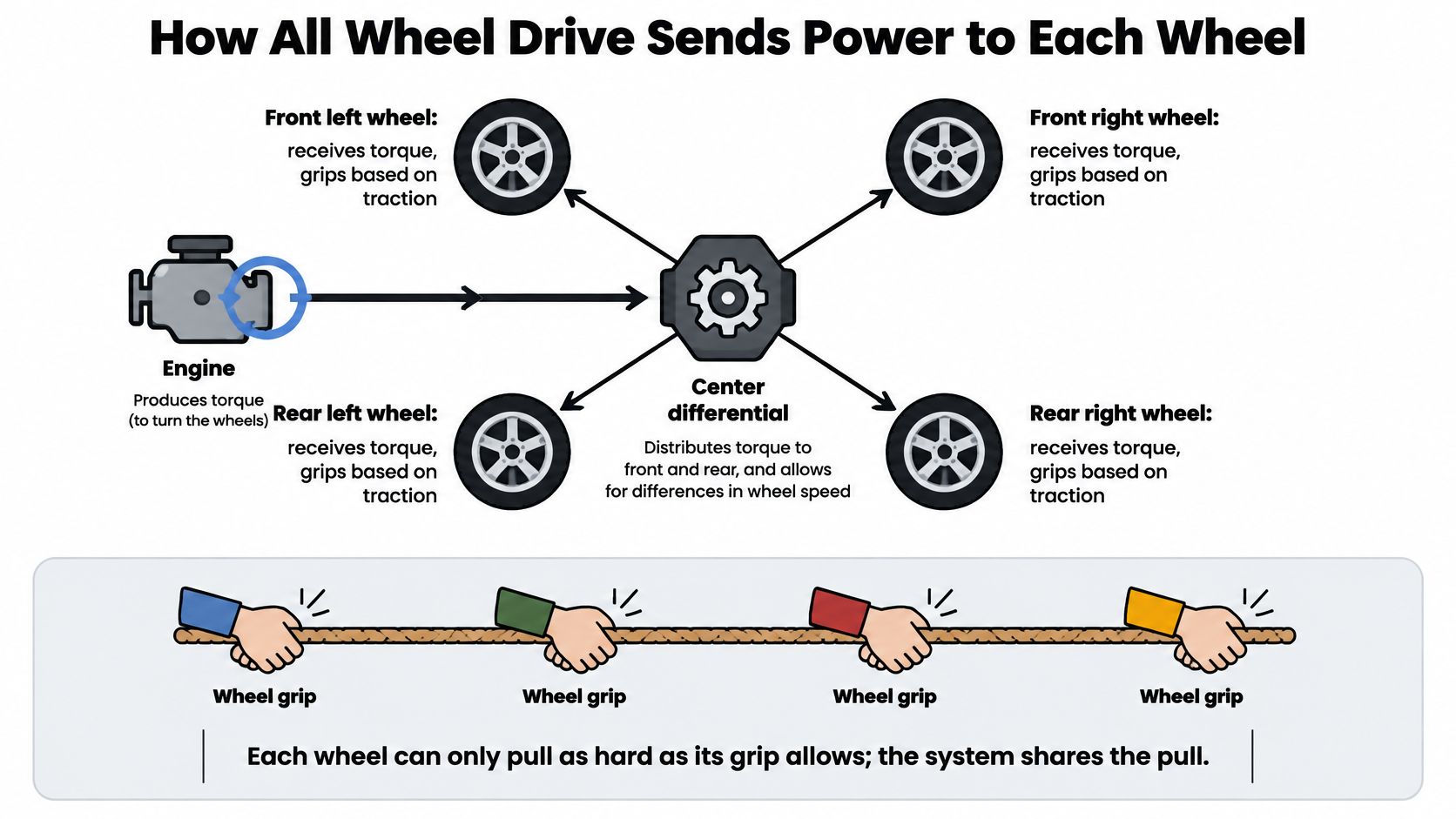
Think of a tug-of-war team standing on uneven ground. Someone on firm footing can pull effectively, while someone standing on slippery mud can't contribute as much. Each wheel faces a similar limit, and the AWD system's job is to share the pull without overwhelming the available grip.
Say you turn out of a gravel parking area onto pavement. The front tires reach the firmer surface first while the rear tires remain on loose stones. The drivetrain must accommodate both the turn and the difference in traction.
Follow the torque through the drivetrain
The engine produces torque, which passes through the transmission toward the mechanism distributing drive between the axles. Depending on the design, that mechanism may include a center differential, a controlled clutch pack, or a related coupling.
A center differential allows the front and rear axles to rotate at different speeds. That freedom matters during a turn: the wheels follow different paths, and the outside wheels travel farther than the inside ones. Differentials at the axles accommodate left-to-right speed differences.
A controlled clutch pack or coupling can change how strongly the other axle participates. If an axle starts spinning, the system can adjust torque delivery so the tires with better footing do more useful work. The exact result also relies on the axle differentials and traction-control hardware.
Why AWD vehicles can feel different
Some systems spend ordinary cruising predominantly front- or rear-driven, engaging the other axle when conditions demand it. Others deliver torque to both axles more continuously.
- Reactive control: The system responds when sensors detect wheel-speed differences or other signs of slip.
- Predictive control: Software can prepare torque delivery using accelerator position, steering input, and other signals.
- Hardware capacity: Couplings and differentials have operating limits, so similar badges don't guarantee identical performance.
The torque split isn't necessarily 50:50, nor does leaving dry pavement automatically lock it there. The system may adjust distribution as the driver accelerates, turns, or encounters a changing surface.
On a test drive, ask how AWD engages, whether a selectable mode is required, and what operating restrictions apply. Don't deliberately provoke a skid to evaluate it. Judge the vehicle by its documented control strategy, the suitability of its tires, and how smoothly it responds during normal driving.
Where All Wheel Drive Helps and Where It Stops
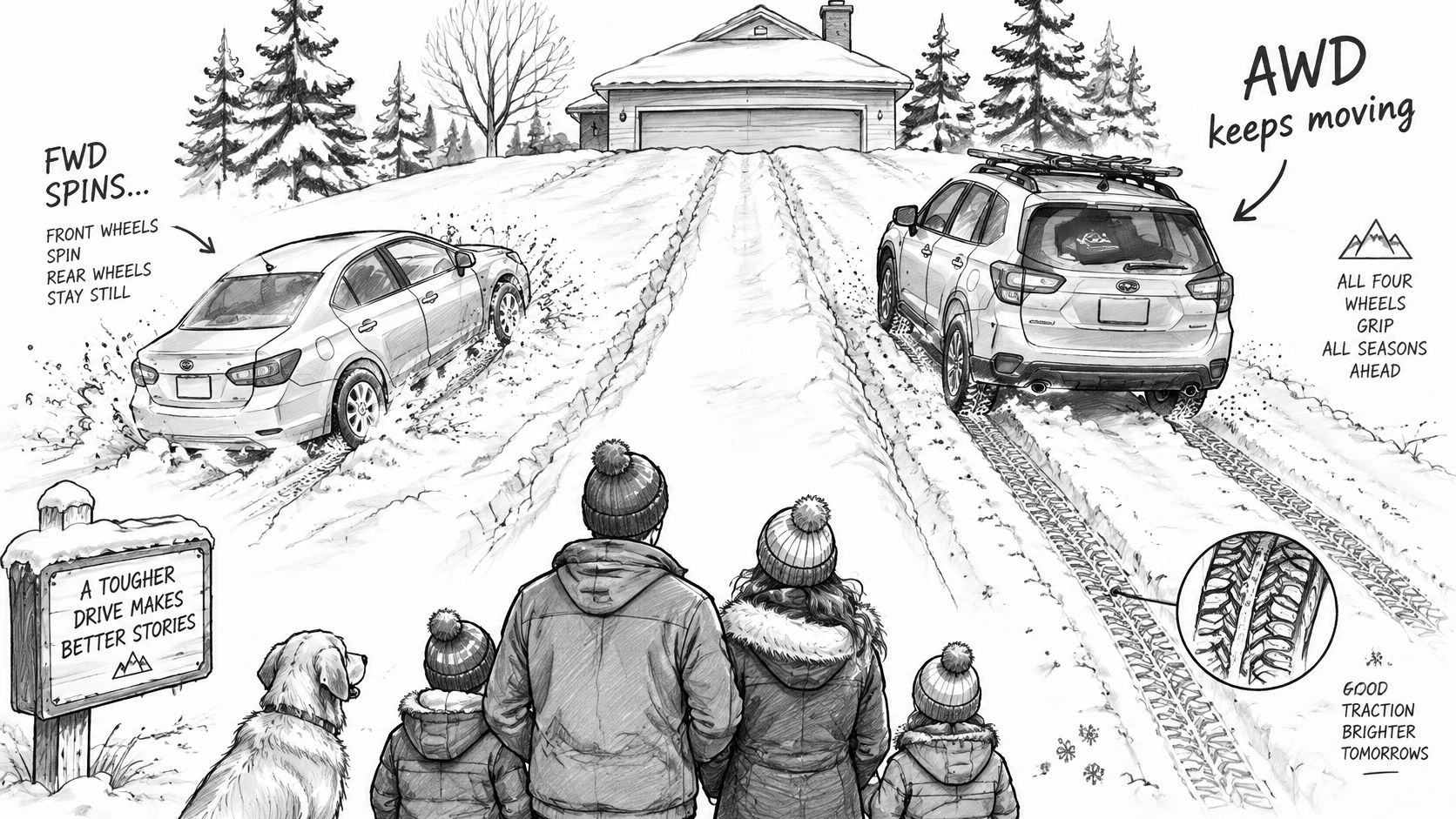
A family arrives home during snowfall, and their front-wheel-drive car struggles at the steep entrance to the driveway. An AWD vehicle makes the same climb with less wheelspin, giving its driver an understandable sense of reassurance.
That's a useful advantage. The mistake is assuming the easy climb predicts an equally easy stop on the way back down.
Where sharing engine power helps
AWD is most valuable when the driver asks the tires to propel the vehicle:
- Pulling away on slippery pavement. Sharing the driving effort can reduce the tendency to overwhelm the grip available at a single driven axle.
- Climbing a steep, slippery incline. More driven tires can contribute to the climb, although an ice-covered slope may still offer too little traction.
- Accelerating on gravel. The system can distribute effort when loose material makes traction inconsistent.
- Maintaining forward motion across mixed surfaces. When part of the vehicle crosses a slippery patch, appropriately controlled torque delivery can help the remaining tires keep it moving.
Consider the driveway again. If the engine asks more of the front tires than they can transmit, they spin instead of producing enough forward movement. Bringing the rear axle into the job can spread that demand across additional contact patches.
The benefit isn't permission to press harder on the accelerator. Gentle inputs still matter, especially when the surface changes under the vehicle. If every tire is on polished ice, redistributing torque can't manufacture the missing friction.
The stopping and steering reality check
AWD improves acceleration traction, not necessarily braking or cornering. Tire compound, tread, and the condition of the contact patch remain central to those outcomes.
As The Motor Guy's AWD winter-driving comparison explains, a front-wheel-drive vehicle on dedicated winter tires can outperform an AWD vehicle on all-season tires when braking and cornering in snow or ice, even though the AWD vehicle may pull away more effectively.
That comparison exposes the weakness in judging safety by how confidently a car accelerates. A driver can reach an unsuitable speed quite smoothly, then discover the tires don't have enough grip for the next bend.
What AWD changes in common driving scenarios
| Scenario | Does AWD help? | What decides the result |
|---|---|---|
| Pulling away from a stop on snow | Yes, usually | Torque split and tire grip at the driven wheels |
| Braking on ice | Little or none | Tire compound, tread and braking system |
| Cornering on a wet road | Limited | Tire grip, speed and steering input |
| Hydroplaning on standing water | No | Tread depth, tire condition and speed |
| Emergency avoidance | Limited | Tires, stability control and driver reaction |
Electronic stability control can assist when a vehicle starts deviating from the intended path. It can't fully correct excessive cornering speed when the tires have insufficient lateral grip. Enter a slippery bend too quickly, and there may not be enough traction available for the correction you want.
An easy launch is evidence that the car could accelerate there. It isn't evidence that the next corner or stopping distance is safe.
Keep appearance and mechanical grip separate
A polished body and protected paint can make a winter-driven vehicle easier to care for, but neither changes the friction between tire rubber and pavement. Ceramic-coated exterior panels don't provide extra braking or cornering grip.
That distinction matters for detailers. A clean wheel face can hide uneven tire wear, and a freshly dressed sidewall doesn't establish that the rubber is suitable for cold conditions. Inspect the tread and sidewalls, check inflation, and discuss seasonal tire choice before treating the vehicle as winter-ready.
Plan washing around the conditions, too. Our guidance on car washing in cold weather helps owners think about cleaning as part of seasonal care rather than a substitute for mechanical preparation.
For a practical safety check, separate the questions: Can the vehicle pull away? Can it stop? Can it turn? Can the driver see clearly enough to react? A positive answer to the first question doesn't settle the others.
Tires decide most of these outcomes. AWD is an added advantage, not a replacement for appropriate rubber, suitable speed, and room to respond.
Matching Tires and Ownership Costs on AWD
You find a puncture that can't be repaired, and the tire shop offers a replacement. The immediate temptation is to buy the matching-looking tire and keep the other tires until they wear out.
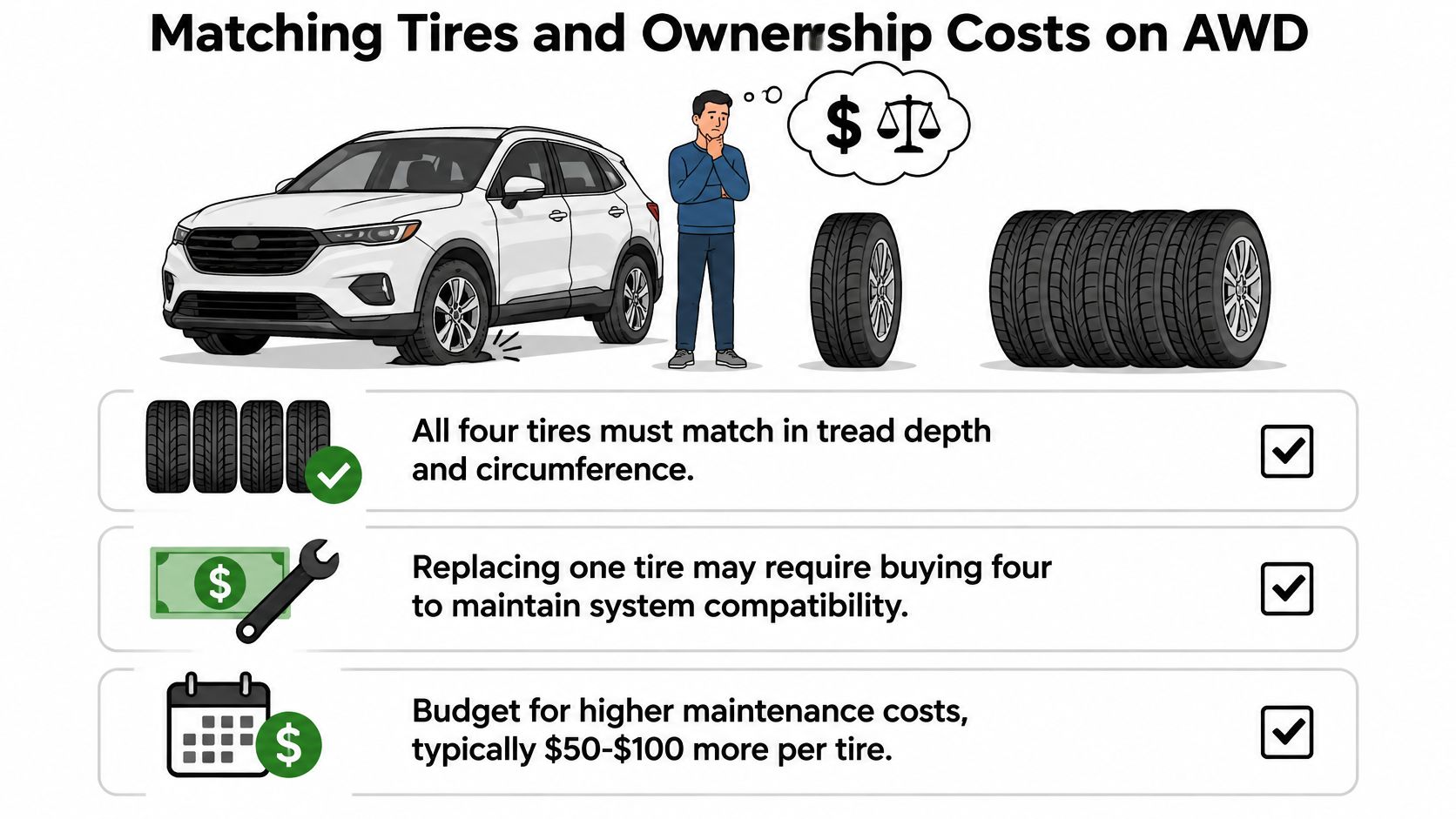
With AWD, the decision needs more care. Michelin's tire-mixing guidance explains that AWD and 4WD systems commonly require matching tire circumference, because even small differences can stress drivetrain components or interfere with vehicle systems; the permitted differences are manufacturer-specific.
Measure before authorizing replacements
A smaller rolling circumference means a tire turns more often over the same distance. An unsuitable mismatch can make the drivetrain accommodate a persistent speed difference even while the vehicle travels straight.
- Find the vehicle's permitted difference. Use the owner's manual or manufacturer service guidance for the exact model, not a general AWD rule.
- Measure every tire. Use a tread-depth gauge in several grooves and around the circumference. Record uneven wear rather than relying on an average.
- Match the specification. Confirm tire size, construction, load rating, and speed rating. A familiar brand name alone doesn't establish compatibility.
- Compare the remaining wear. Decide whether a single replacement, an axle pair, or a complete set will meet the vehicle maker's requirements.
- Limit temporary mismatches. Follow the restrictions for a spare tire and arrange a compatible permanent solution promptly.
Workshop check: Ask for the actual tread measurements and the vehicle's allowed difference before approving the replacement plan.
You don't automatically need a complete set after every puncture. You do need evidence that the proposed combination is acceptable for your drivetrain.
Budgeting for AWD should therefore include the possibility that tire damage affects more than the damaged tire. There's no universal extra charge per tire, so obtain a vehicle-specific quote rather than treating a generic cost estimate as a rule.
Cosmetic wheel cleaning and car paint rust protection belong in a care routine, but they serve different purposes. Tire compatibility protects mechanical operation; clean, protected surfaces address the condition of the vehicle around it.
Protecting an AWD Vehicle Through Temperature Swings
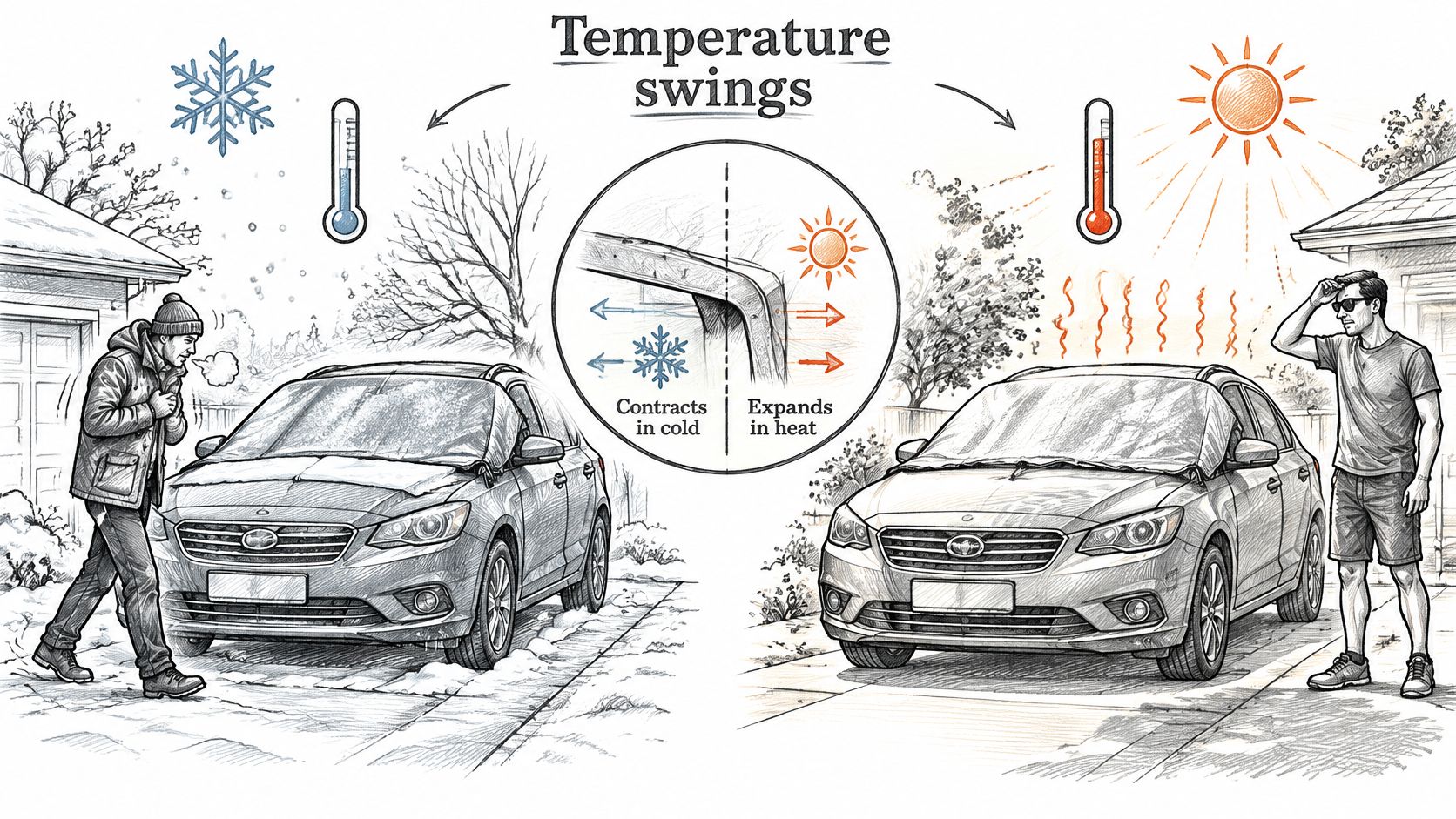
Say a delivery driver leaves an AWD wagon in a frozen lot at dawn, then parks it in full sun by the loading dock that afternoon. The hood that felt like a cold plate at sunrise is warm enough to sting a bare hand. Metal contracts in the cold and expands in the heat, so any coating sits on a surface that keeps changing size, not on a bench that never moves.
All-wheel drive is a traction-management tool. It sends power toward the wheels that still have something to push against. It does not stop a panel from growing in the afternoon, and it does not keep clear coat from chalking after months of sun. Grip still depends on the tires. The finish depends on what you put on the paint, and on whether that product was applied inside its own rules.
Match the coating to the job
Dark Matter Technology combines carbon nanotubes and high-performance coatings. It is designed for cars, boats, and aircraft, and it resists UV rays, scratches, and chemicals. That is a practical reason to protect a vehicle that lives outside through cold mornings and hard sun. It is not a promise that temperature can never mark a finish, or that a stone chip will bounce off.
Judge any coating by its documented preparation and temperature requirements, not by how glossy it looks on the day it goes on. The DIY product category is for clients who want to maintain their vehicles and keep them shining and in great shape. The all-products shop page includes products for mobile detailers, DIYers, and professional detailers. Read the sheet for the bottle in your hand. A water-beading windshield still needs wipers, clean glass, working demist, and a speed that matches the road.
Preparation decides the finished result
Easy application only helps if the film is even and cured. Wash thoroughly, remove bonded contamination, correct defects where appropriate, and complete the specified final surface cleaning. Then lay down a thin, even coat.
Work inside the product's temperature and moisture limits. Inspect for uneven residue under good light, and keep the panel protected while it cures. A spray bottle does not skip those steps. Apply in the shade of a cold morning and you may be outside the curing window the label requires. Rush the same job on a hot hood and the product can flash before you level it.
AVOTTO Mobile's explanation of how desert sun ruins clear coat is a useful companion when the threat is heat and UV rather than ice. Our guidance on harsh weather conditions helps you weigh exposure across the year, so protection is chosen for the whole swing from frost to strong sun, not for one season alone.
Confirm Your AWD Setup Before Winter Arrives
Before the first forecast of snow, walk around the parked vehicle with a tread-depth gauge, pressure gauge, and clean glass towel. That's a more useful starting point than waiting for wheelspin to reveal what needs attention.
Make the inspection part of a scheduled service or your next detailing session. You'll have time to resolve a tire mismatch, replace worn wipers, or complete surface preparation without rushing before a storm.
Build a practical departure checklist
- Inspect the tires together. Compare tread depth and evenness of wear, and resolve compatibility questions before replacing a damaged tire.
- Set the correct pressures. Check cold tires against the vehicle placard rather than inflating to the maximum marked on the sidewall.
- Choose seasonal rubber deliberately. If snow and ice are common on your routes, arrange dedicated winter tires suitable for the vehicle.
- Prepare the glass. Clean inside and outside, inspect the wipers, and remove frost fully before moving.
- Leave a driving margin. Allow room for braking and make steering and accelerator inputs progressively.
Our guide to winterizing your vehicle can help turn that inspection into a repeatable seasonal routine. Choose the setup for your climate and daily journey, whether that means frequent snow, prolonged rain, or cold mornings followed by strong sunshine.
For surface-care purchases, distinguish convenience from suitability. DIY owners need manageable application requirements, mobile detailers need a process that fits their working environment, and professional studios need a coating matched to the surfaces they're treating.
Our DIY category serves owners who want to maintain their vehicles and keep them shining and in great shape. Our Dark Matter Technology combines carbon nanotubes with high-performance coatings designed for cars, boats, and aircraft, with resistance to UV rays, scratches, and chemicals.
APEX NANO – Titan Coatings offers surface-protection options for DIY owners, mobile detailers, and professional detailers preparing vehicles for changing weather. Visit APEX NANO – Titan Coatings to choose protection for your paint and glass, alongside the tire preparation and careful driving your AWD vehicle still needs.
0 Comments