
When you’re searching for the best ceramic coating for your windshield, you absolutely need an elastomer-based formula designed specifically for glass. This kind of formula gives you the flexibility and durability to stand up to constant wiper friction and drastic temperature shifts. A great example is Titan Coatings’ Apex Glass Ceramic Coating, which delivers such intense water repellency that driving in the rain becomes safer and far less of a white-knuckle experience.
The Search For Ultimate Driving Clarity
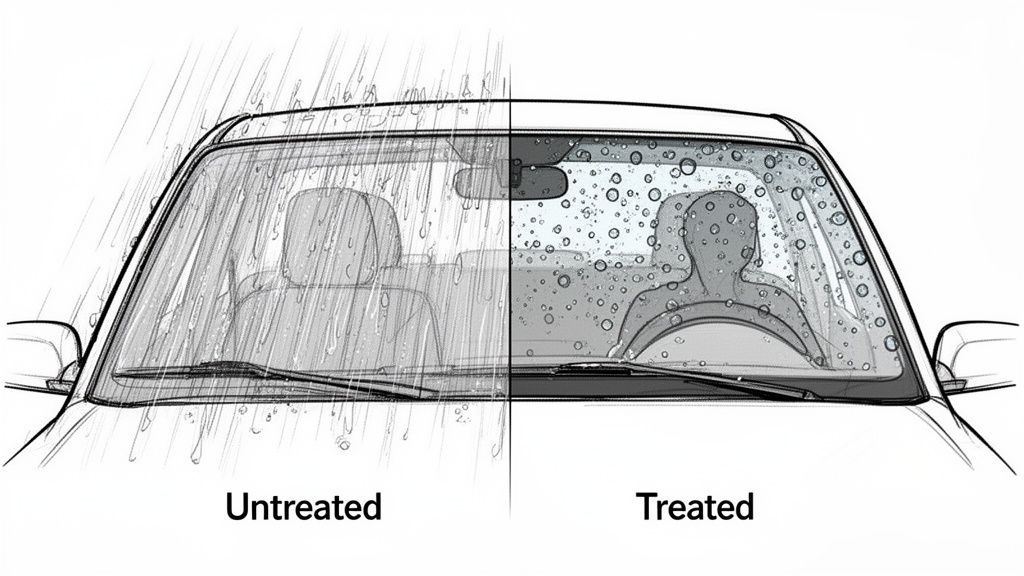
The gray clouds burst open without warning, turning Alex’s afternoon commute into a tense battle. Every swipe of his wiper blades just smeared the road grime and rain into a blinding sheet. He found himself leaning forward, gripping the wheel, straining to make out the taillights ahead. It was a stressful, all-too-familiar routine that made every downpour feel genuinely dangerous. Driving shouldn’t be this hard, he thought, fed up with the terrible visibility right when he needed it most.
A few weeks later, the scene repeated itself—but this time, the difference was night and day. As the first drops hit the glass, Alex watched in awe as they instantly formed perfect little beads. Before his wipers even had a chance to move, the water droplets danced across the windshield and were whisked away by the airflow, leaving his view stunningly clear. The road ahead was sharp and safe. The anxiety was gone, replaced by a feeling of complete control.
The Power of Specialized Glass Protection
So, what changed for Alex? He learned that not all protective coatings are the same, especially when it comes to automotive glass. It’s a classic mistake: people spend a fortune coating their paint but completely neglect the most critical surface for their safety—the windshield. Slapping a standard paint coating on glass is a recipe for disappointment, often leading to poor performance and potential long-term issues. To really get why clarity is so key, it’s worth understanding the qualities of ultra clear glass itself.
A dedicated windshield coating is engineered from the ground up to bond with a non-porous surface and handle challenges that paint will never see.
A purpose-built glass coating doesn’t just repel water; it fundamentally changes your relationship with driving in bad weather. It transforms a high-stress situation into one of confidence, ensuring your vision remains unobstructed when it matters most.
Introducing a Smarter Solution
This is where advanced science carves a better path. Titan Coatings broke new ground as the first company to introduce elastomer coatings to the market, using our pioneering nano-tube structures and Dark Matter Tech. Our Elastic coatings are a total game-changer for windshields, which have to endure constant vibration, wiper blade abrasion, and wild temperature swings from freezing winters to scorching summers.
Unlike rigid, old-school coatings that can develop micro-cracks under stress, Titan’s coatings are hard like glass but remain flexible. This resilience means they last far longer and keep their water-shedding properties without breaking down. The flexibility ensures the coating won’t crack under temperature changes, from frozen to hot. For anyone wanting to dive deeper into this topic, our guide on ceramic coating for glass offers a ton of great info. This guide will demystify the science and help you find the ultimate protection for your vehicle.
Why Your Windshield Needs a Specialized Coating
It’s a thought many car owners have had: “If a ceramic coating is amazing on my paint, it must be great for my windshield too, right?” It seems logical, but this common assumption can lead to some serious headaches down the road.
Slapping a coating designed for a metal body panel onto your primary window is like using wood polish on a glass table. The materials are fundamentally different, and the results just won’t cut it. Your paint and glass couldn’t be more distinct—they have different densities, porosity, and, most importantly, they react to temperature changes in completely opposite ways.
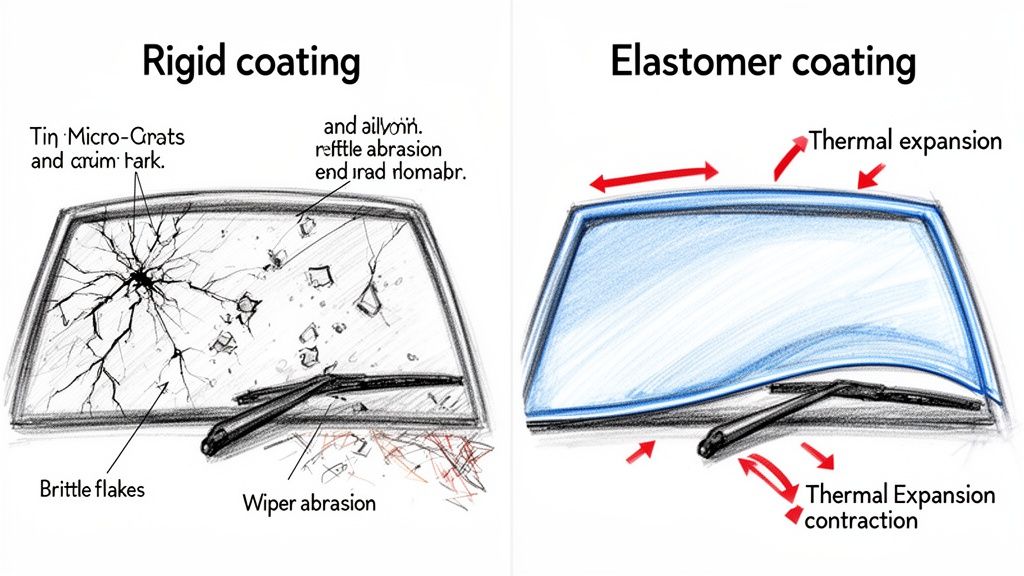
A car’s body is relatively stable, but your windshield is under constant, immense stress. It flexes with the chassis, endures the relentless back-and-forth abrasion of wiper blades, and takes a direct beating from road debris. A rigid coating designed for paint is simply destined to fail here. It’s too brittle to survive the dynamic, demanding environment of automotive glass. This gets to the heart of why specialized protection isn’t just a good idea; it’s essential for both performance and safety.
The Problem with Rigidity on Glass
The single biggest enemy of any windshield coating is thermal expansion. When your car bakes in the summer sun, the glass expands. On a frigid winter morning, it contracts. A traditional, rigid ceramic coating can’t keep up with these changes.
Instead, it develops microscopic cracks across its surface. While you can’t see them at first, these tiny fractures are a death sentence for the coating’s integrity. Water and grime get trapped inside, the slick hydrophobic effect vanishes, and the whole layer starts to break down far sooner than it should.
This premature failure is why so many detailers see paint coatings on glass fail within a few short months. The constant stress from temperature swings, vibrations, and wiper friction is just too much for a brittle shield. Dealing with the fallout, like trying to remove hard water stains from windows that have etched into a failing coating, shows exactly why robust, dedicated protection is critical from the start.
The Elastomer Advantage: Where Flexibility Meets Durability
This is where Titan Coatings changed the game. As the first company to introduce elastomer coatings, we used our advanced nano-tube technology and proprietary Dark Matter Tech to create a coating that is both hard like glass and flexible.
Imagine a protective layer with the same scratch resistance you expect from a top-tier ceramic, but with the built-in elasticity of rubber. This unique combination allows our coatings to move, flex, and adapt right along with the glass surface.
When the windshield expands in the heat or contracts in the cold, our elastomer coatings stretch and shrink right along with it. This completely prevents the formation of those destructive micro-cracks, ensuring the coating maintains a perfect, unbroken shield against the elements.
This flexibility is the secret to true longevity. Because the coating doesn’t crack under pressure, it lasts dramatically longer. It’s a purpose-built solution, designed from the ground up to conquer the specific challenges that windshields face every single day.
Engineered for the Real World
We developed our Apex Glass Ceramic Coating for this exact reason. It’s not a repurposed paint product; it’s a dedicated elastomer formula engineered specifically for automotive glass. This very easy-to-use coating delivers the intense water-beading that enhances visibility and makes driving under rain stress-free, all while having the structural flexibility to endure years of wiper use and extreme weather.
The same principle drives our popular Alpha Quartz elastomer coating. Its elasticity ensures it does not crack under temperature changes from frozen to hot, or when bugs hit the car’s surface at high speed. It’s easy to install and provides great results. By choosing a flexible coating, you’re not just protecting your glass—you’re investing in smarter, more durable technology built for the real world. You can see how our products compare on our comparison page.
The Science Behind a Flexible Glass Shield
If you want to create the best ceramic coating for a windshield, you can’t just slap a modified paint coating on it and call it a day. You have to start from scratch, completely rethinking the chemistry of how protection works on glass. That’s exactly what we did at Titan Coatings when we pioneered the first-ever elastomer coatings for the automotive world, built with advanced nano-tube structures and our proprietary Dark Matter Tech.
This journey led us to a simple but incredibly powerful idea: a material that is hard like glass and flexible. Imagine a hybrid shield. It has the 9H or higher hardness needed to fend off fine scratches from wiper blades and road grit, but it also has the built-in elasticity of rubber. This combination is the secret sauce for real, durable windshield protection.
The Problem with Brittle Coatings
Let’s talk about traditional ceramic coatings for a moment. They’re known for being incredibly rigid. Now, think about what happens when you apply that rigid layer to a windshield—a surface that’s constantly expanding in the heat, shrinking in the cold, and flexing from every bump in the road. That brittle coating is put under an unbelievable amount of stress.
This constant push and pull inevitably leads to micro-cracks. You can’t see them, but these tiny fractures are a death sentence for the coating. They trap dirt, kill the water-repelling effect, and cause the entire protective layer to fail way too soon. It’s a fundamental design flaw that makes rigid coatings a terrible match for the dynamic life of a windshield.
The Titan Elastomer Solution
Titan’s elastomer technology sidesteps this problem entirely. Instead of fighting against the glass as it moves, our coatings are designed to move right along with it.
- Thermal Resilience: When the temperature plummets overnight or skyrockets in the afternoon sun, the flexible polymer network expands and contracts without breaking a sweat. This prevents micro-cracks from ever forming, keeping the shield intact.
- Impact Absorption: That elasticity also helps cushion the blow from minor impacts, like a bug hitting your windshield at 70 mph. A rigid coating might chip, but our flexible layer can absorb and dissipate the force.
- Wiper Durability: The back-and-forth grind of wiper blades is a coating’s worst enemy. The flexible-yet-hard surface of an elastomer is simply far more resilient to this constant abrasion than a brittle alternative.
This built-in flexibility is the reason our coatings last so much longer. By engineering out the main point of failure—cracking under stress—we’ve created a shield that holds up to years of real-world abuse. If you’re curious about the deep-dive, you can explore more details on the science behind Titan Coatings’ elastomer technology.
Apex Glass: The Ultimate Expression of Flexible Tech
All this advanced science comes together in our Apex Glass Ceramic Coating. This isn’t just another coating; it’s a purpose-built flexible shield engineered from the ground up specifically for glass. It delivers the kind of intense hydrophobicity that makes driving in a downpour almost relaxing, as water beads up and flies right off the windshield.
The heart and soul of Apex Glass is its elastomer foundation. This allows it to form a tough, optically clear bond with your windshield that simply won’t crack, haze, or break down, even under the most extreme conditions. It’s the ultimate expression of our “hard like glass and flexible” philosophy.
We also made sure the application was straightforward enough for seasoned pros and dedicated weekend warriors alike, so anyone can get a flawless, long-lasting finish. When you’re looking for the best ceramic coating for your windshield, choosing one built on flexible, resilient technology isn’t just a good idea—it’s the only way to get clarity and safety that truly lasts.
What to Look For in a Windshield Coating
Trying to find the right protection for your car can feel like a maze. But when you’re looking for the best ceramic coating for your windshield, it really comes down to a few key things that actually matter on the road. Knowing what to look for helps you cut through the marketing fluff and pick a product that keeps your vision clear and safe, day in and day out.
At the end of the day, a windshield coating has to win in four critical areas: intense water repellency (hydrophobicity), long-term resilience (durability), perfect optical clarity, and a simple ease of application. If a coating falls short on even one of these, what seemed like a good investment can quickly turn into a total headache.
Unmatched Hydrophobicity for Clear Vision
Let’s be honest, the main reason we coat our windshields is to make rain vanish. This is called hydrophobicity, and it’s what makes water bead up into tight little spheres that just fly off the glass as you drive. Often, you won’t even need to touch your wipers. This is a game-changer for visibility during a downpour, turning a white-knuckle drive into a confident one.
We engineered Titan’s Apex Glass Ceramic Coating for exactly this—an extreme hydrophobic effect. Its formula creates such a slick surface that driving in the rain actually becomes enjoyable. If you want to dive deeper into the science behind it, our guide to the best hydrophobic car coatings breaks down why this water-shedding magic is so vital for safety.
Durability That Endures the Elements
That awesome water-beading effect is pretty useless if it disappears after a month. Real durability means a coating can stand up to the constant friction of wiper blades, harsh washer fluids, and the relentless sun beating down on it. This is where so many traditional, rigid coatings just can’t hang. They crack under pressure.
And this is where Titan’s elastomer technology gives you an almost unfair advantage. Our coatings are uniquely hard like glass and flexible, so they don’t get the micro-cracks that plague brittle products. This built-in elasticity lets them absorb the abuse from wipers and handle wild temperature swings—from a frozen morning to a blistering afternoon—without failing. The result? You get protection that lasts for years, not just a few months.
This diagram shows how we pull it off.
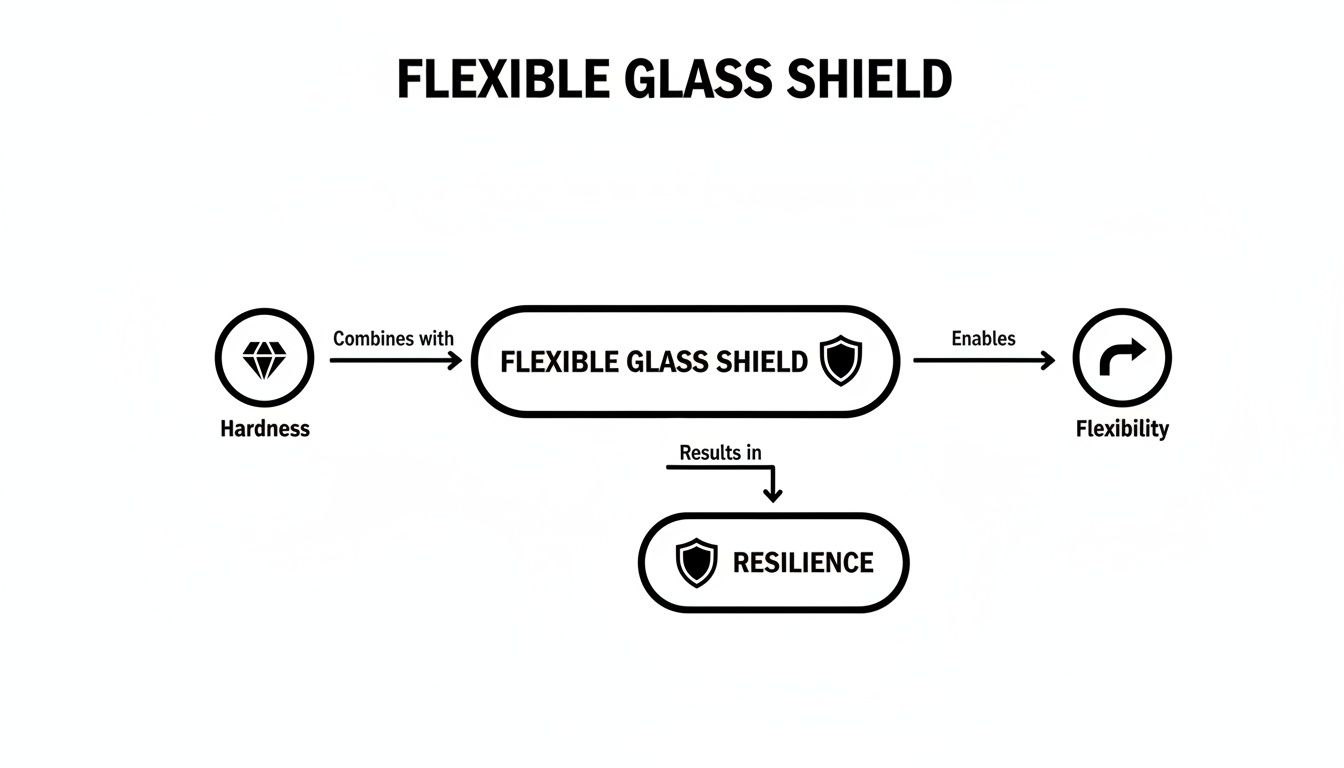
By bringing together extreme hardness and flexibility, the coating achieves a resilience that rigid products can’t even touch.
Comparing Windshield Coating Technologies
Not all glass treatments are created equal. Let’s break down how a modern elastomer coating like Titan’s stacks up against older technologies you might find on the shelf.
| Feature | Basic Rain Repellent | Traditional Ceramic Coating | Titan Elastomer Glass Coating |
|---|---|---|---|
| Hydrophobicity | Good, but short-lived | Very Good, but can degrade | Extreme and long-lasting |
| Durability | 1-3 months | 6-12 months | 2+ years |
| Wiper Abrasion | Wears off quickly | Prone to micro-scratching | Highly resistant due to flexibility |
| Optical Clarity | Can cause wiper chatter/haze | Generally clear, but can streak | Flawless, invisible finish |
| Application | Easy, but frequent reapplication | Moderately difficult, fussy | Straightforward for pros & DIYers |
As you can see, while basic products offer a temporary fix, only an advanced elastomer formula delivers the complete package of performance and longevity your windshield truly needs.
Flawless Optical Clarity and Easy Application
Finally, a windshield coating has to be completely invisible. It’s there to improve your view, not get in the way of it. There should be absolutely no hazing, streaking, or distortion that could mess with your vision, especially at night or when the sun hits just right. We formulate our coatings for pure optical clarity, so your view of the road is sharper than ever.
On top of that, a great product shouldn’t require a chemistry degree to use. The application for Apex Glass is designed to be user-friendly, letting both professional detailers and serious car enthusiasts get a perfect, pro-level finish every time.
When you put it all together—unbelievable water repellency, unmatched elastomer durability, perfect clarity, and a no-fuss application—you’re looking at a new standard for windshield protection. This isn’t just about keeping your glass clean; it’s about giving you lasting safety and confidence every time you get behind the wheel.
Getting a Flawless Finish: How to Apply Your Coating
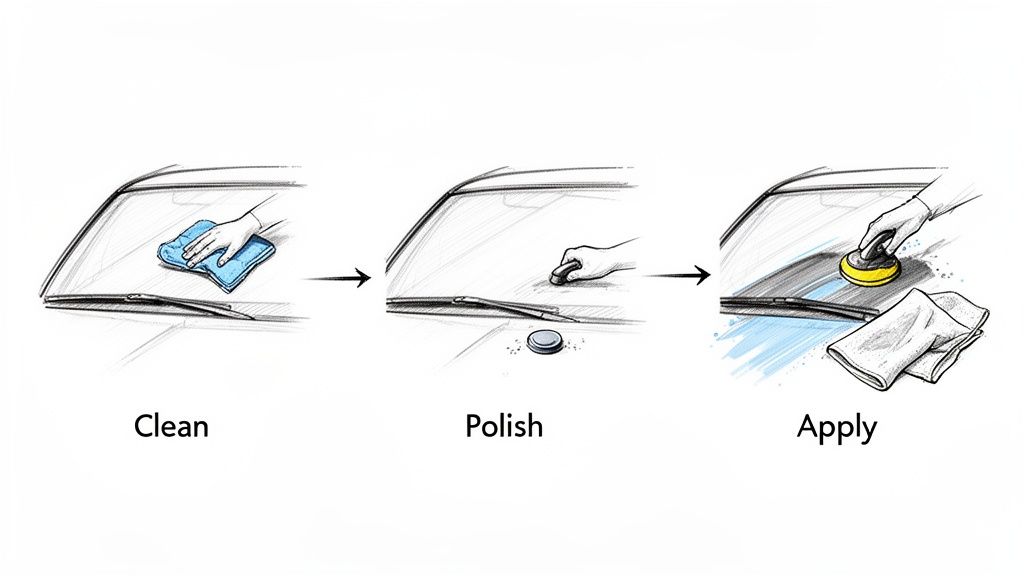
So, you’ve picked out the best ceramic coating for your windshield. That’s the first step. But even the most advanced formula on the planet won’t live up to its potential if it’s slapped onto a dirty, contaminated surface. You’ve got to get the prep right to unlock every bit of performance from your investment.
The good news? Getting a professional-grade finish isn’t about some secret handshake or hidden technique. It all comes down to following a proven process with care and precision. Your goal is to create a perfectly clean, smooth canvas for the coating to grab onto. Do that, and the application itself is surprisingly simple.
Step 1: Deep Clean and Decontamination
First things first, you need to get that glass surgically clean. This goes way beyond a quick spritz with your household glass cleaner. Start with a thorough wash using a high-quality, pH-neutral car soap to get rid of the easy stuff—loose dirt and road grime.
Next, it’s time for chemical warfare. Grab an iron remover spray. You can’t see the tiny iron particles from brake dust embedded in your glass, but they’re there, creating a gritty surface that prevents a good bond. A quality iron remover will dissolve them on contact. Follow that up with a dedicated tar remover to tackle any stubborn road film and sticky organic gunk.
Step 2: Create a Smooth-as-Glass Surface
Even after a deep chemical cleaning, your windshield can still feel slightly rough to the touch from bonded contaminants. This is where a clay bar becomes your best friend. With plenty of clay lubricant, glide the bar across the windshield in straight, overlapping passes. You’ll literally feel it picking up those tiny imperfections, transforming the glass from gritty to buttery smooth.
If your glass has some light scratches or stubborn hard water spots, a light polish with a glass-specific compound is a great idea. This extra step ensures the surface is optically perfect before you seal it all in.
Don’t rush the prep. This is where 90% of your results are determined. A meticulously cleaned, decontaminated, and smoothed surface is the only foundation for a strong, lasting bond and the crystal clarity you’re after.
Step 3: The Final Wipe and Application
You’re on the home stretch. With all the heavy lifting done, the last bit of prep is a final wipe-down with an isopropyl alcohol (IPA) solution. This removes any lingering oils from your hands, leftover lubricants, or polishing residues. It makes the surface completely sterile, which is exactly what you need for the strongest possible chemical bond.
Now, for the main event. Let’s say you’re using Titan’s Apex Glass Ceramic Coating. Following the instructions, apply a few drops to your applicator pad. Work in a small, manageable section at a time—maybe a 2×2 foot square—wiping in a neat cross-hatch pattern.
Watch closely. You’ll see the coating “flash,” which is just the carrier solvents evaporating. Once it does, gently buff the residue away with a clean, fresh microfiber towel. What’s left is an incredibly slick, crystal-clear finish. It’s a process that empowers both weekend warriors and seasoned pros to get phenomenal results.
For a more detailed breakdown of the general coating process, check out our complete guide on how to apply ceramic coating to a car.
Maintaining Your Coated Windshield For Lasting Clarity
You’ve just applied the best ceramic coating to your windshield, and that feeling of watching water zip right off is a huge win. But getting that flawless performance isn’t a “set it and forget it” deal. To keep that crystal-clear view and unbelievable water repellency for years, a little bit of simple, consistent maintenance is the name of the game.
Proper care isn’t about adding more work to your car wash routine; it’s mostly about avoiding a few things that can wear down the coating. Think of it like a high-end non-stick pan. It’s designed to be tough, but you wouldn’t take a steel wool scrubber to it, right? The same logic applies here—using the wrong stuff can slowly chip away at even the most advanced coating.
The Do’s and Don’ts of Coated Glass Care
The golden rule is simple: be gentle. Your coating is a microscopic shield, and while it’s incredibly durable, it’s not bomb-proof. Harsh chemicals and abrasive tools are its Kryptonite.
- DO Use pH-Neutral Soaps: Stick with quality, pH-neutral car wash soaps. They’re designed to lift dirt and grime without stripping away protective layers, and that includes your glass coating.
- DON’T Use Harsh Glass Cleaners: Stay away from common household glass cleaners. Many of them are packed with ammonia or high levels of alcohol, which are far too aggressive and will slowly degrade the coating, killing its hydrophobic magic.
- DO Keep Wiper Blades Clean: Your wiper blades are magnets for grit and road film. Every few washes, give the rubber blades a quick wipe with a clean microfiber towel and a little isopropyl alcohol (IPA). This stops them from dragging that gunk across your perfectly coated glass.
This kind of advanced vehicle care is becoming the new standard worldwide. In fact, the Asia-Pacific region now dominates the ceramic coating market, accounting for about 42% of global consumption. This massive demand, fueled by huge automotive markets in all sorts of climates, shows just how many people are turning to specialized coatings to protect their investments. You can dive deeper into these trends at onyxcoating.com.
Why Elastomer Technology Makes Maintenance Easier
This is where having a coating built with Titan’s elastomer technology really pays off. Because our coatings are uniquely hard like glass and flexible, they have a built-in resilience against the daily grind. The coating can actually flex with the glass as it heats up and cools down, preventing the kind of micro-cracking that causes lesser, more brittle coatings to fail over time.
Even with that built-in toughness, gentle care is what keeps the coating at peak performance. It’s a partnership between your maintenance habits and the advanced chemistry doing the heavy lifting.
Troubleshooting Common Issues
Even with a flawless application, a couple of minor things can pop up. Here’s how to deal with them.
Wiper Shudder or Chattering: This is the #1 issue people ask about, and it’s almost never the coating’s fault. It happens when your wiper blades are dirty or just plain old. The super-slick surface of the coating can make old, stiff rubber blades skip and hop. A thorough cleaning of the blades usually fixes it right up. If that doesn’t work, it’s a sure sign you need a new pair.
Hard Water Spots: If you have hard water, those pesky mineral deposits can leave spots behind after a wash. It’s important to tackle these quickly before they have a chance to etch into the coating’s surface. For any stubborn spots, a dedicated product is your safest bet. We have a full guide on how to use an auto hard water spot remover effectively without harming your coating.
Common Questions About Windshield Coatings
Even after getting the full rundown on the science, you probably still have a few questions floating around. That’s totally normal. Let’s tackle some of the most common ones we hear, giving you the straight-up answers you need to feel confident about protecting your glass.
Can I Use a Paint Coating On My Windshield?
This is a big one, and the answer is a hard no. It’s a mistake we see people make, and we strongly advise against putting a coating designed for paint onto your glass. Think about it: a paint coating is engineered to be incredibly rigid to protect a solid metal panel. Your windshield is anything but rigid—it’s a dynamic surface that flexes constantly and has to deal with massive temperature swings from a hot sun to a cold rainstorm.
Slapping a brittle coating onto a flexible piece of glass is just asking for trouble. As the glass expands and contracts, that rigid coating will inevitably form micro-cracks, which completely ruins the clarity and kills the water-beading effect. You need a specialized formula, something like Titan’s Apex Glass Ceramic Coating. It’s an elastomer-based formula built from the ground up to stay flexible, withstand constant wiper friction, and maintain perfect optical clarity.
How Long Does a Quality Windshield Coating Last?
Durability can be all over the map. It really depends on the quality of the product, your local climate, and how you take care of it. Those basic silicone rain repellents you grab off the shelf? You’ll be lucky to get a few weeks or months out of them. A true professional-grade ceramic glass coating, on the other hand, is in a completely different league and can last for years.
This is precisely where elastomer technology becomes a game-changer. Titan’s flexible coatings last so much longer because they don’t break down under the stress of thermal expansion, road vibrations, and thousands upon thousands of wiper swipes. With proper application and a little care, you’re looking at serious long-term performance.
Will a Ceramic Coating Prevent Rock Chips?
Let’s clear this one up right away, as it’s a common misconception. A ceramic coating adds a super thin, hard, and slick layer of protection to your glass. While it’s fantastic at fending off minor scratches, bug splatters, and tree sap, it’s simply not thick or soft enough to absorb the intense, high-velocity impact of a flying rock.
The best way to think about it is this: its main job is to create an incredibly slick surface that makes water fly off, dramatically improving your visibility in a downpour. It keeps your glass cleaner for longer and makes driving in the rain a whole lot safer and less stressful.
At Titan Coatings, we developed elastomer technology specifically to solve the unique challenges your windshield faces every single day. Our Apex Glass Ceramic Coating isn’t just another product; it’s our commitment to delivering unmatched clarity, durability, and safety. Ready to completely change how you see the road? Explore the incredible performance of Apex Glass and make every journey a clearer one.
0 Comments