
A black coupe rolled into the bay after a weekend detail, still glossy under the lights, until the owner pointed at a dull patch near the hood edge. Bird droppings had sat there through one hot afternoon, and the finish had already started to etch.
The Hidden Threats to Your Car’s Perfect Finish
That kind of damage is why a chemical resistant coating matters. Most paint doesn’t lose its sharp look because of one dramatic event. It loses it through repeated contact with small, ugly contaminants that show up in normal driving. Bird droppings, bug remains, tree sap, road tar, alkaline cleaners, fuel drips, hard water spotting, and winter grime all attack the surface in different ways.
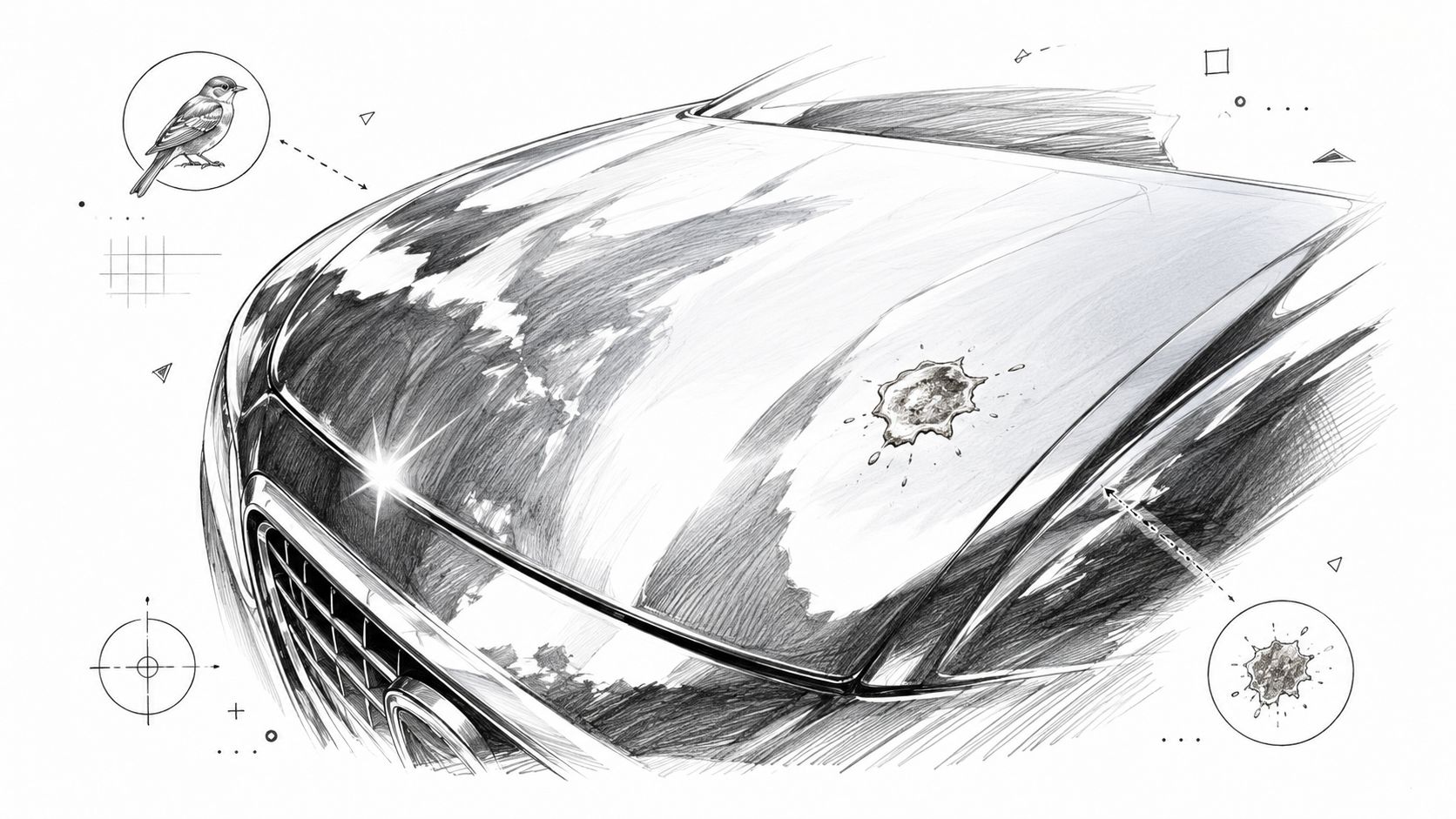
A detailer sees this constantly. The customer says the car was “just washed,” but the paint already feels rough, the gloss looks slightly muted, and there’s a stain outline where contamination sat too long. The finish may still be polished back, but every correction removes material. Protection buys time. Good protection buys margin for error.
Everyday contaminants do real damage
The biggest mistake car owners make is assuming chemical damage only happens in industrial settings. It doesn’t. It happens in driveways, parking lots, and highway commutes.
- Bird droppings: They don’t just sit on top of the paint. Heat accelerates staining and etching.
- Bug splatter: The front bumper and mirrors take repeated impacts, then those remains bake onto the surface.
- Tree sap and road film: Both cling hard, then force aggressive cleaning if the surface has no release characteristics.
- Improper cleaners: Strong products can solve one problem while creating another if the finish is unprotected.
That’s why prep and maintenance chemistry matter as much as polishing. A dedicated bug cleaner for cars helps remove one of the most common paint contaminants before it has time to bond harder to the surface.
Practical rule: If a contaminant is difficult to remove, the finish already needed a better barrier before the wash started.
This isn’t a niche category either. The global chemical resistant coating market reached USD 7.7 billion in 2025 and is projected to reach USD 11.0 billion by 2035 at a 3.7% CAGR. That steady expansion reflects how central these systems are in protecting assets across automotive, aviation, marine, and defense work.
Why detailers should care
For a professional detailer, chemical resistance isn’t just a lab term. It affects callback rates, maintenance wash results, customer satisfaction, and how long a vehicle keeps that freshly corrected look. If the barrier fails early, the paint pays the price.
The Science Behind a Chemically Bulletproof Barrier
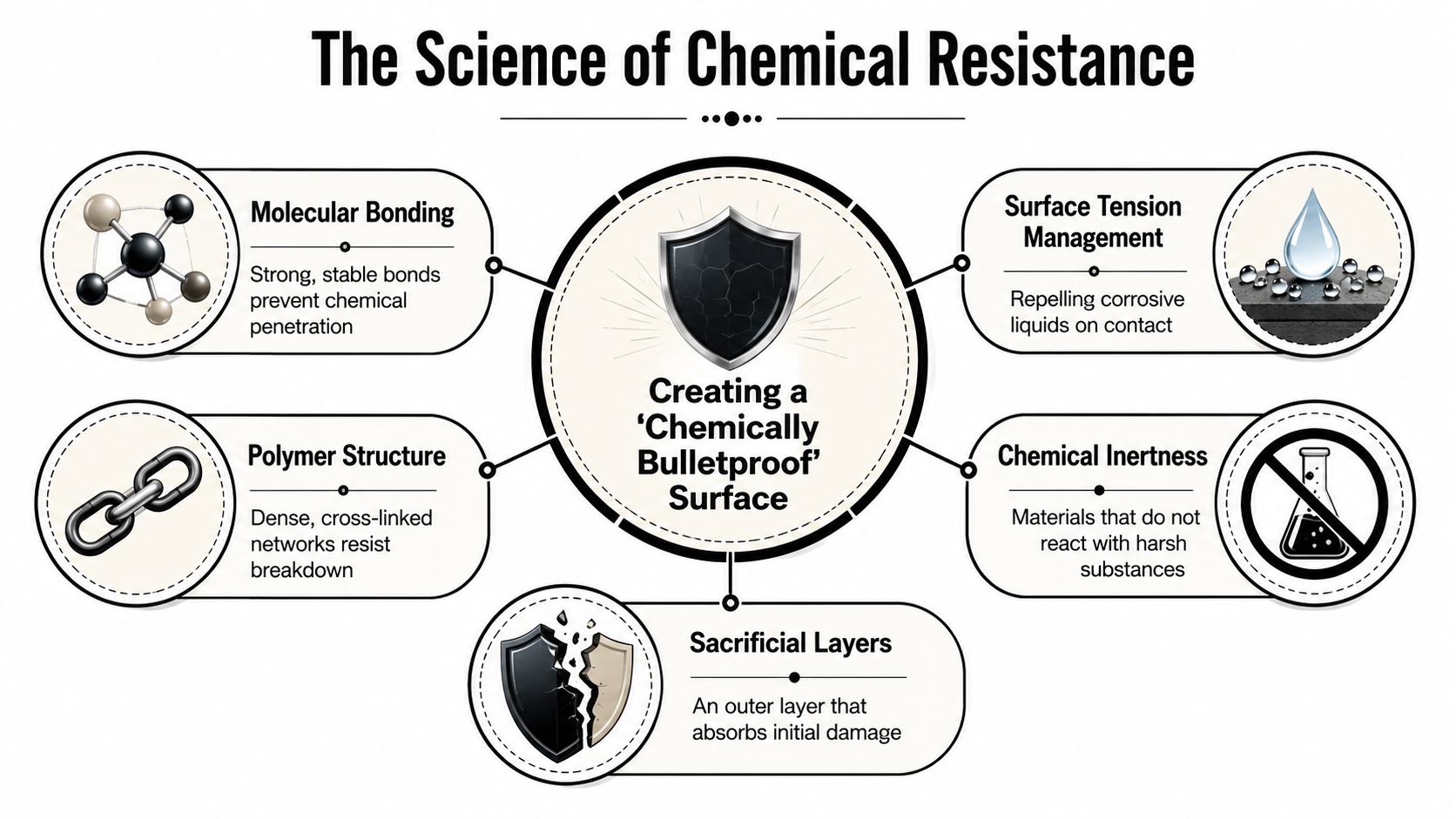
A quality coating works like microscopic chain mail over the paint. Not bulky armor. A tightly organized film that makes it harder for aggressive substances to penetrate, bond, or degrade the surface underneath.
Crosslinking creates the barrier
At the molecular level, the first job is building a dense network. When a coating cures properly, the polymer chains connect into a tighter structure. That reduces pathways where chemicals can migrate through the film.
If the network is weak, the coating may still look good on day one, but solvents, acidic fallout, or repeated wash chemistry can exploit those weak points. The result is softening, staining, loss of slickness, or premature failure around edges and high-stress panels.
A useful reference point comes from heavy-duty industrial chemistry. Sikagard®-170 CR is applied in a 2:1 resin-to-hardener mix ratio, with components preconditioned to 70°F (21°C) for 24 hours, then installed in two 20-mil coats at 80 ft²/gal, and it reaches full cure after 7 days at 75°F and 50% relative humidity. The lesson for detailers is simple. Cure discipline matters. Chemical resistance depends on film formation, not just the label on the bottle.
Surface behavior matters too
Resistance is not only about surviving contact. It’s also about controlling it. If contaminants bead, release, and wipe away more easily, they spend less time attacking the finish.
That’s where polymer design changes the actual outcome. The base chemistry determines how inert the film is, how stable it stays, and how much punishment it can take before it starts reacting or swelling.
- Base polymer: Sets the core resistance mechanism.
- Crosslink density: Tightens the barrier against penetration.
- Film uniformity: Prevents weak spots, especially on edges and curves.
- Cure quality: Locks in final hardness, adhesion, and chemical stability.
For a broader technical breakdown, this overview of what polymer coating means in practical surface protection is worth reviewing.
A coating can be glossy and still be vulnerable. Appearance tells you very little about the quality of the molecular network underneath.
Why some polymers outperform others
Fluoropolymers resist concentrated acids at elevated temperatures because their molecular structure, reinforced by strategic crosslinking agents, creates a highly stable film, and the base polymer dictates the coating’s fundamental resistance mechanism. That point matters because many people talk about chemical resistance as if it were a generic feature. It isn’t. The chemistry decides what the coating is naturally good at resisting, and the formulation decides how well that potential shows up on the vehicle.
Not All Coatings Are Created Equal A Chemistries Comparison
Walk through any detailing supply shelf and you’ll see hard coatings, flexible coatings, sprays, hybrids, ceramics, graphene blends, and polymer sealants all competing for the same promise. The problem is that they don’t fail the same way.
Where traditional systems shine and where they struggle
Epoxy systems are known for hardness and chemical toughness in many environments. The trade-off is brittleness. On a vehicle, rigid films don’t love movement, panel flex, impact, or large temperature swings.
Polyurethanes usually handle flexibility better. They can absorb movement and help with UV performance, but they don’t always bring the same level of harsh chemical defense that more specialized chemistry can provide. In automotive work, that trade-off becomes obvious on cars that see heat, road contamination, repeated washing, and outdoor exposure all year.
Elastomer-based systems change the conversation because they target a combination most installers want but rarely get in the same film. They aim for hardness, flexibility, and sustained function under stress.
Coating Chemistry Performance Comparison
| Coating Type | Hardness | Flexibility | Chemical Resistance (Acids/Solvents) | UV Resistance |
|---|---|---|---|---|
| Epoxy | High | Low | Strong in many harsh environments, but performance depends heavily on cure and exposure conditions | Fair to good, depending on formulation |
| Polyurethane | Moderate to high | Moderate | Good broad protection, but not always the top choice for the harshest chemical exposure | Good |
| Traditional ceramic-style rigid films | High | Low to moderate | Good against common automotive contaminants, but rigid behavior can become a limitation under stress | Good |
| Elastomer coating | High surface resilience with impact tolerance | High | Designed to maintain protection under dynamic automotive exposure | Good to strong, depending on formulation |
That table is why chemistry selection shouldn’t start with marketing language. It should start with the vehicle’s duty cycle.
- Daily commuter: Needs resistance to road film, bugs, wash chemicals, and repeated heat cycling.
- Garage-kept weekend car: May value appearance first, but still needs margin against accidental contamination.
- Work truck or off-road build: Needs a film that can handle both impact and contamination without becoming brittle.
A lot of installers also compare newer coating families against each other before choosing a package. This breakdown of graphene coatings vs ceramic coatings helps frame that discussion from a practical detailing angle.
The best coating chemistry isn’t the hardest one on paper. It’s the one that still performs after heat, washing, contamination, and movement pile up together.
The Titan Advantage Elastomer and Nanotube Technology
A rigid coating can look impressive until everyday conditions start flexing the panel, cycling the temperature, and throwing debris at the surface. That’s where elastomer technology stands apart.
Hard like glass, flexible where it counts
Titan created its own coating technology, and Titan Coatings introduced elastomer-based ceramic coatings using nano-tube technology and proprietary Dark Matter Technology®, marking the first company to deploy this specific combination for automotive surface protection. That matters because automotive surfaces don’t live in static conditions. They flex, expand, contract, vibrate, heat soak, cool down, and take impact.
A coating that is hard like glass but flexible solves a real weakness in traditional rigid films. If the film can resist surface wear while moving with the panel, it’s less likely to crack down when temperatures swing from frozen mornings to hot summer panels. That flexibility also helps when bug impacts and road debris hit the finish. Instead of behaving like a brittle shell, the coating has some give.
Why Alpha Quartz fits the real world
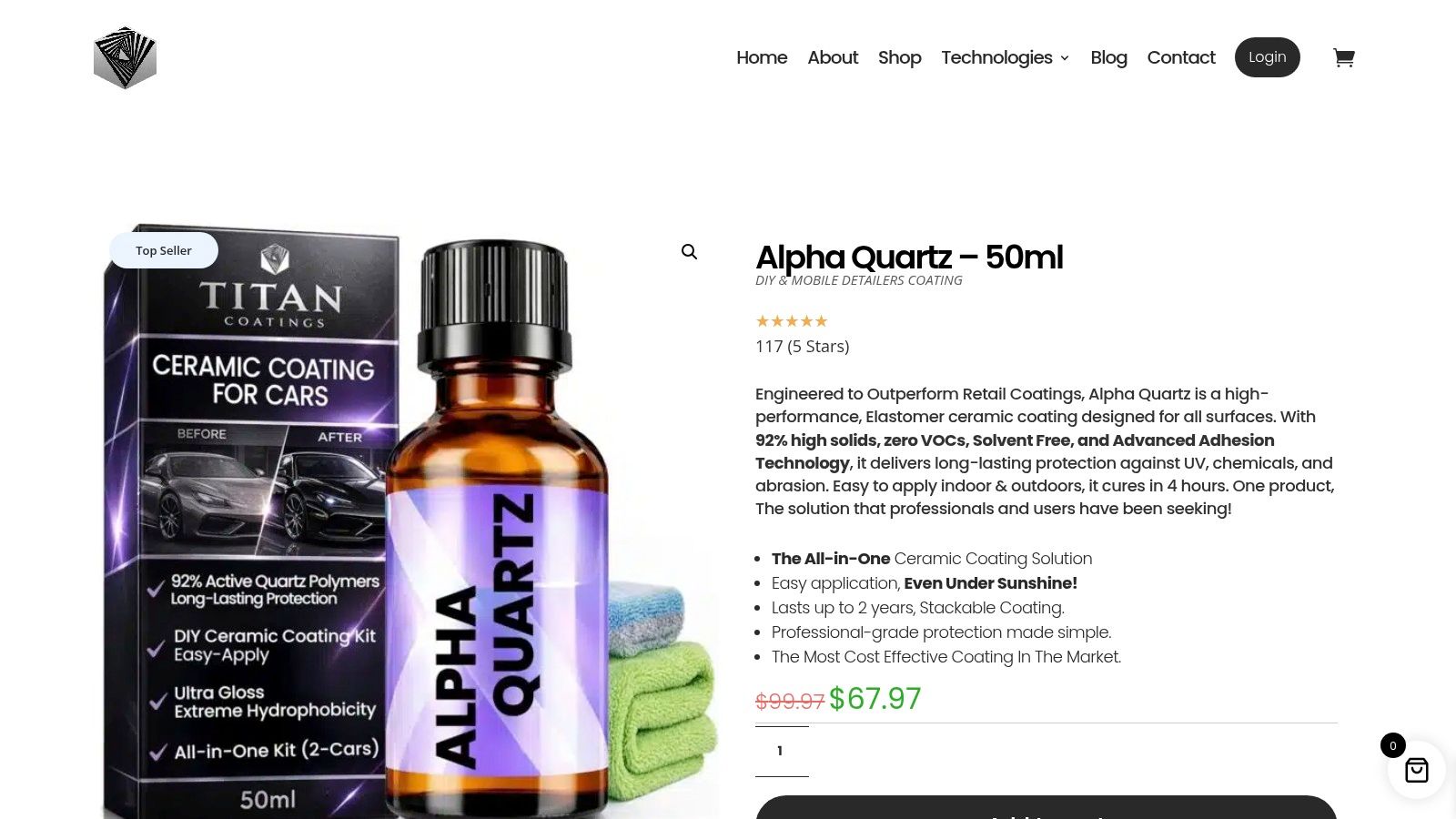
Alpha Quartz stands out because it aligns with what detailers and mobile installers need. It’s easy to install, produces strong visual results, and makes sense for both professional bays and capable DIY users. Ease of installation isn’t a minor benefit. If a coating is too sensitive, too finicky, or too narrow in its application window, many users won’t extract its full performance.
What makes this category interesting is that flexibility doesn’t have to mean soft. In advanced formulations, the film can stay firm at the surface while remaining resilient underneath. That’s the kind of balance a detailer notices after repeated wash cycles, temperature shifts, and normal road use.
- For mobile detailers: Easier installs reduce risk in less controlled environments.
- For DIY users: A forgiving system raises the chance of a clean result.
- For long-term owners: Flexibility helps the coating last longer because the film isn’t fighting every thermal cycle.
For a deeper look at that coating class, review Titan’s page on elastomer coating technology.
The larger point is simple. In automotive protection, outright hardness is only part of the story. Functional elasticity is what keeps that hardness useful over time.
Selecting The Right Shield For Your Vehicle
Picking the right chemical resistant coating starts with one question. What does the vehicle face every week? Not what the label says. Not what looks good under studio lights. The answer depends on rain exposure, wash frequency, storage conditions, highway use, and how much abuse the surface takes.
Think in terms of functional stability
The better question isn’t merely whether a coating survives one chemical encounter. For automotive and aviation clients, the real issue is whether the coating maintains regenerative properties and UV and scratch defense after chemical exposure cycles, a direction shaped by nanomaterial advancements. That’s the difference between short-term resistance and functional stability.
A coating can technically resist contamination once and still lose slickness, clarity, or surface behavior too fast. Detailers notice this when a car still has “protection” but no longer cleans easily and no longer feels refined during maintenance.
Match the product to the job
For glass, the use case is different from painted panels. A windshield coating has to support visibility, water behavior, and easy upkeep without complicating installation.
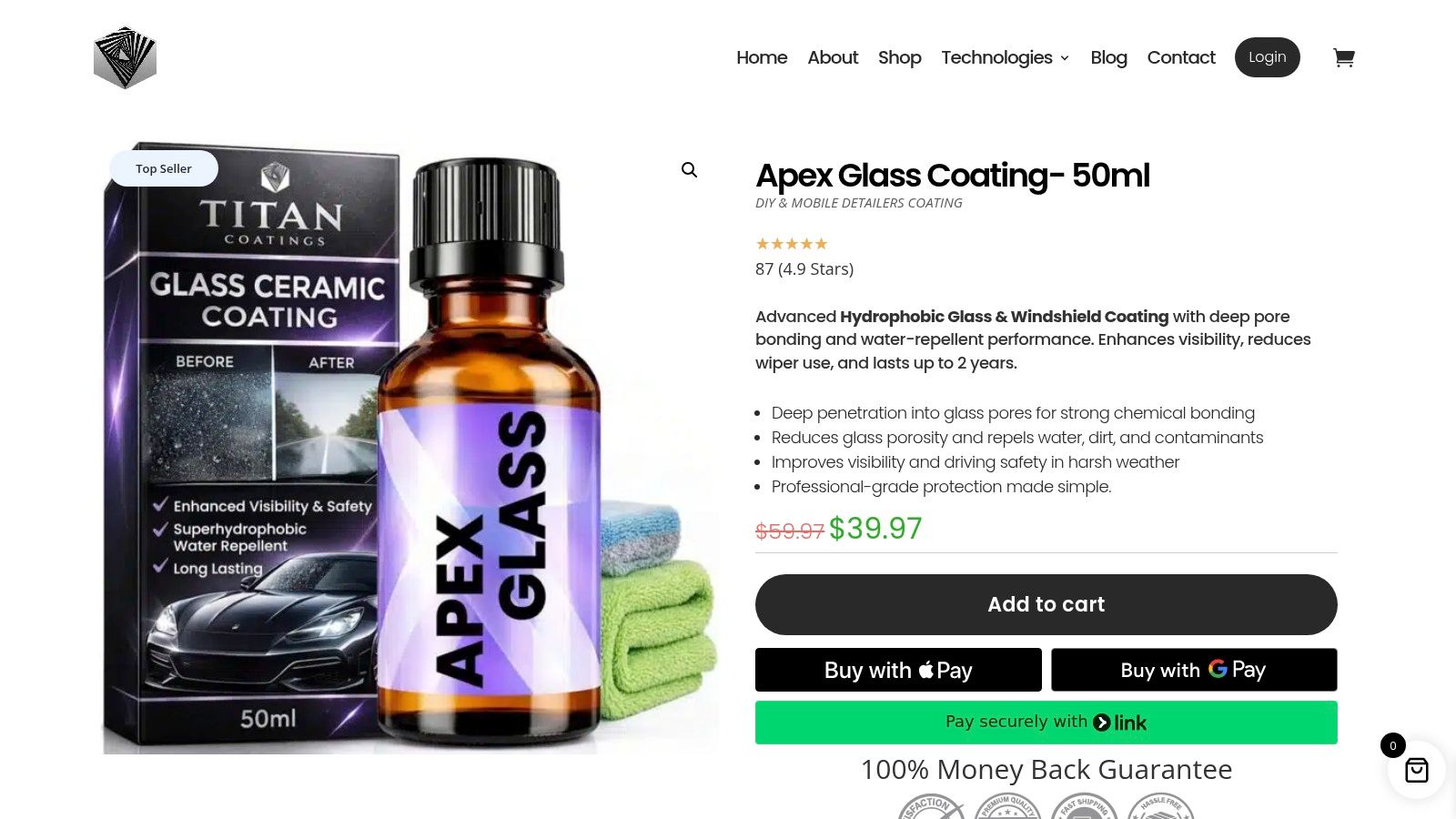
- APEX Glass: Best for drivers who want cleaner glass, easier maintenance, and improved visibility during rain. It’s a practical upgrade because driving stress often comes from poor water behavior on the windshield, not just from dirt.
- Alpha Quartz: Best for users who want strong body protection with an easier install profile. It suits DIYers and mobile detailers because it balances usability with strong real-world performance.
- Ultra Ceramic Spray: Best for someone who wants a fast application with noticeable protection and gloss enhancement. It’s a strong fit for maintenance work and for owners who prefer quick, repeatable installs.
That’s also why the product shop matters. Different vehicles need different levels of effort and protection, and the Titan Coatings shop makes it easier to sort solutions by use case rather than by hype.
A simple selection framework
Use this approach when recommending a system:
- Daily driver in all weather: Prioritize easy maintenance and contamination release.
- DIY enthusiast: Choose a forgiving install with dependable finish quality.
- Mobile detailer: Favor products that perform well without a perfect shop environment.
- Glass-first concern: Use a dedicated windshield and glass solution, not a body coating as a compromise.
- Fast top-up protection: Reach for a spray format that can be applied often without drama.
Good coating selection starts with service conditions, not with the most aggressive marketing claim on the box.
Beyond the Lab Real-World Performance and Testing
Lab charts are useful. They just aren’t the whole story.
Most chemical resistance tables test clean, controlled exposures. A pure substance touches a cured panel for a defined period under fixed conditions. That gives you a baseline, but cars don’t live in baselines. They live through heat soak in traffic, cool nights, repeated washing, bug impact, road salt residue, UV, and mixed contamination that sits longer than it should.
Why static claims can mislead
Real coating failure is driven by dynamic exposure variables like temperature cycling, trace contaminants, and immersion-to-vapor transitions that drastically reduce coating lifespan, which static lab charts often ignore. That’s exactly what detailers see when a product tests well in theory but disappoints on a car that lives outdoors.
A front bumper doesn’t deal with chemistry in isolation. It gets bug acids, impact, wash friction, sun, and engine heat nearby. A hood deals with droppings and thermal cycling. A windshield sees wiper abrasion, washer fluid, road film, and weather swings. Real performance comes from surviving that combination.
What to look for instead
When assessing a coating, don’t stop at whether it “resists chemicals.” Ask better questions:
- Does it stay easy to clean after repeated exposure?
- Does the surface behavior remain consistent through temperature swings?
- Does impact tolerance support long-term film integrity?
- Does the coating still look and feel stable after maintenance washes?
That’s why flexible coating technologies have an advantage in automotive use. They’re designed for a moving, contaminated, temperature-cycling environment rather than a motionless test panel in a controlled room.
Application and Maintenance for Lasting Protection
Even the best coating loses ground if the install is sloppy. Surface prep, wipe technique, cure discipline, and maintenance all determine whether the chemistry gets a fair chance to perform.
Application habits that help
Alpha Quartz appeals to DIY users and mobile detailers because it’s approachable. Keep the process simple and disciplined.
- Start with a surgically clean surface: Remove bonded contamination, polishing oils, and residues before coating.
- Work small sections: Tight control gives a more even layer and cleaner leveling.
- Watch the environment: Stable conditions help the coating flash and settle more predictably.
- Don’t rush first exposure: Let the coating set up properly before exposing it to contamination or moisture.
Ultra Ceramic Spray is even more straightforward. Spray, spread, level, and buff with clean towels. It’s a practical option for maintenance packages, topper applications, or clients who want fast protection with solid visual payoff.
Maintenance decides the long game
After install, maintenance keeps the film functioning as designed. Poor washing can blunt performance faster than many people realize.
Use pH-appropriate maintenance products, soft wash media, and fast contaminant removal. Don’t let bug remains, droppings, or mineral-heavy water sit on the surface any longer than necessary. For long-term upkeep, this guide on how to maintain ceramic coating covers the habits that preserve appearance and performance.
A coating should make ownership easier. If the process, maintenance, or reapplication path is too complicated, most users won’t stay consistent enough to get the best result.
APEX NANO – Titan Coatings builds its reputation around that next step in protection. Not just chemical survival, but coatings that stay functional under real driving stress. If you want to explore windshield protection with APEX Glass, flexible body protection with Alpha Quartz, or fast-install maintenance options like Ultra Ceramic Spray, visit APEX NANO – Titan Coatings.
0 Comments