
You’re standing in front of a listing that looks almost right. The photos are clean, the price sounds negotiable, and the seller keeps talking about “easy income.” That’s exactly where first-time buyers get in trouble, because a DIY car wash for sale can mean a portable kit in a box, a self-serve site with real cash flow, or a full commercial wash that takes serious capital and even more diligence.
The first mistake is buying the wrong thing for your actual goal. A hobbyist wants a better wash routine at home, while an operator wants an asset that produces repeatable revenue. Those are different purchases, different risk profiles, and different standards for what counts as a good deal.
If you’re trying to sort out which lane you’re in, start with the practical buyer questions and avoid the shiny-object trap. A useful place to compare that thinking against a real-world setup is SwiftJet tips for car wash bays, and if you’re considering a broader service business around detailing rather than just buying equipment, the planning sequence at Titan Coatings’ detailing business guide is a smart companion read.
Practical rule: don’t shop listings until you know whether you’re buying a consumer tool, a mobile setup, or an income-producing site. Otherwise, you’ll compare things that don’t belong in the same conversation.
The three questions that matter first are simple. Are you buying a wash tool or a business. Is the site already operating. And does the model fit your time, capital, and tolerance for maintenance.
What a DIY Car Wash for Sale Really Means
A weekend detailer and a first-time investor can both search the same phrase and land in completely different worlds. One sees a foam cannon, hose, and portable kit. The other sees a self-serve bay, a pressure system, and a closing statement that can reach real-estate-level money.
That difference matters because the phrase DIY car wash for sale is overloaded. A consumer kit is a convenience purchase. A business acquisition is an income asset, and the value comes from cash flow, site quality, and how reliably customers keep coming back.
Know which buyer you are before you compare listings
If you want a better wash process for your driveway, you’re shopping for tools, not for a business. That means you care about ergonomics, chemical compatibility, and how well the kit works on your own vehicle. If you want to own a site, you’re buying traffic, permits, equipment condition, and a revenue stream that has to survive bad weather, water costs, and downtime.
The wrong buyers often mix those two. They look at a low-cost kit and then start evaluating a commercial listing like it’s just a bigger version of the same thing. It isn’t.
A self-serve property is usually closer to a small operating business than a retail product. BizBuySell’s car wash marketplace shows a median asking price of $1.2 million for established car washes, with listings ranging from under $456,250 to over $2.51 million BizBuySell car wash listings. That alone should tell you the decision is about more than hoses and bays.
A good listing doesn’t just show equipment. It shows whether the business can keep producing cash after you own it.
Before you scroll further, answer three things. Are you a consumer buyer, a hands-on operator, or an investor? Do you want wash quality at home, or recurring revenue from a site? And are you equipped to verify the paperwork, utilities, and maintenance history before you sign?
Comparing the Four Main DIY Wash Formats
The market gets clearer once you stop calling everything a “DIY car wash.” There are really four different formats here, and each one attracts a different buyer. If you blur them together, you’ll overpay for convenience or underprice the work required to run the site.
The four formats side by side
| Format | Capital Range | Best For | Key Trade-Off |
|---|---|---|---|
| Portable home kit | Low | Home users and mobile detailers | Cheap entry, no revenue asset |
| Pressure-wash station | Low to moderate | Service providers and DIY operators | More capable, still labor-heavy |
| Self-serve bays | Moderate to high | First-time owners who want an operating business | More complex, but more scalable |
| Touchless in-bay automatic | High | Buyers who want less manual labor and fewer paint-damage disputes | More equipment risk and higher capital |
Portable kits are for washing cars, not buying a business. They’re the easiest entry point, but they don’t give you a site, customers, or recurring income. They’re the right answer if you want control over the wash process and nothing more.
Pressure-wash stations sit in the middle. They need more equipment discipline and more water management, but they can support mobile detailers and small operators. For practical pressure-wash buying criteria, the internal guide at Titan Coatings’ pressure washer resource fits this format better than generic retail advice.
Self-serve bays remain the most accessible business entry point because the model is understandable, and the labor burden is lighter than a full-service site. Touchless in-bay systems tend to attract buyers who want fewer direct contact issues, fewer paint-damage complaints, and a more automated customer experience.
Most first-time buyers should not start with a heavily customized or undermaintained site. They should buy a format they can inspect, maintain, and finance. If you can’t explain how the site earns money in plain language, it’s the wrong format for you.
What each format says about the property
A portable setup pairs with a garage, driveway, or mobile service route. A pressure-wash station can live inside a small commercial footprint. Self-serve bays need a location with traffic, visibility, and enough physical room for cars to queue without frustration. Touchless automatic systems usually demand more infrastructure and more comfort with mechanical downtime.
The high-level decision is simple. Buy the format that matches your operating style, not the one that looks most impressive in photos.
Equipment Specs That Actually Matter
Specs sheets are full of noise, and sellers know it. They’ll talk about stainless steel, upgraded pumps, or “newly serviced” gear, but the buyer who knows what to check will focus on the few things that change performance and downtime.
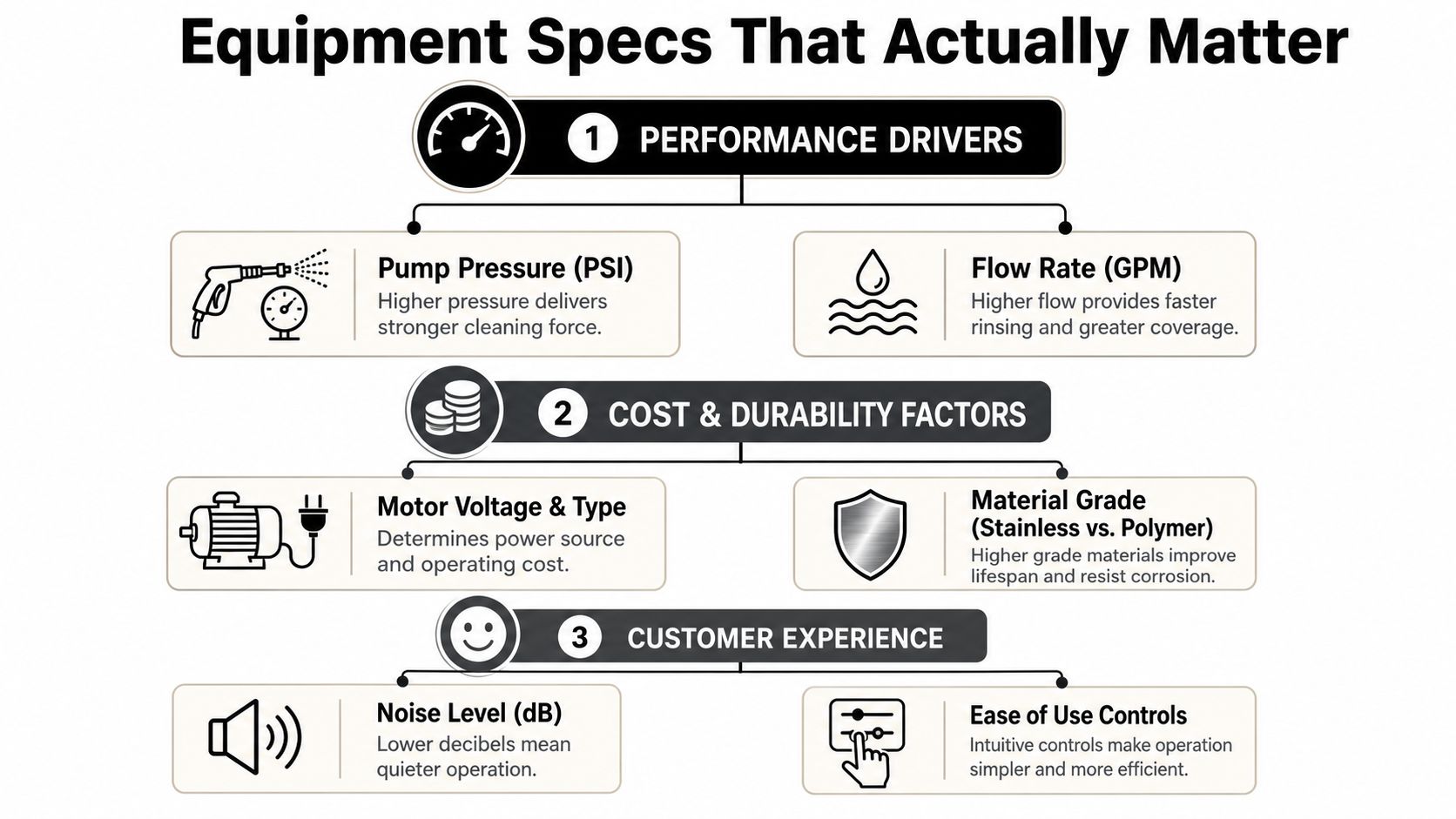
Pressure, layout, and payment hardware
For pressure washing, 1,500 PSI is the floor for basic washing, while most commercial operations use 2,000 to 3,000 PSI because that range improves soil removal without turning the job into a paint-risk problem EPOS Now equipment guide. Higher pressure still needs control. Nozzle choice, stand-off distance, and technique matter just as much as the number on the machine.
Bay layout is the next thing to inspect. Self-serve washes are built around multiple bays with pressure hoses, soap dispensers, foam brushes, towel dispensers, and vacuums Mark VII self-serve guidance. If the site looks cramped or the bays feel awkward to move through, throughput suffers even when the equipment is technically functional.
Inspection rule: if the payment system still depends on one old method, treat that as a modernization expense, not a feature.
Payment flexibility matters too. Modern buyers should prefer systems that go beyond coin-only operation. That shift affects convenience, but it also affects how you can sell memberships, loyalty, and repeat usage later.
What you can upgrade later, and what you can’t
Soap dispensers, vacuum heads, and some controls can be improved after closing. Undersized infrastructure is harder to fix. If the water handling, drainage, or core mechanical setup is weak, you’re not buying a business, you’re buying a repair list.
Water reclamation and chemical metering deserve attention because they affect both compliance and operating cost. A site that looks cheap on paper can become expensive the moment a buyer discovers recurring downtime or water-related issues.
For a broader equipment checklist that fits mobile and semi-mobile operators, Titan Coatings’ mobile detailing equipment list is a better reference point than guessing from a seller’s ad copy. The key test is whether the equipment supports uptime and clean customer flow, not whether it sounds upgraded.
A quick buyer read on underbuilt gear
If the pumps are weak, the bays are awkward, or the payment hardware feels dated, assume the operator has been deferring investment. That doesn’t automatically kill the deal, but it lowers the price you should pay. Equipment should support the model, not distract from it.
Cost Ranges and What Drives the Asking Price
The asking price for a DIY car wash for sale can swing hard because buyers aren’t just paying for machines. They’re paying for location, traffic, equipment condition, and the quality of the cash flow underneath it all. That’s why one ad looks cheap and another looks absurd, yet both can be priced correctly.
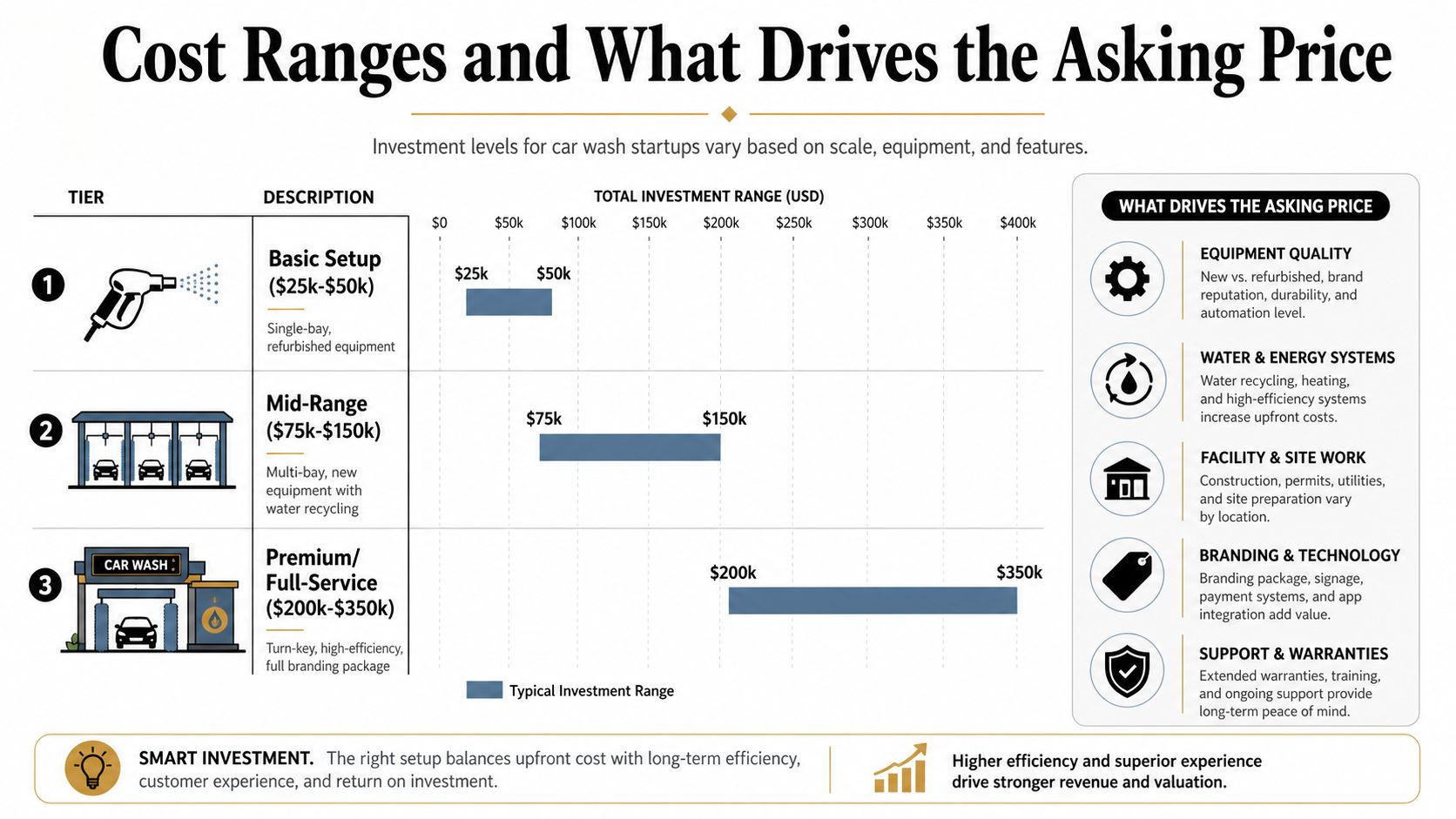
Why the numbers move so much
The equipment guide shows a spread from about $3,000 for basic mobile setups and around $5,000 for hand-wash operations, up to $40,000+ for self-service systems and $150,000 to over $500,000 for automatic or tunnel systems EPOS Now equipment guide. That range explains why the word “DIY” can be misleading. It may refer to a portable kit, a self-service business, or a capital-heavy automatic site.
Car wash acquisitions are usually valued by cash flow quality. BizBuySell’s guidance shows single-site car wash businesses commonly sell at 3x to 12x EBITDA depending on format, with full-serve or in-bay automatic sites generally lower and express tunnel businesses generally higher BizBuySell car wash listings. That spread is a reminder that the income profile matters more than the visible equipment count.
The metrics that deserve a request
Ask for the numbers lenders and appraisers use. Cash-on-cash return, net operating income, debt service coverage ratio, and cap rate should be part of the conversation LoopNet CRE explained. If the seller can’t discuss those plainly, they’re either not prepared or trying to keep the valuation fuzzy.
A separate valuation guide notes that some car wash sales are anchored to 2.0x to 2.5x revenues Miracle car wash sale prep. That doesn’t mean every deal should be priced that way, but it does mean revenue quality and documentation can move the number fast.
What actually pushes a listing up or down
Traffic count matters. So does site visibility, access from busy roads, and how well the wash is positioned for commuter use. Membership mix matters too, because recurring revenue is more stable than walk-up volume. Utility costs also matter, because a site with weak control over water, power, or maintenance can look stronger on revenue than it really is.
A higher asking price is not always seller greed. Sometimes it reflects cleaner income, stronger access, and lower risk.
Before you get emotional about a price, compare the asset’s durability to what the seller claims. If the model is stable, the price can be rational. If the site is fragile, any premium is your problem after closing.
Permits, Water, and Maintenance Essentials
Buyers get blindsided here because the listing photos look finished, but the compliance stack underneath the site is not. A car wash is not just a building with hoses. It’s a regulated operating system with water, waste, signage, occupancy, and local approvals tied to it.
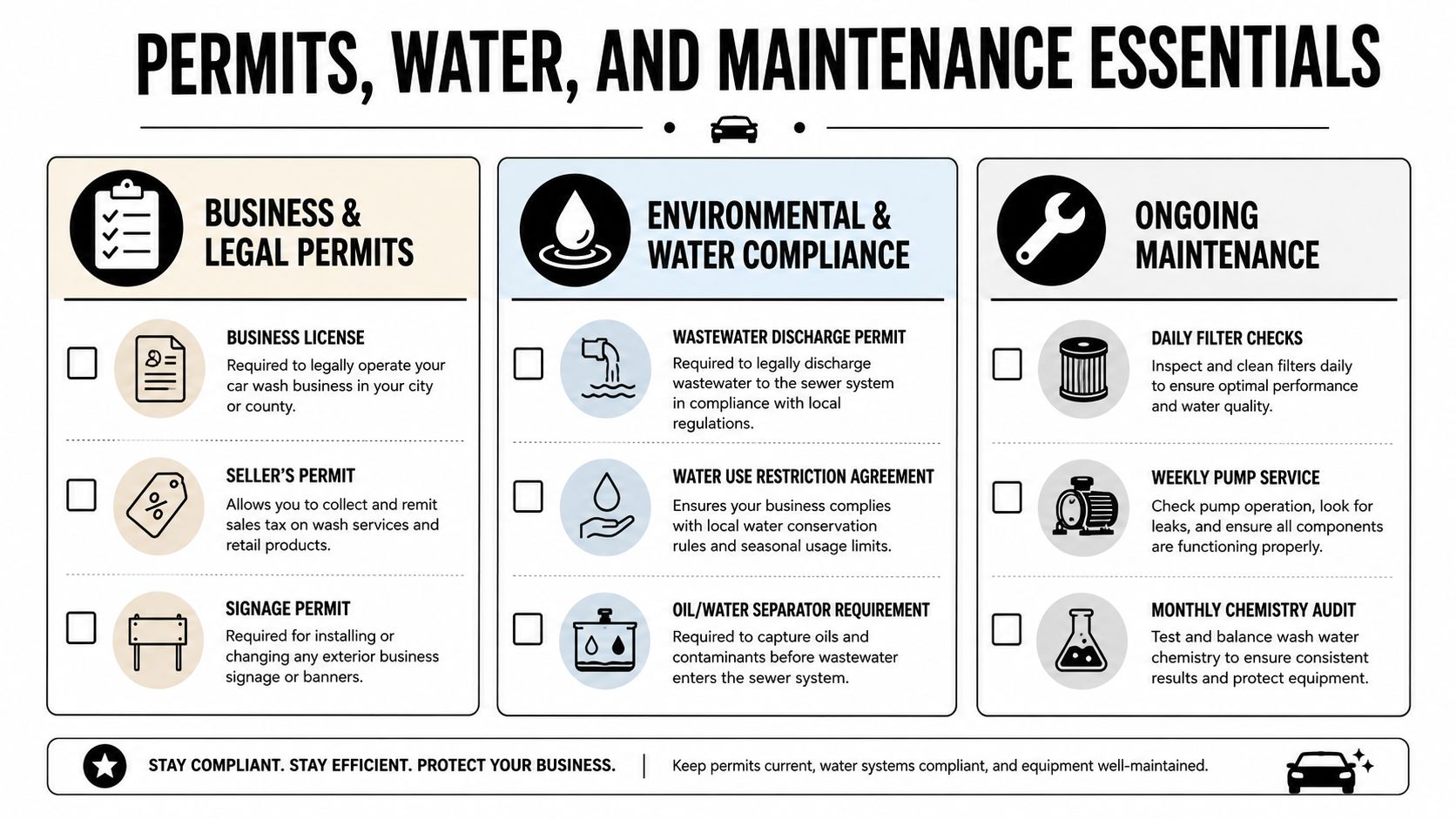
The permit stack buyers should expect
A fixed-location wash such as a tunnel, in-bay automatic, or self-serve site typically needs a business license, a seller’s permit for sales tax collection in many states, environmental permits for wastewater discharge, a certificate of occupancy, zoning approval, and sometimes a grading permit for stormwater management Start Permit car wash guide. For mobile operators, the same guidance calls out commercial auto insurance and EPA-compliant water-capture equipment.
Do not treat permits as paperwork after the fact. They affect whether the site can operate cleanly and whether a lender will take the deal seriously.
Water management and why it shows up in the deal
A seller who shrugs off water use is not helping you. Recent buyer guidance stresses utility bills, water use, environmental permits, and the durability of memberships before acquisition KKE Wash buyer blueprint. That is exactly the right lens. Water cost and compliance are not background issues, they’re part of the operating margin.
If you suspect hidden leakage or waste, bring in a specialist early. A practical reference for this kind of issue is MG Drain Services LLC leak detection, because water loss and drainage failures can damage both income and resale value.
Maintenance rule: treat leaks, vacuum problems, and chemical line issues as profit leaks, not small annoyances.
What to inspect every time
Look for detergent and wax line maintenance, leak checks, and vacuum system upkeep. A clean-looking site can still have clogged lines, weak suction, or recurring shutdowns that the seller has normalized away. Those are not cosmetic issues. They hit uptime and customer wait times directly.
For buyers evaluating water handling upgrades, Titan Coatings’ deionized water car wash system is a useful technical reference alongside the permit conversation. The main point is simple. A site that manages water well is easier to run and easier to resell.
How Modern Coatings Change the Wash Equation
A coated vehicle changes the job for both the buyer and the operator. It changes how often the customer needs service, how much rework gets needed, and what a “good wash” looks like. That’s why coatings matter in a car wash conversation, even when the site itself is the asset under review.
Why coating chemistry matters to a wash buyer
Titan Coatings’ elastomer technology brought Elastomer ceramic coatings to market using nano-tubes technology and Dark Matter tech, and the point of that chemistry is practical. The coating is hard like glass, but it flexes instead of cracking when temperature swings or impact stress show up. That matters for frozen-to-hot cycles, road grime, and bug strike conditions.
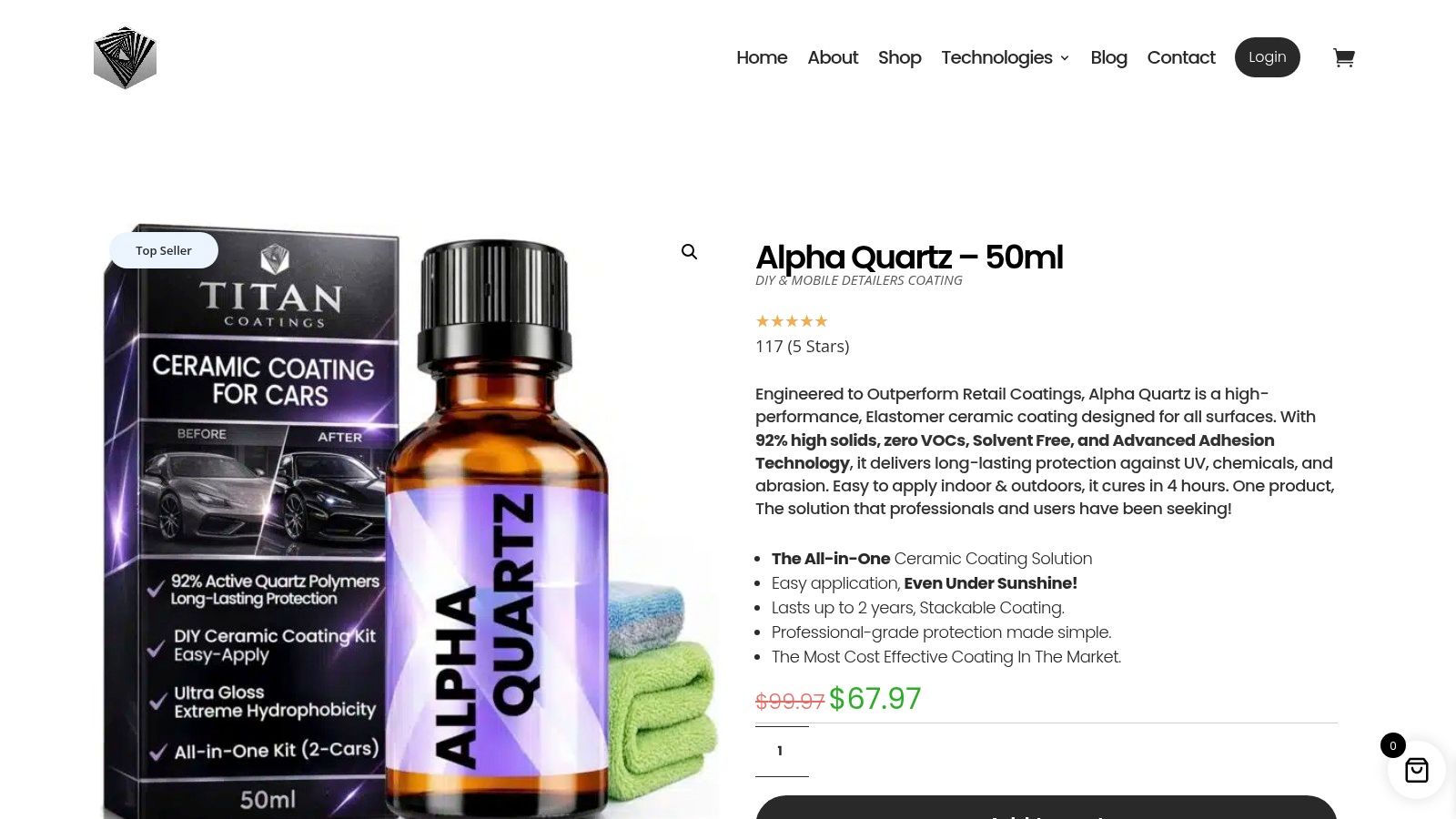
The flagship fit for DIYers and mobile detailers is Alpha Quartz. It is a high-performance Elastomer ceramic coating for all surfaces, with 92% high solids, zero VOCs, a solvent-free formulation, advanced adhesion technology, and protection that lasts up to 2 years while being stackable for added durability Alpha Quartz product page. If you’re building a detailing or wash service around that kind of workflow, the same product can be paired with the shop catalog at Titan Coatings shop.
The products that fit the workflow
APEX Glass Ceramic Coating is the windshield-focused option when visibility matters in rain and the driver wants less wiper dependence. Ultra Ceramic Spray works as a flexible membrane sealant for paint, glass, wraps, PPF, and trim, which makes it useful when you’re maintaining multiple surface types in one job.
A useful way to think about this is simple. Coatings don’t replace washing, but they change the effort curve. Less bonding on the surface means less scrubbing, fewer complaints about water behavior, and a better experience for customers who pay for protection, not just cleanup.
Why operators should care
If a site or mobile business can offer coating services, it can add a higher-margin line item without changing the entire wash model. That doesn’t make the business easy, but it does make the revenue mix more resilient. Buyers should look at coatings as part of the operating system, not a side hobby.
Operator takeaway: the right coating reduces repeat labor and helps the finish stay cleaner longer, which makes the wash process easier to sell and easier to defend.
For buyers and detailers who want a simple maintenance path after coating, Titan’s wash guidance emphasizes a microfiber wash mitt, a pH-neutral shampoo, and thorough drying with a microfiber drying towel. That’s the kind of process discipline that keeps the finish in shape after the sale closes.
Your Buyer Decision Checklist Before You Sign
The first thing to verify is model fit. If you want a consumer tool, don’t let a commercial listing distract you. If you want a business, don’t pretend a box of equipment is an income asset.
Next, check the site itself. Look at traffic access, visibility, queue space, and whether the layout supports real throughput. Then verify the equipment condition, payment systems, and the parts of the site that cost money when they fail.
Documents and questions to demand
Ask for three to five years of profit-and-loss statements, balance sheets, cash-flow statements, and tax returns Miracle car wash sale prep. If the seller can’t produce them cleanly, slow down. You need enough history to see whether earnings are stable, inflated, or propped up by one-time fixes.
You should also ask:
- What is the membership versus walk-up split? Recurring revenue is more durable than casual traffic.
- What are the utility bills and water costs? If the seller won’t discuss them plainly, you’re not getting the actual margin.
- What permits are current? Business, zoning, occupancy, wastewater, and any mobile compliance items must be visible.
- What’s deferred maintenance? Vacuums, pumps, lines, drainage, and controls tell the truth fast.
- What’s the exit story for the equipment? If the setup is old or mismatched, your first year may be a repair year.
A broker can help you pressure-test the financing side too. If you’re trying to strengthen the package before you approach a lender, improve loan approval odds with a broker is the kind of practical resource that keeps you from guessing.
What to do before you negotiate
Do not negotiate from excitement. Inspect, document, and compare. A site with decent revenue but weak compliance may still be a pass. A site with clean books, stable retention, and sane maintenance can justify a stronger number.
If you want to add a coating-driven service angle, review Titan’s lineup on APEX NANO – Titan Coatings. The right coating choice won’t fix a bad purchase, but it can support the finish quality, customer satisfaction, and operating discipline that make a wash business easier to run after closing.
If you want to buy smarter, start by checking the asset’s condition against the way you plan to use it, then build your wash process around coatings that protect the finish and simplify maintenance. APEX NANO – Titan Coatings gives you coating options like Alpha Quartz, APEX Glass, and Ultra Ceramic Spray for vehicles that need durable protection, and you can review the full range at APEX NANO – Titan Coatings.
0 Comments