
Ask any car owner how often they wax their car, and you'll probably hear the standard "every three months" answer. While that's a decent starting point, it's a bit like saying every person needs exactly eight hours of sleep—it’s a generic rule that completely misses the nuance of real life.
The truth is, a rigid calendar schedule isn't the key to long-lasting paint protection. It's all about understanding what your car actually goes through day-to-day.
Why Your Car Waxing Schedule Matters
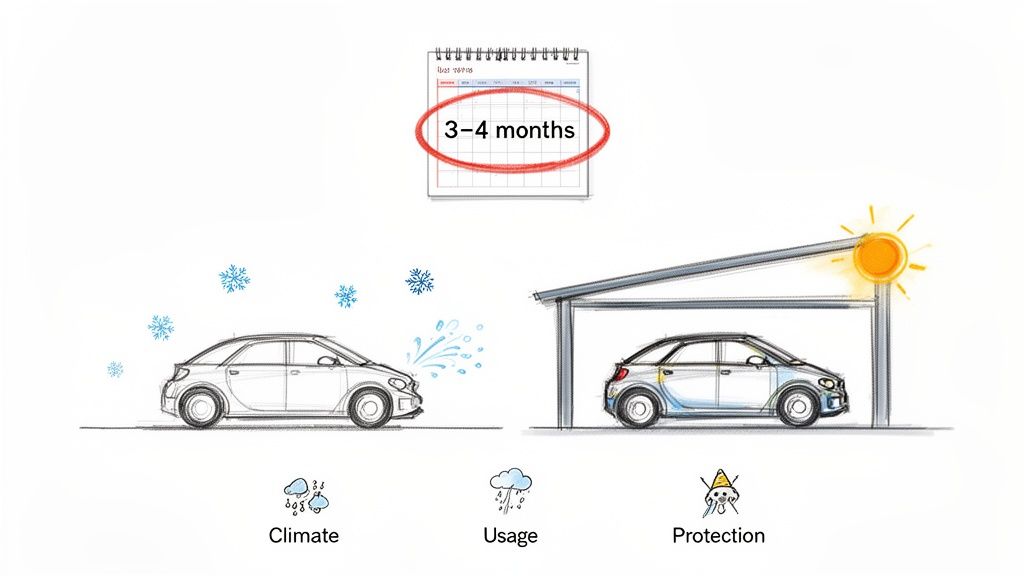
Think of car wax as a sacrificial shield for your car’s clear coat. It's a thin, transparent layer that takes all the hits so your paint doesn't have to. Without that shield, your car's finish is left exposed to a whole host of environmental attackers that can cause costly, and sometimes irreversible, damage.
This protective layer is constantly getting worn down. Knowing what wears it down is the first step to moving beyond guesswork and creating a smart, effective waxing routine.
The Enemies of Your Car's Shine
Your car's paint is in a constant battle with the elements. The main culprits actively working to break down that protective wax layer are:
- UV Rays: The sun is relentless. Its ultraviolet radiation slowly bakes your paint, causing it to oxidize, fade, and lose that deep, glossy look.
- Environmental Contaminants: Things like acid rain, bird droppings, and industrial fallout are more than just messy. They contain corrosive compounds that can permanently etch into your clear coat if they sit for too long.
- Road Grime: Salt from winter roads, tar, and all the other gunk kicked up by your tires act like sandpaper, physically abrading your paint's finish.
When you start timing your wax jobs based on these real-world conditions, you shift from being reactive to proactive. You stop fixing damage and start preventing it from happening in the first place. This isn't just about keeping your car looking good—it's about protecting your investment. If you're looking to get that head-turning look, check out our guide on choosing the best car wax for shine.
A consistent waxing routine does more than create a beautiful gloss; it forms a critical barrier that absorbs environmental damage, so your clear coat doesn't have to. It's the difference between routine maintenance and expensive paint correction down the road.
The goal here isn't just a shiny car for the weekend. It's about building a sustainable defense that keeps your vehicle looking factory-fresh for years. Let's dig into how you can tell when your protection is fading and how to create a schedule that really works.
How to Tell When Your Car Needs a Wax
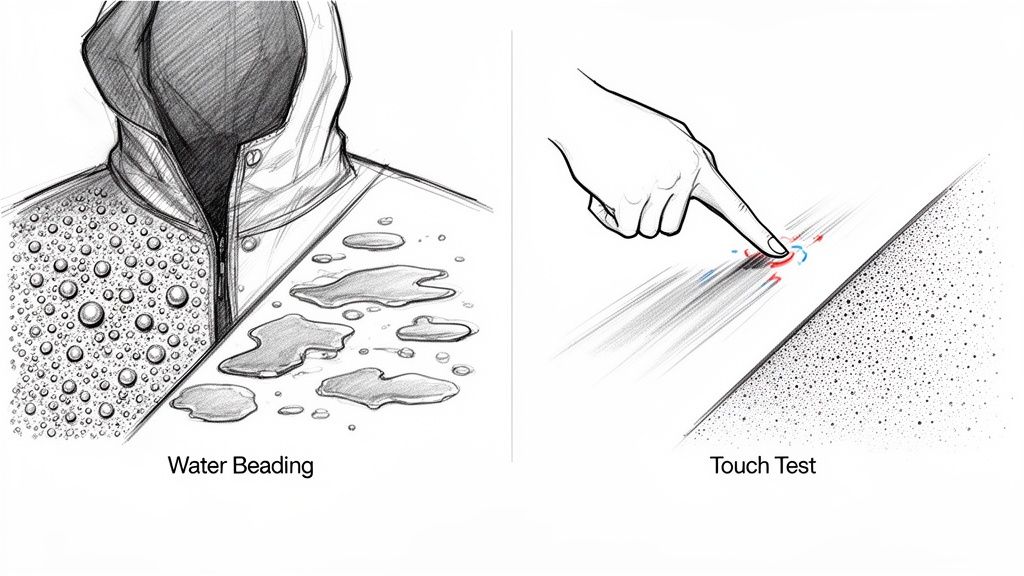
Forget circling a date on the calendar. The absolute best way to know when to wax your car is to simply let the paint talk to you. Seriously. Your car’s finish gives off some pretty clear signals when its protective layer is starting to fade, and learning to read them is the key to perfect timing.
This approach is about working smarter, not harder. You’ll save time and money by only applying protection when it’s truly needed, ensuring your paint never gets left exposed to the elements. All it takes are two quick, foolproof tests.
The Water Beading Test
This is the classic, old-school test for a reason: it works. The way water behaves on your paint is the most honest indicator of how much protection is left. What you're looking for is a property called hydrophobicity—a fancy word for how well the surface repels water.
- Healthy Protection: Grab a hose or spray bottle and give your car a light misting. If you see tight, tall, uniform beads of water that look like tiny marbles, your wax or coating is in prime condition. They should roll right off with the slightest incline. That’s a sign of high surface tension, which means the protective barrier is doing its job perfectly.
- Failing Protection: As that protection wears down, those perfect little beads will start to look sad. They’ll get lazy, becoming larger, flatter, and misshapen. The final nail in the coffin is when the water stops beading entirely and just sits on the paint in big, slow-moving pools. We call this "sheeting," and it’s a blaring alarm that your paint is naked and exposed.
When water stops beading and starts sheeting, it’s a direct visual cue that your protective barrier is gone. That water is now sitting directly on your clear coat, leaving it vulnerable to water spots, acid rain etching, and other contamination.
The Touch Test
Your fingertips can be just as insightful as your eyes. A properly protected surface has a feel that's impossible to miss. Right after a good wash and dry, gently slide the back of your (clean!) fingers across the hood or a side panel.
What you're feeling for is pure, effortless slickness. The surface should feel like polished glass, with absolutely no drag. If you feel any hint of friction, grittiness, or a slightly tacky texture, that’s your clear coat you're feeling. The protective layer has worn off, and your paint is vulnerable. To get the most accurate feel, you need a truly clean surface, which is why learning what clay barring a car does is a game-changer for any serious detailing routine.
Once you master these two simple checks, you can throw out the generic "every three months" rule. You'll be working in perfect sync with your vehicle, giving it exactly what it needs, right when it needs it.
Key Factors That Dictate Your Waxing Schedule
So, how often should you really be waxing your car? The old-school advice of "every three months" is a decent starting point, but honestly, it’s a bit like giving everyone the same-sized shoes. It just doesn't fit the real world. Your car’s daily grind and the environment it lives in are what truly determine how often you need to lay down a fresh coat of protection.
Think of it this way: your car's clear coat is in a constant battle. UV rays from the sun are always trying to bleach the life out of your paint. Acid rain leaves tiny, damaging etches on the surface, and if you live where it snows, road salt is a downright corrosive menace. To win this fight, you need a game plan that’s built around your specific situation, not some generic calendar reminder.
Your Climate and Driving Habits
Where you live and how you drive are the biggest factors by far. A daily driver that sits outside through blizzards and scorching summers is going to need a lot more attention than a weekend toy that lives in a climate-controlled garage. It’s just common sense.
- Harsh Climates: If you're dealing with intense sun, heavy snow, and salted roads, your wax is working overtime. Salt and UV radiation are two of the biggest wax killers out there. You’ll need to re-apply much more often. We actually have a whole guide on how to protect car paint from sun damage if that’s a major concern for you.
- Daily Commuting vs. Garaged Storage: A car that lives outside 24/7 is constantly bombarded by dew, pollen, bird droppings, and UV rays. A garaged car is shielded from most of this, which can easily double or triple the life of your wax.
Your Car Care Routine
What you do between waxes is just as critical. Your washing habits can either help your wax last longer or strip it right off.
One of the most common mistakes I see is people grabbing dish soap or some aggressive all-purpose cleaner to wash their car. That stuff is designed to cut grease and it will take your wax right off with it, sometimes in a single wash. Always stick with a quality, pH-neutral car shampoo. Also, don't forget that your car's color can play a role—darker paints show every little swirl and flaw, which often pushes owners to wax more frequently to keep that deep, mirror-like shine.
This more personalized approach is really catching on. In North America, which made up a massive 42.67% of the global car wax market in 2023, car lovers are ditching the old rules. With over 280 million vehicles on U.S. roads, smart owners are now waxing 2-4 times a year, finding that sweet spot between bulletproof protection and practical effort. This lines up with what the market shows: a $1.5-2 billion annual spend on car wax, fueled by a DIY community that demands real, lasting results. You can read more about these car care market trends if you're curious.
The Evolution From Wax To Elastomer Coatings
For generations, the answer to "how often should I wax my car?" was a familiar, repetitive cycle. Traditional carnauba waxes gave us that deep, warm glow we all love, but they demanded reapplication every few months. Protecting your paint felt like a constant ritual.
Professional detailers know this routine all too well, spending countless hours re-waxing client vehicles, only to watch that brilliant shine fade with the changing seasons. It's an endless loop of temporary protection. But what if there was a way to break that cycle? This is the story of how Titan changed the game.
That search for a genuine leap forward in paint care has led to a groundbreaking innovation: Elastomer coatings. As the first company to introduce these to the market, Titan pioneered a new category using nano-tube and Dark Matter technology.
Beyond Traditional Protection
This isn't just another wax or sealant; it's a fundamental shift in how we think about protecting paint. You've probably heard of ceramic coatings, known for their incredible hardness. But that rigidity can also be a weakness, making them susceptible to cracking from minor impacts or even extreme temperature shifts.
Titan’s coatings are different.
Our Elastic coatings are engineered to be hard like glass yet remarkably flexible. This unique elasticity is the game-changer. It allows the coating to absorb the energy from a bug splattering at 70 mph or a stray piece of road debris, flexing on impact instead of fracturing. This flexibility means the coating lasts longer.
This diagram shows just a few of the environmental factors that are constantly attacking your vehicle's protective layer.
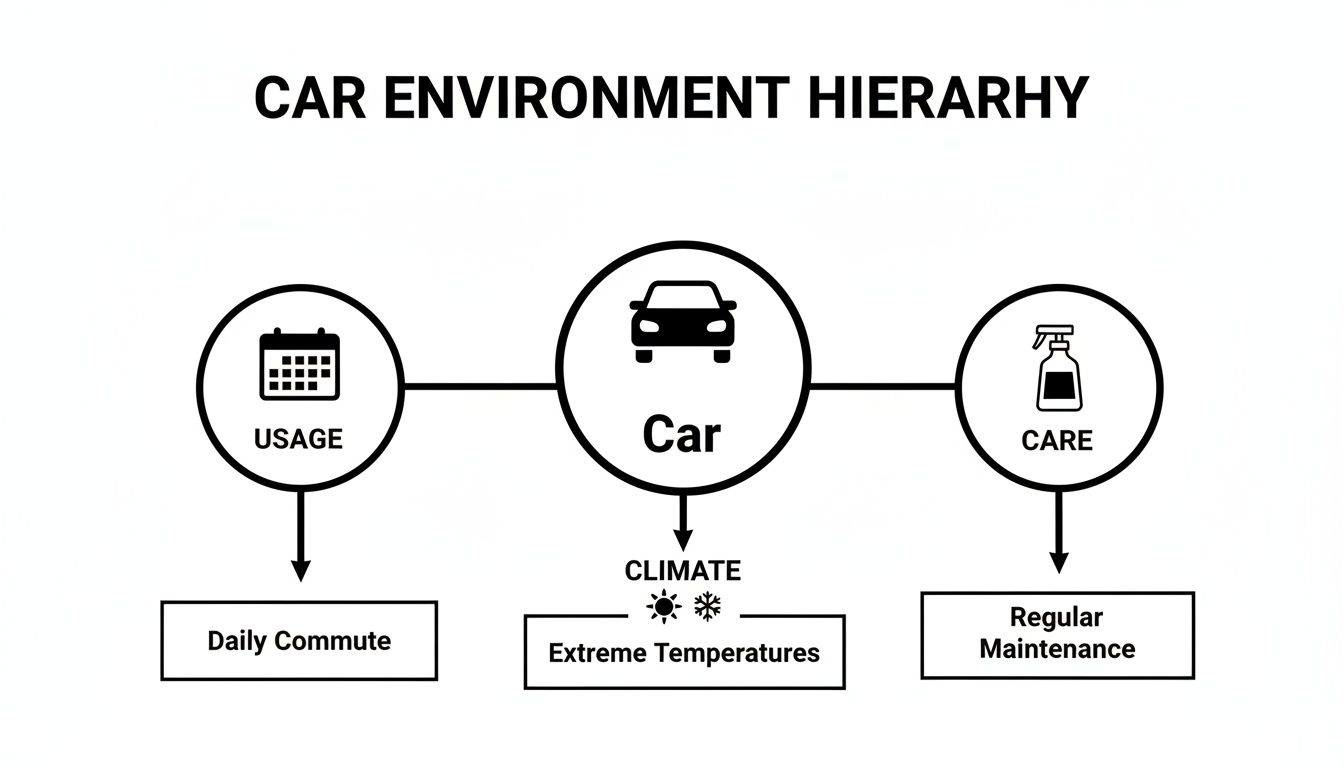
When you understand how things like usage, climate, and your own care habits degrade protection, the value of a durable, flexible elastomer coating really starts to click.
Built For The Real World
That built-in flexibility solves another major problem: stress from temperature changes. As a car goes from a freezing winter night to a blazing hot summer afternoon, its metal panels are constantly expanding and contracting. A rigid coating can't keep up and eventually cracks down under this constant movement.
But Titan’s elastic coatings move with the vehicle. Temperature changes, from frozen to hot, won't affect the coating anymore because its flexibility prevents it from cracking. This ensures that protective shield remains intact and uncompromised. We're talking about durability measured in years, not months.
This need for smarter, longer-lasting solutions is a global trend. For example, the Asia-Pacific car care market is projected to contribute 36.4% to the industry's worldwide growth through 2030. In polluted urban centers where vehicles face everything from monsoons to intense humidity, owners are ditching monthly waxes for more resilient protection.
With vehicle ownership in China alone expected to surpass 300 million by 2025, the demand for premium, long-lasting products that can withstand harsh, real-world conditions is exploding. You can see more about these global car care market shifts and how they're shaping the industry.
The evolution from wax to elastomer coatings represents a move from temporary beauty to permanent defense. It’s about applying a smart, flexible shield that adapts to the real world, freeing you from the repetitive waxing schedule of the past.
This is more than just an incremental improvement; it has redefined what’s possible for paint protection. It's a solution that finally keeps pace with modern vehicle technology and the demands of today's car owners. You can learn more about the science behind these incredible Titan Coatings Elastomer solutions and see how they're changing the game.
Paint Protection Technology Compared
Choosing the right protection for your car can feel overwhelming with all the options out there. This table breaks down the key differences between traditional waxes, modern synthetic sealants, and the advanced technology found in Titan Coatings to help you decide.
| Attribute | Carnauba Wax | Synthetic Sealant | Titan Elastomer Coatings |
|---|---|---|---|
| Primary Benefit | Deep, warm, "wet" look | Slick, reflective shine | Extreme durability & flexibility |
| Durability | 1-3 months | 4-6 months | 3-7+ years |
| Protection | Good UV and water repellency | Very good UV and chemical resistance | Superior impact, chemical, UV, and scratch resistance |
| Application | Easy, but frequent reapplication needed | Moderate, requires clean surface | Professional or DIY-friendly options |
| Key Weakness | Low melting point, wears off quickly | Can lack the depth of carnauba | Higher initial investment |
| Best For | Enthusiasts who enjoy frequent waxing | DIYers looking for durable shine | Owners seeking long-term, low-maintenance protection |
Ultimately, the best choice depends on your goals, your budget, and how much time you want to spend maintaining your car's finish. While waxes and sealants still have their place, elastomer coatings offer a level of "set it and forget it" protection that was unimaginable just a few years ago.
Finding the Right Titan Coatings Protection for You
The whole game has changed. We've moved so far beyond traditional waxes that the conversation is no longer just about technology; it's about finding a solution that genuinely fits your life and your car. After all, the best protection is the one you can actually apply with confidence and know it's going to work.
That's where Titan Coatings comes in. We've developed a lineup that brings professional-grade durability to everyone, from the weekend warrior in their garage to the seasoned mobile detailer.
This is where that old question—"how often should I wax my car?"—starts to feel obsolete. Instead of penciling in another wax job three months from now, you can choose a level of protection that lasts for years.
For The Car Lover Who Wants The Best, Long-Term Shield
Let's talk about the dedicated DIYer. Maybe this sounds like you: you're tired of the endless wax-on, wax-off cycle. You’ve just bought a new car and want to lock in that showroom finish with something serious, but the horror stories about difficult ceramic coating applications have you spooked.
Your search ends with Alpha Quartz, our flagship Elastomer coating. It was designed for people just like you—meticulous and detail-oriented, but not necessarily working in a climate-controlled professional bay. The installation is refreshingly straightforward, making it great for DIYers and mobile detailers.
But what really seals the deal is its unique flexibility. If you live anywhere with real seasons—freezing winters that transition into blistering summers—you know that a car's metal panels are constantly expanding and contracting. A rigid, brittle coating just can't keep up and eventually develops micro-cracks. Alpha Quartz, on the other hand, is elastic. It moves with your car, preventing cracks and shrugging off impacts from rock chips and bug splatters like nothing happened. Its elasticity ensures it doesn't crack under temperature changes or when bugs hit the car surface.
- The Tech: Alpha Quartz is an easy-to-use Elastomer coating that cures into a hard, glass-like shell with incredible flexibility.
- The Real-World Win: It stands up to harsh temperature swings and daily road hazards without cracking or failing, making it perfect for a daily driver in a tough climate.
- Who It's For: The DIY enthusiast or mobile detailer who demands a simple, forgiving application process but refuses to compromise on long-term results.
See for yourself just how easy it is to get lasting protection on the Alpha Quartz shop page.
For Powerful Protection in a Flash
Look, not everyone has the time or desire to do a full coating application. Sometimes you just need a quick, easy way to amp up the shine and protection. For those moments, there's Ultra Ceramic Spray.
Imagine this: you've just finished washing your car. In the time it takes to dry it, you can add a layer of legitimate ceramic protection. Just spray and wipe. It’s that simple.
But don't mistake simplicity for weakness. This isn't your average quick detailer. Ultra delivers a ridiculous level of gloss and some of the most unbelievable water-beading you'll ever see from a spray product. It's incredibly easy to install with great results, keeping your car looking amazing and making future washes a breeze.
For Crystal-Clear Vision and Safer Driving
Think about the daily commuter. Her drive home in a sudden downpour is a white-knuckle affair. The wipers are smearing, visibility is shot, and the stress is through the roof. She found Apex Glass Ceramic Coating, and it completely transformed her experience behind the wheel.
After one simple, easy-to-use application, water doesn't just bead up on her windshield—it literally flies off. Once she hits highway speed, she barely even needs to use her wipers. The intense hydrophobic effect enhances visibility and makes driving under rain stress-free, calm, controlled, and, most importantly, much safer.
This is a perfect example of a targeted solution for a real-world problem. Having a clear, unobstructed view in any weather is one of the single biggest safety improvements you can make to your vehicle.
You can learn more about achieving this level of clarity with Apex Glass Ceramic Coating here. Each of these products offers a specific answer, moving beyond the simple question of waxing frequency to a much more important one: what's the best way to protect my car for my life?
Answering Your Top Car Waxing Questions
Even with the best game plan, you're bound to have questions. Figuring out the ideal waxing schedule can feel like a moving target, but with the right info, it becomes second nature. Let's tackle some of the most common questions we hear from detailers and passionate car owners to help you dial in your car care routine.
Can You Wax a Car Too Often?
It's highly unlikely you'll damage your paint by waxing too much, but you'll definitely be wasting time and good product. Today's waxes and sealants are built for endurance. Slapping on a new layer before the old one is tired offers almost no extra benefit and can sometimes create a strange, hazy buildup on the surface.
Forget the rigid schedule. Let your car tell you what it needs. Trust the water beading test and how the surface feels to the touch. Is it still slick? Does water form tight, neat little beads? If so, your protection is still doing its job. Just focus on safe washing techniques to keep that layer happy.
Of course, this whole question gets a lot simpler when you step up to modern protection like Titan Coatings. A single, solid application of a product like Alpha Quartz gives you years of tough, flexible protection. It pretty much frees you from the endless waxing cycle for good.
What Is the Difference Between Polishing and Waxing?
This is probably one of the most important things to get right in car care. Just remember this: polishing corrects, while waxing protects.
Think of polishing as a cosmetic procedure for your paint. It uses incredibly fine abrasives to gently level a microscopic layer of the clear coat. This is how you smooth away annoying swirl marks, light scratches, and that dull, hazy look from oxidation. The result is a flawless, mirror-like surface.
Waxing, on the other hand, adds something on top. It’s a non-abrasive layer of protection that shields the paint you just perfected from the outside world. This is why you always polish before you wax. If you wax over flawed paint, you're just locking in and magnifying all those imperfections for everyone to see. The goal is always to perfect the finish first, then protect that perfection.
Does a New Car Need to Be Waxed?
Yes, 100%. This is a huge misconception that costs new car owners down the road. That car may look perfect on the showroom floor, but the "protection" on it from the factory is practically nonexistent and isn't meant to last. Dealerships often apply a cheap glaze to give it that temporary pop, but that shine usually washes away in a couple of weeks.
Getting a high-quality wax, sealant, or—even better—a durable coating on your new vehicle is the single best investment you can make. You're locking in that perfect factory finish from day one and putting up a shield against UV rays, road salt, and bird droppings before they even get a chance to cause damage.
A lot of new owners ask if they can stack different kinds of protection. You can learn more about that by reading up on whether you can wax over a ceramic coating. At the end of the day, starting with a powerful base layer is the key to keeping your new car looking new for years.
At Titan Coatings, we're obsessed with creating solutions that deliver lasting, real-world protection. Whether you're a weekend warrior detailing in your garage or a seasoned pro, our advanced Elastomer coatings were engineered to blow traditional waxes and sealants out of the water. We want to give you a superior finish that truly stands the test of time.
Explore the full range of Titan Coatings products in our shop
0 Comments
Trackbacks/Pingbacks