
Marco spent a full Saturday correcting his black truck. By Sunday evening, a rushed wash with a dusty mitt had already put a gray veil of swirls back into the finish. That kind of disappointment is why people start looking for a scratch resistant lens coating mindset, even when the surface in question is paint, glass, plastic, or anything else that lives in daily environments and gets handled every day.
The lesson is the same across industries. Protection fails when we confuse hardness with durability.
The Unending Battle Against Scratches and Swirls
I’ve seen the same scene play out in shops for years. A vehicle leaves with sharp reflections and a clean finish, then comes back after a stretch of normal use wearing a fresh layer of wash marks. No collision. No abuse. Just the steady grind of contact, friction, heat, dust, and hurried maintenance.
That pattern matters because it exposes a mistake people make across every surface category, including eyewear. A scratch resistant lens coating exists for the same reason paint protection matters. Daily handling does the damage. Lenses get wiped on shirts, dropped into bags, set face-down on counters, and cleaned with whatever cloth is nearby. Over time, even careful owners build wear into the surface.
Where the damage starts
The more common enemy is repeated stress.
One bad event can leave a mark, but most visible scratching comes from smaller contact happening again and again:
- Dry wiping over dust: Grit gets trapped between the surface and the towel, then cuts fine lines into the coating.
- Automatic washes: Dirty brushes and hanging debris create repeatable micro-marring.
- Poor storage habits: Glasses in a bag and vehicles parked outdoors both collect contamination that gets dragged across the surface later.
- Rushed upkeep: Quick cleanups often skip lubrication, proper wash media, and inspection of what is already sitting on the surface.
Optical professionals have pointed out for years that plastic lenses scratch more easily than glass, which is why hard coats became standard protection. That was a useful step, but it also trained buyers to focus on one word: hard. In practice, hard surfaces still fail if they cannot absorb everyday movement and friction without breaking down at the microscopic level.
Most scratching looks sudden to the owner. In the shop, it usually reads like accumulated wear.
That distinction changes how coatings should be judged.
Why old assumptions fall short
Swirls and fine scratches are not just cosmetic defects. They change how the surface behaves in use. Paint loses depth. Lenses scatter light, pick up haze, and feel older than they are. Maintenance gets harder because damaged surfaces hold contamination more stubbornly and show every wipe more clearly.
This is also where traditional ceramic thinking starts to show its limits. A rigid coating can test well on hardness and still disappoint in service if it becomes brittle, develops micro-cracks, or loses integrity under repeated expansion, contraction, washing, and abrasion. Detailers see that gap all the time between what sounds impressive on paper and what still looks good months later.
A scratch resistant lens coating is valuable because it helps the surface survive the wear cycle people put it through. That same standard should apply to automotive coatings. Long-term protection depends on durability with flex, not hardness alone.
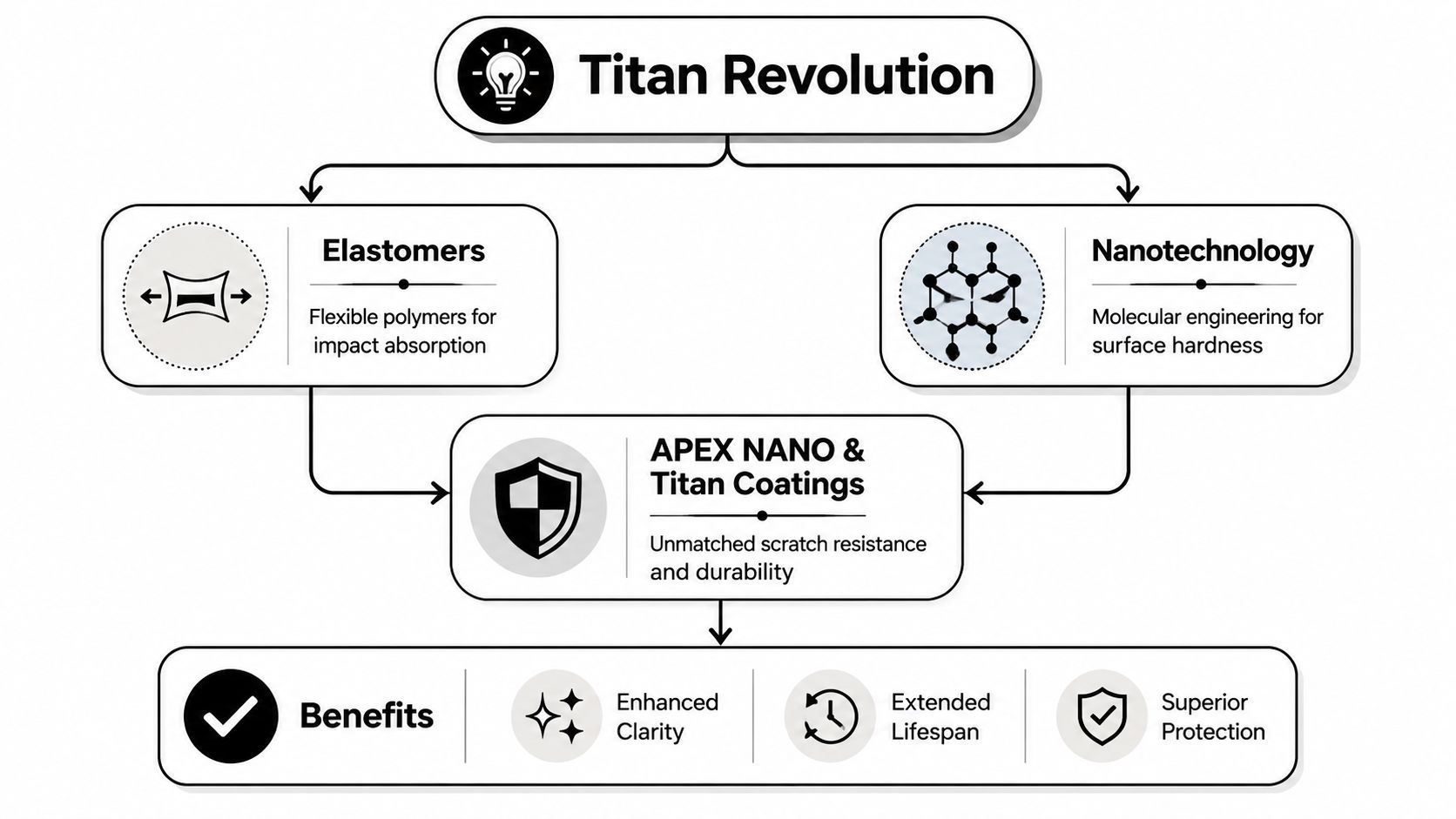
The Titan Revolution Elastomers and Nanotechnology
For years, most of the market chased one idea. Make coatings harder. Advertise that hardness. Let the customer assume hardness means survival.
That approach works right up until the surface gets stressed.
A rigid wall can be strong and still fail when it can’t move. A tower that flexes survives wind because it absorbs energy instead of fighting every load with pure stiffness. Coatings work the same way. If a coating is hard but brittle, impact, expansion, contraction, and repeated surface friction eventually expose that weakness.
Why flexibility changes the conversation
In lens manufacturing, the technical side is already clear. Advanced coating performance doesn’t come from surface hardness alone. It comes from the whole system. As Central Florida Eye Center’s lens coating overview notes, durability improves when cure temperature, viscosity, and solid content are tightly controlled, allowing multi-layer systems to maintain adhesion and flexibility while reducing haze, yellowing, and micro-cracking.
That matters because it mirrors what experienced detailers learn the hard way. The coating that lasts isn’t always the one that feels hardest in a sales pitch. It’s the one that stays bonded, stays clear, and keeps performing after heat, cold, washing, and contamination.
What elastomer coatings solve
Titan’s angle is simple and different. Instead of treating flexibility as a weakness, it treats flexibility as part of durability. The elastomer concept is appealing for one reason above all others: a coating can be hard like glass and still flexible enough to absorb stress.
That matters in places where traditional brittle layers often struggle:
- Temperature swings: Frozen mornings and hot panels stress rigid films.
- Minor impacts: Bug hits, wash contact, and debris don’t arrive politely.
- Long-term clarity: Surface protection only counts if the coating keeps its shape and adhesion.
The excitement around this shift is justified because it aligns with what surface failure usually looks like in practice. Surfaces don’t just get “scratched.” They get rubbed, heated, cooled, flexed, contaminated, and cleaned over and over.
Practical rule: If a coating can’t tolerate movement, it won’t stay attractive for long on a surface that lives outdoors.
Why the lens analogy still matters
A true scratch resistant lens coating doesn’t promise miracle immunity. It works by improving resistance to the kind of wear people cause. Titan’s elastomer story fits that same real-world logic. Flexible systems are better positioned to deal with repeated stress than coatings that treat rigidity as the whole game.
That’s the shift I find most interesting. The industry spent years selling hardness. The future belongs to coatings that combine hardness, adhesion, and controlled flexibility into one system.
Choosing Your Armor A Guide to Titan Coatings
Different jobs need different tools. A mobile detailer protecting a daily driver has different priorities than a client who only cares about windshield behavior in bad weather. The mistake is buying one coating category and expecting it to solve every problem equally well.
Alpha Quartz for installers who need resilience
For detailers who want a more forgiving protection system, Alpha Quartz is the interesting option in this lineup. The appeal isn’t just durability language. It’s the practical idea behind elastomer technology. A coating that can stay intact through expansion, contraction, road use, and routine maintenance solves a common problem that rigid films often expose later.
I especially like this kind of product for mobile work. A mobile detailer doesn’t always have a pristine enclosed bay, perfect climate control, or unlimited correction time. A coating that is easier to install and less prone to the usual brittle-coating headaches gives that installer more confidence on real customer cars.
APEX Glass Coating for the visibility problem
Windshield performance is where many drivers feel the result immediately. Good glass protection changes how the car behaves in rain, during road spray, and during cleanup after bugs and grime.
This is the product page worth reviewing if glass performance is your priority:
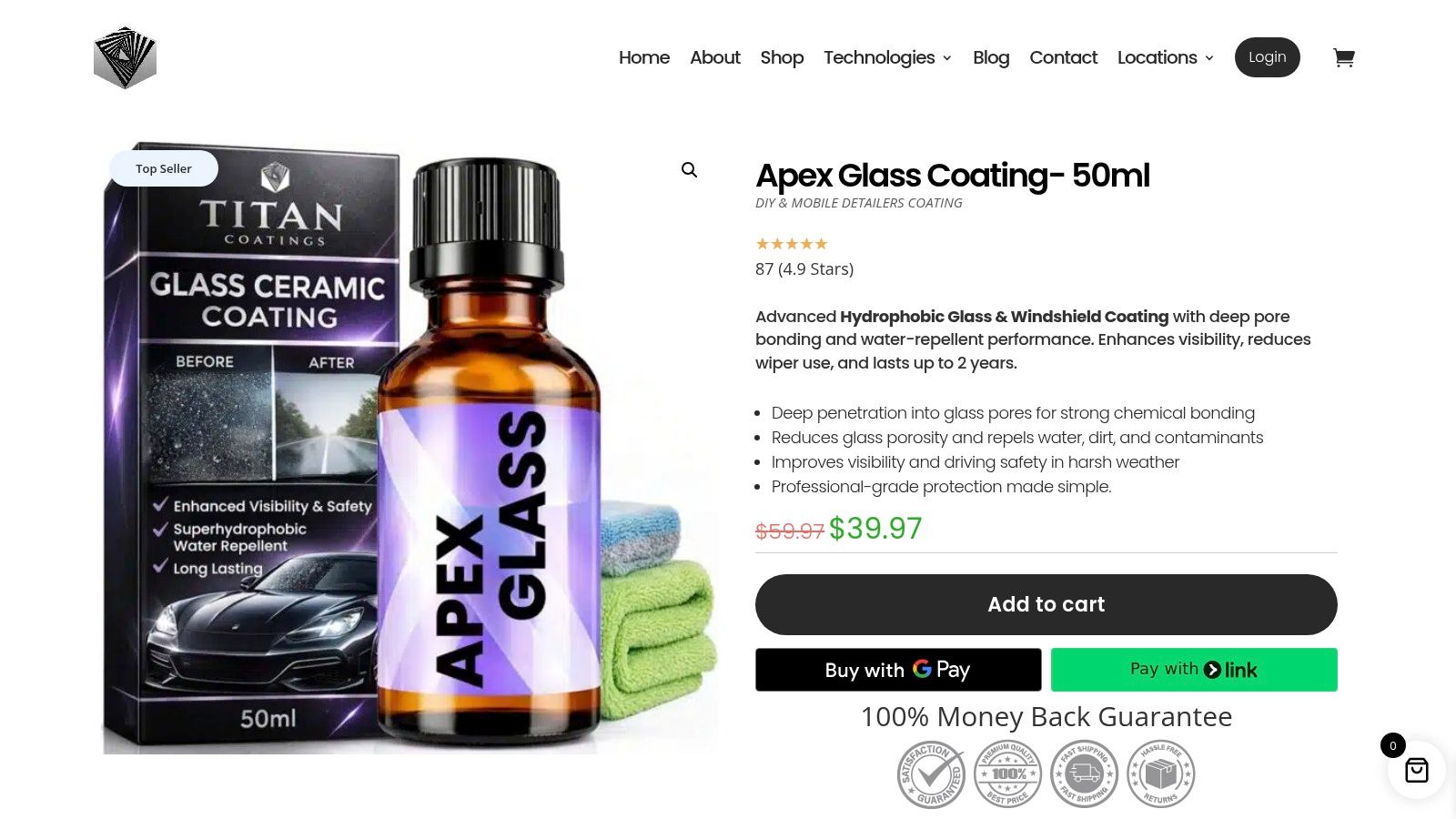
Titan’s scratch-resistant glass oleophobic coating is relevant here because glass protection isn’t only about marks. It’s also about making contamination less eager to stick and making routine cleaning easier.
A lot of people don’t connect this with lens science, but they should. In optical systems, scratch resistance is often bundled with anti-reflective and easy-clean functions because the user experiences those layers as one package. Poudre Valley Eyecare’s pricing example shows exactly that, listing $85 for a premium anti-reflective package with scratch resistance, $45 for basic anti-reflective, and $140 for a fuller package adding UV protection, scratch resistance, and easy-clean properties. That bundling reflects how people buy surface performance. They want durability, clarity, and easier upkeep together.
ULTRA Ceramic Spray for fast maintenance
Not every customer needs a full long-term install. Some need something fast, clean, and easy to maintain across multiple surfaces. That’s where ULTRA Ceramic Spray makes sense. A spray format lowers the barrier for DIY users and gives professionals a practical topper or maintenance option between larger jobs.
Here’s how I’d think about the lineup:
| Need | Better fit |
|---|---|
| Flexible long-term body protection | Alpha Quartz |
| Rain visibility and easier glass cleanup | APEX Glass Coating |
| Quick application and maintenance support | ULTRA Ceramic Spray |
If you like seeing how durability thinking shows up in other gear categories, Karoo Outdoor’s Element Titan 5 insights are worth reading. Different product category, same lesson. Material choices matter most when conditions stop being gentle.
The True Measure of Durability Beyond the Hype
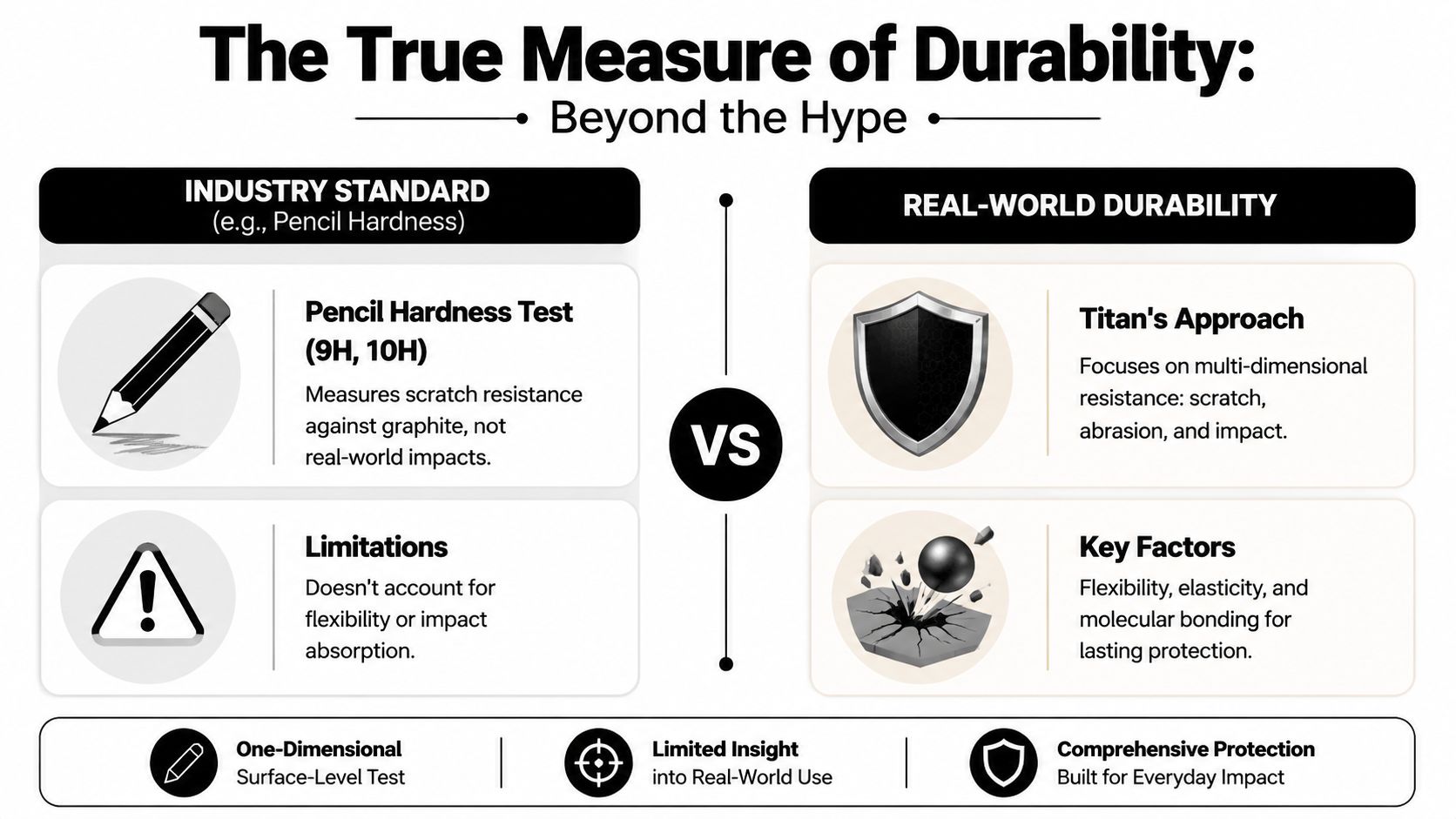
A lot of coating marketing still leans on one familiar shorthand. Pencil hardness. It sounds technical, so it sells. The problem is that it doesn’t describe what owners put a surface through.
A surface can test hard and still behave poorly when it faces vibration, wash contact, thermal cycling, and repeated abrasion. That’s the same reason a scratch resistant lens coating should never be judged only by whether it resists a single sharp event. In actual use, the more common threat is wear from handling and cleaning.
Abrasion matters more than the label
Optical trade guidance makes this distinction clearly. As 2020 Magazine’s discussion of scratch and anti-reflective lenses explains, coatings often improve abrasion resistance more than true resistance to a sharp-point scratch. That’s not a minor technicality. It tells you what to value.
Most protected surfaces fail from:
- Repeated rubbing during cleaning
- Contaminated contact during maintenance
- Localized stress on softer substrates
- Poor formulation matching between coating and base material
What I’d trust more than a hardness claim
When I evaluate durability claims, I care more about behavior than slogans. I want to know whether the coating stays bonded, whether it keeps optical clarity, and whether it avoids the brittle failure pattern that shows up after environmental stress.
That’s why substrate choice also matters. Polycarbonate and similar materials often need more from the coating system because they’re softer and more vulnerable to surface damage. Titan’s UV protective coating for polycarbonate fits that conversation because protection has to match the material below it, not just the marketing above it.
Hardness numbers can be useful. They just aren’t the final answer when the real enemy is repeated stress.
The better durability test
A better standard asks harder questions:
- Does the coating handle heat and cold without failing visibly?
- Does it keep clarity after normal cleaning cycles?
- Can it absorb minor impacts without turning brittle over time?
- Does it suit the surface underneath it?
Those questions describe actual ownership. They also explain why flexible systems are getting more attention. Real durability is multi-dimensional, and coatings that can flex without giving up hardness are closer to that real-world target.
Best Practices for Application and Long-Term Care
Even strong coating chemistry loses value with sloppy prep. Most failures blamed on the bottle start with contamination, poor wipe technique, or maintenance habits that grind dirt into the surface.
That’s not unique to cars. Optical guidance makes the same point. IOT Lenses on coating types and care notes that real-world durability depends heavily on the lens material and the owner’s cleaning habits, and that even premium coatings can fail when people use abrasive cloths or improper cleaners.
Application habits that help
A good install starts before the coating touches the surface.
- Decontaminate first: Remove bonded grime, traffic film, old residues, and anything that can interfere with adhesion.
- Correct only as needed: Don’t chase perfection where the substrate doesn’t justify it, but don’t trap visible defects under protection either.
- Control towels and applicators: The wrong towel can undo your prep faster than a poor polishing pass.
- Respect cure conditions: Temperature, moisture, and timing all affect how the coating settles and bonds.
Maintenance habits that preserve the result
Owners shorten coating life with impatience more often than with malice. They wipe dry dust. They use household cleaners. They scrub bug remains after they’ve baked on.
A better routine looks like this:
| Situation | Better move |
|---|---|
| Dusty surface | Rinse before touching |
| Bug residue | Soften contamination before wiping |
| Routine wash | Use pH-neutral soap and clean wash media |
| Between washes | Use clean towels and plenty of lubrication |
If you work on a full exterior package, ceramic coating for headlights belongs in the same planning conversation because front-end surfaces take some of the harshest exposure on the vehicle.
Think like a maintenance planner
The smartest owners treat care as a schedule, not a reaction. That mindset is close to the logic behind Forge Reliability on predictive maintenance. You don’t wait for obvious failure if routine observation can stop the decline earlier.
Cleaners and towels are part of the coating system. If they’re wrong, the coating takes the blame for user error.
That’s the practical side of a scratch resistant lens coating idea. The coating helps. The user finishes the job.
Troubleshooting and Making the Smart Selection
People often overcomplicate coating selection. The better question isn’t which product sounds toughest. It’s which product matches your surface, your environment, and your maintenance habits.
Common issues and what they usually mean
If you see problems early, the cause is often predictable:
- High spots after application: Too much product, uneven leveling, or poor lighting during wipe-off.
- Streaking on glass: Residue wasn’t fully removed, or the surface wasn’t clean enough before application.
- Premature marring: The surface is seeing abrasive contact during washing or drying.
- Disappointing longevity: Installation may have been fine, but care habits weren’t.
This is also where people make another mistake. They assume every surface should get the same chemistry. It shouldn’t. Material behavior matters. If you want a good technical mindset for that decision, selecting materials based on chemical resistance is a useful reference because it reminds you that surface protection always depends on the substrate and the exposures involved.
A simple selection filter
Here’s the practical version:
- If you want a more flexible long-term coating behavior on painted surfaces, Alpha Quartz is the logical first look.
- If your main complaint is wet-weather visibility and stubborn windshield contamination, start with APEX Glass Coating.
- If you want fast application or an easy maintenance layer, ULTRA Ceramic Spray is the easier entry point.
For anyone dealing with failed coatings or old layers that need to come off before starting over, Titan’s guide to removing scratch-resistant coating from eyeglasses is relevant in principle even outside eyewear. Old damaged protection changes how new coatings behave. Surface prep starts with removing what no longer belongs there.
What not to assume
Don’t assume a harder coating will always last longer. Don’t assume one test result describes daily use. Don’t assume premium pricing protects against poor washing.
Those are the same misconceptions that shaped the eyewear market before better coating packages became standard. The smarter choice is the one that survives your actual use pattern, not the one with the loudest label.
Frequently Asked Questions About Elastomer Coatings
Do elastomer coatings replace traditional hard coatings
Elastomer coatings shift the goal. Old-school hard coatings chase surface hardness first, which can work until the surface flexes, heats up, cools down, or takes repeated contact. That is where cracking, premature dulling, and uneven wear start to show.
An elastomer-based coating is built to absorb some of that stress instead of fighting all of it. In practice, that means the coating can stay intact longer on real vehicles and high-use surfaces, where durability depends on more than a hardness number.
Is a scratch resistant lens coating scratch proof
No. Scratch resistant means the surface stands up better to normal cleaning, handling, and day-to-day abrasion. It does not mean keys, grit, bad wash media, or aggressive wiping cannot mark it.
That distinction matters because a lot of coating disappointment starts with the wrong expectation.
How long should coating performance realistically matter
A coating should hold up through the normal service life of the surface or ownership cycle, not just look good for the first stretch after application. In eyewear, as noted earlier, scratch resistance became a standard feature because people expect that protection to last through regular use, not fail early.
The same standard applies here. If a coating turns brittle, starts marring fast, or loses its easy-clean behavior too soon, the chemistry was not matched well to the job.
Why do some coated surfaces still get damaged quickly
Because failure is rarely caused by one thing. I see the same pattern over and over. The coating gets blamed, but the problem is usually a mix of poor prep, a soft or stressed substrate, contaminated wash tools, or maintenance that is too aggressive for the surface.
Flexible coatings help because they address one of the big weaknesses in traditional ceramics. Brittle hardness. They still need proper prep and sane maintenance, but they are less prone to the micro-cracking and stress fatigue that shorten the life of rigid films.
Where does glass protection fit into the bigger system
Glass is part of the protection package, not an afterthought. Easier contaminant release, cleaner wiping, and better wet-weather behavior improve the way a vehicle feels to use every day.
Titan’s ceramic coating for automotive glass fits that role well when the goal is a full system, not a collection of unrelated products.
Are elastomer coatings only for professionals
No. Professionals benefit from them because they reduce comeback problems tied to brittle failure. Serious DIY users benefit for the same reason.
The key is honest product matching. If the surface sees flex, weather swings, frequent washing, or daily wear, flexible durability usually makes more sense than chasing maximum hardness on a label.
If you want to explore a coating system built around flexible durability instead of brittle hardness, take a closer look at APEX NANO – Titan Coatings. The product range covers paint, glass, and maintenance needs with a clear focus on real-world protection, easier upkeep, and coating behavior that makes sense outside the lab.
0 Comments