
The black hood looked flawless when it left the studio. By the fifth summer, the same panel had lost depth, the roof felt hotter to the touch than the doors, and the finish carried that dry, tired look detailers spot immediately.
That slow decline is why the phrase sun protection roof paint deserves a harder look in automotive care. The breakthrough is not merely house paint adapted to cars. It’s the evolution from simple reflectivity into flexible nanotechnology built for moving surfaces, changing temperatures, road impact, and long-term gloss retention.
The Unseen Battle on Your Car’s Roof
A car’s roof lives a harsher life than most owners realize. It sits flat to the sun, catches the longest direct exposure, and absorbs daily cycles of heating, cooling, contamination, and washing. When clients ask why the roof, hood, and trunk usually fail before the lower doors, the answer is simple. Those horizontal panels take the worst beating first.
I’ve seen the pattern repeat across black cars, red cars, fleet vehicles, and weekend toys. The finish doesn’t usually fail in one dramatic event. It starts with slight dulling, then oxidation, then a surface that no longer looks tight and healthy under sharp light. If the owner ignores it long enough, restoration becomes harder and maintenance becomes more expensive.
That’s why paint correction alone never solves the whole problem. Correction removes defects that already formed. Protection is what keeps that same damage from returning at the same pace.
Practical rule: If the roof is fading faster than the sides, solar exposure is driving the problem, not just poor washing.
For vehicle owners who want to understand the earliest warning signs, this guide on how to prevent oxidation on car paint is worth reading before the surface gets chalky or uneven.
Why the roof matters most
The roof is the closest automotive equivalent to a building roof, but the comparison only goes so far. A house roof can prioritize utility. A vehicle roof has to keep gloss, color accuracy, slickness, and visual uniformity with every surrounding panel.
That changes the engineering target. A car coating can’t just bounce sunlight back. It has to preserve appearance while surviving road life.
The modern fight isn’t just about shine
Many owners still think in old categories: wax for gloss, ceramic for hardness, polish for correction. Sun exposure doesn’t care about those labels. It attacks clear coat chemistry day after day.
A serious protective system has to manage heat, UV stress, expansion and contraction, and the mechanical abuse that comes from real use. That’s where automotive surface protection moved far beyond the old idea of “roof paint.”
Understanding the Enemy The Science of Solar Damage
Solar damage isn’t one thing. It’s a combined attack from different parts of the spectrum, and each one hits the vehicle in a different way. If you only protect against one form of energy, the other forms keep working on the paint, plastic, trim, and glass.
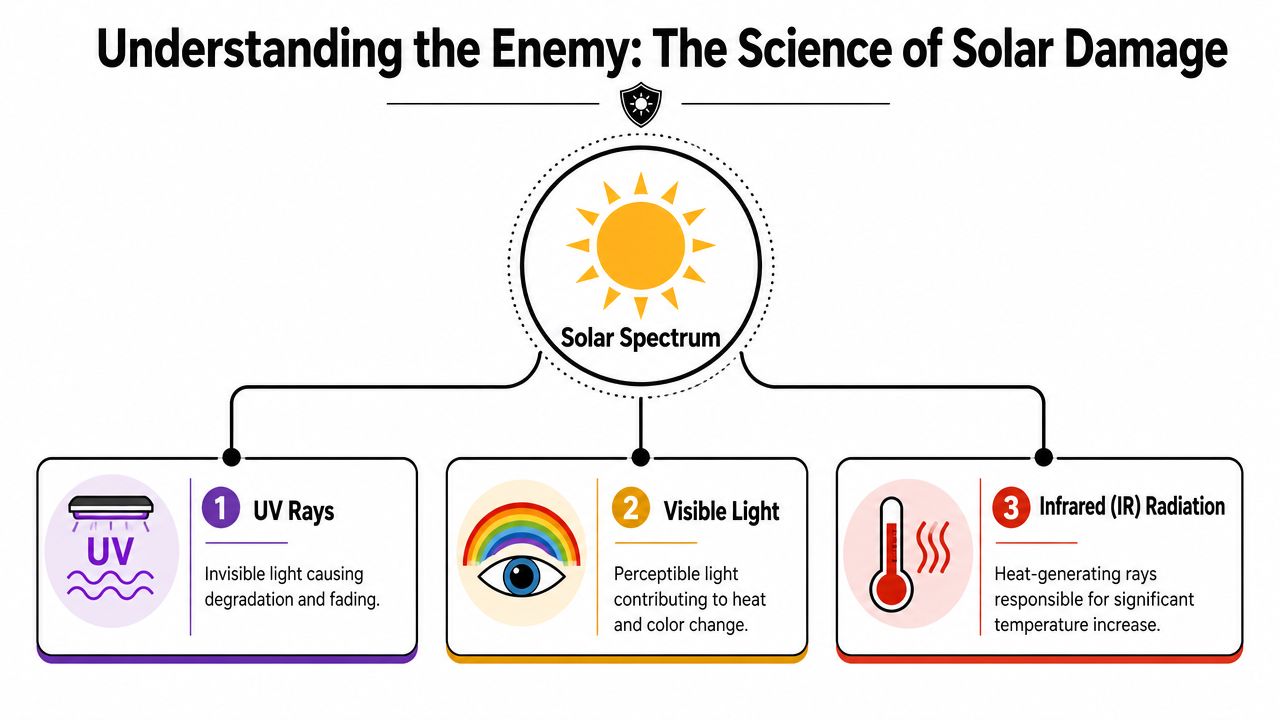
Three attackers, three jobs
Think of sunlight as a three-punch combination.
- UV rays damage the surface over time. They’re a major reason clear coats lose freshness and exposed materials start to age.
- Visible light is what you see, but it also contributes to surface heating.
- Infrared radiation is the heavy hitter for heat load. It’s the part many buyers overlook because they can’t see it working.
That last point matters. Most content on sun protection roof paint treats bright white reflectivity as the whole answer. It isn’t.
Why simple reflection isn’t enough
A common mistake is assuming any bright coating with “ceramic” marketing automatically delivers advanced thermal protection. It often doesn’t. According to this NASA-backed test discussion on reflective paint versus true thermal blocking, specialty ceramic coatings performed nearly identically to standard white paint, and 53% of solar energy is infrared heat, which reflective paints cannot block but true thermal blockers can.
That single distinction clears up a lot of bad advice in the market. High-albedo coatings mostly bounce visible light. Thermal-blocking systems are designed to address the energy that keeps baking the substrate.
If a product only talks about brightness and color reflectivity, ask what it does with infrared. That’s where a lot of heat lives.
For detailers, the automotive parallel is straightforward. A coating that looks good on day one but doesn’t manage thermal stress is still leaving the surface exposed to repeated heat cycling.
What this means on a real vehicle
The roof and hood don’t just get hot. They expand, contract, and repeat that cycle over and over. Every wash, every summer parking lot, every cold morning after a hot afternoon adds stress. Over time, brittle protection systems lose the fight.
That’s also why sun damage often shows up alongside other weathering symptoms. Tires, for example, age under UV and environmental stress too. If you’re inspecting a car with heavy sun exposure, this guide to signs of tire dry rot is useful context because exterior aging rarely appears in only one place.
For a deeper automotive-specific view, this resource on the best UV protection for car paint helps connect the solar science to what works on modern finishes.
From Rooftops to Hoods The Evolution of Protective Coatings
The first serious push behind sun protection coatings came from buildings, not cars. Flat roofs in hot climates created a straightforward engineering problem. Reduce heat absorption and the building needs less cooling.
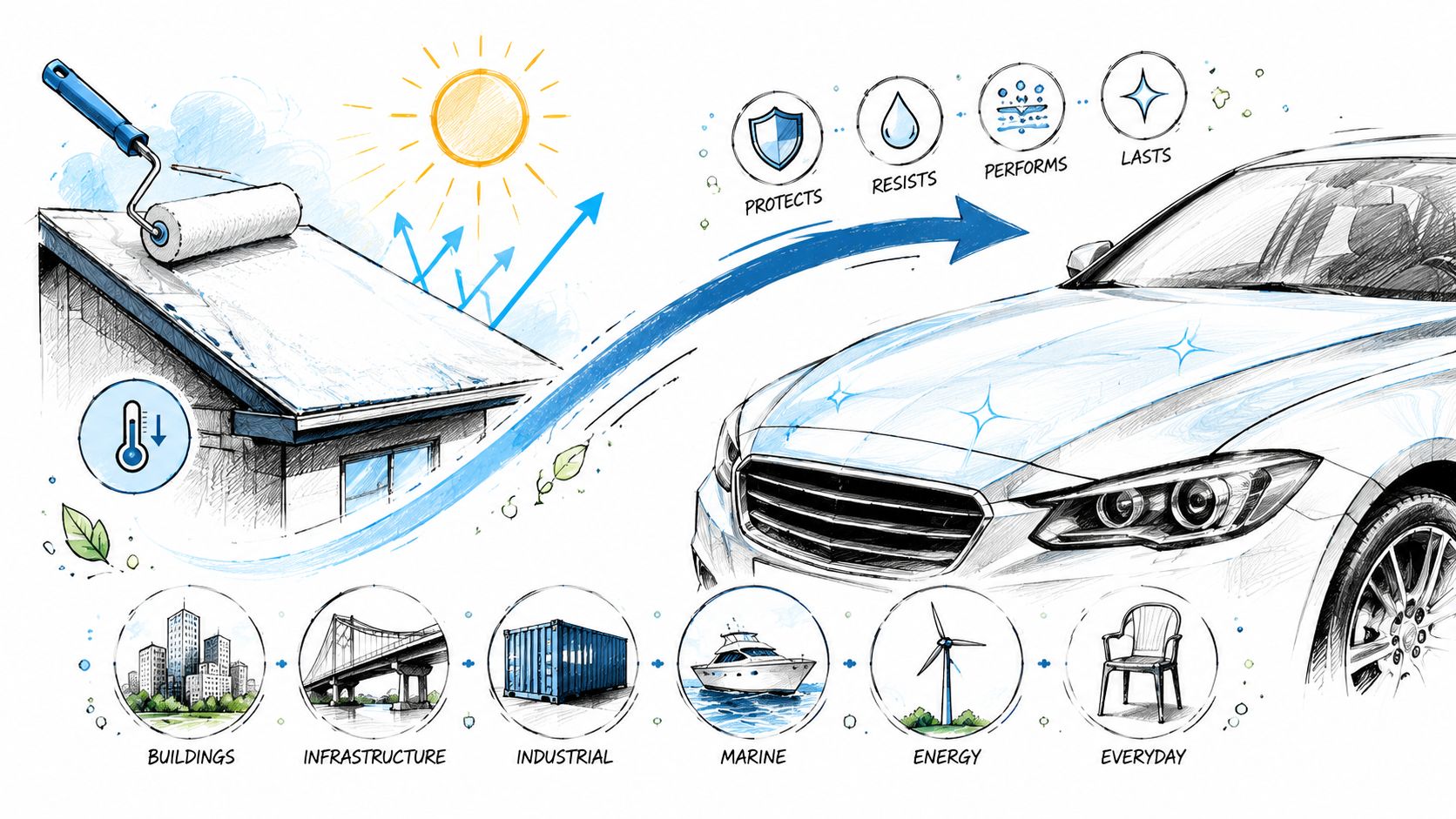
Reflective roof coatings can improve a building’s energy efficiency by up to 30% in warm climates, and one real-world report described a roof surface temperature drop of approximately 15°C after application, with significant cooling-energy reduction, as explained in this review of roof coating reflectivity and energy efficiency.
What worked on buildings
On a building, the logic is elegant.
| Surface need | Building roof answer |
|---|---|
| Lower heat gain | High reflectivity |
| Reduce cooling load | Reflect more solar radiation |
| Broad area coverage | Liquid-applied coating |
| Utility over appearance | White or light finish is acceptable |
For property owners comparing contractors and roof systems, a local reference can help. This visual link to Find trusted South Florida roofing is useful if the conversation starts on the building side before shifting to vehicle protection.

Why a car needs more than a cool roof concept
A car is nothing like a commercial roof once you move past the shared exposure to sun.
A vehicle coating has to maintain gloss on curved panels, tolerate wash chemicals, handle road grit, resist bug impact, survive flex in the substrate, and stay visually clean on a finish people inspect from two feet away. White reflective roof chemistry doesn’t answer that brief.
A house roof can win by being functional. A vehicle coating has to be functional and beautiful at the same time.
That’s where automotive protection split from architectural coating logic. The next generation didn’t just chase reflectivity. It chased controlled hardness, controlled flexibility, adhesion, and resistance to real-world abuse on painted surfaces.
The Elastomer Revolution How Titan Changed the Game
Traditional ceramic thinking solved one problem well. It gave detailers a harder sacrificial layer than waxes or sealants. The weakness was always the same. Hardness without flexibility becomes a liability once the surface starts moving through thermal cycles and impact.
That brittleness issue is where Titan changed the direction of the category. Titan Coatings was the first company to bring Elastomer coatings to the market, using proprietary nano tube technology and Dark Matter tech to solve the fracture problem built into older ceramic concepts, as outlined in Titan’s overview of nano coating for cars.
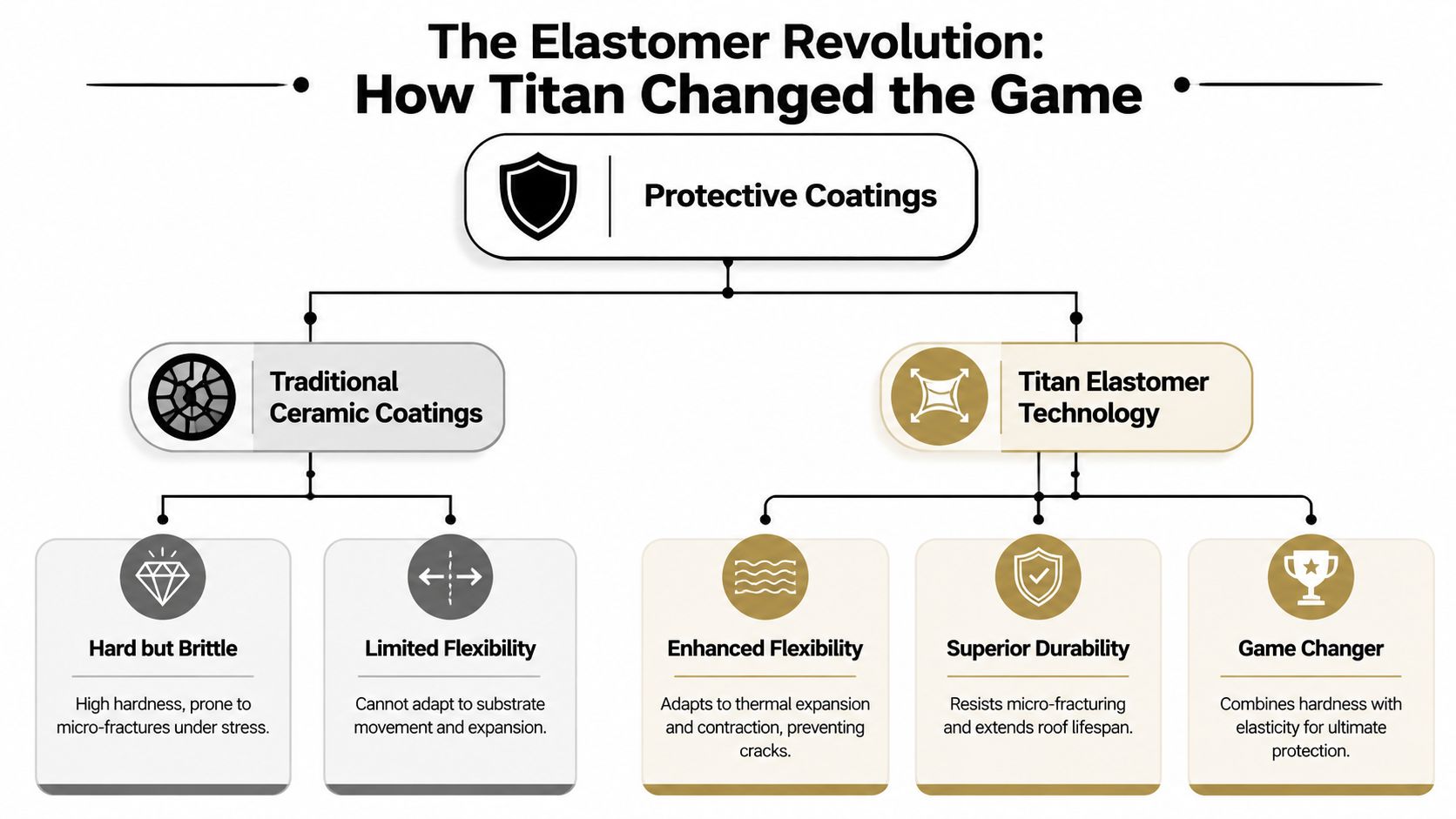
Hard like glass, flexible where it counts
That combination is what detailers had been missing. You want a coating surface that behaves with the crispness clients associate with ceramic protection, but you also need a film that won’t become fragile when temperatures swing from frozen mornings to hot panels in direct sun.
An elastomer coating answers that by moving with the surface instead of fighting it. On a vehicle, that matters everywhere. Roof skin movement, panel vibration, thermal expansion, and even repeated minor impacts all test the coating film.
Here’s the practical difference:
- Traditional brittle coatings can develop stress points when the substrate moves.
- Elastomer-based coatings absorb movement more effectively and reduce the tendency to crack under temperature change.
- Mobile detailers and DIY users benefit because a forgiving coating is easier to live with over time, not just easier to admire after installation.
Why the material science matters
The phrase “nano technology” gets thrown around loosely in detailing. It shouldn’t. Material architecture determines whether the coating stays intact when the environment stops being gentle.
Titan’s broader technology story includes proprietary Dark Matter Technology®. A published company description states that this system uses vertically aligned carbon nanotubes on chlorine-etched aluminum foil to absorb 99.995% of light, with thermal stability and wear-resistance features tied to additional material components, according to Titan’s Dark Matter Technology post on Facebook.
That doesn’t mean every buyer needs to become a chemist. It means the coating discussion has moved past surface buzzwords. There’s real engineering behind why one product becomes brittle and another remains resilient.
The best coating film isn’t the hardest one in isolation. It’s the one that stays intact after heat, cold, vibration, washing, and impact all take their turn.
Why this is a business advantage for detailers
A detailer doesn’t build a reputation on what the car looks like at pickup. The reputation comes from how the coating behaves later.
If the installed film holds up through temperature change without cracking down, the detailer gets fewer callbacks, stronger word of mouth, and better repeat work. That’s one reason elastomer technology matters commercially, not just technically.
For anyone studying the platform in more detail, Titan’s page on elastomer coating technology gives the clearest product-family context.
Your Shield A Guide to Titan’s Protective Technologies
A useful coating lineup works like a toolkit. One product protects painted panels at the highest level. Another improves glass behavior in bad weather. A third gives fast maintenance protection for customers who want speed and convenience. That’s how these technologies make sense in the bay and in the driveway.
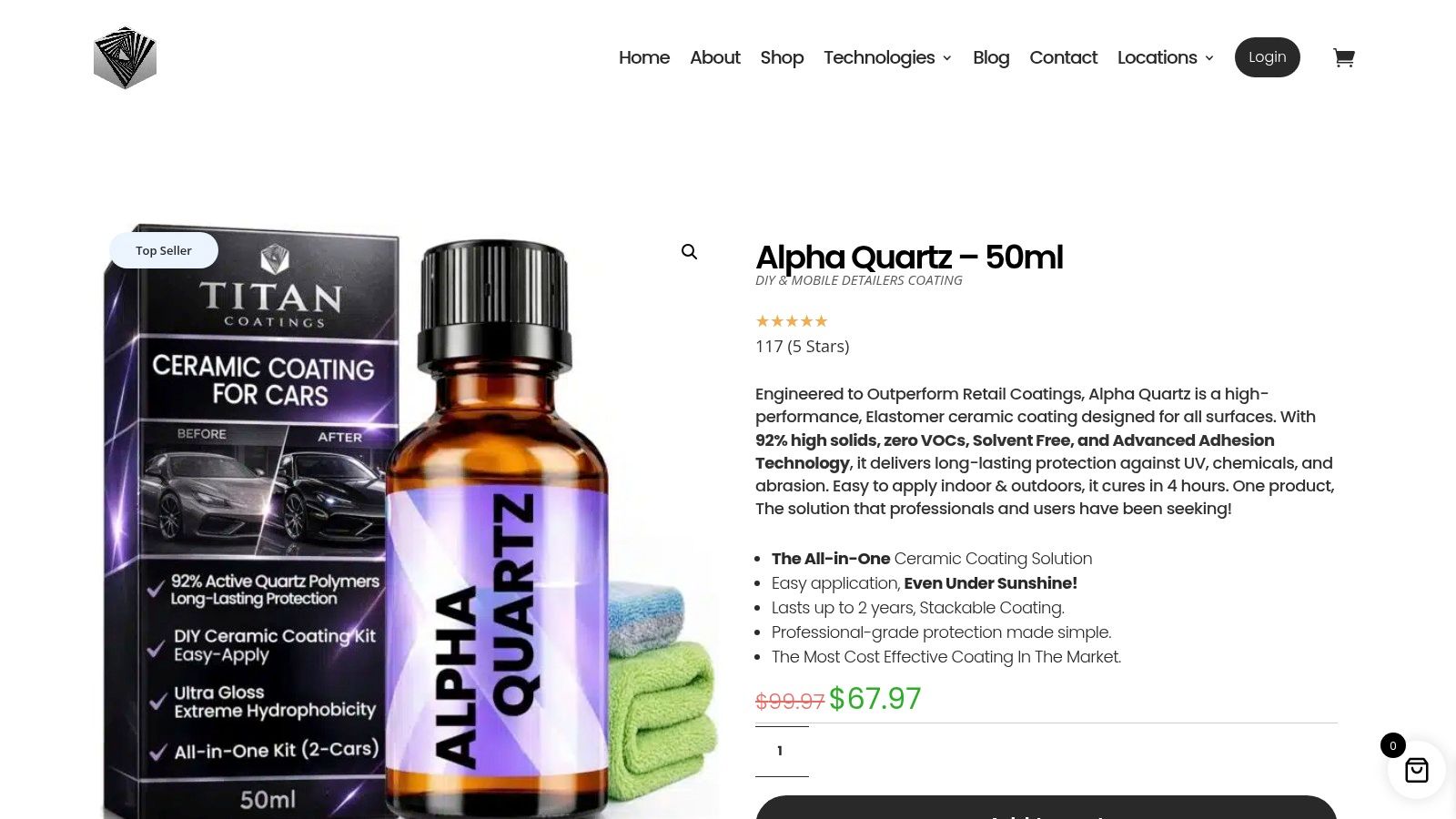
Alpha Quartz for paint and panel durability
If you want the product that best fits the discussion around sun protection roof paint in an automotive context, Alpha Quartz is the obvious place to start. It carries the elastomer logic into a form that works well for pros, mobile detailers, and capable DIY users.
What makes it stand out isn’t just protection on paper. It’s install practicality. A product can have advanced chemistry and still fail in the market if it’s fussy to level, too sensitive to working conditions, or unforgiving for newer installers. Alpha Quartz is easier to install than old-school brittle systems and gives strong visual results with less drama.
That flexibility also matters once the job leaves the shop. Bugs hitting the front end, panel movement, and heat swings from cold to hot conditions all expose the difference between a rigid film and an elastic one.
Apex Glass for visibility in rain
Most coating discussions stop at paint. That leaves one of the most immediate safety upgrades untouched. Apex Glass addresses windshield and glass performance, and the user benefit is easy to understand. Better water behavior on the glass makes driving in rain feel calmer and more controlled.
For detailers, that matters because clients notice it the first time the weather turns bad. They might not have the vocabulary to describe contact angle or surface behavior, but they know when visibility improves and the windshield becomes easier to live with. The Apex Glass ceramic coating is also positioned as easy to use, which makes it a practical add-on service rather than a complicated specialty step.
Ultra Ceramic Spray for speed and maintenance
Then there’s Ultra Ceramic Spray. This type of product matters because not every customer wants a full flagship install every time. Some want something fast, effective, and easy to maintain between major services.
The Ultra Ceramic Spray fits that role well. It’s approachable, quick to work with, and still tied to the broader coating philosophy that values strong real-world results over marketing noise.
How the three fit together
Here’s the cleanest way to think about the lineup:
- Alpha Quartz handles the core painted-surface protection role.
- Apex Glass improves glass clarity behavior and wet-weather confidence.
- Ultra Ceramic Spray supports accessible protection and upkeep.
A complete studio can build packages around that structure. A DIY owner can do the same at a smaller scale.
For readers comparing coatings with other protection categories, this explanation of the benefits of paint protection film is helpful because film and coatings solve different problems and often work best as complementary layers.
One more point matters here. Professional-grade heat-control coatings in adjacent sectors set a high bar. Some expert-level formulations contain up to 46% solid ceramics, are engineered to block 85% of incoming solar heat, and are designed around strict application thickness with a typical 10-year lifespan, as described in this technical product summary for SunShield heat reflective paint. That doesn’t mean a car should be treated like a roof. It means real performance always comes from disciplined formulation and disciplined installation.
For a broader look at finish quality and coating performance standards, Titan’s page on coating excellence adds useful context.
If you want to browse the full product range directly, the Titan Coatings shop is the simplest way to compare options.
Application and Long-Term Care for Lasting Protection
A high-end coating can still underperform if the installer gets casual with prep. Most failures blamed on the product start on the surface. Oils, polishing residue, bonded contamination, and poor process control stop the coating from bonding the way it should.
Start with surface discipline
Before application, the vehicle needs to be washed, decontaminated, and corrected as needed. The goal isn’t just visual cleanliness. The goal is a chemically ready surface.
Use a repeatable process:
- Wash thoroughly to remove loose dirt and traffic film.
- Decontaminate the paint so bonded contamination doesn’t sit under the coating.
- Polish only as needed to refine the finish and remove oxidation or haze.
- Panel wipe carefully so the coating bonds to paint, not leftover oils.
That last step is where many rushed installs go sideways. If the surface isn’t ready, the coating can’t fix that.
Follow the technical sheet, not your mood
In coating work, discipline beats improvisation. On the building side, top-tier reflective coatings can achieve a Solar Reflectance Index of 102–122, and maintaining that performance requires strict compliance with technical data sheets, including the correct primers for specific substrates, because skipping approved primers can void warranties and cause coating detachment, as noted in this technical listing for solar reflective roof coating specifications.
The automotive lesson is identical even though the substrate differs. Read the product instructions. Respect cure windows. Don’t freelance the process.
Good coatings are engineered systems. Treating them like wipe-on cosmetics is how installers create their own failures.
Maintenance decides lifespan
After cure, maintenance becomes the next test. Owners don’t need a complicated ritual, but they do need consistency.
- Use gentle wash methods so you don’t grind contamination into the coated surface.
- Remove bug residue early because organic debris bakes hard on hot front ends and roofs.
- Avoid harsh cleaners unless needed and choose products that won’t leave heavy residue.
- Top up protection when appropriate if the product family includes maintenance support options.
A coated vehicle also deserves inspection, not neglect. If water behavior changes, gloss drops, or contamination starts to cling, correct the issue early. This guide on how to maintain ceramic coating is a solid reference for keeping performance stable over time.
Common Questions on Advanced Sun Protection
Can I use white building roof paint on my car?
No. A building coating is engineered for static roofing substrates, not automotive clear coat, panel movement, road contamination, wash cycles, or appearance standards. Even if the heat discussion sounds similar, the use case is completely different. You’d sacrifice finish quality and likely create adhesion and durability problems.
How is an elastomer coating different from a traditional ceramic coating?
The key difference is flexibility under stress. Traditional ceramic systems built their reputation on hardness, but many detailers have seen the downside of brittle behavior over time. An elastomer coating is designed to stay hard enough to protect while remaining flexible enough to handle expansion, contraction, and daily use without cracking as readily.
How much heat can advanced thermal-blocking coatings actually manage?
The upper end of the category is serious. Advanced formulations have been globally tested to block 92% of visual light heat, 99% of UV heat, and 99.5% of infrared heat, with some blocking up to 96.1% of the total solar heat load and reducing cooling costs by up to 19.2% in warm climates, according to this breakdown of solar thermal reflective coating performance.
That data comes from the architectural side, but it makes one point very clearly. Serious heat management goes far beyond simple bright-white reflection.
Is Alpha Quartz difficult for a beginner to apply?
It’s one of the more approachable ways into advanced coating technology. That matters for DIY users and mobile detailers who need strong results without an unforgiving install experience. As with any coating, prep, panel control, and following instructions still matter. But the user-friendly nature is part of the appeal.
What should a detailer focus on when choosing protection for a client?
Start with the client’s reality. Daily driver or garage queen. Painted-surface priority or all-around package. Rain visibility concerns. Maintenance habits. Budget. A good recommendation isn’t the most expensive one. It’s the one that matches how the vehicle is used and how the owner will care for it.
If you want coating technology built around real-world durability, easier installs, and protection that goes beyond old ceramic limitations, explore APEX NANO – Titan Coatings. Their lineup brings elastomer innovation, glass protection, and practical maintenance options into one system for detailers, mobile pros, and owners who want lasting results.
0 Comments