
A weekend detailer in Phoenix pulled a “100% UV protection” cover off a black coupe in July and found something he didn’t expect, dull clear coat, hot seams, and a cabin that still felt cooked from the inside out. The cover had done one job badly and another not at all, which is exactly why UV resistant car cover is a spec buyers need to interrogate, not just a label to trust.
The Cover That Failed Its Own Job
I’ve seen this happen on client driveways more times than I can count. Someone buys a cover because the packaging says UV resistant, parks outside for a season, and assumes the paint is safe because the car looks shaded. Then the clear coat starts losing gloss, the trim goes chalky, and the owner realizes the cover blocked the sun on paper, not in practice.
Why the label isn’t enough
UV damage on a parked car starts long before the finish looks ruined. The clear coat oxidizes, the color layer fades, and interior vinyl and leather dry out under repeated exposure. A cover that’s loose, thin, or non-breathable can still leave the car vulnerable, and in some cases a bad cover is worse than no cover because it traps heat and moisture against the surface.
That’s why shade and garage parking still beat a weak cover. If you’ve got a car parked under a roof line, a tree that doesn’t drip sap, or a real garage, those options can be safer than a bargain shell that acts like a humid blanket. The smarter question isn’t “is it UV resistant,” it’s “how much UV does it block, how is it built, and can it breathe?”
Practical rule: a cover earns its keep only when it blocks UV, sheds heat, and lets moisture escape without rubbing the finish.
That’s the same reason I send clients to Titan’s guide on protecting paint from sun damage when they’re comparing parking habits and protection layers. The best buyers stop thinking in slogans and start thinking in proof.
The Real Damage UV Does to a Parked Car
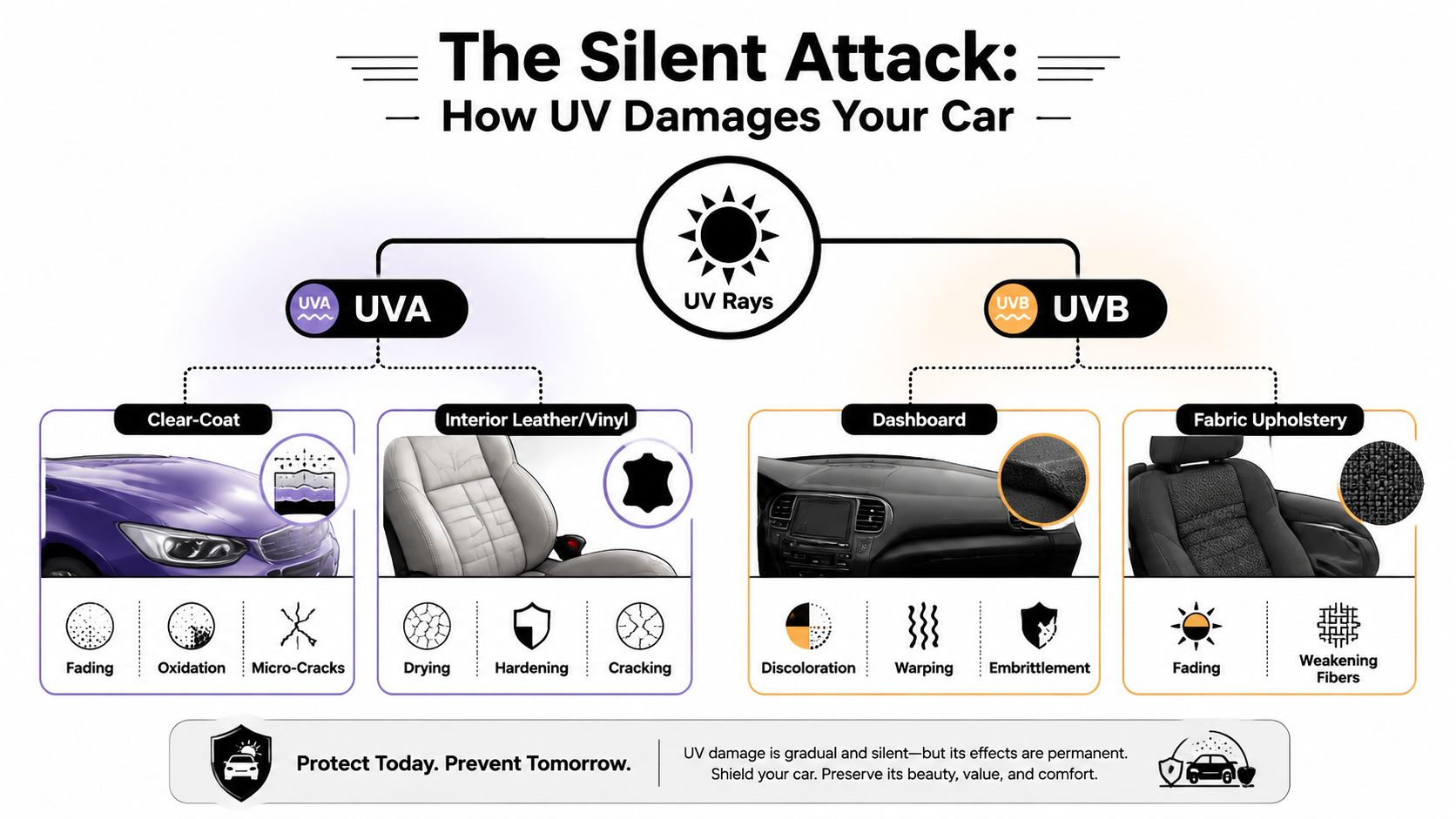
The damage starts in the surface, then spreads inward
UVA and UVB do different jobs, but they wear the car down in the same order. Clear coat takes the first hit, so oxidation shows up as dullness and chalking before a panel looks burned or faded. Once that outer layer weakens, the color layer loses depth and the surface starts to fatigue.
The cabin tells the same story in slower motion. Dashboard plastics discolor and turn brittle, rubber seals lose flexibility, and leather or vinyl dries out and cracks under repeated exposure. For a plain-English comparison of how UV protection is measured on glazing and film, UV window benefits explained connects the idea of blocking radiation to everyday vehicle use.
The two numbers that matter to buyers
The first number is UPF, the easiest way to compare how much ultraviolet energy a fabric stops. A 2026 outdoor-cover guide treats UPF 50+ as the minimum practical baseline, and says top performers can reach the equivalent of 2,000 hours in UV exposure testing when the benchmark floor is 1,000 hours (best outdoor car covers guide). It also says 99%+ UV-blocking designs are the key feature for harsh-summer use, and that UPF 50+ blocks 98% of harmful rays (best outdoor car covers guide).
The second number is UV-blocking percentage, which is easier to compare when a seller gives a clear spec. A cover with a higher blocking percentage is not automatically better if it traps heat or moisture, but it does give you a real benchmark instead of a marketing adjective. I’d rather see a plain, measurable number than a glossy promise every time.
UV protection is necessary, but it isn’t sufficient on its own. Heat and humidity still decide whether the cover helps or hurts.
A parked car still needs a real protective layer, not just a label that sounds reassuring. If you want a practical baseline for what sun exposure does to paint and trim before you compare cover materials, how to protect car paint from sun damage lays out the trade-offs clearly.
The Five Materials for Blocking UV
The materials that hold up, and the ones that only sound good
A lot of outdoor covers look similar from ten feet away. The difference shows up in the material stack, and that stack decides whether the cover survives a summer of real sun or starts failing after a few months.
| Material | UV Blocking | Breathability (g/m²/24h) | Cold Flex | Typical Lifespan |
|---|---|---|---|---|
| Woven polyester | Modest unless heavily treated | 1,200–1,800 (material guide) | Good when light, can stiffen when coated | Short to moderate |
| Solution-dyed acrylic | Strong natural UV stability | Varies by weave and finish | Usually good | Long |
| Multi-layer non-woven | Very strong when UV-stabilized | Varies by build | Good if engineered well | Long |
| Tyvek-style HDPE | Strong, with verified cover use | Varies by product design | Good | Moderate to long |
| PE/PVC coated covers | Can block well, but often at the cost of airflow | Lower vapor transmission in many builds | Coated 600D can get stiff below 10°C (material guide) | Moderate |
What the specs say in real life
The covers that hold up longest usually do more than rely on fabric weight. Kimberly-Clark’s BLOCK-IT Evolution uses a four-layer construction with two microfiber layers plus a two-part UV protection system, and the technical sheet reports a UPF rating of 180 and up to 99% blockage of harmful sun rays over the life of the cover (Kimberly-Clark specifications). That is the kind of detail worth asking for, because it shows the UV performance comes from structure and chemistry, not a vague coating claim.
DuPont’s vehicle-cover data gives another practical reference point. It says Tyvek vehicle covers can stop up to 95% of UV rays (DuPont protective covers). That matters because UV exposure drives clear-coat oxidation and interior wear, but only if the cover stays intact and still lets trapped heat and moisture move out instead of sitting against the paint.
The short version I give clients
Layering and UV-stabilized chemistry beat raw fabric weight almost every time. A heavier single layer can still underperform a lighter multi-layer build if the latter handles sunlight, heat, and moisture more intelligently. For a useful contrast, this polycarbonate UV guide shows how UV-blocking logic changes when the goal is long-term surface preservation instead of simple shading.
Breathability Is the Half of UV Protection Nobody Talks About
A cover that traps heat can damage paint
A cover that looks protective on the outside can still cook the finish underneath if it seals in hot, wet air after a car sits in full sun. That is the part a lot of buyer guides gloss over. They focus on reflection, then ignore what happens when the trapped air has nowhere to go. On dark cars, that stale heat can sit against the clear coat, and the moisture can linger long enough to leave behind paint problems, mildew, and the kind of smell that tells you the cover did its job badly.
That warning is practical, not theoretical. Guidance on best car cover for sun and UV protection points out that non-breathable or tarp-like covers can do more harm than leaving a car uncovered, because they trap hot, humid air instead of letting it escape. If you have ever pulled a cover off and felt damp heat rush out, you already know why breathability matters.
Reading the material numbers correctly
The spec sheet only helps if you read the right line. Compare protection against vapor movement, not just fabric thickness or how tough the outer shell feels in your hands. A practical material guide notes that woven 300D polyester is often listed at 1,200–1,800 g/m²/24h breathability, while coated 600D polyester can bring higher water resistance but lower vapor transmission, and it may stiffen below 10°C. That trade-off matters because a cover that handles rain well on paper can still be a poor summer choice if it cannot vent trapped moisture.
The cleanest rule is simple.
In hot and humid climates, prioritize layered, breathable, microporous construction over pure water resistance.
That also explains why a summer-focused cover should be judged differently from a rain cover. One harsh summer cover guide says a cover built for harsh summers is meant to handle UV and heat, not rain, and stresses a UV-blocking outer layer, breathable construction, a lighter reflective tone, and a semi-custom fit. The moisture side of the equation matters just as much, because trapped humidity can move from an annoying odor issue into a real storage problem, as outlined in this note on interior mold risk.
How to Evaluate a UV Resistant Car Cover Before You Buy
The checklist I’d use before spending money
Start with what can be verified. If a seller cannot show UPF 50+ or a comparable UV-blocking rating, I move on. I look for testing language that names exposure limits and test conditions, because vague “weatherproof” copy does not tell you much about real sun resistance. A useful buying rule is to treat higher UV testing claims as a sign of better material control, not as a promise that the cover solves every outdoor problem.
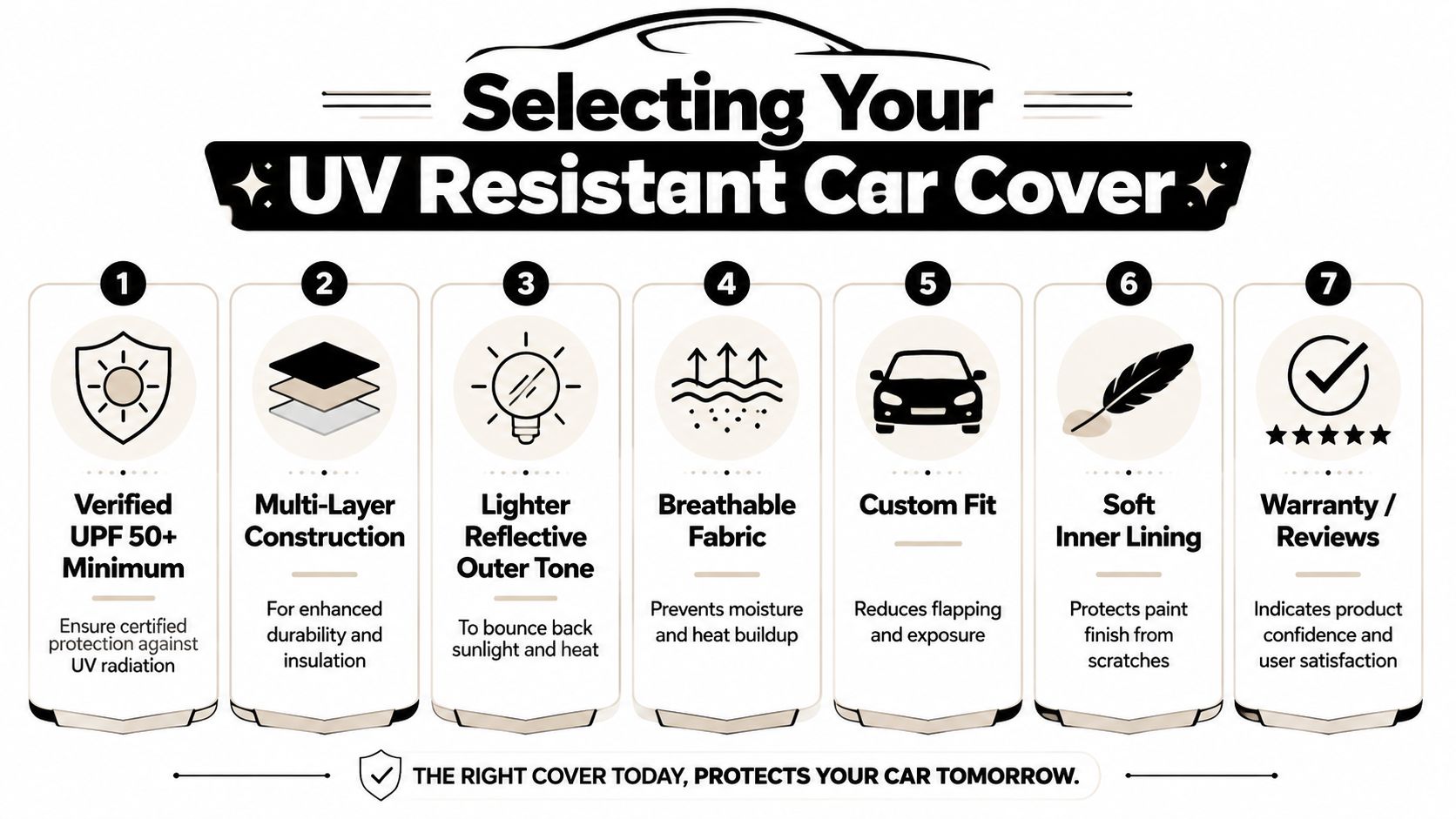
What to look for on the product page
- Verified UPF 50+ Minimum: Use this as the floor, not the finish line.
- Multi-layer Construction: Look for a real stack, not a single shell dressed up with marketing copy.
- Lighter Reflective Outer Tone: A reflective outer surface helps bounce back sunlight and heat.
- Breathable Fabric: This keeps moisture from sitting against the paint.
- Custom or Semi-custom Fit: A loose cover flaps, rubs, and creates exposed pockets.
- Soft Inner Lining: Paint safety depends on what touches the finish.
- Warranty and Reviews: If the seller will not name UV in the warranty, that tells you something.
For a second outside reference point on buying behavior, Motor Sportsland cover recommendations are a useful reminder that fit and material usually matter more than the loudest claim. The same mindset applies here. A cover that looks impressive in a listing can still trap heat, scratch trim, or sag badly once it sits in real driveway sun.
What I skip immediately
Bare polyester shells, no listed UPF, and anything described as “UV-proof” without test data go straight to the bottom of the list. I also skip marketing that says “blocks everything” but never explains the fabric, the seams, or the breathability. If the seller cannot back up the number with a sheet, the number does not mean much. That is especially true for a UV resistant car cover, where surface reflection alone does not tell you how the cover handles trapped heat and moisture under long exposure.
For anyone comparing paint protection strategies more broadly, this UV protection guide for car paint is a good companion read. It is worth comparing a cover against coating-based protection as well, because a well-applied elastomer coating can sometimes outlast a cheap cover in daily use, even if the cover still wins when the car sits parked for long stretches.
UV Resistant Covers vs Ceramic and Elastomer Coatings
Covers and coatings solve different problems
A quality cover blocks sunlight at the parking spot. A coating protects the surface when the car is driven, washed, and exposed without a cover. Those jobs overlap in theme, but not in practice, which is why the smartest setup isn’t either-or.
3M’s FX ST automotive window film blocks 99% of UV radiation and rejects up to 46% of total solar energy (3M technical data sheet). That’s a useful benchmark because it shows what engineered layers can do when UV rejection is built into the material itself.
Where Titan fits into a real-world stack
For paint, Alpha Quartz uses Titan’s elastomer approach with nano-tube technology and Dark Matter tech, and it’s presented as easy to install for DIY users and mobile detailers. For glass, APEX Glass Ceramic Coatings are aimed at visibility and easier rain driving on windshields, which matters when the car is uncovered or in motion. Ultra Ceramic Spray is the quick-maintenance option for paint, PPF, glass, and trim, and it fits well as a periodic topper in a mixed protection plan.
The main difference is simple. A cover stops UV and heat when the car is parked, while a coating keeps working when the car is being used and washed. If a vehicle lives outdoors, the strongest setup is usually both, because the cover handles storage and the coating handles the moments the cover can’t.
Maintenance, Warning Signs and the Right Way to Combine Both
Keep the cover honest
Wash the cover monthly with mild soap, and don’t use bleach or harsh detergents. Dry it fully before storage, because a damp cover becomes a mildew problem fast, and inspect the inner lining for wear before you trust it against fresh paint again. If the inner UV-blocking layer cracks, delaminates, or starts tearing at the seams, replace the cover instead of hoping it’ll last one more summer.
A good maintenance habit also means watching the car itself. Fading, brittleness, and torn seams are early failure signals, not cosmetic annoyances. If you want a practical maintenance companion for coated vehicles, this ceramic coating care guide helps keep the rest of the protection stack in good shape.
The combination that makes sense
- Garage-parked daily driver: A light cover or none at all, plus APEX Glass on the windshield and Alpha Quartz on exposed surfaces.
- Outdoor weekend car: A breathable UV resistant car cover, Alpha Quartz on paint, and Ultra Ceramic Spray on trim and glass.
- Mobile detailer fleet: Coatings first, cover only for storage or transport, because daily usability matters.
- Sunny-coast family SUV: A breathable cover for long parking periods, APEX Glass for wet-weather visibility, and Alpha Quartz for exterior durability.
One last note from the paint bay, a cover is not a replacement for surface protection, and a coating won’t stop a parked car from baking in direct sun. They work best when each one is assigned the job it does well.
If you want a protection plan that makes sense in real heat, real parking lots, and real driveway use, APEX NANO – Titan Coatings can help you build that stack with coatings for paint, glass, and trim that work alongside a quality cover. Visit APEX NANO – Titan Coatings to compare the coating options that fit your car, your climate, and the way you park.
0 Comments