
You know the moment. The car is washed, polished, the paint looks deep enough to swim in, and then the light catches it. One scratch. One fresh swirl. One bug stain that etched a little harder than you expected.
If you care about paint, that moment gets under your skin because you know what usually comes next. More washing. More correcting. More protection steps that look good for a while, then fade, thin out, or fail right where the car lives hardest. On the hood, the front bumper, the mirrors, the glass.
That's why so many detailers and car owners ask the same question in different ways. What is surface coating, really? Is it just a fancy word for wax? Is it a harder version of a sealant? Is it a permanent shell? Or is it something more like a purpose-built membrane engineered to take abuse before the surface underneath does?
The short answer is this. A surface coating is an added functional layer that changes how the surface behaves without changing the core material itself. In practice, that means better resistance to water, chemicals, wear, and environmental fallout. In the automotive world, it also means less panic every time the weather turns, the bugs hit, or the wash mitt comes out.
The Agony of the First Scratch and the Promise of Protection
A client once brought in a black SUV he had owned for only a few weeks. He didn't come in because the paint was ruined. He came in because it was starting. A few wash marks on the doors. Light marring on the piano black trim. A faint etch on the hood from a bird dropping that sat too long in the sun.
That's how it usually starts. Not with catastrophic damage. With tiny insults that add up until the finish no longer looks fresh, even though the vehicle is still new.
For years, the answer was simple. Polish it. Wax it. Baby it. Repeat. That routine can still make a car look beautiful, but it also puts you on a treadmill. Protection becomes a temporary event instead of a durable system.
Why people started looking beyond wax
Surface coating is old technology in the broad industrial sense. Humans have used paint as a decorative or protective coating for more than 30,000 years, and coating methods accelerated in modern manufacturing during the 20th century, as described in this history of the coatings industry. That long history matters because it shows a clear shift from simple coverage to engineered performance.
By the time automotive coatings became central to styling and protection, the industry had already learned something detailers know by instinct. The surface takes the beating first. If you can control what happens at the surface, you control how long the finish keeps its look.
Practical rule: Protection works best when it becomes the sacrificial layer. You want the coating to deal with the environment so the paint doesn't have to.
That's the promise people are really buying when they invest in a coating. Not magic. Not invincibility. A controllable layer that stands between your vehicle and everything trying to age it.
Beyond Wax What Is a Surface Coating Really
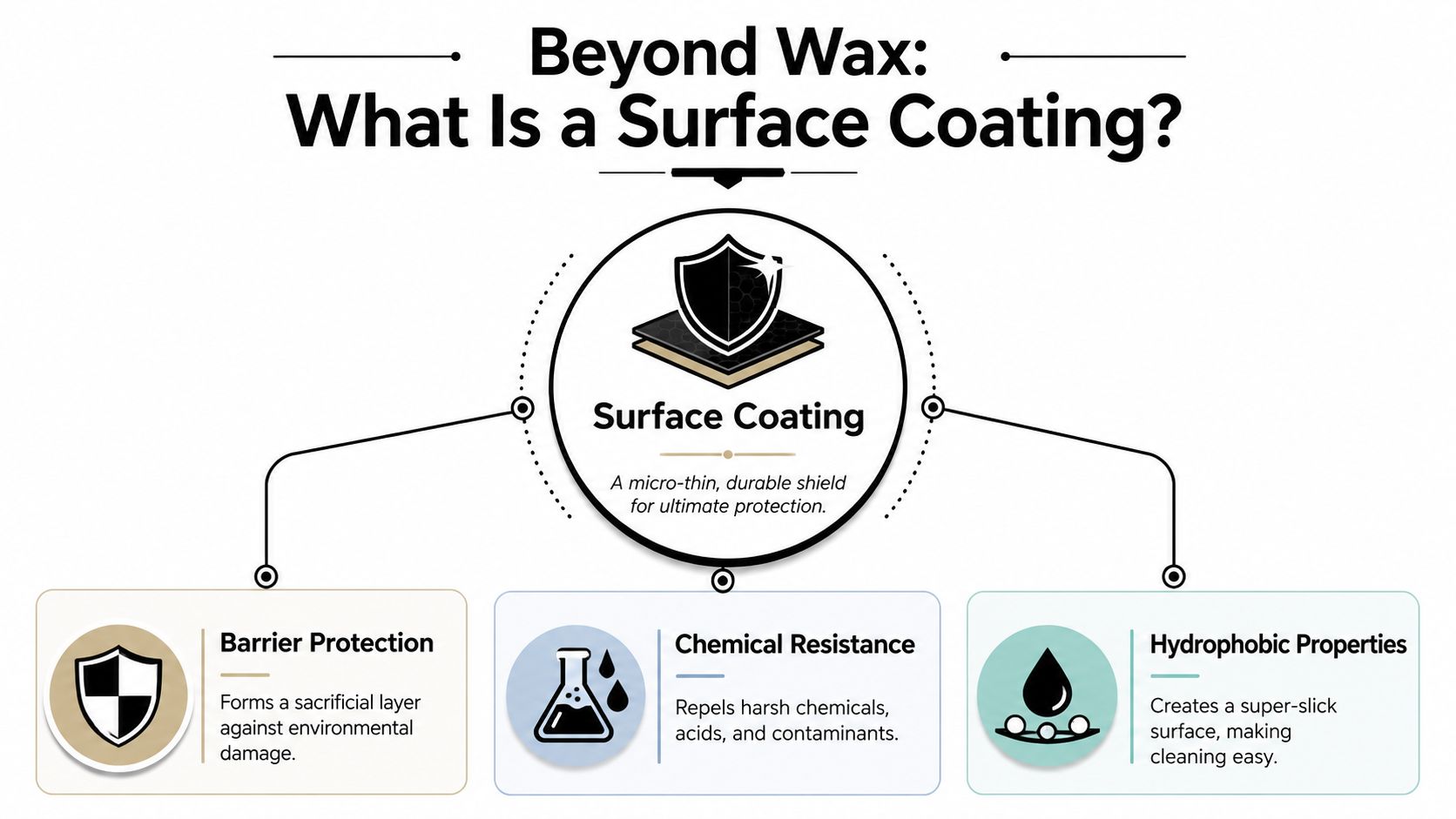
The easiest way to understand a surface coating is to stop thinking about shine first and think about function first. A coating is a thin added layer that dries or cures into a film over the surface. It's not the paint. It sits on top of the paint and changes how that surface responds to water, chemicals, light abrasion, and contamination.
It acts as a high-tech second skin. The skin doesn't replace the body underneath. It shields it.
What a coating is made of
At the chemistry level, a coating is built from a few basic parts:
- Film-forming matrix made from resins such as acrylics, polyesters, or epoxies
- Solvents that help with application viscosity
- Pigments when color or opacity matters
- Additives that tune performance, such as UV stability or corrosion resistance
That combination matters because the finished film acts as a diffusion barrier. It slows oxygen and moisture from reaching the substrate, which is one of the key ways coatings help prevent electrochemical corrosion on metal surfaces. In harsher environments, standards such as ISO 12944 even define corrosion categories and dry film thickness needs, including 160 to 240 µm for C5 marine environments, based on the verified chemistry principles provided in your brief.
Coating versus treatment
Many people find this distinction confusing. A surface coating adds a layer. A surface treatment changes the surface itself.
That difference is explained clearly by GGB's overview of surface coatings and treatments. If you apply a coating to paint, you're adding a functional film on top. If you anodize aluminum or chemically modify a surface, you're changing the surface structure or chemistry of the base material itself.
Here's the simplest way to separate them:
| Term | What happens | Easy example |
|---|---|---|
| Surface coating | A new layer is applied over the surface | Wax, sealant, ceramic, glass coating |
| Surface treatment | The original surface is modified | Anodizing, conversion coating, activation process |
A good coating doesn't need to become the substrate. It needs to bond to it, stay stable, and take the abuse the substrate would otherwise absorb.
That's why asking “what is surface coating” is really asking a deeper question. Are you adding a layer for protection, or are you changing the material itself? In detailing, most of the time, you're adding a layer.
The Quest for the Perfect Shine From Wax to Brittle Glass
Automotive protection has always moved in steps. Each step solved one problem and exposed another.
Wax gave people warmth, glow, and that just-detailed look. It also asked for frequent reapplication and didn't hold up well against daily chemical and environmental abuse. Synthetic sealants improved durability and consistency, but many users still felt they gave a sharper, less organic look than a favorite carnauba finish.
Then ceramic coatings took over the conversation.
Why ceramic changed expectations
Ceramic-style protection raised the bar because it pushed buyers to think beyond gloss. Hardness mattered. Chemical resistance mattered. Surface behavior mattered. Suddenly people expected protection to survive rain, soap, heat, fallout, and long maintenance intervals.
That leap makes sense when you look at the broader evolution of coatings. Coating science has moved steadily away from “cover it so it looks better” and toward “engineer it so it performs better.” That's the same logic that drove industrial coating advances in automotive and manufacturing long before detailing adopted the language.
The limitation most people learn late
Traditional hard ceramic systems have a weakness that often gets buried under marketing language. Hard isn't the same as adaptable.
If a coating behaves like a very rigid shell, it may resist certain kinds of abrasion well, but rigidity can also create stress points. Panels heat up and cool down. Plastic and metal expand at different rates. Front-end surfaces take bug impacts, wash contact, grit, and road shock. A brittle film can look tough on paper and still be vulnerable in real use if it can't flex with the surface.
That doesn't make ceramic chemistry useless. Far from it. It means hardness by itself isn't the whole story.
Here's the simple analogy I use with detailers. A thin glass screen protector feels hard. A flexible protector may absorb stress better. On a vehicle, that tradeoff matters because the car doesn't live in a lab. It lives through heat, cold, vibration, impact, and repeated cleaning.
The Elastomer Revolution Hard Like Glass Flexible Like Rubber
A key step forward in surface protection came when formulators stopped chasing hardness alone and started asking a better question: can the coating stay protective after the panel bends, heats, cools, vibrates, and takes light impact?
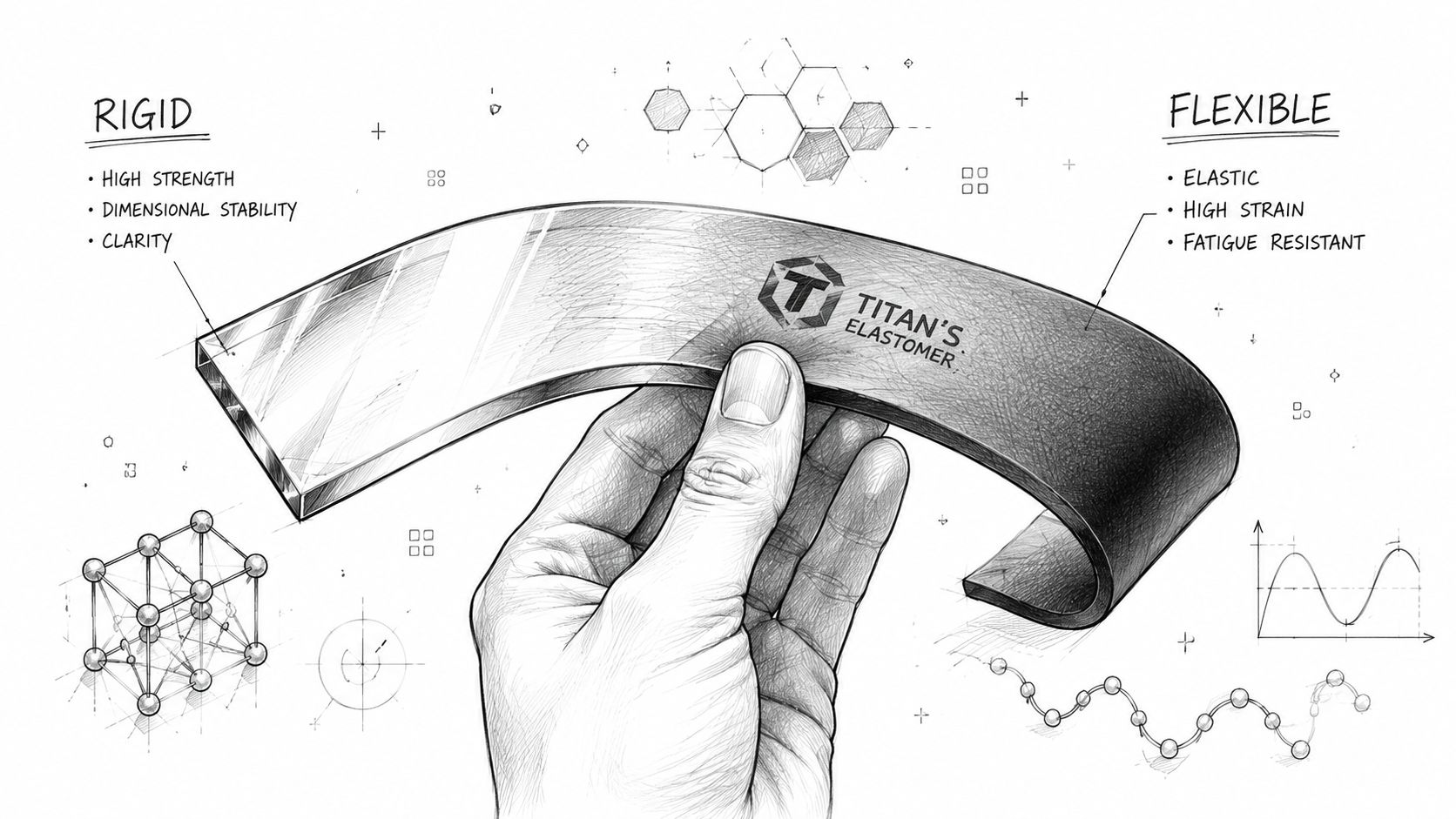
That question led to elastomer-based coatings. An elastomer film is built to keep the dense, slick, chemically resistant surface detailers want, while adding controlled flexibility so the coating can move with the substrate instead of fighting it.
Why flexibility changes the outcome
A painted panel is never at rest. It expands in heat, tightens in cold, flexes from vibration, and gets tapped by wash media, road grit, and insect impact. If the coating behaves like a thin sheet of glass, those repeated stresses can create microfractures or weak points over time.
That is the limitation of many traditional ceramic coatings. They can be very hard, but hardness alone does not guarantee durability in daily driving conditions.
A good analogy is safety glass versus a rigid cracker. Both may feel firm in your hand. One absorbs stress and stays together better. The other snaps once the strain passes its limit. Coatings face the same kind of tradeoff at a microscopic level.
That is why elastomer technology matters. It aims to give you a surface that still resists chemicals, washing, and contamination, while lowering the chance of stress-related cracking when the panel underneath moves.
How formulators build that balance
In coating chemistry, flexibility does not mean soft in the sloppy sense. It means the polymer network has enough mobility to deform slightly under stress and then recover, instead of fracturing. You still want crosslinking, because crosslinking is what helps the film hold together, resist solvents, and stay bonded. The trick is choosing a resin structure that does not turn the whole coating into a brittle shell.
Newer hybrid systems diverge from older hard-film thinking. Formulators can combine inorganic components that add surface hardness with elastomeric polymers that absorb strain. The result is closer to a suspension bridge cable wrapped in armor than to a glass plate glued to paint.
For a detailer, that difference shows up in service life. A coating that remains intact keeps doing its job. A coating with tiny fractures may still look glossy at first, but its barrier performance starts to weaken once contaminants and moisture find entry points.
Why nanotechnology helps
Nanoparticles such as silica, alumina, and carbon-based additives are used because they can reinforce the film without forcing the whole coating to become overly rigid. In plain terms, they work like well-dispersed mineral reinforcement inside a flexible matrix.
They also make it harder for water, salts, and chemicals to travel through the coating. Coatings scientists often call that a tortuous path. The contaminant has to weave around obstacles instead of moving straight through the film.
Used correctly, that approach improves scratch resistance, helps the coating hold its shape under heat, and supports long-term barrier performance. Used poorly, it can create dispersion problems and inconsistent curing. The chemistry still has to be balanced.
What this means in practice
For a DIY user or mobile detailer, Alpha Quartz fits this discussion because it is positioned as an elastomer coating, not just another hard shell. The point is practical. Protection on a vehicle has to survive temperature swings, panel movement, wash contact, and minor surface impacts without giving up the barrier.
That same design direction appears across the APEX NANO – Titan Coatings lineup. The emphasis is on films that stay bonded and functional under use, not coatings that only sound impressive on a hardness chart.
If a coating can stay intact while the surface underneath keeps living a normal automotive life, that is where flexible protection earns its place.
Specialized Armor for Every Surface
Paint gets most of the attention, but it isn't the only surface that makes daily driving harder when it's unprotected. Glass is the perfect example. You don't notice how stressful a weak windshield surface is until rain, road film, and wiper chatter start working together.
A lot of drivers think of glass protection as a nice extra. It's not. It changes visibility, cleaning effort, and how calm you feel when the weather turns ugly.
The windshield story every driver knows
You're on the highway, the rain picks up, spray comes off the trucks ahead, and your wipers are doing their best but still leaving a smeared film in your line of sight. That's not just annoying. It's fatiguing.
A glass coating changes that experience by making it harder for water and grime to anchor to the surface. The practical benefit isn't abstract. Water beads and sheds more easily. Bug cleanup gets easier. Winter grime has less grip. The windshield becomes easier to keep clear.
For drivers focused on that kind of use case, Apex Glass Ceramic Coating is directly relevant because it's made for glass and windshield application rather than paint alone. That matters because different surfaces ask for different behavior, even when the guiding principle is the same.
One protection system, different jobs
A good detailer thinks in zones, not just products. Here's how surface needs differ across the car:
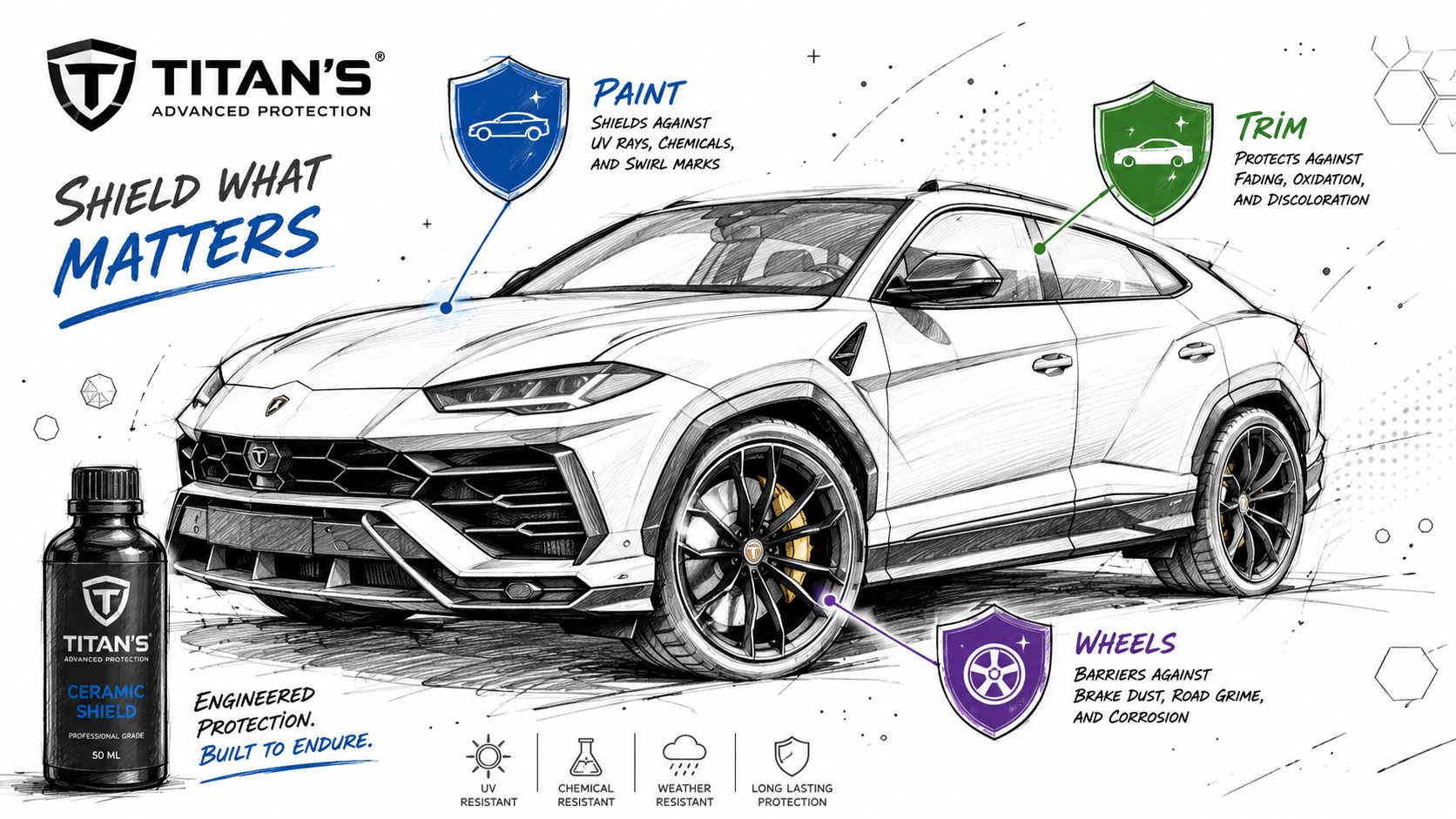
- Paint and trim need resistance to contamination, wash wear, and weathering.
- Glass needs clarity, easy cleaning, and water-shedding behavior.
- Maintenance layers need speed and convenience when the customer wants a refresh between major correction or coating work.
That last category is where a spray product can make sense. Ultra Ceramic Spray works as a simpler option for users who want easier application and visible hydrophobic behavior without committing to a more involved install. It can also fit maintenance routines where speed matters.
Why property tradeoffs matter
The chemistry behind all this isn't just about adding “more protection.” Coatings are polymer-based composite systems, and their adhesion, flexibility, gloss, chemical resistance, and durability depend on the matrix and additives used. As Britannica's explanation of surface coating notes, one of the underserved parts of coatings education is understanding performance tradeoffs and sustainability pressure, including low-VOC and longer-life demands.
That's useful to remember when comparing products. A coating can be glossy but not flexible enough. It can be hard but difficult to live with. It can bead water beautifully and still not be the right answer for every surface on the vehicle.
How to Measure a Coating's True Strength
Marketing loves a single headline metric. Real performance doesn't live in a single metric.
If you want to judge a coating intelligently, ask what it does under abrasion, under chemical exposure, under temperature swings, and under daily maintenance. A serious coating should improve surface hardness, wear resistance, corrosion resistance, and wettability, which is why coatings are so widely used in manufacturing and tribology, as described in this history and overview of powder coating.
The numbers people talk about
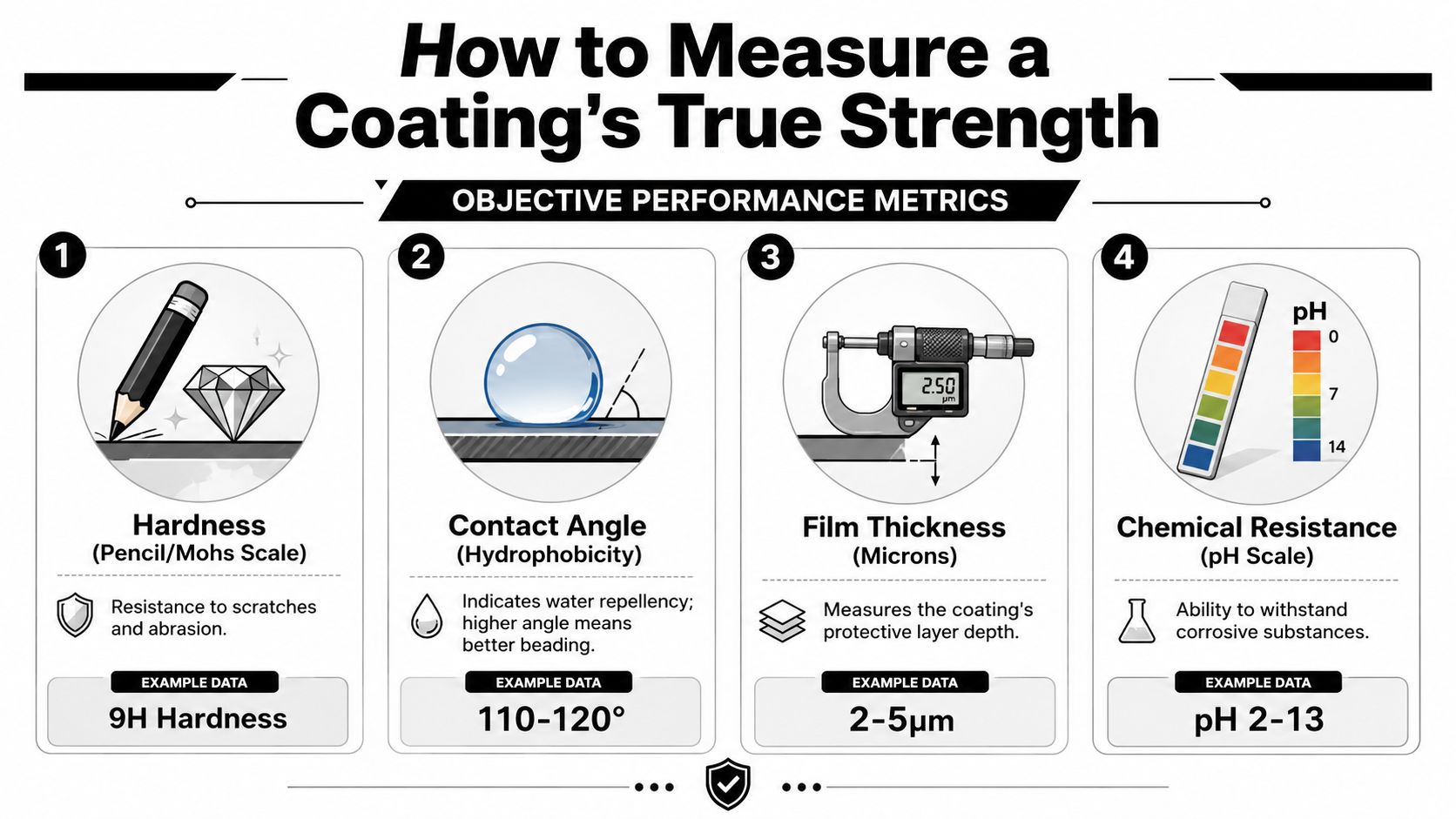
A few measurements show up repeatedly in detailing:
| Metric | What it tells you | What it means on the car |
|---|---|---|
| Hardness | Resistance to certain kinds of scratching or abrasion | How well the surface resists light marring |
| Contact angle | How strongly water beads | How easily water rolls and dirt releases |
| Film thickness | Depth of the protective layer | How much material is actually sitting on the surface |
| Chemical resistance | Tolerance to acidic or alkaline contamination | How the coating handles fallout, bird droppings, and cleaners |
These tests are useful, but they're incomplete if you stop there.
The metrics that matter in the real world
A daily-driven vehicle doesn't fail protection because the owner read the wrong spec sheet. It fails because the coating faced stress the brochure didn't talk about.
Look harder at these questions:
- Flexibility: Can the film move with the substrate, or does it become vulnerable when the panel expands and contracts?
- Impact tolerance: How does it behave when bugs, grit, or wash contact hit the surface repeatedly?
- Barrier stability: Does the protective layer stay continuous, or does it open weak paths for moisture and contaminants?
What to ask before you buy: Don't just ask how hard the coating gets. Ask how it behaves after heat, cold, washing, and impact.
That's where a lot of detailers start seeing why two coatings that sound similar in sales language can behave very differently on customer cars.
Debunking Common Surface Coating Myths
The coating world has no shortage of dramatic claims. Most of them get weaker the moment you ask how the chemistry works.
Myth one that needs to die
“A coating makes your car scratch-proof.”
No coating should be described that way. A coating can improve resistance to wear and light abrasion, but it's still a film sitting on a vehicle that operates in typical conditions. Wash damage, bad towels, grit, and impact can still mark the surface. The goal is resistance and easier maintenance, not immunity.
Myth two that sounds attractive but fails in practice
“Once coated, the car needs no maintenance.”
Also false. A coating helps because it creates a functional barrier. In general coating chemistry, that barrier comes from the film-forming matrix plus additives that help limit oxygen and moisture ingress, which is one of the core ways coatings help prevent corrosion. But even a strong barrier performs better when you wash correctly and avoid contaminating or abrading it unnecessarily.
Myth three that confuses buyers most
“All ceramic coatings are basically the same.”
They're not. Formulation choices matter. Resin system, solids, additives, curing behavior, and whether the film is tuned toward rigidity or flexibility all change how a coating behaves.
One straightforward way to approach this is:
- Some coatings prioritize hardness and present as rigid shells.
- Others focus on balance between hardness, slickness, and maintainability.
- Newer elastomer-style approaches try to solve the brittleness problem by keeping protective strength while allowing more flex in use.
The right question isn't “Is it ceramic?” The right question is “What kind of film does it build, and how does that film behave on a real vehicle?”
That's a much better filter than brand hype.
Your Questions About Advanced Coatings Answered
Can I install Alpha Quartz myself
Yes, if you already have disciplined wash and prep habits. The coating step is usually not what trips people up. The paint correction, panel wipe, lighting, and leveling are where the result is won or lost.
A DIY-friendly coating helps because it gives you a wider working window and a more forgiving wipe-off. That matters in the field, especially for mobile detailers who are dealing with temperature swings, humidity, and less-than-perfect shop conditions. Good chemistry should perform outside the lab, not only on a spec sheet.
How do I maintain a coated vehicle
Use the same mindset you use with polished paint. Fewer wash-induced defects, less contamination left sitting, and less abuse from dirty towels.
Wash with clean media. Dry with fresh towels. Remove bug splatter, bird droppings, and mineral-heavy water spots before they sit long enough to bite into the film. A coating reduces how strongly grime sticks, but it still needs sane care if you want the surface to keep its gloss and water behavior.
Can I use a spray coating over a more durable base coating
Usually, yes.
A spray product works like a sacrificial top layer. It refreshes slickness and hydrophobics, and it takes some of the routine wear so the base coating does not have to absorb every wash cycle directly. That pairing makes sense if you want the durability of a cured base layer with easier upkeep between major services.
Is glass coating actually worth it
For a daily driver, often yes. The benefit is not limited to looks. Water clears faster, bug residue releases more easily, and winter film is less stubborn during cleanup.
That said, windshield performance depends on wiper condition and proper prep. A poor install on glass will show up fast.
What should I look for when comparing coatings
Start with film behavior, not headline hardness.
A very rigid ceramic film can deliver shine and chemical resistance, but rigidity has a tradeoff. On real vehicles, panels flex, temperatures swing, and surfaces take light impacts from road debris and wash contact. If the film is too brittle, that glass-like character can become a weakness. Micro-cracking, chipping, or premature failure can start there.
That is why newer elastomer-modified coatings matter. They aim to keep the clean, dense protection people like from ceramics while adding some give to the film, more like a tough clear shield than a thin shell of glass. If you care about how a coating survives actual use, ask how it handles flex, impact, and thermal cycling, not just how hard it sounds in marketing.
If you want to explore coating options built around multi-surface protection, including paint, glass, and maintenance products, take a look at APEX NANO – Titan Coatings. Start with the surface you care about most, choose the film behavior that matches how the vehicle is used, and build protection like a detailer who understands the chemistry.
0 Comments