
A mobile detailer asked me a question after a training day that stuck with me: “If boron nitride survives brutal heat in industry, why not put it on paint and call it the next big thing?” That question sounds smart because it is smart. It’s also where a lot of coating conversations go sideways.
The Search for the Ultimate Shine
Every serious detailer knows the pattern. You learn one coating system, get your prep dialed, fix your wipe technique, and then the market starts whispering about the next material that’s supposed to change everything.
That’s how boron nitride coating started showing up in automotive conversations. Not from detailing first, but from industry. It already had credibility before most car people ever said the name. Boron nitride was commercially produced by Carborundum Corporation as early as 1954, and by the 1990s boron nitride coatings had already been patented for uses like antisputter welding coatings, anticorrosive coatings, and thermal applications, which tells you this wasn’t some new internet fad but an established engineering material with real industrial history (Saint-Gobain historical background on boron nitride).
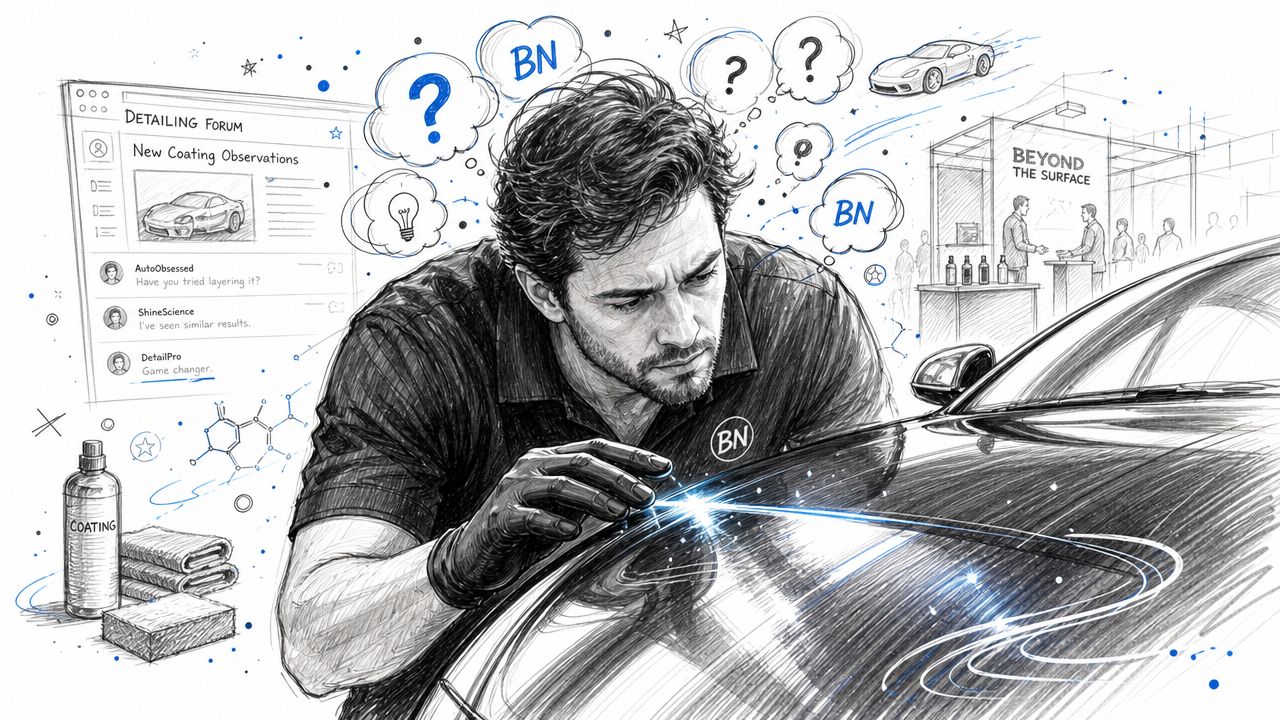
Why detailers got interested
The appeal is obvious. Detailers hear terms like “white graphite,” “high heat,” “lubricity,” and “non-stick,” and they start connecting dots.
A coating that resists heat, reduces friction, and sounds more advanced than yesterday’s ceramic will always get attention. That curiosity is healthy. Good detailers should be skeptical, but they should also keep learning.
Boron nitride sounds exotic in automotive circles, but in materials science it’s old-school. That’s exactly why people trust it so quickly.
The real question under the hype
The chase for better gloss and protection isn’t really about buzzwords. It’s about performance under abuse. Wash cycles. Road film. Bird droppings. Heat soak. Cold mornings. Bug impact. Chemical exposure. Fast installs for mobile operators. Predictable results for studios.
That’s where the conversation gets more serious. A material can be brilliant in a furnace fixture and still be the wrong answer for a hood, roof, or daily-driven windshield.
If you spend enough time around coatings, you start separating interesting chemistry from useful automotive chemistry. Those aren’t always the same thing. That’s also why many installers keep comparing product claims against real-world user feedback and test culture, not just spec-sheet excitement. A good place to see how professionals think through that difference is this collection of ceramic coating reviews from Titan Coatings.
What professionals are actually searching for
Most pros aren’t hunting for a lab trophy. They want a coating that:
- Installs reliably under normal shop or mobile conditions
- Looks sharp without becoming fussy during leveling
- Holds up through real maintenance cycles
- Stays stable when panels heat up and cool down
- Makes service easier for the client after delivery
That’s why boron nitride deserves a fair evaluation, not a knee-jerk dismissal and not blind hype. It has real strengths. The catch is that its strengths were proven somewhere very different from a black daily driver parked outside.
What Exactly Is Boron Nitride
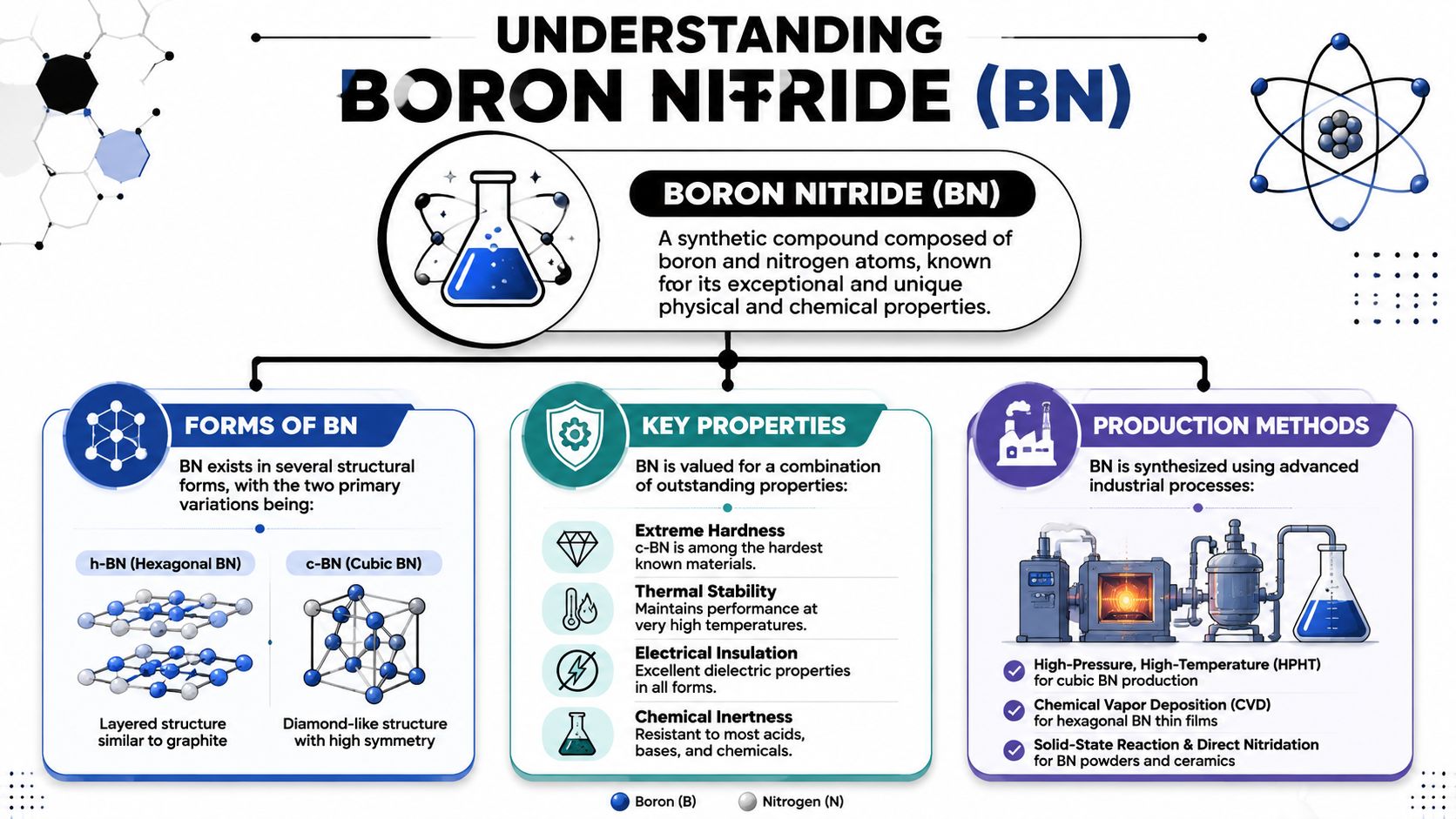
Boron nitride is a synthetic compound, and the form most detailers hear about is hexagonal boron nitride, often shortened to h-BN. If you want a simple mental picture, think of very thin layers stacked on top of each other, with strong behavior across the plane of each layer and easier sliding between layers.
That layered structure is why h-BN gets attention in engineering. It isn’t just chemically interesting. It behaves in ways that are useful when heat and friction are major problems.
The property set that made it famous
One technical summary reports that h-BN has in-plane thermal conductivity of about 400 W/m·K and an ultra-low friction coefficient of roughly 0.03–0.1, which is why engineers value it as both a heat-moving material and a high-temperature dry lubricant (h-BN properties summary).
That combination is rare enough to matter. Most materials don’t handle heat well and reduce friction well at the same time.
In plain terms:
- Heat management: It can move heat laterally through the coating structure.
- Lubricity: It allows sliding behavior where oils or greases may fail or contaminate the process.
- Chemical calmness: It doesn’t jump into reactions easily in the environments it was designed for.
Why industry loves it
Once you understand the property set, the use cases make sense. h-BN fits places where metal parts, high heat, repeated cycles, and contamination risk all show up together.
That’s why you see boron nitride discussed around hot tooling, furnace fixtures, release surfaces, and wear points. Engineers aren’t picking it because it sounds premium. They’re picking it because the structure solves specific process problems.
Practical rule: When a material becomes popular in casting, thermal processing, or furnace work, ask what problem it solved there before assuming it solves your paint problem too.
A note on due diligence
If you’re vetting unfamiliar chemistry for compliance or supply-chain questions, it helps to check regulatory databases before you even start debating performance. For that kind of groundwork, detailers and distributors can find REACH chemicals data and confirm whether they’re dealing with a known substance, mixture, or regulated component category.
The key misunderstanding in automotive talk
The phrase “advanced material” often causes confusion. People hear that h-BN is stable, slippery, and heat resistant, then assume it must be ideal on painted body panels.
That leap skips the hardest part. A detailing coating doesn’t live in a furnace or a controlled lab stack. It lives through wash mitt abrasion, alkaline cleaners, mineral deposits, bug remains, sun exposure, handling mistakes, and customer maintenance habits.
So the chemistry itself is real. The industrial value is real. The question is narrower than most marketing makes it sound. Not “is boron nitride impressive?” It is. The main question is whether the type of boron nitride coating people admire in industry maps cleanly onto exterior automotive detailing.
Industrial Strength vs Real World Roads
Many coating conversations need a reset: Industrial performance and automotive suitability are not the same test.
One of the biggest gaps in current content is exactly this issue: whether boron nitride coating is practical as an automotive surface coating, or whether it’s mainly an industrial release and thermal coating. The available evidence most often highlights high-temperature protection, sometimes up to 1,100 °C, and non-wetting or release behavior in casting environments, which doesn’t directly answer how it handles washing, abrasion, contamination, or stone-chip exposure on vehicle exteriors (Nature discussion of boron nitride use-case gap).
Where boron nitride is strong
On the industrial side, the strengths are easy to respect. It has credibility where high heat, controlled substrates, release behavior, and oxidation resistance matter.
That matters in manufacturing. It matters in process equipment. It matters in environments where sticking and thermal loading ruin productivity.
Where a car asks different questions
A car doesn’t care that a material is elegant in a lab. The road asks different things:
- Can the coating keep integrity after repeated hand washing and chemical exposure?
- Does it survive bug impact and grit contact without becoming brittle?
- What happens when the panel moves through daily thermal expansion and contraction?
- How forgiving is the coating during installation by a shop, a mobile operator, or a skilled DIY user?
That’s where rigid systems often hit a practical ceiling. Hardness helps, but hardness alone doesn’t guarantee durability. A coating can feel strong and still behave like a brittle shell when hit, stressed, or cycled.
Coating Technology Comparison
| Property | Boron Nitride (Industrial) | Traditional SiO2 Ceramic | Titan Elastomer Coating |
|---|---|---|---|
| Core design intent | Release, thermal protection, lubricity in industrial environments | Hard surface protection for automotive finishes | Flexible protective membrane for automotive use |
| Best-known strength | High-heat and non-wetting behavior in industrial settings | Gloss, chemical resistance, hard-shell feel | Balance of hardness and flexibility |
| Road impact question | Less clearly answered for paint, chips, wash wear, and exterior abuse | Can be vulnerable to brittleness under stress | Designed around movement and impact tolerance |
| Thermal cycling fit | Strong in heat-focused applications | Can perform well but remains a rigid coating family | Built around flexibility during temperature swings |
| Installer practicality | Depends heavily on product type and intended substrate | Familiar to many detailers | Geared toward real-world automotive application |
| Best use case | Foundries, tooling, release surfaces, thermal equipment | Paint protection where rigid ceramic behavior is acceptable | Vehicles facing daily use, weather swings, and repeated abuse |
A comparison table like this doesn’t mean boron nitride is weak. It means use-case fit matters more than headline properties.
A coating made for molten-metal release can be excellent at its job and still be the wrong category for a client’s daily driver.
What testing mindset actually helps
Professionals get better results when they test coatings by the stress profile of the vehicle, not by the novelty of the ingredient list. If you want to think like an evaluator instead of a marketer, it helps to study how coatings are challenged in broader durability programs, such as the testing perspective shown in Titan Coatings’ coating testing resources.
That’s the pivot point. The best automotive coating isn’t the one with the most impressive industrial résumé. It’s the one engineered for roads, wash routines, heat swings, and impact.
The Elastomer Revolution A New Philosophy
The real leap in automotive protection came when formulators stopped asking, “How hard can we make the shell?” and started asking, “How well can the surface survive movement?”
That question changed everything.
Why rigid protection hits a limit
Traditional coating thinking often rewards hardness first. Hardness has value. It can improve surface feel, resistance to light marring, and general durability. But if the film behaves too much like glass, it can become vulnerable in the exact moments real vehicles suffer most. Sudden temperature change. High-speed debris. Repeated expansion and contraction across large panels.
A rigid coating may still look excellent on day one. The challenge shows up later, when stress accumulates.
A different materials mindset
Elastomer technology came from a different philosophy. Instead of building only a hard outer shell, the coating is engineered to behave like a resilient membrane. It still protects. It still gives the sharp, clean finish detailers want. But it also has room to flex with the surface rather than fighting the surface.
That matters more than many installers realize.
A hood in sun doesn’t live the same life as a quarter panel in shade. A windshield in winter wash conditions doesn’t move through stress the same way as a garage queen. Real vehicles are dynamic. Their coatings need to be dynamic too.
Hardness protects against some threats. Flexibility protects against the threats hardness alone can’t absorb.
Why flexibility changes durability
Modern elastomer systems offer a distinct advantage. If a coating can move through cold-to-hot transitions without becoming prone to cracking, it keeps its protective behavior more consistently over time. If a bug strikes at speed or the panel takes repeated environmental stress, a flexible film has a better chance of absorbing that event instead of concentrating the stress.
That’s the practical value of the newer generation. The innovation isn’t just “stronger chemistry.” It’s a more realistic response to how cars live.
Titan built that philosophy into its automotive coating direction with elastomer-based systems, using a combination of nanotube concepts and proprietary Dark Matter Technology to chase a harder-but-flexible outcome instead of old-school brittle behavior. If you want a closer look at that design philosophy in automotive terms, the overview on car paint coating solutions shows where that thinking leads.
What this means for a professional detailer
For a shop owner or mobile installer, the benefit isn’t abstract science. It’s operational.
- Fewer stress-related concerns when weather changes sharply
- More confidence on daily-driven vehicles that see abuse
- Better alignment with client expectations because the coating is built for real maintenance cycles
- A more modern definition of toughness that includes movement, not just hardness
That’s the shift. Boron nitride represents a respected old-school material with proven industrial value. Elastomer coatings represent a new-school automotive answer built around the reality that a car isn’t a furnace fixture, a casting die, or a lab coupon.
Meet Alpha Quartz The Detailers Elastomer
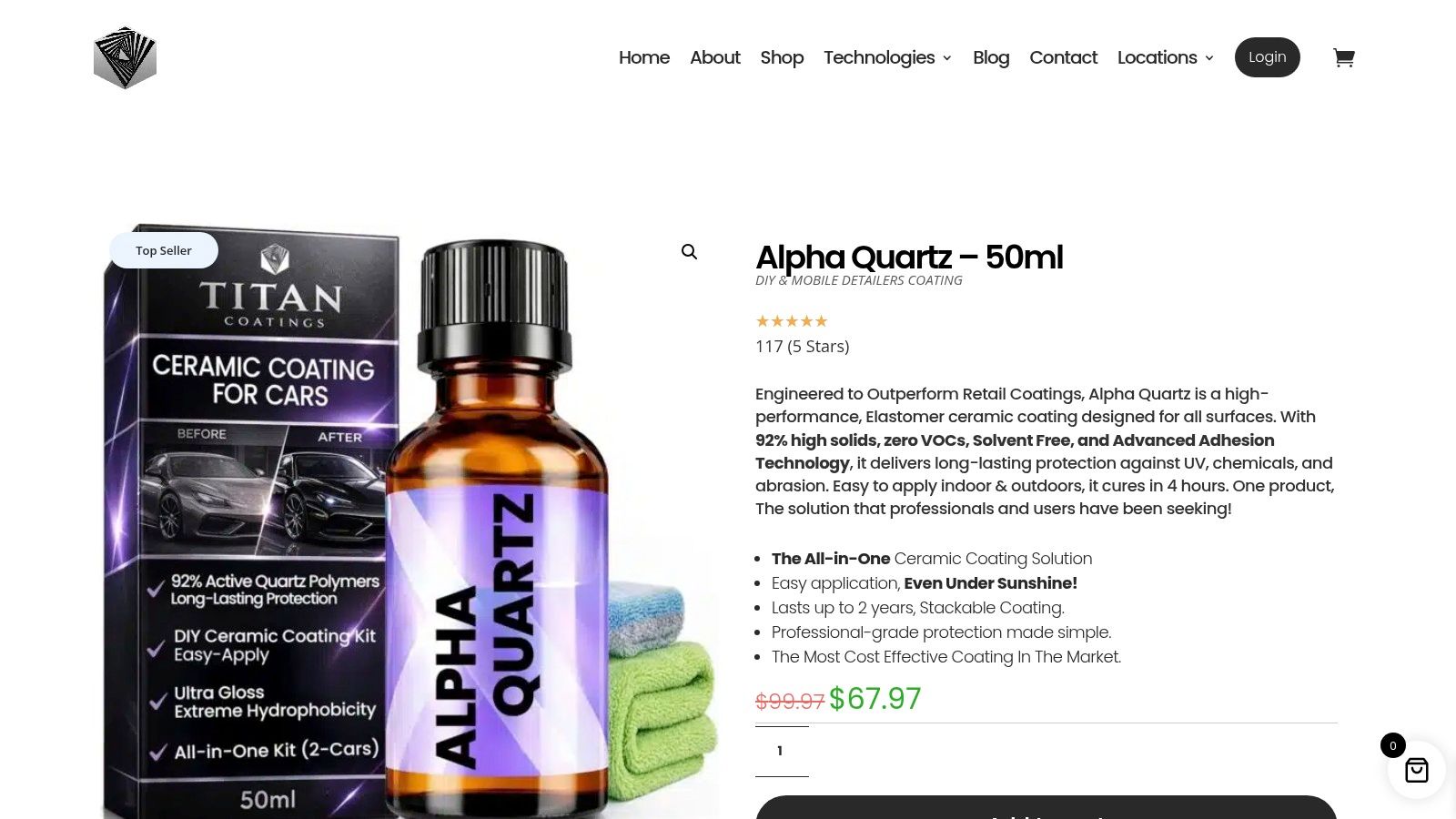
A good theory still has to survive install day. That’s where Alpha Quartz makes sense to professionals who don’t have the luxury of perfect shop conditions every hour of every week.
Some coatings feel like they were designed for a calm lab bench. Alpha Quartz feels like it was designed by people who understand mobile detailers, changing humidity, client schedules, and the simple fact that easy application matters.
Why Alpha Quartz stands out
The biggest advantage is that it brings elastomer behavior into a product detailers can use without turning the install into a high-risk event.
That means it fits two groups especially well:
- Mobile detailers who need practical working time and less drama during application
- DIY users who want strong results without the steep penalty of a fussy pro-only coating
It’s one thing to talk about flexibility in theory. It’s another to package it into something that still wipes, levels, and finishes in a way that makes sense on a full vehicle.
A workable install flow
A clean Alpha Quartz install still depends on the basics. No coating fixes lazy prep. But once the surface is corrected and oils are removed, the process stays approachable.
- Decontaminate the surface thoroughly. Remove bonded contamination, polishing residue, and anything that interferes with bonding.
- Work panel by panel. Don’t over-apply. Controlled coverage keeps leveling predictable.
- Watch the coating, not the clock. Ambient conditions always matter, so visual cue reading is part of the skill.
- Level cleanly. Use quality towels and avoid overworking a panel once it is set.
- Let the elastomer do its job. The value comes later, when the film faces temperature swings and impact stress.
Why pros like coatings that are easier to live with
Ease of use isn’t a luxury feature. It’s part of performance. A coating that’s easier to apply consistently often produces better outcomes across more vehicles and more installers.
That’s one reason Alpha Quartz has been a useful option for people who want advanced chemistry without the brittle feel that can define older rigid systems. The product line is part of the broader Titan Coatings elastomer technology platform, and that connection matters because it explains why the behavior on the vehicle feels different from standard ceramic expectations.
Good installation products don’t just impress in a demo. They reduce mistakes, lower installer stress, and stay predictable when conditions aren’t perfect.
Where it fits best
Alpha Quartz makes the most sense when the vehicle is going to be used like a vehicle. Daily driving. Outdoor parking. Mixed temperatures. Regular maintenance. Occasional bug abuse. Normal life.
That doesn’t make it “basic.” It makes it practical. And in detailing, practical products are usually the ones that stay in the cabinet the longest.
Frequently Asked Questions About Modern Coatings
Can I use an industrial boron nitride coating on car paint
Usually, that’s not the right move.
Boron nitride release coatings are effective in metal-processing because they combine chemical inertness with non-wetting behavior. They’re often selected for applications such as aluminum casting, hot-forming dies, or kiln hardware because they reduce sticking and hold up in those severe environments better than many organic coatings (industrial bulletin on boron nitride release coatings).
That résumé is real, but it points to industrial release and thermal service, not exterior paint protection on a vehicle you wash, dry, and expose to road debris.
Is boron nitride the same thing as a ceramic coating
Not in the way detailers usually mean it.
People often use “ceramic” as shorthand for an automotive paint coating category. Boron nitride belongs to a different conversation. It has legitimate value as a technical material, but that doesn’t automatically place it in the same real-world use class as a purpose-built automotive coating.
What’s the practical difference between a rigid ceramic and an elastomer coating
A rigid ceramic focuses heavily on hard-shell behavior. An elastomer coating is built to protect while still flexing with the panel.
That difference matters when the vehicle sees:
- Temperature swings: Flexible films are less likely to be stressed by constant expansion and contraction.
- Road impact: A more resilient membrane handles dynamic abuse better than a purely brittle layer.
- Long-term service: Durability isn’t just about hardness on day one. It’s about film integrity over time.
Does flexibility mean the coating is soft
Not in the way commonly feared.
The better way to think about it is resilient hardness. The goal isn’t to make the film weak. The goal is to avoid a glass-only behavior that can become a disadvantage under real stress.
Which Titan product makes the most sense for glass
For glass, many users want quick installation and a clear visibility benefit in bad weather. That’s where products like Apex Glass fit the conversation, especially for drivers who care about easier wet-weather visibility and low-effort application.
For paint, the choice leans more toward elastomer systems such as Alpha Quartz, where flexibility under changing conditions is part of the value.
What about a fast option for maintenance clients
Not every customer needs a full coating package. Some need speed, clean gloss, and easier repeat service. In those cases, spray-applied ceramic options can make sense because they’re easier to integrate into maintenance workflows and mobile packages.
What should a detailer focus on when choosing a coating
Start with the vehicle’s real life, not the trend cycle.
Ask:
- How is the car stored
- How often is it washed
- Will it see harsh winters or strong sun
- Is the client disciplined about maintenance
- Do you need fast installation or maximum customization
Then choose a coating family that matches those conditions. If you’re comparing more traditional hard-shell systems with newer alternatives, this overview of 9H ceramic coating options helps frame the older expectation against what modern buyers often assume they’re getting.
Is boron nitride useless for automotive work
No. That would be the wrong conclusion.
It’s a respected material with clear technical value. The smarter conclusion is narrower: its strongest proven use cases don’t automatically make it the best answer for exterior automotive detailing. For road cars, the better solution is usually the one engineered from the start around impact, weather, washing, and thermal movement.
If you want a coating system built for real vehicles instead of borrowed industrial hype, take a close look at APEX NANO – Titan Coatings. Their lineup covers flexible elastomer protection for paint, practical options for installers, and easy-to-apply glass solutions that help drivers maintain visibility when rain and road spray make the drive harder than it needs to be.
0 Comments