
The coupe rolled into the bay at 8:10 a.m. with patchy, shiny freckles across the hood, and the owner swore the paint had changed overnight. It hadn’t; the last wash had used wax, and the matte finish car had been polished into a different surface.
The Morning a Wax Job Ruined a Matte Finish
He’d done what a lot of careful owners do. He bought the satin-finish car, kept it clean, and used the same wax he’d used on every glossy vehicle before it. The problem showed up as soon as the hood caught the sun, because the clear coat’s micro-texture had been filled and smoothed, which made some areas reflect more light than others.
That’s burnishing, and once you see it, you don’t unsee it. The finish stops reading as one even sheet and starts looking blotchy, with random panels flashing a little brighter than the rest. On a gloss car, that kind of polishing is the goal. On matte, it’s the mistake that turns a premium look into a repair estimate.
Practical rule: if a product is made to make paint look wetter, glossier, or deeper, it’s the wrong instinct for matte.
The owner’s mistake also explains why matte ownership feels more like a long-term relationship than a one-time styling choice. The surface doesn’t forgive aggressive chemistry or friction, and every bad habit leaves a visual trace. That’s why the rest of the bay talk centered on correction, prevention, and the right kind of protection, not on “fixing” the finish with more shine.
If you’re already dealing with wax haze or patchiness, start with a dedicated removal process rather than more polishing. A practical reference point is Titan’s own guide to removing wax from car paint, because the main issue is usually what was applied, not how dirty the vehicle was.
What a Matte Finish Actually Is
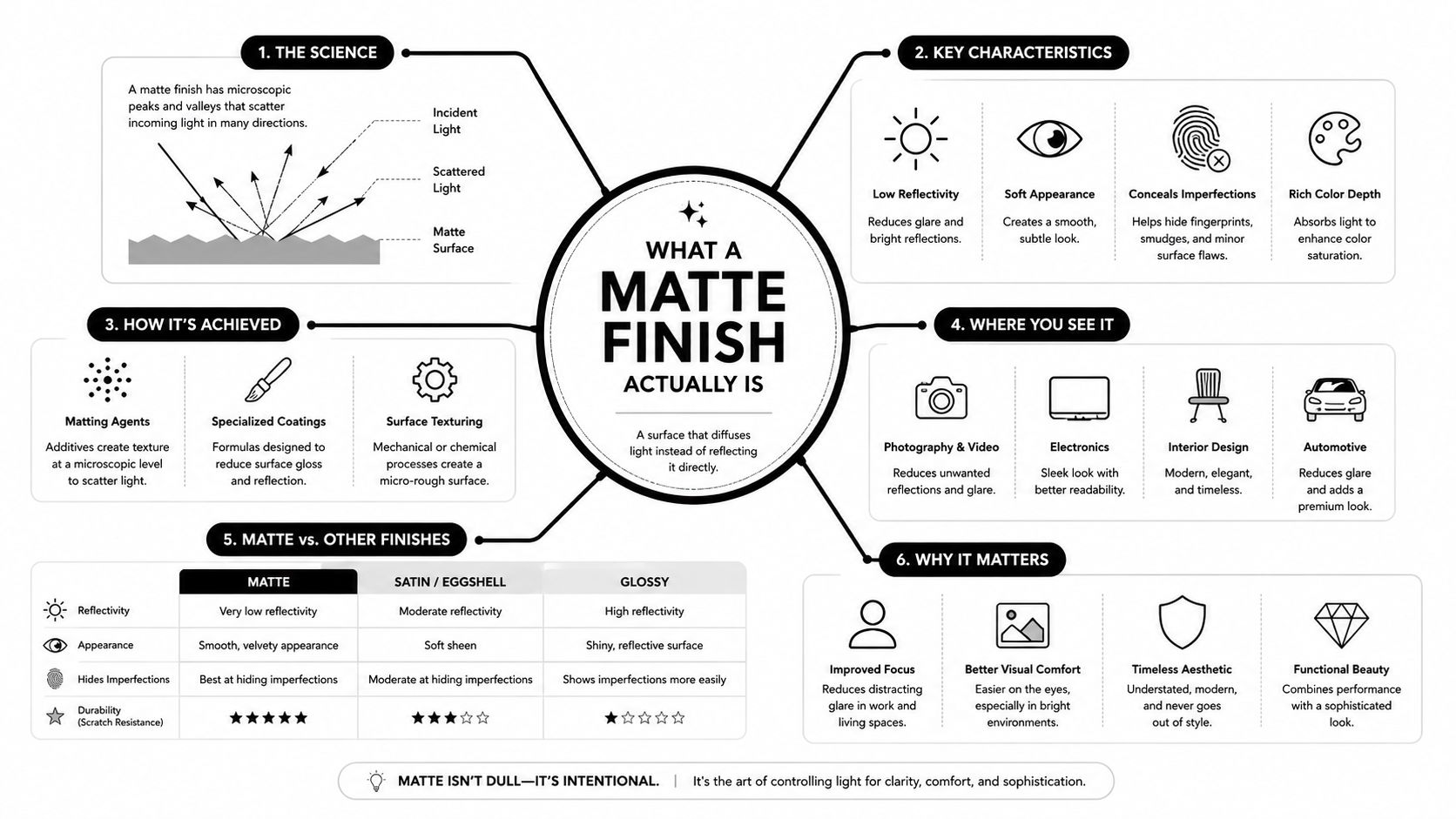
A matte finish car usually starts with a clear coat that leaves microscopic texture on the surface, so light gets scattered instead of bouncing back in a sharp reflection. In the shop, that shows up as a soft, low-gloss panel that reads as satin, hazy, or flat depending on the angle. Kelley Blue Book describes matte paint in that same basic way, and the point matters because the wrong product can change how the surface reflects light KBB on matte paint finish.
I saw that difference on a black coupe that came in after a well-meaning owner had tried to “refresh” the finish. The panels still looked clean at a glance, but under the booth lights the hood and fenders no longer matched, because the coating had been altered in spots and the texture that created the matte look was no longer even. That kind of mismatch is exactly why matte ownership is a relationship, not a one-time styling choice. Every wash, touch-up, and repair has to respect the surface that gives the car its character.
Four ways that look shows up on a vehicle
A factory matte finish is the cleanest example, because the vehicle is painted that way from the start and the whole body is built around that appearance. A wrap can copy the look and peel off later, which helps owners who want a change they can reverse. Matte PPF adds impact resistance while keeping the low-gloss appearance, and a protective coating sits over the existing finish to help preserve it without replacing the paint. If you want a closer look at how film fits into that decision, Titan’s overview of paint protection film is a useful reference.
That difference matters the moment someone starts talking numbers. Kelley Blue Book notes that factory matte paint often carries a steep premium, which is one reason many owners choose wrap, film, or coating instead KBB paint history. The factory route delivers the original look, but it also ties the owner to the factory finish and the cost that comes with it.
Matte is a surface behavior, not a color family. Once light scatters differently, the maintenance rules change with it.
The rarity is part of the appeal, too. Factory matte still stands apart from the usual road colors, and that makes the car read as intentional rather than ordinary Dr. Beasley’s on matte market context. That same rarity is what makes repair work sensitive, because a blend that looks fine on gloss can leave a matte panel with a visible sheen shift.
A good body technician will also check the panel before chasing cosmetics, because paint thickness readings can help uncover hidden accident damage that would make a later matte repair harder to match. On a finish like this, the surface story and the repair history are tied together.
Factory Paint, Wraps, PPF, and Coatings Compared
I once had a matte black coupe roll into the bay after a quick wax job gone wrong. The owner had only wanted a cleaner look, but the hood came in with a patchy sheen where the applicator had burnished the surface, and the repair quote changed fast once the color match turned into a sheen match. That is the long-term side of a matte finish car, the finish is not just a style choice, it becomes a relationship with every wash, repair, and protective layer that follows.
Factory paint gives the car its original matte character straight from the line, and that is hard to copy cleanly later. Wraps, matte PPF, and coatings all change the ownership math in different ways. Wraps and film can be removed when the look no longer fits, while coatings keep the underlying finish in place and shift the job from replacing panels to caring for the surface that is already there.
Here is the comparison a shop owner usually sketches before an estimate, because the decision is rarely just about appearance.
| Matte Finish Methods Compared | Upfront Cost | Repairability | Reversibility | Best For |
|---|---|---|---|---|
| Factory matte paint | High, often bundled into premium trim | Limited, sheen matching is difficult | No | OEM authenticity |
| Vinyl wrap | Moderate | Moderate, but film wear and edge issues happen | Yes | Temporary styling changes |
| Matte PPF | Higher than wrap | Better impact protection, still surface-sensitive | Yes | Owners who want protection plus matte look |
| Protective coating | Lower than replacing finish | Depends on the underlying paint | No, but non-permanent in feel | Preserving original paint and simplifying wash care |
The gap in price and attention is one reason matte stays uncommon. Dr. Beasley’s points out that matte finishes remain a small share of vehicles, while common gloss colors still dominate the road, and the same source says a matte finish can add a meaningful premium over standard paint, with repaint work climbing even higher when the goal is to restore the original look Dr. Beasley’s on matte market context. In the shop, that premium shows up later too, because any touch-up has to respect the surface texture, not just the color code.
A technician who checks paint thickness before correcting the finish has a better chance of spotting previous body work, and that can matter before anyone commits to a repair path. The process is often used to uncover hidden accident damage, especially when a panel may already have been sprayed, sanded, or blended once before.
Film planning deserves the same care. A car paint protection film guide helps show where matte PPF makes sense, where the extra impact protection is worth the tradeoff, and where a simpler coating is enough to keep the finish easier to live with.
The Safe Wash Routine for a Matte Finish Car
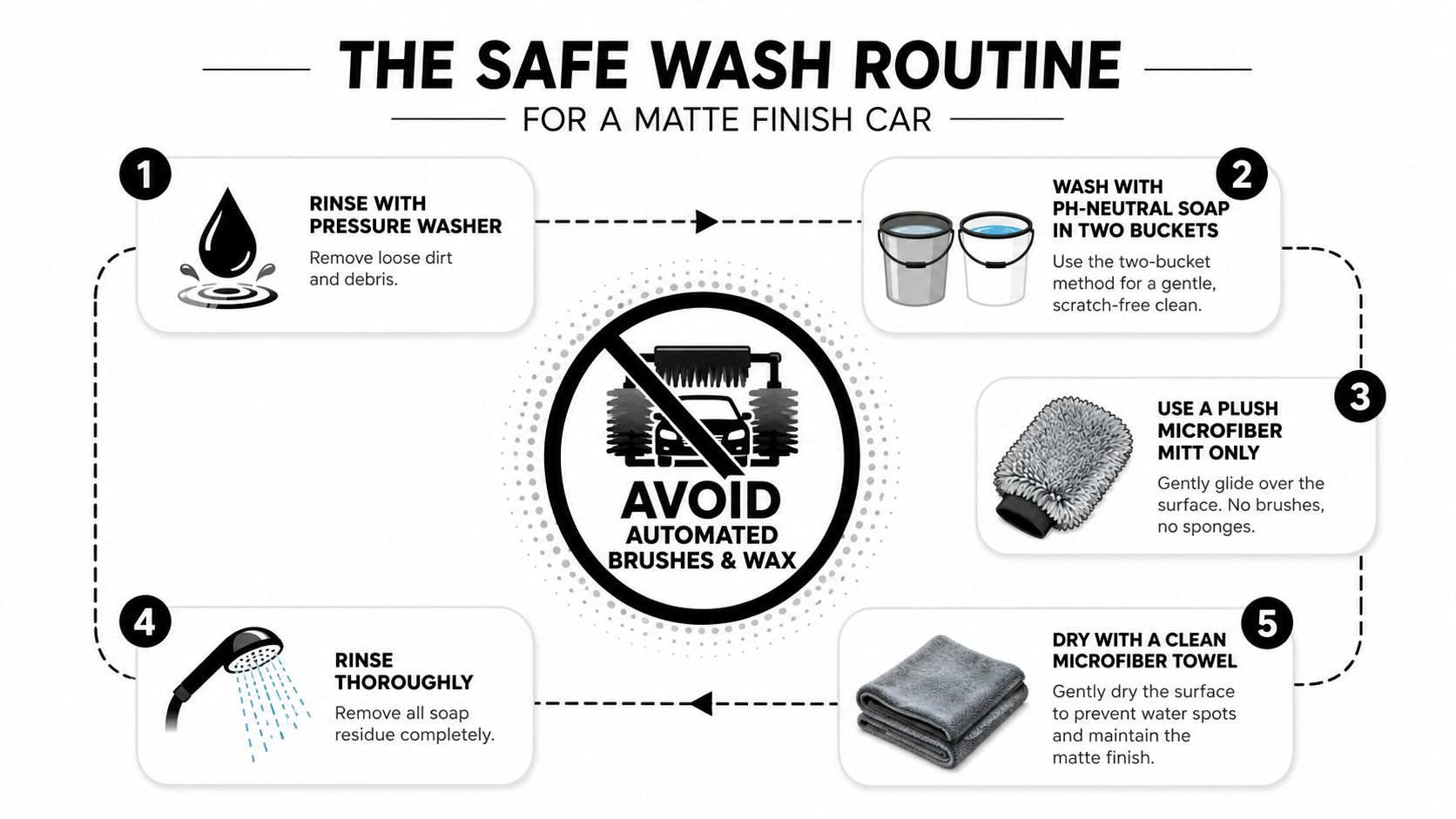
A matte owner usually learns the wash routine the hard way. I’ve watched a fresh black matte hood come back from a quick tunnel wash looking blotchy, not because the paint was dirty, but because a rough mitt and a hurried dry pass left behind a faint burnish that caught the light from one angle and disappeared from another. That kind of mismatch is exactly what makes matte ownership feel like a long-term relationship, every wash either preserves the texture or starts a small problem that shows up later.
The safest wash starts before the sponge touches paint. A cool pre-rinse knocks loose grit off the panel, and that matters because matte surfaces show scuffs and disturbance faster than gloss when contamination gets dragged across them. The PPG matte finish care guide recommends hand washing, using soft microfiber tools, washing in small sections, and avoiding circular motions.
The wash mechanics that matter
Use a two-bucket method with a pH-neutral, matte-specific shampoo, then keep your pressure gentle and your passes straight. A good wash has the feel of guiding debris off the surface, not scrubbing it free. That is the part people miss when they treat matte like ordinary clear coat.
OEM guidance for low-gloss finishes also puts limits on spray force and distance, because too much pressure too close to the panel can mark the texture and make later repairs harder to blend cleanly OEM care bulletin. In a repair bay, I’ve seen that show up as a subtle sheen shift after a panel was sprayed, washed hard, and then matched beside untouched paint. The panel was clean, but the texture no longer read the same in the sun.
Drying matters just as much as the wash. Dry the finish with a damp microfiber or chamois before water spots form, and handle bugs, tar, or sap as soon as you see them. Matte surfaces are less forgiving of residue, and the wrong towel pressure can leave a permanent sheen change that a gloss panel would hide more easily. If you want a step-by-step refresher on the hand-wash sequence, how to hand wash a car walks through the same low-friction approach in plain language.
Keep the motion flat, the pressure light, and the drying fast. That’s the whole game.
A flexible, elastic coating can make this routine easier because contamination does not cling as stubbornly, so the wash takes less rubbing. That matters on a matte finish, where every extra pass raises the odds of burnishing, and where a coating that moves with the panel can help the surface keep its original look longer without forcing the owner into a harsh wash cycle.
Are Ceramic and Nano Coatings Safe on Matte
Matte owners get conflicting advice, and some of it comes from people who treat every coating like it behaves the same way. It doesn’t. A coating that’s tuned to add gloss can fill the micro-texture of a matte surface and create unwanted sheen, which is why standard retail ceramic products often make matte owners nervous.
What matters more than the word ceramic
The label matters less than the behavior. A matte-safe product should preserve the low-reflective look, add hydrophobic and chemical resistance, and avoid smoothing out the finish. OEM guidance already points the owner toward matte-specific shampoo, careful drying, and low-shear cleaning, so a coating has to fit into that same maintenance logic rather than fight it OEM low-gloss care guidance.
A few selection questions cut through the noise:
- Will it change sheen? If yes, it doesn’t belong on matte.
- Is it elastic or rigid? Matte-friendly systems need to move with the panel.
- Is it meant for a single layer or stacking? Layering can change appearance if the product isn’t designed for it.
- Can the shop deliver the curing window? A rushed install can leave streaks or inconsistency.
Titan’s ceramic coating for matte paint sits in this category of finish-aware protection, not gloss-first dressing. Ultra Spray Ceramic also fits the same conversation as a sprayable maintenance layer for paint, wraps, and matte finishes when the goal is easier cleaning without turning the surface shiny.
A matte-safe coating should protect the surface you already chose, not redesign it.
The practical standard is simple. If the product helps water sheet off, resists contamination, and leaves the finish looking the same under daylight, then it’s doing the right job. If it makes the panel look richer in the wrong way, it’s a mismatch.
Why Elastic Coatings Are a Game Changer for Matte
Rigid ceramic coatings can be hard, but hardness alone isn’t the whole story. A car panel flexes with heat, cold, vibration, and small impacts, so a coating that can’t move with the substrate is always working against the surface it’s supposed to protect.
That’s where Titan’s elastomer approach changes the conversation. The company’s Alpha Quartz is a high-performance elastomer ceramic coating with 92% high solids, zero VOCs, a solvent-free formulation, advanced adhesion technology, protection against UV, chemicals, and abrasion, a 4-hour cure time, and up to 2 years of durability that can be layered Titan Alpha Quartz. The important part for a matte finish car is not just the protection claim, it’s the flexibility behind it.
Hard like glass, flexible in motion
Elastic coatings built on elastomer membrane technology with nano tubes are designed to bend with the panel instead of cracking when temperatures swing. That matters on frozen mornings, hot summer panels, and the small flex you get from road vibration. A rigid surface can protect well until it loses the fight with movement, then it starts failing where you can see it most.
A flexible coating also changes the way bug hits and small abrasions behave in daily use. The finish still needs proper washing, but the coating layer can absorb more of the stress instead of transmitting it directly into the paint system. That’s the key advantage, not magic, just material behavior that better matches how cars live outside.
Titan’s coating-flexibility notes explain the idea in plain terms, and the logic holds up in the shop. Coating flexibility matters because the panel is not a dead slab of metal. It expands, contracts, and moves, and the coating has to keep up.
A mobile detailer can live with that. So can a DIY owner who wants a simpler wash cycle and fewer worries about every bug splatter becoming a polishing session.
Repairing and Restoring a Damaged Matte Finish
I have seen a matte hood turn into a headache after what should have been a simple repair. A customer brings in a car with a scuffed fender, the shop matches the color, and the panel looks fine in the bay lights. Then the car rolls outside, the sun catches it, and the repaired area reads differently from the panel next to it. On a matte finish car, that sheen mismatch is often the part nobody notices until the bill is already written.
Repair specialists point out that matte surfaces are hard to blend cleanly, because the finish itself gives the repair away National Collision Repairer on matte repair. A gloss panel can hide a transition better. Matte usually cannot, so a proper repair may stretch across two panels or more, sometimes across the whole side of the car.
Why the repair bill climbs
The hidden cost is not the paint alone. It is the extra labor, the additional refinishing, and the judgment calls a body shop has to make before it can release the car with confidence. A repair that would stay local on gloss can spread on matte because the fresh surface sits next to aged paint and reads differently under daylight.
I have watched owners learn this the hard way after a minor parking lot hit. The damage looked small, but the finishing work kept growing as soon as the shop tried to keep the sheen even from one panel to the next. That is the hidden cost of matte ownership over time, the finish does not forgive shortcuts, and it does not hide repairs well.
Dr. Beasley’s has also noted that an aftermarket matte repaint can run much higher than a glossy repaint Dr. Beasley’s on matte market context. That gap is not about style alone, it comes from trying to match a surface that exposes every transition instead of masking it.
If a shop says it can “spot repair” matte the same way it does gloss, ask how it plans to keep the sheen consistent across the neighboring panels.
Preserving the original finish matters because every panel you replace or repaint raises the chance of a visible mismatch later. A matte-safe coating with elastic, nano-tube elastomer behavior helps here because it moves with the panel instead of fighting it, so daily flexing and small impacts are less likely to push the surface toward premature repair. For an owner already dealing with damage, the question is not how cheap the fix looks on paper, it is which panels will still read as one finish when the car sits in full sun.
Common Matte Mistakes and How to Avoid Them
The same mistakes keep showing up because glossy-car habits are hard to shake. I have seen owners grab wax, polish, and circular motions, then stare at a finish that starts to look blotchy under shop lights. I have also watched a car leave an automatic brush wash with faint abrasion lines and uneven sheen that no amount of rinsing could undo.
A matte finish asks for a different routine from the start. A detailer handling one of these cars learns fast that every swipe, pad, and wash choice leaves a more honest trace than it would on gloss.
The habits to drop
- Stop using standard wax or polish. Use matte-specific cleaners and protectants instead, because gloss products can fill texture and create shine.
- Skip automatic brush washes. Hand washing keeps the surface from getting mechanically polished.
- Back off from close-range pressure washing. Stick to the OEM limits discussed earlier and keep the nozzle moving.
- Avoid circular wiping. Straight, light passes are safer on low-gloss surfaces.
- Don’t apply glossy ceramic coatings to matte panels. Choose a product labeled for matte or low-gloss finishes.
A second habit is keeping the glass in good shape at the same time, because a clean windshield changes the whole drive in rain. Titan’s APEX Glass ceramic coating enhances visibility in rain, reduces wiper use, repels water, dirt, bugs, ice, and snow, and lasts up to 2 years. That kind of glass protection fits naturally beside a careful matte wash routine, since one service protects the panels and the other keeps the view clear through the windshield.
Matte is not fragile. It is less forgiving, and that means the better setup is the one that lowers friction, lowers risk, and keeps the finish looking intentional instead of worn down by repeated mistakes. In the shop, that is the difference between a car that still reads as one clean surface after years of use and one that starts showing patchwork, dull spots, and repair lines every time the sun hits it.
0 Comments