
You’re in the bay on a Saturday, the coating’s flashed, the customer is waiting, and the towel in your hand is the one you grabbed because it was closest. That’s usually how a coating gets ruined, not by some dramatic mistake, but by one lazy wipe that leaves a high spot, a smear, or a trail of grit across fresh product. In this business, towels for car work aren’t a side purchase, they’re part of the finish.
I’ve seen detailers blame the coating, the weather, the applicator, even the panel prep, when the problem was the towel stack. A towel choice can turn a clean elastomer coating job into a rework job, and that means time lost, product wasted, and a customer who notices the finish before you do. If you want fewer callbacks and cleaner handoffs, read towels the same way you read polish or coating chemistry.
There’s another reason this matters now. The global automotive drying towel market was valued at $1.2 billion in 2024 and is forecast to reach $2.08 billion by 2033, with a 6.3% CAGR as reported here. That scale tells you towels have moved from shop accessory to real operating tool, which is exactly how you should treat them. If you’re running Alpha Quartz, APEX Glass, or Ultra Spray, the towel stack has to protect the surface, not fight it.
One last thing before we get practical. If you’ve ever wanted a sanity check on coating failure modes, keep a bookmark on Titan’s coating failure analysis, because towel mistakes show up there faster than in a sales brochure. The goal here is simple, a specific stack, a specific wash routine, and a clear match between towel, coating, and job.
The Morning a Towel Cost a Coating
The worst jobs do not fail loudly. They fail when a guy in the bay grabs the wrong cloth, wipes too hard, and leaves a coating looking “mostly fine” until the sun hits it. That kind of mistake eats the whole day, because now you are re-leveling instead of moving on to the next vehicle.
The part people keep underestimating
A coating does not care how expensive the bottle was. It cares whether the towel pulled residue cleanly, whether the surface stayed free of grit, and whether the wipe left a uniform film behind. If the towel is wrong, the coating job turns into a cleanup job.
That is why I do not talk about towels as an accessory. I treat them like the last piece of paint correction, because that is what they are when fresh coating is on the panel. The right towel makes the coating look intentional, the wrong one makes the finish look rushed.
Practical rule: if you would not trust a towel on black paint in direct light, do not trust it on a fresh coating either.
I also keep a close eye on failure patterns in coatings, because towel mistakes show up there fast. Titan’s coating failure analysis is the kind of reference that reminds you how small handling errors become visible problems on the surface. That is how it is in the bay, where the towel stack can protect Alpha Quartz, APEX Glass, or Ultra Spray, or it can ruin the last step.
The best shop habit is to plan the towel stack before the coating bottle opens. Drying towels, leveling towels, glass towels, and utility towels should each have a job, a wash lane, and a storage place. Do that consistently, and the coating gets a clean final pass. Skip it, and you pay for the mistake with your own time.
What a Car Towel Is
A real towel for car work starts with microfiber, a split-fiber material built from strands less than 10 micrometers in diameter source. That tiny fiber structure is what makes it useful on paint and coatings. It grabs contamination and holds it in the towel instead of dragging it across the surface like a blunt cloth would.
For a deeper spec breakdown, use Titan’s cleaning cloth guide for car care as a practical reference. It helps separate the towels that belong near paint from the ones that should stay in the dirt bucket.
The fiber blend matters
Microfiber towels used in detailing are usually built from a polyester/polyamide blend, most commonly 80/20 or 70/30 source. Polyester gives the towel structure and cleaning bite, while polyamide adds softness and water uptake. A 70/30 blend is usually softer and more absorbent, while 80/20 is the tougher, more budget-friendly choice that still works well for general detailing.
GSM matters too, because it tells you how dense the towel is. GSM means grams per square meter, and you should read it as weight, feel, and intended use, not as a bragging number. For paint-safe work, one detailing guide sets 300 to 350 GSM as the minimum, while another says 500 to 600 GSM is safest for paintwork, wax, and polish applications source.
The weave tells you the rest. Plush towels feel deep and cushy, waffle towels have pockets that move water fast, twisted-loop towels are built for heavy drying, and edgeless towels remove the hard border that can bother sensitive finishes. If you know those four families, product pages stop being noise.
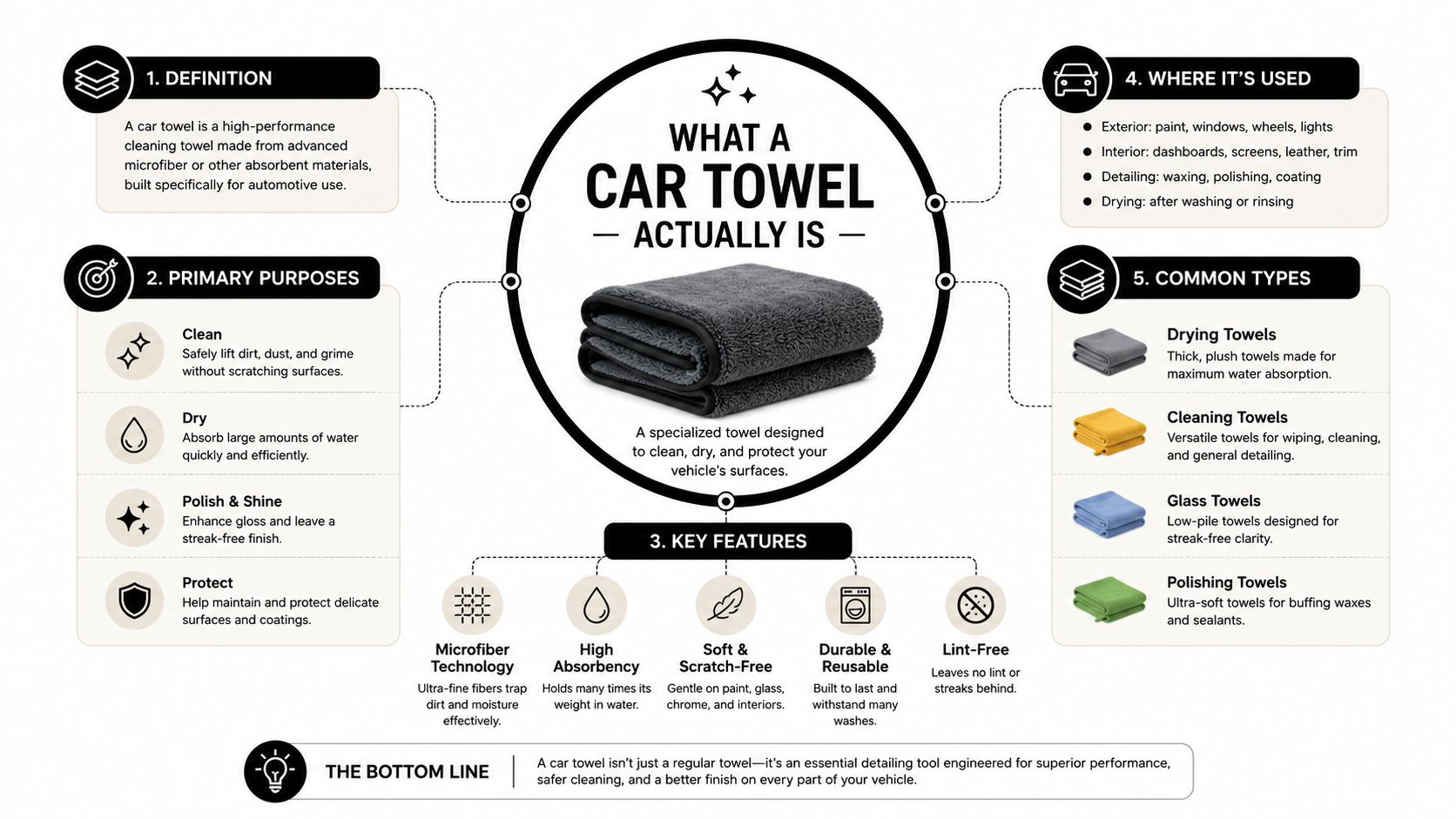
For a quick outside reference, the team at GP Mobile Car Wash & Detail has a solid breakdown on why microfiber towels beat cotton rags, and it lines up with what you see in the bay every day. Cotton smears. Microfiber lifts.
Matching Each Towel to the Job
Once you stop buying towels as a pile and start buying them as a stack, the choices get easier. The job decides the weave, the size, and the blend. That’s the only order that makes sense if you care about finish quality.
Drying, buffing, glass, and utility are different jobs
A plush long-pile towel is my first pick for drying and final buffing on paint, because it holds more water and gives you a softer contact patch. A waffle weave belongs on glass and quick water removal, because it pulls moisture off the surface without loading up as fast. A short-pile towel is the cleaner choice for coating leveling and polish removal, since it gives you control instead of drag.
For wheels, door jambs, and other dirty zones, use a dedicated utility-grade towel and don’t pretend it’s still a paint towel after the first contamination cycle. A towel that touched brake dust should never wander back onto a hood. That’s how you create hidden scratches and then spend the afternoon diagnosing your own mistake.
Here’s the simple way to shop it:
| Towel Type | GSM Band | Best Blend | Best Job |
|---|---|---|---|
| Plush long-pile | 500 to 1200+ | 70/30 or 80/20 | Drying, final buff |
| Waffle weave | 300 to 450 | 80/20 | Glass, quick water removal |
| Short-pile | 300 to 600 | 80/20 | Coating leveling, polish removal |
| Utility grade | Task-based, not vanity-based | 80/20 | Wheels, jambs, dirty zones |
If you want a product-page comparison that stays close to real shop usage, keep Titan’s rag and cloth guidance in your browser and use it as a sanity check, not a shopping addiction. The right towel for glass is not the same towel for black paint, and it shouldn’t be.
The size logic is just as simple. 16 by 16 inches works well for general work, while 20 by 30 inches or larger makes sense for full-vehicle drying towels. Smaller edgeless cloths shine on trim and tight spaces where a bulky towel only gets in the way.
The Thickness Trap
A bigger GSM number sounds safer, and that is exactly why a lot of buyers pick the wrong towel. High GSM does mean more absorbency, but it also means more bulk, more drag, and more towel to fight when you are working around coating residue or glass. For a quick reference on how towel weight changes the job, use this towel GSM comparison guide.
A thick towel can be the right call for drying a full panel. It is the wrong call when you need control. That is the mistake people make with towels for car work. They buy by feel, not by task, then wonder why a plush towel behaves like a sponge during coating leveling.
Heavy is not the same thing as better
A 1500 GSM towel the size of a bathmat is fine for drying a sedan, and clumsy for leveling coating around a mirror. The weight, bulk, and slow handling make it a poor fit for fine work. If you want cleaner, more repeatable results on coatings like Alpha Quartz, APEX Glass, or Ultra Spray, the towel has to match the surface and the residue it is removing.
Thick towels also get in the way in practical ways. They are heavier when wet, harder to refold to a clean edge, more likely to streak on glass, and more likely to waste product during coating removal. On a coated surface, that extra pile can load up too fast and start dragging instead of lifting residue.
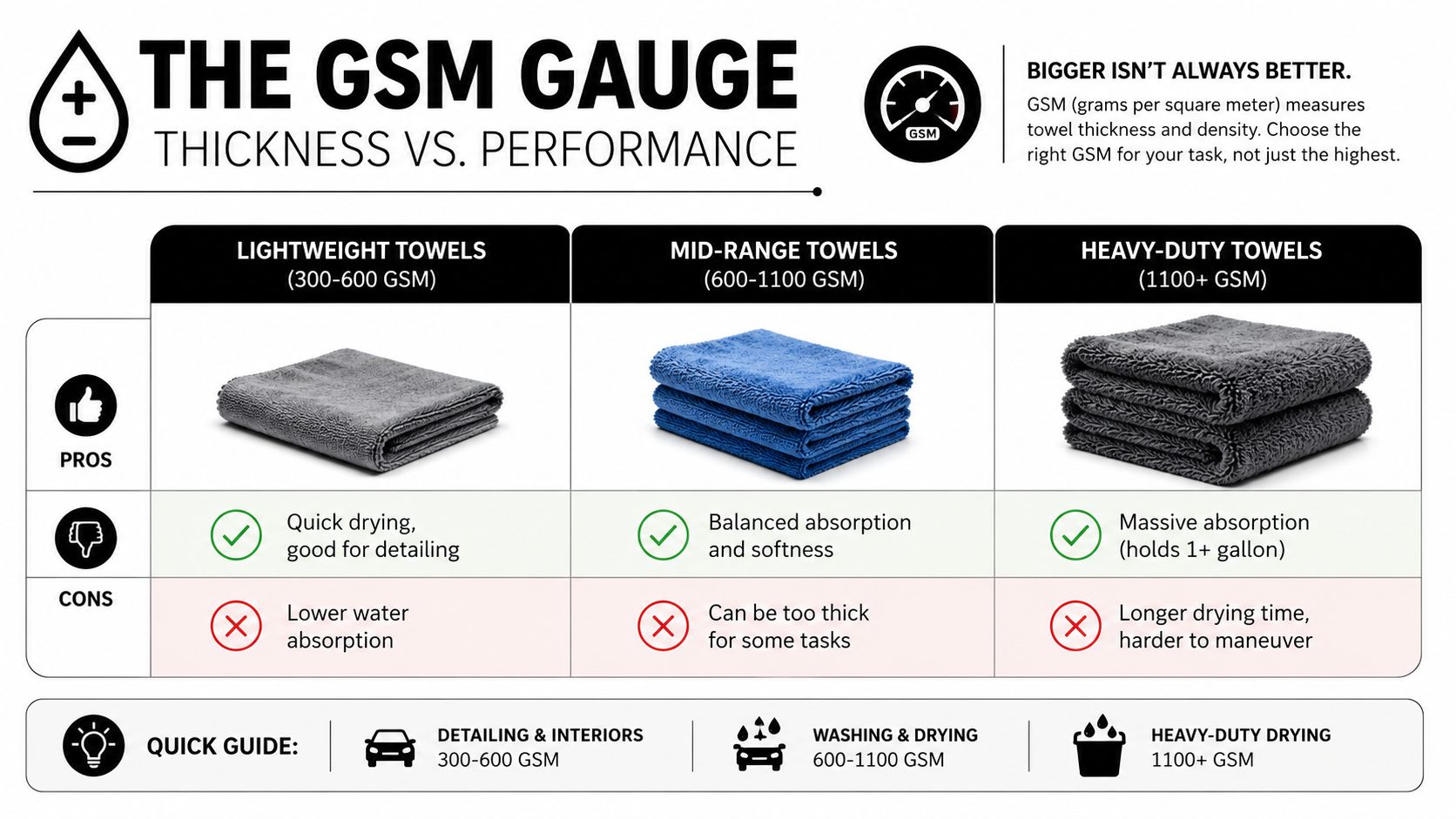
The better rule is task-matched density. A towel for glass should be lean and controlled. A towel for full-panel drying can be thick and thirsty. A coating towel should give you a predictable wipe, not a sponge effect that grabs product and smears it around the panel.
Shop test: if the towel feels like a blanket, do not buy it for coating leveling.
If you want a tighter handle on what works in the bay, use Titan’s best detailing microfiber towels guide as a check against marketing hype. It is the kind of reference that keeps you from buying the wrong texture for the wrong surface. The right towel for glass is not the same towel for black paint, and it should never be treated like it is.
You can grade a towel in under a minute. Check the stitching first, then the edge finish, then do a quick lint test by rubbing it against your black shirt or a clean panel light. Finish with a simple absorbency test, a few drops of water should spread and pull in quickly, not sit there like the towel is offended by moisture.
Wiping Techniques for Coatings and Glass
The towel matters, but the wipe sequence matters just as much. On coatings, I want a first towel that pulls off the bulk, then a second towel that finishes the leveling pass cleanly. Titan’s application guidance follows that same two-towel logic, and it is the right way to handle residue control during coating work.
Alpha Quartz and Ultra Spray need a system
On Alpha Quartz, I like 20 to 25 drops on the applicator, a cross-hatch spread, and a dwell of 3 to 5 minutes, with up to 15 minutes depending on conditions source. After that, use a short-pile microfiber first to clear the bulk residue, then a long-pile towel for the final level and buff. The short-pile towel gives you control. The long-pile towel cleans up the last film without pushing it back across the panel.
Ultra Spray calls for a simpler routine. Spray onto a fresh short-pile cloth, work the product in, then follow with a separate long-pile cloth for the final wipe. Keep those jobs in separate towels. One towel doing both roles usually leaves you chasing smears instead of finishing the surface.
Glass needs its own lane
For APEX Glass, use 10 to 15 drops on an applicator in circular motions, let it sit, then wipe with a dedicated glass towel so you do not build streaks into the finish source. Glass towels should stay out of the paint stack completely. Glass will expose the wrong cloth fast, and it does not forgive a towel that is carrying paint residue or lint.
Keep the wipe simple. Fresh towel, fresh surface, fresh direction.
Keep dirty towels away from clean ones, and refold every 2 to 3 panels so you keep exposing a fresh face to the paint. That small habit matters on coated cars. It keeps grit from riding along with the wipe and cutting into the finish you just protected.
Washing, Storing, and Controlling Contamination
Microfiber stays useful only when you handle it like a shop tool, not like random laundry. The three things that ruin it fastest are hot wash, high-heat drying, and fabric softener. Heat can deform or melt the fibers, and softener leaves a waxy film that has no place touching paint.
Wash by task, not by convenience
Paint towels belong in a different load from glass, wheels, and interior towels. That is contamination control, plain and simple. A wheel towel loaded with brake dust should never share a wash with a drying towel that touches a coated panel.
Use warm, not hot, water with a residue-free detergent, then dry on low heat or let the towels air dry. If you want a practical reference for wash timing and laundry rhythm, how often to wash towels gives useful context, even if your shop cycle is rougher than a home laundry setup. The goal is simple, keep the towels clean enough that they never become the problem.
For a straight setup on laundering microfiber the right way, use this microfiber cloth washing guide. It belongs in the same workflow as your coating towels, because a dirty towel stack can scratch, haze, or drag residue across a finish that was already protected.
Store towels folded in a sealed bin or another dust-free container. In a dusty bay, an open shelf turns clean microfiber into a dust collector. That is not storage, it is contamination with better lighting.
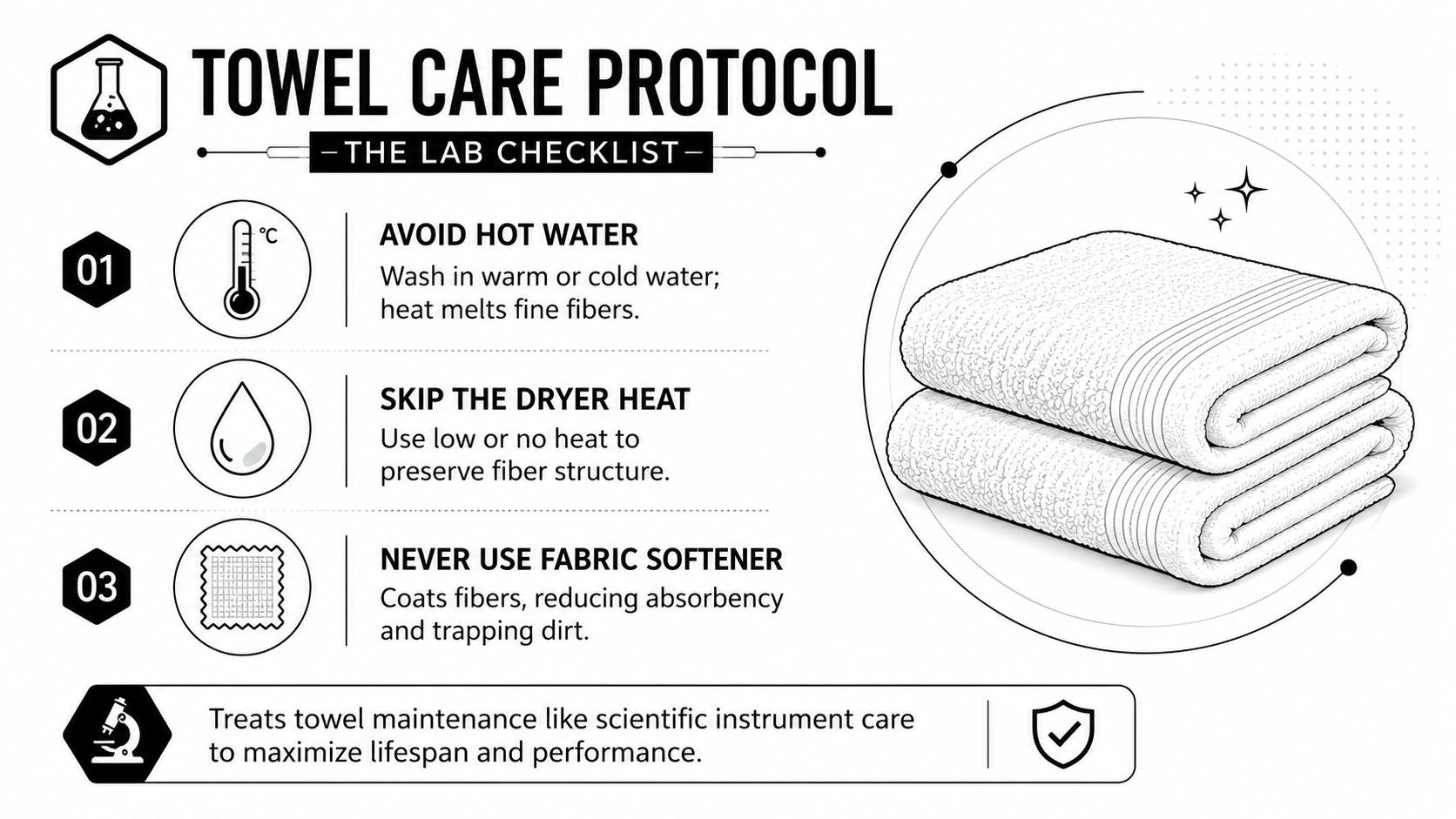
Three field rules keep the stack honest. Work top to bottom on the vehicle. Keep dedicated towels for glass, wheels, and interior surfaces. Refold every 2 to 3 panels so you always expose a clean face. That habit matters even more on coating work, because once a towel picks up grit or leftover product, it starts pushing contamination instead of removing it.
Mistakes That Ruin Towels and Coatings
The biggest towel myths sound harmless until they cost you a rewash or a repolish. Any microfiber is paint-safe is wrong, because cheap blends and hard edges can scratch sensitive finishes. A good towel has the right fiber, the right edge, and the right job.
What not to do
More GSM is always better is another bad habit. High GSM can be perfect for drying, but it’s clumsy on glass and wasteful for coating leveling. The quick rule is simple, match density to task, not ego to shelf appeal.
One towel does the whole car is a contamination mistake, plain and simple. Paint, glass, wheels, and interiors need their own cloths, or you’re moving grime from one surface to another. If a towel touches dirty work, it stays out of the clean stack.
Fabric softener makes towels softer is the kind of advice that ruins microfiber. It coats the fibers and wrecks absorbency. If a towel comes out smelling like laundry room perfume and feeling slick, it’s already compromised.
You can wash microfiber with your shop towels is another no. Cotton lint embeds in microfiber, and it doesn’t come back out cleanly. Edges don’t matter is wrong too, because an edge is still a contact point on dark paint and a bad one can leave a trace you’ll chase later.
And no, you can re-use a coating towel after a quick rinse is not a smart shortcut. Residual product can cure in the fibers and turn a fresh wipe into a sticky, dragging one. Once a coating towel has started loading up, retire it to lighter work before it becomes a problem.
Your Towel Stack and the Titan System
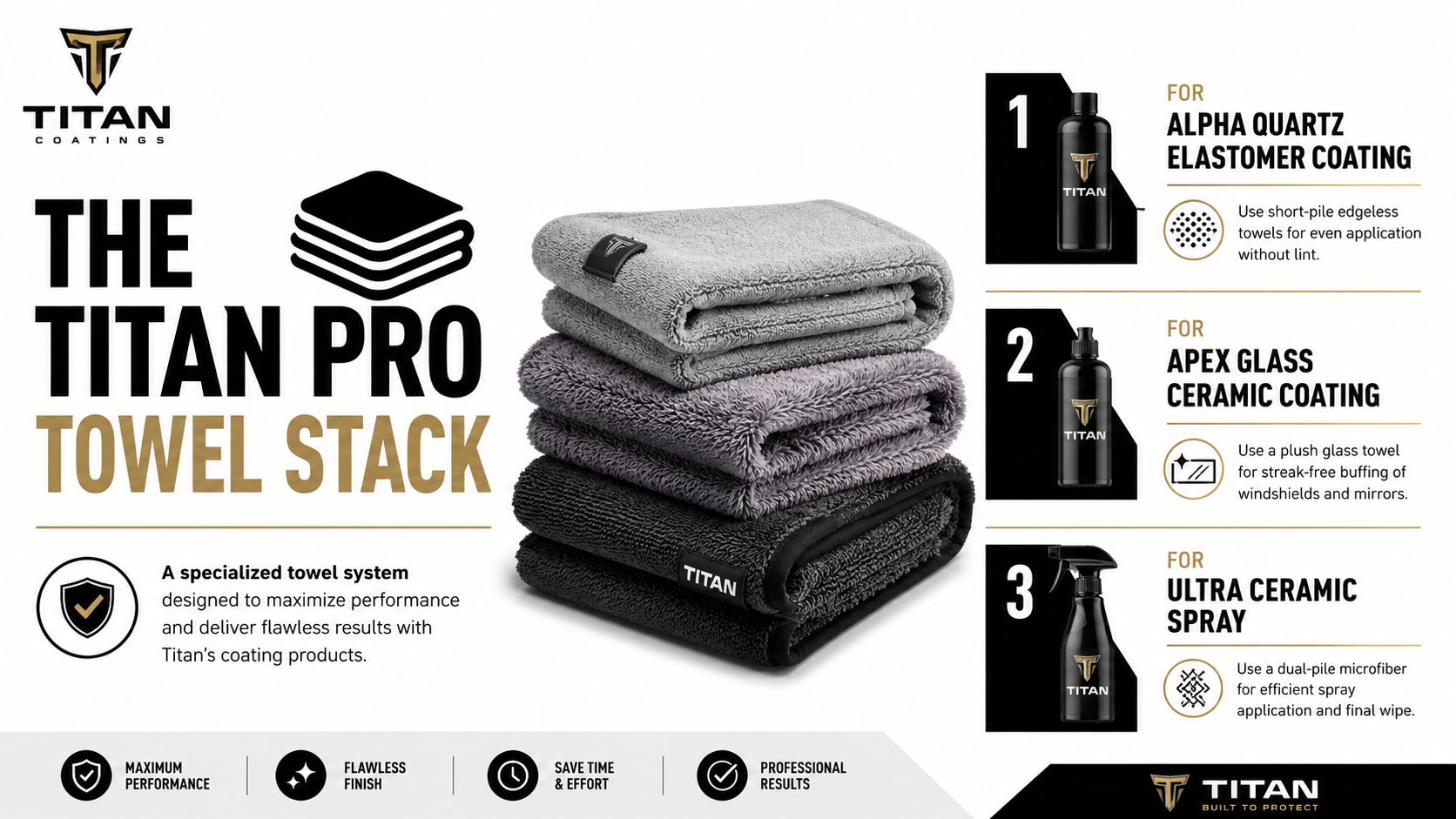
Here’s the stack I’d run if I wanted fewer mistakes and cleaner finishes. For Alpha Quartz, start with a waffle weave for drying, then use a short-pile edgeless towel for leveling and a long-pile towel for the final buff. That order matters, because you want the panel clean and dry before the coating touches it, then you want the towel to remove residue without smearing it back across the surface.
For APEX Glass, keep a dedicated waffle or low-pile glass towel that never touches paint. Glass towels pick up different contamination, and once that cloth sees paint residue, it stops being a glass towel in any useful sense.
For Ultra Spray, use a dedicated short-pile towel for application, then a separate long-pile towel for the final wipe. That split keeps the product film even and keeps the finish from getting dragged around by one overloaded cloth. Titan’s towel pairing logic fits that workflow, because the coating and the towel should behave like one system.
That’s the part people miss about elastomer coatings. They act hard on the surface, but they still flex under real-world abuse instead of cracking the way brittle products can. The towel’s job is to leave that film uniform, not fight it with lint, grit, or excess drag. Pair the surface, the coating, and the cloth correctly, and you get a finish that stays cleaner and levels more predictably.
Screenshot this stack. Drying, short-pile leveling, long-pile buffing, dedicated glass, dedicated wheels, separate wash loads. If your towel shelf can’t support that, your coating shelf is doing too much work.
If you want a coating and towel system that is built for real bay work, APEX NANO – Titan Coatings gives you products and application logic that fit how detailers finish cars. Use Titan Coatings to build the stack around the surface, the coating, and the towel, not around whatever cloth happened to be cheapest that week.
0 Comments