
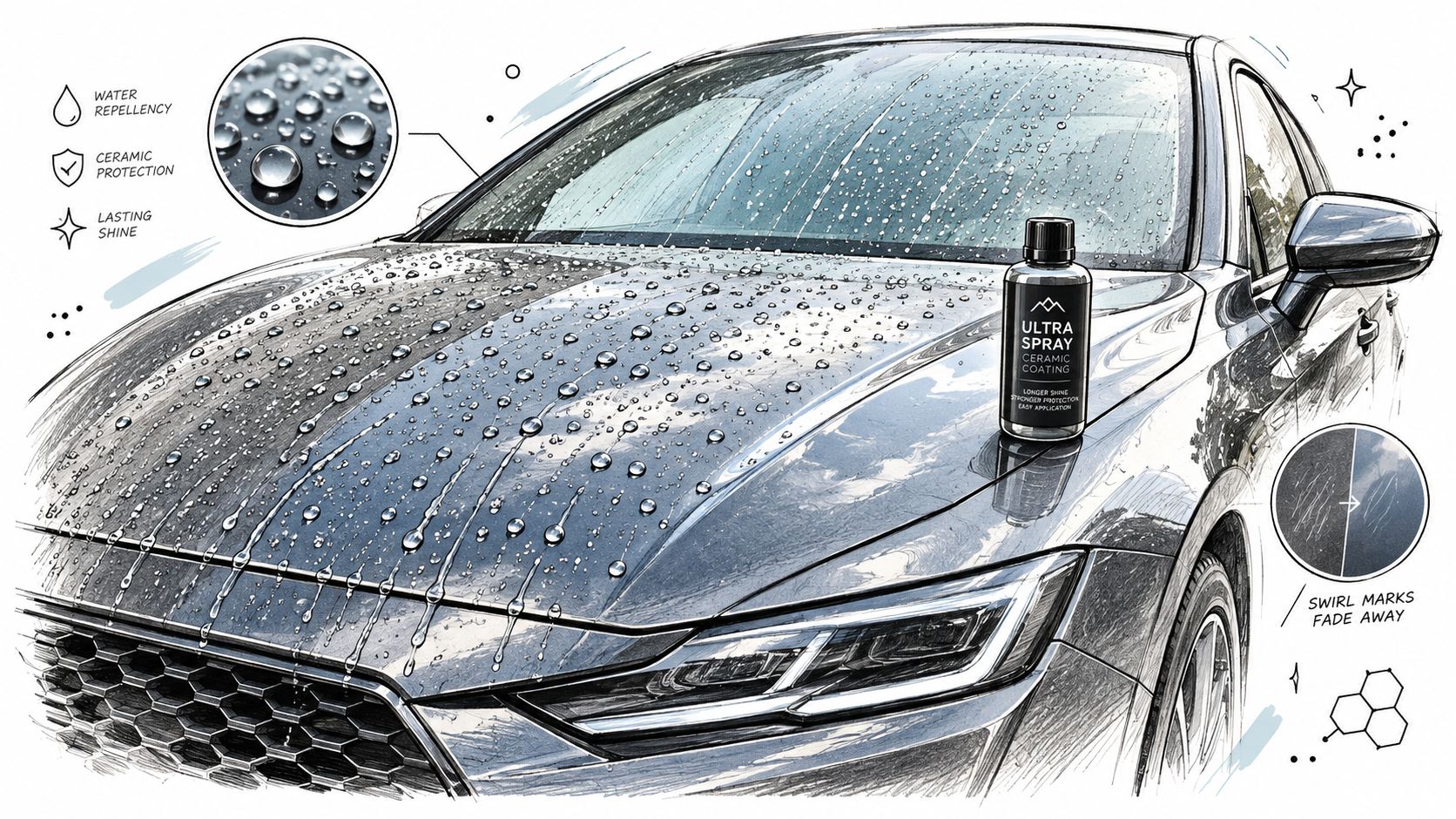
You're driving home through steady rain, watching water bead on the hood while the windshield glare makes every headlight feel sharper than it should. The next morning, the paint still looks glossy, but a wash reveals fine swirls, road film, and the first signs that a coating's shine doesn't tell the whole story. You wanted protection. What you got depends on the film's structure, the preparation underneath it, and whether the coating can handle movement as well as contamination.
That's where 3D ceramic coating enters the conversation. The phrase can describe a dense, cross-linked protective film, a marketing label for added depth, or a newer membrane approach designed to combine glass-like hardness with flexibility. Those differences matter. A hard film may resist chemicals well, yet a brittle layer can struggle when a surface expands, contracts, or takes repeated impact.
This guide follows the coating from its nanoscale structure to the situations you face on the road. You'll learn what “3D” can mean, how standard ceramic films compare with Titan's Elastomer concept, why water beading isn't the same as abrasion resistance, and which tests can turn a glossy promise into a measurable claim.
By the end, you'll be in a better position to match a coating to your climate, driving habits, surface, and application skill. You'll also know why preparation remains just as important as the bottle you choose.
Introduction What 3D Ceramic Coating Promises Drivers Today
After a wet commute, water tightens into beads, rolls toward the panel edges, and leaves the hood looking freshly detailed. That response is satisfying, yet it represents only one part of the protection story. A surface can repel water and still require careful washing, controlled chemical exposure, and thorough preparation.
The term 3D often describes a cured coating's three-dimensional network, rather than a simple liquid layer resting on the paint. It can also refer to visual depth. A smoother, denser film gives light a clearer path to reflection, producing the rich, wet appearance associated with premium ceramic protection.
The useful question is not whether a bottle carries the 3D label. Ask what the cured film is designed to withstand.
A glossy surface catches your eye. A well-selected coating earns its keep through preparation, bonding, flexibility, and resistance to the conditions it will face.
That distinction matters as ceramic coatings reach beyond enthusiast garages. The global ceramic coating market was estimated at USD 13.78 billion in 2026 and is projected to reach USD 22.93 billion by 2032, with an implied 8.81% compound annual growth rate over that period, according to 360iResearch's ceramic coating market overview. Automotive detailing is one end-use segment among aerospace, defense, industrial, and healthcare applications.
Market growth does not make every automotive product industrial-grade. It does show why buyers should ask application-specific questions. A windshield coating, flexible paint coating, spray topper, and machinery thermal barrier face different stresses and need different evidence.
Titan's Elastomer membrane reframes the 3D idea as a balance between hardness and movement. Its intended role is a glass-like protective surface that can flex through temperature swings and absorb the demands of everyday impacts, rather than behaving like a rigid shell. Verify that promise through relevant ISO and ASTM testing, such as methods addressing adhesion, abrasion, chemical resistance, or flexibility, instead of relying on gloss or bead formation alone. The rest of this article examines the film's nanoscale structure, Titan's nanotube-enhanced Elastomer approach, measurable hydrophobic performance, and practical ways to judge durability beyond shine.
How 3D Ceramic Coating Works at the Nanoscale
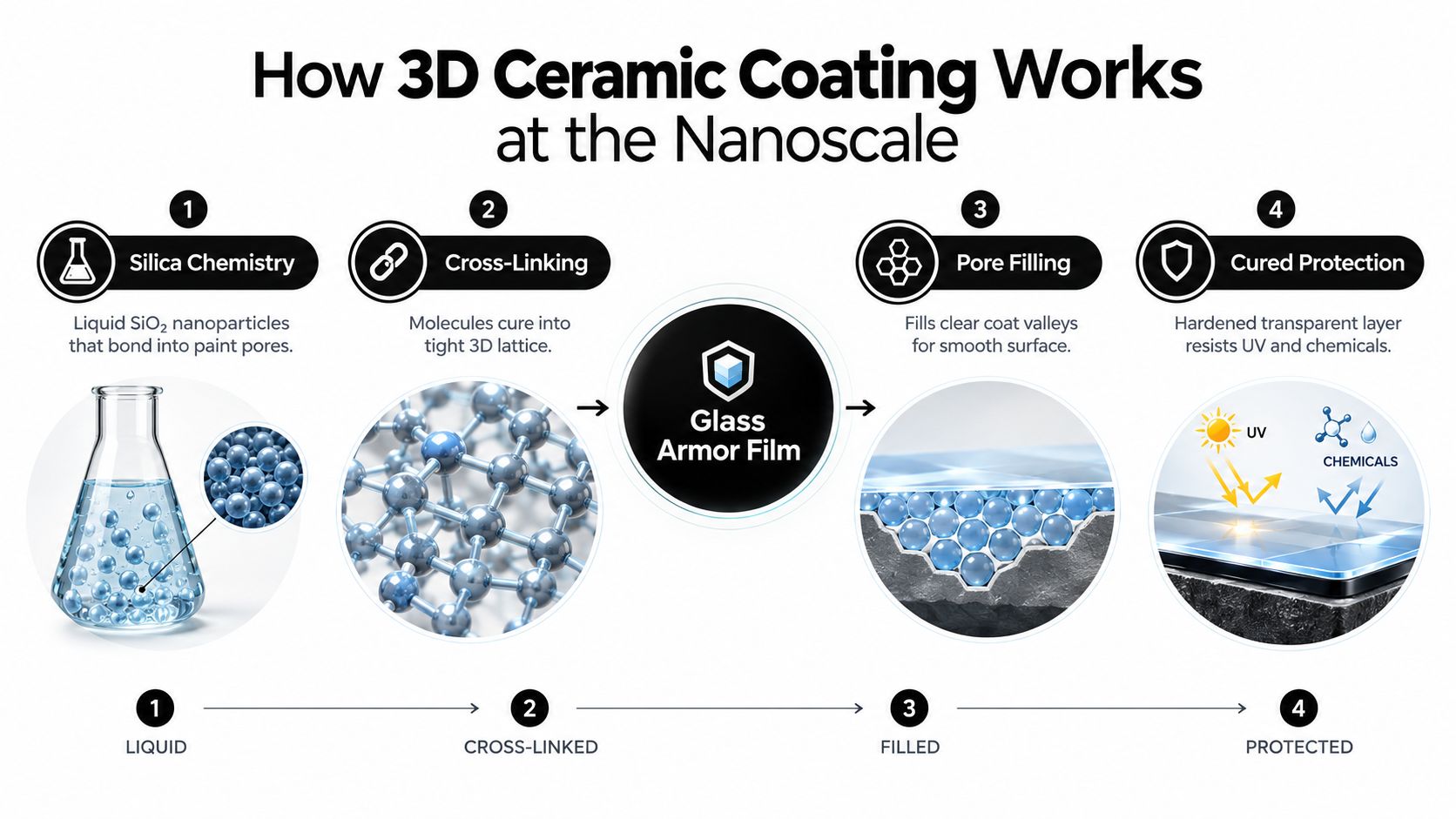
Start with the liquid inside the bottle. Automotive ceramic coatings are typically silica-rich films that chemically bond as they cure. Silica, often discussed through SiO₂ chemistry, provides the foundation for a hard, transparent surface. The liquid must spread evenly across a clean substrate before its reactive components connect and form a more stable structure.
Think of clear coat as a terrain of tiny valleys and peaks. A coating doesn't make the underlying paint disappear. Instead, it wets those microscopic irregularities, fills some of the visual texture, and creates a more continuous surface for light to reflect from.
From liquid chemistry to glass-like armor
As the coating cures, molecules connect through cross-linking. The result is less like a sheet of plastic laid over paint and more like a connected three-dimensional lattice. This architecture helps explain why a cured ceramic film can feel harder and resist chemical attack more effectively than a conventional wax.
“3D depth” has two meanings in everyday use:
- Structural depth: The cured network has connected dimensions through the film, rather than behaving like a loose, easily displaced residue.
- Optical depth: A smooth, clear surface reflects light with fewer scattered highlights, making the paint look richer and more liquid.
Automotive ceramic films can last about one to three years, depending on formulation and maintenance, according to the peer-reviewed discussion of automotive ceramic coatings. The same source notes an important preparation risk. Because the coating creates a dense, hard surface, it can lock in swirl marks, tar, and fine scratches that remain underneath.
Why flexibility changes the picture
Traditional explanations often stop at hardness. Titan's approach adds another design goal through its proprietary Dark Matter Technology and nanotube-enhanced Elastomer coatings. The intended behavior is a film that's hard like glass yet flexible, allowing the protective layer to accommodate movement instead of treating every thermal or impact event as a fracture opportunity.
That's the central idea behind Titan's nano coating for cars. Hardness can help resist contamination and surface marking, while flexibility can help the film remain intact when the coated surface experiences stress. The two properties aren't identical, and one can't automatically replace the other.
A good analogy is a phone screen protector with a rigid feel but enough compliance to absorb small movements. It still presents a hard outer face, yet its underlying structure doesn't behave like a thin pane of brittle glass. That balance is what makes an Elastomer membrane relevant to drivers who deal with freezing weather, hot panels, road debris, or frequent washing.
How 3D Ceramic Coating Compares to Standard Ceramic Coatings
The easiest way to understand the market is to separate three ideas that are often blended together. Standard ceramic coating generally emphasizes a hard, chemically bonded silica-rich film. 3D ceramic coating may describe a cross-linked film with added emphasis on depth, density, or layered structure. Titan's Elastomer membrane adds flexibility as a primary performance characteristic.
None of those labels tells you everything by itself. The formulation, substrate, application process, and maintenance routine still decide the outcome.
| Feature | Standard Ceramic | 3D Ceramic Marketing Claim | Titan Elastomer Membrane |
|---|---|---|---|
| Primary emphasis | Hardness, gloss, and chemical resistance | Added depth, dense structure, or advanced nanotechnology | Hard surface combined with elastic flexibility |
| Surface feel | Smooth and glass-like after curing | Smooth and optically rich when properly applied | Hard like glass while designed to flex |
| Temperature movement | Depends on formulation and substrate | Depends on formulation and test evidence | Flexibility is intended to help the film accommodate temperature change |
| Impact behavior | Can vary, especially with thin or rigid films | Claim requires application-specific verification | Elastic behavior is positioned to reduce cracking from movement and impacts |
| Best buying question | What tests support hardness and durability? | What does “3D” describe in measurable terms? | How does the membrane perform under cycling, abrasion, and chemical exposure? |
Hardness isn't the whole durability story
A rigid coating can feel impressive during an initial inspection. It may provide a slick finish and help resist common contamination, but a film that cannot accommodate movement may be more vulnerable when the panel repeatedly shifts between cold and heat.
Titan presents its Elastomer coatings as a way to combine glass-like hardness with flexibility. The objective is not to make a soft coating. It's to create a protective membrane that can flex rather than crack when the surface experiences thermal change or impact.
Alpha Quartz is the relevant example for painted surfaces, wheels, plastic, and PPF or vinyl. It's positioned for DIY users and mobile detailers who need a coating that can be applied outside a permanent studio environment. Buyers comparing products should still ask for application instructions and performance evidence rather than treating the word “elastomer” as a substitute for testing.
Before choosing, compare the claims against your actual conditions. A garage-kept weekend car may prioritize optical finish and easy maintenance. A daily driver exposed to winter grit, insects, road salts, and strong sunlight may benefit more from a flexible film architecture. The graphene coating versus ceramic coating comparison can help clarify why a coating's chemistry and structure matter more than a fashionable label.
Performance Claims Decoded From Gloss to Chemical Resistance
A strong water bead is easy to see. Chemical resistance, adhesion, and abrasion behavior are harder to judge from a driveway inspection. That's why coating evaluation should move from the visible claim to the measurable property behind it.
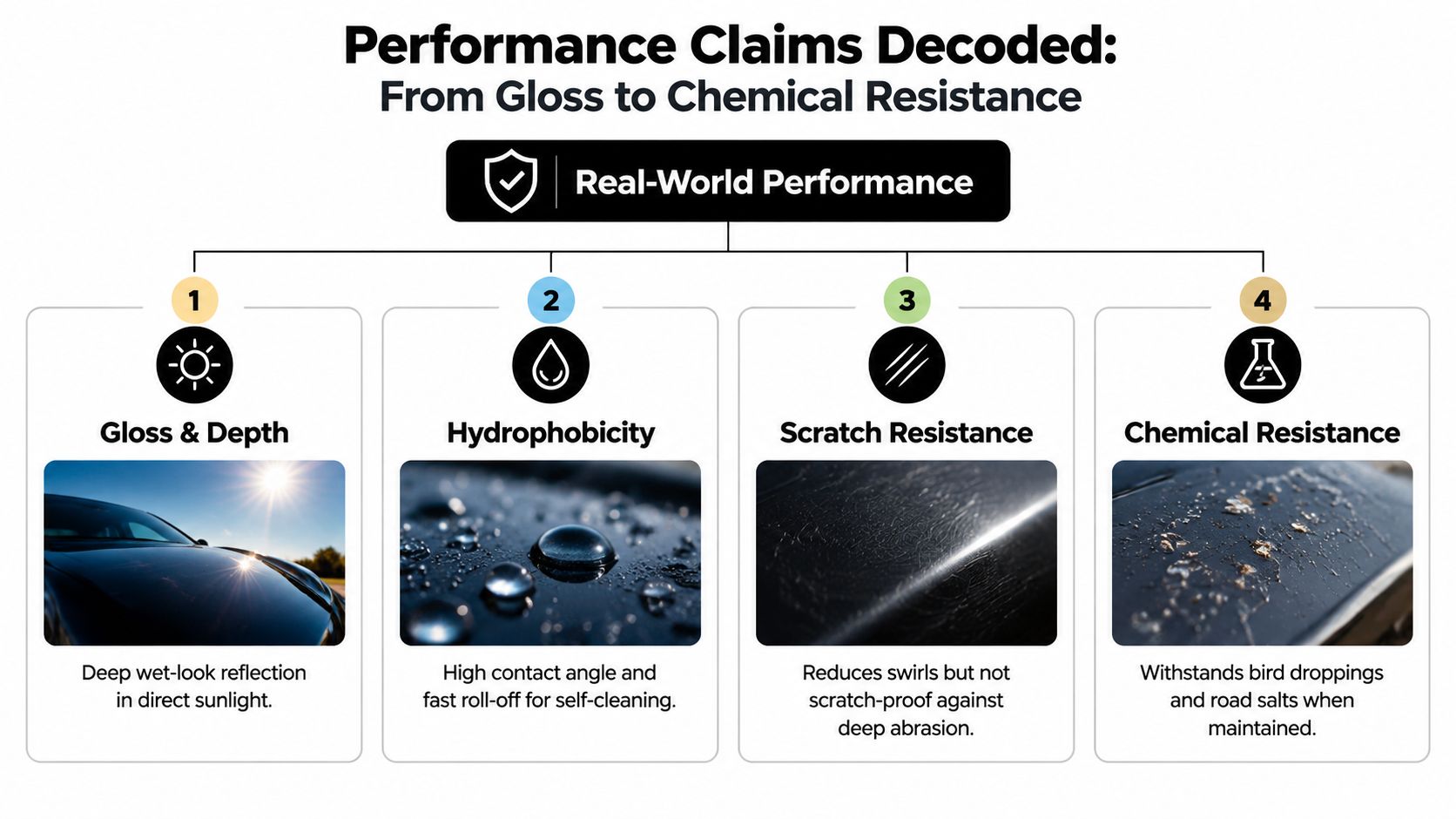
Gloss and depth are optical results
A smooth cured film can make reflections look cleaner and paint appear deeper. Direct sunlight exposes the difference quickly. If the surface is properly corrected, the coating can sharpen reflections and give dark paint a richer wet-look appearance.
The coating doesn't erase defects that were already present. It can preserve them beneath the cured layer, which is why polishing, tar removal, and panel inspection should happen before application.
Hydrophobicity has a more technical measurement than “water beads nicely.” Researchers evaluate water contact angle, which describes how widely a droplet spreads, and roll-off angle, which indicates how much the surface must tilt before the droplet moves.
What water behavior can and can't prove
Independent research on ceramic and nanoceramic surfaces has recorded water contact angles around 163° with roll-off angles near 6°, a combination associated with strong water shedding and self-cleaning behavior, as reported in this PubMed-indexed study of superhydrophobic ceramic surfaces. Those measurements describe wetting behavior, not every aspect of service life.
The same research context matters because a coating can shed water rapidly without automatically resisting abrasion or remaining chemically stable over extended use. Dirt can still accumulate in low spots, contaminated water can dry on the panel, and aggressive washing can gradually affect the surface.
Scratch and chemical resistance need careful wording
A ceramic film may reduce the visibility or frequency of light wash marring, but it isn't scratch-proof. Deep abrasion can still reach the clear coat, especially when a sharp object or abrasive contamination applies concentrated force.
Chemical resistance is similarly conditional. Bird droppings, bug residue, road salts, and acidic contamination should be removed promptly. A coating buys time and adds a protective barrier, but it doesn't make maintenance optional. Product-specific evidence, such as the testing information discussed in Titan's chemical resistance test resource, is more useful than a broad promise printed on packaging.
Practical rule: Treat beading as a maintenance signal, not a complete durability certificate.
The most persuasive coating is not always the one with the most dramatic water video. Look for a clear description of the substrate, preparation requirements, expected maintenance, and test method. That's how you separate visual performance from protective performance.
Where 3D Ceramic Coating Shines From Daily Drivers to Glass
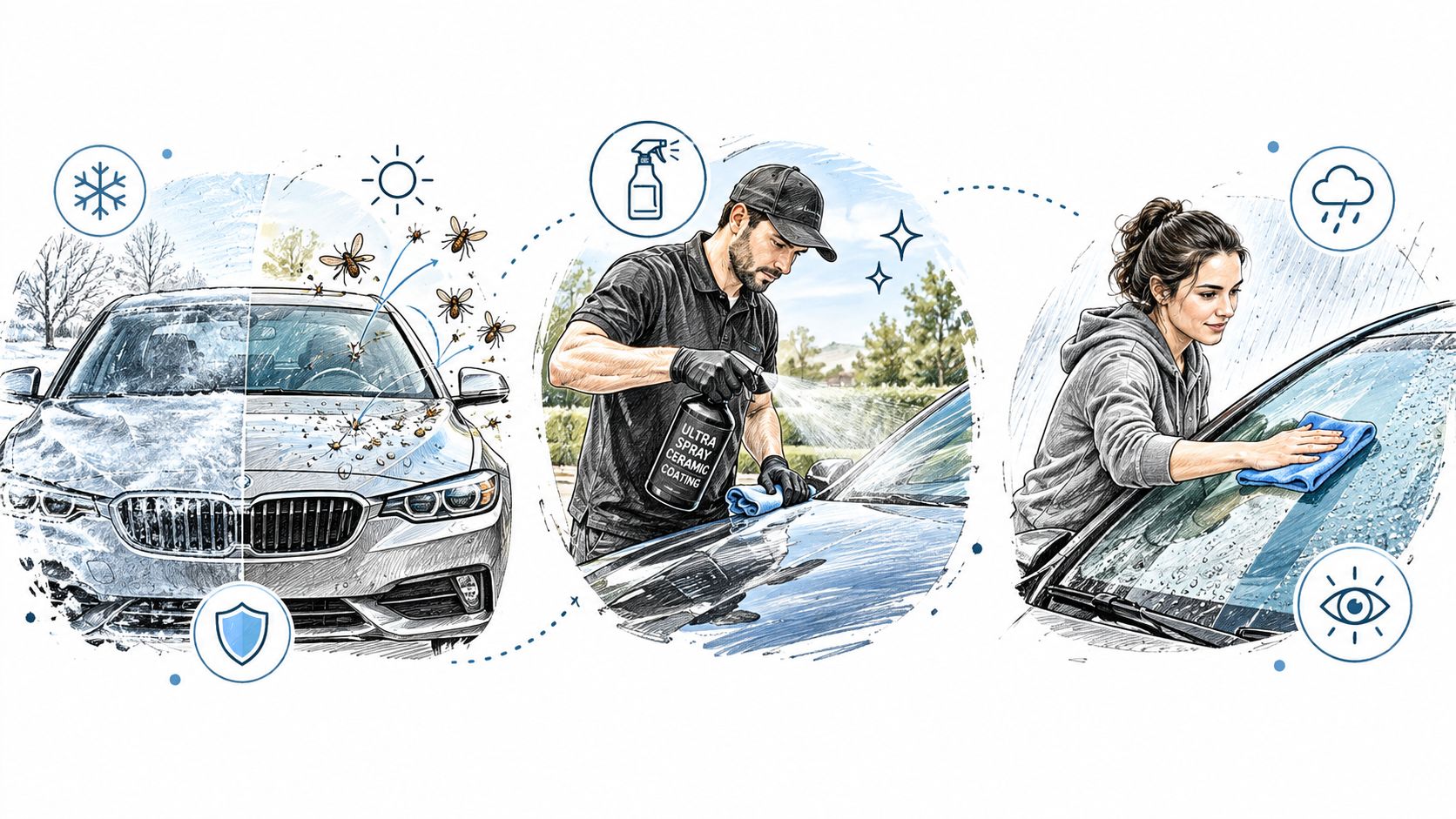
A commuter in a cold climate experiences coating performance differently from a weekend detailer. Frost, road film, insects, and repeated temperature changes test the vehicle every day. A detailer focuses on working time, wipe-off behavior, lighting, and whether the product suits a mobile setup.
The right recommendation depends on the surface, exposure, and installation conditions.
The driver who can't see clearly in rain
Windshield glare and slow-moving water create a different concern from paint contamination. Apex Glass Ceramic Coating is made for automotive glass and windshields, where water behavior affects visibility and wiper use. Titan's product page describes water shedding at 30 MPH, so review the conditions and instructions behind that claim on the Apex Glass Ceramic Coating page.
Clean, decontaminated glass without oily residue gives the coating a consistent surface. The result can be rain that clears more readily while driving, especially when the wipers are in good condition and the glass has been properly prepared.
The mobile detailer working outdoors
A mobile detailer needs a coating that can be installed without a permanent bay. Alpha Quartz is presented as an easy-to-install Elastomer coating for DIY users and mobile professionals. Its membrane concept combines glass-like hardness with flexibility, helping the film stay intact through movement, temperature changes from frozen conditions to hot panels, and impacts such as insects striking the vehicle's front.
That flexibility separates an Elastomer membrane from a coating that cures rigidly. The film can move with the surface instead of behaving like a brittle shell. It may suit painted surfaces, wheels, plastic, PPF, and vinyl when the required cleaning and curing steps are followed.
The owner who wants a quick refresh
Ultra Ceramic Spray 4.0 uses Titan's Dark Matter Technology and is designed for fast application on paint, PPF, wraps, and trim. It fits a DIY owner seeking flexible protection without the preparation and installation demands of a more involved coating. Follow the product-specific directions on the Ultra Ceramic Spray product page.
For any of these use cases, separate a product's intended application from its marketing gloss. A flexible coating can be useful on a daily driver, while a glass coating addresses a visibility problem and a spray suits a quick refresh. Choose according to the surface and exposure, then verify durability claims through the stated ISO or ASTM test method rather than relying on a dramatic water video.
How to Test Verify and Apply Your Coating With Confidence
A professional evaluation starts before the bottle is opened. Walk around the vehicle under strong, even lighting and identify swirls, tar, oxidation, old wax, and bonded contamination. A coating cures over what you leave behind, so paint correction is a preparation decision, not an optional cosmetic upgrade.
Use a disciplined application sequence
Clean the substrate: Wash thoroughly, remove traffic film, and decontaminate the surface. Glass requires special attention because invisible oils can interfere with uniform coverage.
Correct visible defects: Polish paint where needed before applying a hard, transparent film. Don't assume the coating will hide scratches or swirls permanently.
Control the environment: Work in a shaded, clean area with stable conditions. Mobile detailers should plan around dust, direct sun, wind, and sudden moisture.
Apply in manageable areas: Follow the manufacturer's spread, flash, and buffing instructions. Inspect from multiple angles so high spots don't cure unnoticed.
Protect the cure: Keep the vehicle away from contamination and moisture for the period specified by the product. Later maintenance should use compatible wash methods rather than abrasive shortcuts.
Ask what testing actually means
ASTM D6944 is a recognized practice for determining cured coating resistance to thermal cycling, as described in this technical reference on thermal cycling durability. That matters for flexible and rigid films alike because repeated hot and cold exposure tests the coating's ability to stay attached and intact.
Other verification programs may include scratch resistance, film hardness, adhesion, UV and condensation weathering, and cyclic salt-fog exposure. ASTM D5894-96 covers cyclic salt fog and UV exposure, while ISO 15184 and ASTM D3359 are used for hardness and adhesion-style checks, according to HAMK's long-term durability testing resource.
Nanocomposite research also gives a useful reason to examine structure, not just marketing language. Nanophase additions can improve thermal-expansion compatibility and help deflect cracks during cycling, while a 2025 review reported improved thermal cycling life when nanostructure loading reached about 8% unmelted nanoparticle matrix content, as discussed in this review of nanostructured thermal barrier coatings.
Use Titan's coating testing resource as a starting point for questions about test methods, process control, and product fit. A test name doesn't guarantee that a particular bottle passed every method, so ask for the exact product, substrate, conditions, and result.
Choosing Your 3D Ceramic Coating and Next Steps With Titan
The right coating depends on what you need the film to survive. A daily driver exposed to freezing mornings, hot body panels, insects, and road contamination has different priorities from a show car stored indoors. A windshield needs optical clarity and water shedding, while PPF, vinyl, trim, and painted panels may benefit from a coating that can accommodate movement.
That's the practical case for Titan's Elastomer coating technology. The membrane is designed to be hard like glass and flexible like an elastomer, combining a resistant outer surface with the ability to flex through changing conditions. Flexibility is intended to reduce the risk of cracking when the film moves between frozen and hot environments or receives impact.
Use the product category as your first filter:
- Alpha Quartz: Choose it when you want an easy-to-install flexible coating for paint and other compatible vehicle surfaces, especially as a DIY user or mobile detailer.
- Apex Glass: Choose it when rain visibility and windshield water behavior are the priority. Follow the glass preparation instructions closely.
- Ultra Ceramic Spray 4.0: Choose it when you want a quicker spray application for paint, PPF, wraps, or trim, with Dark Matter Technology in the formula.
Titan says its coating development serves automotive, aviation, marine, and defense applications, with product selection still depending on the surface and expected exposure. You can review available options in the Titan Coatings shop and watch the company's demonstration videos on YouTube before committing to an application.
Don't buy “3D” as a shortcut. Ask how the film bonds, how it handles movement, what maintenance it requires, and which ISO or ASTM tests support the claim. Then choose the coating that fits your climate, surface, and skill level.
APEX NANO – Titan Coatings offers ceramic, glass, Elastomer, and spray coating solutions for drivers, DIY detailers, mobile professionals, and demanding automotive surfaces. Visit APEX NANO – Titan Coatings to compare products, review application guidance, and choose a 3D ceramic coating approach built around both hard protection and flexible performance.
0 Comments