
You’ve just finished washing a vehicle. The paint looks deep, the reflections are sharp, and water is rolling away in tight beads. Then a strong cleaner sits too long on the hood, a fuel splash lands near the filler, or road salt dries into the lower panels. Days later, the surface looks hazy. The gloss has changed. A section that felt hard now feels slightly soft under the towel.
That’s where a chemical resistance test earns its place. A coating isn’t durable because it looks impressive immediately after installation. It has to handle the chemicals, temperature changes, abrasion, and contamination that arrive after the customer drives away.
Why Chemical Resistance Testing Matters for Every Coating
A comeback appointment often begins with a customer pointing to a cloudy patch under a door mirror, a dull ring near the fuel cap, or a windshield that no longer sheds rain evenly. The vehicle may have looked perfect after installation. In service, cleaner residue, fuel, salt, heat, and repeated washing can soften the film, reduce gloss, weaken adhesion, or leave the surface prone to blistering.
One field example is a bug remover left on a sun-heated bumper. Another is wheel cleaner running across a lower door and drying before anyone notices. These exposures rarely resemble a dramatic spill, yet they reveal whether a coating can tolerate the chemicals and temperature changes built into daily use.
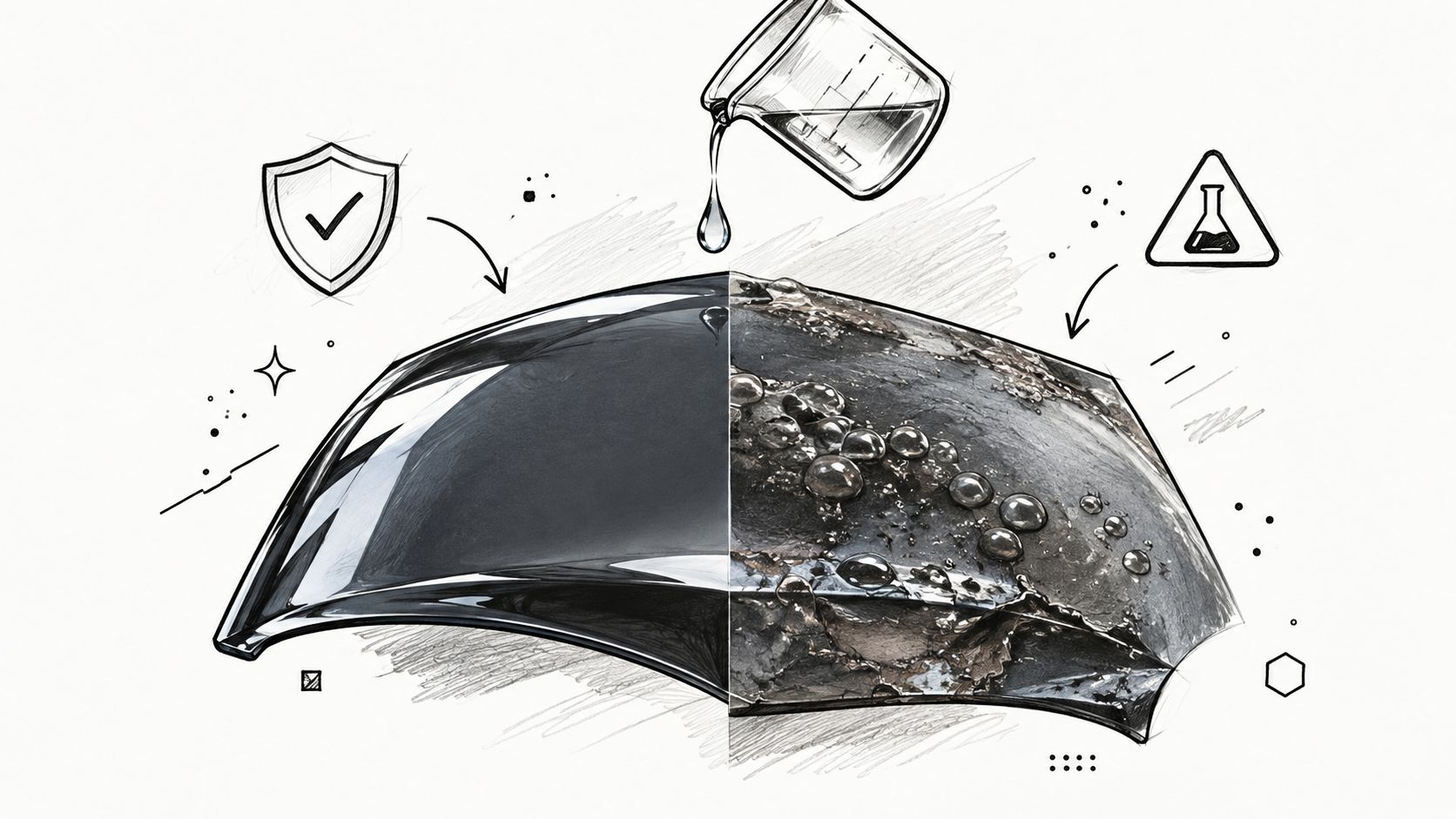
The surface tells a chemical story
A controlled chemical resistance test replaces guesswork with a comparison. Prepared panels receive selected reagents under defined exposure conditions, then technicians inspect changes in appearance, hardness, adhesion, swelling, or cracking. ASTM D543-21 scope update covers plastic resistance to chemical reagents across cast, molded, laminated, and sheet materials, providing a useful reference for interpreting how polymers respond.
That method matters when a coating must flex with the substrate. A rigid film may resist a reagent during a short exposure, then crack as a panel expands and contracts through temperature cycling. An elastic hard coating can absorb that movement while retaining a protective surface, a distinction that matters on automotive panels, marine equipment, and aviation components exposed to changing temperatures and aggressive contaminants.
Why standardized exposure matters
A controlled method lets a shop compare products against the chemical events expected in service. The test should reflect maintenance chemicals, storage conditions, climate, immersion or splash exposure, and the likelihood of repeated contamination. A spot exposure for a cleaner spill cannot answer questions about vapor, immersion, heat, or long-term cycling.
Practical rule: Match the exposure to the service event. Test the chemical, contact time, temperature, and coating system that the finished surface will actually face.
For a daily driver, that may mean wheel cleaner, degreaser, fuel, and road salt. A boat may face salt water and fuel exposure, while an aircraft component may need a film that stays bonded as temperature shifts and solvents contact the surface. Product selection should therefore begin with the substrate and exposure profile, then consider gloss and appearance.
Titan’s car paint protective coatings belong in that evaluation because a protective film must suit the surface and its working conditions. Lab results become useful only when they guide that real-world choice.
Understanding the Main Categories of Chemical Resistance Tests
A chemical resistance test doesn’t mean the same thing for every material. A molded plastic part, an organic clear coat, an elastomer seal, and a construction floor face different failure mechanisms. The useful question isn’t “Did it pass?” It’s “What was exposed, how was it exposed, and what changed afterward?”
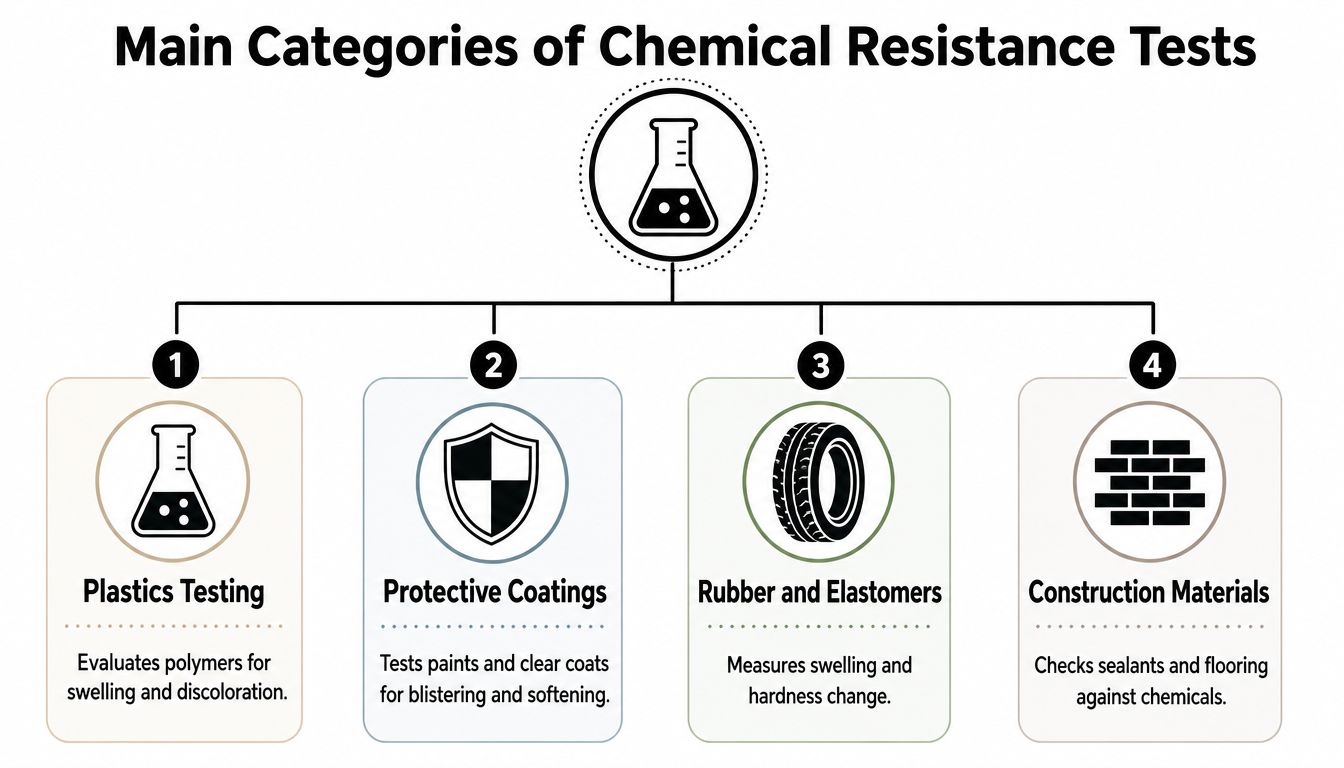
Plastics testing
Plastic testing focuses on how the polymer responds to reagents. The evaluator may look for changes in appearance, dimensions, mass, or other retained properties. ASTM D543 is a foundational reference because it covers several resinous product forms and provides a structured way to compare material behavior after exposure (ASTM D543 scope).
A plastic component might remain visually intact while absorbing a chemical and changing dimension. That matters for clips, housings, tanks, and panels where fit and mechanical behavior are as important as appearance.
Protective coatings
Paints, clear coats, and lining systems need a film-focused evaluation. ISO 2812-1 addresses single-layer and multilayer coating systems exposed to liquids other than water, and it allows the tester to assess damage to both the coating and the underlying substrate (ISO 2812-1 coating resistance).
This category maps closely to detailing. A coating can discolor, lose gloss, blister, soften, swell, or lose adhesion. Those observations help a formulator identify whether the weakness sits at the surface, through the film, or at the bond line.
Rubber and elastomers
Elastomer testing considers movement as well as chemical contact. Swelling and hardness change can reveal whether a flexible material is absorbing or reacting with the liquid. A flexible coating also needs to accommodate substrate movement, impact, and temperature shifts without opening a path for contamination.
That’s why a hard surface alone doesn’t settle the durability question. A film can resist a reagent but still become vulnerable when repeated expansion, contraction, or impact creates microcracks.
Construction and high-consequence materials
Construction materials include sealants, flooring, and protective systems that may encounter standing chemicals or repeated cleaning. The relevant exposure can be longer and more severe than an incidental automotive spill.
The same principle applies to specialized coatings. ASTM D3912-10(2023) evaluates coatings and linings used in nuclear power plant service levels I and II, illustrating how high-consequence industries formalize chemical performance instead of relying on informal wipe checks (ASTM D3912-10(2023)).
A useful mental map looks like this:
- Plastic specimen: Track material change after reagent exposure.
- Coating film: Track surface appearance, film integrity, and substrate damage.
- Elastomer: Track chemical uptake, swelling, hardness, and flexibility.
- High-consequence lining: Relate exposure conditions to service-level requirements.
Once the category is clear, the choice between spot, immersion, and vapor exposure becomes much easier.
Key ASTM and ISO Standards Every Detailer Should Know
A cleaner spill on a vehicle hood, salt-laden spray on a boat fitting, and chemical vapor around an aircraft component pose different questions. A supplier’s technical sheet may list the same standard for all three, yet the method may not match the exposure. Read each reference as a description of the test question, then compare it with the coating’s actual service.
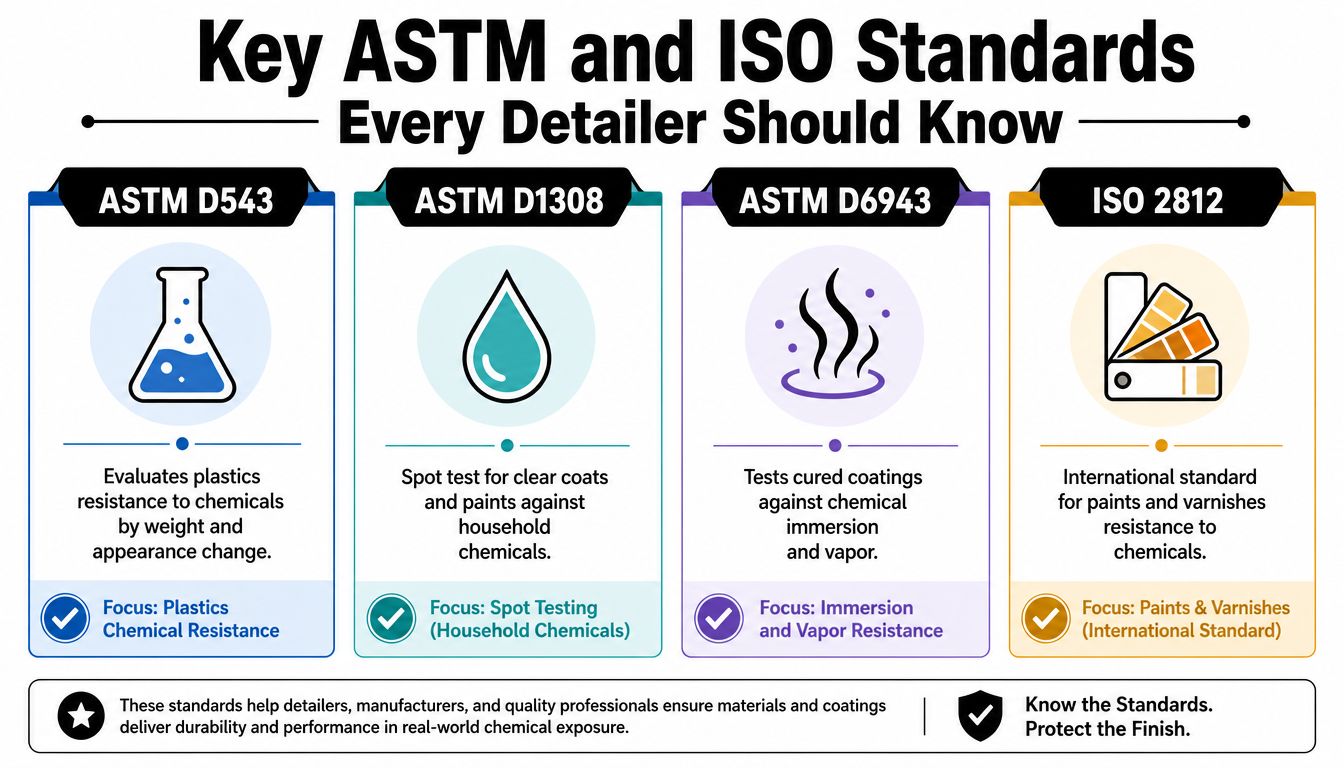
ASTM D543 for plastics
ASTM D543-21 evaluates how plastics respond to chemical reagents. Its scope includes cast, hot-molded, cold-molded, and laminated resinous products, as well as sheet materials. That makes it useful when the specimen is a plastic component rather than a conventional coating panel.
The working sequence is simple:
- Identify the plastic form and reagent.
- Expose the specimen under controlled conditions.
- Inspect appearance and material changes.
- Compare the result with the intended service requirement.
Use it as a screening foundation. A favorable plastic result does not establish that a finished automotive coating will withstand every cleaner, fuel, or temperature cycle in service.
ASTM C581 for thermosetting resins
ASTM C581-20 applies to thermosetting resins used in reinforced thermosetting plastic laminates. It examines hardness, weight change, thickness, appearance, and flexural strength or modulus after reagent exposure. The standard also states that it has no known ISO equivalent, so a marine or industrial specification naming this method should be followed directly. The ASTM C581 reference should match the standard named in the project documents.
For a laminate, a change in thickness or flexural behavior may carry more weight than a small visual shift. That distinction matters when an elastic hard coating must flex with a panel instead of cracking as a rigid film would.
ISO 17491-5 for protective clothing
ISO 17491-5:2024 determines resistance of complete protective clothing to inward leakage of liquid chemicals. Its method aligns with ASTM F1359, according to the ISO 17491-5 context.
This is not a car-paint procedure. It still illustrates a useful testing lesson: chemical protection can involve penetration and leakage, not only visible surface damage.
ISO 2812-1 for paints and varnishes
ISO 2812-1 provides an international reference for coating systems exposed to liquids other than water or paste-like products. It can assess the coating response and, where needed, damage to the substrate.
For automotive, marine, and aviation programs, ask whether the tested system matches the actual substrate, preparation, film build, topcoat, and liquid. A standard creates a common language, but the specimen and exposure still determine how useful the comparison is.
ASTM D1308 for organic finishes
ASTM D1308-20 suits short-term spot exposure of clear and pigmented organic finishes. It examines household or service chemicals and records effects such as discoloration, gloss change, blistering, softening, swelling, loss of adhesion, and other objectionable surface defects.
A detailing shop can use it when comparing cleaners, fuels, or maintenance chemicals. It answers a focused question: how does the finish respond to controlled incidental contact? It does not establish indefinite immersion durability.
Corrosion projects require the chemistry and environment to stay connected. A coating that passes a spot check may still need salt exposure, cyclic weathering, and substrate-corrosion evaluation. Titan’s salt spray corrosion testing resource fits that broader qualification process.
How Spot Immersion and Vapor Tests Work in Practice
A cleaner splashes a door panel, fuel sits against a marine component, or aviation equipment rests in a solvent-rich enclosure. The coating may face the same chemical in each case, yet the contact method changes the result. Spot testing models a localized spill, immersion surrounds the specimen, and vapor exposure challenges the film without direct liquid contact.
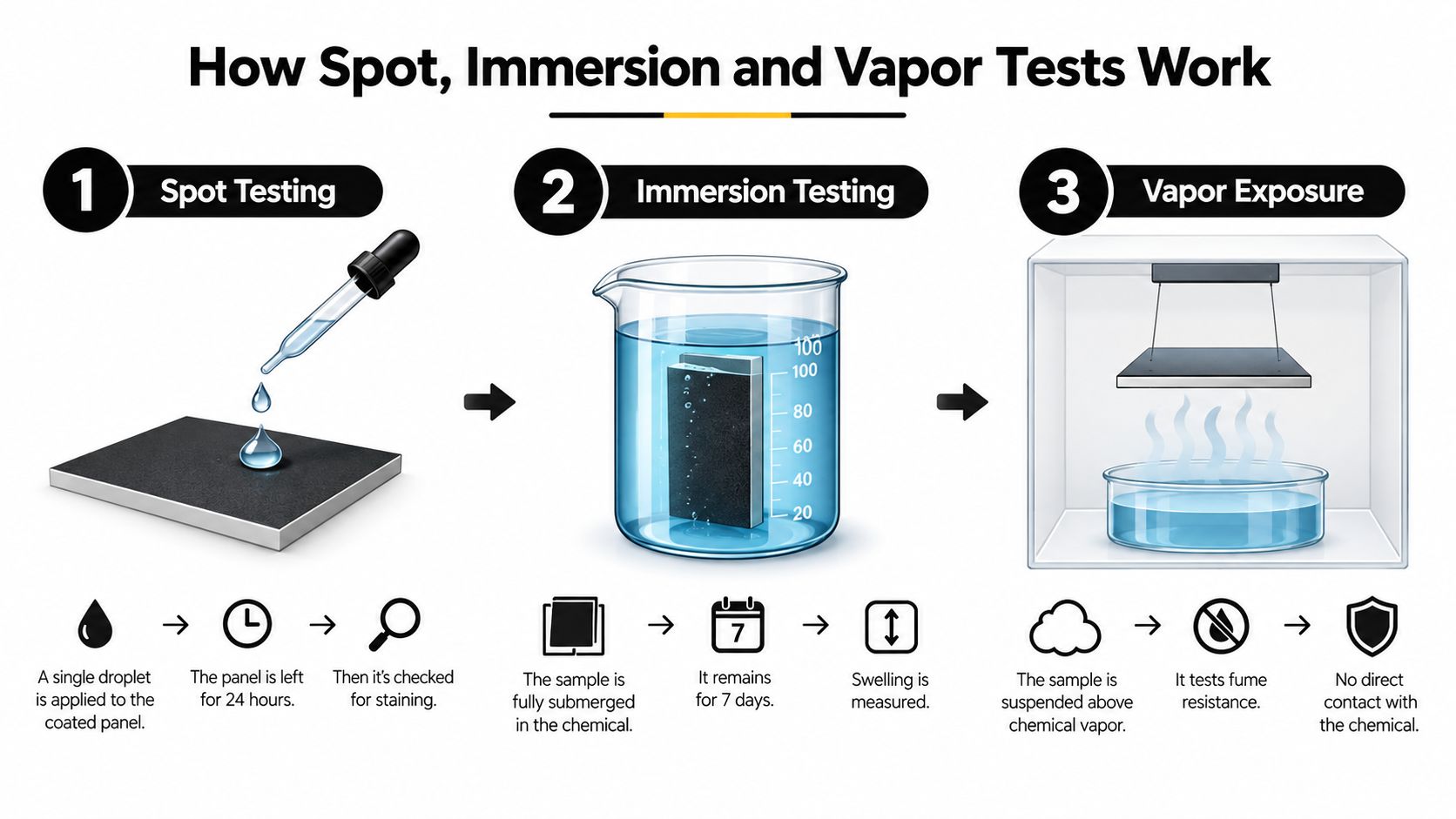
Spot testing
The technician prepares a clean, cured panel and applies a measured amount of reagent to a defined area. A cover can limit evaporation when the selected procedure calls for it. After the specified dwell, the operator removes the reagent, cleans the area consistently, and examines the film.
ASTM D1308 provides procedure options for short-term spot exposure, with commonly cited dwell points including 1, 24, or 48 hours. These intervals support controlled comparisons, but they do not represent every service exposure. The coating chemical-resistance testing guide offers additional practical context for setting up this type of evaluation.
A short spot test fits a cleaner splash, fuel drop, or maintenance chemical left briefly on a panel. It can expose staining, gloss loss, softening, or swelling before a shop approves a coating for repeated field use.
Immersion testing
Immersion places the specimen fully in the reagent, keeping the exposed area in constant contact. The bath can reveal absorption, swelling, dimensional change, or deeper chemical attack that a surface droplet may miss.
Use this method when service includes standing liquid, fuel contact, bilge contamination, or a component surrounded by chemical exposure. The result still requires judgment. A quiet bath may be harsher than normal vehicle use, while an actual part also faces stress, heat, abrasion, and weathering.
Vapor exposure
Vapor testing suspends a specimen above the liquid or places it in an atmosphere containing the reagent’s vapors. The liquid never touches the surface directly, but the surrounding atmosphere can still interact with the film.
This method suits fumes, enclosed storage, fuel vapor, and chemical processing areas. It may expose a barrier weakness that a quick wipe misses, particularly when the coating must retain protection as well as appearance.
A controlled dwell time makes comparisons useful. An uncontrolled exposure only creates an anecdote.
For automotive, marine, and aviation work, record the reagent, application condition, cure state, contact mode, temperature, dwell, cleaning method, and observations. Flexible hard coatings deserve testing under temperature cycling and chemical contact, since their elastic response can accommodate movement where a rigid film may crack. A product such as Titan Solvent Resistant Spray Paint can then be assessed against the actual job, rather than an undefined promise of “chemical proof.”
Reading Test Results and Spotting Coating Failure Early
A test panel rarely announces failure with one dramatic event. More often, the technician sees a sequence. The color shifts first. The reflection becomes uneven. The film feels different under the cloth. Later, the coating may blister or release at an edge.
Read the surface in layers
Start with appearance. Discoloration indicates that the film or pigment has changed. Gloss loss may signal surface attack, even when the coating still looks intact from a distance. A small haze can become a maintenance problem because dirt and oils often cling differently to a damaged surface.
Next, assess physical response. Softening suggests that the chemical has affected the film’s cohesion. Swelling indicates uptake or expansion. Blistering points to localized separation or trapped interaction beneath the surface. Loss of adhesion is more serious because the coating no longer maintains its bond to the substrate.
ASTM D1308 explicitly includes discoloration, gloss change, blistering, softening, swelling, and loss of adhesion among the surface changes considered during evaluation (ASTM D1308 failure criteria). ISO 2812-1 also allows assessment of damage to the coating and underlying substrate, so a visually acceptable top layer doesn’t automatically mean the system is sound (ISO 2812-1 evaluation).
Chemical Resistance Failure Modes Quick Interpreter
| Failure Sign | What It Indicates | Next Step |
|---|---|---|
| Discoloration | Chemical interaction with pigment, resin, or surface chemistry | Compare against an unexposed control and identify the reagent |
| Gloss change | Surface attack or alteration of the top film | Check whether cleaning or polishing restores appearance |
| Blistering | Localized separation, swelling, or trapped reaction beneath the film | Inspect adhesion and substrate condition |
| Softening | Reduced film cohesion under contact | Test after cleaning and confirm whether hardness returns |
| Swelling | Chemical uptake or dimensional response | Consider immersion or longer exposure evaluation |
| Loss of adhesion | Bond failure between coating layers or coating and substrate | Stop treating the product as suitable for that exposure |
The visual result should guide the next test, not replace it. A faint haze may need a repeat exposure. A softened film or adhesion failure demands a deeper review of surface preparation, cure, substrate compatibility, and chemical concentration.
For difficult cases, a structured coating failure analysis helps separate chemical attack from abrasion, contamination, poor preparation, or incomplete cure.
Why Elastic Hard Coatings Outlast Rigid Films
A customer once brought in a panel that looked excellent until the temperature changed. The film had resisted routine cleaning, but a brittle section opened along a stressed area after repeated cold-to-hot movement. The problem wasn’t just hardness. The coating had no practical way to absorb the movement beneath it.
Titan built its own coating technology around a different position. The company introduced elastomer coatings using nanotube technology and Dark Matter Technology, combining a hard surface with flexibility. That combination matters because a coating can feel hard like glass while still flexing instead of behaving like a brittle shell.
Hardness without brittleness
A rigid film can offer a pleasing tactile finish, but rigidity becomes a liability when the substrate moves. Vehicle panels, trim, glass, marine structures, and aircraft components all experience changes in temperature and mechanical stress. The coating expands and contracts with the surface, encounters vibration, and receives impacts from contamination such as bugs and road debris.
An elastic hard coating is designed to keep its protective film continuous while accommodating that movement. It won’t eliminate every possible failure, and no coating can compensate for poor preparation or misuse. It does, however, address the mechanical weakness that often sits behind field cracking.
Research on a superhydrophobic multiwalled-carbon-nanotube and silicone composite film reported endurance through more than 4,000 thermal cycles between -30 °C and room temperature (thermal-cycling evidence). That result concerns a specific published composite, not every nanotube coating, but it demonstrates why flexible chemistry deserves attention when temperature cycling is part of the service environment.
Chemical resistance needs mechanical resilience
A short bench exposure may show that a coating resists swelling or softening. The field can still produce a different outcome when UV, abrasion, vibration, temperature changes, and contamination act together. Recent standards activity reflects that wider concern. ISO 11997-1:2026 addresses cyclic corrosion with wet, dry, and humid exposure, ISO 6529:2026 focuses on permeation during continuous contact, and ASTM D6990-20(2026) evaluates marine coating systems in a biofouling context (recent standards activity).
A coating doesn’t protect the substrate if the film cracks open before the chemical reaches it.
That’s the practical case for elastic hard coatings. Flexibility helps the film remain continuous through freeze-to-hot transitions and impacts, while hardness supports resistance to routine contact and surface wear. The result is a more balanced durability strategy than choosing a coating based on hardness alone. Titan’s coating flexibility technology explains that design direction in the context of elastomer protection.
Choosing the Right Coating for Automotive, Marine, and Aviation Use
A winter road test, a marina washdown, and an aircraft service bay expose coatings to different chemical routines. Road salt may dry in seams, fuel can sit around a filler neck, and alkaline wheel cleaner can reach painted panels. Boats face saltwater, standing moisture, cleaning cycles, abrasion, and biological contamination. Aircraft add de-icing fluids, hydraulic contamination, ultraviolet exposure, and tightly controlled maintenance procedures. Product selection starts by matching those contact events to the relevant test method and likely failure mode.
Automotive work starts with the contact event
A daily driver receives repeated, localized attacks rather than one isolated exposure. Bug residue remains on the front end, fuel spills near the filler, and cleaner may pool on wheels or lower panels. A useful qualification review looks for discoloration, gloss loss, blistering, softening, swelling, adhesion loss, or cracking after the expected reagent contacts the film.
Windshield treatment requires a different surface decision. Apex Glass Ceramic Coating is positioned for water behavior on glass, so its relevant service question is whether rain-focused use can be supported without turning application into a lengthy correction job. A mobile detailer should still assess preparation, dwell, removal, and the product information before treating it as a solution for wet-driving conditions. Review the Apex Glass Ceramic Coating alongside the glass exposure and maintenance routine.
Alpha Quartz fits painted or otherwise flexible vehicle surfaces where movement and impact matter. A rigid film can develop cracks after repeated frozen-to-hot transitions or front-end strikes from ordinary contamination. Its elastomer character makes the relevant check less about initial hardness alone and more about whether the coating remains continuous after temperature movement, impact, and subsequent cleaner contact. That makes the product a candidate for mobile and DIY work, provided the intended exposure is confirmed against available product information.
Marine and aviation demand broader thinking
Marine service exposes a coating through overlapping stresses. Saltwater and standing contamination can remain on the surface, while cleaning and abrasion disturb the film. A short spot exposure may miss the failure that appears after repeated wetting, drying, and biological buildup, so the buyer should compare the test duration and conditions with the vessel’s actual maintenance cycle.
Aviation raises the same question with less tolerance for an unsuitable choice. De-icing fluids and service chemicals may contact painted structures while temperature and environmental cycling continue around them. ISO 2812-1 offers a common reference for liquid exposure, but continuous contact, permeation, or cyclic corrosion concerns may call for additional evaluation rather than a single result.
Ultra Ceramic Spray suits a shorter, repeatable application workflow, but the spray format does not replace exposure review. Its product information should be compared with the customer’s likely cleaner, fuel, saltwater, or maintenance contact, especially where uneven coverage could leave early weak points. See the Ultra Ceramic Spray product details before matching it to the exposure profile.
Titan’s shop lets detailers compare available products. Use application videos as preparation and installation references, then verify chemical suitability through product documentation and the test method that best represents the working environment.
Quick Reference Lookup for Tests, Reagents, and Product Matches
A customer reports hazing after fuel splashes, softening under cleaner, or cracks across a panel after temperature changes. Match that failure pattern to the exposure method before choosing a coating.
- Cleaner, fuel, or maintenance splash: Use spot testing based on ASTM D1308. Check discoloration, gloss change, blistering, softening, swelling, and adhesion loss rather than relying on appearance alone.
- Paint or multilayer coating qualification: Use ISO 2812-1 when liquid exposure and possible substrate damage require a consistent reference.
- Plastic component selection: ASTM D543 provides a foundation for evaluating covered plastic forms against chemical reagents.
- Continuous contact or permeation: A short spot exposure may miss gradual penetration. ISO 6529 and related standards activity addresses permeation during continuous contact. Cyclic corrosion conditions require a related method and separate review.
- Workplace chemical handling: Pair coating selection with clear procedures and WHS hazardous chemical controls, particularly when technicians use concentrated reagents or cleaning products.
- Flexible automotive protection: Choose an elastic hard coating when temperature movement, bug impact, and repeated washing challenge film continuity. Alpha Quartz suits DIY and mobile detailer installation, while Ultra Ceramic Spray uses a simpler spray format.
- Glass visibility: For rain-heavy driving, Apex Glass Ceramic Coating targets water behavior and windshield clarity, not paint-film protection.
Record the reagent, contact mode, dwell time, temperature, substrate, and failure sign. Elasticity matters alongside chemical resistance. A hard coating that flexes with the panel can stay continuous through thermal cycling, marine exposure, or aviation service, while a rigid film may crack as the surface moves.
APEX NANO – Titan Coatings offers coating solutions for chemical exposure, surface protection, and elastic hard-film performance across automotive, marine, aviation, and defense applications. Visit APEX NANO – Titan Coatings to compare Alpha Quartz, Apex Glass Ceramic Coating, Ultra Ceramic Spray, and its broader coating technology.
0 Comments