
A first-time buyer can spend ten minutes staring at bottles marked 9H, 10H, SiO2, graphene, pro, and consumer without knowing which one belongs on the car in the driveway. The bottle usually gets the attention, but the result is decided earlier, during preparation, application, and the coating's ability to flex as the panel heats, cools, and takes road abuse.
What an Automotive Ceramic Coating Kit Actually Is
An automotive ceramic coating kit is a workflow packaged in a box, not a magic bottle. A typical kit contains the coating liquid, an applicator block with suede cloths, microfiber towels for leveling and buffing, a panel wipe or surface cleanser, and instructions covering application and curing. Some systems add a base coat, topper, gloves, or trim and glass products.
That distinction matters because a chemically durable coating can still fail when polish oils remain on the clear coat, contamination sits beneath the film, or the installer leaves high spots to cure. The liquid is only one part of the system. The applicator controls film thickness, the towels control residue removal, and the instructions determine whether the coating gets enough time to bond before exposure to water or dirt.
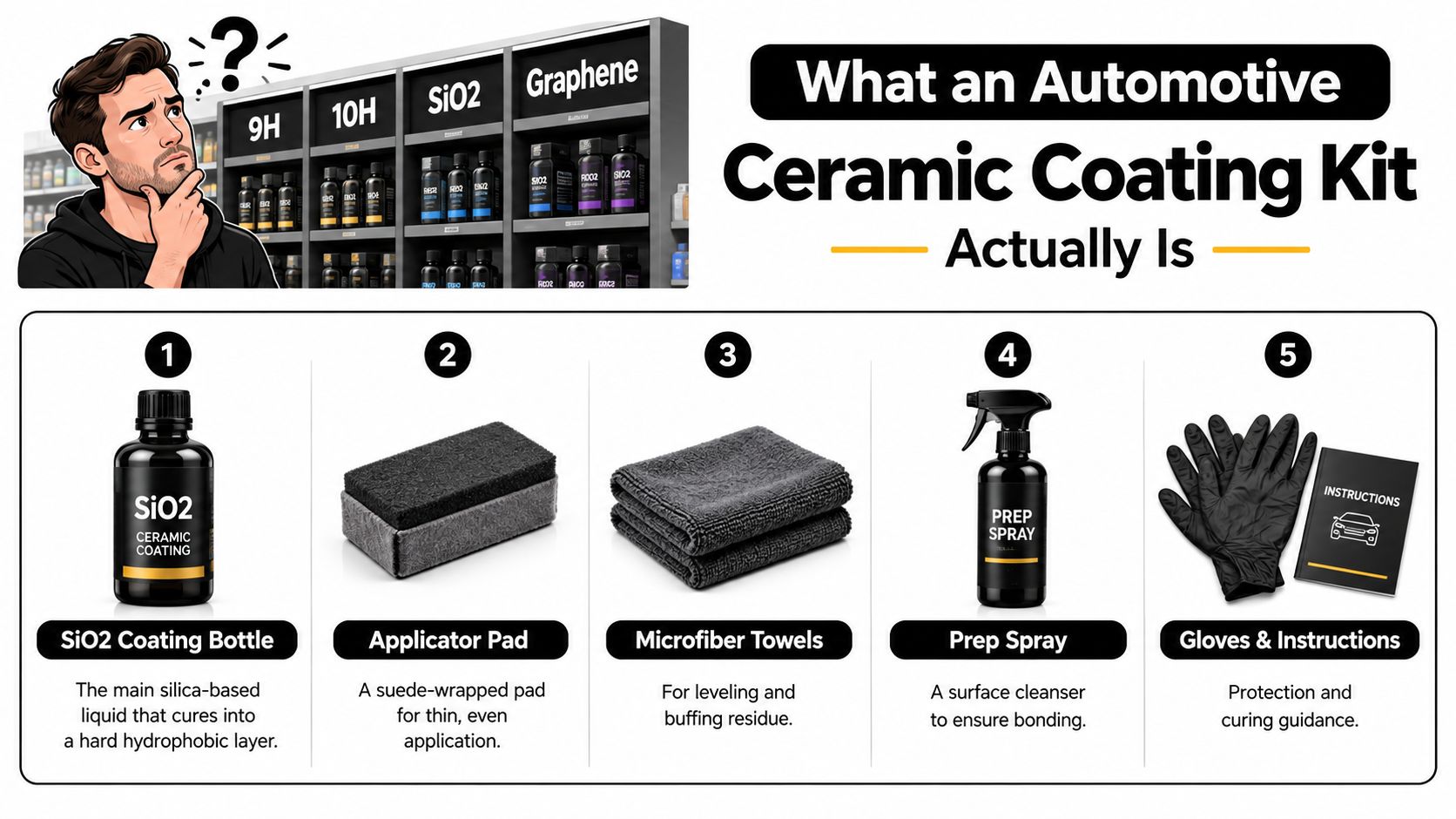
The kit is really a sequence of decisions
The category has grown because owners want durable gloss, easier washing, and water-shedding behavior without repeatedly waxing the vehicle. Market projections estimate the global automotive ceramic coating kits market at USD 720.0 million in 2026, rising to USD 1,583.5 million by 2036, with an implied 8.2% CAGR over that period (Fortune Business Insights). The same outlook identifies SiO2 ceramic spray coatings as the leading product type by demand share, a sign that consumer-ready formats are influencing adoption.
That growth doesn't remove the practical trade-off. A kit with a difficult flash window may suit an experienced detailer but frustrate a first-time installer. A forgiving spray may be easy to use but provide less durable protection. Before buying, read the product as a complete process. The useful question isn't “How hard is the coating?” It's “Can I prepare, apply, level, and maintain this system correctly?”
For a plain-language explanation of the technology, see what ceramic coating means for a vehicle. The answer should help you separate a genuine coating system from a bottle that borrows ceramic language for marketing.
How Ceramic Coating Technology Reached Your Garage
Ceramic coatings entered automotive detailing from industrial and aerospace work, where heat resistance, chemical resistance, wear protection, and durability mattered more than showroom gloss. Detailers adapted that technology for paint, glass, wheels, and trim, but vehicle surfaces introduce movement, impact, and temperature changes that controlled industrial applications do not.
The broader ceramic coatings market was valued at USD 1.96 billion in 2018 and projected to reach USD 3.32 billion by 2026. Asia Pacific represented 41.49% of the market in 2018, according to independent market coverage (Market Intelo). Those figures cover more than automotive kits, yet they show how specialist coating chemistry became a globally scaled commercial field.
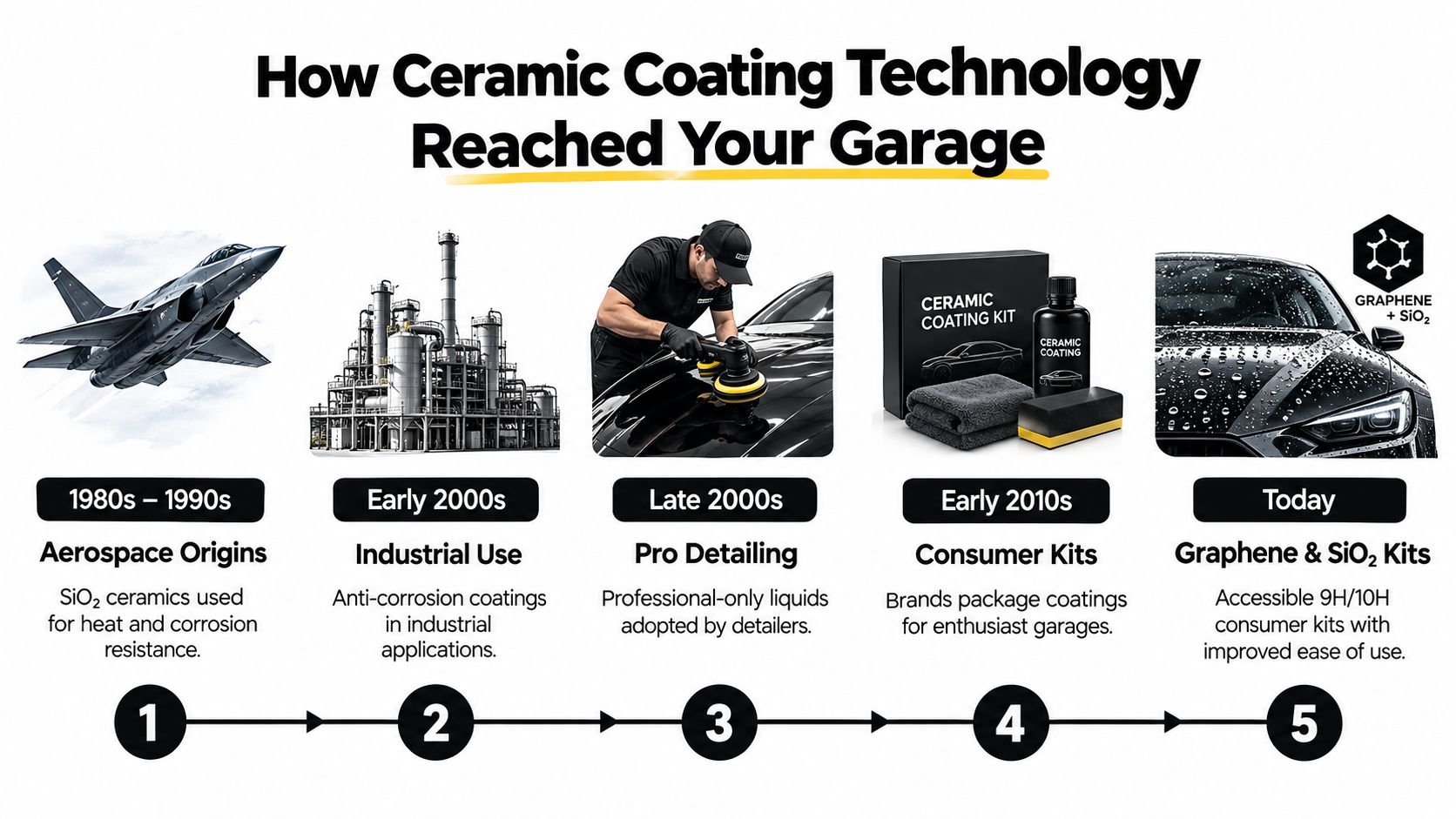
Hardness solved one problem and exposed another
Traditional SiO2 systems cure into a glass-like, silica-rich film. That hardness helps resist chemical attack and release contamination, but rigidity creates a weakness under real driving conditions. Paint, coating, and panel surfaces expand at different rates as temperatures change. Stone impact, repeated thermal cycling, or poor adhesion can then produce cracking, lifting, or lost water behavior.
A kit's hidden performance variable is surface preparation combined with coating flexibility. Even advanced chemistry cannot compensate for oil, bonded contamination, or unstable paint beneath the film. Preparation determines adhesion, while flexibility determines how well the cured layer handles movement after installation.
Research examines hardness and flexibility as compatible engineering targets. Flexible hard nanocomposite coatings are designed to reduce cracking in brittle films (ScienceDirect). Separate work has studied carbon nanotubes for toughening ceramic coatings and improving high-temperature stability in alumina-based thermal barrier systems (ScienceDirect).
Titan Coatings describes its ElastoTek® technology as a proprietary membrane-forming system built around specialized elastomers. Elastomers can stretch and return toward their original shape, supporting flexible coating behavior (Titan Coatings). Titan also presents nano tube technology and Dark Matter tech as approaches that address brittleness instead of treating pencil hardness as the complete durability test.
That history explains why advanced coating technology deserves closer examination than a single hardness number. Related presentation work, including Auto dealership window cleaning, also depends on clean glass and consistent surface preparation. A modern kit must balance a hard protective surface with enough flexibility to tolerate daily vehicle movement and temperature swings.
Comparing the Main Kit Formats on the Market
Most buyers compare brands before they compare formats. That reverses the decision. A professional liquid kit, an elastomer membrane system, and a spray sealant may all be sold as ceramic protection, but they place very different demands on the installer.
| Format | Durability | Prep Required | Cost Per Vehicle | Best For |
|---|---|---|---|---|
| Pro-grade liquid SiO2 | Designed for long-term protection when correctly installed | Extensive wash, decontamination, paint correction, panel wipe, controlled curing | Higher product and labor commitment | Experienced detailers and studios |
| Elastomer membrane | Built to combine ceramic hardness with flexibility | Thorough preparation, but often a more forgiving choice for serious DIY work | Mid-range commitment, depending on system and vehicle size | Serious DIYers and mobile detailers |
| Spray sealant kit | Easier, shorter-term protection | Basic cleaning and surface preparation | Lower initial commitment | Weekend users and maintenance applications |
Pro-grade liquid SiO2
A pro-grade liquid SiO2 system can produce a dense, glossy finish, but it isn't a casual Saturday product on every vehicle. Machine polishing may be needed to remove defects before they become sealed beneath the coating. The installer also needs reliable lighting, clean towels, stable working conditions, and enough experience to recognize the flash before the residue becomes difficult to level.
Elastomer membrane systems
An elastomer-based membrane occupies the useful middle ground. It aims to retain a hard, glass-like surface while allowing the film to move rather than fracture when the panel experiences heat changes or impact. That makes the format attractive to a careful DIY installer who wants more than a seasonal spray but doesn't have a dedicated studio environment.
Titan's Alpha Quartz is relevant here because the company positions it as an elastomer coating that is easy to install and suited to DIY users and mobile detailers. The practical advantage isn't a promise that preparation no longer matters. It's that flexibility can reduce one of the failure modes associated with rigid films, particularly when a vehicle moves between cold and hot conditions.
Spray sealant kits
Spray formats win on speed and simplicity. They work well as maintenance layers or for owners who want improved gloss and water behavior without committing to a demanding correction and coating process. They also make a sensible choice when the vehicle has a short ownership window or the owner won't follow a coating maintenance routine.
The trade-off is straightforward. Less preparation and easier application usually mean less durable protection. The difference between ceramic and polymer protection helps clarify why similar-looking water behavior doesn't mean identical film chemistry or service life.
Surface Prep the Silent Performance Variable
A ceramic coating can't choose a clean surface for itself. Preparation determines the bond, and the bond determines whether the coating behaves like a protective film or a temporary layer that fades unevenly.
Independent coating-preparation guidance emphasizes removing oils, dust, old wax, and loose contamination before application. It also describes controlled surface roughening, including uniform abrasive profiles in the Ra 350–500 micro-inch range, as a way to support strong bonding (EonCoat preparation guidance). Automotive paint shouldn't be treated like an industrial blast substrate, but the principle carries across. Contamination beneath the coating is a bonding problem.
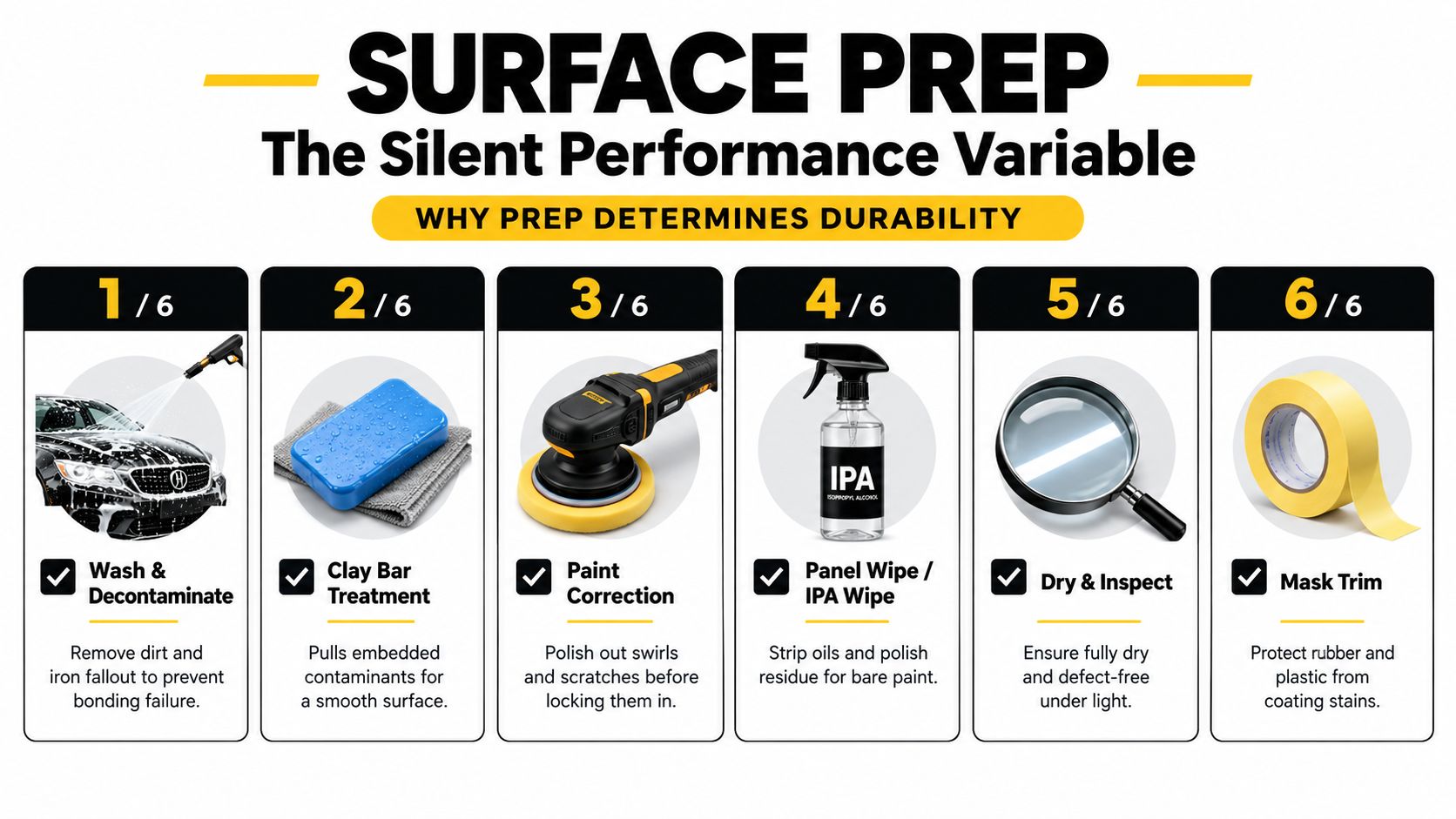
The preparation checklist
Wash and decontaminate. Remove road film, dust, loose grit, and chemical residue with a paint-safe wash. Use dedicated wheel tools so brake contamination doesn't reach the bodywork.
Clay only when needed. A clay bar or clay mitt removes bonded contamination that washing leaves behind. Run your clean hand over the paint after washing. If the surface feels rough, chemical and mechanical decontamination may be appropriate.
Correct the paint. Machine polish swirls, oxidation, and haze before applying protection. A coating preserves the finish beneath it, so polishing after application defeats the purpose.
Perform a panel wipe. Isopropyl alcohol or a dedicated surface cleanser removes polishing oils and residue. A panel that looks clean can still be chemically masked by oils.
Inspect under proper light. Dry every panel and inspect from multiple angles. Strong lighting reveals residue, haze, missed defects, and high spots that ordinary garage lighting hides.
Mask vulnerable trim. Tape rubber, textured plastic, badges, and sharp edges where the coating could stain or collect. Keep fresh towels and applicators available throughout the process.
Practical rule: Don't open the coating bottle until the paint is clean, dry, defect-checked, and free of polishing oils.
The coating surface preparation guide is useful when building a repeatable process. Preparation isn't wasted effort added before the job. For a coating kit, preparation is the foundation of the job.
Ceramic Coating Kit vs Sealants and Spray Coatings
The expensive option isn't automatically the sensible option. A full coating kit earns its place when the owner values long-term paint presentation, accepts the preparation burden, and will maintain the surface correctly. A sealant or spray coating may be the better decision when simplicity matters more than maximum durability.
| Feature | Ceramic Coating Kit | Paint Sealant | Spray Coating |
|---|---|---|---|
| Upfront effort | High, especially with correction and panel wiping | Low to moderate | Low |
| Film character | Hard, chemically resistant ceramic-style layer | Polymer protection layer | Thin, consumer-friendly protective layer |
| Gloss | Deep, highly reflective finish when paint is prepared well | Strong initial gloss | Noticeable gloss improvement |
| Water behavior | More persistent when correctly installed and maintained | Temporary to medium term | Convenient but shorter-lived |
| Maintenance | Requires coating-safe washing | Straightforward reapplication | Easy refresh applications |
| Skill required | Moderate to high | Beginner friendly | Beginner friendly |
| Sensible use case | Long-term daily driver, enthusiast car, detailing service | Short ownership window or low-maintenance owner | Weekend vehicle, maintenance coat, quick refresh |
A daily driver kept for years can justify the preparation because the owner gets ongoing easier cleaning and a stable finish. An enthusiast vehicle can benefit from the visual depth and controlled maintenance routine. A mobile detailer may prefer an elastomer system that balances application speed with a more resilient film.
A rental vehicle, heavily neglected commuter, or car likely to be sold soon may not justify paint correction and controlled curing. In those cases, a quality sealant can deliver useful protection without turning a simple detail into a multi-stage project. The comparison between ceramic coating and paint sealant provides a useful framework for matching protection to ownership goals.
Applying an Automotive Ceramic Coating Kit Step by Step
Application becomes manageable when the installer controls the size of the work area. Work panel by panel, keep the applicator moving evenly, and don't chase a large section because the bottle seems to cover it.
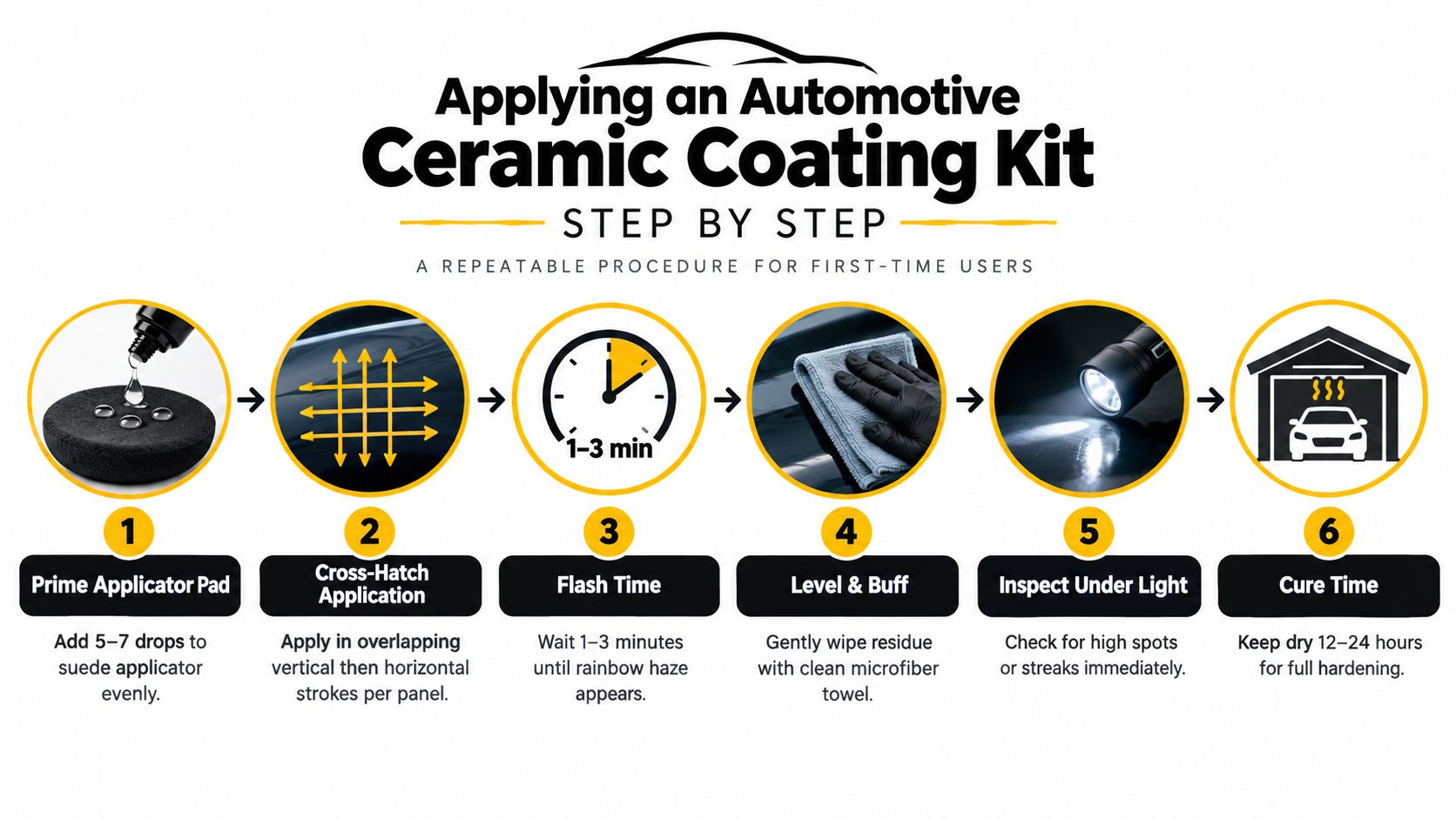
A controlled application sequence
Prime the applicator. Place the manufacturer-specified amount of coating across the suede-wrapped block. The goal is an even, wet leading edge, not a saturated pad that floods the panel.
Use a cross-hatch pattern. Apply overlapping horizontal passes, then vertical passes across the same small section. This reduces missed areas and spreads the film consistently.
Watch the flash. As the coating begins to set, the residue may show a rainbow haze or change in drag. Timing depends on the formula and environment, so follow the product instructions rather than copying someone else's wait time.
Level with a short-nap towel. Fold the towel and make gentle passes until the heavy residue is removed. Turn to a clean face frequently.
Finish with a plush towel. A second, softer towel removes the remaining film and reveals streaks or high spots. Inspect under a strong light immediately.
Allow the coating to cure. Keep the vehicle dry and protected for the time specified by the manufacturer. Avoid touching the surface unnecessarily during that window.
High spots are not cosmetic trivia. They are excess coating left to harden, and they can require additional leveling or polishing if ignored. Edges, body lines, mirrors, and trim also need smaller applicator movements because residue gathers where panels change shape.
Glass offers a lower-stakes way to develop application discipline. Apex Glass Ceramic Coating is intended for automotive glass and windshields, where improved water shedding can help visibility during rain. The Apex Glass Ceramic Coating product page describes a straightforward application format, but the glass still needs thorough cleaning and residue removal. Clean glass, correct application, and proper curing make wet-weather driving less stressful without relying on exaggerated promises.
Why Flexible Hard Coatings Outperform Brittle Ones
A high hardness rating looks persuasive on a product label, but a vehicle is not a motionless test panel. Paint and panels expand and contract as temperatures change, flex under driving loads, and take impacts from grit, insects, and road debris. A rigid film may resist scratching yet crack or lose adhesion when the surface beneath it moves.
Flexible hard coatings address that mismatch. Titan describes its ElastoTek® system as an elastomer-based membrane technology. Research on flexible nanocomposites likewise supports designing hard films to resist cracking. The practical point for kit buyers is straightforward: a flexible film can absorb some movement and shear, rather than forcing every stress into a brittle fracture.
Where nano tube technology fits
Carbon nanotubes have been studied as reinforcing structures in ceramic coatings, including alumina-based thermal barrier systems. The findings support a broader engineering approach, reinforcing a hard coating without treating flexibility as a defect. They do not prove that every automotive kit will withstand every impact, so treat the technology as an indicator of design direction, not a guarantee of service life.
Hydrophobicity also depends on surface architecture. Peer-reviewed research on inorganic hydrophobic coatings reports contact angles around 163–170° in superhydrophobic structures and describes stability after light exposure and tape testing for over 13 months in one study (peer-reviewed hydrophobic coating research). Repeated abrasion can reduce contact angles from above 160° to around 135°, showing that water behavior can decline gradually rather than disappear at once.
For kit buyers, the useful questions sit beyond “9H” or “10H.” Check whether the technical data sheet discusses elongation, modulus, membrane behavior, adhesion, and reinforcement. Those details reveal how the cured film is expected to handle movement and stress.
Environmental tolerance matters too. One review cites a coating with a pH tolerance of 3–14 and an application range of 3–40°C (ceramic coating literature review). Flexibility cannot compensate for poor preparation or contaminated paint. It can, however, give the coating a better chance of staying bonded as a working vehicle cycles through temperature changes, washing, and everyday road use.
Maintenance Habits That Make the Coating Last
A coated car still needs correct washing. The coating reduces adhesion and simplifies cleaning, but it doesn't make the paint immune to abrasive grit, mineral deposits, bird contamination, or poor drying technique.
Build a low-abrasion wash routine
Start with a thorough pre-rinse or foam pre-wash to loosen traffic film before a mitt touches the paint. Use the two-bucket method, a dedicated microfiber wash mitt, and a pH-neutral automotive shampoo. Keep wheel brushes separate from paint tools, because brake dust and heavy wheel grime can turn a safe wash into a polishing session.
Dry promptly with a clean waffle-weave or twisted-loop towel, or use forced air around mirrors, badges, grilles, and trim. Water left to evaporate can leave mineral deposits that obscure the coating's behavior. Don't drag a dry towel across a dusty panel, and don't use a strong degreaser on coated paint unless the product instructions specifically permit it.
The safest maintenance wash removes contamination with the least contact and the least aggressive chemistry.
A compatible SiO2 topper can refresh water behavior when the coating is clean but the surface feels muted. Use one system consistently rather than stacking unrelated waxes, polymers, and sprays that can mask the coating and complicate diagnosis. Avoid automated brush washes, abrasive towels, and routine clay barring unless you can verify bonded contamination.
Diagnose before adding product
When beading fades, inspect before assuming the coating has failed.
- Check for traffic film. A dirty surface can hide otherwise healthy hydrophobic behavior.
- Look for iron fallout. Orange or brown specks may point to embedded contamination rather than coating loss.
- Review washing chemistry. Strong cleaners or repeated solvent exposure can change the surface response.
- Confirm the cure window. Don't judge the finished behavior before the manufacturer's curing period has passed.
- Inspect under lighting. Streaks and high spots indicate application residue, not necessarily failed chemistry.
Titan's Alpha Quartz is positioned as an elastomer coating for painted automotive surfaces, with an application approach intended for DIY users and mobile detailers. Its flexible membrane concept is relevant when a vehicle sees pronounced temperature changes or repeated bug and road impact. Titan's Ultra Ceramic Spray offers a simpler spray format for users who prioritize easy installation, while its shop provides additional coating options for different surfaces and workflows.
APEX NANO – Titan Coatings offers coating systems for automotive surfaces, including flexible protection concepts, glass treatment, and spray application formats that address different preparation and skill levels. Visit APEX NANO – Titan Coatings to compare the available products, review application guidance, and choose a system that matches your vehicle, working conditions, and maintenance routine.
0 Comments