
Ceramic coating headers usually costs $150 to $600 for the coating itself, and the full job often lands around $400 to $1,800 once removal and reinstallation labor is added, with labor alone commonly falling between $120 and $900. I've watched more than one driver walk into a shop thinking this would be a simple few-hundred-dollar job, only to learn the invoice depends as much on access and prep as it does on the coating.
One Saturday morning, a customer rolled in with a small-block project and a pair of tired headers that had started looking rough. He'd already gotten three quotes, and each one was different enough that he thought somebody had to be making a mistake. Usually, nobody is. They're just pricing three different jobs under one name.
Why Ceramic Coating Headers Cost Confuses Every Driver
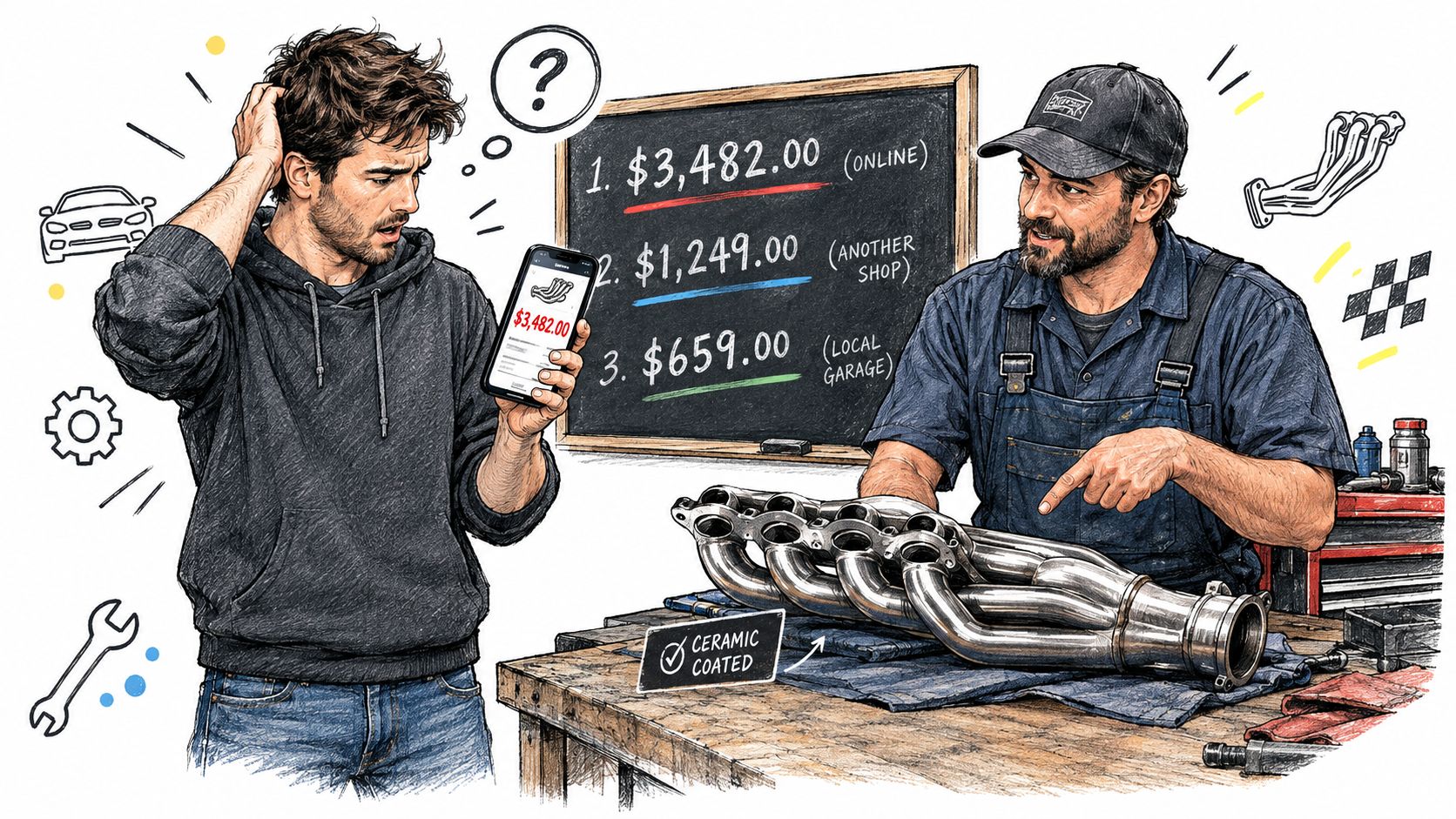
A driver gets one quote for header coating and hears “three hundred bucks.” The next shop says the job could be four figures. Same headers, same car, same basic goal. That's usually the moment the whole subject starts feeling slippery.
What changes is the definition of the job.
A shop may be pricing only the coating itself. Another may be pricing removal, rust and oil cleanup, surface prep, coating, cure time, and reinstall. That is the difference between buying paint for a toolbox and paying someone to strip, repair, spray, bake, and reassemble the toolbox so the lid still closes right.
Why one “header coating price” is really several prices
One historical pricing reference shows how coating-only charges often vary by engine layout and header size, with examples such as V8 long-tube headers priced higher than short-tubes, and smaller four-cylinder sets lower than both, in this automotive ceramic coating pricing reference.
That explains a lot of the spread by itself. More tubing means more surface to prep and coat. More bends and collectors also make handling and finishing slower.
For the broader project, this ceramic coating price guide breaks out the job the way a careful shop should: coating charges, labor to remove and reinstall, and the combined project total. That breakdown matters because two invoices can look far apart even when neither shop is overcharging. They are often quoting different layers of the same repair.
Shop rule: If coating, prep, and R&R are not separated, the number is too blurry to compare.
Where the confusion really starts
The coating is only one part of what you are buying. The other part is protection over time, and that is where many drivers miss the bigger value question.
Traditional ceramic-style finishes are often discussed as if all heat protection behaves the same. In real service, it does not. Headers expand and contract every drive cycle. They vibrate. They get splashed, cooled, and reheated. A brittle protective layer can do a decent job on day one and still lose ground later if it cannot flex with the metal underneath.
Elastic protection changes that conversation. A temperature-flexible coating system, including Titan elastomer technology, is built around movement as well as heat. That does not make the first invoice disappear. It does change how you judge the invoice, because a coating that stays bonded through repeated heat cycles can protect longer than one that hardens well but cracks sooner.
That is a practical garage lesson, not sales talk. A cheaper coating that flakes after seasons of use was never really cheap.
The parts of the quote drivers should slow down and read
Confusion usually comes from hidden labor and hidden assumptions.
- Engine bay access: Tight chassis layouts raise labor because reaching the fasteners takes time.
- Header condition: Old coating, rust, and oil residue add prep work before any new finish can stick.
- Tube size and shape: Long-tubes and complicated collectors usually cost more to handle than compact shorties.
- What “protection” means: Some quotes cover appearance and basic heat control. Others are built around longer-term durability under thermal cycling.
That last point is easy to miss. Two coatings can both be sold under the ceramic label while behaving differently once the headers start living through real hot-cold cycles.
Four questions that make quotes easier to compare
Ask these before you approve the job:
- Is this coating only, or does it include removal and reinstall?
- What prep work is included before the coating goes on?
- What temperature cycling is the coating designed to handle over time?
- If hardware breaks or the old finish is rough, how is that added cost billed?
Drivers get confused because “ceramic coating headers cost” sounds like one line item. In the shop, it is really a stack of decisions about labor, prep, and how the coating behaves after hundreds of heat cycles. That last part often decides whether the lower quote saves money or just delays a second bill later.
How Ceramic Coating Protects Headers From Heat and Corrosion
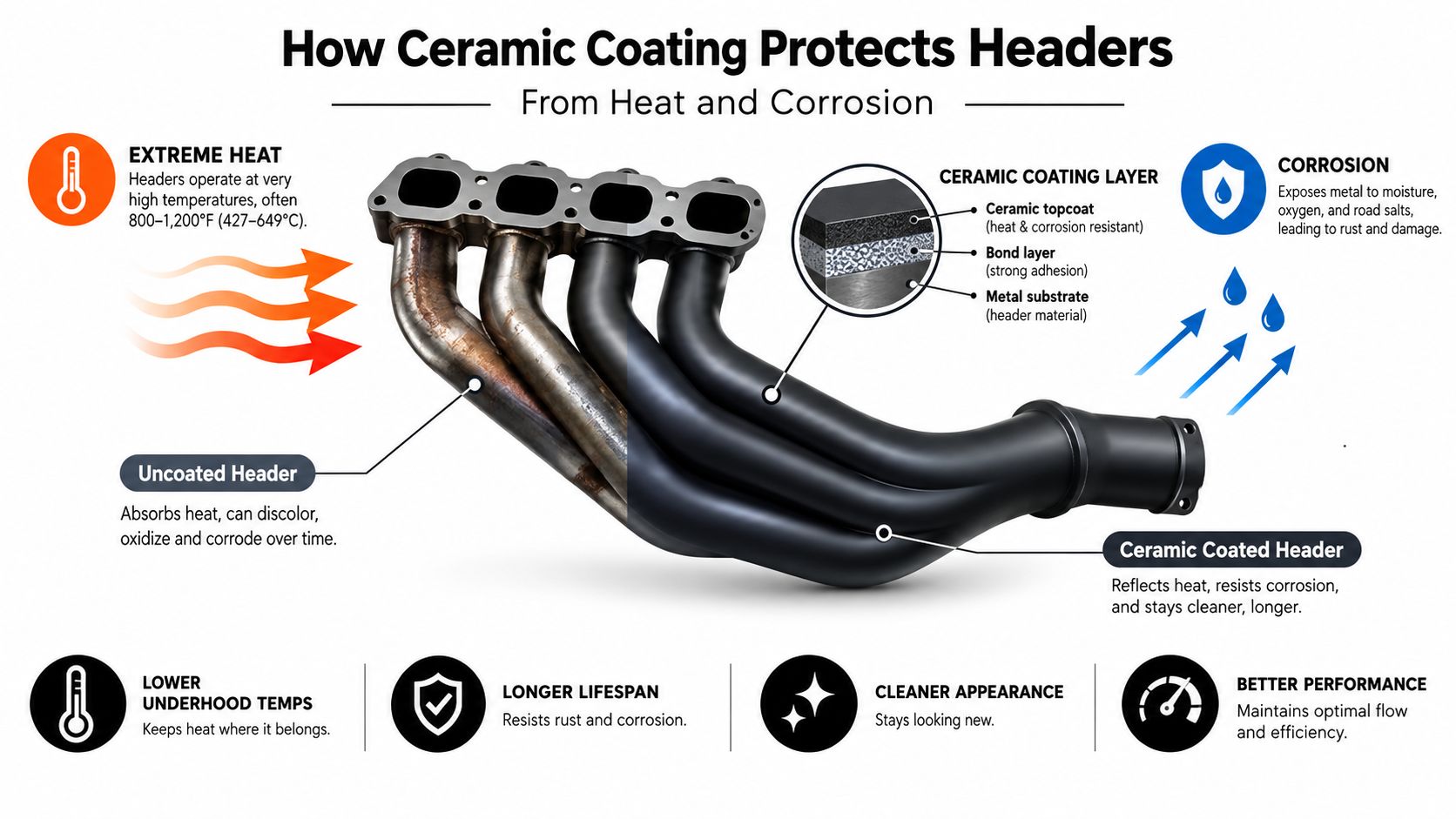
Headers live in one of the ugliest environments on the car. They see heat, moisture, vibration, and constant thermal cycling. Ordinary finishes don't stay happy there for long.
The easiest way to understand ceramic coating is to think of it as a heat-managing skin on the metal. It's not there just to make the headers look cleaner. Its main job is to stand between the tube and the punishment.
What the coating actually does
A good header coating acts as a thermal barrier. One exhaust source says a thermal barrier coating can reduce under-hood temperature by about 50 degrees Fahrenheit and help protect nearby parts from thermal fatigue in this header coating options page.
Ceramic coating on headers works like a fitted heat blanket, not a decorative paint layer.
That same source says its header coatings withstand temperatures up to 1200°F, with discoloration if that threshold is exceeded. That matters because heat rating is not just marketing language. It's a survival limit.
Why temperature rating matters
Shops and owners sometimes talk about “ceramic” as if every version is the same. It isn't.
Some specialty exhaust coating providers rate products for severe conditions up to 2000°F, and another related coating system is described as withstanding continuous temperatures of 600 to 800°C depending on formulation in this high-temperature coating overview. If the coating can't live in the header's heat zone, the finish won't last.
Here's the simple hierarchy:
- Heat control: The coating helps keep more heat in the exhaust stream and less radiating into the engine bay.
- Corrosion resistance: A general performance source notes that ceramic coating also resists corrosion better than many other coatings in this Summit Racing knowledgebase article.
- Surface protection: It helps the metal fight off the abuse that bare steel and even some stainless systems see over time.
The shell problem
Many people get confused. They assume “hard” automatically means “durable.” Sometimes hard is good. Sometimes hard and brittle becomes the problem.
If you've ever dropped a cheap ceramic mug, you already understand it. The mug is hard until stress hits it the wrong way. Headers see repeated expansion and contraction, plus road vibration and wrench contact during service. So the question isn't only “how hot can it take?” It's also “how well does it live through repeated cycles?”
That's where prep, coating chemistry, and flexibility start to matter just as much as the label on the box.
What Drives Your Final Ceramic Coating Headers Price
A quote for header coating works a lot like a machine shop estimate. Two parts can look close from ten feet away, then land in different price ranges once they are cleaned, measured, and put under good light.
That surprises a lot of drivers. They hear “coat my headers” and expect one simple number. A shop sees part size, bends, weld seams, surface condition, heat target, and whether the headers arrive loose on the bench or still trapped in the car.
Size and engine layout
More tubing usually means more labor and more coating area. A compact four-cylinder header is a smaller job than a long-tube V8 set with tighter bends and more total surface to prep and spray.
Earlier pricing examples in this article showed the usual pattern. Long-tube V8 headers often cost more than shorties, and both usually cost more than a smaller four-cylinder header. The reason is straightforward. Bigger, more complex parts take longer to clean, mask, coat, and cure.
Header category changes the labor
Shape matters almost as much as size.
A simple shorty header is like painting a straight ladder. A multi-piece race header or fenderwell set is more like painting a folding lawn chair with every joint exposed. The coating tech has to reach more angles, handle more pieces, and keep coverage even in spots that are easy to miss. That added handling is one reason shops often separate shorty, full-length, block-hugger, and competition headers into different pricing groups, as shown in this ceramic coatings price listing.
Labor can cost more than the coating itself
A broad cost guide notes that coating service can sit in a moderate range by itself, but the full project can climb fast once removal and reinstallation are part of the job. It also explains that labor for access and R&R can become one of the biggest line items in this cost breakdown for ceramic coated headers.
I have seen this in cramped engine bays. A loose set of headers on the counter is a coating job. An installed set wrapped around steering shafts, motor mounts, and stubborn bolts becomes a coating job plus a wrestling match.
Tight access raises the bill because you are paying for careful disassembly and reassembly time, not just for the finish on the metal.
The five levers that move the quote
- Header type: Long-tubes, multi-piece sets, and unusual routing need more handling.
- Condition: Rust, grease, old paint, and peeling coatings add prep time.
- Heat target: Higher-heat use can call for different coating systems or build methods.
- Finish choice: Some finishes and color options add process steps.
- Vehicle access: Off-car parts are usually simpler to price than installed headers.
Why prep and flexibility affect value
Here is the part that gets missed. The invoice is not only paying for “ceramic.” It is paying for how the surface is prepared and what kind of protection you get after thousands of heat cycles.
A hard shell can look great at first and still lose the long game if it acts brittle when the header expands and contracts over and over. An elastic, temperature-flexible coating system changes that value equation because it moves with the metal instead of fighting it. That is the practical difference behind Titan elastomer technology. The upfront quote may not tell you that story unless you ask how the shop handles prep, film build, and coating application methods.
One practical garage example
One customer drops off clean shorty headers, already off the car and stripped. Another brings in long-tubes still bolted into a tight chassis, with surface rust and old hardware that has not moved in years.
The second quote comes in higher for plain reasons. There is more part to handle, more prep to do, and more labor before the coating work even starts.
If you want a cleaner estimate, ask three questions up front. Are the headers off the car, how much cleanup is needed, and what coating chemistry is being used for repeated heat cycling. Those answers usually explain the price better than the number alone.
Mail In Service Local Shop or Buy Coated Headers
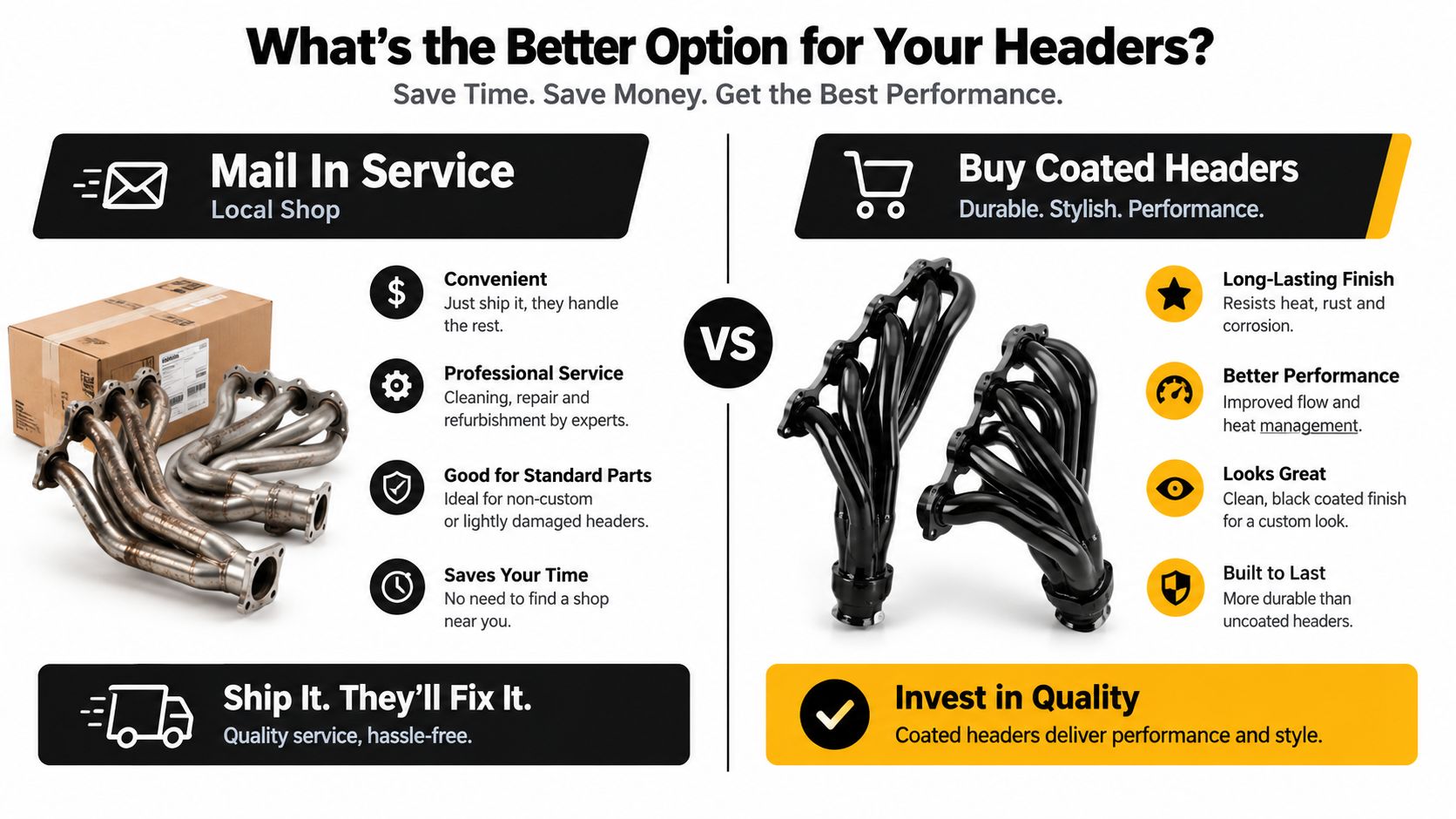
At some point, every owner hits the fork in the road. Coat the headers you have, send them out, let a local shop handle it, or skip all that and buy a coated set new.
I've seen two friends make opposite choices on the same week. One had a rare fitment that already cleared everything on his car, so reusing and coating his existing headers made sense. The other had common small-block parts and didn't want downtime, so he bought a coated set and moved on.
Buying coated headers new
A separate pricing comparison notes that retail ceramic-coated headers often sit around $360 to $515+ for complete header products, while coating services alone can be about $210 to $450 depending on size and complexity in this ceramic coating pricing comparison.
That means buying new can be reasonable when:
- Your current headers are common parts: Replacement is easy.
- Your old set needs too much work: Heavy cleanup can erase coating-only savings.
- You want less downtime: Swap-and-go is often simpler.
Mail-in service
Mail-in makes sense when you already have the exact headers your car needs and the local options are thin.
Good fitment is hard to replace. If your headers clear the steering shaft, plugs, mounts, and floor exactly right, keeping them can be smarter than gambling on another set. The tradeoff is packaging, shipping, and waiting. That delay may be nothing on a winter project and a major headache on a daily driver.
Local shop service
Local performance shops win on convenience and accountability. You can put the parts on the counter, point at the problem areas, and ask direct questions.
A local quote is usually easier to trust when the shop can see the actual hardware, rust, bends, and bolt access.
The downside is that local shops vary a lot in equipment, prep standards, and familiarity with specialty exhaust coatings. Ask how they handle curing, prep, and whether they outsource any part of the work.
A simple decision matrix
| Path | Best for | Watch out for |
|---|---|---|
| Buy coated headers | Common applications, low downtime needs | Fitment changes |
| Mail-in coating | Rare headers you already know fit | Shipping and wait time |
| Local shop coating | Hands-on owners who want one point of contact | Shop-to-shop process differences |
If you're weighing DIY options for adjacent vehicle surfaces while a header job is being planned, an automotive ceramic coating kit can be useful for non-header protection work around the car.
Why Elastic Coatings Last Longer and Save You Money
The usual conversation about header coatings stops at the invoice. I think that leaves out the more important question. What happens after heat cycles, road vibration, winter cold, and real use start stacking up?
That's where the difference between brittle protection and elastic protection starts to matter.
The garage lesson most people learn the hard way
I've handled parts that looked good on day one and disappointed later because the protective layer acted like a rigid shell. It was hard. It was glossy. It also didn't like repeated expansion and contraction.
Headers don't live a calm life. Neither do surrounding surfaces on a working vehicle. Parts go from cold starts to serious heat, then back down again. Add vibration, wrench contact, road grime, and the occasional impact, and a rigid coating can become the weak link.
Why flexibility changes the value equation
Titan has created its own coating technology and says it was the first company to introduce elastomer coatings to the market using nano tubes technology and Dark Matter tech. The practical idea is easy to grasp in shop terms. A coating that is hard like glass and flexible has a better chance of lasting when surfaces move, expand, contract, and take light impact.
That flexibility matters because temperature swings from frozen conditions to hot operating temperatures can punish a brittle layer. When a coating has elasticity, the change in temperature is less likely to turn into cracking. The same logic applies when debris or bug strikes hit coated exterior surfaces.

Where this matters beyond headers
This is also why I tell detailers and DIY owners not to think in silos. The lesson from a hot exhaust part applies across the car. Surfaces last longer when protection matches real-world stress instead of just showroom appearance.
One option in that broader protection conversation is APEX NANO – Titan Coatings, which offers elastomer-focused products and education through its coating flexibility resources. The value angle is straightforward. If the coating is less likely to crack when temperatures swing, the first application has a better chance of staying useful longer.
Two Titan products that fit that philosophy
- Alpha Quartz: Titan positions this as an easy-to-install elastomer coating with strong DIY and mobile detailer appeal. The key idea is that its elasticity helps it deal with temperature change and surface impact better than a rigid-only approach.
- Ultra Ceramic Spray: This is the quick-application side of the lineup. For owners and mobile detailers, it gives a simpler route to applying surface protection with less installation drama.
Hardness helps. Flexibility keeps hardness from becoming fragility.
For anyone wanting to explore the lineup directly, Titan's online shop is the cleanest place to compare products. And if you want to see how the company presents its technology in action, its website at Titan Coatings is part of that story as well.
Beyond Headers Protecting Glass and Every Surface
One rainy evening tells this story better than a catalog ever could.
A customer spent weeks thinking about heat management under the hood, then drove home in a storm and realized visibility was the bigger stress point that night. Wipers were working. The windshield still felt busy, smeared, and tiring to watch through. That's when the protection conversation widened from headers to the whole vehicle.
The same logic applies to glass
Header coating teaches a simple lesson. Protection works best when it matches the environment. Exhaust parts need heat resistance. Windshields need clarity, water behavior, and easy maintenance.
That's where Apex Glass Ceramic Coating fits. Titan describes it as easy to use, and the practical benefit is easy to understand. Better glass behavior can make driving in rain feel calmer and less fatiguing because the windshield stays easier to read. You can see the product details on Apex Glass Ceramic Coating.
A complete vehicle mindset
Owners often buy protection one problem at a time. Headers for heat. Paint for gloss. Glass for visibility. That works, but a full-system mindset is usually smarter.
Consider the layers:
- Headers: Need thermal and corrosion-focused protection.
- Paint and trim: Need durable surface protection that can live with weather and washing.
- Glass: Needs visibility support, especially in bad weather.
Why detailers should care
For mobile detailers and studio shops, this broader view makes quoting easier and service more useful. A customer who comes in asking about one harsh-use surface usually has another one giving them trouble too.
Alpha Quartz and Ultra Ceramic Spray fit that same practical mindset for exterior surfaces because they're positioned as easy to install and friendly to DIY users and mobile detailers. The point isn't to use one product everywhere. It's to choose protection based on what the surface faces.
That's the same lesson headers teach, just with less burnt knuckle language.
Your Smart Plan to Get the Best Value Today
If you want the short shop-floor answer, don't chase the lowest number first. Chase the clearest quote and the coating strategy that fits how the vehicle gets used.
A clean-looking bargain can get expensive if the job skips prep, hides labor, or uses a protection layer that doesn't live well through repeated heat and cooling cycles. The best value usually comes from asking sharper questions before anybody touches a wrench.
The checklist I'd use
- Split the quote: Ask for coating, prep, and removal/reinstall as separate lines.
- Match the part: Confirm the quote is based on your actual header type, not a generic assumption.
- Ask about heat rating: The coating has to suit exhaust temperatures, not just look good on paper.
- Discuss condition: Old rust, old finish, and greasy contamination change labor.
- Think past day one: A coating that stays intact through temperature swings can protect your first investment better.
When to spend and when to simplify
If you already own a hard-to-fit header set that clears everything nicely, coating those parts often makes sense. If your application is common and your old headers are rough, buying coated parts may be cleaner. If your surrounding vehicle surfaces also need protection, it can be smart to line up glass and exterior products at the same time so the whole car is easier to live with.
The cheapest header coating job and the best header coating value are often two different things.
A practical next move
If you're comparing options today, gather one local quote, one mail-in quote, and one replacement-header option. Put them side by side. Then look at the variables. Downtime, fitment confidence, prep condition, and whether the protection is built for repeated stress.
For owners who like to work on their own cars, and for mobile detailers building a flexible service menu, Titan's product line is worth a look. Alpha Quartz, Ultra Ceramic Spray, and Apex Glass Ceramic Coating all fit the broader theme here. Protection shouldn't just look tough. It should stay useful when the car gets hot, cold, dirty, wet, and driven.
If you want protection that makes sense beyond the header invoice, APEX NANO – Titan Coatings offers solutions for flexible exterior protection, easy-application spray coatings, and glass treatment that supports visibility in rough weather. To explore products like Alpha Quartz, Ultra Ceramic Spray, and Apex Glass in one place, visit APEX NANO – Titan Coatings.
0 Comments