
A rainy morning once turned a routine mobile detail into a lesson I still use today. The paint looked perfect at pickup, but poor preparation and a rigid coating later produced cracking around a stressed area, while a properly prepared panel treated with a flexible system held its finish through daily use.
Why Your Coating Application Method Decides Durability
Coating application methods aren’t just about how quickly you can spread product across a panel. They determine how much material reaches the surface, how evenly the film builds, how much rework you create, and whether the coating can tolerate movement after installation.
For more than 60 years, conventional air spray served as the primary industrial paint application method, yet its average transfer efficiency was only 24%. That means most coating solids didn’t land on the part. Established efficiencies were higher for airless and air-assisted airless spray at 40%, electrostatic air spray at 70%, electrostatic disk or bell at 85%, and dipping at 90%. These historical figures explain the industry’s move toward systems that reduce overspray, waste, emissions, and cleanup, as documented in this industrial coating application reference.
Practical rule: The cheapest coating job is the one that avoids stripping, correcting, and returning to the customer’s driveway.
A mobile detailer usually works with tighter constraints than a factory. You may have limited lighting, changing temperature, windborne dust, and only one chance to make the vehicle look right before the customer inspects it. A wipe-on coating can offer excellent control on a panel, while a spray system may cover large areas faster but demands more discipline around atomization, distance, flash time, and masking.
Titan Coatings presents a different approach through elastomer coatings using nano tubes technology and Dark Matter Technology. The stated design idea is an elastic coating that remains hard like glass while retaining flexibility, allowing the film to move rather than crack when the substrate experiences thermal change or impact. That flexibility matters on vehicles because paint, trim, and coated surfaces don’t remain perfectly static from a frozen morning to a hot afternoon.
The practical decision isn’t “Which coating is strongest?” It’s “Which application method gives this substrate the right film, with the least waste and lowest defect risk?” A glass coating needs a different workflow from paint. Trim may benefit from a flexible system. A fleet panel may favor a spray process, while a DIY owner may get better results from a controlled wipe-and-level routine.
Before choosing, check the surface’s condition and the intended service environment. Anyone preparing glass for wet-weather driving can also benefit from this practical resource on window maintenance during monsoon season, because contamination and visibility problems don’t stop at the vehicle’s paint.
Titan’s guidance on coating adhesion is useful when you need to connect surface condition with product behavior. The method only works when the coating can form a clean, continuous bond.
Surface Preparation and Environment Control Before You Coat
A coating job can fail before the bottle is opened. Embedded iron, polishing oils, failing clear coat, or moisture in a seam remain under the film, so preparation determines both durability and total job cost. Product wasted on a dirty panel costs less than the rework, callbacks, and lost driveway time that follow premature failure.
Before mixing or applying anything, make a go or no-go decision. The surface must be clean, dry, inspected, and stable for the expected conditions. If it is not, stop and use this guide on how to prep car paint. That pause is cheaper than leveling cured high spots or explaining why a coating failed.
Build a clean bonding surface
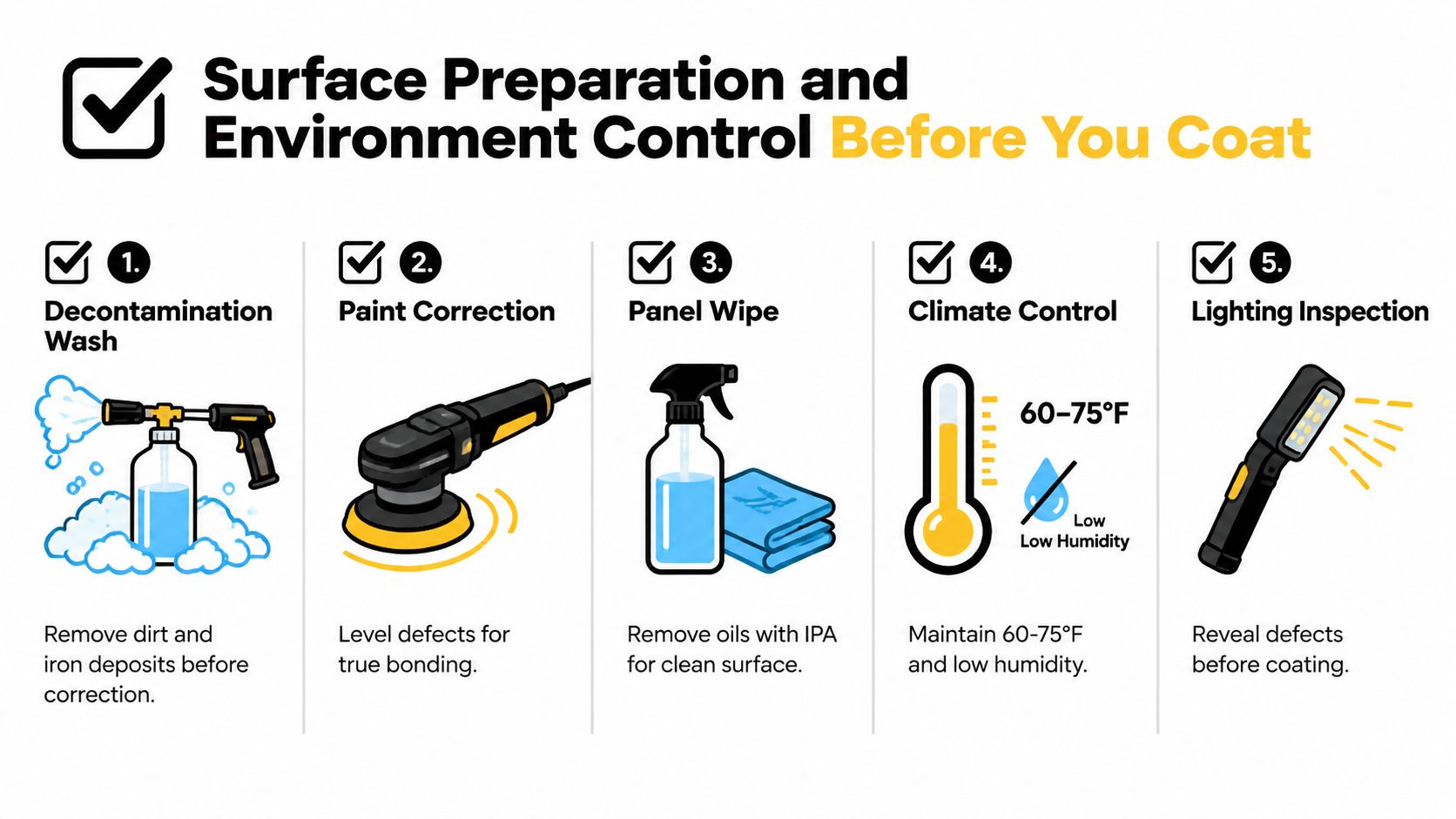
Wash away loose dirt first, then remove iron deposits and bonded contamination before polishing. Contamination makes an applicator drag, interrupts leveling, and leaves isolated areas where the coating cannot contact the substrate evenly. On a mobile job, this step also limits product waste caused by repeatedly correcting a panel that was never ready.
Correct the finish when its condition and the customer’s target justify it. Choose a suitable polisher and pad combination to improve the surface, but do not chase every mark when the agreed finish does not require it. The practical goal is a clean, uniform panel that will show the coating consistently.
Panel wipe provides the final chemical reset. Use a suitable cleaner to remove polishing oils and residue, then inspect the panel again. The same preparation logic applies to other surfaces, as this wood cleaning sanding priming guide shows.
Treat the environment as part of the process
Temperature, humidity, airflow, and lighting control working time and leveling. A cool panel may resist spreading, while heat shortens the open time. Wind carries dust onto fresh coating, and weak lighting hides streaks or high spots until the vehicle reaches daylight.
Elastomeric products can have narrower limits. One technical data sheet specifies ambient temperatures above 40°F, protection from temperatures below 40°F for at least 24 hours after installation, and no application above 100°F ambient or 120°F surface temperature. Review the Sikawall elastomeric coating technical data sheet when those conditions apply.
Controlled or predictable conditions reduce defect risk and help a mobile detailer decide whether the job should proceed. Titan’s Alpha Quartz may suit outdoor work when conditions are appropriate, but it does not remove the need for decontamination, correction, panel wipe, or lighting checks. Titan’s elastic Dark Matter elastomer technology is designed to stay hard like glass while flexing through freeze to heat, yet the film still depends on a properly prepared surface and suitable cure conditions.
Use strong diffused light with a narrow inspection light. Move around the panel, change viewing angles, and check for oily trails, missed contamination, dull correction marks, and residue. If the surface is difficult to see, coverage cannot be judged confidently.
Comparing Spray Wipe Dip and Spray Gun Methods
Every method solves a different problem. Wipe application gives the operator direct tactile feedback. Spray improves speed and can create a uniform distribution across broad surfaces. Dip coating reaches complex shapes from all directions, but it belongs mainly to controlled industrial workflows rather than driveway detailing.
Transfer efficiency is the ratio of coating solids deposited on the substrate to total coating solids used. In practical terms, 40% transfer efficiency means 4 gallons reach the part out of 10 gallons consumed, while 60% means 6 gallons reach the part. HVLP systems are commonly reported at roughly 65% to 75%, and electrostatic spraying can reach 65% to 95% under favorable conditions, compared with older conventional air spray at about 24%, according to the ASTM D5327 referencee1.pdf).
| Application Method | Transfer Efficiency | Typical Dry Film Thickness | Best Use Case |
|---|---|---|---|
| Conventional air spray | 24% | Spray systems can range from about 0.5 to 20 mils | Fine atomization where equipment and overspray controls are available |
| HVLP spray | 65% to 75% | About 0.5 to 20 mils for spray application | Controlled automotive panels and broad surfaces |
| Airless or air-assisted airless | 40% | About 0.5 to 20 mils for spray application | High-build primers, industrial protection, and throughput-focused work |
| Electrostatic air spray | 70% | About 0.5 to 20 mils for spray application | Conductive parts and production finishing |
| Electrostatic disk or bell | 85% | Process-dependent | Industrial and OEM finishing |
| Dipping | 90% | Process-dependent | Full coverage of components and complex industrial shapes |
| Brush | Not stated in the cited data | About 2 mils | Small repairs, seams, edges, and restricted access |
| Roller | Not stated in the cited data | About 3 mils | Broad, accessible surfaces where texture is acceptable |
| Wipe application | Product and technique dependent | Product-dependent | Ceramic and elastomer coatings on manageable sections |
The spray thickness range and brush and roller benchmarks come from this coatings application reference. That same reference identifies spray, dipping, and flow coating as the basic liquid-coating categories, while also noting that spray can increase surface-defect risk because atomization introduces more variables.
Match the tool to the substrate
For a vehicle, wipe application is usually the most forgiving choice for paint when you need control over product placement. It also creates little overspray, which matters in a garage or driveway. The trade-off is labor and timing. You must maintain a consistent section size, recognize the leveling window, and remove residue before it becomes a high spot.
HVLP is useful when speed and even distribution matter, but the gun must be set up correctly. Nozzle size, fluid delivery, atomization pressure, distance, and traverse speed all affect film consistency. A spray-gun workflow that works for spray painting kitchen cabinets still illustrates the same broader lesson, equipment control matters as much as the coating itself.
Airless and air-assisted airless systems make sense for coatings that need higher build or industrial throughput. They can be excessive for a consumer vehicle coating where overspray control and cosmetic precision matter more than rapid deposition. Dipping provides excellent coverage in manufacturing, but it isn’t a realistic option for an assembled car.
For a mobile detailer, Titan’s sprayable ceramic coatings can fit the middle ground when the product, equipment, and work area support spray application. Titan’s Ultra Ceramic Spray also belongs in the speed-oriented category, especially for operators who prefer a spray-and-buff workflow over a full spray-gun setup.
How to Apply Wipe Spray and Glass Coatings Like a Pro
A reliable application is controlled, small, and observable. Don’t coat an entire hood because the product appears easy to spread. Work a manageable section, watch how the film behaves, and adjust before the same mistake reaches the next panel.
Wipe application for Alpha Quartz
Alpha Quartz is the practical choice when you want a hand-applied elastomer coating with a flexible film. Titan positions its elastomer technology as hard like glass while remaining flexible, which is useful for surfaces exposed to thermal movement and ordinary road impact.
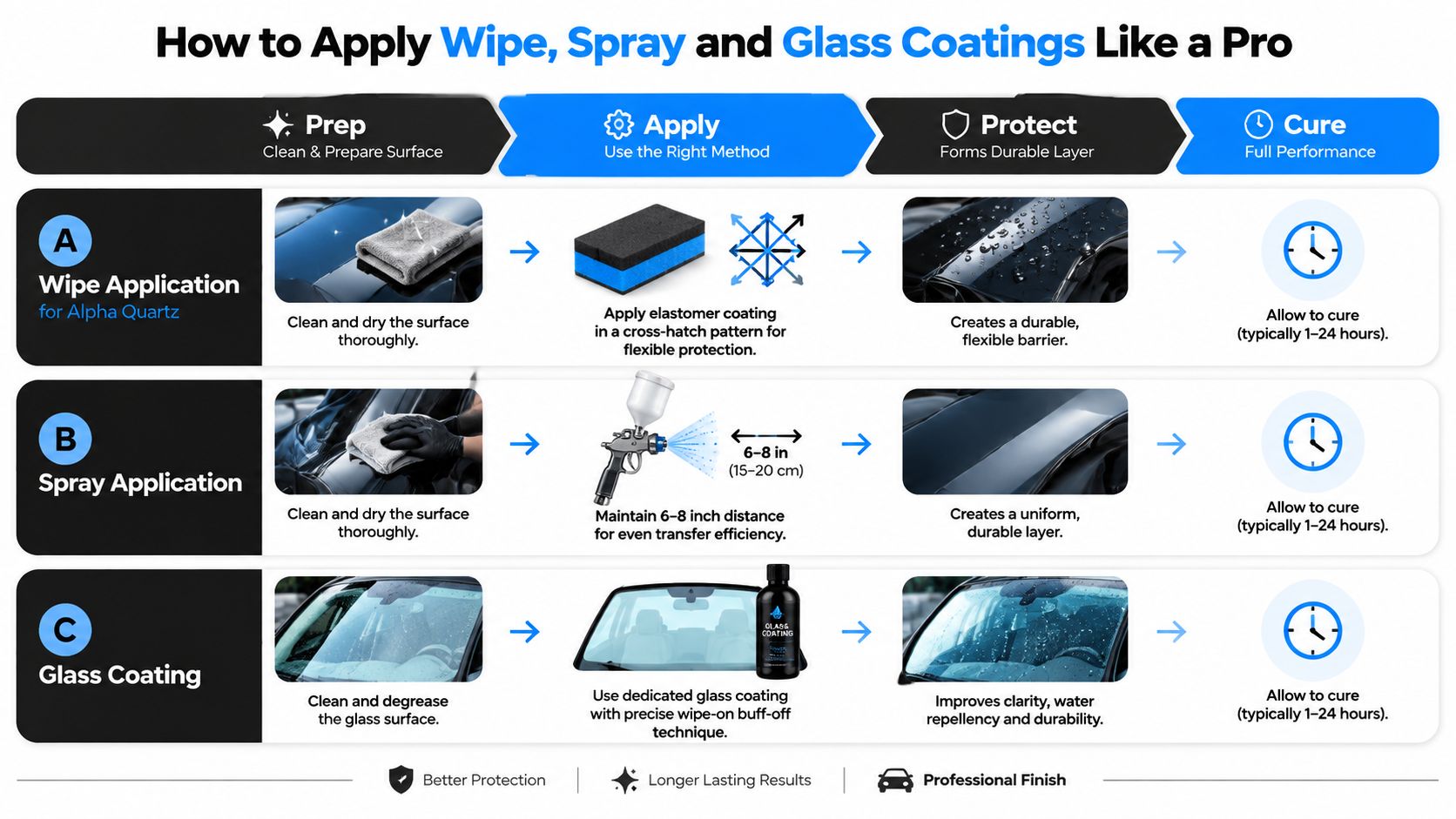
Use a clean applicator block and load it lightly. The exact amount should follow the product’s instructions, because overloading wastes material and increases leveling problems. On a prepared panel, work in sections around 50 by 50 centimeters when conditions are warm, humid, or unpredictable.
Draw the applicator in overlapping vertical passes, then cross-hatch horizontally. Keep pressure light and consistent. Circular motion can make coverage harder to read, while a cross-hatch pattern gives you a visual map of where the product has been placed.
Watch for the coating to begin leveling or flashing according to the product behavior and the environment. Use a short-pile microfiber to level the heavier residue, then follow with a clean long-pile towel to refine the finish. Turn the towel often. A saturated towel can redistribute residue instead of removing it.
Inspect each section under diffused light before moving on. High spots usually show as darker, oily, or rainbow-like areas. Correct them during the working window rather than assuming the curing process will flatten them.
Spray and buff with Ultra Ceramic Spray
Ultra Ceramic Spray is suited to a faster spray-and-wipe routine. Start with a cool, clean panel and keep the spray controlled. Apply a light, even amount to the panel or applicator as directed by the product instructions, then spread it across a small section instead of chasing maximum coverage in one pass.
A short-pile towel handles initial distribution and heavier residue. A fresh long-pile microfiber provides the final buff. If the towel begins to drag, stop and inspect. Dragging can mean insufficient product, a drying surface, contamination, or a working section that’s too large for the conditions.
A spray-gun workflow requires more setup. Select the nozzle for the coating’s viscosity, establish even atomization, and maintain a consistent distance and traverse speed. The visual guide associated with this workflow uses a 6 to 8 inch distance for even transfer, but always reconcile that starting point with the product instructions and gun pattern. Spray in controlled passes, overlap consistently, and avoid stopping over the panel.
Pore-bonding for Apex Glass
Glass needs a dedicated process because wiper paths, mineral deposits, and invisible oils can interrupt bonding. Clean and polish the windshield until water behaves uniformly across the glass, then perform a final wipe and inspect for smears under angled light.
Titan’s Apex Glass Ceramic Coating is designed for windshield use and is available through the Apex Glass product page. Apply it with an applicator block using overlapping passes. Keep the coating in a controlled area, allow the appropriate dwell time from the instructions, and remove residue with a leveling towel before refining with a clean microfiber.
A properly installed glass coating can improve wet-weather visibility and reduce the amount of wiper work needed to clear water. It won’t replace good wipers, clean glass, or safe driving, but it can make rain management less stressful when the surface is prepared and the residue is fully removed.
For product-specific handling, use Titan’s glass coating guidance rather than relying on a generic ceramic routine. Glass can reveal application marks quickly, especially at night when streetlights catch a haze.
Common Mistakes and Troubleshooting Coating Defects
Most defects have a process cause. The surface was contaminated, the gun was too far away, the section was too large, the coating was applied too heavily, or the operator waited too long to level it.
Spray is especially sensitive because atomization creates more variables. The coating failure analysis guidance is useful when a defect needs to be connected to preparation or application rather than blamed on the product.
Read the defect before reaching for a towel
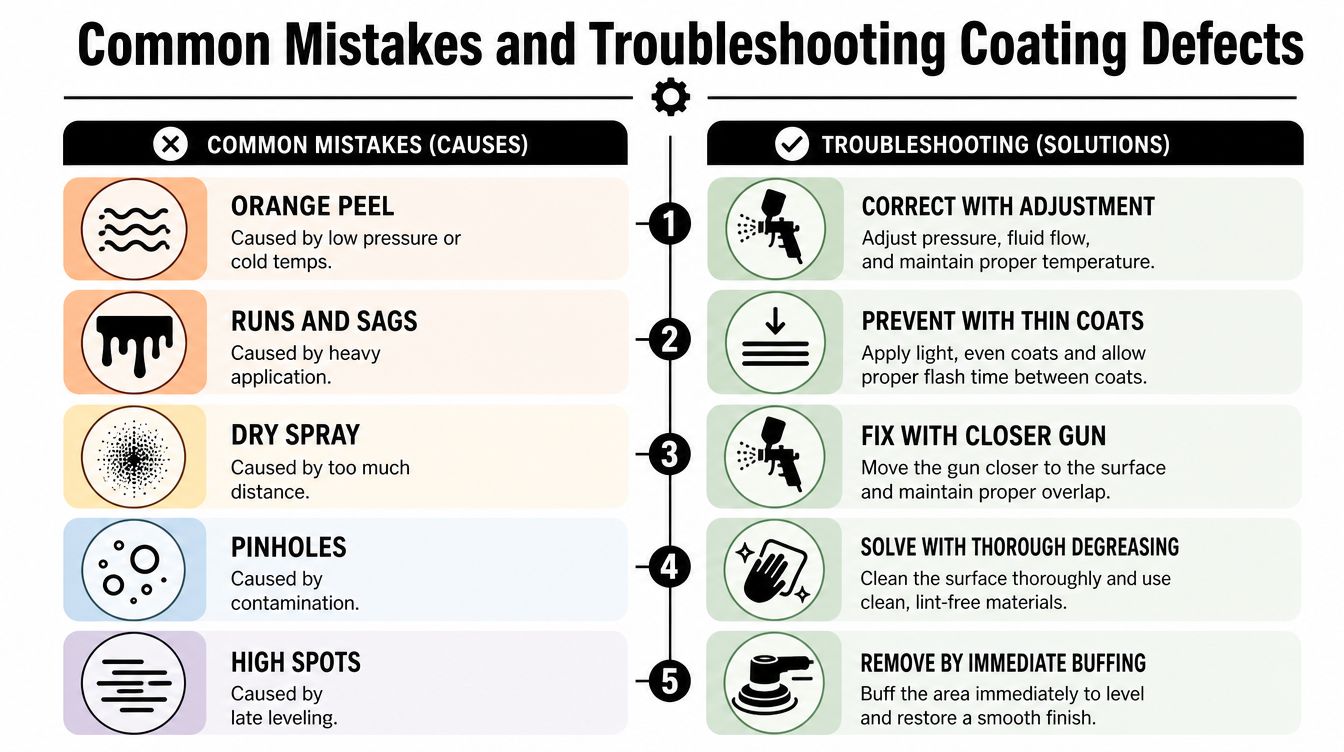
- Orange peel: A wavy texture can result from poor atomization, unsuitable pressure, cold conditions, or a coating that isn’t leveling. Adjust the process before applying more material.
- Runs and sags: These usually point to excessive wet film or a slow traverse. Use lighter passes and avoid trying to build thickness in one heavy application.
- Dry spray: A dusty, rough finish often means the spray is traveling too far or drying before it reaches the panel. Bring the gun closer within the safe operating range and verify atomization.
- Pinholes: Contamination, trapped air, or an unsuitable surface can create small voids. Stop, inspect, and correct the surface rather than sealing the defect under another layer.
- High spots: A dark or streaked area is often excess product that wasn’t leveled in time. Use the correct towel while the coating remains workable. Once cured, removal may require more aggressive correction.
Powder coating operations commonly report reject rates of 2% to 8%, while stringent visual or performance criteria can push rejects to 10% to 25%. Unstable substrates combined with tight standards can drive rates to 15% to 40%, as detailed in this Powder Reject Rates reference.
Failure analysis also places 75% to 95% of coating failures in surface preparation and application errors, while an Australian study cited in the same technical discussion attributed 46% of failures to application error in a later update, down from 68% in an earlier dataset. Tighter spray-parameter control was reported to reduce defects by up to 60%, including 55% less orange peel, 60% fewer runs and sags, 70% less dry spray, and 50% less uneven coverage, all from that same source.
If a defect is isolated and the coating is still workable, level it immediately. If contamination, widespread uneven coverage, or cured high spots affect the panel, strip or correct the area and recoat. A quick shortcut is only profitable when it doesn’t create a return visit.
Making Coatings Last Through Temperature Swings and Daily Driving
Lifecycle value includes product, towels, labor, correction time, travel, callbacks, and maintenance. A method that saves minutes during application but creates a rework appointment isn’t efficient.
Flexible elastomer coatings deserve attention for vehicles that face repeated temperature changes. ASTM D6083 requires low-temperature flexibility testing for liquid-applied acrylic roof coatings, including a pass at -15°F, or -26°C, under ASTM D522, as described in this ASTM D6083 standards overview. Independent product data also records one acrylic roof coating passing a 1/2-inch mandrel bend at -15°F after 1,000 hours of accelerated weathering, while another elastomeric coating passed a 1/8-inch mandrel bend at -30°F with no cracking, according to the Rust-Oleum technical data sheet.
Those tests concern roof coatings, not a guarantee for every automotive product. They do show why flexibility is a meaningful performance property. Titan’s Dark Matter elastomer concept applies that logic to a coating intended to stay hard like glass while flexing through movement, helping reduce cracking risk when the surface goes from frozen conditions to intense heat or experiences ordinary impact from road debris and insects.
Apex Glass belongs in the maintenance plan too. Keep the windshield clean, monitor wiper performance, and inspect for haze or uneven water behavior rather than assuming a premium coating eliminates upkeep. Good application makes maintenance easier, but disciplined aftercare preserves the result.
APEX NANO – Titan Coatings offers coating options for paint, glass, and spray-oriented workflows, including flexible elastomer technology and Apex Glass Ceramic Coating. Visit APEX NANO – Titan Coatings to choose a method that fits your substrate, working conditions, and long-term maintenance plan.
0 Comments