
You've just finished a summer highway run. The windshield is stippled, the bumper wears a brown film, and the hood feels rough beneath your fingertips. A quick pass with a dry towel seems tempting, but that's how a manageable cleanup becomes scratched paint, smeared glass, or etched clear coat.
The practical answer to bug repellent for cars isn't one miracle spray. It's a system built around three decisions: reduce how strongly residue adheres, remove contamination before heat and sunlight set it, and choose products that suit paint, glass, PPF, or vinyl. A coating can make that system easier, but it can't stop every insect from contacting the vehicle.
Why Bug Residue Is More Than a Cosmetic Problem
After a long drive through warm rural roads, the front end often tells the story before the driver does. The windshield carries dozens of impact marks, the mirrors have translucent smears, and the leading edge of the hood is covered in dried organic residue. Leave it until the next wash and the deposits become harder to soften, especially after the panel has baked in direct sun.
That residue isn't ordinary dust. Insect remains contain biological material that can bond to paint and glass, then become more difficult to release as they dry. Heat and sunlight accelerate that process, turning a quick rinse into a job that needs soaking, lubrication, and patient agitation. On clear coat, PPF, and vinyl, the risk isn't identical, but dry scrubbing can create marring or disturb the surface.
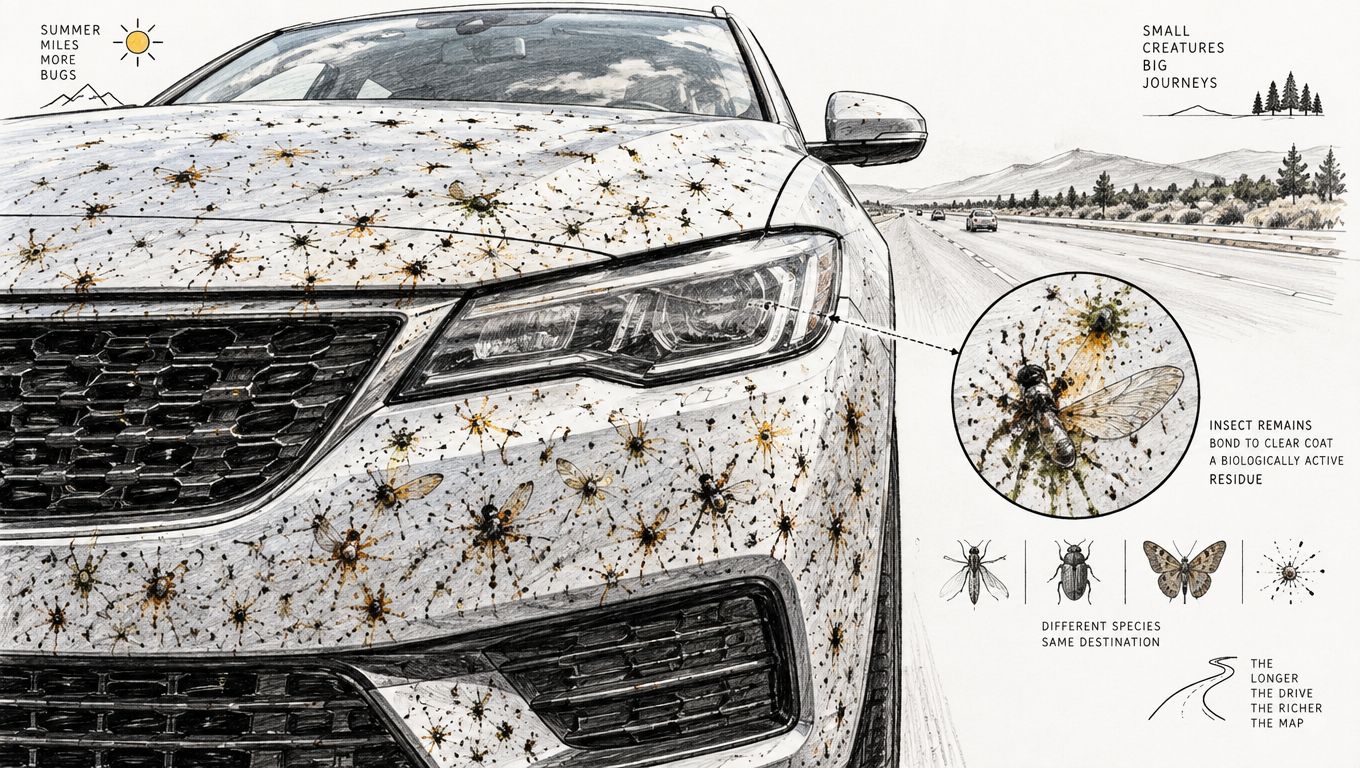
The contamination cycle
Vehicle and insect collisions happen during ordinary driving, not only on unusual road trips. A 2021 citizen-science study examined 3,530 driving transects covering 83,019 km across Europe and, to a smaller extent, China. Participants recorded 124,606 insects on windshields, approximately 1.5 insects per kilometer (Frontiers in Ecology and Evolution study).
The same research found that counts were highly repeatable between days at the same location. That matters to detailers because contamination reflects route, season, geography, and local insect abundance. It isn't just random bad luck.
Practical rule: Treat bug residue as a recurring maintenance contaminant. Prevention helps, but prompt, gentle removal protects the finish when prevention fails.
A chemically resistant exterior treatment, such as the systems described through Titan's chemical-resistant coating options, can support easier maintenance. It shouldn't be marketed as a force field. The useful goal is to reduce residue bonding and protect the underlying surface while you follow a safe wash process.
What Insect Residue Actually Does to Paint and Glass
Insect adhesion depends on more than whether a surface beads water. Contact area, surface chemistry, microtexture, and the composition of the insect's adhesive secretions all influence how firmly a deposit remains attached. A residue can spread into tiny surface irregularities, dry into a stubborn film, and leave behind staining even after the visible material disappears.
Bio-inspired adhesion research demonstrates how strongly geometry can affect attachment. In one study, mushroom-shaped micropillars produced pull-off forces up to 30 times those of flat reference surfaces (bio-inspired adhesion research). That finding isn't a direct test of automotive coatings or insect splatter, but it reinforces a useful detailing principle. Surface structure changes how materials interact at the interface.
Beading isn't proof of repellency
A smooth, chemically stable, low-surface-energy film may give residue fewer places to anchor. Water or a mild cleaner can then help lift deposits with less mechanical force. That's anti-adhesion and cleanability, not necessarily insect repellency.
Superhydrophobic behavior alone doesn't prove that insects avoid a vehicle, that impacts occur less often, or that biological residue won't stain. A credible test would measure residue release force, defined exposure time, stain change, gloss retention, and finish condition after cleaning. Visual beading is useful for judging water interaction, but it doesn't measure biological adhesion.
For routine maintenance, a product such as OMNIGUARD, Waterless Wash is described as a quick sealant for fast wipe-downs, water mark removal, and UV protection. Its stated HYPERBEAD™ particle system is intended to support self-cleaning and oxidation resistance, with durability described as up to 6 weeks. Use that type of product as a maintenance aid, not as evidence that insects can't contact the surface.
Glass needs a stricter standard
Windshield residue is a visibility issue. Bugs, road grime, sap, and accumulated wax products can contribute to wiper streaking, so glass care requires a product designed for automotive glazing. Avoid oily or silicone-rich treatments that leave an uneven film, particularly if you drive at night or in wet conditions.
For paint, PPF, and vinyl, always follow the substrate manufacturer's compatibility guidance. The safest coating is the one that improves release without creating a new problem during washing.
Prevention Approaches Compared
Drivers usually choose between a professionally installed coating, a ceramic spray, a wax or sealant, and a home remedy. The right option depends on mileage, storage, finish condition, and how quickly you'll clean the car after exposure.
A professional coating generally offers the most controlled preparation and the most consistent film. It also demands correct decontamination, paint correction when needed, panel-temperature control, and careful curing. A spray sealant is easier to apply and useful for maintenance, but it usually offers a lighter protective layer and needs more frequent renewal.
Wax remains practical for owners who enjoy regular detailing and want a forgiving application. It can improve slickness and make residue easier to wash, but water beading still isn't proof that bugs are being repelled. Household remedies, including improvised oils or harsh solvents, create the greatest compatibility risk. They can smear glass, soften trim, stain porous surfaces, or interfere with existing protection.
| Approach | Durability | Best For |
|---|---|---|
| Professional ceramic coating | Longer-term surface protection when correctly prepared and maintained | High-mileage drivers, studios, and owners seeking a durable system |
| Ceramic spray | Shorter maintenance interval and simple application | DIY users and mobile detailers refreshing an existing finish |
| Wax or paint sealant | Regular renewal with straightforward application | Enthusiasts who wash and protect their vehicles often |
| DIY household remedy | Unpredictable and substrate-dependent | Generally unsuitable for paint or automotive glass |
A useful comparison of long-term film behavior and maintenance expectations appears in Titan's ceramic coating versus paint sealant guide. The question isn't whether one product beads more dramatically in a driveway. It's whether the surface stays cleanable and visually stable after repeated contamination and washing.
For readers researching natural pest-control principles around the home, how to keep pests out naturally provides broader context. Automotive surfaces are different, though. A product that deters insects in a room or campsite shouldn't be transferred to a vehicle's paint or windshield without explicit automotive-use guidance.
One coating option built around flexibility is Alpha Quartz 50ml Ceramic coatig. Its product information describes a high-performance Elastomer ceramic coating for all surfaces, with 92% high solids, zero VOCs, solvent-free formulation, advanced adhesion technology, and protection against UV, chemicals, and abrasion. It's described as easy to apply indoors or outdoors and curing in 4 hours. Those are product specifications, not proof that it prevents insect contact.
Safe Bug Removal Protocol
The safest bug removal starts before the first towel touches the panel. If the hood, bumper, or mirror is hot, move the vehicle into shade and let the surface cool. Spraying cleaner onto a hot panel can cause uneven drying and reduce dwell time.
Use a low-force sequence
Pre-rinse gently. Remove loose grit with water before touching the finish. Don't use a pressure washer at an unsafe distance or aim concentrated spray at damaged PPF edges, badges, or trim.
Pre-soak the residue. Apply a compatible, pH-controlled automotive cleaner and allow a brief dwell. The goal is to soften the organic film, not to let the product dry.
Add lubrication. Use a clean, soft microfiber or wash media with plenty of solution. Glide across the surface rather than scrubbing a dry deposit.
Rinse and inspect. If marks remain after the residue is gone, look for etching or staining. Don't jump straight to aggressive polishing. A light correction may be appropriate, but deeper damage needs a measured inspection.
Clean the glass separately. Use an automotive glass product and wash the wiper blades. Check for streaking from the driver's seat in both dry and wet conditions.
The same logic applies when researching unrelated vehicle pests. A resource on how to remove car ants may help with an infestation, but insect splatter needs a surface-cleaning protocol rather than an interior pest treatment.
For a vehicle that has taken heavy impact, follow a substrate-aware method such as Titan's guide to removing insects from a car. Clear coat, PPF, and vinyl can respond differently to solvents, heat, and agitation. Prompt removal is safer than leaving residue in place and then trying to force it off later.
How Elastic Ceramic Coatings Change the Equation
Hardness and flexibility solve different problems. A hard surface can resist abrasion, while a flexible film can accommodate movement caused by panel stress and temperature changes. A rigid coating may resist scratches but become vulnerable if the film and the panel expand or contract at different rates.
Titan's coating technology uses an elastomer-based membrane approach. The company describes ElastoTek® as an elastic polymer system reinforced with carbon nanotubes and Dark Matter Technology®. Its stated design goal is to help the film stretch and return toward its original shape while tolerating mechanical stress and thermal expansion.
That combination supports a more realistic reason to consider an elastic ceramic coating for a high-mileage vehicle. The coating can be hard like glass while remaining flexible, helping it resist abrasion without treating flexibility as a weakness. Temperature changes from frozen conditions to hot surfaces can place stress on any film, so a flexible structure is intended to reduce the chance of cracking caused by that movement.
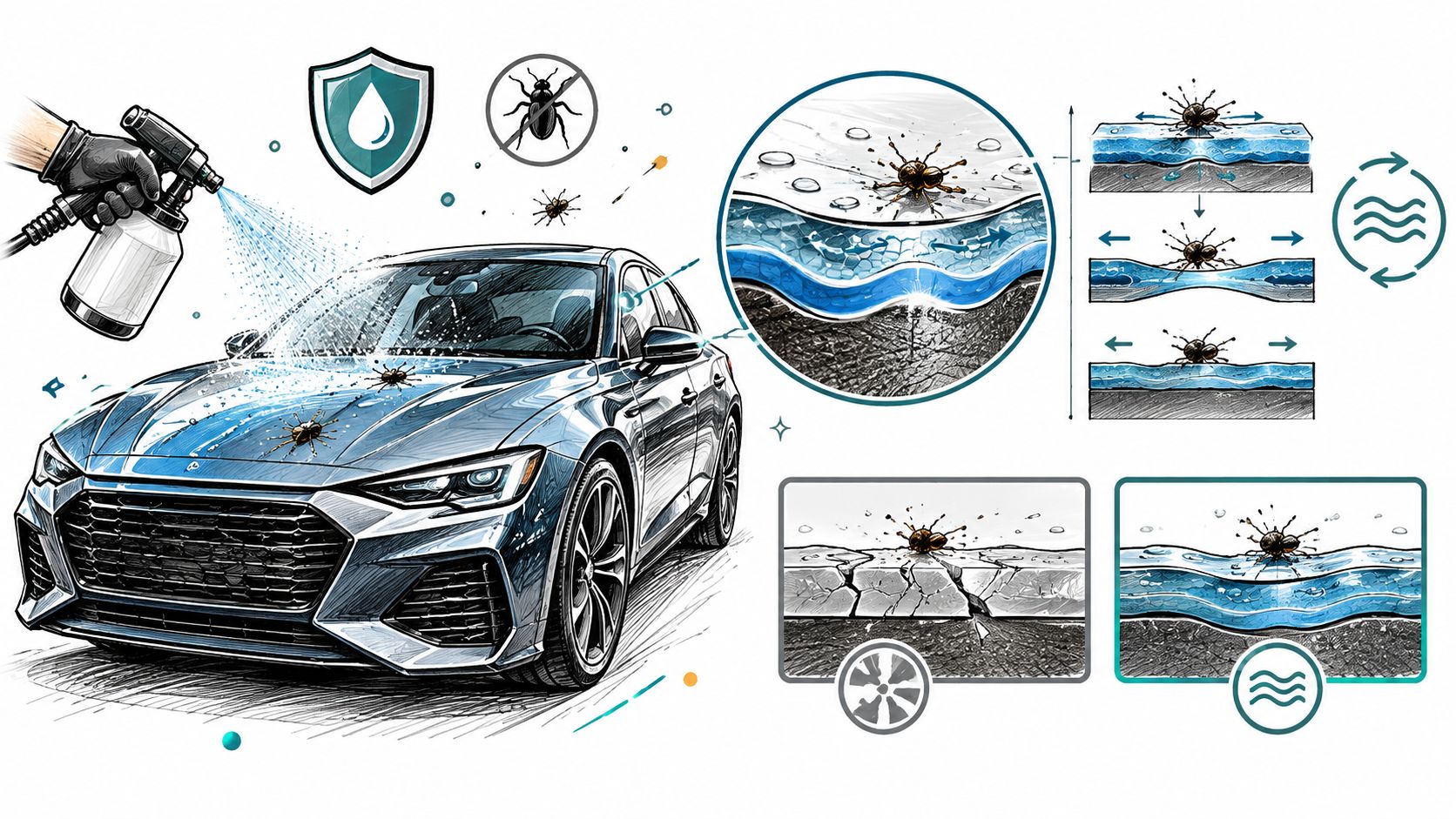
Where elasticity helps
Bugs and road debris still hit the car. Elasticity doesn't prevent contact, and it doesn't guarantee that a mark won't form. It can, however, support a protective barrier that remains more tolerant of repeated thermal and mechanical movement, which may make later cleaning less punishing for the underlying finish.
The distinction between surface hardness and movement tolerance is explained further in Titan's coating flexibility information. For detailers, that distinction matters when choosing a system for a hood, bumper, or mirror that sees repeated contamination rather than a display vehicle that spends most of its time indoors.
Basic contamination-removal habits also translate across surfaces. Guidance such as South Mountain Window Cleaning tips reinforces the value of softening biological deposits before wiping. Bird residue and insect residue aren't identical, but both reward patience over dry abrasion.
Titan's systems also describe Dark Matter Technology® and carbon-nanotube reinforcement in relation to resistance against chemicals, UV exposure, and everyday grime. Those features should be presented as protective-coating characteristics, not as evidence that the film repels every insect or eliminates washing.
Year-Round Bug Protection Routine
A useful routine changes with the way you drive. A seasonal driver can inspect the coating before summer travel, while a highway commuter needs a quicker response after repeated exposure. An off-road enthusiast may need more frequent pre-rinsing because dust and biological residue combine into a more abrasive film.
Match the routine to the driver
Seasonal drivers: Before warm-weather trips, wash, decontaminate, and inspect the front bumper, mirrors, hood edge, and windshield. Store clean microfiber towels in a sealed container so they don't collect grit.
Highway commuters: Keep a compatible cleaner, plush microfiber, and rinse water available. Remove fresh residue as soon as practical instead of allowing several drives to build one hardened layer.
Off-road enthusiasts: Rinse loose dust first, then address bugs. Combining dry soil with a towel creates unnecessary abrasion, even when a coating is present.
Use a pH-controlled cleaner suited to the surface, and never let a chemical product dry on hot paint or glass. Separate towels used on lower panels from those reserved for the windshield and upper paint. Once a towel touches greasy trim or a dirty rocker panel, move it out of your finishing rotation.
After a long trip, inspect the front end under cool, even lighting. Look for faint stains, loss of gloss, streaking, or a change in water behavior. A coating doesn't remove the need for maintenance. It gives you a better starting surface for that maintenance.
Environmental context also matters. A Danish study used 1,375 standardized windshield surveys between 1997 and 2017, with one route showing an 80% decline in flying-insect abundance and another a 97% decline over the study period (Wired's coverage of the windshield survey). Fewer splats on one route may reflect changing insect abundance, not superior product performance.
Red Flags in Bug Repellent Claims
A product that makes water bead dramatically may still provide no evidence that insects avoid the vehicle. Ask whether the manufacturer measured residue adhesion, removal force, stain retention, gloss change, and finish condition after exposure. If the only demonstration shows water rolling across a panel, it proves water interaction, not biological repellency.
Watch for claims that blur three separate outcomes:
- Reduced contact: A product supposedly changes insect behavior or collision frequency. That requires controlled observation.
- Reduced adhesion: Residue still lands but releases with less effort. This is the more practical coating objective.
- Improved cleanup: The surface remains easier to wash after the deposit dries. This needs repeatable before-and-after testing.
Video demonstrations can be useful for showing application technique, but they're easy to misread. A freshly prepared panel, a short dwell time, favorable lighting, or a carefully chosen deposit doesn't establish long-term durability. Look for testing on standardized panels, repeatable contamination, heat and UV exposure, and inspection after cleaning.
Also question glass claims. A treatment that leaves an uneven film can cause glare or wiper streaking. The U.S. Environmental Protection Agency's automotive bug and tar remover definition supports a product category focused on removing insect carcasses and related grime without damaging automotive finishes (EPA automotive product guidance). That's a more defensible promise than calling a cleaner a pesticide or implying that a coating stops insects from landing.
Next Steps for Cleaner Drives
Start with the part of the system you're currently neglecting. If residue sits on the car for days, improve the removal process before buying another protectant. If washing is easy but the finish loses slickness quickly, consider a maintenance sealant or coating that matches your application skills and substrate.
For glass, use a treatment explicitly designed for automotive glazing. Titan's Apex Glass Ceramic Coating is presented as a windshield and glass coating intended to enhance visibility in rain and simplify application. It should still be applied to clean, prepared glass, then inspected for uniformity and wiper compatibility.
For a flexible membrane spray, Ultra Ceramic Spray is described as a concentrated, water-based sealant designed for paint systems, wraps, PPF, glass, wheels, plastic trim, and household or personal items. Its broad substrate description makes compatibility testing and proper preparation especially important before using it across a vehicle.
Titan's shop provides access to its listed coating and maintenance products, while the company's educational material and YouTube videos can help detailers review application technique. Product videos are most useful when you compare the demonstration with the technical information, surface limitations, and care instructions rather than treating the visual result as independent performance data.
The wider ecological context deserves restraint. A UK and Ireland citizen-science project reported a 59% decline in flying-insect impacts between 2021 and 2025 (CBC coverage of the monitoring project). That figure doesn't show that a coating repels insects. It shows why a clean windshield can't automatically be used as proof of product success, and why responsible detailers should distinguish reduced adhesion from reduced insect collisions.
The most dependable plan is simple: protect the surface, soften contamination, use low-force cleaning, and inspect before polishing. That approach preserves gloss without promising an impossible barrier against every highway impact.
APEX NANO – Titan Coatings offers flexible ceramic and glass coating options that can help reduce residue adhesion and simplify maintenance after insect-heavy drives. Visit APEX NANO – Titan Coatings to review the coating systems, application resources, and product choices for your vehicle or detailing service.
0 Comments