
Car paint guard protection is a flexible, engineered barrier applied over the clearcoat to shield paint from UV radiation, scratches, chemicals, and temperature-related stress while preserving gloss for months or years. In practice, it’s the layer that helps a finish survive sun, salt, and wash damage instead of just looking good on delivery day.
You see the need fast when a car spends one week baking in summer sun, then gets blasted with winter road salt and routine tunnel washes. That’s the point where a lot of owners notice the factory finish turning tired before they expected it to, because clearcoat is a measurable protective layer, not an unlimited shield, and weathering can keep eating away at it over time (automotive coating weathering study).
Why Modern Paint Needs More Than Wax
A commuter car can look fine on Monday and still take a beating every time it leaves the driveway. Sun, salt, and wash chemicals keep working on the surface until the barrier starts to thin and lose strength. That is why car paint guard protection matters as much for preservation as it does for appearance.
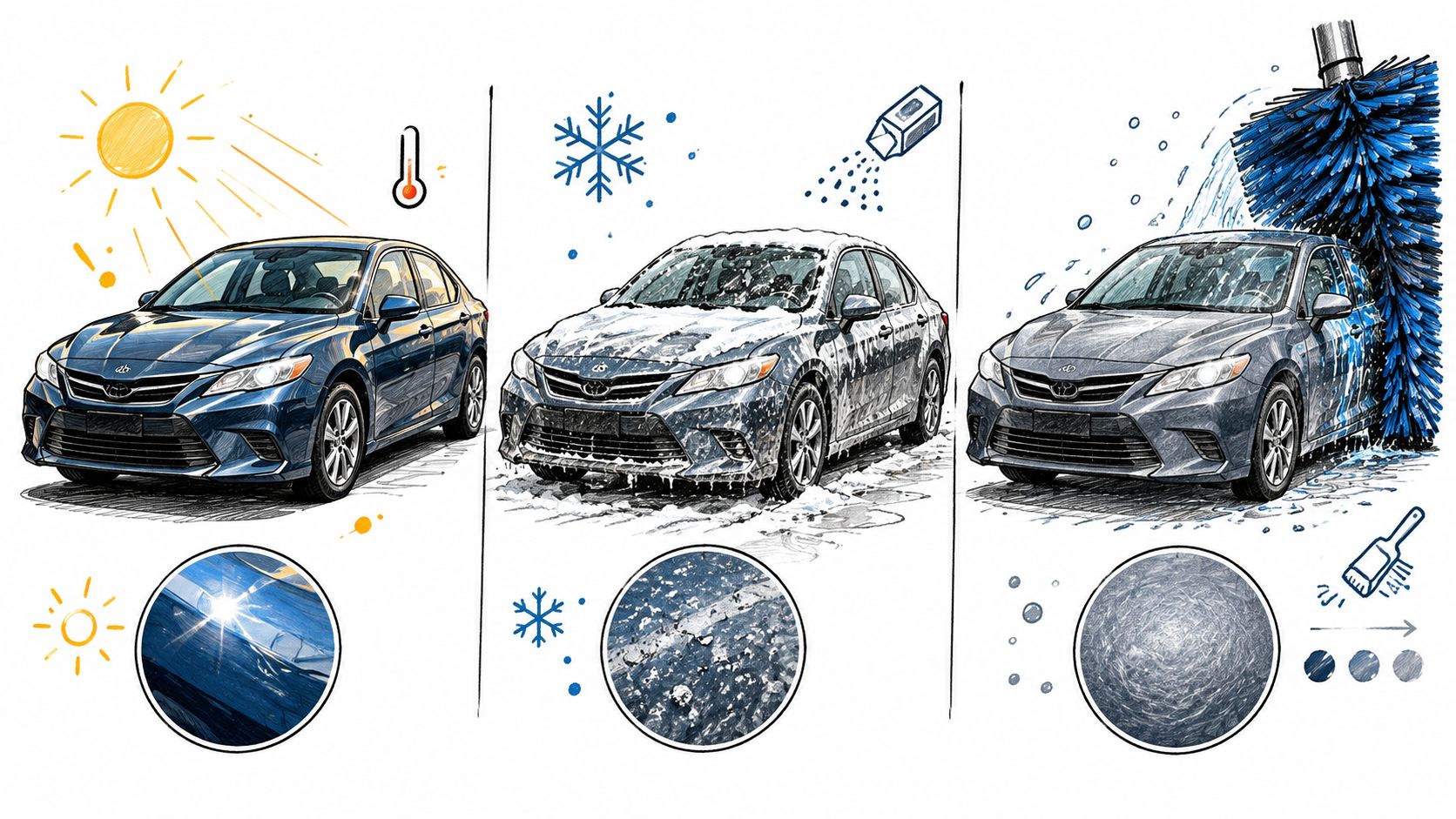
The job of a barrier layer
Modern automotive paint was built as a layered system in the 1970s, with a colored basecoat and a thicker clearcoat taking the environmental abuse. The clearcoat was engineered with specialized resins, ultraviolet absorbers, and radical scavengers to slow degradation. That layered chemistry is why protection products need to work with the finish, not replace it.
A barrier layer takes the daily abuse so the factory coating does not have to.
Practical rule: if a product cannot preserve the original layer underneath it, it is merely sitting on top of it.
Wax can still serve a purpose, especially for short-term gloss and easy maintenance, but it falls short in hard-use environments. It may look good after application, yet it is not built for the same long-term environmental load as a designed coating system. For a plain-language breakdown of that trade-off, see this comparison of wax and ceramic coating.
A real protection plan slows damage before the clearcoat loses thickness, hardness, and the ability to defend the color coat. When the finish is already under constant UV, moisture, salt, and wash stress, durability matters more than a quick shine.
How Clearcoat Failure Really Starts
Clearcoat failure usually does not begin with a peel or a crack you can spot from across the driveway. It starts with small losses in surface behavior, a flatter gloss, weaker hardness, and a finish that no longer resists fine marring the way it once did. By the time the paint looks a little dull, part of the protective system is already gone.
UV and contamination work together
Clearcoat research shows how the breakdown starts below the surface. One study found that 5,000 hours of accelerated weathering reduced ultraviolet absorbance by 33% and film thickness by 16%, and the researchers estimated that about half of the ultraviolet-absorber loss came from physical erosion of the coating film (automotive coatings weathering study). That matters because the clearcoat is not just there for shine. It is the first barrier against ultraviolet radiation, oxidation, moisture, chemicals, and abrasion. Once that layer starts thinning, it loses the margin owners assume is still present.
Chemical exposure makes the problem worse. UV, synthetic acid rain, and repeated wet-dry cycling can change the coating and reduce its resistance to erosion, so a finish can still look acceptable while becoming easier to damage from sand, grit, and road debris (clearcoat failure overview). Gloss is only one signal. Water behavior, staining, visible marring, and adhesion tell you more about whether the surface is still doing its job.
For a deeper look at how coatings break down, see our coating failure analysis.
Test against the environment the car faces
Professional evaluation should match the environment. Weathering methods such as xenon-arc and QUV testing, or cyclic corrosion and UV standards, exist because a coating can survive one stress and fail under another (accelerated weathering methods) (ASTM D5894). A product that beads water today still needs proof that it can hold adhesion and resist loss under repeated light, moisture, and temperature cycling.
Alpha Quartz 50ml Ceramic coatig is presented as a high-performance elastomer ceramic coating for all surfaces, with 92% high solids, zero VOCs, solvent-free chemistry, advanced adhesion technology, and a 4 hour cure time. That kind of product language only matters if the surface prep is right, because contamination or polishing oils can stop proper bonding and make durability look worse than the material can deliver.
Coatings vs Films: Choosing the Right Shield
A lot of owners ask for the “strongest” option, but the better question is what kind of damage the car sees day to day. A highway commuter in winter salt has different needs from a weekend toy that mostly sees garage time. The right answer is rarely one universal product; it is the best match for the car’s abuse pattern.
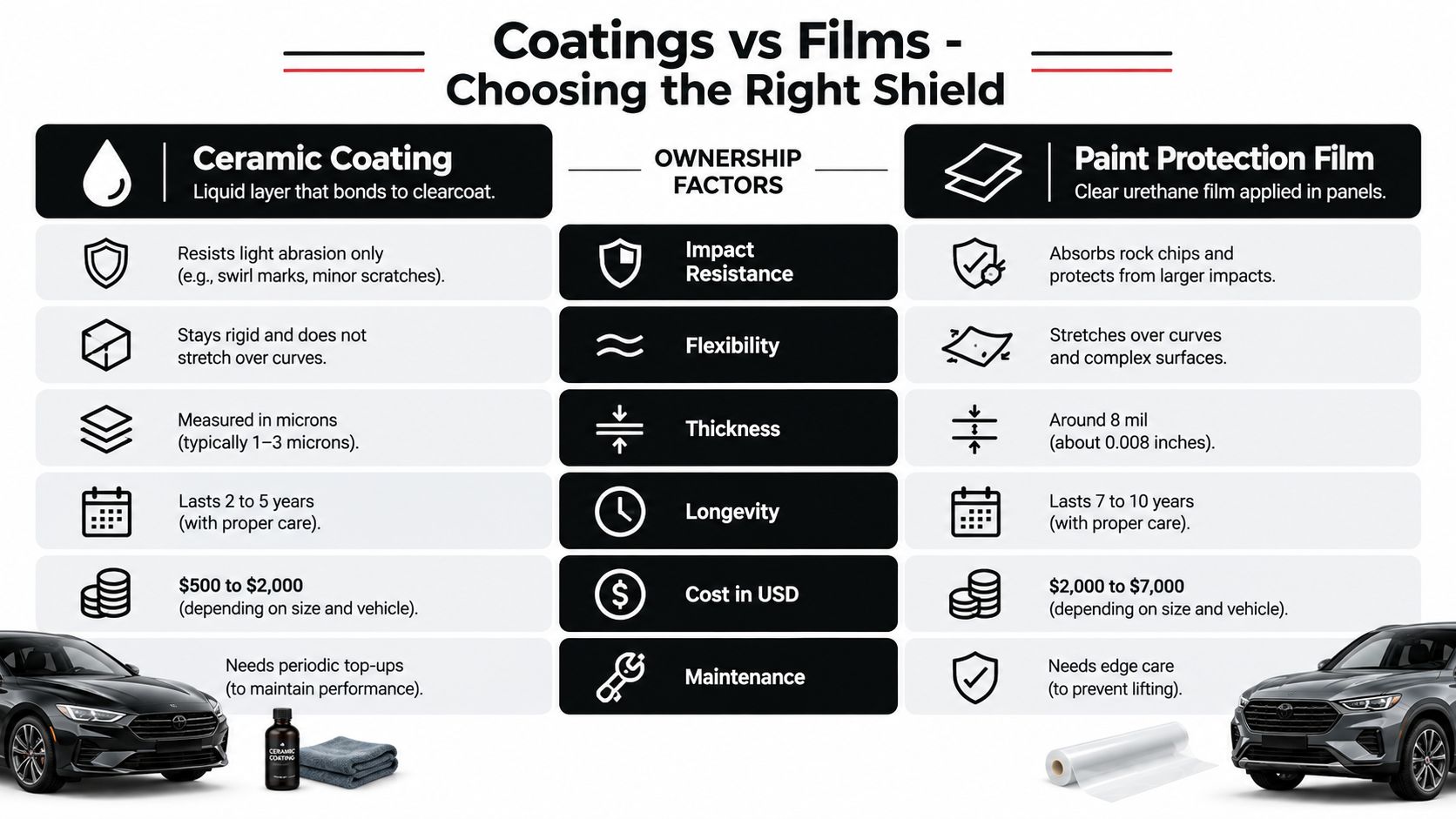
What each shield is good at
Paint protection film gives you a thicker physical layer, so it is the stronger choice when the car takes rock chips, edge strikes, and repeated abrasion. Coatings do a better job with chemical resistance, hydrophobic behavior, and keeping the surface easier to clean. That trade-off matters before money goes into the wrong layer.
The wrong product can still look impressive on day one.
Film belongs on the high-impact zones, like front bumpers, hoods, mirrors, and other places that catch debris first. Coatings make more sense when the goal is to slow contamination, improve wash behavior, and keep the finish looking fresher with less effort. On many cars, the practical answer is a mix, film where the hits are hardest, coating where the damage is more chemical than physical. For a full side-by-side, see our paint protection film vs ceramic coating breakdown.
A simple decision frame
If the car lives on rough roads, film belongs on the front of the vehicle. If the owner wants easier maintenance and better chemical resistance, a coating is the cleaner fit. If the paint is already compromised, the answer may be correction first, or repainting if the clearcoat and basecoat are beyond sensible rescue.
For maintenance between full applications, OMNIGUARD – Waterless Wash is described as a quick sealant with fast wipe-downs, water mark removal, UV protection, HYPERBEAD™ particles, and self-cleaning and oxidation resistance for up to 6 weeks. That kind of topper is useful when the goal is upkeep, not a full protective rebuild.
The market reality is simple. Coatings and films solve different problems, so the best program is the one that matches the car’s exposure, budget, and willingness to maintain it.
Why Elastic Nanotube Coatings Outperform Rigid Options
A rigid coating can look excellent until the weather starts working the panel. Temperature swings push paint and coating through repeated expansion and contraction, and if the film cannot move with that cycle, stress builds at the interface. Cold mornings, hot afternoons, and constant seasonal changes expose that weakness fast.
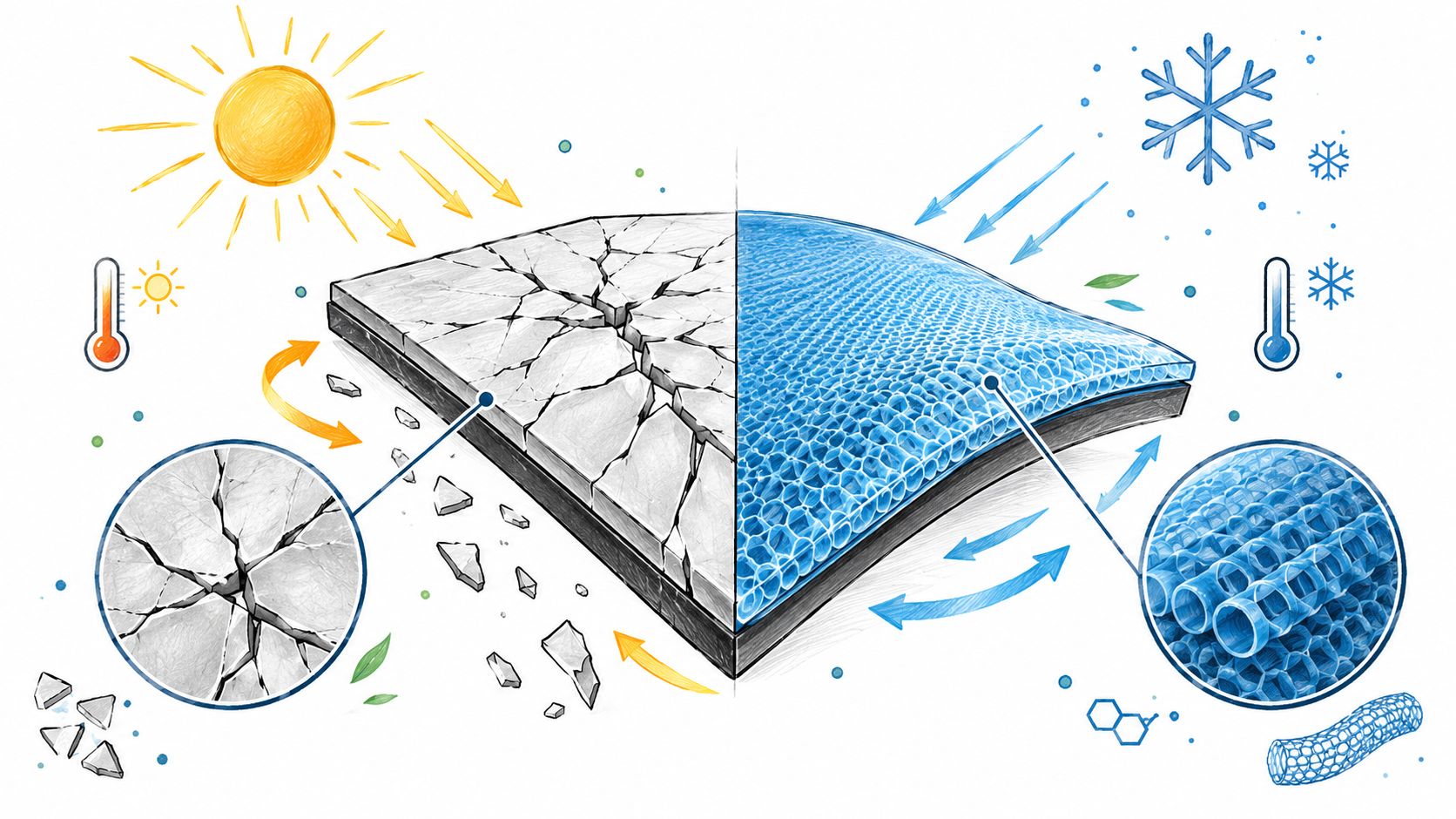
Hardness and flexibility need each other
ASTM-related durability guidance treats temperature cycling, moisture, UV exposure, and wet-dry transitions as separate damage mechanisms, not one generic weather test (temperature cycling guidance). That matters because a coating that reads hard on paper can still fail early if it turns brittle in the cold. Flexibility is part of what lets protection survive movement.
We cover the mechanics in more depth in our coating flexibility guide.
Titan Coatings’ Dark Matter and elastomer direction fits that physics. The company says its coatings are built around military-grade polymers and a broader nanomaterials approach. A hard-like-glass surface that can also flex has a better chance of handling thermal stress than a rigid shell that fights the panel at every cycle.
Why nanotubes matter mechanically
Nanotubes are more than a buzzword when they are dispersed properly. A technical plastics report notes that carbon nanotubes can contribute electrical and thermal conductivity, structural strength, stiffness, and thermal stability, while conductive performance can often be reached with lower loading than carbon black, which helps preserve toughness and elongation (carbon nanotubes in automotive plastics). That is the kind of engineering logic that belongs in a coating discussion, because it points to reinforcement without turning the film brittle.
A coating has to stay bonded through repeated expansion and contraction. If it cracks, chips, or loses adhesion, hardness stops mattering. Controlled flexibility keeps the barrier in place long enough for the rest of the protection to do its job.
Practical Protection Applications for Different Surfaces
Good paint guard protection isn’t limited to the hood and doors. Glass, trim, wheels, and even the surfaces you touch every week all benefit from the same basic idea, keep contaminants from clinging and make the finish easier to maintain. That’s why a complete care routine usually includes more than one product category.
Use the right product on the right surface
Apex Glass coating is built for glass and windshields, with deep-pore bonding and water-repellent performance that improves visibility and reduces wiper use. On a daily driver, that can make rainy commutes less tiring because the windshield sheds water faster and stays clearer under load.
Ultra Ceramic Spray is the easier maintenance layer when you want a flexible sacrificial shield without a full studio setup. It’s useful on gloss, matte, and satin finishes, so you can use it as a practical protection step on vehicles that need quick application and consistent upkeep. That kind of product makes sense for mobile work, home garages, and fast turnaround routines.
A simple field routine
- Clean first: remove road film, dust, and bug residue before any coating or spray touches the surface.
- Work section by section: smaller panels help you avoid streaking and missed spots.
- Keep pressure light: you’re laying down a barrier, not scrubbing a stain out of the paint.
- Check the surface after cure: look for uniform beading, even wipe-down behavior, and no stubborn haze.
For plastic and exterior trim, the same logic applies. If the surface is porous or aging, a product designed for that substrate is usually a better fit than a general-purpose shine product. Titan’s trim coating guidance is relevant here because trim is one of the first places where UV and wash abuse show up.
The point is simple, match the chemistry to the surface, and the results get easier to live with.
Maintenance Habits That Extend Protection Life
Protection lasts longer when the car is washed like it matters. Dirt, salt, and old soap residue all interfere with how a coating behaves, and aggressive washing can shorten life faster than normal weathering. A clean finish is easier to inspect, and inspection is how you catch wear before the barrier is gone.
What to watch for
Bead formation tells you something, but it doesn’t tell you everything. A coating can still look shiny while losing resistance to chemicals or marring, so I look at staining, water behavior, and visible scratches together. If the surface stops shedding contamination as easily, it’s time to think about maintenance instead of waiting for obvious failure.
Practical rule: if the finish still glosses but starts holding grime, it’s already asking for help.
That’s where regular washing pays off twice. First, it removes contaminants before they bond harder. Second, it lets you spot dull patches, light marring, and edge wear early enough to correct them before you’re forced into heavier polishing.
What ruins protection fastest
- Abrasive washing tools: they drag grit back across the coating.
- Harsh cleaners: they can strip the surface faster than normal exposure.
- Ignoring bug and salt residue: contamination stays active on the finish.
- Skipping inspection: small failures turn into bigger rework.
Small habits protect resale value and reduce the chance of expensive correction later. The less you let contamination sit, the more the barrier keeps doing its job. That’s true whether the finish is coating, film, or a maintenance sealant between bigger applications.
Choosing the Right Protection Path for Your Vehicle
The right path starts with honest assessment. If the clearcoat is healthy and the car needs better chemical resistance and easier maintenance, a coating makes sense. If the front end takes real impact, film belongs on the high-strike areas, and if the vehicle just needs upkeep between bigger jobs, a maintenance sealant is often enough.
For detailers and shop owners, it also helps to think about how to explain options clearly to customers. A useful resource on that side of the business is benjiads for auto detailers, especially when the challenge is translating product differences into a recommendation clients can trust.
Titan Coatings’ lineup fits that decision model in practical ways. Alpha Quartz is positioned for elastomer-based durability, Apex Glass is aimed at windshield visibility, and Ultra Ceramic Spray is the quick maintenance option for in-between care. The smart move is to pick the layer that matches the car’s real exposure, not the one that sounds toughest in a sales pitch.
If you want a protection plan built around real vehicle abuse, not just shine, APEX NANO – Titan Coatings offers coatings and maintenance products that fit different surfaces and use cases. Visit APEX NANO – Titan Coatings to compare options for paint, glass, and upkeep, then choose the layer that matches how you drive and maintain your car.
0 Comments