
The car is clean, but the coating no longer behaves like it did after installation. Rain used to bead tightly and leave quickly. Now water sits in broad patches, the wash mitt feels less willing to glide, and winter road film seems to return as soon as the car leaves the driveway.
A common explanation is that the coating has failed. Sometimes the problem lies in the wash routine. Repeated contact, unnecessarily strong pre-wash chemistry, excessive product concentration, and foam that dries on warm paint can hide or weaken the performance of waxes, sealants, ceramic coatings, and PPF.
A gentle snow foam gives the wash a safer first move. It wets and loosens contamination before a mitt touches the surface. It isn't a complete wash, and it isn't automatically coating-safe because the bottle says "pH neutral." The result depends on the chemistry, the working dilution, the dwell time, and whether the product dries.
Why Coated Cars Need a Gentler Pre-Wash
A customer once arrived with a dark coated hatchback after a winter of automatic washes and strong alkaline pre-washes. The paint still looked glossy under the studio lights, but the bonnet told a different story. Water no longer gathered into the tight beads the owner remembered, and the sides carried a dull road film that needed more pressure to remove.
The first wash pass revealed the likely cause. The owner had been putting a mitt directly onto a gritty surface, then compensating with stronger chemicals when the paint felt difficult to clean. That combination creates two separate problems. Abrasive particles can become trapped between the mitt and clear coat, while aggressive or poorly controlled chemistry can reduce the performance of sacrificial protection and leave residue behind.
Practical rule: Make the surface safer before you make contact with it.
The foundational job of snow foam is simple. A surfactant-rich solution clings to the paint, wets contamination, and helps loosen dust, oils, winter grime, and road film. Rinsing then removes part of that soil before the mitt arrives. Less remaining grit means less opportunity to drag particles across the surface and create wash-induced marring.
Gentle snow foam is therefore best understood as a low-contact pre-wash, not a replacement for the full vehicle-washing process. A coated car may still need a lubricated contact wash after rinsing, especially when bonded film remains. The foam should reduce the burden placed on the mitt, not convince you that every vehicle is clean without touching it.
The same principle applies whether the surface carries Titan's elastomer-based technology, a traditional wax, a synthetic sealant, or a ceramic coating. The objective is controlled soil release while preserving the protection beneath it. Titan's ceramic-coated car washing guide is useful background for owners who want to connect coating maintenance with safer wash technique.
What Makes a Snow Foam Actually Gentle
After an alkaline pre-wash has dulled wax behavior or left a coated panel feeling dry, a tall blanket of foam can look reassuring. The bubbles alone do not make it gentle. Foam is gas dispersed through a surfactant solution, helping the liquid stay on the panel while surfactants wet and loosen oily road film. The formula, dilution, dwell time, and rinsing technique determine the result.
Anionic surfactants often deliver strong detergency and visible foam. Amphoteric and nonionic co-surfactants can moderate harshness and help the formula perform across different water conditions. The useful question is whether the product loosens soil at its stated working concentration and rinses away without a film, not how high the foam rises.
A dry, tall blanket may carry less liquid than a wetter layer. For a first wash on a coated car, look for foam that stays wet during the intended dwell period, softens contamination, and rinses without demanding extra pressure or repeated passes. That behavior matters more than appearance.
Foam performance needs a measured test
pH is one reading, not the whole wash. Research on surfactant foam behavior found that pH can affect foamability, stability, viscosity, and elasticity, while one tested biosurfactant system showed its strongest measured foam properties at pH 10. That finding describes a formulation-specific test, not a recommendation for alkaline foam on a coated vehicle. Automotive cleaning conditions differ from soil-remediation testing. (Research on surfactant foam behavior)
Test a small panel with the same product, pressure, and dilution you plan to use. Watch whether the foam stays wet, how clearly runoff carries soil, how much rinsing it needs, and whether a film remains after drying. For soap selection on coated cars, compare that behavior with the guidance in our car wash soap for ceramic coating guide.
A coating-maintenance product also shows why controlled washing matters. ULTRA Ceramic Spray is described as a highly concentrated, water-based flexible membrane sealant for paint systems, wraps, PPF, glass, wheels, plastic trim, and other items. Its broad surface range does not remove the need to control chemical dosing and mechanical stress during the wash.
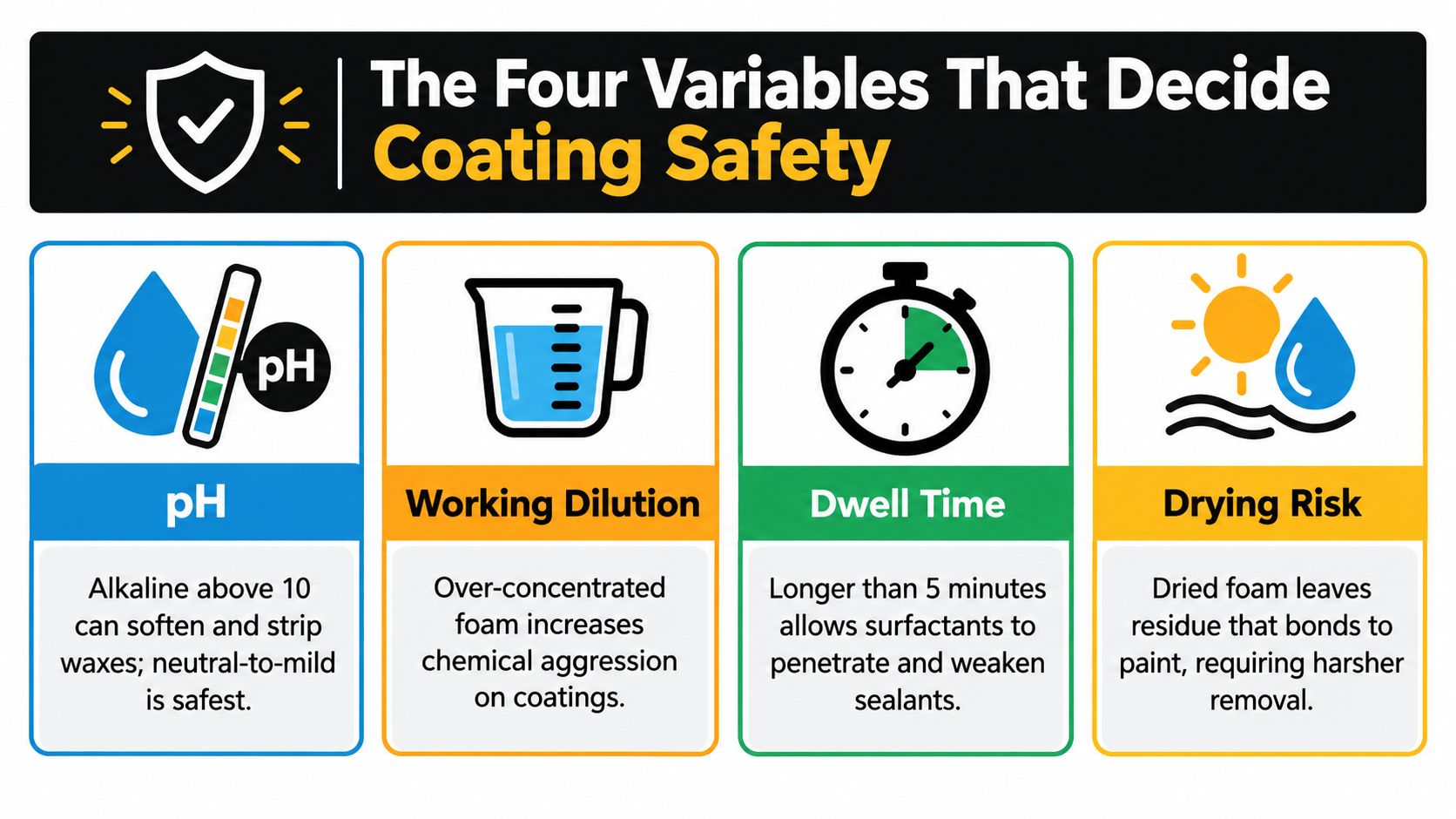
The Four Variables That Decide Coating Safety
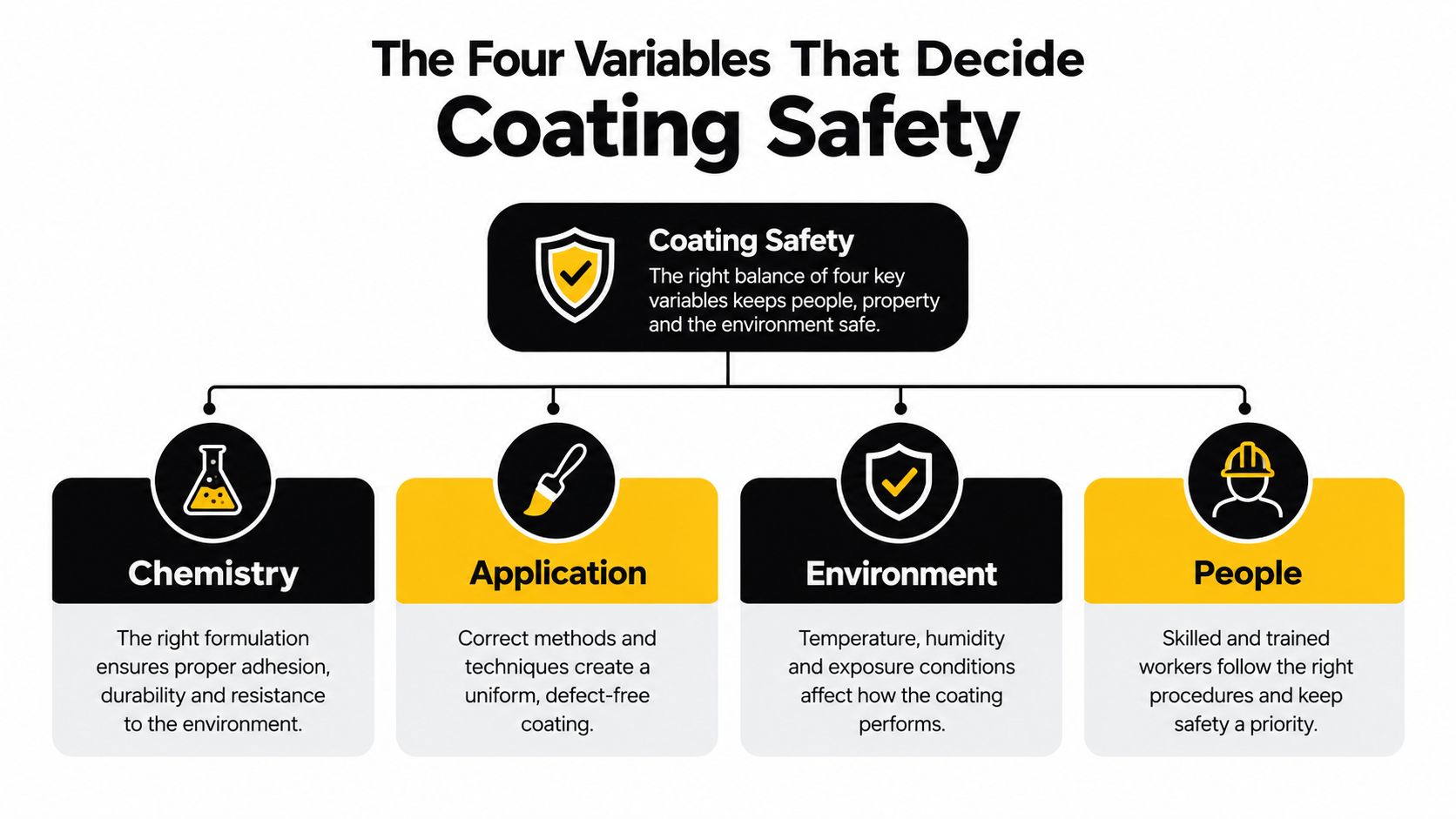
A customer arrives with a coated car and a familiar complaint: the last alkaline pre-wash made the wax feel flat. The replacement foam is near-neutral, but that label alone cannot guarantee a safe wash. Chemistry, application, environment, and people all shape what reaches the coating.
pH is only the first reading
Near-neutral chemistry generally places less chemical stress on sensitive trim, wax, and some sealant systems. Strongly alkaline chemistry can attack traffic film more aggressively, while repeated use may shorten the life of sacrificial protection. "pH balanced" on a label tells you less than a pH reading taken at the dilution sprayed onto the car.
The measurement basis matters. A named gentle foam may report a pH value without stating whether it applies to the concentrate or the ready-to-use mixture. Direct comparisons then become unreliable. For a closer look at why a mild reading does not prove compatibility, see this chemistry versus compatibility guide.
Dilution controls the chemical load
On the first foam job, the bottle may look harmless until the rinse reveals a greasy film. Too little product can leave oily soil behind and encourage extra mitt pressure. Too much raises the surfactant load, makes rinsing harder, and can leave residue even when the formula itself is mild.
Use the product's stated dilution range instead of copying a ratio from another foam cannon or pump sprayer. Equipment changes the water and air entering the mix, so a bottle ratio needs testing before it is treated as universal.
Dwell time needs a boundary
Foam needs time to wet and loosen soil. Extra dwell does not automatically improve cleaning. A concentrated product left on a warm panel keeps the chemistry in contact with the coating longer than intended.
Set a timer for the first application. Note when the foam reaches the panel, watch when it begins to thin, and rinse before the surface starts to dry.
Drying risk changes the job
A cool panel in shade gives the operator more control. A sunlit bonnet can turn a promising pre-wash into residue before the final door is covered. Once foam dries, surfactants and dissolved soil may require another chemical pass or more agitation.
Apex Glass Coating- 50ml illustrates why surface-specific protection deserves careful maintenance. Titan describes it as a hydrophobic glass and windshield coating with pore bonding, water-repellent performance, improved visibility, reduced wiper use, and durability of up to 2 years (per Titan product information). A mild foam still requires careful application on glass, paint, and trim.
Gentle Foam Versus Alkaline Pre-Wash on Real Panels
On a lightly dusty coated panel, a near-neutral foam usually offers the more predictable maintenance approach. It can soften fresh road film and reduce the amount of grit left for the contact wash while placing less chemical stress on waxes and toppers.
An alkaline traffic-film remover has a different role. It can be useful when heavy oil, grease, or embedded road film needs stronger chemical action, particularly before a coating is reapplied or on an unprotected vehicle. The trade-off is that stronger cleaning can also reduce the life of sacrificial protection.
The categories aren't completely fixed. An alkaline product used at a controlled concentration and short dwell may behave more gently than a neutral product that has been over-concentrated and left to dry. The panel, not the foam height or label language, gives the useful feedback.
| Behavior | Near-Neutral Gentle Foam | Alkaline Pre-Wash |
|---|---|---|
| Primary role | Routine pre-wash for light to moderate contamination | More forceful removal of traffic film and oily soil |
| Protection impact | Generally less stressful to waxes and sealants when correctly diluted | More likely to reduce sacrificial protection during frequent use |
| Best use | Coated, waxed, sealed, or regularly maintained vehicles | Heavy contamination or preparation where old protection must be removed |
| Main risk | Over-concentration, residue, or drying | Excess chemical strength, prolonged dwell, and coating or wax degradation |
| What to measure | Soil release, rinse effort, residue, and beading afterward | Cleaning gain compared with the protection lost |
Run a small test area when the history of the product or coating is unclear. Apply the same foam to adjacent sections, rinse completely, and compare runoff, surface feel, drying behavior, and water response. Don't treat one strong beading change as proof of permanent coating failure. Residue can temporarily mask hydrophobic behavior.
Panel decision: Choose the least aggressive chemistry that removes the contamination without increasing contact pressure.
For coated vehicles, chemistry versus compatibility becomes more useful than a simple “neutral equals safe” rule. Product strength, application behavior, and the condition of the surface all belong in the decision.
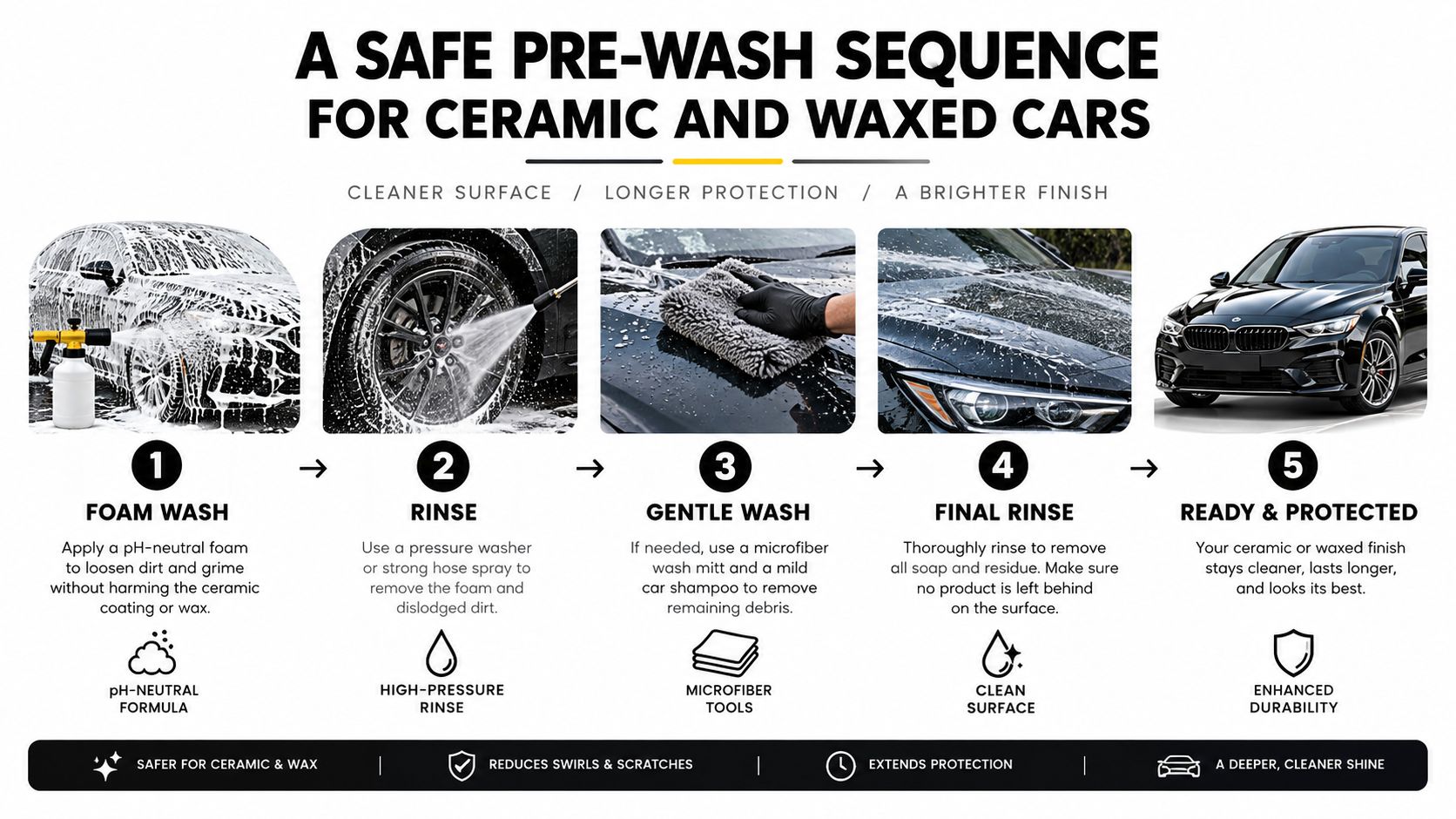
A Safe Pre-Wash Sequence for Ceramic and Waxed Cars
The first job on a customer's coated car starts before the bottle is connected. I check the panel with my palm, look for heat from direct sun, and move the vehicle into shade whenever possible. Cool paint gives the foam a better chance to remain wet long enough to work.
The controlled sequence
Inspect the surface. Identify loose dust, oily road film, insect residue, and areas where contamination has bonded. Don't begin with a mitt on a visibly gritty panel.
Set the mixture. Use the product label's working dilution for your specific foam cannon, foam gun, or pump sprayer. Keep the nozzle, pressure, and mixture consistent so you can judge the result rather than chasing changing variables.
Apply evenly. Cover the vehicle methodically, usually from lower panels upward when you want the foam to reach dirtier areas, while avoiding unnecessary overspray onto surfaces you aren't treating. Keep the product away from hot panels and monitor the first areas you sprayed.
Control the dwell. Let the foam soften the soil, but don't allow it to dry. A phone timer prevents guesswork, especially when working across a full vehicle in changing weather.
Rinse deliberately. Use a thorough top-down rinse so loosened contamination travels away from the surface rather than being pushed across it. Inspect the panel before introducing a mitt.
After rinsing, use a lubricated contact wash when a visible or tactile film remains. A ceramic coating shampoo guide from GP Mobile Car Wash & Detail can help compare shampoo characteristics for the next stage, but no shampoo replaces the need to remove loose grit first.
A mobile detailer without a hose can use a pump sprayer and controlled rinse buckets, provided the wastewater is managed responsibly and the panel stays wet. The same logic applies: loosen first, rinse away what you can, then use minimal lubricated contact.
Titan's car pre-wash guidance fits this workflow because the pre-wash is a preparation stage, not the entire wash. The goal is a cleaner, safer hand-wash surface.
How Elastic Coatings Change the Wash Conversation
The owner of a coated car often thinks only about hardness. A hard surface sounds protective, but a vehicle body moves through temperature changes, flexes during driving, and receives small impacts from road debris and insects. A film that combines hardness with flexibility raises a different maintenance question: how can the wash routine preserve both the surface and the film beneath it?
Titan states that it introduced carbon nanotubes into the automotive-coatings market in 2021. Its Dark Matter Technology® combines carbon nanotubes with other carbon allotropes, while ElastoTek® uses elastomer polymers to create a flexible membrane. Titan describes the nanotube component as contributing mechanical strength and thermal stability, while the elastomer component helps the cured film retain flexibility rather than behaving like a purely brittle ceramic layer. (Titan on harsh-weather coating technology)

Hardness and movement have to coexist
Titan describes its elastic coatings as combining glass-like hardness with rubber-like flexibility. The stated mechanical rationale is that a flexible coating can expand and contract with the substrate as conditions change, reducing the likelihood of stress fractures and microcracks compared with a more rigid film. Titan frames this behavior around movement between freezing conditions and hot panels, but the performance remains formulation-dependent. No coating is immune to every impact, crack, or thermal event. (Titan on industrial coating technology)
That flexibility is relevant to washing. A pre-wash that reduces abrasive contact helps protect the top surface, while controlled chemistry avoids placing unnecessary stress on the coating system. An elastic film can support the owner's maintenance routine, but it can't compensate for dried foam, aggressive agitation, or a mitt that is carrying grit.
Titan describes Dark Matter Technology® as a self-healing elastomer coating with heat-activated recovery for fine swirls and scratches. The claim applies to fine surface defects, not every kind of damage, and deeper scratches generally need correction before coating application. (Titan on vehicle paint coating)
Independent research on carbon-nanotube coatings supports interest in strength and thermal conductivity, while also cautioning that the long-term stability of healing agents under ultraviolet exposure, moisture, and thermal cycling remains unproven. Repeated damage-and-recovery performance needs systematic field evaluation. (Independent coating research and evidence limits)
That uncertainty makes wash discipline more important, not less. If a coating can recover fine heat-activated marring, the best result is still to create less marring in the first place.
What Snow Foam Does Not Fix for Your Wash
The thickest foam in the driveway isn't automatically the most effective or responsible choice. Foam volume can improve visual coverage and surface residence time, but it doesn't prove better soil release, lower water consumption, or lower environmental impact.
The water context is substantial. The U.S. Environmental Protection Agency records residential hand washing at approximately 116 gallons per vehicle, while commercial car washes generally use about 60 percent less water for the entire wash process than a homeowner uses for rinsing alone. The same guidance reports conveyor washes averaging 34 gallons per vehicle in a 2002 study, and in-bay automatic systems averaging 43.3 gallons per vehicle in 2002 and 44.8 gallons in 2018. Without reclamation, an in-bay system can use as much as 74.1 gallons per vehicle. With reclamation, that figure can fall to 19.1 gallons. (U.S. EPA vehicle-washing guidance)
These figures don't prove that foam alone saves water. Foam may help loosen contamination before prolonged agitation, but the final result also depends on pressure, nozzle choice, dilution, rinse behavior, reclamation, and wastewater controls.
Runoff belongs in the calculation
Independent wastewater research identified snow-foam stations as producing measurable pollutant loads, including suspended solids, oils and grease, chemical oxygen demand, phosphate, and total phosphorus. The investigated snow-foam station had the highest concentrations among the washing stations studied, which the researchers partly attributed to larger foam volumes and surfactant use. (Wastewater research on vehicle-washing stations)
That finding changes the meaning of “gentle.” Gentle should describe how the process treats the vehicle surface, not permission to use unlimited product or discharge uncontrolled runoff. Biodegradable ingredients don't automatically make unrestricted driveway discharge acceptable.
A mobile detailer working under water restrictions should compare litres used, rinse stages, cleaning performance, and contact passes across different methods. In some conditions, a rinseless or low-water wash may be more appropriate than adding a foam stage. And when bonded contamination remains after the pre-wash, a targeted auto cleaning clay bar may be more rational than repeatedly increasing foam concentration.
A Practical Checklist Before You Pull the Trigger
The next foam job should begin with four questions, not with the thickest setting on the cannon. I use them before the first panel, then adjust only when the surface gives a clear reason.
Check the four controls
- Working pH: Confirm the pH at the ready-to-use dilution when that information is available. Treat “pH neutral” as one data point, not a complete safety certificate.
- Dilution: Follow the label for the equipment in your hand. A foam cannon, pump sprayer, and bucket don't necessarily deliver the same concentration to the paint.
- Dwell time: Start a timer when application begins. Rinse before the product dries, and shorten the interval when panels are warm or weather conditions accelerate evaporation.
- Panel condition: Work on cool paint whenever possible. Keep the foam wet from application through rinsing, rather than trying to revive dried product with more water or stronger chemistry.
A small test section can prevent a full-vehicle mistake. Apply the mixture to one panel, rinse thoroughly, and inspect the runoff, residue, surface feel, and water behavior. If the panel needs increasing mitt pressure after the pre-wash, the foam hasn't solved the contamination problem, and more concentration may not be the right answer.
Stop when the result turns against you
- Foam dries on the paint: Rinse immediately and change the working conditions before continuing.
- The mitt needs pressure: Stop contact washing and reassess the remaining contamination, lubrication, and pre-wash performance.
- Beading drops suddenly: Check for residue, incomplete rinsing, or chemical interference before assuming the coating has permanently deteriorated.
Some vehicles don't need foam every time. A lightly dusty car may suit a carefully controlled rinseless process, while a vehicle with minimal contamination and safe access to a lubricated wash may need only a simple pre-rinse and contact routine. Foam is a tool, not a ritual.
Keep the standard simple: loosen contamination, rinse thoroughly, touch lightly, and control the chemistry. That protects the coating owner's investment while reducing the chance that the wash itself becomes the source of the next correction job.
APEX NANO – Titan Coatings offers coating systems and maintenance products for automotive surfaces, including flexible membrane technologies and windshield protection designed to support clearer wet-weather visibility. Visit APEX NANO – Titan Coatings to review the available coating options and choose a surface-care approach that matches your vehicle, washing conditions, and detailing workflow.
0 Comments