
What happens when a coating has impressive hardness but the wrong relationship with the surface beneath it? That question exposes the gap in most discussions about chemistry vs compatibility. Detailers and vehicle owners often compare hardness first, yet long-term protection depends just as much on wetting, bonding, flexibility, and the way a coating responds to paint, glass, trim, contamination, and temperature movement.
A coating isn’t successful because it looks strong in the bottle. It succeeds when its material chemistry works with the vehicle surface during installation and continues to move, resist, and protect in daily use. Titan Coatings built its automotive technology around that practical problem, combining carbon nanotube reinforcement with elastomer-based flexibility. The result is a different way to think about protection, one that treats hardness and movement as partners rather than opposites.
The Detailing Mistake That Undermines Hardness Claims
A customer arrives with a new ceramic coating and asks one question: “Is it 9H or 10H?” The label sounds decisive. It suggests that the harder product will provide safer, longer-lasting protection against road grit, chemical exposure, and repeated temperature changes.
That assumption can lead to a poor coating choice. During installation, the product may haze on a difficult panel, leave uneven coverage on trim, or show early wear after repeated heating and cooling. Strong bulk chemistry does not prove that the coating suits the surface, the preparation, or the conditions in which it was installed.
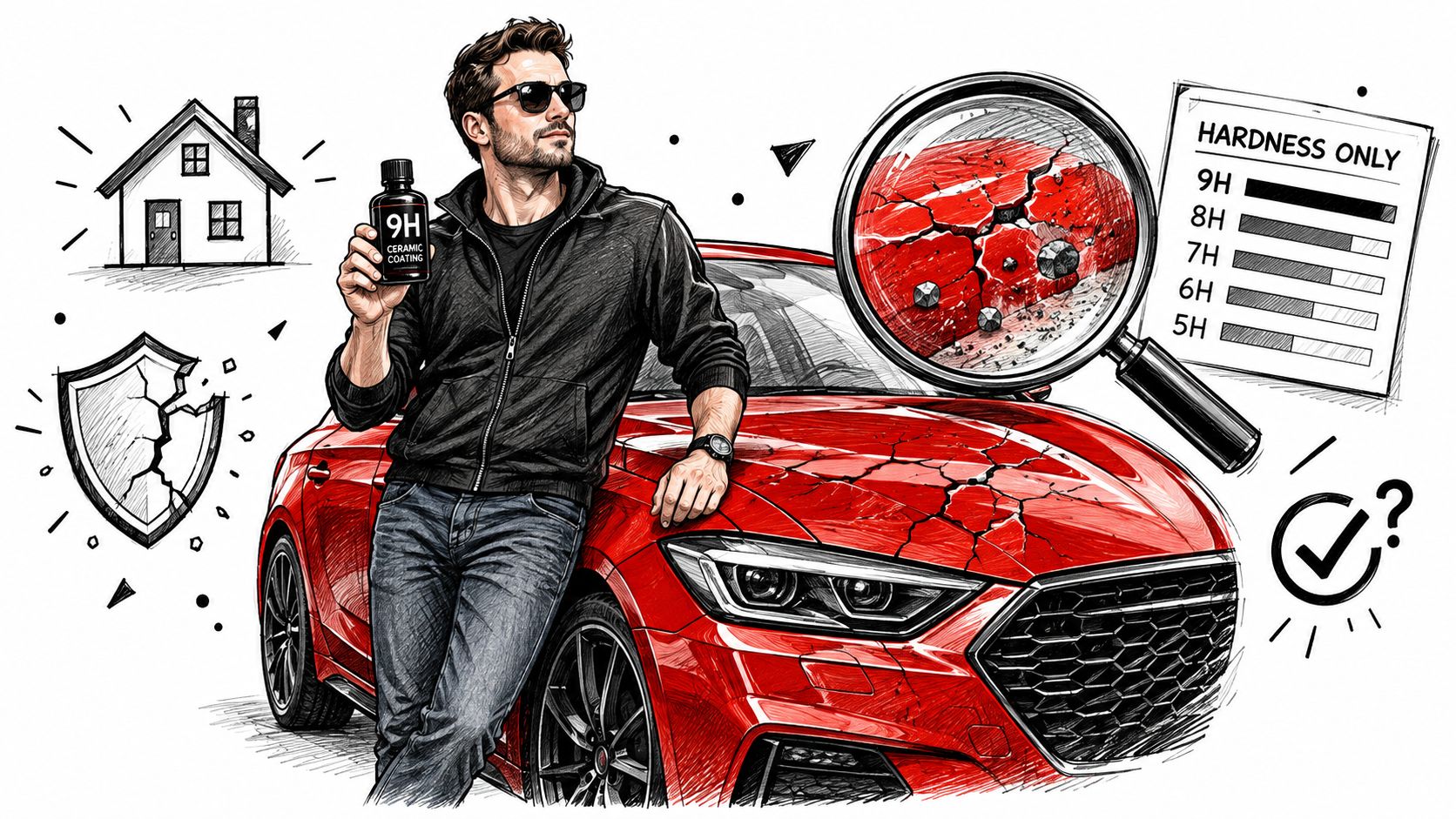
Hardness is only one part of protection
Chemistry describes the coating itself. Its polymers, solvents, additives, and functional groups influence how the film cures and behaves. Those ingredients affect hardness, gloss, water behavior, chemical resistance, and service life.
Compatibility describes the relationship between the coating and the receiving surface. Paint, glass, wraps, PPF, plastic trim, and previously cured coatings have different surface chemistry. A formula that spreads and bonds cleanly to one material may sit poorly, swell an older layer, or lose adhesion on another.
Preparation determines whether that relationship can form properly. Cleaning removes residues that interfere with bonding, while polishing can improve the condition and consistency of the substrate. Titan’s guidance on coating surface preparation treats this work as part of the coating system rather than a routine prelude.
Practical rule: Choose a coating for the surface and operating environment, not for a hardness label alone.
A familiar failure pattern
Consider contaminated paint paired with a coating selected only for its hard-finish claim. If decontamination is skipped, the product may bond to oil, residue, or an unstable prior layer instead of the clear coat. The formula can be well-developed while the interface remains weak.
Movement creates another test. A rigid film and the panel beneath it may expand and contract at different rates. A coating that resists scratching in a controlled test can still develop stress when those materials move differently. Hard like glass does not need to mean brittle. Titan’s elastic coatings combine a hard protective character with flexibility, helping the film accommodate movement instead of relying on rigidity alone.
Raw strength has value, but only after the coating wets, bonds, and stays attached to the actual substrate. Match the formula to the surface, prepare that surface correctly, and install within conditions the system can handle. That process turns a hardness claim into usable protection.
Understanding Chemistry and Compatibility
Chemistry and compatibility answer different questions, so treating them as interchangeable creates poor buying decisions.
Ask chemistry, “What is this coating made to do?” Ask compatibility, “How will it behave on this specific surface?” The first question covers the formula’s polymers, solvents, additives, and functional groups. The second covers adhesion, flexibility, wetting, curing, and interaction with paint, glass, plastic, or a previous layer.
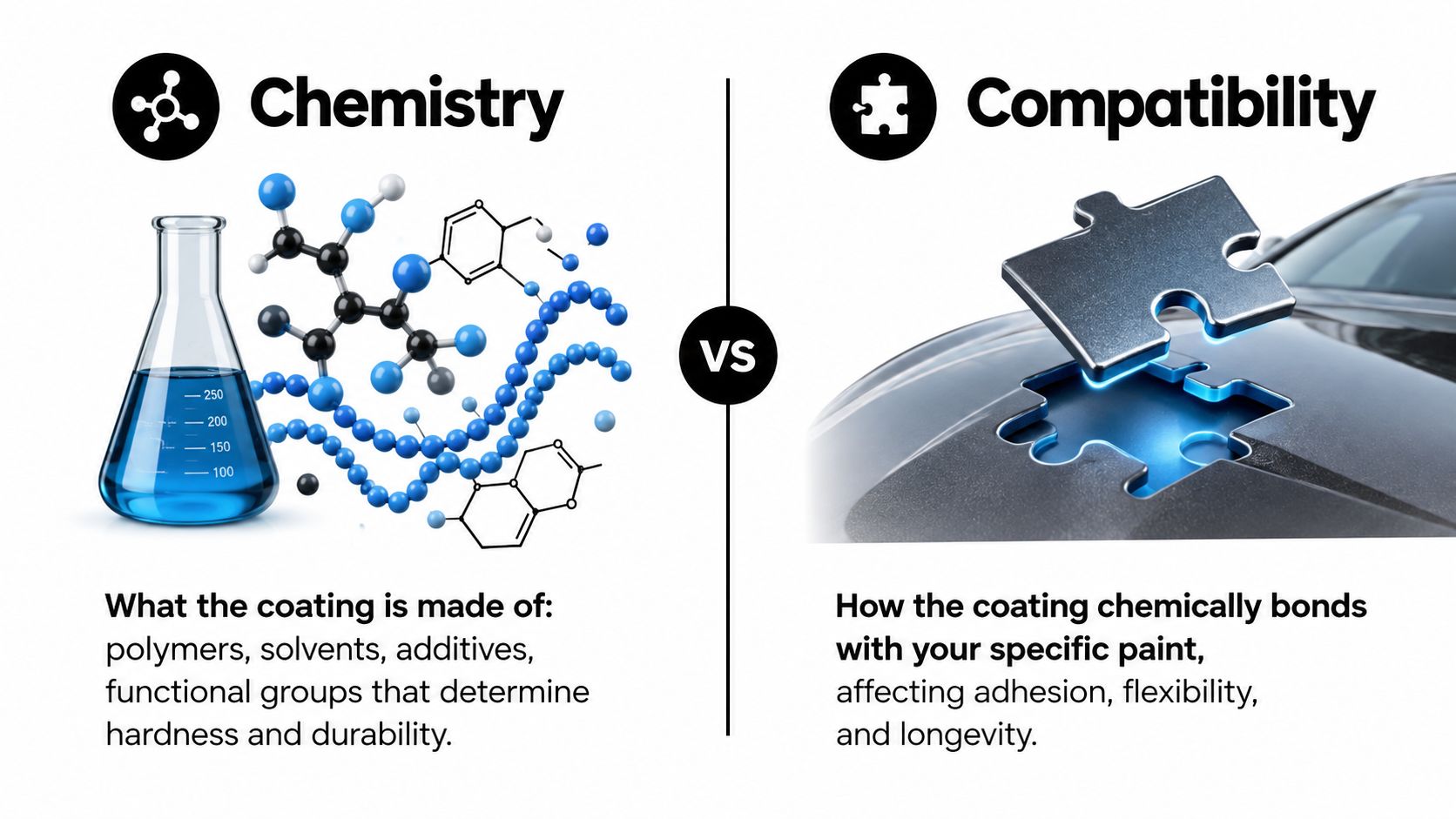
Ingredient strength versus surface fit
A useful analogy is cooking. Chemistry is the ingredient list and the cooking behavior. Compatibility is whether that recipe works with the pan, temperature, and food being prepared. A powerful solvent system may help a coating flow and level, but the same solvent can be unsuitable for a sensitive plastic or an older cured layer.
This is why detailers should consider surface type before reaching for a bottle. Glass has a different energy and pore structure from painted clear coat. PPF and wraps introduce polymer surfaces that can respond differently to solvents and film-forming materials. Plastic trim may have a low-energy surface that makes uniform wetting difficult.
A practical reference on the compatibility of plastics and metals can help explain why material pairing matters beyond visual appearance. The central point is that a coating isn’t working in isolation. It forms an interface with another material.
How the distinction changes product selection
For multi-surface work, a flexible membrane sealant can offer a broader compatibility strategy than a formula intended for one narrow substrate. ULTRA Ceramic Spray is described as Ultra 4.0, a highly concentrated, water-based flexible membrane sealant designed for paint systems, wraps, PPF, glass, wheels, plastic trim, and household and personal items.
That description doesn’t remove the need for testing. It gives the detailer a starting point for matching the product to the job, followed by cleaning, a small test area, and observation of leveling and wipe-off. The right coating should spread predictably, cure without unwanted residue, and remain compatible with the surface after application.
Titan’s focus on polymer nanocomposite coatings reflects the same principle. A coating’s performance comes from the interaction between its ingredients and the conditions around them. Chemistry creates capability. Compatibility determines whether the vehicle can use that capability.
Why Surface Chemistry Matters More Than You Think
A coating can’t protect a surface it hasn’t properly contacted. Before a film can bond, it must wet the substrate, spread across it, and establish a consistent interface. If the liquid beads instead of leveling, coverage becomes uneven and the eventual bond can remain weak even when the cured coating is chemically durable.
For reliable wetting, a common rule of thumb is that the substrate’s surface energy should be about 5–10 dynes/cm higher than the coating’s surface tension, as described in technical guidance on adhesion and energy in curable coatings. The relationship matters because a coating with higher surface tension than the substrate can retract into droplets instead of forming a continuous film.
Why beading can signal a problem
Detailers often associate beading with protection, and after curing, tight water behavior can be a desirable result. During installation, however, immediate beading can indicate poor wetting. Low-surface-energy materials, contamination, silicone residue, or an under-activated surface can prevent a coating from spreading across the panel.
This creates a confusing outcome. The installer sees water behavior and assumes the surface is ready, while the coating itself may have failed to establish sufficient contact. Preparation has to remove the substances that alter surface energy without damaging the substrate or leaving another incompatible residue behind.
The interface controls the bond
Solvent choice and polymer similarity also matter. Technical guidance on ink and coatings adhesion explains that compatible solvent and polymer systems can support chain entanglement across an interface. Mismatched systems may weaken a bond through swelling, dissolving, or degradation of the coating layer.
That is why “strongest coating” is an incomplete description. A coating can be durable in bulk while underperforming on a contaminated, low-energy, chemically mismatched, or previously coated surface. The installer has to evaluate the substrate’s condition, the product’s intended use, and the cleaning process as one connected system.
Titan’s coating adhesion guidance is useful in this context because adhesion isn’t just a curing event. It begins with surface preparation and continues through wetting, molecular interaction, film formation, and exposure to the environment.
A practical inspection should include:
- Surface condition: Look for oils, traffic film, mineral deposits, embedded contamination, and remnants of older protection.
- Material identity: Confirm whether the area is clear coat, glass, PPF, vinyl, textured plastic, or another substrate.
- Small-area testing: Check spread, leveling, wipe-off, and appearance before committing to the entire vehicle.
- Environmental control: Account for panel temperature, humidity, ventilation, and the time available for controlled application.
The coating doesn’t get to choose its interface. The detailer does, through product selection and preparation.
How Titan Solves the Chemistry Compatibility Problem
Titan Coatings approached the limitation from a materials perspective. The company says it introduced carbon nanotubes, or CNTs, to the automotive coatings market in 2021, describing Dark Matter Technology® as a system that uses carbon nanotubes for stiffness and strength. Titan also describes ElastoTek® as an elastomer-based membrane-forming technology built for elasticity and flexibility. (Titan’s patent information)
The practical value lies in combining properties that are often treated as opposites. A protective film needs enough structure to resist environmental attack, yet it also needs to accommodate movement from the vehicle surface and the surrounding climate. Titan’s elastic coatings are presented as hard like glass while remaining flexible, a combination intended to help the film stay attached as conditions change.
Reinforcement without abandoning movement
Independent materials research supports the mechanism behind CNT and elastomer systems. Carbon nanotubes dispersed in an elastomer matrix can act as reinforcement, improving mechanical, electrical, and thermal properties when the materials are properly combined. (Published CNT elastomer research)
The word “properly” matters. Dispersion, matrix chemistry, loading, and processing all influence whether reinforcement improves the finished film or creates defects. Nanomaterials don’t replace sound formulation and application discipline.
Research on CNT-filled rubber nanocomposites associates CNT reinforcement with improved heat resistance. Another study reported that a polymer-coated CNT coating remained intact, without cracks, delamination, or swelling, after accelerated aging at 60 and 75 °C for 45 days. (Research on CNT coatings and aging)
Why elasticity changes real-world durability
A vehicle doesn’t remain at one temperature. Panels heat in sunlight, cool overnight, and flex under ordinary use. A rigid coating can protect well while its movement remains synchronized with the substrate, but a mismatch can create stress at the interface.
Industry information on elastomeric coatings reports stretch capacity of up to 400% of original size, with the coating returning to shape without losing adhesion. (Industry presentation on elastomeric coatings) That stretch behavior is the key mechanic behind resistance to cracking during freeze-thaw movement and hot-temperature exposure.
For the installer, the benefit is not just a specification. It changes the selection question from “How hard is this film?” to “How does this film respond when the surface moves?” Titan’s coating flexibility information addresses that second question directly.
An example for glass is Apex Glass Coating- 50ml, described as an advanced hydrophobic glass and windshield coating with deep pore bonding and water-repellent performance. The product description also states that it enhances visibility, reduces wiper use, and lasts up to 2 years. Those properties make surface compatibility especially important, because the windshield must remain optically clear while the coating forms a consistent film.
Titan’s approach doesn’t mean every product fits every substrate without preparation. It means the material design recognizes a central failure mode in automotive protection: a coating must be strong enough to protect and flexible enough to remain attached.
Choosing the Right Coating for Your Vehicle
The correct choice starts with the surface, not the marketing category. Paint, glass, wraps, PPF, wheels, and plastic trim each present different bonding conditions, so a detailer should first identify the substrate and its existing condition.
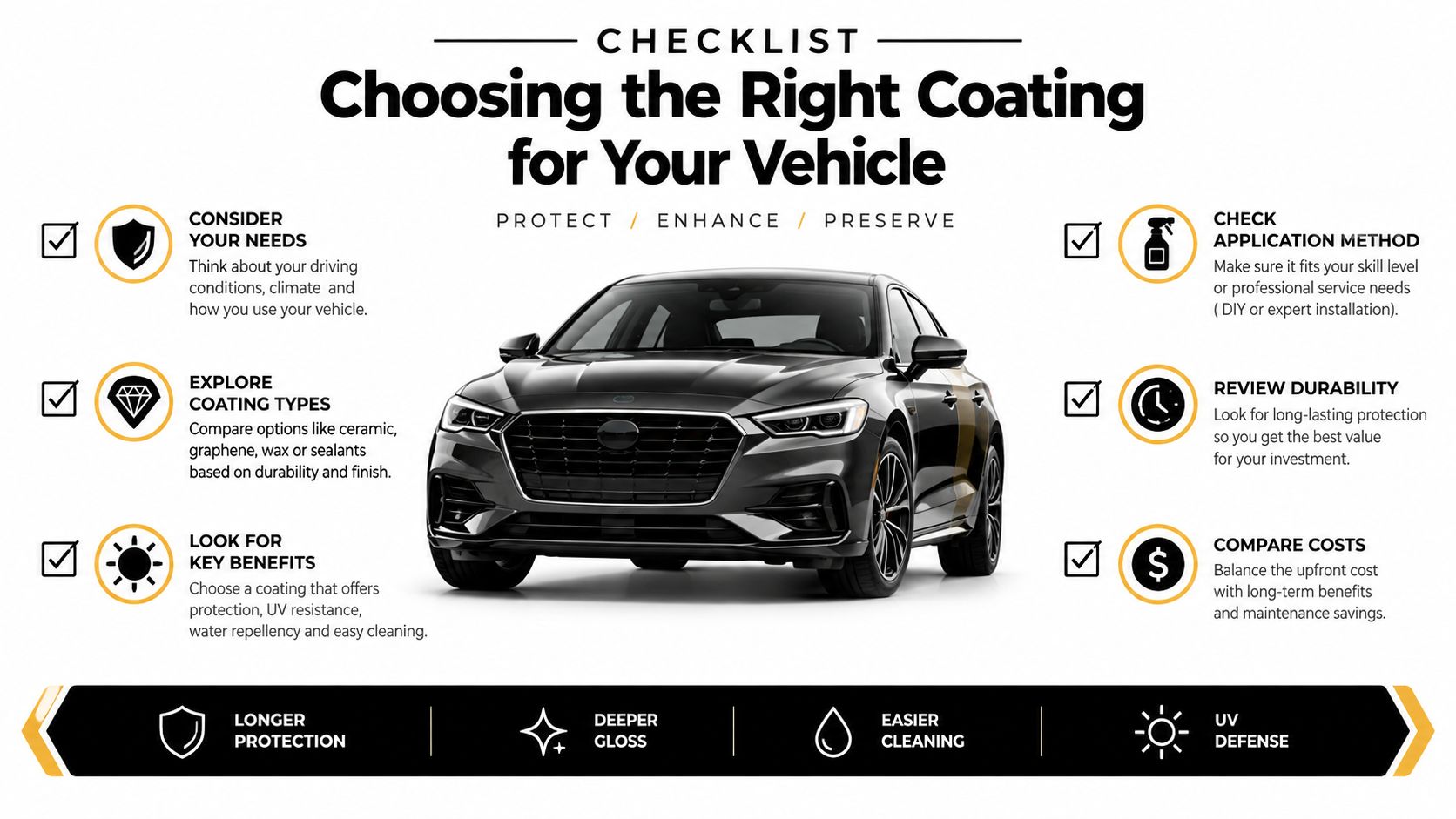
Match the product to the job
For an elastomeric paint coating, Alpha Quartz is described as a high-performance elastomer ceramic coating for all surfaces, with 92% high solids, zero VOCs, solvent-free chemistry, and advanced adhesion technology. The product information states that it can be applied indoors and outdoors and cures in 4 hours.
That profile suits a DIY enthusiast or mobile detailer who needs a coating designed around practical installation rather than a controlled studio alone. The application still depends on proper washing, decontamination, polishing where necessary, panel wipe selection, and a small test area. “Easy to apply” doesn’t mean preparation can be skipped.
Use glass-specific chemistry on glass
Windshields need a clear, even film. A product formulated for painted panels may not deliver the same optical behavior or pore interaction on glass. Titan’s Apex glass and windshield coating is described as penetrating glass pores for chemical bonding, reducing glass porosity, and repelling water, dust, and contaminants.
The practical objective is improved rain visibility and less dependence on wipers. Apply it to clean, residue-free glass, work in manageable areas, and inspect the surface under strong lighting before allowing the film to set. Any uneven residue can affect the driver’s view, so wipe-off control matters as much as water repellency.
Choose a flexible spray for broad maintenance
Ultra Ceramic Spray is described as Ultra 4.0, a water-based flexible membrane sealant for paint systems, wraps, PPF, glass, wheels, plastic trim, and household and personal items. That range makes it relevant when a detailer needs one flexible product for multiple compatible surfaces, provided the installer follows the product’s application guidance and verifies the finish on a discreet area first.
Use cleaning agents that leave as little residue as possible. A glossy panel can still be chemically unprepared if a dressing, oily cleaner, or old protection remains on the surface. For technical evaluation, Titan’s information on third-party testing provides useful context for separating controlled testing from assumptions based only on appearance.
A simple selection sequence works well:
- Identify the substrate: Paint, glass, PPF, wrap, wheel finish, or plastic trim.
- Assess the existing layer: Determine whether you’re coating bare material, cured protection, or an uncertain residue.
- Prepare and test: Clean, decontaminate, inspect, then test spread and wipe-off in a small area.
- Prioritize movement: Select a flexible system where temperature changes and substrate movement are part of the vehicle’s use.
- Follow maintenance requirements: A coating still needs safe washing and sensible contamination removal.
Good product selection reduces correction work. It also gives the coating a fair chance to deliver the chemistry promised on the label.
Building a Coating Strategy That Lasts
A lasting coating strategy combines two capabilities. Chemistry supplies the protective behavior, such as hardness, chemical resistance, water response, and film formation. Compatibility determines whether that behavior survives contact with the vehicle, including the substrate’s surface energy, existing layers, contaminants, and movement.
The engine-parts analogy is useful here. Strong components that don’t fit the vehicle can’t transfer their strength. Parts that fit but lack structural capability won’t survive demanding use. Coatings work the same way. A chemically impressive film needs a compatible interface, and a compatible interface needs a film with enough protective structure.
Titan’s system brings those needs together through elastomer technology and carbon nanotube reinforcement. Dark Matter Technology® is described as using CNTs for stiffness and strength, while ElastoTek® is built around an elastomer-based membrane that provides elasticity. That pairing supports the practical goal of a coating that feels hard like glass but remains flexible as the vehicle experiences movement.
Temperature change is where the difference becomes visible. A rigid film can struggle when its movement doesn’t match the substrate, while an elastic film can accommodate expansion and contraction more effectively. Titan’s elastic approach is intended to reduce cracking from frozen conditions through hot temperatures, and flexibility can also help the coating remain intact when bugs strike the surface rather than fracturing like a brittle layer.
The right questions are straightforward:
- Will the coating wet this substrate?
- Will its solvent and polymer system work with the existing surface?
- Can the film move with the panel?
- Does the application process suit the detailer’s environment?
- Can the owner maintain the finish without introducing incompatible residues?
No coating eliminates the need for preparation or maintenance. The best result comes from treating the product, surface, environment, and installation method as one system. That is the useful conclusion from chemistry vs compatibility. Hardness may attract attention, but adhesion and controlled flexibility determine whether protection keeps working after the vehicle leaves the bay.
APEX NANO – Titan Coatings develops coating systems for automotive, aviation, marine, and defense applications, including elastomeric and nanomaterial-based technologies designed around surface protection and durability. Visit APEX NANO – Titan Coatings to review the coating options, application guidance, and surface-specific products before choosing the system that matches your vehicle.
0 Comments