
A car leaves the driveway on a frozen morning, sits in hot sun by afternoon, and returns with rain and bug residue across its bonnet. The coating may still bead water beautifully, but those beads don't tell the owner how well the finish underneath is resisting ultraviolet damage.
Why UV Chemistry Matters on Every Coated Surface
A detailer can inspect gloss under a lamp, feel surface contamination, and watch water slide off a panel. UV protection ingredients are harder to judge because their most important work happens inside the protective film, before deterioration becomes visible.
That distinction matters when a client asks whether a freshly coated vehicle is protected for outdoor parking. Shine describes appearance today. UV durability concerns how the coating and underlying finish will behave after repeated exposure to sunlight, oxygen, heat, and weather.
Consider the different surfaces on that vehicle. Painted panels, transparent plastics, exterior trim, and glass don't have identical protection requirements. A useful product recommendation starts with the material and its exposure, rather than assuming that every surface benefits from the same bottle.
Think in terms of a coating lifecycle
For a detailer, the practical questions extend beyond application:
- At installation: Is the product appropriate for the substrate, and can the installer achieve the specified film and cure?
- During exposure: Does the formulation address light-driven degradation while maintaining the required appearance and flexibility?
- During maintenance: What evidence or inspection criteria tell the owner when protection needs attention?
The same surface-first reasoning is useful outside automotive detailing. For readers comparing vehicle care with building maintenance, Alex Trend Painters' Dublin paint guide provides a climate-focused resource for thinking about exterior paint selection. It shouldn't be treated as evidence for automotive ceramic-coating performance.
Practical rule: Choose protection for the surface and the exposure, not for the most impressive adjective on the label.
A coating evaluation therefore needs separate questions about optical protection, chemical stability, mechanical behavior, and upkeep. A product might satisfy one requirement without establishing the others.
When a customer asks why one finish stays attractive while another deteriorates, the useful answer is that one coating is harder. Ask what prevents the initial chemical damage, what limits subsequent degradation, and what keeps the protective film intact.
The Two Damage Channels Coatings Must Stop
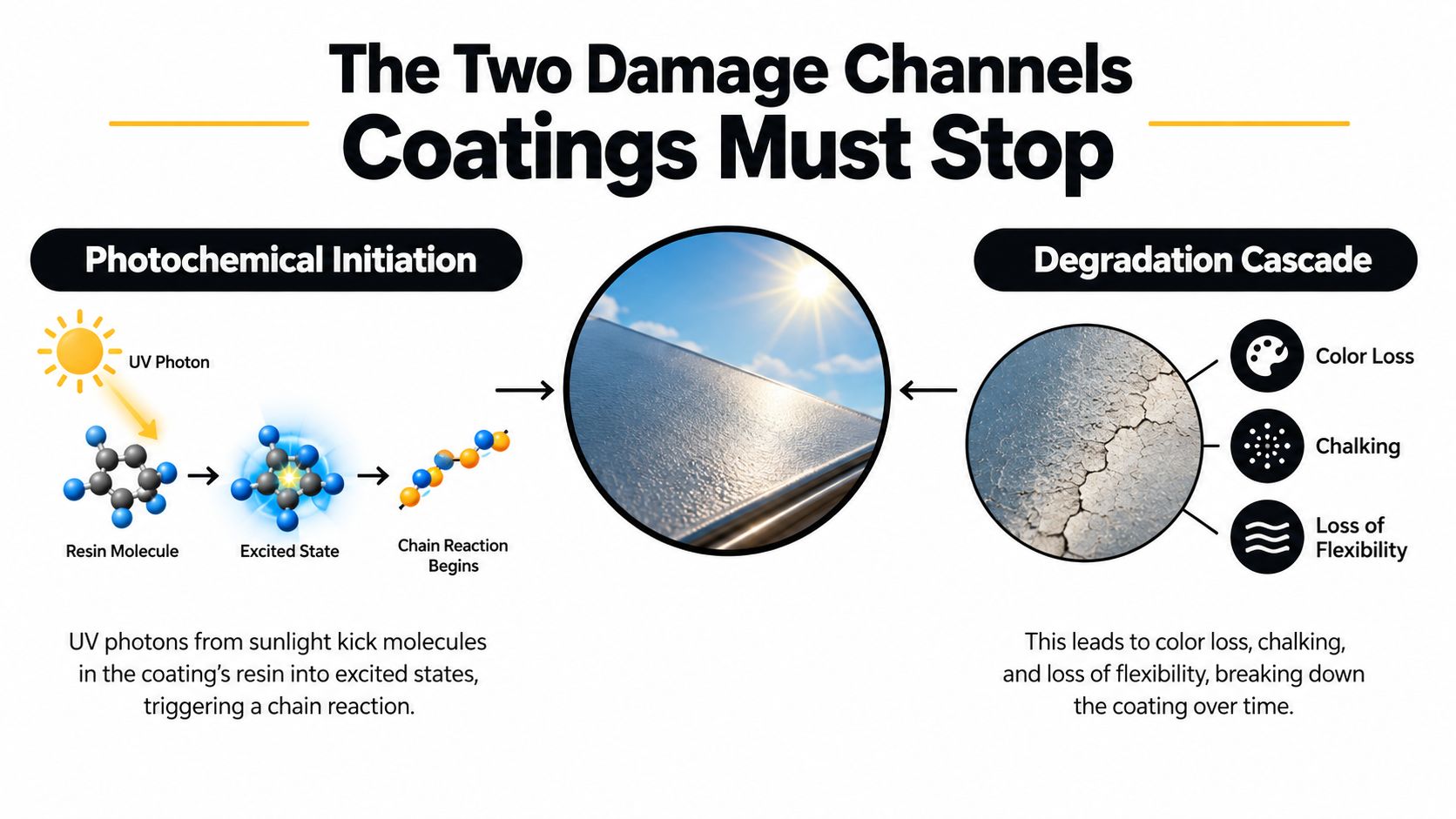
The first channel is photochemical initiation. When a susceptible part of the resin or pigment absorbs ultraviolet energy, that energy can initiate chemical changes that ultimately damage the polymer. The visible consequences may include discoloration, reduced gloss, and embrittlement.
The second channel is oxidation propagation. Reactive fragments formed during initiation can participate in further reactions involving oxygen, allowing degradation to continue through a chain of chemical events. Preventing some incoming radiation and interrupting those reactions are different jobs.
Why the sunscreen analogy has limits
Sunscreen provides a familiar starting point, but its terminology can confuse coating buyers. The FDA distinguishes broad-spectrum protection against UVA and UVB from SPF, which primarily measures UVB protection; those are skin-protection concepts, not automotive durability ratings, as explained in its sun-protection guidance.
There's another naming trap: in coatings literature, UVA can mean ultraviolet absorber. In sunlight discussions, UVA identifies a region of ultraviolet radiation. Reading the abbreviation correctly prevents a surprisingly common misunderstanding.
For coatings, UV resistance isn't binary. Ingredient type, loading, film thickness, compatibility, and retention all matter: an acrylic-melamine clearcoat containing 3% UV absorber and 1% HALS lost 33% of its UV absorbance and 16% of its thickness during approximately 5,000 hours of xenon-arc exposure, with about half the absorbance loss attributed to erosion in the automotive-clearcoat weathering study.
A protective film can lose both material and protective capacity. Initial appearance doesn't establish retained performance.
That makes substrate-specific questions important. Someone evaluating a UV-protective coating for polycarbonate should ask about transparency and material compatibility, not borrow conclusions from painted metal. The chemistry has to suit the surface it protects.
UV Absorbers and How Each Class Disposes of Energy
A black dashboard in a July parking lot demonstrates the principle behind every UV absorber: light arrives, the surface takes it in, and the energy leaves again as heat. UV absorbers run that same conversion at molecular scale, intercepting photons inside the film before they can reach the resin and set off bond-breaking chemistry.
The cycle repeats for the life of the coating. A photon strikes the absorber molecule, the molecule jumps to an excited state, then sheds that energy through vibration and relaxes back to its original form, ready for the next photon. The materials literature describes preferential absorption across roughly 290–380 nm, alongside protection against yellowing, gloss loss, and embrittlement, while stressing formulation compatibility, additive retention, and possible interference with UV curing in its discussion of UVA and HALS stabilization.
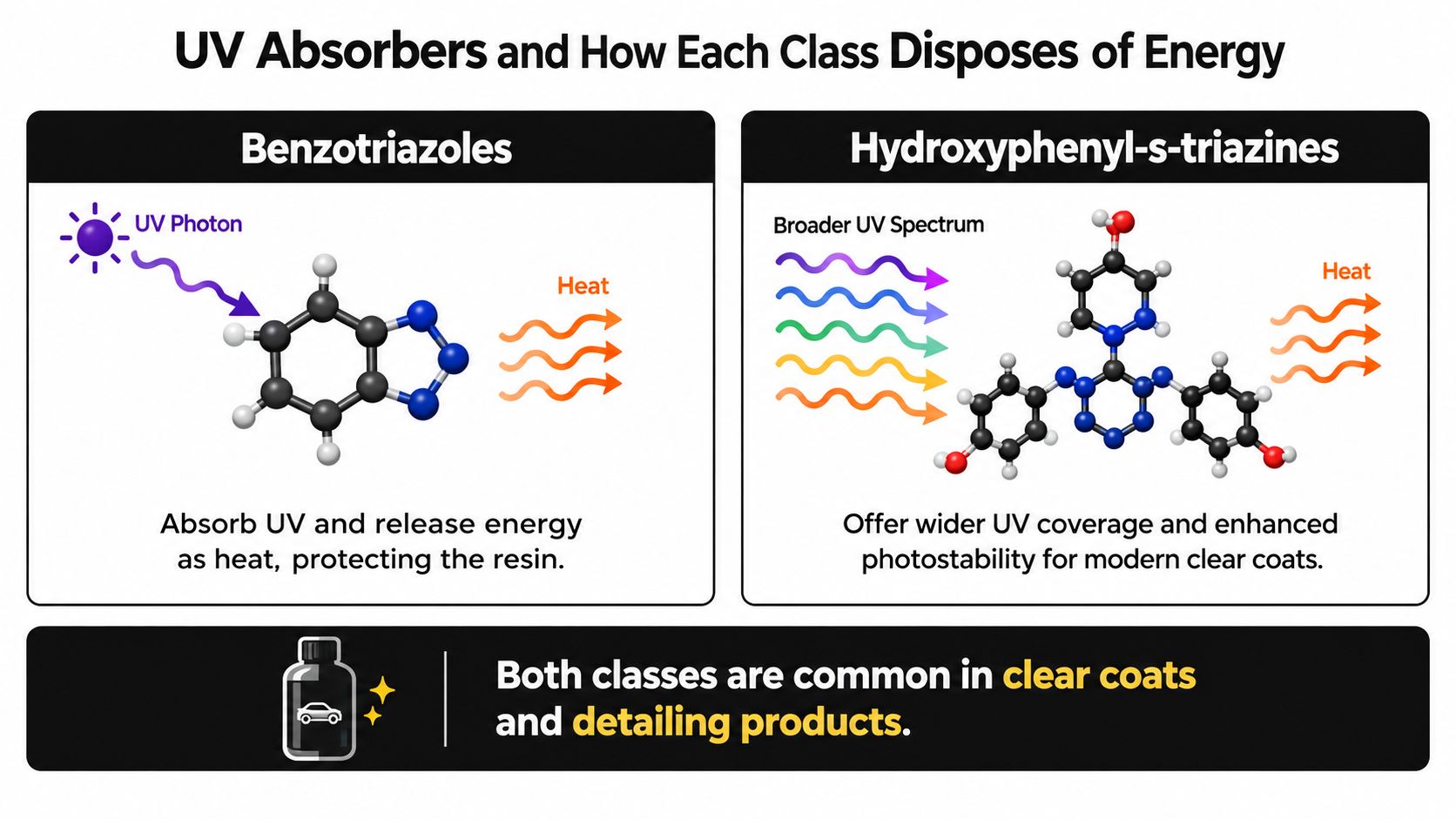
Two ingredient families come up constantly in product literature: benzotriazoles and hydroxyphenyl-s-triazines. Both dispose of absorbed energy through the same heat-releasing cycle. What separates one commercial derivative from another is the shape of its absorption window, how well it stays dissolved and dispersed in the binder, and how long it survives doing the job. The illustration above simplifies that comparison; a family name alone proves nothing about a specific product.
| Question for the supplier | Why it changes the outcome |
|---|---|
| Which derivative is actually in the formula? | Absorption curves, solubility, and permanence vary within each family |
| Does the absorption window match the exposure? | Protection only exists where the curve overlaps incoming UV |
| Was performance measured on the finished coating? | Results from a different resin don't transfer |
| Any effect on UV cure or clarity? | Absorbers can compete with curing chemistry and shift appearance |
Avobenzone and octocrylene make handy reference points because many detailers know them from sunscreen labels. Familiarity doesn't equal qualification: approval for skin says nothing about whether an absorber survives inside a clear coat through years of summer heat.
The same logic carries over to architectural finishes, where readers can find UV-resistant coating options through CP Painting Company. Keep the categories separate, since a wall coating and a transparent automotive film face different appearance demands.
One question covers all of them. What does the finished coating still transmit and retain after seasons of exposure, rather than at application?
HALS, the Radical Catchers That Keep Coatings Flexible
Hindered amine light stabilizers, usually shortened to HALS, address the reaction stage that absorbers don't fully prevent. They aren't primarily UV filters. They intercept reactive radicals involved in oxidation, helping the polymer retain surface integrity.
That difference explains why HALS matter to detailers concerned about gloss, flexibility, and cracking. Reducing the radiation reaching a resin is valuable, but it doesn't eliminate the need to control reactions that begin despite that protection.
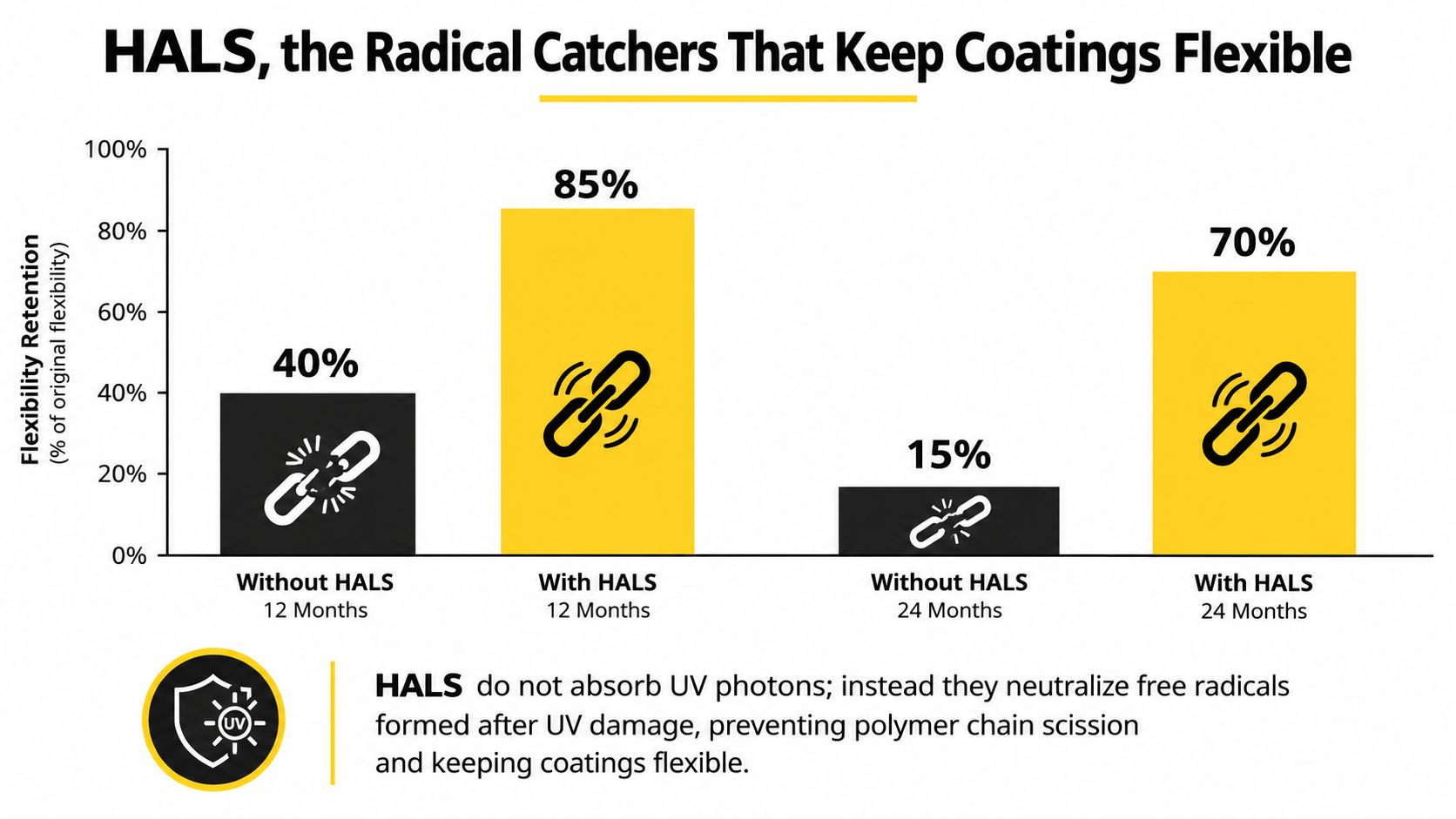
The chart above is illustrative, not validated performance evidence. Its flexibility percentages and month-based comparisons aren't supported by the weathering results discussed here and shouldn't be used to predict a coating's service life.
What the documented tests actually demonstrate
Historical coating results provide a more useful comparison. In a powder-coating study, an unstabilized coating cracked after 1,800 hours; adding solid HALS extended the observed lifetime by 1,200 hours under QUV-A and 800 hours under xenon exposure, according to the published exterior-coating stabilization results. These are comparative test outcomes, not an installation warranty.
The same publication reports that adding a hydroxyphenyl-s-triazine absorber to the stabilization package produced resistance to failure for up to 5,200 hours under QUV-A and 4,800 hours under xenon exposure. Gloss nevertheless declined under those severe conditions.
Its separate Florida exposure results describe a clearcoat containing 2% UV absorber and 1% HALS retaining approximately 80% of its original gloss after five years. The unstabilized control showed cracking and gloss loss after about six months.
Evidence checkpoint: These results support complementary stabilization mechanisms. They don't establish that an unrelated ceramic coating will achieve the same outcome.
A coating chemist reads these results as evidence of ingredient synergy within particular formulations. A detailer should read them as a reason to request system-level testing.
Neither reader should convert accelerated exposure hours directly into years on a customer's driveway. Climate, substrate, film construction, and the test's failure criterion all affect the comparison. Ask what failed, how it was measured, and whether the tested coating matches the product being installed.
Inorganic Blockers and the Rise of Nano TiO2 and ZnO
A white garage door stays bright for years while the untreated surface beside it chalks and fades. The difference often comes down to a white pigment working inside the film. Titanium dioxide, TiO2, and zinc oxide, ZnO, reflect, scatter, and absorb ultraviolet radiation at the same time, so calling them purely reflective barriers leaves out part of their behavior.
The EPA describes these combined mechanisms in its explanation of sunscreen ingredients. That document explains light interaction well, but it isn't a performance certificate for mineral-containing automotive coatings.
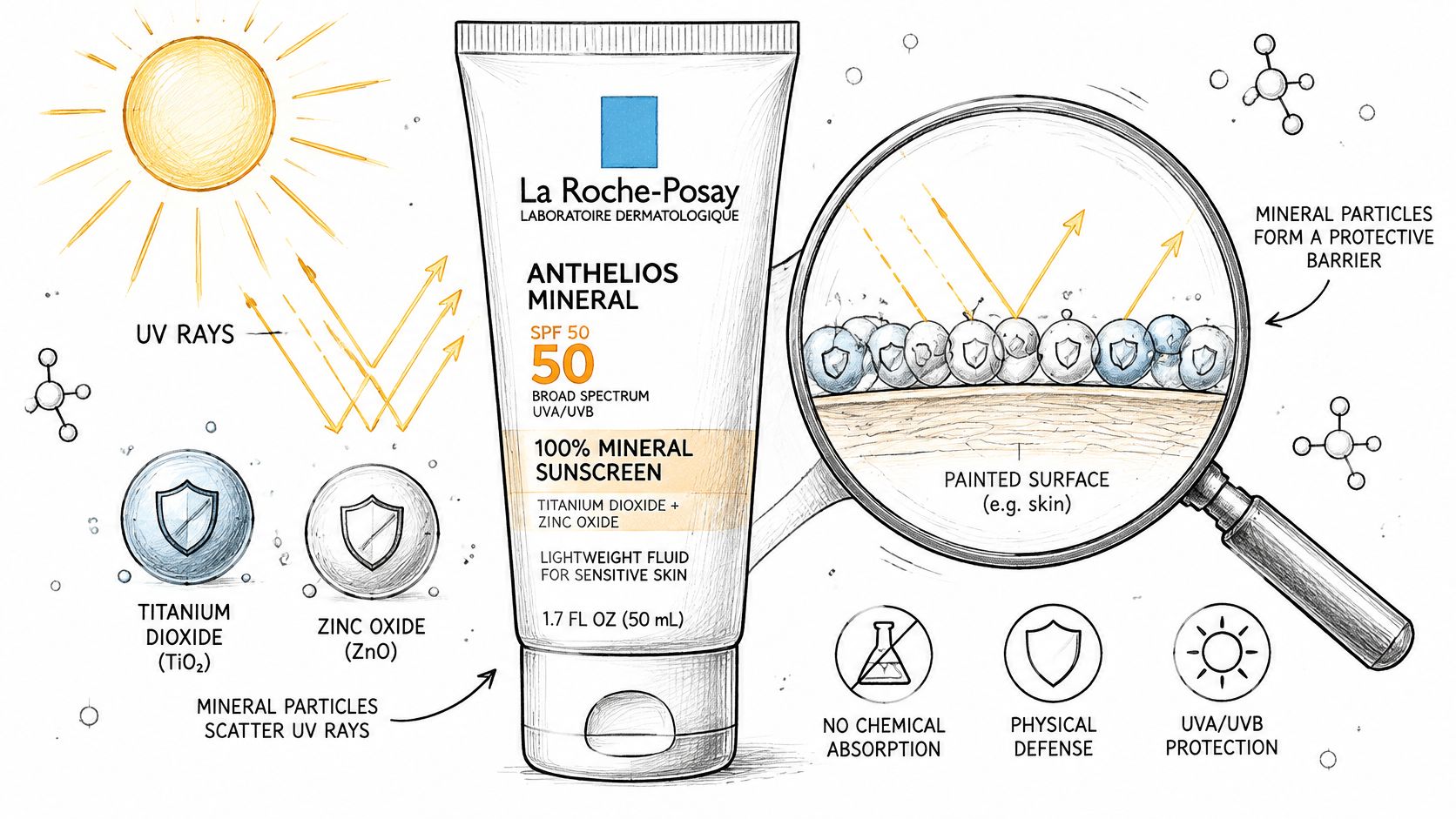
The sunscreen illustration works as an analogy, not as evidence of an automotive application or an endorsement of a skincare product. For a clear automotive finish, the key question is whether the formulated particles attenuate UV without producing haze, whitening, or color shift. Zinc oxide covers broad spectral territory, including longer-wavelength UVA, yet a general property says nothing about the optical performance of a specific film. Particle characteristics, distribution, loading, and the surrounding formulation still decide the result.
The substrate changes what "good" looks like. On dark paint, check haze and color shift alongside gloss, because a finish can read differently under inspection lighting than it does in daylight. On glass, optical clarity matters more than water behavior. On trim, the finish should stay visually consistent with the substrate it sits on.
Engineered nanoscale particles turn transparent protection into a genuine formulation opportunity. Still, "nano" describes an approach, not a durability result. Poor dispersion or an unsuitable binder can undermine the very appearance the client is paying for. A useful discussion of polymer nanocomposite coatings connects the particles to the binder and the application instead of treating particle size as the whole explanation.
A quick check for any mineral claim: ask for spectral coverage data, clarity measurements, and retention evidence on the specific coating. "Mineral" and "chemical" are ingredient categories, not verdicts.
Choosing between mineral and organic protection is an engineering decision about spectral coverage, clarity, compatibility, retention, and environmental profile for a specific material and use. Neither label guarantees the outcome, and both can appear inside the same well-built stabilization package.
Proprietary Stacks Like Elastomer Membranes and Dark Matter Technology
A client looking at a glossy bonnet sees a surface. A formulator considers the binder, stabilizers, adhesion, and how the film responds when its substrate moves. An elastomeric coating addresses mechanical behavior, which is related to durability but distinct from optical UV attenuation.
Titan describes its proprietary coating development in terms of elastomer membranes, nanotube technology, and Dark Matter Technology®. The company also presents itself as the first to introduce its elastomer coating approach using those technologies. That priority statement is a brand claim, not an independently established industry history.
Separate the membrane claim from the UV claim
Titan's description of elastic coatings as hard like glass yet flexible communicates the intended balance: surface resistance alongside the ability to accommodate movement. Its claims about resisting cracking between frozen and hot conditions, or during bug impacts, should be assessed with temperature-cycling and mechanical evidence, not treated as unconditional guarantees.
The relationship between coating flexibility and film integrity is worth discussing with an installer. Flexibility may help accommodate substrate movement, but it doesn't make temperature irrelevant or eliminate every cause of cracking.
Alpha Quartz 50ml Ceramic coatig is described in Titan's catalog as an elastomer ceramic coating for all surfaces, with 92% high solids, zero VOCs, a solvent-free formulation, Advanced Adhesion Technology, and a four-hour cure. The catalog positions it for indoor and outdoor application and claims protection against UV, chemicals, and abrasion; those are manufacturer specifications, not independent comparative results.
A proprietary technology name should start a technical conversation, not end one.
Dark Matter Technology® is similarly a starting point for questions. For claimed improvements in anti-static behavior, contact angle, or chemical resistance, ask which product was tested, against what comparison, and under which conditions. Don't assume a named technology discloses the presence of UV absorbers, HALS, or mineral blockers.
Other exterior systems offer useful context without proving automotive performance. Blue Lake Roofing Supply's bitumen guide is a separate resource for readers considering weather-exposed membrane materials.
Layering can be sensible, but more layers don't automatically establish additive UV protection. Compatibility and finished-stack testing remain necessary.
Common Misconceptions About UV Protection Ingredients
Two coatings sit side by side on a detailer's shelf. One advertises a higher absorber loading, the other discloses less, and the bigger number pulls the eye first. That number alone can't settle the choice. An absorber still has to stay compatible with the binder, remain evenly distributed through the cured film, and avoid interfering with cure or mechanical performance. A concentration figure stripped of those details is a partial answer.
Borrowed labels that answer the wrong question
Sunscreen regulation shows how easily an ingredient's presence gets mistaken for finished-product protection. The FDA OTC sunscreen monograph sets maxima of 3% avobenzone, 10% octocrylene, and 25% each for titanium dioxide and zinc oxide. Those ceilings govern topical drug products, and a ceramic coating formula sits outside their scope.
The same borrowing problem appears with "broad spectrum." In U.S. sunscreen testing, the term requires a critical wavelength of at least 370 nm, as explained in the American Academy of Dermatology's sunscreen-label guidance. Reaching that mark on skin says nothing about gloss retention, adhesion, or survival through freeze-thaw cycling on a hood.
A third assumption treats ceramic, nano, and elastomer as synonyms for proven UV durability. Each word can describe a real part of a product's material design. None substitutes for a weathering report on the finished formulation.
Evaluating a claim comes down to three questions. Which method produced the data? ASTM G155 xenon-arc and ASTM D4587 fluorescent-UV are named methods a buyer can request documentation against. What was measured? Gloss retention, color change, cracking, adhesion, and haze carry more weight than before-and-after photographs. What was it compared against? Substrate, coating construction, exposure conditions, and the chosen failure criterion all shape the answer.
A UV resistance rating earns its place only with that context attached. Method, endpoint, and tested system turn a rating into something applicable to a specific vehicle; without them it functions as decoration on the spec sheet.
Suppliers may reasonably protect proprietary chemistry, and buyers can still request method-based documentation and clear application limits without demanding the complete formula. Specificity does that work.
Practical Choices for Detailers and DIY Enthusiasts
Start with the vehicle's surfaces and the installer's working conditions. A mobile detailer needs instructions suited to the actual application environment; a DIY owner needs a manageable process and clear cure requirements. Neither should substitute a high-solids claim or dramatic product name for an installation plan.
Comparing UV Protection Ingredient Classes
| Ingredient Class | Primary Mechanism | What It Protects Best | Watch Out For |
|---|---|---|---|
| Organic UV absorbers | Absorb ultraviolet energy and dissipate it as heat | Coating bulk and underlying light-sensitive materials | Spectral coverage, retention, cure compatibility |
| HALS | Interrupt radical-driven oxidation | Gloss, flexibility, and film integrity | Binder compatibility and finished-system evidence |
| Inorganic UV ingredients | Reflect, scatter, and absorb radiation | UV attenuation where optical requirements permit | Haze, whitening, particle distribution |
| Elastomeric binders | Accommodate mechanical movement | Film continuity under suitable conditions | Not inherently proof of UV attenuation |
Use a practical purchasing and installation checklist:
- Identify the substrate: Separate paint, PPF, wraps, trim, and glass before selecting products.
- Request relevant documentation: Ask about absorber families, HALS use, total solids, weathering reports, and approved layer combinations.
- Prepare and cure correctly: Follow the product's cleaning, application, leveling, and curing instructions.
- Plan maintenance: Confirm compatible wash chemistry and the supplier's criteria for inspection or renewal.
ULTRA Ceramic Spray is described in the catalog as a concentrated, water-based flexible membrane sealant for paint systems, wraps, PPF, glass, wheels, plastic trim, and household and personal items. Before using it as a maintenance layer, confirm compatibility; the description alone doesn't establish renewed UV performance.
For windshields and windows, APEX Glass is the relevant glass-coating option to investigate for easier wet-weather visibility and straightforward application. Treat reduced rain-driving stress as an intended benefit, not a safety guarantee or a replacement for sound wipers and appropriate driving.
Use the guide to protecting car paint from sun damage to organize maintenance questions, then compare options in the Titan Coatings shop. Verify product claims against documentation for the exact system you intend to install.
APEX NANO – Titan Coatings offers elastomer ceramic coatings, flexible membrane sealants, and glass-coating options for different surface-care needs. Visit APEX NANO – Titan Coatings to discuss your vehicle, installation conditions, and the technical documentation needed to evaluate UV protection and coating durability.
0 Comments