
You finished the wash, dried every panel, and stood back expecting that deep shine to hold. Two weeks later, the water sits flat, bugs stick harder, and you're reaching for the wax tin again. That short cycle is what sends most drivers looking for a best car polymer sealant in the first place.
The Search for the Best Car Polymer Sealant
A mobile detailer I know kept a simple rotation for years. Wash on Saturday, carnauba on Sunday, repeat when the beading died. It looked warm and rich on dark paint, but his daily driver lived outside, got highway miles, and saw regular detergent washes. The protection faded in weeks, not because he applied it badly, but because natural wax sits on the surface as a sacrificial layer with limited resistance to heat and washing.
That frustration is familiar if you're maintaining a family SUV, a work truck, or client cars that can't come back every month. You don't need a show car ritual. You need a film that survives sun, rain, road film, and normal washing long enough to make the effort worthwhile.
Why the Label Rarely Tells the Whole Story
Polymer sealants entered that gap with synthetic chemistry designed for a more uniform film. Independent automotive care references commonly describe polymer sealant durability in months, whereas conventional wax protection is generally measured in weeks, with a commonly reported service life of approximately 3 to 6 months for polymer sealants depending on preparation, climate, washing, chemical exposure, and storage.
That range is the honest starting point. A garaged weekend car in a mild climate and an outdoor commuter in intense sun won't get the same result from the same bottle. Road salt, frequent washing, and strong detergents shorten the interval further.
Practical rule: Choose the sealant with the most predictable maintenance interval for your conditions, not the one with the longest headline claim.
The search therefore isn't for a universal winner. It's for the product that matches your climate, parking, mileage, wash method, and willingness to reapply. A spray you will use every few months beats a demanding product you postpone. A more durable elastic coating makes sense when you want fewer cycles and better resistance to temperature movement. The sections that follow give you a way to judge those trade offs without relying on beading photos taken on day one.
What Sets Polymer Sealants Apart
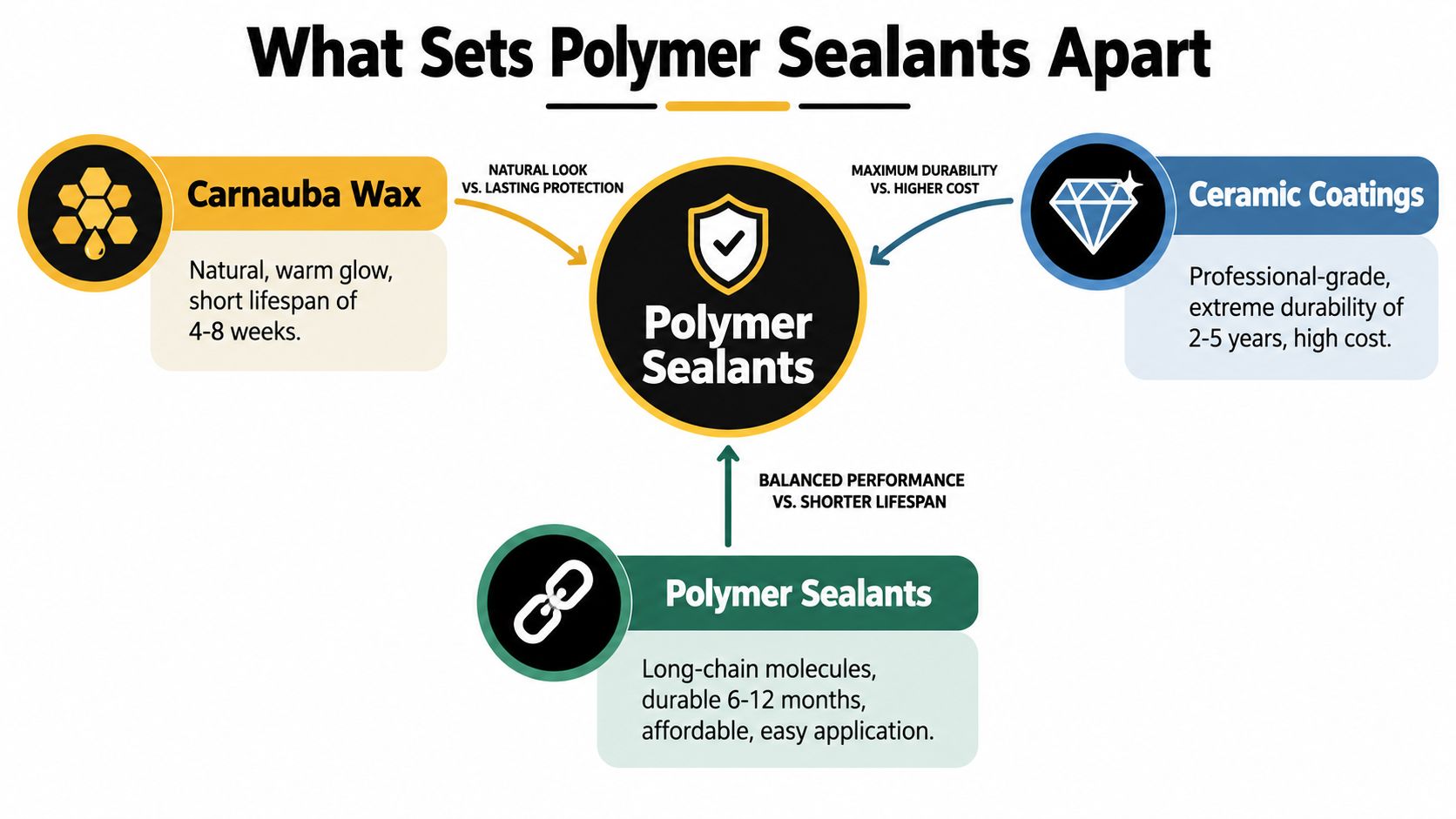
A polymer sealant isn't just thin wax. It's generally made from long chain synthetic polymers that crosslink after application to painted surfaces, and a 2025 review reports that these products are commonly sold as sprays or pastes and typically provide approximately 4 to 6 months of protection, with a reflective finish, resistance to environmental contaminants, and an ability to visually mask fine scratches and swirl marks.
Carnauba gives a warm glow, but its natural film is less uniform and usually needs more frequent renewal. A professional ceramic coating sits at the other end, with greater durability potential but more preparation, cost, and application discipline. Polymer sealants occupy the middle because they're accessible, repeatable, and easier to refresh.
The Chemistry in Plain Terms
Think of wax as a coat laid over paint. A crosslinked polymer is closer to a net that sets across the surface. That structure helps the film stay more even, shed contamination more easily, and retain gloss through more washes than a simple natural layer.
- Carnauba wax: Warm appearance, simple concept, shortest maintenance cycle.
- Polymer sealant: Synthetic crosslinked film, balanced durability and ease.
- Ceramic coating: Harder, longer term system that demands stricter preparation.
- Elastic coating: Adds flexibility to a hard film so it can follow surface movement.
Color choice also changes what you notice in a finish, whether it's a deep automotive paint or a lighter specialty vehicle finish, which is why this golf cart color guide is useful background when you're thinking about how gloss and tone present outdoors.
If you're weighing the categories before buying, read the detailed difference between ceramic and polymer protection and focus on maintenance, not just hardness claims. Titan's elastic coating concept, described by the company as hard like glass while remaining flexible, builds on the sealant idea by adding movement to the film. That flexibility matters because paint and panels expand and contract. A rigid film can concentrate stress. An elastomer based film is designed to accommodate that movement while preserving a hard, glossy surface.
How to Evaluate a Polymer Sealant
Start with weathering, not shine. A peer reviewed automotive coatings study reported that after 5,000 hours of exposure, ultraviolet absorbance fell by 33% and film thickness declined by 16%, with film erosion accounting for about half of the lost ultraviolet absorber performance. Those figures describe automotive coating systems, not a consumer sealant lifespan, but they show why film retention and UV stability matter.
Photo oxidation can reduce clearcoat gloss and eventually contribute to cracking. Loss of UV absorbers can expose layers below and contribute to delamination. A sealant that looks intense on day one but erodes quickly under sun and washing isn't protecting for long.
Five Checks That Matter in the Field
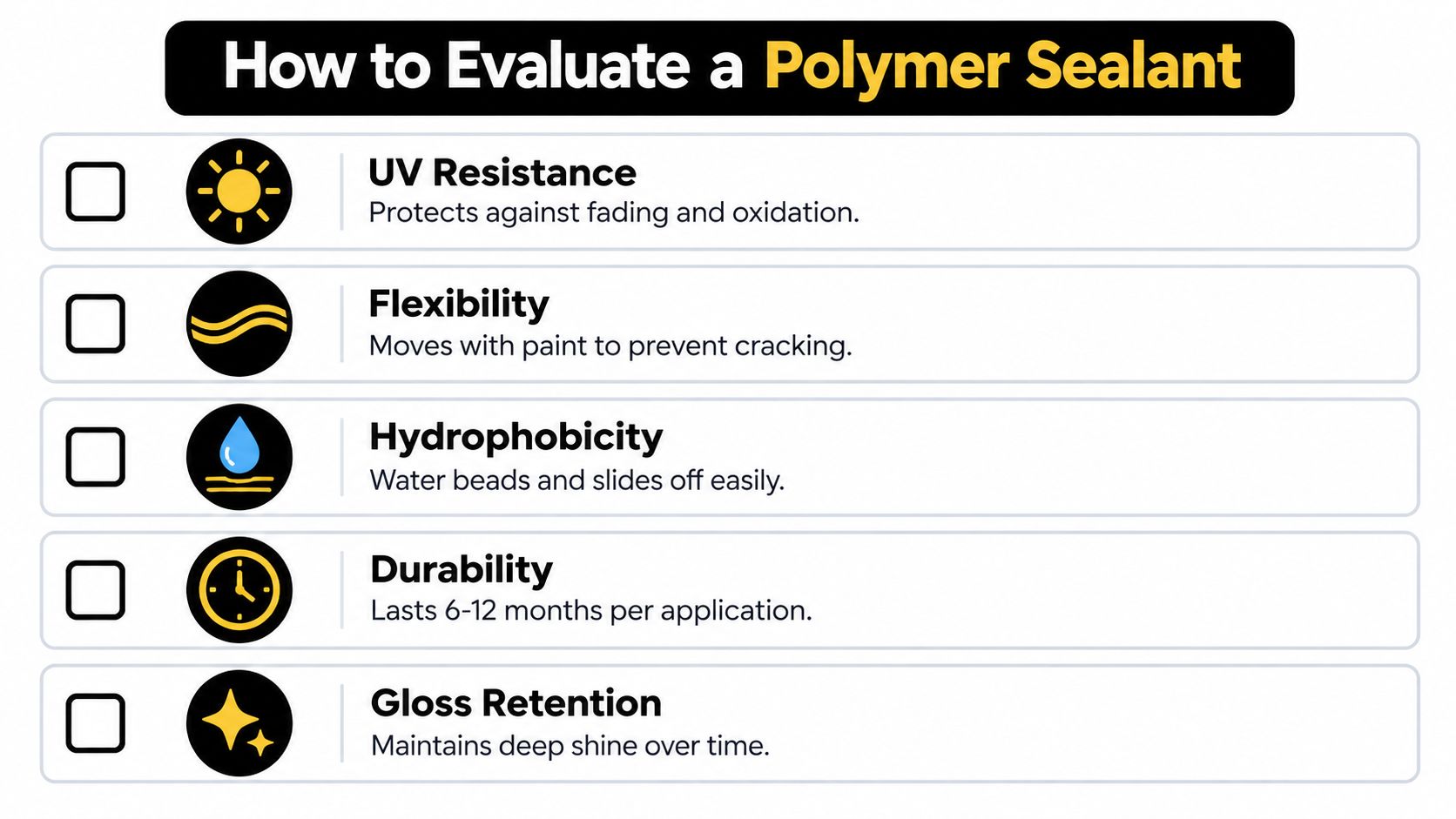
- UV resistance: Look for evidence of gloss and color retention after aging, and review what a UV resistance rating means before comparing claims.
- Gloss retention: Separate initial gloss from gloss after washing and exposure.
- Chemical resistance: Ask how the film handles detergents, bird droppings, and acidic contamination.
- Flexibility: Consider whether the film can tolerate thermal movement without cracking.
- Failure definition: Decide in advance whether you'll judge loss of water behavior, harder contamination removal, visible gloss change, or a scheduled inspection.
Water behavior belongs on the list, but it can't carry the whole decision. Slickness and beading can change before all protection is gone, and a fresh topper can create impressive beads over a weak base. Record how the panel cleans, how water sheets, whether contamination releases easily, and whether gloss looks even after several washes.
Judge a sealant after repeated washes in your weather, not by the first rinse in the driveway.
Standardized testing gives claims context. Exposure method, panel type, film thickness, curing time, gloss change, color change, and failure criteria all affect a result. Without those conditions, one brand's duration claim can't be compared cleanly with another's. For a working detailer, the practical standard is simpler. Apply candidates to similarly prepared panels, use the same wash chemistry, inspect on the same schedule, and write down what changes. That record will tell you more about your clients' real interval than a generic durability badge.
Comparing Sealant Technologies Side by Side
The most useful comparison starts with an uncomfortable gap. One comparison reports paint sealants advertised for up to 12 months lasting roughly 3 to 5 months in Florida conditions, while spray ceramic products advertised for a year lasted about 2 to 4 months. The same comparison links shorter life to intense UV, outdoor parking, and inadequate maintenance, while garaging improves durability.
That doesn't make every label dishonest. It means the test environment and your environment may be very different. Build your expectation from climate, parking, mileage, and wash routine before you buy.
Sealant Category Comparison
| Category | Durability | Flexibility | Ease of Use | Best For |
|---|---|---|---|---|
| Traditional polymer paste | Moderate, measured in months | Limited to moderate | More spreading and buffing | Users who prefer a deliberate hand application |
| Elastomeric ceramic coating | Longer term positioning | High, designed to move with the surface | Controlled application, suitable indoors or outdoors for the listed product | Drivers wanting fewer reapplications and temperature resilience |
| Spray ceramic sealant | Shorter, maintenance friendly | Flexible membrane format for the listed product | Fast spray and wipe workflow | Frequent refreshes and multi surface use |
For baseline context on the older choice many buyers still make, compare car wax vs paint sealant before deciding whether warmth or interval matters more.
Within the elastomeric category, Alpha Quartz 50ml Ceramic coatig is described in the catalog as a high performance elastomer ceramic coating for all surfaces, with 92% high solids, zero VOCs, a solvent free formula, and Advanced Adhesion Technology. The listing states that it provides protection against UV, chemicals, and abrasion, can be applied indoors and outdoors, and cures in 4 hours. Those are product specific catalog facts, and your result still depends on preparation and exposure.
Titan presents elastomers with nanotube technology and its Dark Matter technology as its route to a hard but flexible membrane. Treat that as a company specific technology claim and judge it by application behavior, retention, and support documentation. Flexibility is still a sound materials principle, especially where panels cycle between frozen mornings and hot afternoons.
For a faster workflow, ULTRA Ceramic Spray is listed as Ultra 4.0, a highly concentrated, water based flexible membrane sealant for paint systems, wraps, PPF, glass, wheels, plastic trim, and household and personal items. A spray format trades some of the commitment of a coating install for speed and easier renewal.
Choose paste for control, spray for frequency, and elastomeric technology when durability and movement are the priority. In a tropical, high UV setting, shorten every expectation. In a temperate garage kept setting, you may safely inspect rather than automatically reapply. On salted winter roads, wash chemistry and underbody exposure become part of the calculation. The best category is the one whose real interval you can predict and maintain.
Matching a Sealant to Your Detailing Workflow
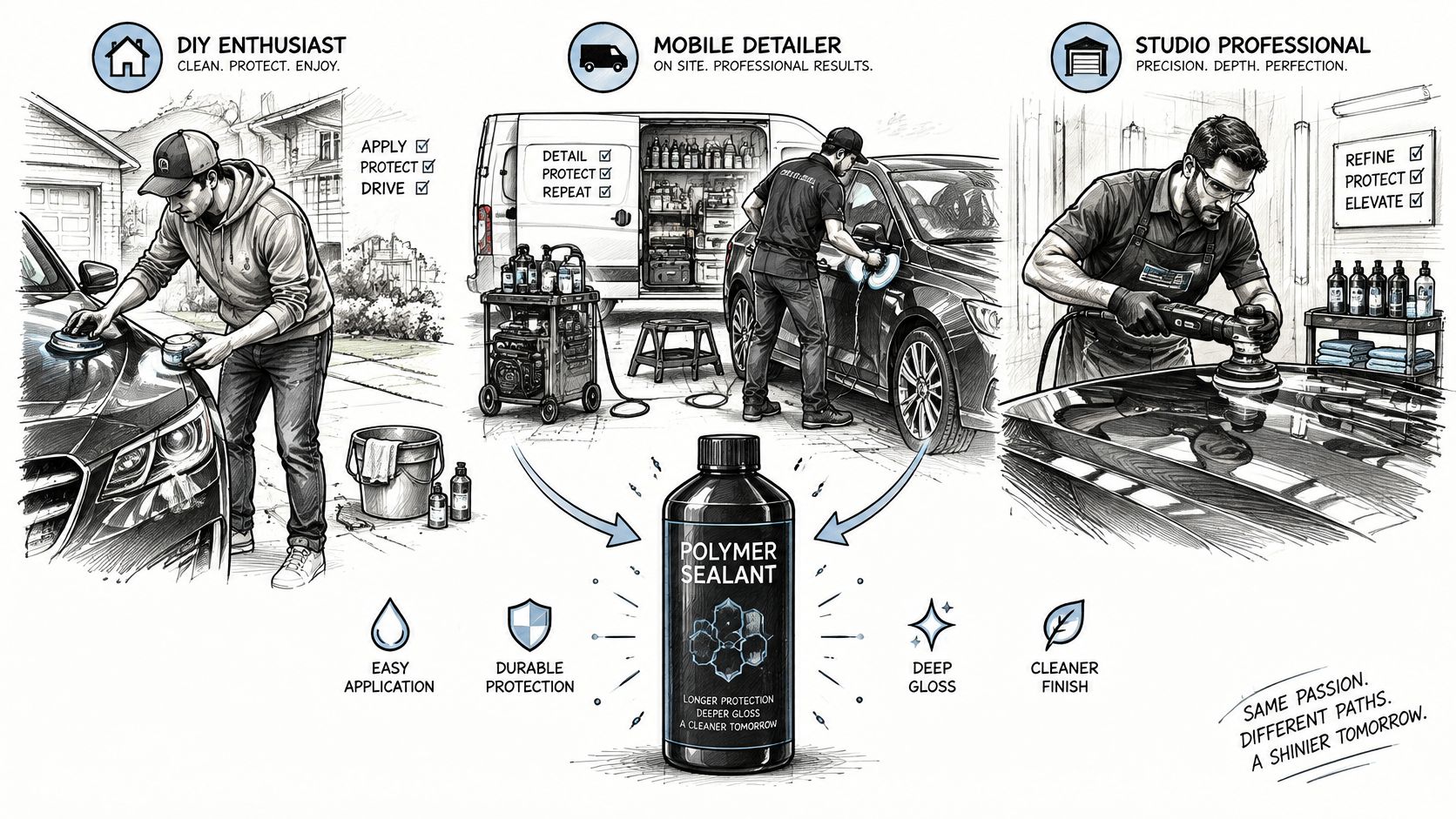
A DIY owner, a mobile detailer, and a studio professional don't fail in the same way. The DIY owner runs out of time. The mobile detailer fights weather and travel. The studio has controlled conditions but must manage client expectations after the car leaves.
Pick by Constraint, Not by Habit
- DIY enthusiast: Choose a forgiving spray or an easy elastomer format you can apply carefully at home.
- Mobile detailer: Prioritize predictable curing, outdoor usability where the product allows it, and a maintenance plan the client will follow.
- Studio professional: Use your controlled prep to sell measurable outcomes, documented inspection points, and honest limits.
Preparation determines whether any of those choices bond evenly, so follow a disciplined process for how to prep car paint before blaming a product for early failure.
Be equally clear about threats. Independent testing oriented coverage emphasizes that ceramic products are chemical barriers, not protection against rock chips or deep scratches, and beading or slickness alone does not prove a coating is still present. A sealant can reduce contamination adhesion and cleaning effort. It won't erase swirls already in the paint, stop a stone chip, or replace a physically thicker impact barrier.
Map the job correctly. Use paint correction for existing defects, a sealant or elastic coating for surface preservation and easier maintenance, and dedicated impact protection where chips are the main risk. That honesty prevents callbacks and helps clients buy the right service.
Glass deserves its own conversation because visibility is a safety benefit clients understand immediately. Apex Glass Coating- 50ml is described as an advanced hydrophobic glass and windshield coating with deep pore bonding and water repellent performance. The catalog states that it enhances visibility, reduces wiper use, and lasts up to 2 years. For a mobile detailer, clearer wet weather driving can be a practical add on. For a DIY owner, it's a focused upgrade that makes rain less stressful without changing the paint protection plan.
The Verdict on the Best Polymer Sealant
There's no single winner for every vehicle. The best car polymer sealant for a garaged occasional car may be a simple product applied carefully twice a year. The right answer for an outdoor daily driver in severe sun may be an elastomeric coating with a shorter inspection cycle. A spray sealant wins when speed keeps maintenance consistent.
Temperature movement is the strongest argument for elasticity. NIST research explains that cooling can create thermal stress in a film and substrate system, allowing an existing crack to propagate along the interface, with debonding dependent on factors including temperature and film thickness. Repeated outdoor heating and cooling can also contribute to fatigue stress, while high temperatures can accelerate chemical degradation.
A Simple Decision Framework
- Define the exposure: UV level, parking, salt, mileage, and wash type.
- Define the threat: Contamination, chemical staining, water spotting, light marring, or impact.
- Define the interval: How often will you realistically inspect and renew?
- Define failure: Use cleaning effort, water behavior, gloss change, and inspection together.
Titan's elastic coatings are positioned around that movement problem, hard like glass and flexible rather than rigid. Flexibility can reduce stress concentration compared with a brittle film, but no coating should be treated as immune to cracking in every frozen and hot condition without product specific temperature cycle results. Bug impacts and road debris also remain physical events, even when an elastic surface is designed to tolerate them better than a stiff film.
Browse the full Titan Coatings shop with your use case written down first. If you want maximum convenience, start with a spray. If you want a more committed elastomer install, compare the coating route. If budget is the limit, choose a conventional sealant and maintain it consistently. Predictability beats a bold duration claim every time.
Applying Your Sealant for Maximum Lifespan
Wash and dry the vehicle thoroughly, then remove bonded contamination before application. Old wax, polishing oils, and embedded grit interfere with an even film. Work panel by panel, follow the product directions for quantity and curing, and don't rush the wipe off. More product rarely means more protection. It usually means streaks and wasted material.
Use clean, appropriate wax applicator pads or the applicator specified for your chosen format, and keep separate towels for removal. If you're learning a new coating, watch the manufacturer's application videos before the first full vehicle. Seeing flash behavior, towel pressure, and panel order on video can prevent avoidable high spots and uneven coverage.
Maintenance That Protects Your Work
- Wash gently: Use suitable wash chemistry and avoid harsh automatic wash detergents where possible.
- Inspect by behavior: Note water sheeting, contamination release, and gloss after each wash.
- Remove contamination promptly: Bird droppings and bug remains should not sit through heat cycles.
- Reapply by condition: Use observed performance, not only a calendar date.
- Keep records: Date, product, cure conditions, and wash routine explain later results.
Between full applications, OMNIGUARD – Waterless Wash is described as a quick sealant for fast wipe downs, water mark removal, and UV protection, with HYPERBEAD particles for self cleaning and oxidation resistance on various surfaces. The catalog lists durability up to 6 weeks and use on vehicles, bikes, and around the home. Treat a product in that role as maintenance support, not a substitute for your base layer.
Store the vehicle in shade or a garage when you can. Rinse salt and heavy road film rather than letting them bake or freeze onto the film. Most early failures I see trace back to rushed preparation, aggressive washing, or expectations copied from a different climate. Fix those three variables and even a modest sealant performs closer to its potential. Choose carefully, apply patiently, and inspect thoroughly. That's how a polymer sealant earns its place.
APEX NANO by Titan Coatings develops elastomer and ceramic coating systems for paint, glass, and other vehicle surfaces, including flexible coating options designed for changing temperatures and demanding daily use. Explore the products, application guidance, and protection categories that fit your vehicle and workflow at APEX NANO – Titan Coatings.
0 Comments