
You search for coating near me, choose a nearby shop with strong reviews, and collect a car that looks brilliant. Then winter passes, and water spots and dull patches leave you wondering what you paid for.
Why a Certified Badge Is Not Enough
Say that owner chose the closest installer with an impressive certification badge. The handover photos looked excellent, but the invoice said nothing about decontamination, polishing, application conditions, or curing. When the finish disappointed, neither the owner nor the installer had a useful record to check.
A badge isn't evidence of a well-executed job. Training matters, but it doesn't show what happened to your particular vehicle. Treat certification as a starting qualification, not your final buying decision.
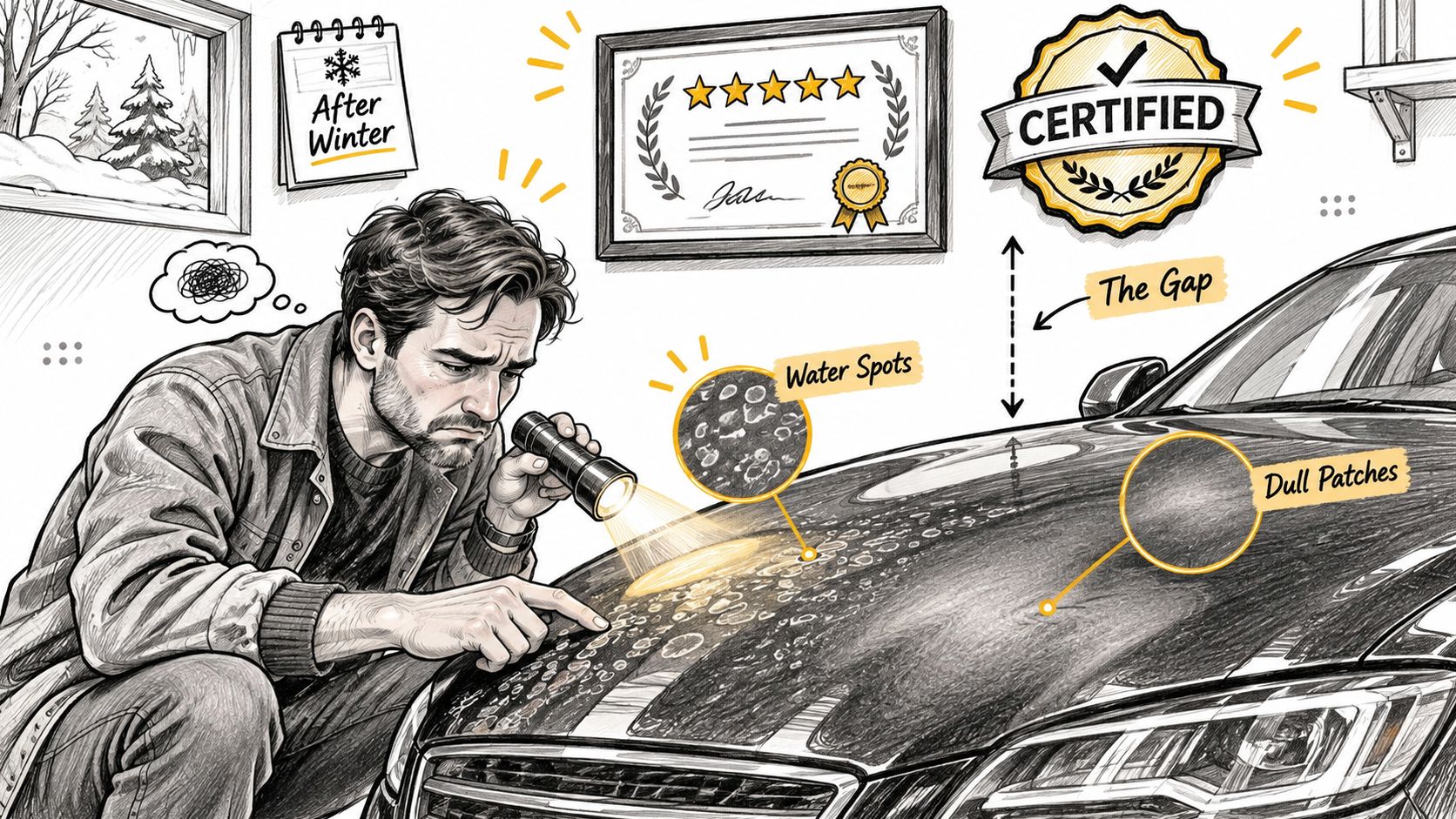
Protection needs more than a product label
A peer-reviewed review of automotive protective coatings reports that ceramic coatings commonly provide effective protection for approximately 1–3 years, depending on formulation, environmental exposure, and maintenance. That's a practical benchmark, not a universal ceiling or a guarantee for every installation.
These coatings are engineered protection systems, not longer-lasting wax. Their performance depends on how the installer prepares the substrate, applies the material, manages curing, and explains upkeep. Paying for a higher-tier bottle won't rescue contaminated paint or careless leveling.
Don't confuse immediate gloss with proven durability, either. A freshly polished vehicle can look spectacular before the protective product even touches it.
Buying rule: Pay for an accountable process, not just a product name and an advertised lifespan.
Our explanation of third-party coating testing helps distinguish measurable evidence from marketing language. Look for the test method, application conditions, and actual result rather than accepting a laboratory logo by itself.
You can find a certified Titan Coatings installer through our website or by contacting us. Put that installer on your shortlist alongside other nearby providers, then compare their preparation records, application controls, and written commitments with the same checklist.
Score Any Nearby Provider With This Checklist
Provider evaluation checklist
| Criterion | Question to ask | Strong answer | Weak answer |
|---|---|---|---|
| Surface preparation | Is paint correction included before coating? | Inspection, decontamination and polishing listed separately | Only a wash and a wipe down |
| Contamination and humidity | How do you control moisture and surface contamination? | Temperature, humidity and panel readings logged | No mention of conditions |
| Application records | What film thickness and cure procedure do you document? | Written record kept for each vehicle | Verbal only |
| Adhesion evidence | What independent test data supports this product? | Pull-off results with failure mode noted | Only a claimed number of years |
| Warranty | What does the warranty cover and exclude? | Written terms tied to layering and products used | Verbal promise |
| Aftercare | Are inspections or maintenance products required? | Scheduled inspection and upkeep plan | No follow-up plan |
| Pricing basis | How is the quote calculated? | Vehicle size, condition and package assessed after inspection | Flat rate with no inspection |
| Certification | Which certification is held and what does it cover? | Named credential with proof of training | Logo only |
Listen for methods, not reassurance
Ghostphorm's guide to ceramic-coating certifications explains that there's no government licensing system for ceramic-coating installers and no single independent standard against which every certification is measured. A credential alone doesn't establish preparation quality, application care, or future warranty support.
A serious installer can describe how they isolate dirty work from application work, monitor moisture, and document curing. A weak answer returns repeatedly to the package name or promised years.
For adhesion evidence, the ISO 4624 pull-off testing standard provides a useful framework: results need the failure mode, because separation at the substrate, failure within a coating, and failure of the test adhesive mean different things. This is supplier or test-panel evidence, not a reason to perform destructive testing on your hood.
Ask how film thickness is established, too. An ordinary paint-depth reading shouldn't be passed off as a precise measurement of the newly applied protective layer.
Compare what the quote actually includes
Our application pricing reflects vehicle size, condition, and the chosen package; an authorized installer provides an accurate quote. Compare itemized preparation, correction, product, layering, curing arrangements, and aftercare rather than a headline figure.
Our coatings carry a warranty when installed by a certified professional. The installer provides that warranty, and its terms depend on the layering and products used, so keep the written terms with your invoice.
Mobile service deserves the same scrutiny as studio work. Our guide to mobile detailing companies is relevant if convenience matters, but convenience shouldn't excuse uncontrolled conditions.
Mark each answer documented, verbal, or missing. Prefer the provider with the clearest supporting records, and discount any answer that substitutes a brand badge for an explanation.
How to Verify Surface Prep Before the Coating Goes On
Paint can look glossy and still hold polish oils, silicone, wax, or moisture that weaken the bond. That is why preparation deserves more attention than the bottle itself. The ISO pull-off adhesion testing document identifies substrate preparation and drying conditions among the variables affecting adhesion results. A nearby provider should be able to show how those variables are controlled, not just point to a coating brand or a finished shine.
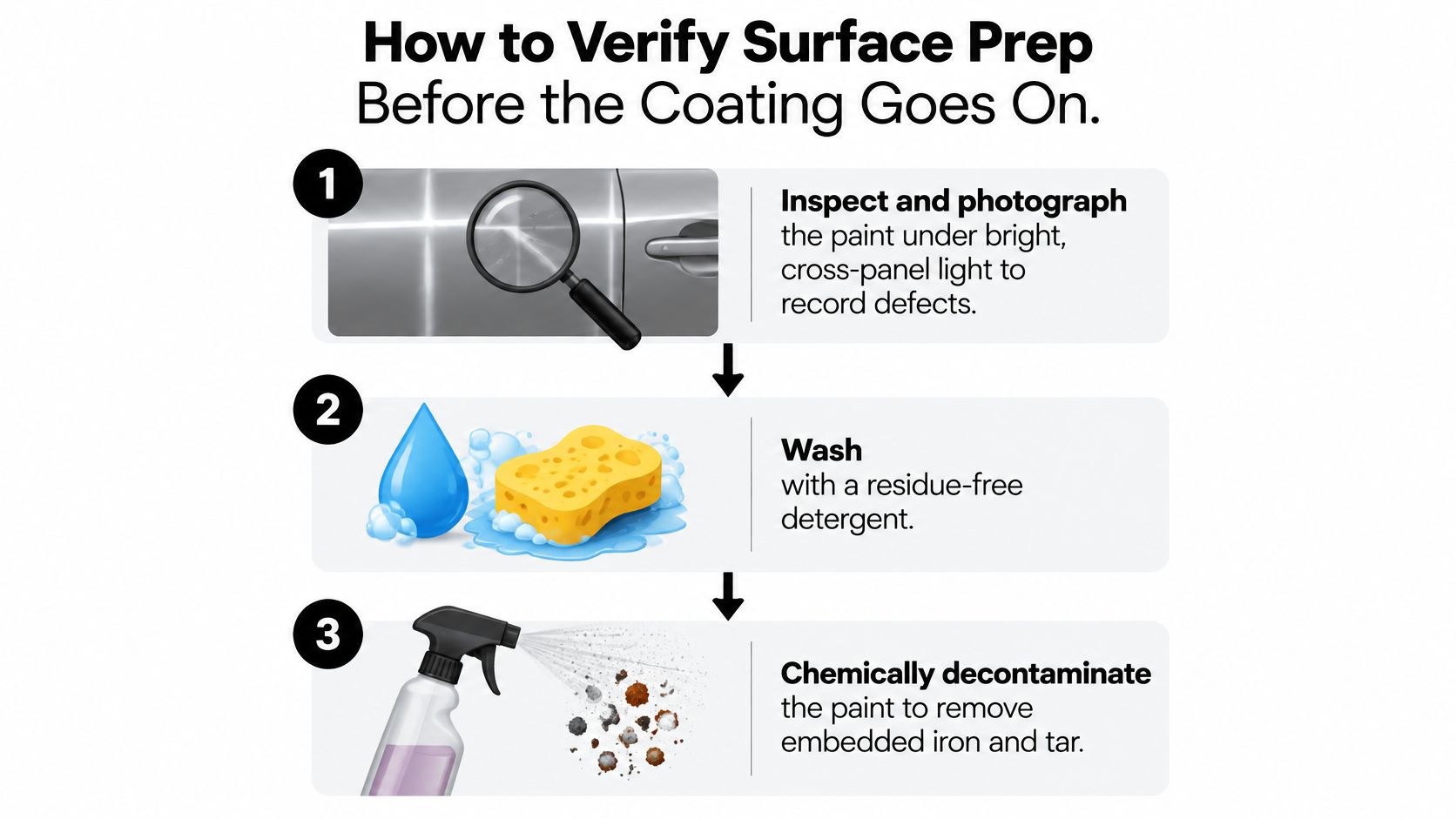
Follow the preparation sequence
Inspect and photograph the paint. Use bright, cross-panel lighting to record swirls, scratches, stains, and existing damage. Straight-on showroom lighting can conceal defects that become obvious outside.
Wash with a residue-free detergent. Remove loose dirt before touching bonded contamination. A wash product that deposits gloss enhancers leaves another material that needs removing.
Chemically decontaminate the surface. Use appropriate iron, tar, and mineral-deposit removers, keeping each chemical within its application instructions. Do not let cleaners dry on a hot panel.
Clay only where contamination remains. Check the surface after chemical treatment rather than automatically claying every panel. Use suitable lubrication, since unnecessary mechanical contact can introduce marring.
Machine-polish the defects that need correction. Agree on the correction scope before work starts, and use a test spot to establish the least aggressive effective combination. Do not chase deep damage at the expense of the remaining clear coat.
Complete the final panel wipe. Surface preparation is required before installing a Titan Coating, and BioPrep with 99.99% pure alcohol is recommended for the best bond. Use dedicated clean towels rather than reusing polishing or wash towels.
Verify dryness and record conditions. Log ambient temperature, relative humidity, and panel temperature. Postpone application whenever moisture could condense on the surface, including after moving a cold vehicle into warmer, humid air.
Check the work before full application
Use the coating surface preparation guide to frame a practical handover discussion. Request photographs or checklist entries for the stages that will disappear under coating, then agree on a small test section before the complete vehicle. A serious provider welcomes that conversation because the process can be explained, photographed, and repeated.
After leveling, the installer should inspect across the panel for high spots, streaks, dust, and uneven coverage while correction remains possible. That inspection is part of the job, not a courtesy. If the answer is vague, the risk stays with your paint.
Glass deserves deliberate preparation as well. Apex Glass Coating- 50ml is a DIY and mobile detailers coating that currently costs $39.97. Cleaner rain visibility can make wet-weather driving less stressful, but a coating does not replace sound wipers, clean glass, or appropriate driving speed.
How Long Coating Should Last Through Heat and Cold
A daily driver parked outside overnight, then driven into strong afternoon sunlight, swings through a wide temperature range every single day. Hardness alone does not describe the protection that surface needs.
A rigid film that cannot move with its substrate stays vulnerable to stress-related cracking and adhesion loss. Flexibility matters alongside hardness, especially for vehicles facing repeated cold-to-hot exposure.
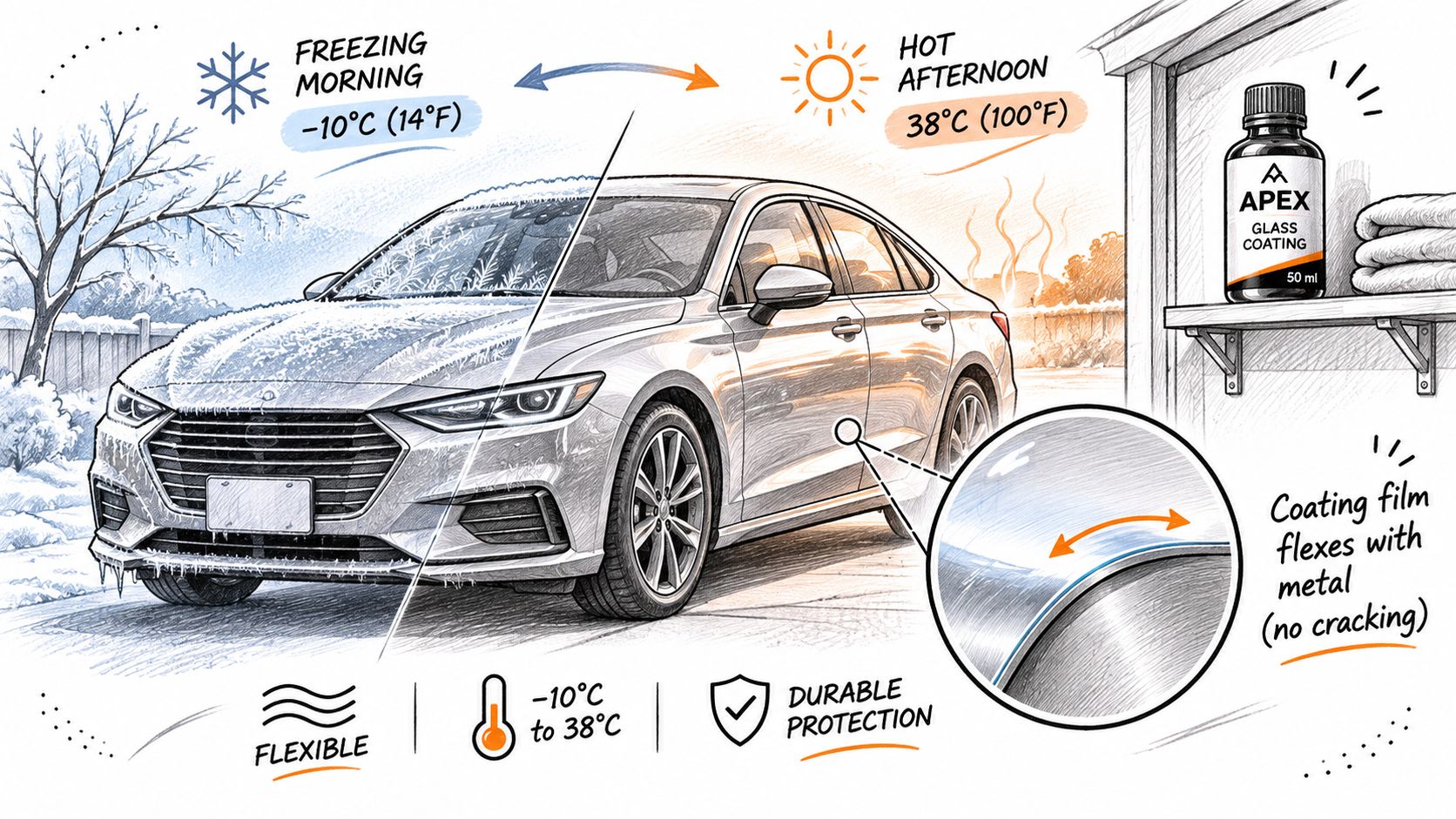
Separate the design goal from the proof
ASTM D6944 evaluates cured coatings under repeated thermal cycling, tracking effects on adhesion along with the development of checking, cracking, and blistering. It gives you a concrete basis for discussing temperature resistance, though results still depend on the specific substrate and application.
Titan Coatings manufactures elastomer-based ceramic coatings, and its PX10 micron membrane base coat is reinforced with Dark Matter Technology. Treat that design story the same way you treat any manufacturer's claims: weigh it against test evidence for the exact product going on your car.
The elastic design goal is glass-like hardness with flexibility, so the film moves with the panel instead of fighting it. Ask any provider you are vetting how their warranty handles a coating that degrades after real freeze-thaw seasons. A certified Titan installer is required to inspect the vehicle, provide feedback, and work on restoring the coating, so the shop worth your money is the one that explains that process before you book.
A claim that a coating won't crack needs relevant test conditions and results, not just a demonstration of water beading.
Alpha Quartz 50ml is an elastomer option built for DIY owners and mobile detailers. Its stated protection targets UV exposure, chemicals, and abrasion, and like any coating it still demands proper surface preparation and suitable application conditions.
Give the coating a realistic working life
Outdoor exposure, harsh chemicals, abrasive washing, tree sap left in place, and skipped maintenance all shorten a coating's working life. For our coatings, wash with a pH-neutral shampoo and avoid harsh chemicals and abrasive cleaning products.
Our discussion of ceramic coating life can help frame ownership expectations. For a car that sees freezing mornings and hot afternoons, request thermal-cycling evidence for the actual product and substrate combination. A provider who answers with documented results has earned your booking, while one who promises the coating can never be affected has told you to keep looking.
Match the Product to Your Car and Budget
Buy by the job, not by the loudest package name. A windshield, daily driver paint, and an already-coated finish need different products. Set the budget after the problem is clear.
Titan products by job and price
| Product | Best for | Price | Where it fits |
|---|---|---|---|
| Apex Glass Coating | Glass and windshield visibility in rain | $39.97 | DIY and mobile detailers |
| Alpha Quartz 50ml | Elastomer protection on paint and other automotive surfaces | $67.97 | DIY and mobile detailers |
| ULTRA Ceramic Spray | Refreshing a coating at home | Not listed | Home maintenance |
Glass visibility, paint protection, and maintenance are different jobs, and your budget should follow your priorities.
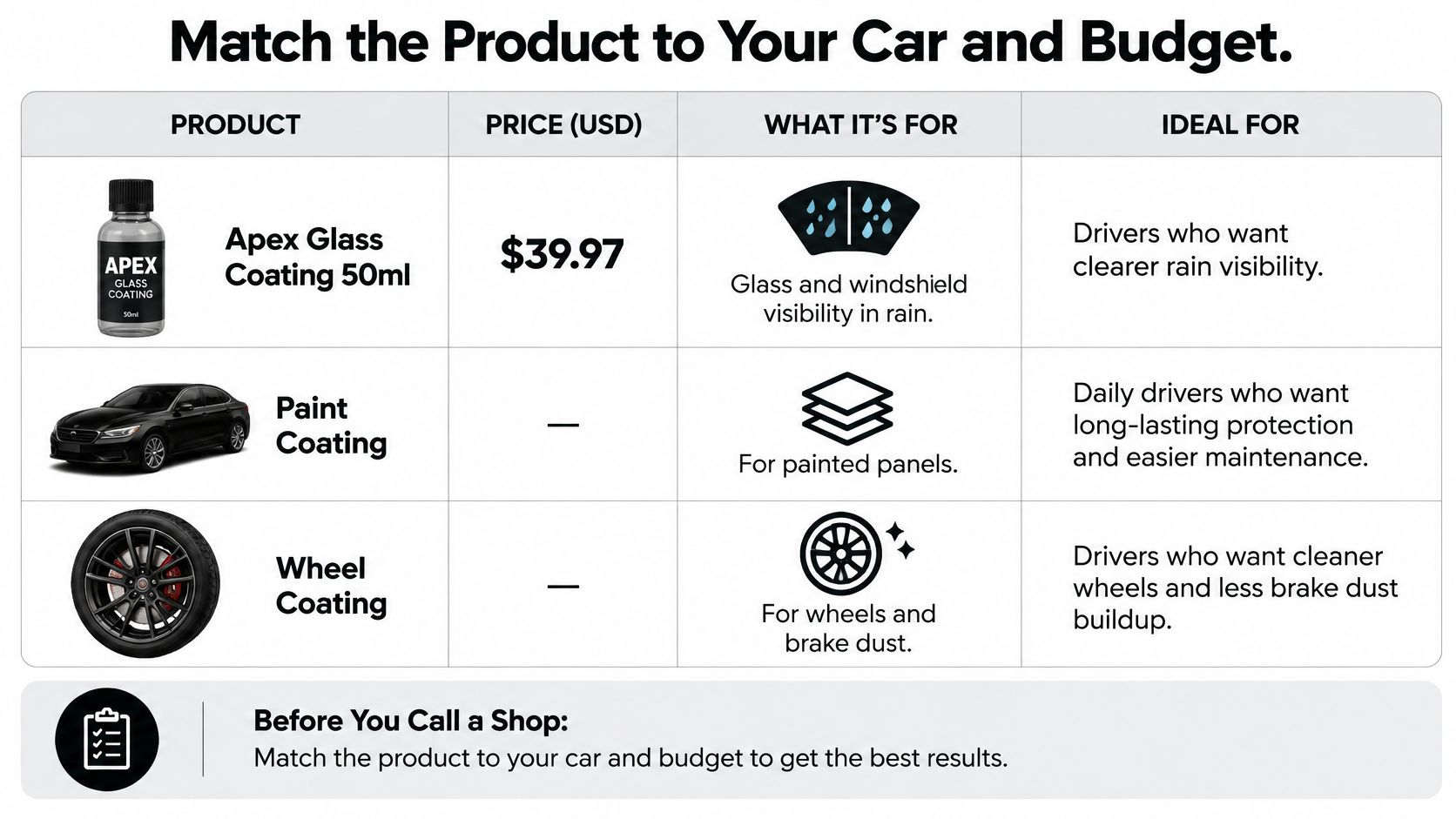
Buy the right kind of application
- For wet-weather visibility, choose a dedicated glass treatment. HYPERGLASS 50ml is a glass coating. Check the windshield for contamination and wiper problems first, so you are not asking a coating to fix damaged glass or worn hardware.
- For broader surface protection, choose a full coating and budget for the preparation the surface needs. Alpha Quartz 50ml is a DIY and mobile detailers coating, while professional-grade coatings must be applied by certified installers.
- For home upkeep, use a product with a clear place in the system. ULTRA and Omniguard are DIY products that help maintain and refresh a coating at home.
ULTRA Ceramic Spray belongs in the maintenance aisle, not the “fix a failed coating” aisle. Use it to refresh an existing coating at home. If water behavior, gloss, or protection has broken down, inspect the surface first. A maintenance product cannot repair the reason the original coating failed.
The difference between ceramic and polymer protection helps when comparing product categories. You can also review our coating shop before speaking with an installer. Buy the smallest set of products that solves the actual job. Overlapping coatings add cost and make the finish harder to judge.
DIY-friendly doesn't mean preparation-free. Start with a clean, dry, decontaminated surface, work within the product's application conditions, and inspect your results under directional light before moving on. Surface preparation is required before installing a Titan Coating, and BioPrep with 99.99% pure alcohol is recommended for the best bond. After coating, wash with a pH-neutral shampoo and avoid harsh chemicals and abrasive cleaning products.
Pricing for a Titan Coatings application depends on vehicle size, condition, and coating package. An authorized installer gives the accurate quote.
Book Your Visit and Get the Plan in Writing
A good booking starts with a specific scope, not a deposit against an undefined package. Use your search results to arrange an inspection, then make the provider commit to what they will do, line by line, before any work is scheduled.
Turn the shortlist into a decision
- Shortlist nearby providers. Search coating near me, review past-work photographs and customer feedback, then call your top three with the checklist questions.
- Arrange an inspection. If one of our coatings has degraded, a certified installer must inspect the vehicle, provide feedback, and work on restoring the coating as needed. Expect the same standard on a first visit: a provider who quotes without looking at the paint is guessing.
- Get an itemized proposal. Record preparation, correction scope, product, layering, curing arrangements, and aftercare before approving work.
- Put the warranty on paper. Titan Coatings come with a warranty when installed by a certified professional, and the installer provides that warranty. Its terms depend on the layering and products used, so ask exactly which coverage applies to your vehicle. Confirm exclusions, required upkeep such as washing with a pH-neutral shampoo, and any maintenance inspections in writing.
- Confirm the installer, not just the brand. Professional-grade Titan Coatings must be applied by certified installers, so ask who will personally work on your car and get that installer's certification confirmation in writing before the appointment.
- Agree on a test section. If offered, use it to confirm the proposed finish and correction scope before committing to the complete vehicle.
Decision rule: Choose specific, documented answers and a written warranty over the lowest price or highest star rating.
You can contact us to locate a certified installer. Bring photographs, describe where you park and how you wash, and request a plan matched to the car you drive.
APEX NANO – Titan Coatings offers elastomer-based surface protection, dedicated windshield coatings, and DIY maintenance options. Visit APEX NANO – Titan Coatings to explore the range and find a certified installer, then request an inspection and a written preparation, application, and aftercare plan before booking.
0 Comments