
A detailer once showed me two coating kits at a shop counter. One promised “9H hardness,” while the other said “lab verified,” yet neither box included a report, method number, batch reference, or lab name. That moment captures what 3rd party testing is really about: not the label, but the evidence behind the claim.
The Coating Aisle Problem and Why Testing Exists
Liquid coatings are difficult to judge at the counter. You can inspect the bottle, read the cure instructions, and watch water bead on a freshly treated panel, but you can’t see how the film will respond after ultraviolet exposure, road salt, chemical contamination, abrasion, or repeated expansion and contraction. A coating may look impressive on installation day and still fail later through peeling, hazing, cracking, or loss of adhesion.
That’s why the phrase third-party testing matters. An independent organization evaluates the product without being the manufacturer, the buyer, or a commercial partner whose interests could influence the outcome. The laboratory receives defined samples, applies recognized methods, records the conditions, and issues a report that can be reviewed by customers, regulators, and downstream users. The broader conformity-assessment framework describes this neutral third party as the verifier of whether a laboratory can properly perform methods such as ANSI, ASTM, and ISO procedures under a controlled quality system (OECD guidance on good in vitro method practices).
The difference between internal checks and independent evidence
A manufacturer can perform valuable in-house quality control. Internal teams may check viscosity, cure behavior, appearance, or batch consistency before a product ships. The limitation is structural: the same company that sells the coating also defines the sample, controls the process, and interprets the result.
Third-party testing separates those roles. The lab’s interests should remain distinct from both the supplier and the customer, which reduces the conflict-of-interest risk built into self-declaration. For buyers researching whether car paint protection works, that distinction is more useful than a bold durability promise printed on packaging.
A practical guide to product performance testing how-to can help organize the broader process, but a coating report still needs product-specific context. The lab must test the correct formula, use a relevant method, and document how the sample was prepared.
Practical rule: “Third-party tested” is only the beginning. Ask who tested it, what standard was used, and whether the report identifies the exact product and sample.
Independent testing compresses a long, hidden failure window into a controlled record. Instead of waiting months to discover whether a film survives environmental stress, a buyer can examine the exposure method, endpoint, and result. Yet independence alone isn’t enough. A neutral lab using an irrelevant method can still produce evidence that says little about the performance a detailer is selling.
ISO, ASTM, and MIL Standards Demystified for Coatings
A coating report can look like alphabet soup until each standard is connected to a visible failure. ISO methods often establish internationally recognized procedures, ASTM methods provide detailed technical test protocols, and military specifications can define demanding qualification requirements for specialized applications. The standard number matters because it tells you what the laboratory measured.
Start with the preparation
Before testing begins, the lab has to create a controlled specimen. ISO 1514 addresses sample preparation, helping laboratories produce comparable panels rather than testing surfaces with unknown cleanliness, roughness, or substrate history. If one lab uses polished steel and another uses an untreated panel with different preparation, their results may not represent the same coating behavior.
Adhesion is another familiar failure. ISO 2409 defines a cross-cut test in which the cured film is scored and exposed to tape pull. The result helps show whether the coating is bonded to the substrate or merely sitting on top of it. On a vehicle, weak adhesion can appear as lifting around chips, edges, repairs, or contaminated areas.
Match the test to the claim
A “9H” statement commonly points to ASTM D3363, the pencil hardness method. It can indicate resistance to marks from pencils of defined hardness, but it doesn’t describe every form of toughness. A hard film can still be vulnerable to impact, flexing, poor adhesion, or thermal movement.
ASTM B117 uses a salt-fog chamber to evaluate corrosion-related behavior under controlled exposure. Coating laboratories also use ASTM D1735 for humidity exposure, along with other ISO and ASTM procedures, when moisture resistance is relevant (Cortec Laboratories coating test services). UV and weathering programs may use ASTM D4587, ASTM D6695, and ASTM G154, depending on the lamps, cycles, and exposure objective.
Military specifications such as MIL-DTL-1629 and MIL-PRF-24667 can signal qualification against more demanding application requirements, including chemical or abrasion resistance. They shouldn’t be treated as universal proof for every automotive claim. The method still has to match the use case.
| Standard | What It Measures | Failure Mode It Predicts |
|---|---|---|
| ISO 1514 | Sample preparation | Inconsistent or incomparable panels |
| ISO 2409 | Cross-cut adhesion | Peeling and delamination |
| ASTM B117 | Salt-fog corrosion exposure | Corrosion under or through the film |
| ASTM D3363 | Pencil hardness | Surface marking and scratch resistance |
| ASTM D4587, D6695, and G154 | Controlled UV and weathering exposure | Fading, haze, chalking, and weathering damage |
| MIL-DTL-1629 and MIL-PRF-24667 | Specialized qualification requirements | Chemical, abrasion, and service-environment failures |
A credible report names the standard number, edition year, sample preparation, exposure conditions, and any deviation from the method. For a broader look at quality systems, why ISO 9001 is important provides useful context, although ISO 9001 management certification isn’t the same as ISO/IEC 17025 laboratory accreditation.
What Independence Is Worth in Numbers
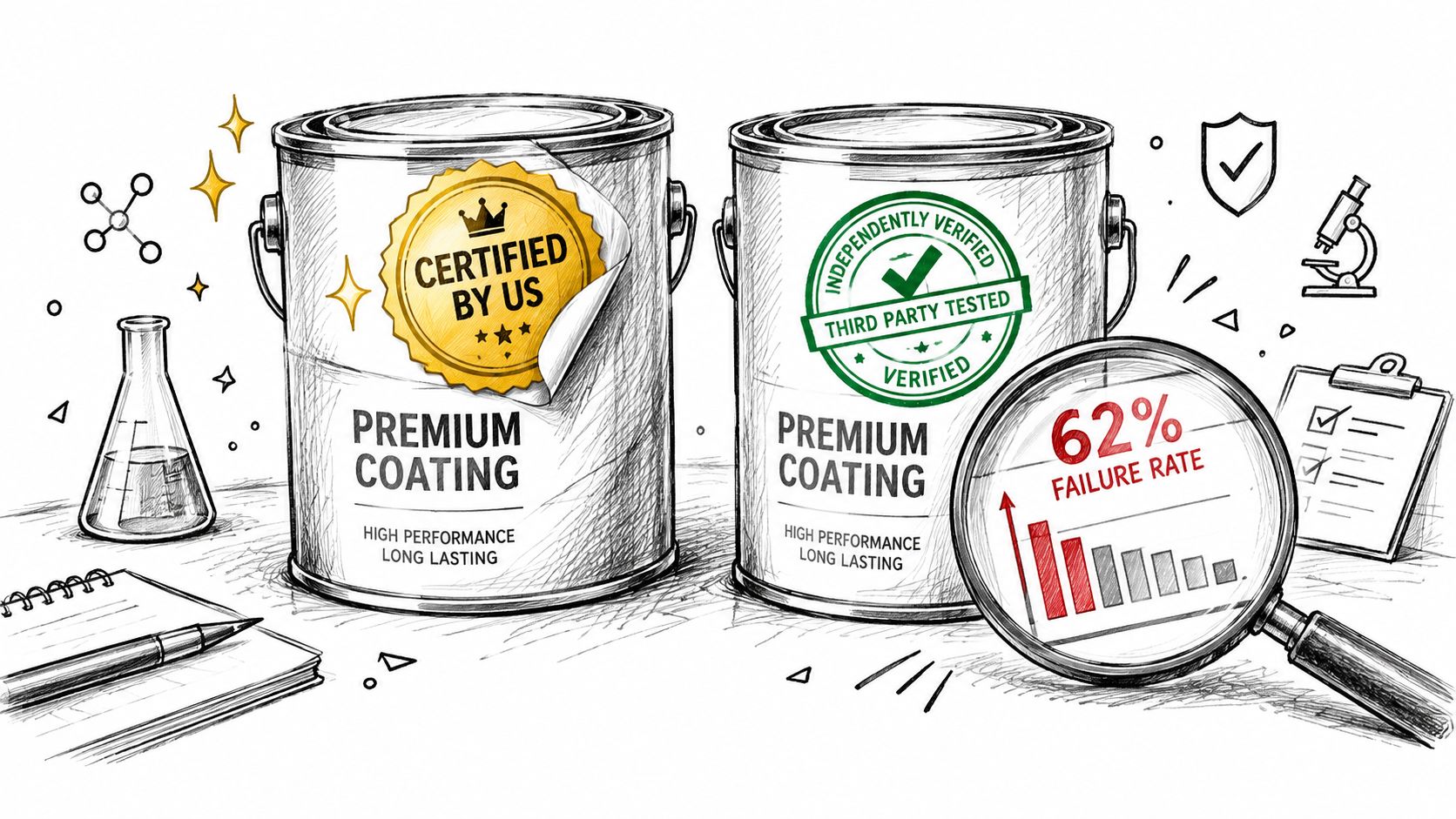
The strongest case for independent evaluation comes from comparative product evidence, not from the phrase “lab tested.” A widely cited market survey found that 17% of self-declared consumer products showed dangerous faults, while less than 1% of third-party certified products did (IFIA CIPC market survey report).
That comparison changes how a detailer should interpret a coating claim. Self-declaration can reflect a supplier’s own testing and confidence, but it doesn’t provide the same structural separation as an accredited, independent evaluation. Third-party certification doesn’t make a product immune to failure, yet the survey presents independence as a measurable risk-control mechanism rather than a decorative badge.
Why the result matters to a working shop
A detailer doesn’t sell a bottle. The detailer sells preparation, installation, appearance, maintenance expectations, and a reputation that follows the vehicle after it leaves the bay. If the coating fails because the formula, substrate, cure, or environment wasn’t suitable, the shop absorbs the customer conversation even when the original marketing claim came from the supplier.
That’s why a salt spray corrosion testing resource can be more useful than a generic durability statement. It points the buyer toward the actual stress condition, the standard applied, and the endpoint recorded.
The useful question isn’t “Does it have a certificate?” It’s “What risk did the certificate measure?”
Independent testing also makes comparisons possible. Two coatings can both claim protection, but their reports may use different substrates, film thicknesses, cure schedules, or exposure cycles. Without those details, the numbers can’t be compared fairly. A report becomes valuable when it preserves enough context for another professional to understand what happened and decide whether the result represents a real vehicle, panel, fleet environment, or industrial surface.
Reading a Coating Test Report Without Falling for Marketing
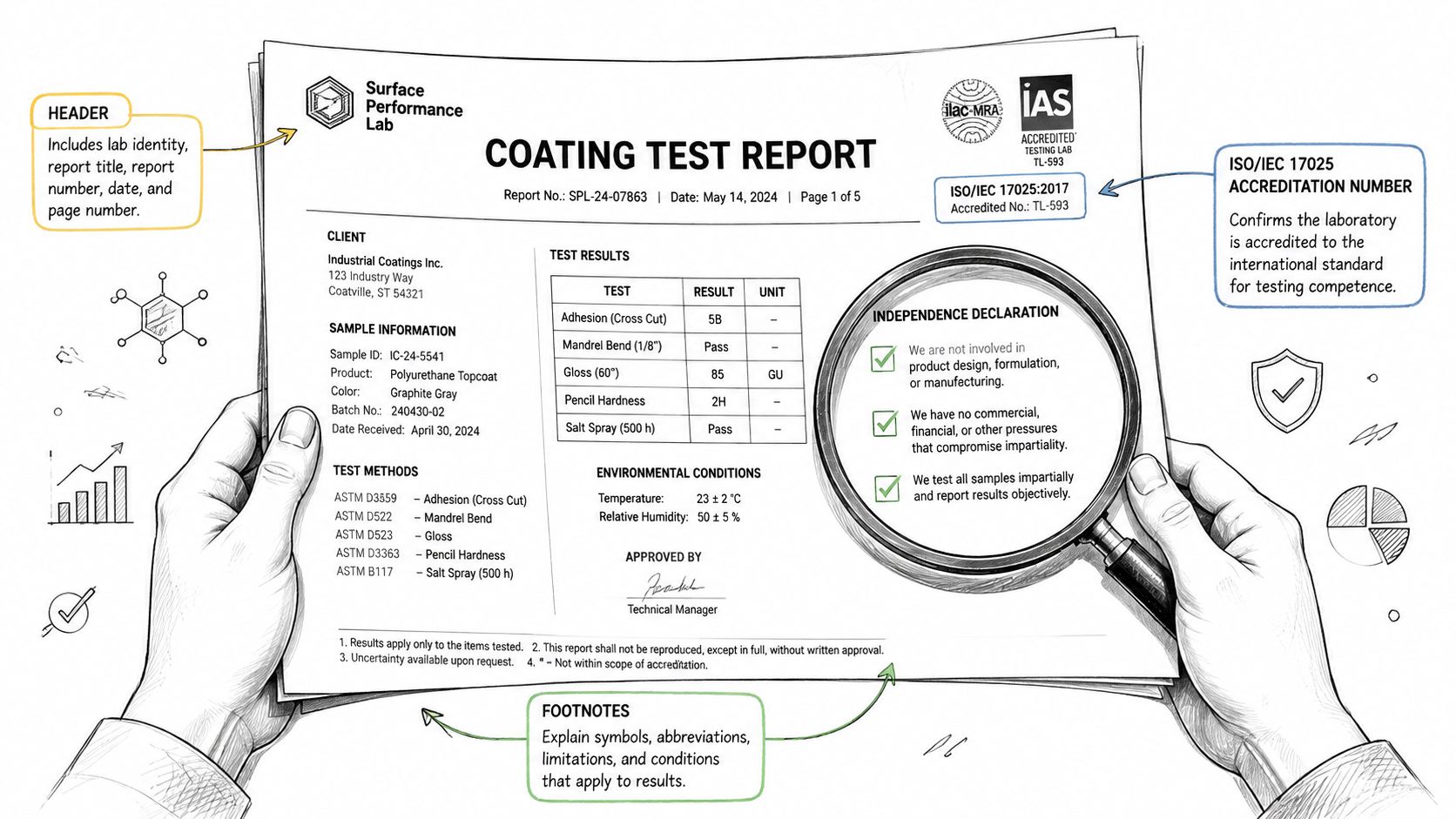
A test report should read like a traceable record, not a brochure. Start at the top and work downward. The header should identify the laboratory, the client, the product, the sample reference, the testing date, and the report number. If the document only shows a logo and a pass statement, you’re missing the information needed to connect the result to the bottle in your hand.
Three signs of meaningful independence
Look for an ISO/IEC 17025 accreditation number and confirm that the laboratory’s scope covers the method being cited. Accreditation relates to the laboratory’s competence for defined activities, not to a blanket approval of every product it has ever tested.
Next, check ownership and branding. The lab should have its own identity and contact information rather than appearing to be a department of the coating manufacturer. A supplier may commission the work, but commissioning the test doesn’t make the supplier independent. The laboratory remains responsible for the method, records, observations, and report.
Finally, match the method code to the claim. A hardness method doesn’t establish flexibility. An adhesion method doesn’t prove chemical resistance. A corrosion exposure doesn’t automatically predict UV durability. The report should state the procedure and, ideally, the edition year and any deviation.
Read the small fields
“Sample preparation” explains how the panel was cleaned, abraded, coated, and cured. “Substrate” identifies what sits beneath the film. “Exposure duration” tells you how long the specimen faced the stated environment. “Deviation from method” reveals where the laboratory changed the standard procedure.
Cure conditions deserve special attention. An ambient-cured panel and a heat-cured panel can produce very different hardness and adhesion results. A report that omits temperature, humidity, film thickness, or cure time leaves the reader unable to judge whether the test resembles field installation.
Use the same discipline when reviewing chemical resistance testing. A pass/fail box without raw observations or measured values provides limited insight into variability. Mean values, ranges, and standard deviation show how consistently the samples performed.
For a coating such as APEX NANO, the useful benchmark is a report style that ties the product identity, preparation, method, and result together. Don’t accept an undated certificate, a missing batch reference, or a generic “formula tested” statement as proof that the current bottle matches the tested material.
How Elastomer Coatings Change the Testing Conversation
Hardness is easy to market because it compresses a complicated film into a familiar number. It isn’t always the right question for a coating that must move with its substrate. A rigid layer may resist a pencil mark while struggling with panel movement, impact, or repeated temperature cycling.
Elastomeric coatings change the priority from hardness alone to flexibility, adhesion, recovery, and environmental endurance. Titan Coatings describes its technology as using elastomer coatings with nano tubes technology and Dark Matter technology. Its product range includes APEX Glass, APEX Ultra Spray, and Alpha Quartz, each of which should be evaluated against the claims being made for its intended surface and installation process.
| Test Method | Quartz Coatings | Elastomer Coatings, APEX Glass, Alpha Quartz, Ultra Spray | Why It Matters |
|---|---|---|---|
| ASTM D3363 or ISO 1522 | Useful for surface hardness | Useful, but insufficient by itself | Shows resistance to surface marking |
| ASTM D522 | Can reveal cracking during bend | Central to evaluating flexible films | Exposes loss of flexibility and adhesion |
| ASTM G154 | Measures controlled UV exposure | Important for long-term weathering | Reveals haze, fading, chalking, and degradation |
| ASTM D2240 | Indicates material hardness | Helps characterize elastomer feel and recovery behavior | Adds context beyond pencil hardness |
| ASTM D412 | Less informative for rigid films | Measures elastomer tensile strength and elongation | Quantifies stretch and recovery behavior |
A published elastomeric coating data sheet reports 344% ultimate elongation, with 96.9% elongation recovery after 10 minutes and 98.4% after 24 hours under its stated testing conditions (Sika elastomeric coating data sheet). Those figures illustrate the type of measurement buyers should look for when a supplier describes flexibility. A qualitative promise that a coating “moves with the panel” can’t replace a defined test result.
The practical benefit is easy to understand. A film that remains flexible can better accommodate movement caused by temperature changes, impact, or substrate flexing. Titan’s elastic-coating message is that the film is hard like glass while remaining flexible, so it can resist surface wear without behaving like a brittle shell. That concept should be proven through relevant tests, not accepted because the word “elastic” appears on a label.
For readers comparing elastomeric materials more broadly, this overview of the benefits of reflective roof coatings offers useful background on why flexibility matters in protective films. For automotive buyers, the next step is to request the exact test methods and conditions for APEX Glass, Alpha Quartz, or Ultra Spray rather than transferring results from another product category. Titan also provides a dedicated explanation of coating flexibility for buyers evaluating movement-related performance.
Four Questions That Separate Real Testing from a Label
“Third-party tested” can describe anything from a serious certification program to a single manufacturer-commissioned laboratory test. The phrase alone doesn’t identify the standard, the accreditation scope, the sample set, or whether anyone outside the supplier can verify the result. That gap is especially important for coatings, where corrosion, weathering, adhesion, abrasion, and flexibility require different methods.
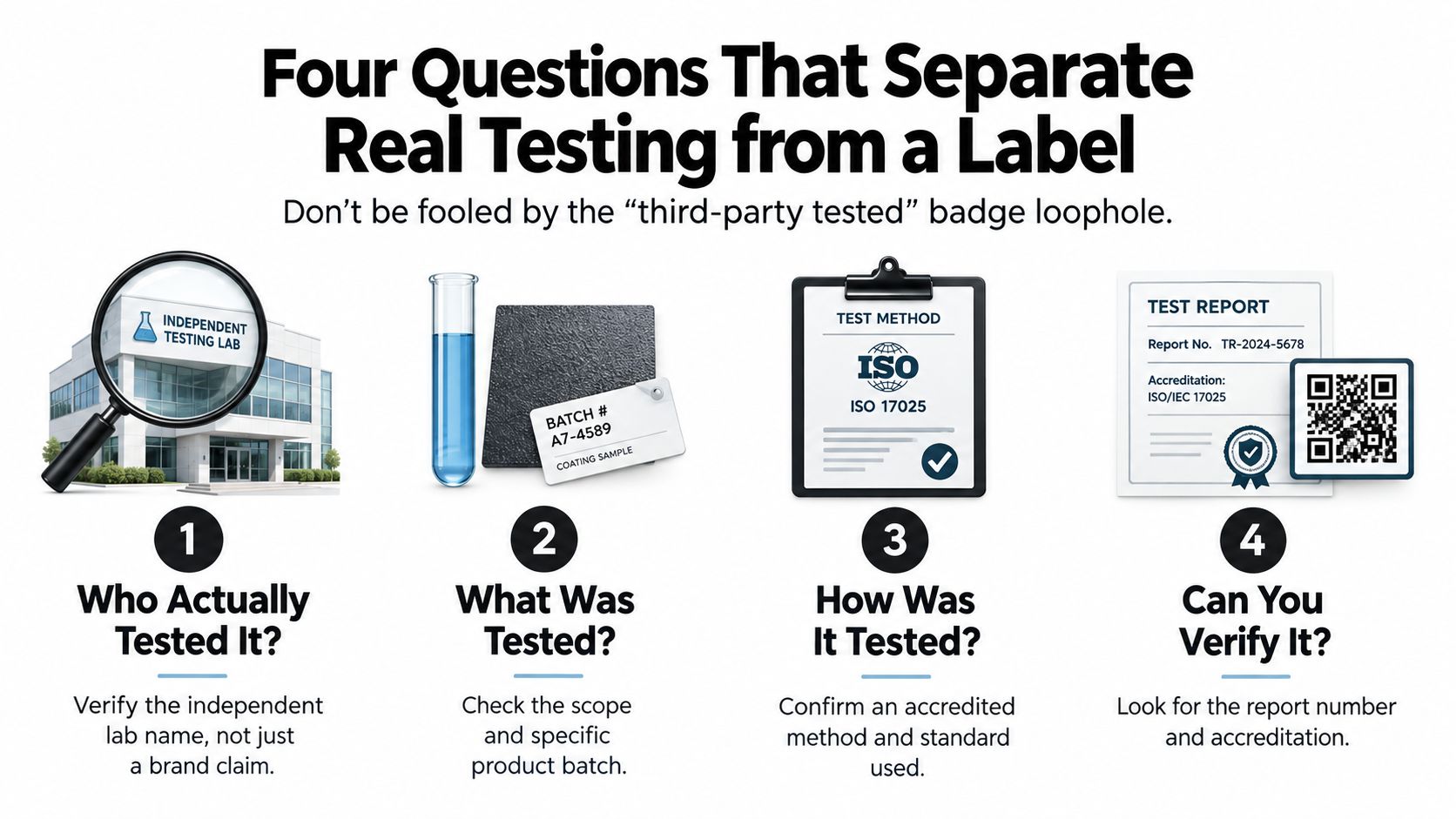
Ask these questions before treating a badge as evidence:
Who actually ran the test? Look for the laboratory’s legal name, address, accreditation information, and direct contact details. If the supplier won’t identify the lab, independence can’t be checked.
What was tested? A report should identify the exact coating, product version, sample type, and relevant batch or production reference. “The technology was tested” is weaker than a result tied to the material being purchased.
How was it tested? Find the method code and compare it with the marketed property. Hardness, adhesion, chemical resistance, UV durability, corrosion resistance, and elongation aren’t interchangeable claims.
Can you verify it? Ask for the full report or a verifiable certificate number. A document should make it possible to confirm the laboratory, method, dates, sample identity, and result.
Apply the filter to a real buying decision
Suppose a mobile detailer is considering APEX NANO documentation for a vehicle package. The detailer should ask whether the report names the product by SKU or version, whether the sample was prepared like a field installation, and whether the lab’s scope includes the cited procedure. The same questions apply to Alpha Quartz, APEX Glass, and Ultra Spray.
A product can still be useful without a public certificate, but the buyer should describe the evidence accurately. A manufacturer summary may support a purchasing conversation. It isn’t the same thing as an independently verifiable, audit-grade report.
A label tells you what the seller wants you to believe. A report shows what the laboratory was asked to measure.
Your Buyer Checklist for Verified Coating Performance
Start with the laboratory, not the coating name. Ask for the ISO/IEC 17025 accreditation number and confirm that the laboratory’s scope includes the methods listed in the report. A laboratory may be competent in one field and not accredited for every test a supplier mentions.
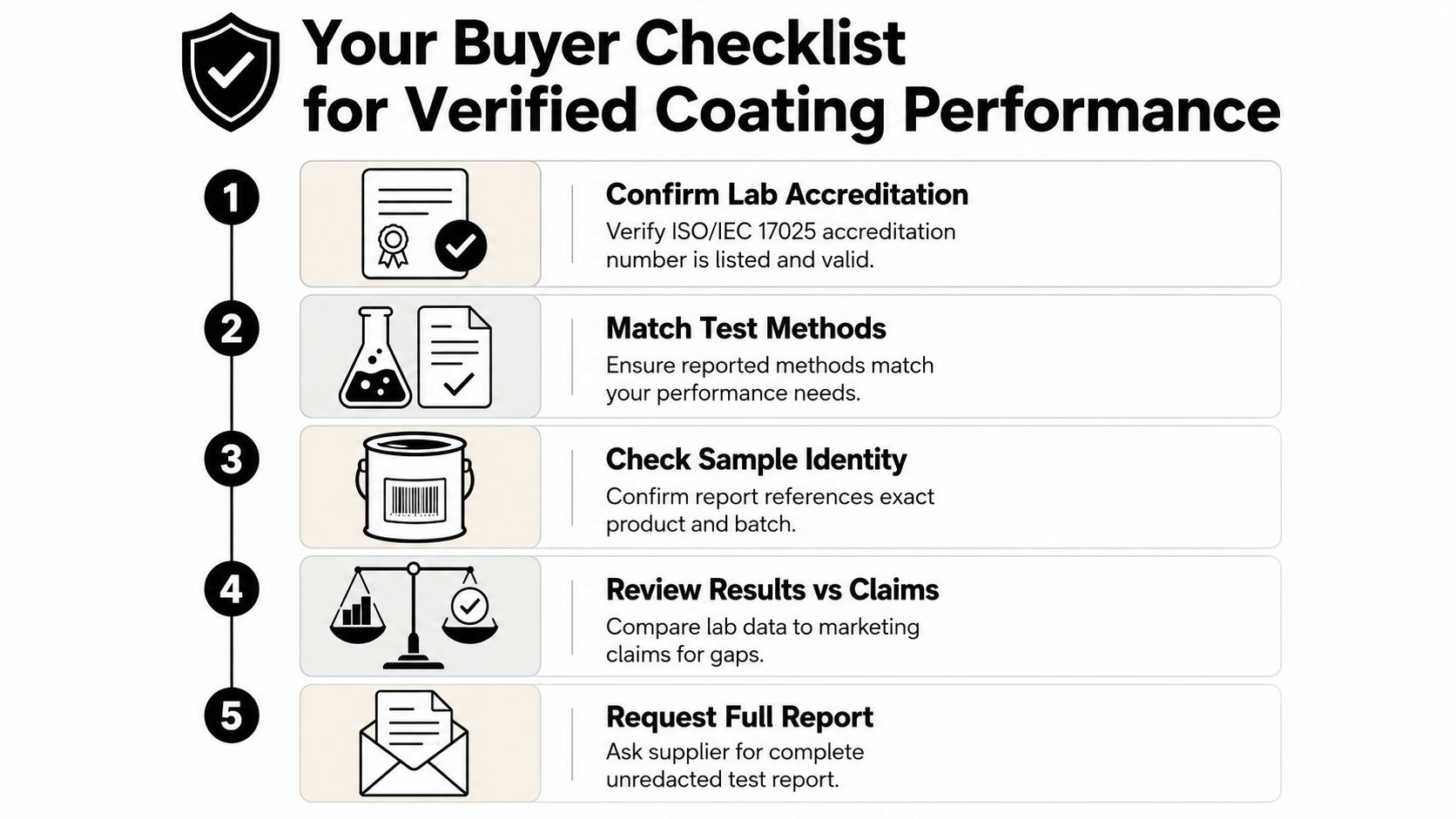
Then work through the product evidence:
Match methods to the claim: Look for ASTM B117 or another corrosion method when corrosion resistance is the claim, ASTM G154 or a relevant weathering method for UV exposure, ASTM D3359 for adhesion, and ASTM D412 when elastomeric tensile strength and elongation matter. Independent coating laboratories commonly evaluate several dimensions, including salt spray, UV exposure, abrasion, hardness, and adhesion (Sika coating performance information).
Confirm sample identity: The certificate should name the exact product, version, substrate, preparation procedure, and batch reference. Without that chain, you can’t know whether the report represents the bottle being installed.
Review the result against the claim: A hardness figure can’t stand in for flexibility, and a salt-fog result can’t stand in for windshield visibility or rain behavior. For APEX NANO Ultra Spray, a careful buyer should request elastomer-suitable evidence such as ASTM D522 and ISO 1522 results when those properties are part of the purchase decision, rather than relying on generic hardness language.
Check dates and conditions: A test is a snapshot. CPSC guidance for regulated children’s products requires re-testing and re-certification after a material change to design, manufacturing process, or component sourcing (CPSC third-party testing and certification rules). The same logic is useful for coatings. A changed resin, additive, pigment, substrate, or process can make an older report less representative.
Request the full report: Ask for the unredacted document, including observations, numerical results, acceptance criteria, deviations, and laboratory signatures. A reusable report helps a detailing studio, fleet buyer, or distributor compare future batches and explain product selection to customers.
For glass and windshield applications, the performance question also includes optical clarity, water behavior, and installation consistency. Titan’s APEX Glass product is presented for windshield and glass coating use, where easier rain visibility and straightforward application are central buying considerations. Those benefits still deserve product-specific instructions and evidence rather than a broad ceramic label.
Elastic coatings deserve the same scrutiny. A flexible film may be designed to resist cracking through temperature changes or minor impact, but the buyer should ask which test demonstrates that behavior. The useful takeaway is simple: protect your margin and reputation with performance evidence that identifies the material, method, laboratory, and conditions.
APEX NANO, Titan Coatings offers coating options including APEX Glass, Alpha Quartz, and Ultra Spray for detailers, DIY users, and mobile professionals who want product claims connected to documented testing and practical installation. Review the available products and contact the team through APEX NANO – Titan Coatings to choose a coating and request the evidence that fits your vehicle, workflow, and performance requirements.
0 Comments