
You’ve finished the wash, decontamination, polish, and panel wipe. The garage thermometer looks acceptable, so you open the coating bottle and start on the hood. A few minutes later, the product feels sticky instead of smooth. By the time you inspect the panel under a light, high spots are already forming.
That failure often has little to do with your applicator technique. Ceramic coating application temperature involves more than the air around the car. The actual panel temperature, humidity, and dew point determine how quickly solvents evaporate, how the coating levels, and whether the film bonds as intended.
Why Temperature Decides Your Coating Success or Failure
A detailer can complete the wash, decontamination, polish, and panel wipe correctly, then lose the finish during application. I’ve seen it in freezing garages and on scorching driveways. The paint looked ready, but the panel developed uneven gloss, stubborn high spots, or weak bonding because its actual temperature differed from the room reading.
The hidden variable is the thermal condition of the paint. Ceramic coating application temperature depends on the panel, not only the air around the vehicle. Humidity and dew point matter too. Moisture near the panel can interfere with bonding, especially when the surface approaches the dew point during a cool evening or in a damp garage.
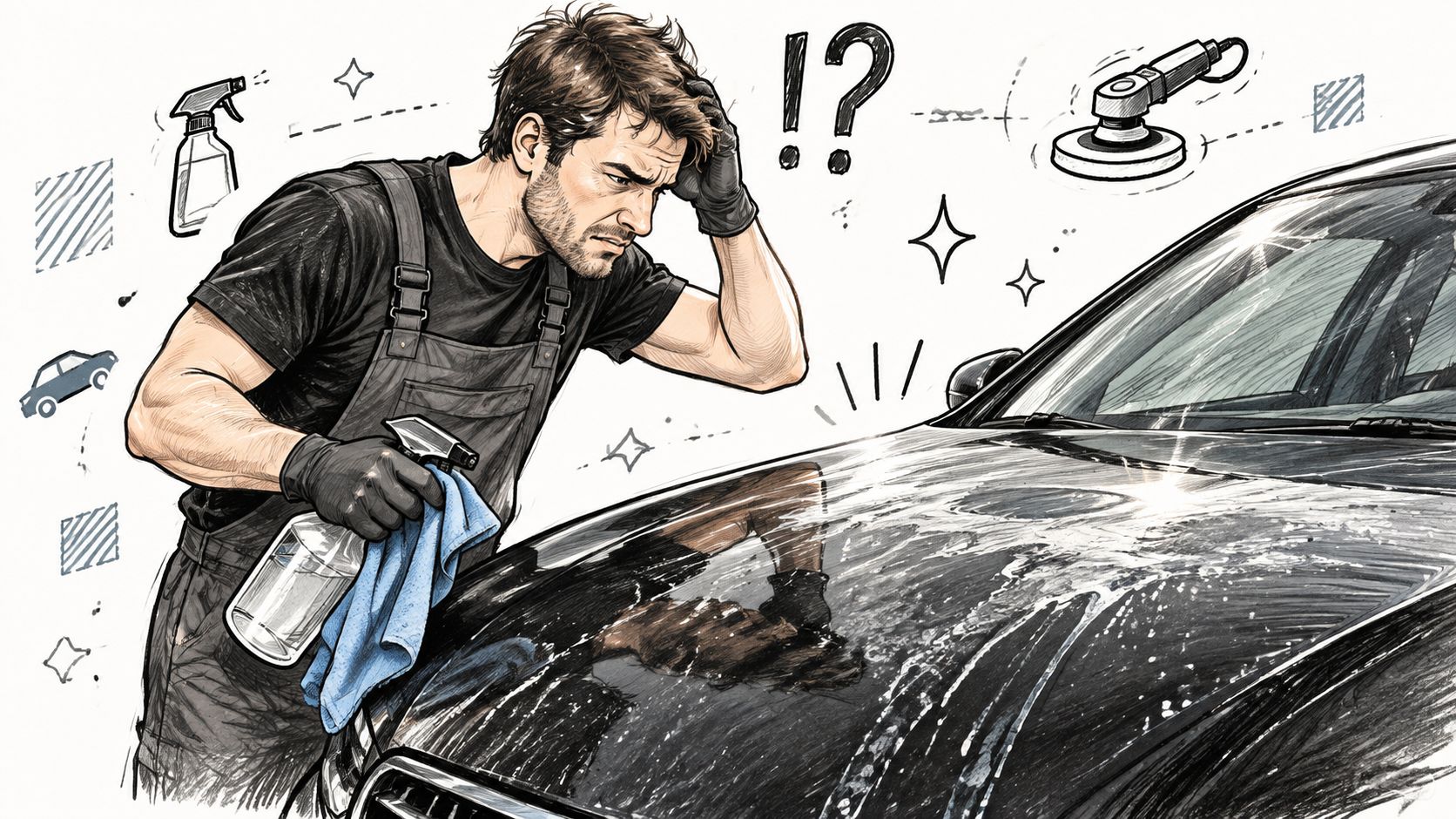
What the coating is doing on the panel
Ceramic coatings use solvents to keep the formula workable during installation. Those solvents must evaporate at a controlled rate while the coating levels and begins crosslinking. A cold panel can leave the film wet for too long, slowing cure and weakening the bond. A hot panel can flash before you finish leveling it.
That shift changes the working method:
- Cold panels: Slow solvent evaporation can leave streaks, delay curing, and reduce adhesion.
- Hot panels: Fast flashing can trap high spots and shorten the wiping window.
- Uneven panels: A sun-exposed hood and shaded door may need different application and wiping rhythms on the same vehicle.
The most consistent working window identified by an independent detailing source is 60°F to 80°F, or 15°C to 27°C. Below 55°F, curing slows and bonding can suffer. At 85°F and above, rapid flashing and high spots become more likely. Temperature guidance for ceramic coating application
Practical rule: Measure the paint, not just the room.
After the final wipe, coatings are commonly sheltered indoors or in a controlled environment for 12 to 24 hours. Full curing typically takes 24 to 48 hours in the ideal range. In colder conditions below 60°F, full cure can extend to 7 days. Keep the vehicle dry and monitor damp conditions during that period.
Titan Coatings offers elastomer-based coatings that combine hardness with flexibility. That material approach can help the film accommodate movement instead of depending only on a rigid layer. It does not remove the need to control panel temperature, humidity, or dew point during application.
The Ideal Temperature Range for Ceramic Coating Application
A shaded garage can show a comfortable air temperature while a sun-heated hood flashes coating before you finish leveling it. The safest starting point for most automotive jobs is ambient air near 60°F to 80°F, or 15°C to 27°C. That range usually provides enough time to spread the product, watch the flash, and remove residue cleanly.
Published detailing guidance gives a broader application window of 50°F to 85°F, or 10°C to 29°C, while another professional recommendation narrows the preferred range to 50°F to 77°F, or 10°C to 25°C. These figures are working references, not interchangeable product specifications. The manufacturer’s instructions decide whether a particular coating can be applied under those conditions. Cold-weather ceramic coating guidance
Ambient air is only half the reading
Air temperature describes the room or weather. It does not reveal the temperature of the paint. A vehicle moved between sunlight and shade can have a hot hood, a cooler roof, and doors that remain near garage temperature. Each panel changes the coating’s flash rate and wiping window.
Use an infrared thermometer on every major panel before application. Check the hood, roof, trunk, and doors separately, then recheck any surface affected by sun, airflow, or cooling. If the panel falls outside the product’s recommended range, warm or cool the paint before coating instead of relying on the weather app.
| Temperature Range | Flash Time | Working Time | Application Implication |
|---|---|---|---|
| Below 55°F | Slower and less predictable | Longer, but the film may remain wet | Allow more time and expect slower cure |
| 60°F to 80°F | Most consistent | Balanced for spreading and leveling | Usually the easiest range to control |
| 80°F to 85°F | Faster | Narrower and more demanding | Work smaller sections and check sooner |
| 85°F and above | Rapid flashing risk | Short and easy to miss | Move the vehicle or cool the panels first |
A technical ceramic insulation coating sheet specifies a minimum surface temperature of 50°F, or 10°C, for adhesion, and 60°F, or 15°C, for curing. It also calls for 72 hours before full hardening and 8 to 12 hours before wet exposure. Those requirements show why a universal temperature rule cannot replace the product sheet. The cure period may also extend substantially in colder conditions, as noted earlier.
Keep the manufacturer’s ceramic coating cure time guidance beside your work cart. Temperature affects more than the initial wipe. It controls how quickly the coating sets and how long the vehicle needs protection afterward.
Measuring Dew Point and Humidity Before You Apply
A panel can be warm enough for application and still be too close to condensation conditions. That’s why dew point deserves the same attention as temperature.
Industrial coating guidance recommends keeping the substrate at least 5°F above the dew point. Some coating references use a 3°C safety margin. If the paint approaches the dew point, moisture can form on the surface or interfere with adhesion, producing blushing, delayed cure, or a weak bond. Substrate temperature and dew point guidance
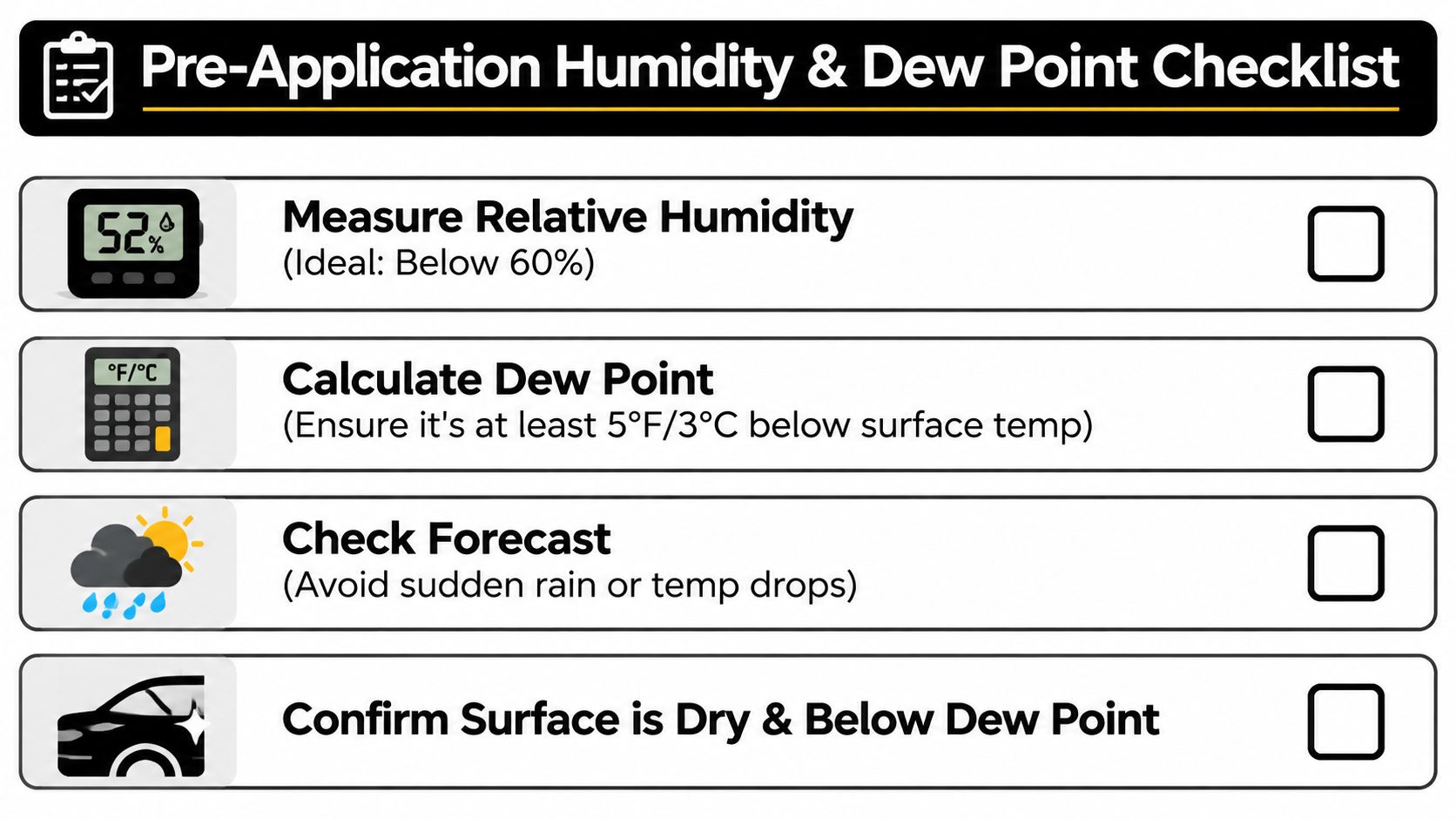
The pre-application reading sequence
Use a digital hygrometer for relative humidity and an infrared thermometer for panel temperature. Many combination weather meters also calculate dew point, but the important part is recording the readings before you start and again if the garage or weather changes.
- Measure ambient air temperature. This establishes the room or outdoor condition, but it doesn’t approve the panel by itself.
- Measure each panel surface. Check the sections you’ll coat first, then recheck surfaces that have been exposed to sun, fans, heaters, or cold air.
- Record relative humidity. Professional coating guidance commonly recommends roughly 40% to 70% relative humidity during application. Humidity guidance for ceramic coating cure time
- Calculate dew point. Confirm the surface is at least 5°F above dew point, or use the 3°C margin cited by some coating references.
- Inspect for moisture. A panel must be clean and dry. If condensation appears, stop and stabilize the environment.
High humidity can make flashing faster or uneven and can interfere with crosslinking and final hardness. Low humidity can slow the cure, while cold, damp conditions create a particularly difficult combination because the panel may remain cool as moisture stays present in the workspace.
The practical response depends on the readings. Dehumidify when moisture is the problem, warm the panel when surface temperature is too low, and postpone the job if you can’t establish a stable margin above dew point. Guidance for industrial coating applications offers useful context for why substrate conditions matter beyond the air temperature.
How Elastomer Coatings Handle Temperature Extremes
Traditional ceramic coatings cure into a hard, glass-like film. That hardness can provide a durable protective surface, but a rigid film has less ability to accommodate movement caused by repeated temperature changes, panel flex, or impact. The coating chemistry and substrate still matter, so no product should be treated as immune to poor preparation or unsuitable installation conditions.
Titan Coatings takes a different position with its Elastomer Membrane Technology. The company’s Alpha Quartz coating combines glass-like hardness with flexibility, using nano tube technology and Dark Matter tech as part of Titan’s proprietary approach. The intended benefit is straightforward: a flexible coating can move with thermal changes instead of cracking as readily as a completely rigid film.
Why flexibility matters on real vehicles
A vehicle doesn’t experience one stable temperature throughout its life. It moves from frozen winter conditions to hot summer panels, encounters vibration and panel movement, and collects road contamination. A hard, flexible membrane can offer a different trade-off from a conventional rigid coating because it aims to preserve surface hardness while allowing movement.
Alpha Quartz is positioned as an easy-to-install option for DIY users and mobile detailers. That matters when the installer doesn’t have a fully climate-controlled bay and must work in a carefully selected outdoor or sheltered environment. Flexibility doesn’t remove the need to control surface temperature, humidity, preparation, and cure conditions. It does give the installer a formulation designed around movement rather than hardness alone.
Titan Coatings’ Elastomer coating technology is particularly relevant for vehicles that face repeated changes between cold and hot conditions. The elastic structure is intended to help the coating resist cracking when temperatures change and when bugs strike the vehicle surface.
Glass protection needs its own approach
Paint coating and glass coating aren’t the same job. Windshield products need a clean, residue-free surface and moderate glass temperature, with shade preferred during installation. Titan’s Apex Glass Ceramic Coating is designed to enhance visibility by making rainwater shed more readily from the windshield, which can make wet-weather driving less stressful. See the Apex Glass Ceramic Coating for the product details.
For fast installation and practical maintenance protection, Titan’s Ultra Ceramic Spray offers a sprayable format intended to be easy to install while producing strong visual and protective results. It’s listed in the Ultra Ceramic Spray product page.
Your Temperature-Aware Application Workflow
Temperature control starts before the bottle is opened. A reliable workflow treats the vehicle as a collection of changing surfaces, not one uniform object.
Prepare the environment first
Move the vehicle into shade or a sheltered space with stable airflow. Measure ambient temperature, surface temperature, relative humidity, and dew point. If the panel is too close to the dew point or outside the product’s recommended range, correct the environment before applying product.
Wash, chemically decontaminate, mechanically decontaminate where necessary, polish if required, and complete the final panel wipe. Keep the surface dry and free from residue. Store the coating at room temperature for 24 hours before application, following the workflow guidance supplied for the product.
Adjust section size to the panel
Use a cross-hatch pattern on sections of approximately 50 × 50 cm. Apply a thin, even film rather than flooding the surface. In comfortable conditions, allow the product to flash according to its instructions, commonly around 3 to 5 minutes for the workflow described here, then inspect the reflection and wipe before the coating becomes grabby.
If the panel is warm, reduce the working area and watch the product continuously. If it’s cold, don’t assume a longer wait automatically helps. The coating may need more time, but excessive delay can leave an uneven film that becomes harder to level.
Level with two towels
Use a short-pile microfiber towel for the initial leveling pass. Follow with a clean, long-pile microfiber towel to refine the finish and remove remaining residue. Rotate towels frequently and inspect from multiple angles under strong lighting.
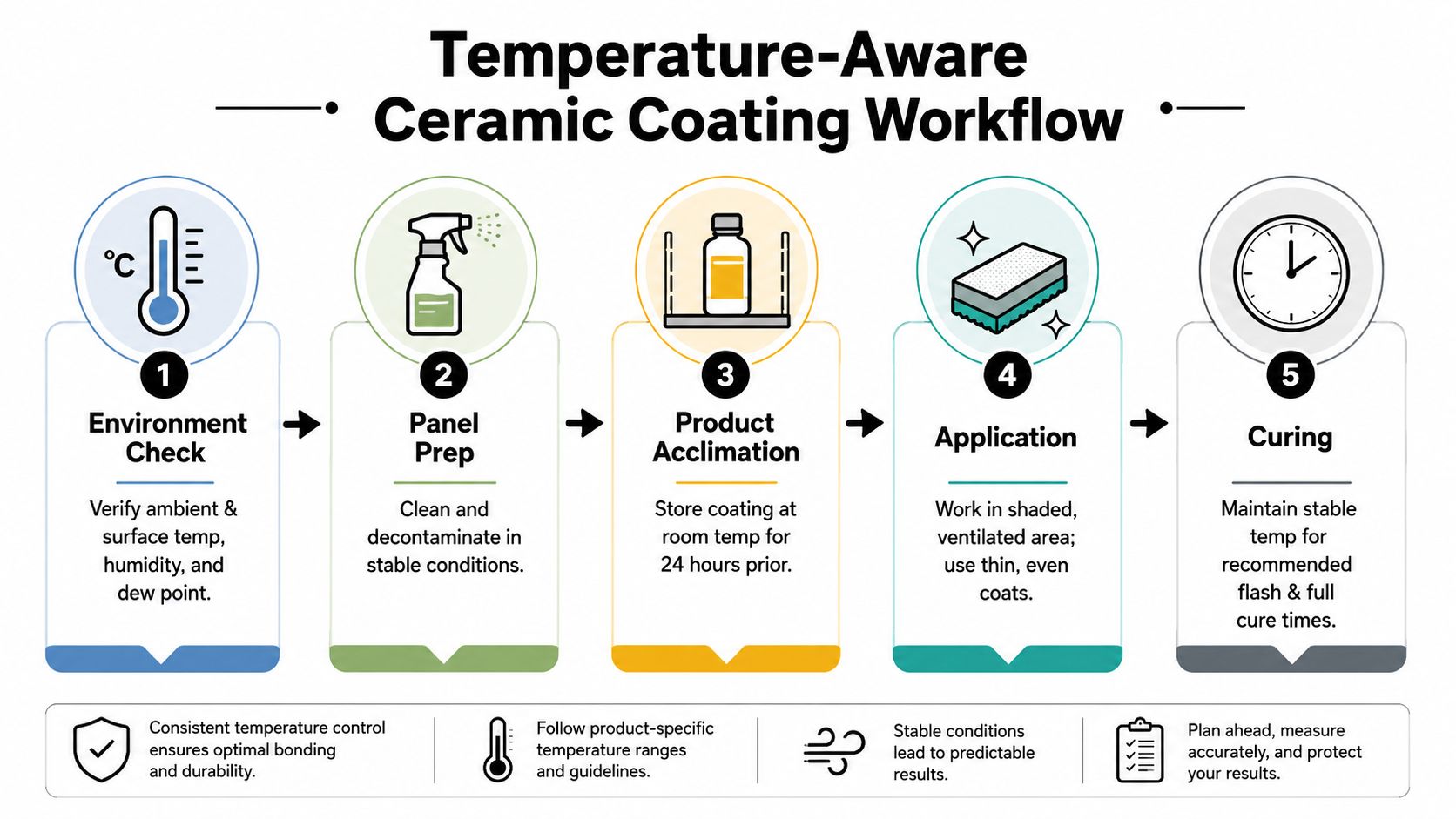
The product’s own instructions remain the authority, but Titan states that Alpha Quartz cures in 4 hours and can be applied outdoors without a garage. That makes it practical for mobile detailers and DIY users who can create a shaded, dry, controlled-enough work area. You can review the broader ceramic coating application guide before starting.
After application, shelter the vehicle for 12 to 24 hours where the product guidance calls for it. Keep moisture away during the full cure period, and don’t treat the vehicle as ready for normal exposure just because the surface feels dry.
Troubleshooting Temperature-Related Coating Problems
A high spot usually means the coating flashed before leveling. Hot panels, direct sun, and an overly heavy application shorten the working window. If the towel starts dragging or the film feels sticky, stop spreading. Check the panel and reduce the working area before continuing.
Cold-panel failures often show as streaking, slow curing, or uneven coverage. The thermometer may read acceptably while the paint remains colder, especially on metal panels exposed to shade or wind. A commonly cited minimum adhesion benchmark is 50°F, or 10°C, but the product’s instructions determine the usable range.
Humidity can cause hazing or a soft finish even when air temperature looks suitable. Compare ambient temperature with the actual panel temperature, then check relative humidity and dew point. A panel close to the dew point can collect invisible moisture, weakening bonding before the coating appears faulty.
High spots that appear quickly after application usually indicate late leveling or excess product. A uniform haze across a section points more toward moisture, cold paint, or poor flashing conditions. If the film has cured with visible high spots or uneven coverage that careful leveling cannot correct, remove it and reapply. Review this coating failure analysis before diagnosing the next job.
Do not push through unstable conditions to protect a schedule. Waiting costs less than correcting a failed coating.
APEX NANO – Titan Coatings includes Alpha Quartz elastomer coating, Apex Glass for windshield visibility in rain, and Ultra Ceramic Spray for straightforward application. Review the product shop for available options, then match the product to the workspace and cure conditions.
0 Comments