
A freshly rebuilt weekend car can look perfect in the garage and tired six months later on the road. The paint near the bay loses its crispness, the exhaust finish turns dull, and the parts you were proud to show off start telling a different story.
Heat did that. Not one dramatic event, but repeated cycles of hot, cool, wet, and hot again.
The Hidden Enemy of Automotive Passion
A lot of enthusiasts learn the hard lesson after the fun part is over. The polishing is done, the engine bay is tidy, the trim is restored, and the first long drive feels like a victory lap. Then the heat starts collecting its debt.
The first signs are subtle. An exhaust component loses color uniformity. A bracket near the turbo starts showing oxidation. A coating that looked solid during install begins to chalk, harden, or flake at the edge. Most owners blame age, road grime, or bad luck. In practice, repeated thermal stress is usually the saboteur.
Heat attacks more than one surface
Automotive heat doesn’t stay in one place. It radiates, cycles, and moves through neighboring materials. That means one weak coating decision on a hot part can create problems around it.
- Exhaust sections pick up the obvious punishment. They face direct heat and corrosive gases.
- Turbo hardware sees rapid expansion and contraction, which exposes brittle films fast.
- Engine bay components live in a less dramatic, but still punishing, environment of constant temperature variation.
- Nearby finishes suffer from the knock-on effect when heat and oxidation aren’t controlled.
That’s why a heat resistant coating shouldn’t be treated like a cosmetic extra. It’s part of the durability system of the vehicle.
Why enthusiasts get caught off guard
Many people still choose coatings the way they choose waxes or dressings. They look at gloss, ease of use, or the promise on the label. High-heat parts don’t care about that marketing language. They care about adhesion under stress, resistance to embrittlement, and whether the film can survive thermal cycling without giving up.
A coating can look excellent on day one and still be the wrong material for the job.
That gap between appearance and performance is where frustration begins. The owner thinks the part was protected. The part was only decorated.
A good build deserves better than a brittle shell that fails when temperatures swing from cold mornings to a fully heated engine bay. The objective is not solely to preserve appearance. It’s to keep the substrate stable, protected, and serviceable for longer, even when the car is driven the way it was meant to be driven.
Understanding How Heat Resistant Coatings Work
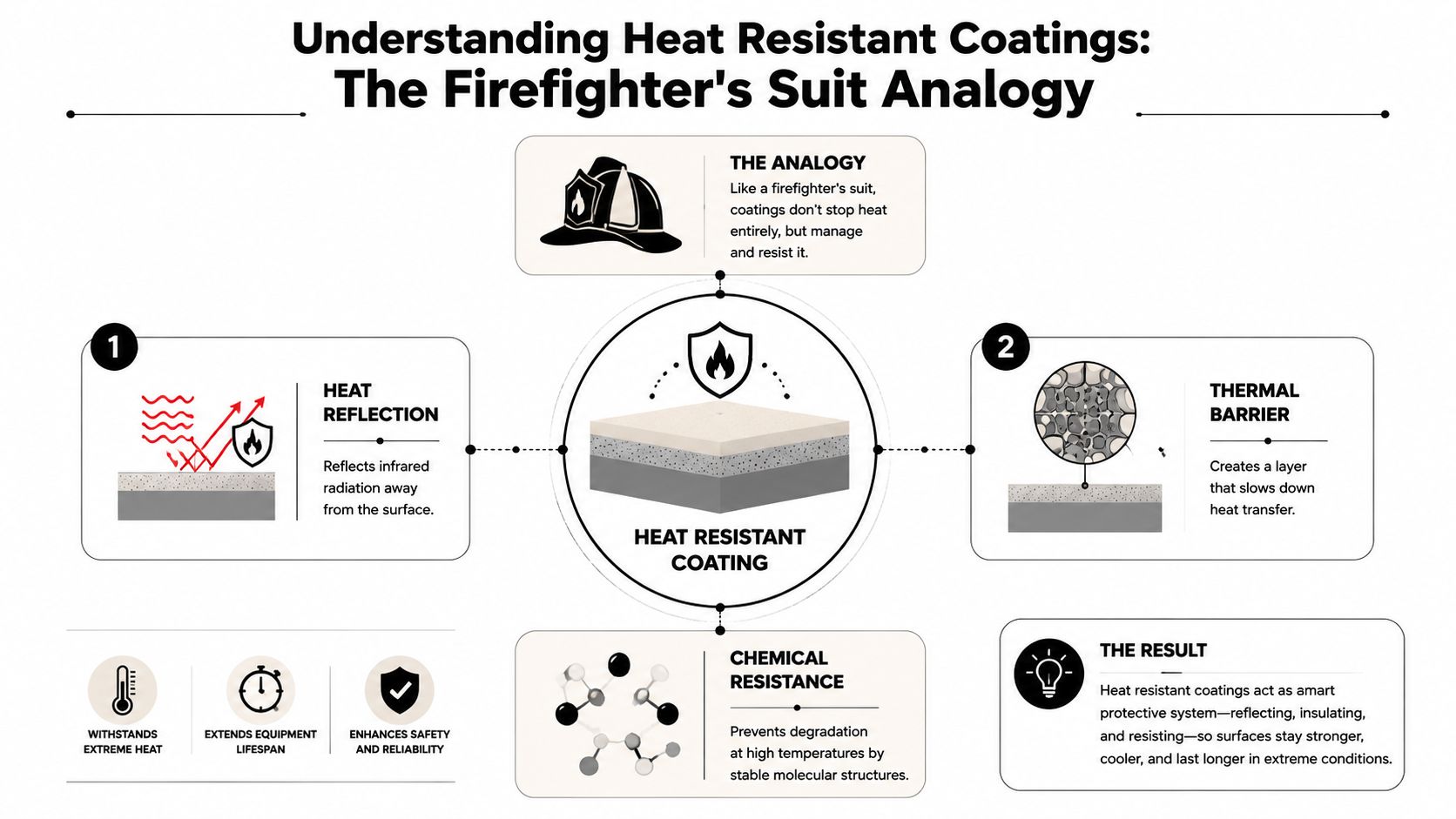
Many individuals misunderstand what a heat resistant coating does. They expect it to cool the part. That’s the wrong model.
Consider a firefighter’s suit. The suit doesn’t make the fire colder. It creates a protective barrier that helps the person survive exposure. A heat resistant coating works the same way. Its main job is to stop heat from damaging the material underneath.
Protection first, cooling second
That distinction matters because a lot of buyers use the wrong product for the wrong expectation. As explained in this breakdown of heat-resistant paint versus reflective paint, most heat-resistant coatings don’t primarily lower operating temperature. They protect the substrate by resisting thermal damage, oxidation, and structural breakdown.
So if someone applies a conventional high-heat coating to an exhaust manifold and expects lower engine bay temperature, disappointment follows. If they apply it to preserve the metal and keep the part from degrading, that expectation is aligned with reality.
Practical rule: Buy thermal protection for durability. Buy reflective or insulating systems when your real target is heat reduction.
What the coating is fighting
Heat exposure creates several failure paths at once:
- Oxidation begins attacking exposed metal when protective films break down.
- Thermal cycling expands and contracts both the metal and the coating.
- Moisture intrusion enters damaged areas and accelerates corrosion.
- Adhesion loss starts at the weakest interface, usually poor prep or the wrong chemistry.
That’s why high-temperature performance isn’t only about surviving one hot moment. It’s about staying bonded and intact after repeated cycles.
Why chemistry matters
At the molecular level, high-performance systems survive because their structure remains stable when ordinary resins begin to fail. Silicone-based systems are a clear example. Their backbone chemistry is far more thermally stable than lower-tier resin systems, which helps the coating hold together under severe temperature changes instead of turning brittle and letting go.
For vehicle owners thinking beyond engine parts, the same logic applies across the car. Barrier performance, environmental resistance, and long-term surface survival all depend on matching chemistry to exposure. That’s also why broad protection strategies matter, not just hot-zone protection. Titan discusses that wider surface approach on its vehicle paint coating page.
A good coating doesn’t perform magic. It performs materials science. And in harsh automotive service, that’s what keeps passion projects from aging before their time.
A Guide to Traditional Heat Coating Technologies
Traditional high-heat products fall into a few familiar buckets. Some are useful within a narrow range. Some are badly misapplied because users assume all “high-temp” labels mean the same thing. They don’t.
The main dividing line is resin chemistry. If the chemistry can’t tolerate the temperature window and the expansion behavior of the part, failure is only a matter of time.
Where common systems work and where they fail
The clearest benchmark comes from KTA’s overview of high-temperature coating limits and application requirements. It notes that novolac epoxies are typically limited to 350–360°F (177–182°C), while high-performance silicone systems can sustain continuous temperatures up to 800°F (427°C) and intermittent temperatures reaching 1,200°F (650°C).
That single comparison explains a lot of field failures. A novolac epoxy may hold up in a moderate industrial environment, but it’s the wrong choice for parts that live in the heat range of exhaust components. Once pushed beyond its limit, embrittlement takes over and protection falls apart quickly.
Traditional options side by side
| Coating type | Where it fits | Main advantage | Main weakness |
|---|---|---|---|
| Novolac epoxy | Lower-heat components | Solid chemical resistance in the right window | Temperature ceiling is too low for many exhaust-side parts |
| High-performance silicone | Exhausts, manifolds, hot industrial metal | Much stronger heat tolerance | Can still become less forgiving under repeated expansion stress depending on formulation |
| Standard ceramic-style films | Surface protection and appearance-focused applications | Hard shell and good surface behavior | Hardness alone doesn’t guarantee survival under aggressive thermal cycling |
The brittleness problem
Hardness gets oversold. In practice, hard but brittle is a dangerous combination on hot automotive metal.
A manifold, turbo housing, or nearby bracket doesn’t sit still. It grows with heat and contracts as it cools. If the coating can’t move with it, microscopic fracture lines start early. Those cracks invite moisture, oxidation, and eventual edge failure.
That’s why many “traditional” systems do fine on paper and disappoint on the car. They can survive heat in a static sense, but they struggle with movement.
- Good on a spec sheet doesn’t always mean good on a driven vehicle.
- Dry hardness isn’t the same as dynamic durability.
- Heat rating alone won’t save a coating that can’t tolerate repeated expansion and contraction.
Surface prep is part of the technology
Even the best conventional chemistry can fail if the surface isn’t prepared correctly. Extreme-temperature coatings need a properly cleaned and profiled substrate. On critical parts, poor prep creates a weak interface that heat will expose quickly.
For automotive users comparing options, this is the practical takeaway. Traditional technologies still have a place, especially when the part’s temperature and service conditions match the chemistry. But once thermal cycling becomes aggressive, conventional systems start showing their age. Titan’s own high temperature ceramic coatings speak to that category, but the bigger shift comes when you move beyond brittle protection and start thinking in terms of flexible high-performance films.
The Titan Revolution Elastomer and Dark Matter Tech
The turning point in coating design came when formulators stopped treating hardness as the only prize. A hard shell is useful. A hard shell that can flex without cracking is a different class of protection.
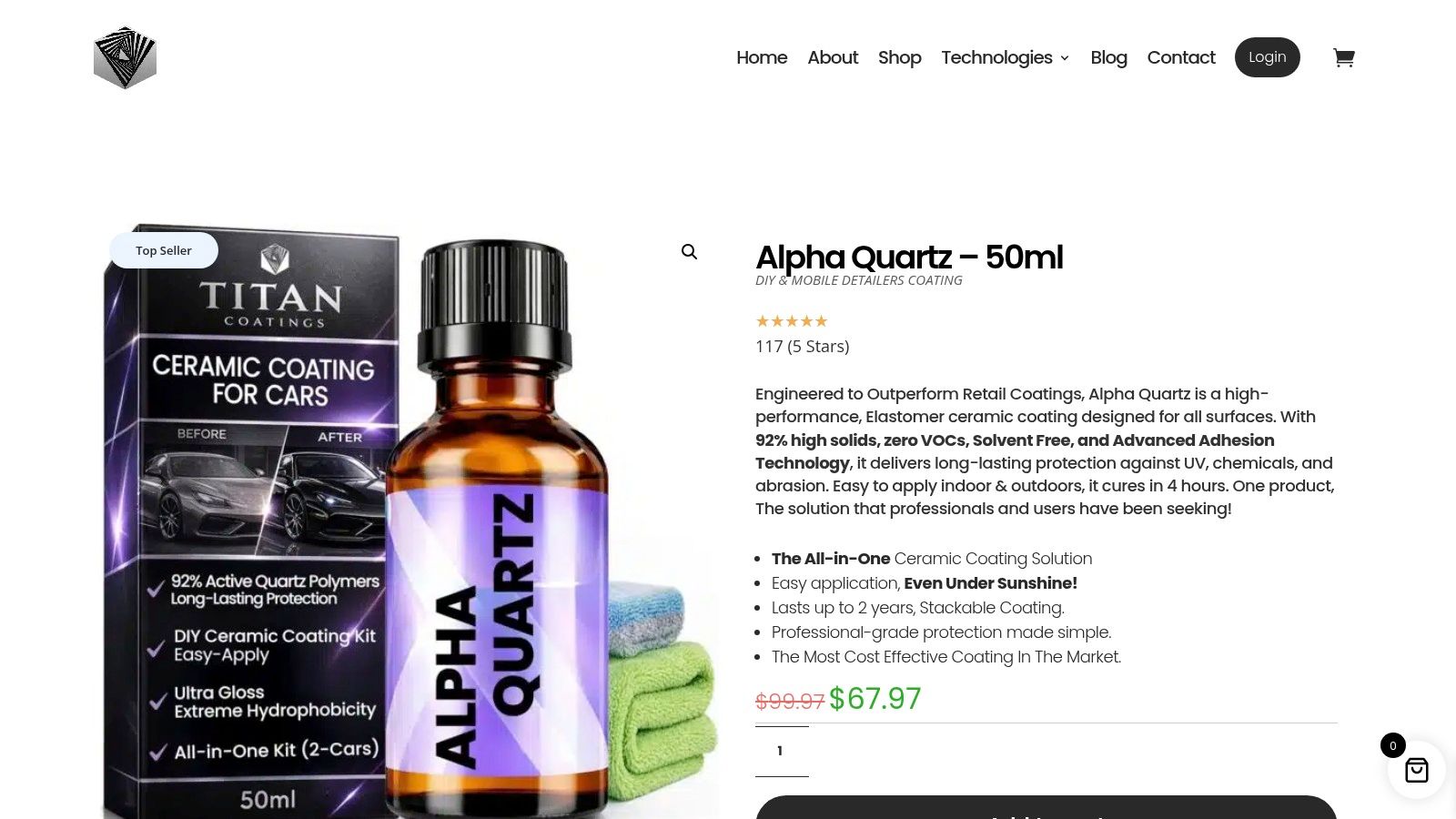
That’s where Titan changed the conversation. According to Titan’s own technology overview on nano ceramic coating development, Titan Coatings is the first company to introduce elastomer coatings to the market using nano-tube technology and proprietary Dark Matter Technology®, creating a coating that is hard like glass yet retains flexibility to prevent cracking under extreme thermal stress.
Why elastomers change the outcome
A traditional brittle coating behaves like a thin cracker on moving metal. It might look rigid and strong, but once the substrate shifts enough times, it fractures. An elastomer behaves more like reinforced athletic fabric coated with glass-like armor. It keeps surface toughness, but it also stretches and recovers with the substrate instead of splitting apart.
That matters in cars because temperature swings are relentless. A vehicle can move from frozen ambient conditions to a fully heat-soaked engine bay, then cool again, over and over. The coating has to survive movement, not just temperature.
The win isn’t just surviving heat. The win is surviving heat while staying bonded.
What nano-tubes and Dark Matter Technology bring to the film
Nano-tube technology helps create a more advanced structural network in the coating. Dark Matter Technology® is part of the proprietary design language behind that performance. In practice, the result is a protective membrane that doesn’t force the old trade-off between hardness and flexibility.
That’s the piece many older systems never solved well. They gave you one or the other. Strong but crack-prone. Tough-looking but short-lived. Flexible but not durable enough on the surface. Titan’s elastomer approach was built to remove that compromise.
Alpha Quartz as a practical example
For installers and DIY users, Alpha Quartz is the kind of product that makes this shift tangible. It’s easy to install, which matters more than some brands admit. A coating that performs well in the lab but punishes the installer with a narrow process window creates avoidable failures in the field.
Alpha Quartz fits the needs of mobile detailers and hands-on owners because the application feels manageable while the underlying film is engineered for abuse. It’s particularly relevant when the vehicle sees real temperature swings and real road impact, including the kind of day-to-day hits that expose brittle chemistry.
Titan also details its broader elastomer platform on the Titan Coatings elastomer page. The central idea is simple. If the part moves, the coating must move with it. If it can’t, longevity is mostly an illusion.
Choosing the Right Coating for Your Automotive Parts
The wrong coating choice usually looks fine on day one. The failure shows up later, after enough heat cycles, vibration, road grime, and wash chemistry expose the weak point. That is why part selection matters more than label claims.
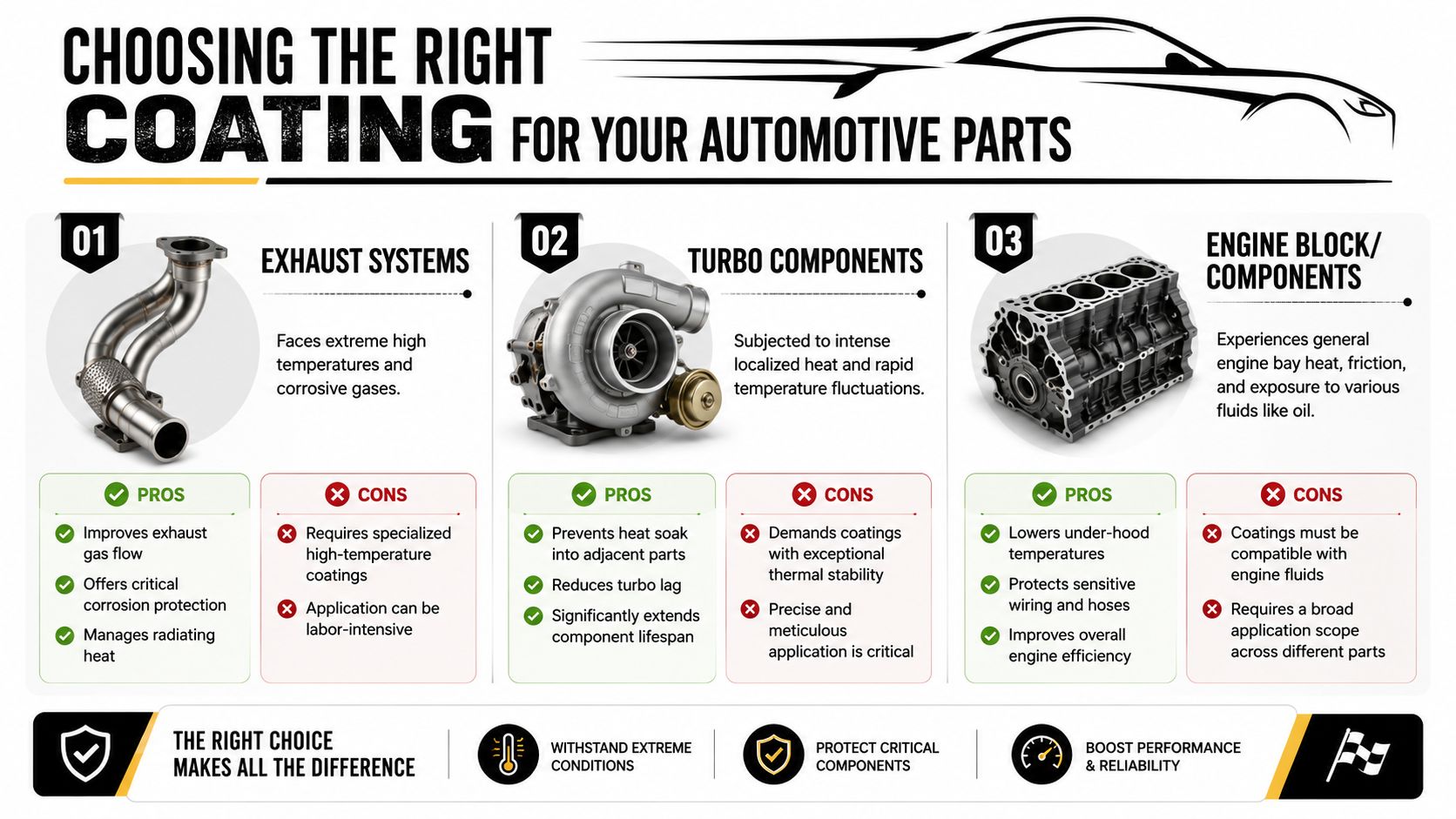
A turbo housing, a windshield, and an engine cover do not stress a coating in the same way. One part sees concentrated thermal shock. Another needs optical clarity and water behavior. Another lives in a zone full of heat soak, fluids, and constant vibration. Start with the service environment, then match the coating chemistry to it.
Exhaust systems and turbo components
These parts punish brittle films.
Exhaust sections deal with sustained heat, moisture, road salt, and corrosive byproducts. Turbo components add sharper thermal cycling and more aggressive localized expansion. A coating that acts like a rigid shell can become its own failure point. Small fractures turn into pathways for oxidation, staining, and film loss.
For those conditions, flexibility is not a cosmetic benefit. It is a durability mechanism. Titan’s FAQ explains that elastomer-based ceramic coatings combine hardness with flexibility, which helps the film stay intact as the metal expands and contracts.
Engine bay parts and trim-adjacent surfaces
Engine blocks, covers, brackets, and nearby hardware usually run cooler than exhaust-side parts, but the job is not easier. These surfaces face vibration, splash exposure, oily residue, cleaners, and repeated temperature swings. The best choice often comes down to which failure you are trying to avoid first. Loss of adhesion, chemical staining, or brittle surface fatigue.
Use a simple filter:
- For repeated heat cycling, choose a coating that keeps adhesion and elasticity instead of chasing surface hardness alone.
- For mixed heat and contamination, use a film that resists chemicals and cleans up without turning dry and fragile.
- For visible parts, treat appearance as a secondary benefit. A coating that keeps its structure will usually keep its finish longer too.
That trade-off matters. A glossy coating that cannot move with the substrate behaves like dry paint on a flexing bumper. It may look sharp at first, then fail at the exact moment the part asks it to work.
Glass and daily-use surfaces
Heat management is only part of vehicle protection. Driver visibility affects real-world performance every time weather turns bad.
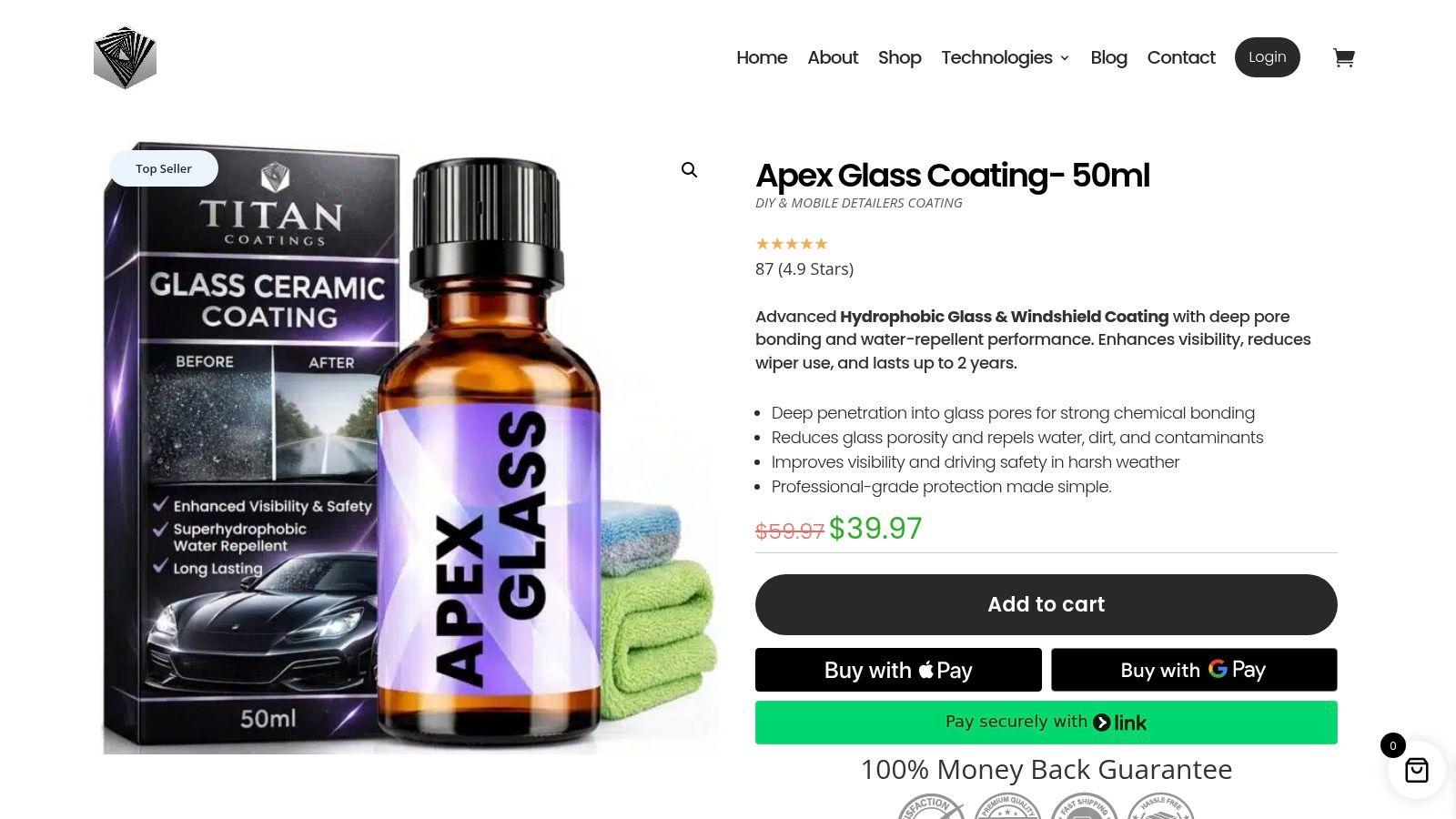
Titan’s Apex Glass Ceramic Coating fits that role because it improves water behavior on glass without turning application into a complicated process. The Apex Glass Ceramic Coating product page shows how that type of protection fits into a broader coating strategy for vehicles that see regular road use.
Fast application options
Some jobs call for a full coating install. Others call for speed, consistency, and easy maintenance.
Titan’s Ultra Ceramic Spray gives detailers and hands-on owners a faster option for daily-use surfaces. It works well where convenience matters, but the decision should still follow exposure level. Use the highest-performance chemistry on the parts that absorb the most abuse.
Choose the coating by failure mode. Heat, flex, chemicals, and visibility each demand a different answer.
The best coating plan is rarely one product across the whole vehicle. It is a matched system, with flexible high-durability chemistry on parts that move and cycle hard, and simpler protection where the load is lower. That shift in thinking is what separates old brittle coating logic from the next generation of automotive heat management.
Best Practices for Application and Long-Term Durability
The coating gets the attention, but prep determines whether the coating gets a fair chance. Most premature failures start before the first layer is ever applied.
On extreme-temperature parts, surface preparation isn’t optional. KTA notes that a near-white metal surface standard known as SSPC-SP10 is a prerequisite for extreme temperature coatings, with a minimum dry film thickness of 2 mils often recommended to maintain barrier integrity against thermal shock. That requirement was covered earlier because it belongs with traditional high-heat systems, but the principle carries across any serious heat resistant coating job. Clean substrate. Stable profile. Correct film build.
The process that actually holds up
Start by deciding whether the part needs stripping, decontamination, abrasion, or all three. Heat-exposed metal usually carries residues that interfere with bonding, even when it looks clean.
Then work in order:
- Strip the weakness first. Remove old failing films, oxidation, and contaminants instead of trying to bury them.
- Match prep to the substrate. Bare metal, painted panels, glass, and trim each need a different approach.
- Control the application. Even easy-to-use products still reward careful leveling, correct wipe technique, and proper cure discipline.
For users who want a stronger process foundation, Titan’s guide to coating surface preparation is a useful practical reference.
Why easy products still need discipline
Alpha Quartz stands out because it’s approachable for DIY users and mobile detailers. That doesn’t mean careless application works. It means the product is more forgiving while still delivering serious results. That’s an important difference.
Ultra Ceramic Spray fits another real-world need. Quick installs matter in busy shops and for owners maintaining multiple vehicles. Easy application, though, should never be confused with low standards. Wash quality, panel condition, and cure handling still decide how long the coating remains effective.
- For DIY users, work on a fully prepared surface and don’t rush the wipe.
- For mobile detailers, control lighting and contamination because field installs expose mistakes fast.
- For hot-zone parts, confirm the product is intended for that service environment instead of assuming all ceramics are interchangeable.
Good coatings fail when rushed. Average coatings fail even faster.
Long-term durability comes from three things working together. Correct chemistry, correct prep, and correct installation. Leave out one, and the part will tell you sooner than you want.
Beyond Heat Complete Protection for Your Vehicle
The best protection strategy doesn’t stop at the engine bay. A vehicle asks for different kinds of defense in different places. Heat matters. So do visibility, weather exposure, road grime, and day-to-day usability.
That broader view is where Titan’s lineup makes sense. The same material mindset that pushes beyond brittle coatings also shows up in glass care. Apex Glass Ceramic Coating is a good example because it addresses a problem every driver understands immediately. In the rain, clear glass changes stress levels behind the wheel.
For paint and exterior surfaces, the same idea applies. Protection should survive real use, not just look good after application. Titan’s automotive paint protection coating range reflects that full-vehicle perspective.
A modern heat resistant coating should do more than survive a spec sheet. It should stay intact through use, movement, weather, and time. That’s why the shift from brittle legacy films to flexible elastomer technology matters. Hard like glass is valuable. Hard like glass and flexible enough not to crack is the future.
If you want coating technology built around durability instead of shortcuts, explore APEX NANO – Titan Coatings. You can also browse the full Titan Coatings shop for solutions like Alpha Quartz, Apex Glass Ceramic Coating, and Ultra Ceramic Spray that fit both professional installers and serious DIY users.
0 Comments