
The first clue usually isn’t in the coating booth. It’s the customer leaning into the bay, taking a breath, and asking why the shop smells different. That moment tells you a low VOC coating isn’t just a regulatory box to check, it’s part of how modern detailing feels to the person paying for the job.
In a working shop, odor, overspray control, cure behavior, and cleanup matter just as much as gloss. That’s why low-emission systems have moved from niche to normal across coatings, and why detailers now think about air quality, layering, and application conditions before they think about marketing terms. If a customer is also trying to make a garage safer or simpler to live with, a practical indoor-air resource like safer indoor air quality guide is worth keeping in mind alongside your coating choices.
A detailer who works in tight garages or on driveways feels the shift most sharply. Less smell, more controlled curing, and fewer ventilation headaches can make the difference between a coating job that’s easy to repeat and one that gets skipped because the environment fights back. Titan also frames this around sustainable application choices on its sustainable coating page, which fits the same real-world pressure shops are under.
Why Every Detailer Is Hearing About Low VOC Coating
The conversation usually starts with a customer noticing the air, then quickly turns into a practical question about durability. That’s the primary reason low VOC coating is showing up in detailing bays, mobile rigs, and prep shops. It’s not only about being cleaner on paper, it’s about matching product chemistry to the way shops function.
Regulation changed the baseline
The modern low-VOC market grew out of U.S. air-quality regulation in the 1960s and 1970s. Los Angeles adopted Rule 66 in 1966 to limit VOCs in coatings and solvents, the federal Clean Air Act followed in 1970, and the 1990 Clean Air Act Amendments added 189 listed toxins for reduction. By the 1990s, the industry had already shifted away from conventional coatings often above 6 pounds of VOC per gallon toward much lower levels, and the EPA’s early target was 3.5 pounds per gallon. That regulatory path created the technical and commercial basis for low-VOC products that are now standard across architectural, industrial, and automotive coatings markets (historical overview).
Detailers feel that legacy indirectly. Product labels, local rules, and shop ventilation needs all trace back to that same pressure. A mobile operator working in a residential garage or at a client’s driveway doesn’t need a lecture on policy, they need a product that behaves predictably in constrained spaces.
Shops are now judged by more than gloss
Practical rule: if a coating makes the shop smell harsh enough that customers complain, the chemistry is already creating friction before the car even leaves.
That’s why low-emission products now sit at the center of shop workflow. They can reduce odor burden, fit stricter indoor requirements, and make it easier to work around neighbors, tenants, and building rules. In places where detailers share space with body shops or storage units, lower-emission systems can also make scheduling less difficult.
Mobile detailers get the same benefit with less infrastructure. A coating that applies cleanly with controlled flash, low odor, and a manageable cure window is easier to use outside a climate-controlled booth. That’s where the value shows up, not in slogans.
What Low VOC Actually Means in Numbers
A label that says VOC is pointing to volatile organic compounds, and on a data sheet the figure usually appears as grams per liter. In shop terms, that number tells you how much volatile material is in the coating. Regulators use it as a hard threshold because it is measurable, enforceable, and easier to compare than a marketing phrase. Under federal U.S. architectural-coating limits, flat coatings are capped at 50 g/L VOC, nonflat coatings at 100 g/L, and nonflat high-gloss coatings at 150 g/L, which shows that “low VOC” is a regulated threshold rather than a brand promise (EPA category caps).
Read the label like a specifier
A detailer does not need to become a chemist, but the label should be read like a spec sheet. Low VOC usually sits around 50 g/L or less, while zero VOC is often defined as under 5 g/L. Those terms are not interchangeable, and a product that qualifies in one market may fail in another because local rules can be stricter or built around a different test method (VOC definition guidance).
The safest habit is to compare the actual VOC number, the product class, and the intended use case. A flat coating limit does not tell you how a spray sealant will behave on a black hood, and a “zero VOC” claim does not tell you whether the coating can still wet out properly, level, and cure without defects. For that kind of check, coating testing standards and application data matter more than the label.
One number does not tell the whole story
A low number helps, but it does not guarantee easy application or low odor after cure.
That matters because coating categories are not all treated the same. Industrial maintenance coatings can live under much higher limits than architectural paints, and that difference changes how you compare products across use cases. For detailers, the practical rule is simple. If the product does not clearly state its VOC, solids, and recommended film build, do not guess.
The right way to shop is to ask three questions. What is the VOC number. What application category does it belong to. What film thickness does the maker expect you to lay down. Without those answers, “low VOC” can become a loose promise instead of a usable specification.
The Chemistry Behind a Durable Low VOC Coating
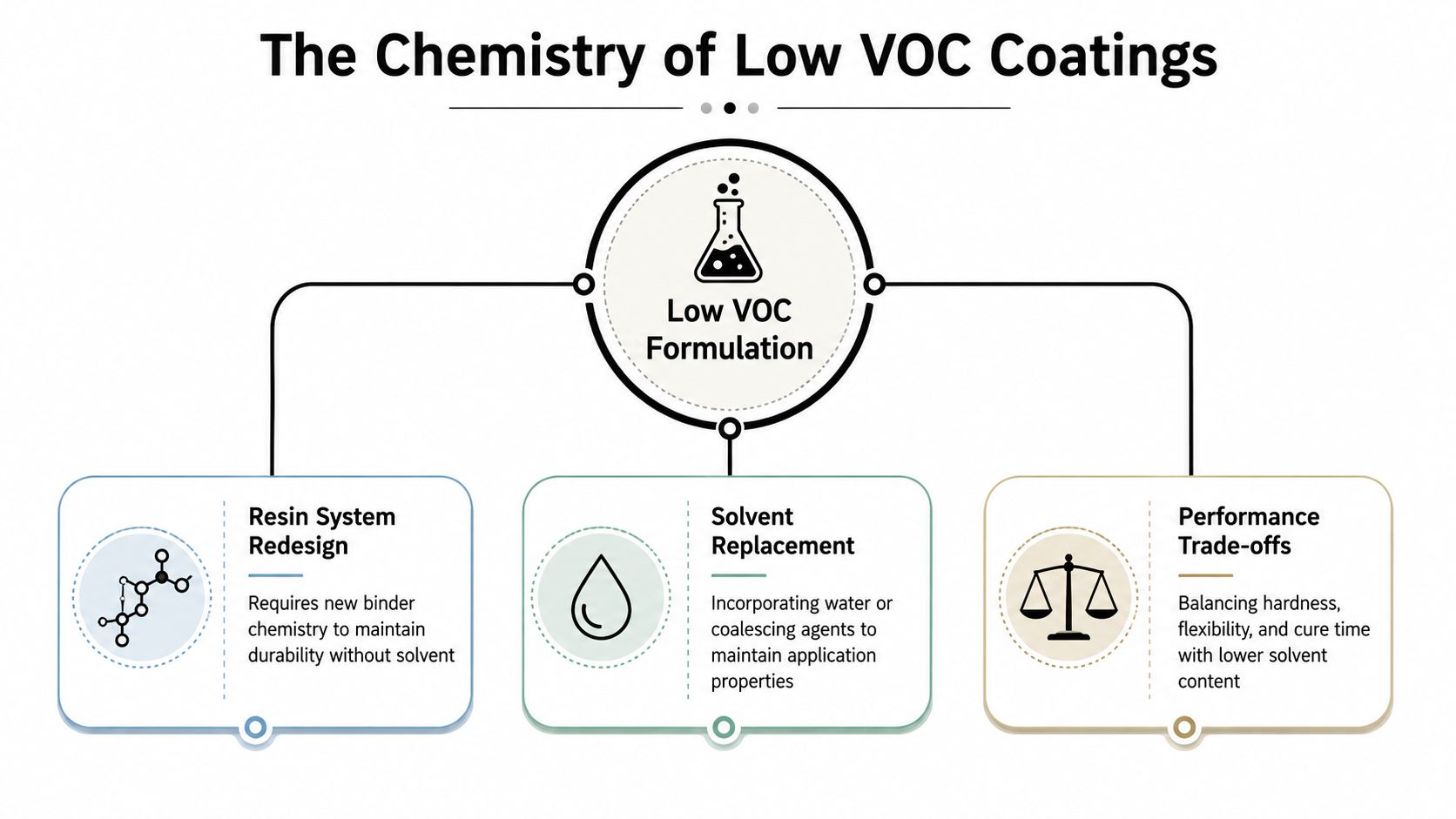
Dropping VOC isn’t just a matter of swapping one solvent for another. Once you push the number down, the formulator has to redesign the binder system, manage solids content, and protect the coating’s ability to flow, wet, cure, and resist abrasion. That’s why the hardest formulations often move toward waterborne, high-solids epoxy, polyurethane, or elastomer chemistries instead of simple solvent replacement.
Solids, film build, and cure have to move together
Independent and industry technical sheets show how tightly chemistry and application are linked. Sherwin-Williams lists an epoxy protective coating at <100 g/L VOC, while Axalta’s NasonXL automotive low-VOC basecoat is 420 g/L VOC with a 10 to 25 micron recommended film thickness and about 13% average volume solids (Sherwin-Williams technical listing). That spread tells you something important. Lower VOC usually means the system is being redesigned, not merely diluted.
The practical consequence is that spray setup matters more, not less. If the product expects a thin film, then heavy passes can trap material and hurt cure. If the product relies on higher solids to build protection, then you need a technique that lays the right film without starving the surface.
Layer-specific compliance is common
For industrial maintenance coatings, one EPA-oriented low-VOC system documented by DTIC specifies spot primer at 300 g/L max, barrier coat at 50 g/L max, and polyurethane topcoat at 50 g/L max (DTIC document). That’s a useful reminder that compliance often happens layer by layer, not as one single number for the whole stack.
For detailers, low-VOC success gets won or lost. The primer may need to wet out a difficult substrate, while the topcoat can stay extremely low in VOC and still provide the finish. If the shop ignores that structure, the result is usually underbuild, poor leveling, or a cure issue that shows up later as reduced durability.
Elastomer Low VOC Systems vs Traditional Ceramic Coatings
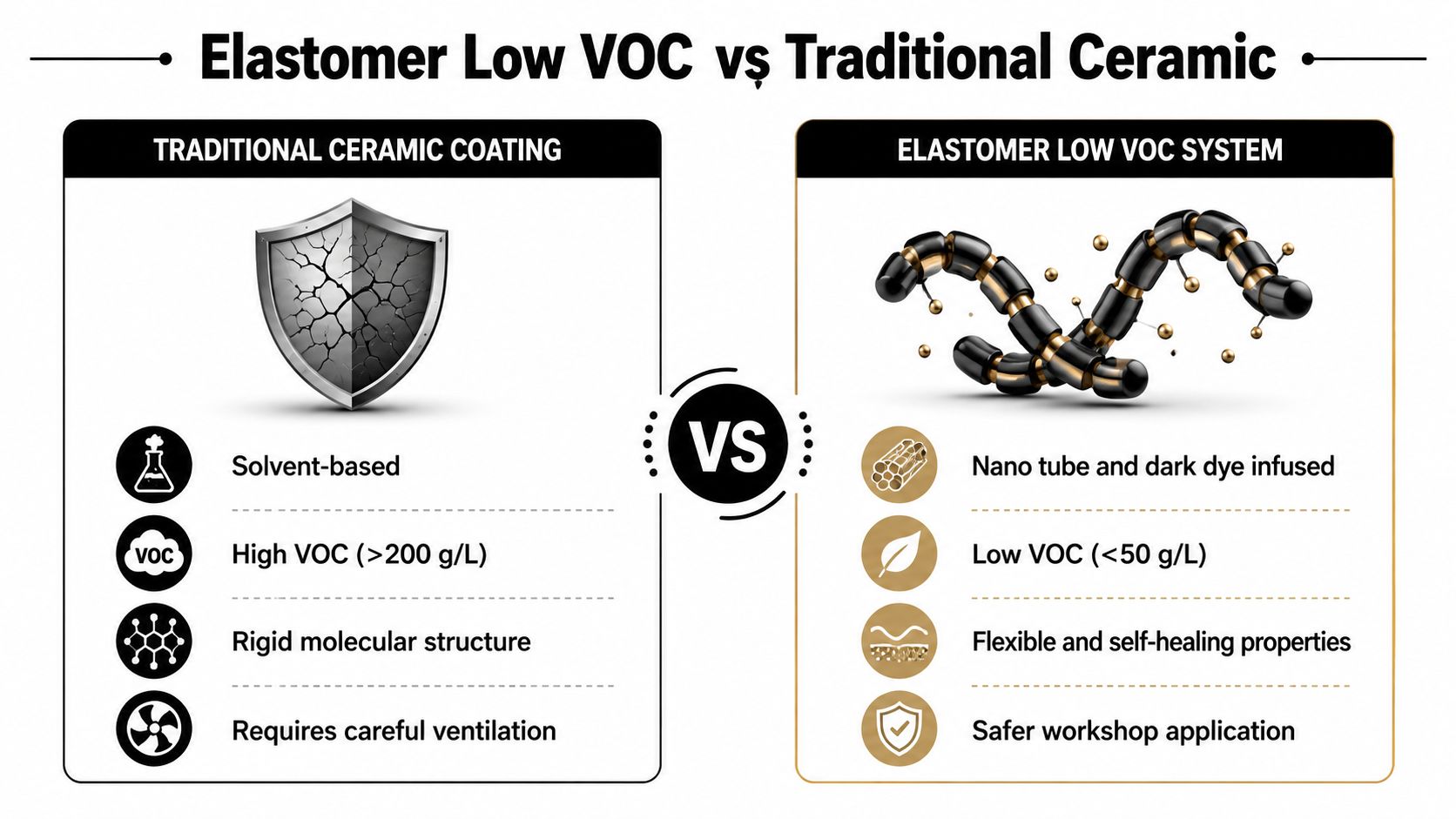
The biggest mistake in coating selection is assuming all protection works the same way. Traditional ceramic coatings get their reputation from a rigid, glass-like structure, while elastomer systems are built to stay hard and flexible at the same time. That difference matters when a panel flexes, a temperature swing hits overnight, or the car lives outside instead of under perfect shop conditions.
Rigid chemistry versus flexible behavior
Classic ceramic systems can deliver a hard surface, but hardness alone doesn’t solve every real-world problem. Panels move, plastic trim shifts, and thermal changes put stress into the coating film. When that film is too rigid, tiny failures can start at stress points and spread over time.
Elastomer coatings take a different path. Titan positions its elastomer technology around nano tubes and Dark Matter tech, with the idea that a coating can stay protective while still flexing with the surface. Titan’s eco-friendly coating page sits in that same conversation, because the useful comparison for shops isn’t just gloss, it’s how the coating survives real use.
Why flexibility matters in the field
A flexible film can absorb stress better than a brittle one, especially on vehicles that see freeze-and-thaw cycles, hot panels, road vibration, and the occasional stone strike. That doesn’t mean every flexible coating is automatically superior. It means the product has to fit the job.
For shop owners, the selection question is straightforward.
- Daily-driven street cars: choose a system that tolerates panel movement and seasonal temperature swings.
- Mobile work: choose chemistry that installs cleanly without demanding perfect booth conditions.
- Long-service paint protection: choose a coating stack that resists micro-cracking instead of just chasing surface hardness.
Hard isn’t enough if the film can’t move with the panel.
That’s why an elastomer low-VOC system can make sense where a rigid coating struggles. The right product stays bonded, keeps its finish, and doesn’t punish the user every time the weather changes. In that sense, flexibility is not a softness problem, it’s a durability strategy.
Applying a Low VOC Coating in a Real Shop Workflow
A low-VOC job still lives or dies on prep. If the surface is contaminated, the coating doesn’t care how good the chemistry is. The workflow starts with decontamination, correction if needed, and a thorough panel wipe so the coating bonds to paint instead of residue.
A practical stack that makes sense in the bay
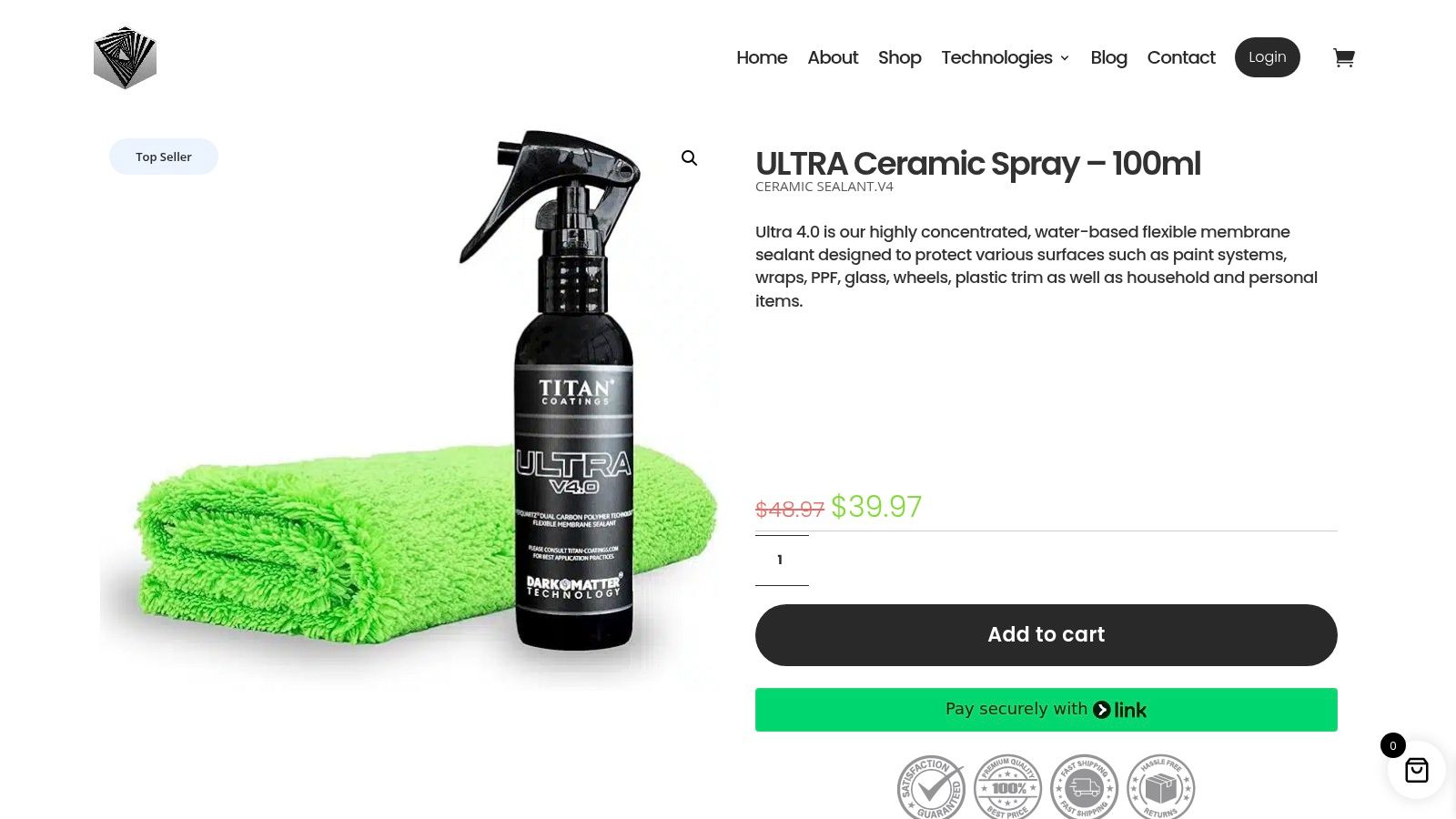
For a controlled base layer, Alpha Quartz is the kind of system that fits mobile detailers and DIY users who want a lower-emission approach without overcomplicating the process. For maintenance, Ultra Ceramic Spray can work as a lighter topper or upkeep layer when a shop wants a fast, manageable finish. Titan’s car-application guidance is useful context here, especially if you’re thinking about how a low-VOC stack goes onto real paint rather than test panels (application guidance).
The order matters. A base layer goes on clean, thin, and evenly. A spray topper goes on as maintenance support, not as a substitute for bad prep. If you skip correction on a compromised surface, the coating will preserve the flaw just as faithfully as it preserves the gloss.
Why low odor helps mobile work
A lower-emission system can make outdoor and mobile application more realistic. That matters for customers who don’t have a dedicated garage and for shops that work in buildings with tighter ventilation rules. It also helps with customer trust, because the car can go home without the heavy lingering smell that often makes people second-guess what was just applied.
Shop rule: if the product is easy to install but unforgiving about prep, treat it like a precision tool, not a shortcut.
The most reliable result comes from matching flash time, film thickness, and cleanup to the specific coating. That’s the core job, not just spraying something that says “eco” on the bottle.
Windshield and Glass in the Low VOC Stack
Glass is where drivers notice the coating every time it rains. It’s also where a lot of detailers leave value on the table. A windshield coating that beads water, sheds road grime, and helps the wipers do less work changes the day-to-day experience more than many owners expect.
Visibility is a safety and comfort issue
Titan’s windshield coating is the kind of product that fits this role because glass is not an afterthought in a complete coating stack. If the paint is protected but the windshield still smears in rain, the car is only half-finished from the driver’s point of view. Pairing a paint system with a glass layer gives the customer a clearer, calmer drive in bad weather.
That’s especially useful in year-round use. Rain, dust, bugs, and frost all hit the windshield first, and the driver feels every bit of it. A well-chosen glass coating can reduce the need for constant wiper use and make highway travel less stressful when visibility turns inconsistent.
Glass belongs in the same buying decision
For shops, the practical question is not whether glass coatings look nice in a demo. It’s whether the chemistry layers cleanly with the rest of the stack. A well-designed low-VOC glass coating can sit alongside an elastomer paint system without creating a compatibility headache, which keeps the workflow simple.
Titan’s Apex Glass ceramic coating and Alpha Quartz make sense as a paired example because one addresses visibility and the other addresses paint protection. If the customer drives in rain, commutes at night, or regularly parks outside, that pairing solves a real problem. It’s a complete system, not a cosmetic add-on.
Common Myths About Low VOC and Eco-Friendly Coatings
The first myth is that low VOC automatically means low emissions after application. Shop reality is messier than the label suggests. Independent research found that even low- or zero-VOC paints can still emit VOCs similar to regular paints and may also release other problematic compounds such as SVOCs, so the product name alone does not tell you the full exposure picture (study on emissions).
Water-based doesn’t guarantee gentle chemistry
The second myth is that water-based equals safe. Research on water-based coatings has shown that formulation details can outweigh the fact that water is the carrier, and some acrylate-modified polyurethane systems still give off toxicologically relevant VOCs at levels that matter in real use. That does not make waterborne chemistry the wrong choice. It means the binder system, cure package, and additive load deserve more attention than the marketing language.
The third myth is that eco-friendly coatings must be weak. Product development does not work that way. The hard part is keeping hardness, flexibility, stain resistance, blocking resistance, lap resistance, corrosion resistance, and appearance while moving down the VOC ladder. If a coating looks cleaner on paper but fails in service, the customer pays for reset time, extra prep, and lost confidence.
What to check before you buy
Before you put a product on a customer car, check the parts of the data sheet that affect how it behaves in the shop and on the road.
- VOC number: verify the actual grams per liter, not just the marketing phrase.
- Solids and film build: make sure the coating can still achieve the thickness the job needs.
- Cure behavior: check whether the product is tolerant of the environment you work in.
- Layer role: decide whether the product is a base layer, topper, or maintenance coat.
That habit keeps bad purchases off the shelf. The label gets attention, but the chemistry decides whether the car still looks right six months later.
Choosing the Right Low VOC Coating for Your Shop
The best choice depends on the job, the substrate, and the customer’s environment. A mobile operator working on driveway cars needs a different answer than a studio that wants fast maintenance work or a driver who mostly cares about wet-weather visibility. Once you think in those terms, the selection gets easier.
| Shop or Customer Profile | Recommended Low VOC Product | Primary Benefit |
|---|---|---|
| DIY owner or mobile detailer | Alpha Quartz | Straightforward low-VOC paint and trim protection |
| Shop needing quick maintenance topper | Ultra Ceramic Spray | Fast upkeep layer with flexible application |
| Driver focused on rain and visibility | Apex Glass | Better windshield behavior in wet conditions |
| Complete low-VOC protection stack | Alpha Quartz plus Apex Glass | Paint protection plus clearer driving in bad weather |
A simple way to decide
If the job needs a base layer that can go on cleanly and tolerate real-world use, choose the coating that fits the panel and the environment. If the goal is quick maintenance, use a spray topper that supports the finish instead of trying to do everything at once. If the driver complains most about rain, glare, or wiper drag, start with glass.
The broader market is still moving because the performance problem hasn’t been fully solved in every use case. That’s why a low-VOC stack built now can be a competitive advantage rather than a compliance expense. The shop that learns to use these products well will be ready for stricter expectations, tighter spaces, and more informed customers.
APEX NANO – Titan Coatings offers coating systems for paint, glass, and maintenance workflows that fit low-VOC shop decisions without forcing you to change your entire process. If you’re building a cleaner, more practical protection stack for real cars and real weather, visit APEX NANO – Titan Coatings and compare the products that match the way you work.
0 Comments