
At 7:15 a.m., a customer pointed at a bottle in my van and asked whether it would give his daily driver the same protection as a professional coating. I had to give him the honest answer before touching the paint: paint protection spray is useful, but its value depends on the product, the preparation, and how the vehicle is used.
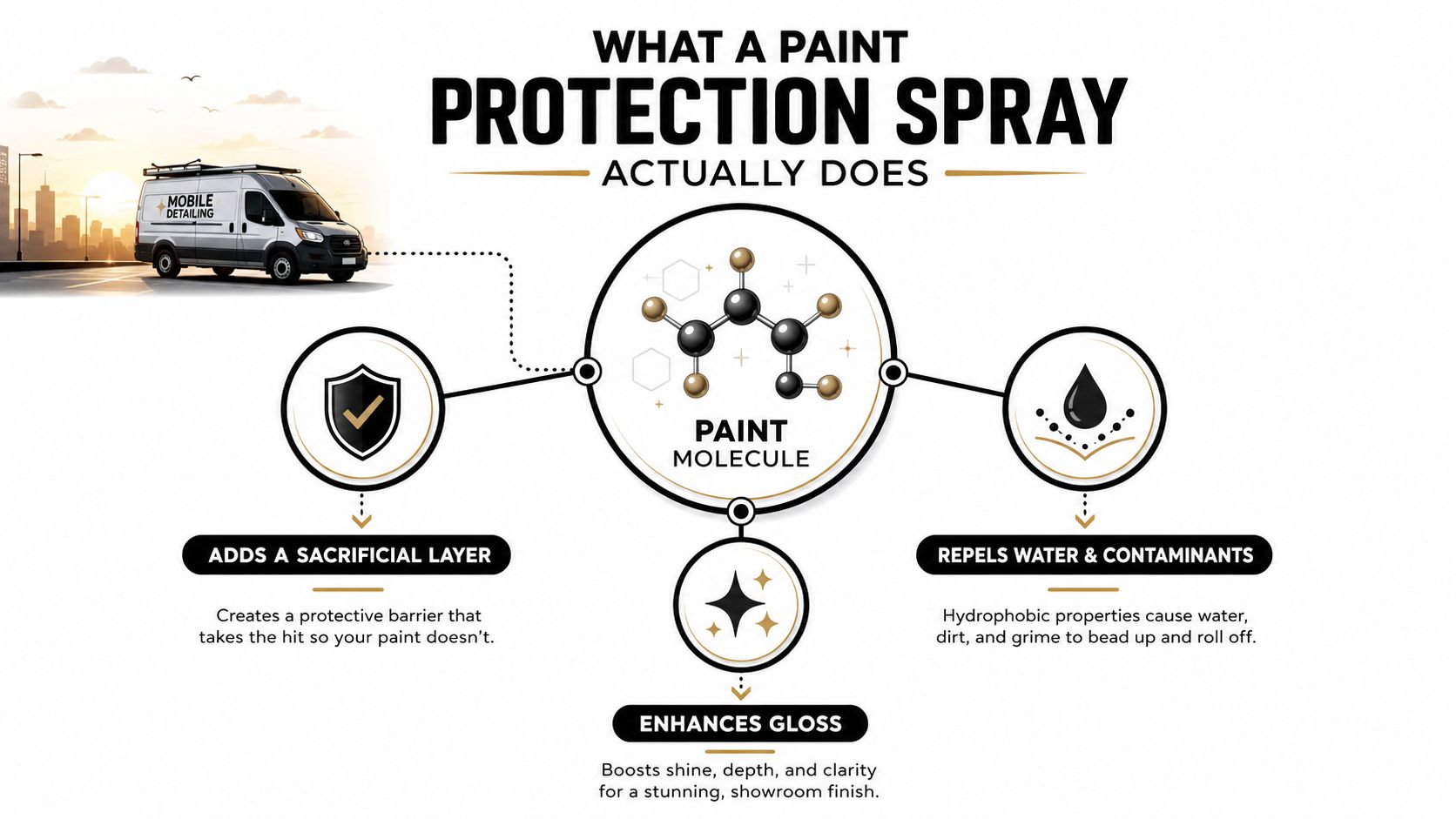
What a Paint Protection Spray Actually Does
A mobile detailer learns quickly that customers often use “ceramic coating,” “sealant,” and “spray protection” as if they mean the same thing. They don’t. A paint protection spray normally lays down a thin sacrificial layer over clean clear coat, helping water release from the surface, reducing the adhesion of everyday grime, and improving gloss. It doesn’t repair chipped paint, stop stone impacts, or transform neglected paint into newly polished paint.
The easiest mental model is a protection stack. A quick detailer offers short-term slickness and light cleaning support. A traditional polymer sealant adds a more durable surface film. A ceramic spray usually adds a silica-based component, often marketed around stronger water behavior and chemical resistance. A true professional coating forms a more substantial, carefully prepared layer and demands stricter installation and maintenance.
Practical rule: Treat spray protection as a maintenance decision, not a permanent-paint decision.
Where the product earns its place
On a daily driver, a good spray can make washing easier and keep the finish looking sharper between services. It can also work as a topper over an existing coating, where the underlying coating provides the long-term foundation and the spray refreshes water behavior and gloss.
The market behind paint protection is no longer a specialist curiosity. Paint protection film, the core technology behind many film-based and liquid-applied protection discussions, was estimated at USD 502.55 million globally in 2024 and projected to reach USD 726.63 million by 2030, with a 6.6% CAGR from 2025 to 2030, according to Grand View Research’s paint protection film market analysis. That broader category shows how strongly owners now value preserving factory paint, but it doesn’t mean every spray delivers film-level protection.
Titan’s elastomer approach offers a different idea. Its elastic coating is designed to be hard like glass while remaining flexible, rather than relying only on a rigid surface that can become vulnerable when the substrate moves or conditions change. That membrane concept is worth keeping in mind when comparing car paint protective coatings from Titan, especially for mobile work where perfect environmental control isn’t always available.
Spray Sealant vs Ceramic Spray vs True Coating
The product label matters less than the role the product is expected to play. A polymer spray sealant is usually the simplest option. It spreads quickly, gives immediate slickness, and suits a short maintenance cycle. A ceramic spray generally adds silica chemistry to the formula, but “ceramic” still doesn’t turn a spray into a multi-year professional coating.
A true coating requires more demanding preparation, controlled application, and careful curing. It can provide a longer service interval, but it also makes poor prep more difficult to hide. Titan’s elastomer-membrane technology sits between the convenience of a spray and the more deliberate installation of a coating. The intended advantage is a surface that combines glass-like hardness with flexibility, so temperature movement and ordinary impact from contaminants are less likely to produce cracking in the protective layer.
| Product Type | Realistic Durability | Prep Effort | Best Use Case |
|---|---|---|---|
| Polymer spray sealant | About 2–4 months in comparative real-world guidance, Bottega del Sarto’s longevity comparison | Low to moderate | Frequent maintenance on a daily driver |
| Ceramic spray | Commonly about 3–6 months in real-world use, with select products approaching 6–12 months under favorable conditions, as discussed in independent spray sealant testing | Moderate | DIY protection or a topper over an existing coating |
| True professional coating | Roughly 2–5+ years as a product class in comparative guidance, Bottega del Sarto’s coating comparison | High | Owners prepared to follow a strict installation and maintenance plan |
| Elastomer-membrane coating | Product-dependent, with flexibility intended to support durability through movement and temperature changes | Moderate to high | Mobile detailers, DIY installers, and vehicles exposed to changing conditions |
Match the tier to the vehicle
For an outside-stored commuter, convenience usually wins. A spray that can be renewed during regular maintenance may be more practical than a coating whose installation demands a controlled studio and a longer customer handoff.
A garaged weekend car gives a stronger spray more favorable conditions. A maintenance topper over a true coating has another advantage, because the spray isn’t carrying the entire protection burden. That’s why a resource such as paint protection spray for Audi can be useful for comparing product positioning, but the installer still needs to separate label language from expected daily-driver performance.
For a deeper product-category comparison, use Titan’s guide to ceramic coating versus paint sealant. The practical question isn’t which category sounds strongest. It’s how much labor the owner will support at each maintenance interval.
Surface Prep That Sets You Up to Win
Prep is the variable you control most directly. Before opening a bottle, the paint should feel smooth under a clean hand, sound quiet under a clay pass, and look uniform under diffused light. If you can still feel grit, see traffic film, or detect oily polish residue, the protection layer is being asked to bond to contamination instead of paint.
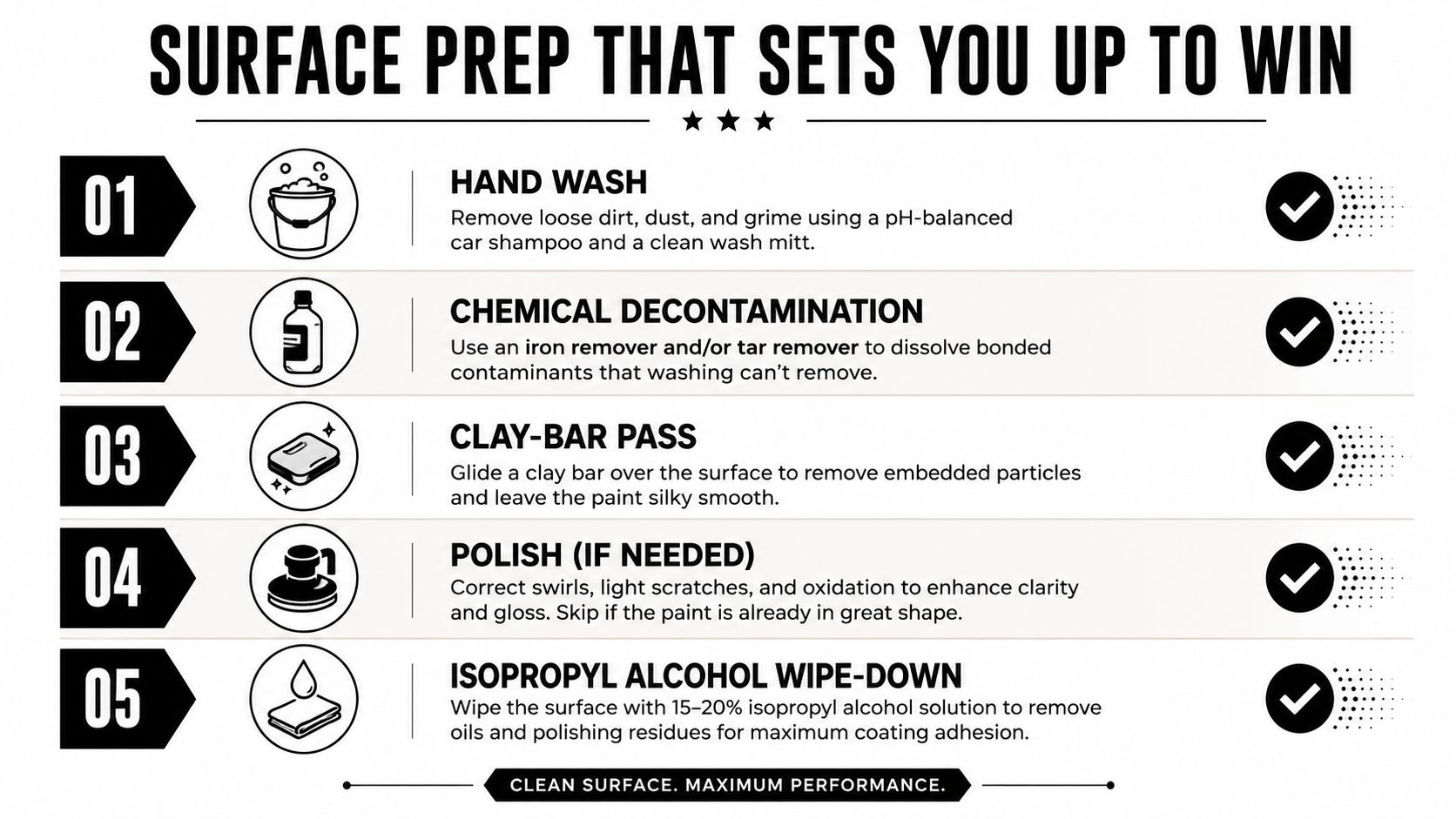
My mobile routine starts with a thorough hand wash using a clean mitt and separate wheel tools. I rinse aggressively around badges, panel gaps, mirrors, and lower doors, because leftover soap or road film can create uneven application. After drying, I use chemical decontamination where needed, then a clay-bar pass with sufficient lubrication. Clay isn’t a ritual. It removes bonded material that washing alone leaves behind.
The finish should pass five checks
- Wash first: Remove loose grit before any contact work.
- Decontaminate chemically: Dissolve embedded contamination that can interfere with leveling.
- Clay carefully: Confirm the surface feels smooth, not grabby.
- Polish only when needed: Correct oxidation, haze, or light defects before sealing them beneath protection.
- Wipe with isopropyl alcohol: Strip polishing oils and residue so the product meets a clean surface.
A polish isn’t automatically an improvement. If the paint already looks clear, polishing can add unnecessary work and create residue that must be removed. I inspect every panel from several angles under shade or diffused light before deciding.
Outdoor application needs discipline. Work out of direct sun, keep panels cool, and avoid starting immediately after washing if moisture remains in seams or mirrors. Wind also matters because it carries dust onto the panel while you’re working. Titan’s car paint preparation guide is a useful companion for building a consistent routine, while adjacent surface-preparation references such as how to paint a window screen reinforce the broader principle that clean, dry material gives a finish a better chance to hold.
Applying the Spray Without Leaving Streaks
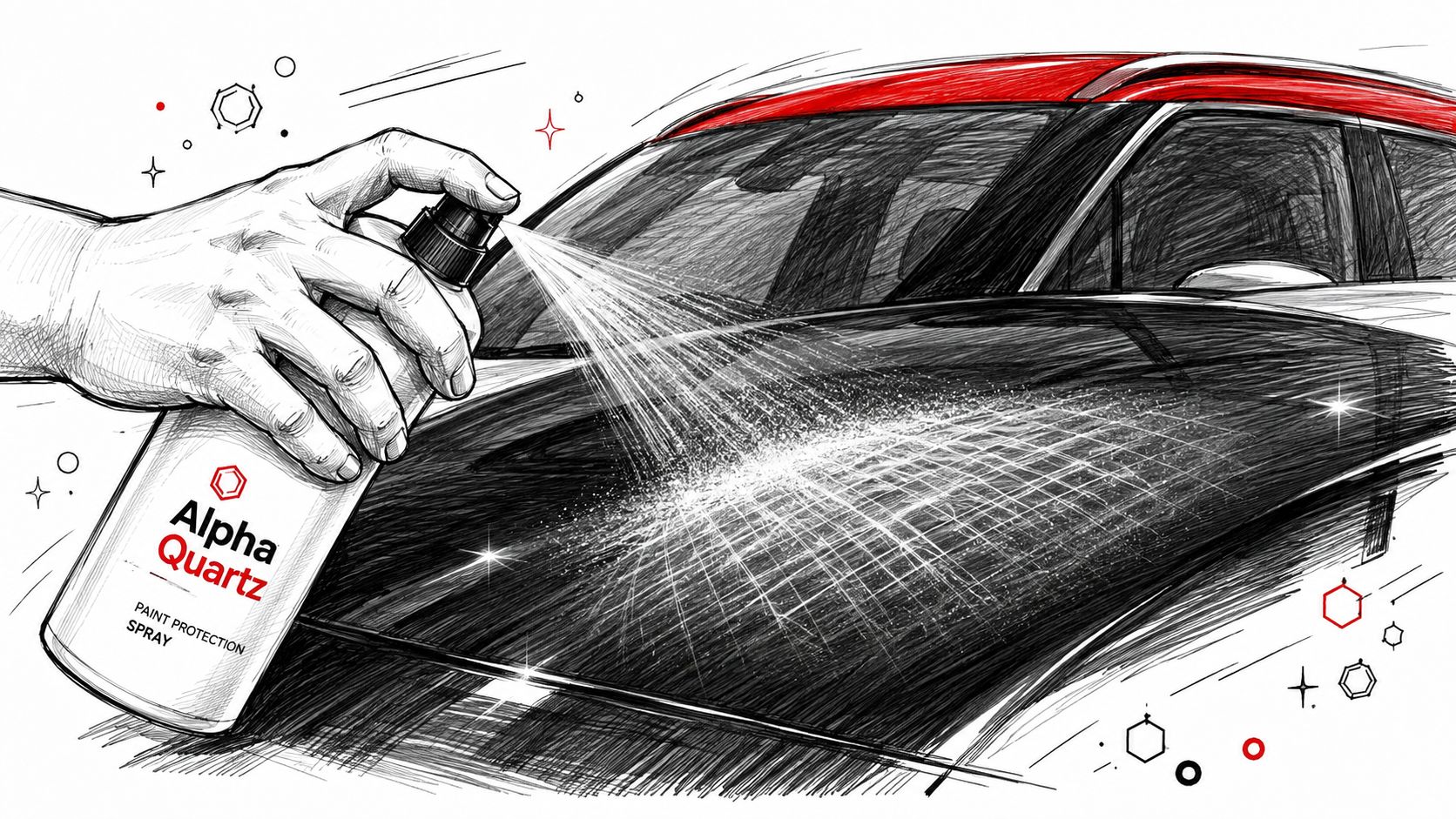
The first time I ran Alpha Quartz through a hood on a warm outdoor job, I treated the panel as several small work areas rather than one large target. That decision prevented the common mistake of allowing one section to flash while the applicator moves too far ahead. With spray coatings, control beats speed.
Start with a cool, dry panel and a clean applicator. Apply a small amount to a manageable section, then work in a cross-hatch pattern, first vertically and then horizontally. The aim is even coverage, not heavy saturation. Excess product creates more wipe-off work and increases the chance of high spots.
A controlled wipe-off matters more than a fast one
Watch the product rather than following a rigid clock. The correct flash point depends on panel temperature, humidity, product chemistry, and the amount applied. When the film begins to level and becomes ready to remove, use the first microfiber to spread and level it, then follow with a second dry microfiber to finish the surface.
Rotate towels often. A towel that’s loaded with residue can move product around instead of removing it. Use bright, even lighting or diffused light to inspect the hood, roof, and door from different angles. High spots often disappear under harsh glare and show themselves only when the light is softened.
Alpha Quartz’s flexible membrane concept is useful for mobile detailers because the coating is intended to remain flexible rather than becoming a brittle layer through temperature movement. Titan presents its elastomer coatings as hard like glass and flexible, with carbon-nanotube technology supporting the idea that a reinforced elastomer can retain rubber-like behavior at high temperatures. A patent example reports at least 0.5 MPa storage modulus at 150°C, documented in WO2016133207A1. That technical result supports the material concept, but it shouldn’t be mistaken for a universal field-life guarantee.
Ultra Ceramic Spray follows the same installer’s logic. Use a clean base, small sections, restrained product, controlled flash, and a two-towel wipe. Keep the bottle and application tools organized, and use Titan’s trigger spray bottle when a controlled, repeatable spray pattern suits the job. Follow the exact product label for drop count, panel size, and cure window. Those details are product-specific, and guessing them is how installers create streaks.
Windshield and Glass as a Separate Step
A customer once called after driving into a sudden rainstorm. He expected the windshield to become a sheet of water, but the treated glass released droplets as the vehicle gathered speed. His wipers still mattered, but they weren’t working through the same heavy film of water. That change is why I treat glass as its own service, not as an afterthought to paint protection.
Paint and glass have different surface behavior. A product that levels beautifully on clear coat may not provide the same clarity, bonding, or wiper resistance on a windshield. Glass also demands a cleaner final inspection because a haze or missed residue sits directly in the driver’s sightline.
How I apply Apex Glass
I begin with a dedicated glass clean, followed by careful removal of traffic film, old water-spot residue, and invisible oils. The windshield must be dry and free from lint. I inspect from both inside and outside because interior film can be mistaken for coating haze.
With Apex Glass, I use a controlled amount on a small section and spread it in overlapping circular motions. Those circles help work the product across the glass texture instead of leaving isolated trails. I allow a short flash, then level and buff with a clean microfiber until the panel is optically clear.
Titan describes Apex Glass Ceramic Coatings as an easy-to-use glass and windshield treatment intended to improve visibility in wet driving. The benefit comes from water behavior and clarity, not from treating the windshield like painted bodywork. Keep the application separate, use dedicated towels, and inspect from the driver’s position before returning the vehicle.
Visibility is the real reason to coat glass
A clean, properly treated windshield can reduce the visual burden of rain and may reduce how often the wipers need to work in suitable conditions. It can also support clearer night driving when the glass is clean and the coating has been leveled correctly. It won’t eliminate glare, replace worn wiper blades, or make unsafe weather safe.
Cure time still matters. Don’t rush the first wash or expose newly treated glass to unnecessary contamination before the product has settled. The correct first-wash timing comes from the product instructions, not from a universal detailing rule. The same principle applies to paint protection spray. Independent testing of spray sealants has found that real-world water behavior can fall off early even when the surface still feels slick. One review measured a water contact angle of 80.3° and gave durability a 7/10 score while reporting hydrophobic performance at 0/10, illustrating why feel alone isn’t a reliable performance test. See the methodology in Detail Score’s spray sealant review.
Durability depends on the maintenance environment
Independent enthusiast testing shows a wide spread. In one outdoor panel test lasting 8 months, some spray sealants had failed while others continued performing. A separate year-long series recorded ceramic sprays surviving roughly 4–6 months, 6–8 months, and, for the strongest examples, about 11–12 months, depending on chemistry and climate. Those results are documented in the long-run spray protectant testing video.
For a daily commuter, plan around frequent washing, road salt, UV exposure, and weather. For a garaged weekend car, a longer interval may be realistic if the surface stays clean and the owner uses gentle wash methods. As a topper over an existing coating, the spray can serve as a refresh layer rather than the vehicle’s only defense.
Wash chemistry and drying technique decide more than most labels admit. Aggressive shampooing, rough towels, repeated automatic-car-wash contact, or washing before cure can shorten the useful life. Titan’s elastomer-membrane approach is designed to stay flexible across frozen and hot conditions, reducing the risk that ordinary thermal movement will crack the protective layer. A carbon-nanotube-filled UV-curable coating has also been reported to improve wear, hardness, scratch resistance, and chemical resistance while remaining flex-resistant at 1.3 wt% nanotube loading, according to EP2228414NWA1. That evidence supports the flexibility principle, but installation and care still determine the result on the vehicle.
Common Mistakes and How to Fix Them
Paint protection spray isn’t foolproof. Most failures I see begin before the product touches the panel or happen because the installer tries to make one bottle serve every condition.
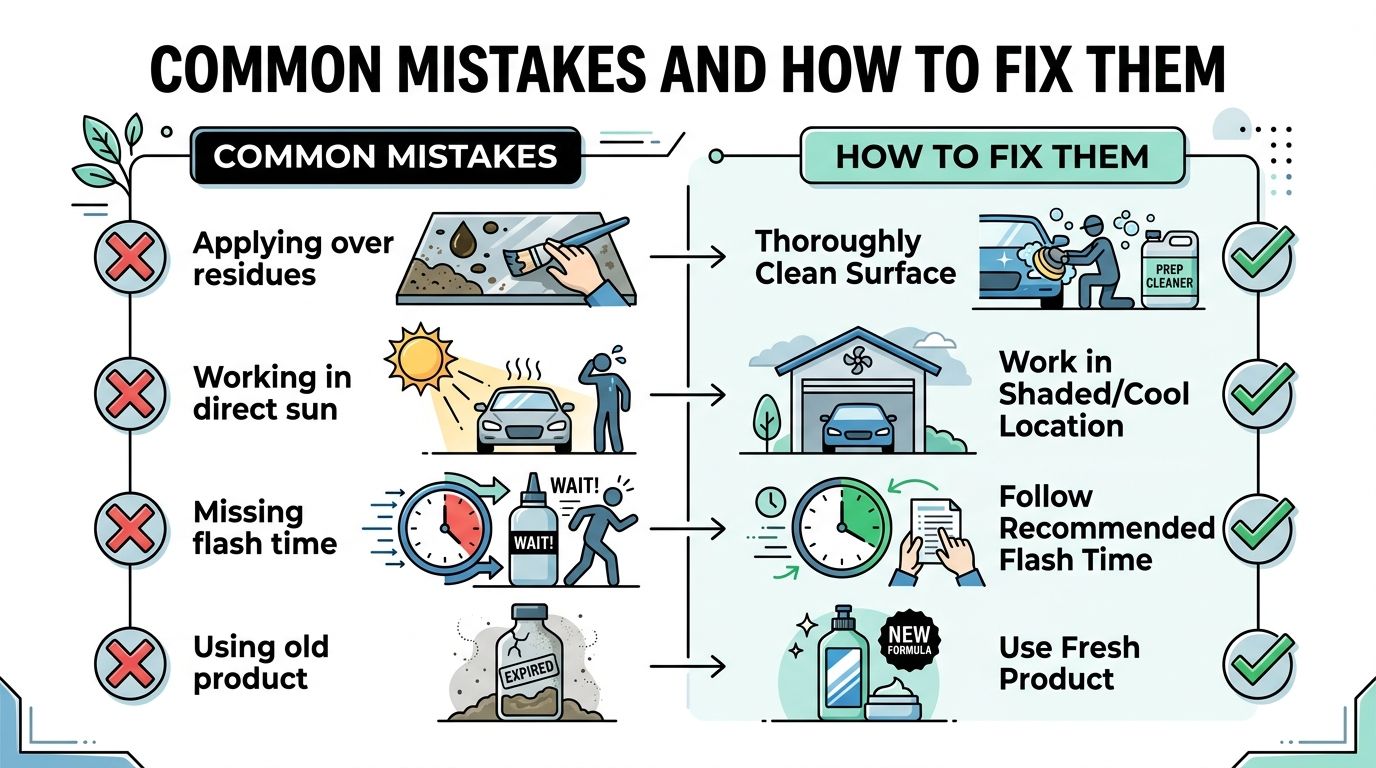
- Applying over residues: Polish oils, soap film, and drying aids can interfere with bonding. Fix it with a proper panel wipe and a fresh inspection.
- Working in direct sun: A hot panel shortens working time and makes leveling unpredictable. Move into shade and touch-test the panel before application.
- Missing flash time: Wiping too early can move the product; wiping too late can leave high spots. Work smaller sections and watch the film.
- Using old product: A bottle that has thickened, separated, or developed particles shouldn’t go on customer paint. Replace it rather than gambling on the finish.
- Washing too soon: Early washing can disturb the curing film. Follow the product’s cure instructions and protect the vehicle from avoidable moisture.
A flexible elastomer membrane can tolerate small pressure and temperature changes better than a rigid film, but flexibility doesn’t rescue contaminated paint or careless wipe-off. Carbon nanotube-polymer research has reported reduced UV degradation and microcracking with 0.5–1.0 wt% functionalized MWCNTs, as described in this composite-materials study. That’s a material-level finding, not permission to ignore installation basics.
Quick troubleshooting
- Hazy finish: Re-level with a clean towel while the product remains workable. If cured, follow the manufacturer’s removal guidance.
- High spots: Use fresh microfiber, softened lighting, and a careful panel-by-panel inspection.
- Uneven beading: Check for residue, incomplete coverage, harsh wash chemistry, or contamination on the surface.
Building a Repeatable Spray Protection Workflow
The common assumption is that the bottle determines the result. In practice, the workflow determines whether the bottle gets a fair chance. A mobile detailer needs a process that survives shade changes, variable weather, customer schedules, and different paint conditions.
Start by assigning every vehicle to a use case. An outside-stored commuter needs a practical maintenance interval and easy wash behavior. A garaged weekend car can justify more preparation and a stronger spray-format product. A coated vehicle may only need a compatible topper that refreshes gloss and water release.
A service sequence that stays consistent
- Inspect and document: Record paint condition, contamination, defects, and customer expectations.
- Wash and decontaminate: Don’t apply over traffic film, bonded grit, or drying residue.
- Correct selectively: Polish only where the finish needs it.
- Panel-wipe and test: Confirm the surface is clean, cool, and ready.
- Apply in small sections: Use restrained product, cross-hatch coverage, and controlled flash.
- Level with two towels: One towel spreads and removes. The second confirms clarity.
- Treat glass separately: Use Apex Glass on properly prepared windshield and exterior glass.
- Explain maintenance: Give the owner wash guidance, cure precautions, and a realistic reapplication plan.
For a studio menu, Titan’s Alpha Quartz can occupy a flexible coating option between a short-cycle sealant and a more demanding professional coating. Ultra Ceramic Spray fits quick protection boosts and maintenance-topper work. The technology discussion should stay honest: Titan’s elastomer coatings are presented as hard like glass and flexible, while temperature-sensitive CNT and epoxy coating research has demonstrated functionality across high and sub-zero conditions with a negative temperature coefficient of resistance of about −0.07% per °C, reported in this open-access coating study. That supports the value of flexibility through temperature swings, but no product removes the need for prep and maintenance.
Save the checklist in your phone, confirm the weather, inspect every panel under diffused light, and sell the service around the customer’s actual routine. Honest expectations create better repeat work than promising a universal lifespan.
APEX NANO – Titan Coatings offers options for hard vehicle surfaces, including elastomer-style protection, Ultra Ceramic Spray for maintenance-focused application, and Apex Glass for windshield visibility support. Review the product range and match the coating to your next vehicle’s prep level and use case by visiting APEX NANO – Titan Coatings.
0 Comments