
A black pickup came into the shop looking sharp from ten feet away. Up close, the story changed. Small bubbles had formed near the wheel arch, the edge of the hood showed early staining, and the owner kept asking the same question every car lover asks when corrosion shows up too early. How did this happen when the paint still looked good?
The Silent Threat to Your Car’s Shine
Corrosion rarely starts with drama. It starts in the quiet places. A chip from highway debris. A seam that held moisture. Salt left behind after winter roads dried out. Humid air after a coastal drive. Those small exposures don’t stay small once water, oxygen, and contamination keep reaching the surface.
For vehicle owners, rust is more than a cosmetic annoyance. It cuts resale value, ruins confidence in the finish, and eventually attacks the metal under the coating system. That matters whether you drive a daily commuter, a garage-kept sports car, or a truck that sees weather every week.

Where damage begins
In the lab and in the field, the failure pattern is familiar:
- Road salt stays active: It clings to lower panels, wheel wells, rocker areas, and fastener zones.
- Tiny defects become entry points: A chip, wash-induced marring, or edge weakness can let moisture sit where it shouldn’t.
- Heat and cold stress the surface: Expansion and contraction test whether a coating stays intact or starts to micro-fracture.
- Contaminants keep working after the drive ends: Moisture trapped under grime can remain active long after the car is parked.
A polished finish can hide early-stage corrosion from the casual eye. It won’t hide it forever.
Practical rule: If a coating only looks good on delivery day, it isn’t protection. Protection means resisting the slow, repetitive attack that happens after every wash, storm, winter commute, and humid morning.
That’s why salt spray corrosion testing matters. In the coatings world, it’s one of the clearest ways to separate decorative claims from protective performance. It’s a harsh, accelerated environment built to expose weak links fast. The chamber doesn’t care about branding, gloss, or marketing language. It shows whether the system can hold a line when salt and moisture keep pressing.
For anyone who cares about a car’s finish, that’s the core issue. The shine gets attention. The barrier underneath earns trust.
What Is Salt Spray Corrosion Testing
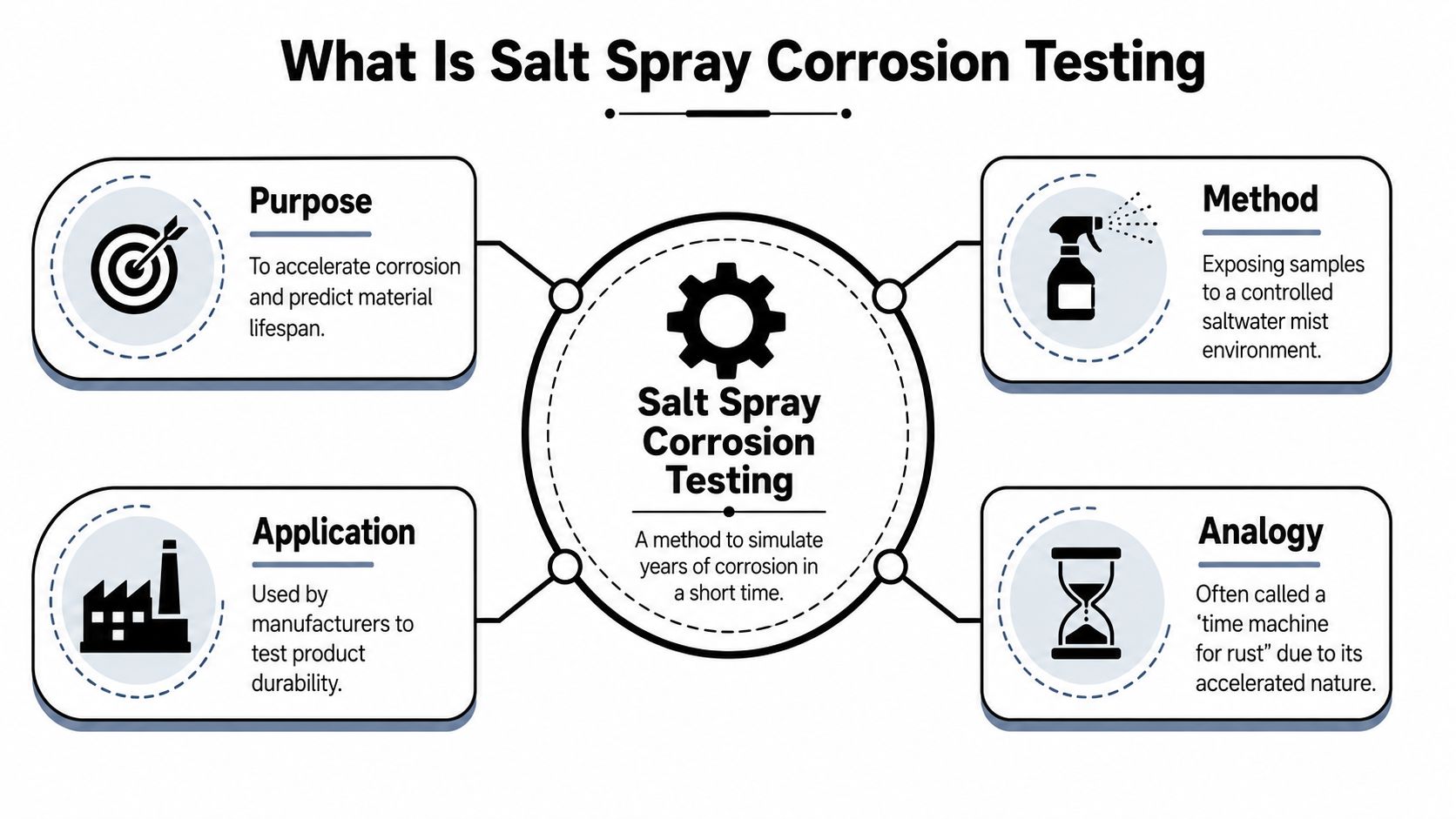
Salt spray corrosion testing is the industry’s accelerated corrosion workout. It pushes coated metal into a controlled salt fog environment so engineers, chemists, and coating manufacturers can compare how surfaces hold up under repeatable attack. For car owners, the simplest way to think about it is this. It’s a time machine for rust, but one built for comparison, not fantasy.
The chamber and the rulebook
The benchmark standard is ASTM B117. Under that method, the chamber runs with a 5% sodium chloride solution at 35°C and a pH range of 6.5–7.2, creating reproducible corrosive conditions for metals and coatings. It is also the most widely used corrosion test method globally and plays a critical role in automotive, aerospace, and military testing for relative corrosion resistance data, as outlined by Q-Lab’s ASTM B117 overview.
That level of control matters. If you want useful comparisons, the environment can’t drift.
A proper setup includes a fog chamber, a salt solution reservoir, and an air supply that maintains continuous salt fog. In practice, technicians place coated panels or components into the chamber and let the environment do one job relentlessly. Attack the surface and reveal where protection breaks down.
What the test is good at
Salt spray corrosion testing works well when you need to compare coatings under the same conditions. It’s especially useful for:
- Quality auditing: Checking whether a production process is staying consistent.
- Material screening: Comparing one coating system to another before wider use.
- Failure spotting: Finding weak edges, poor adhesion, or vulnerable defect areas early.
- Development work: Guiding formulation changes before a product reaches the field.
If you want a useful look at how coatings are evaluated beyond the label, Titan’s overview of coating testing methods gives a practical industry perspective.
A salt spray chamber is less like weather and more like a controlled interrogation. It asks one narrow question very aggressively. How long does the barrier stay intact under constant saline exposure?
That distinction matters for vehicle owners. A test chamber doesn’t recreate your exact commute, parking habits, or climate. It creates a standard challenge so coating performance can be measured on common ground. When that’s done correctly, the results become a valuable part of understanding whether a coating was engineered for real protection or just easy application and short-term gloss.
The Standards Behind the Science ASTM B117 vs Cyclic Tests
Not all corrosion tests stress a coating in the same way. ASTM B117 is static. The chamber applies continuous salt fog under fixed conditions. That’s useful for consistency, but cars don’t live in one endless fog bank. They get wet, dry out, heat up, cool down, sit in humidity, then face contamination again.
That gap is why many serious coating evaluations also use cyclic corrosion tests. These methods alternate between salt exposure, drying, and humidity phases to better reflect what coatings face outside the lab. The transition between those phases often reveals weaknesses that a static chamber can miss.
Static exposure versus environmental cycling
Here’s the practical difference.
| Feature | ASTM B117 (Static Salt Spray) | ASTM G85 (Cyclic Corrosion Test) |
|---|---|---|
| Exposure style | Continuous salt fog | Alternating phases such as salt, dry, and humidity |
| Main strength | Strong repeatability for comparison | Better mimicry of changing service conditions |
| Typical use | Quality control and baseline screening | Advanced durability evaluation |
| Stress pattern | Constant saline attack | Repeated expansion, drying, and rewetting stress |
| Best question answered | Which sample holds up better in one controlled chamber? | Which sample handles changing corrosive conditions more realistically? |
Why the difference matters on a vehicle
A hood, roof, fender, or windshield surround doesn’t fail only because salt touches it. Failure often starts because moisture enters, then leaves, then returns. The surface expands in heat, contracts in cold, and moves under daily service. That sequence can create pathways for underfilm corrosion and adhesion loss.
According to the verified data provided for this article, emerging cyclic corrosion tests show 30–50% better correlation to outdoor conditions than conventional salt spray, though they remain underused in some specifications. That’s a meaningful distinction when the end goal is real-world durability rather than a lab-only benchmark.
For professionals comparing suppliers, this is where experience matters. A company that only talks about one static test may be giving you an incomplete picture. A company that understands both baseline screening and advanced cyclic behavior usually has a deeper grasp of failure modes. Titan’s work as industrial coating suppliers sits in that more serious category, where performance isn’t judged by a single talking point.
What to ask when you review corrosion claims
Use a short filter before you trust any “hours passed” statement:
- Ask what standard was used: ASTM B117 and cyclic methods are not interchangeable.
- Ask how the sample was prepared: Surface prep and cure quality can change everything.
- Ask what failure was measured: Red rust, blistering, and creep tell different stories.
- Ask whether field exposure supports the lab result: If it doesn’t, the number may be thin comfort.
A good coating doesn’t just survive one chamber. It survives the pattern of stress that vehicles see.
How a Coating Earns Its Stripes The Test Process
A meaningful corrosion test starts long before a panel enters the chamber. Good labs know that sloppy preparation creates noisy data, and noisy data leads to bad decisions. The process is methodical because every shortcut can hide a weakness or create a false failure.
Specimen preparation
Technicians begin with standardized panels or production parts. The substrate is cleaned, coated, and cured under controlled conditions. If the coating system includes multiple layers, each layer has to be applied the way the manufacturer intends it to be used, not the way a rushed demo would apply it.
Many evaluations also include a scribe, which is an intentional cut through the coating down to the metal. That scratch creates a known defect so the lab can observe how far corrosion spreads from damage. In practical applications, this matters because coatings rarely fail in perfect untouched areas first. They fail at chips, edges, seams, and impact points.
Chamber placement and exposure
The position of the specimen is more important than often recognized. Panels are mounted at a controlled angle so the salt fog settles consistently and doesn’t puddle unnaturally. Once inside the chamber, the test runs continuously under the selected standard conditions.
At that stage, the test stops being theoretical. The coating is now dealing with concentrated saline attack, constant moisture, and no recovery period.
If you want to understand why adhesion is such a major part of this conversation, Titan’s technical notes on coating adhesion are worth reading. Corrosion resistance doesn’t last if the film can’t stay bonded.
Inspection and interpretation
Labs don’t just wait until the end and glance at the panels. They inspect at intervals, document visible change, and track specific failure modes. The key observations usually include:
- Rust formation on exposed or compromised areas.
- Blistering where the film lifts from the substrate.
- Creep from the scribe where corrosion travels under the coating.
- General appearance changes that may signal early breakdown.
A serious test process isn’t about making a panel look bad. It’s about finding the exact point where the protective system stops doing its job.
For coating developers, this is where formulation earns respect. Resin choice, flexibility, crosslink density, surface preparation, cure behavior, and film build all show up here. Marketing doesn’t enter the chamber. Chemistry does.
Reading the Results Understanding Corrosion Ratings
A corrosion report is only useful if you know what you’re looking at. Too many people reduce salt spray corrosion testing to a single phrase such as “passed” or “failed.” That’s not how experienced evaluators read the panel. They study how the coating failed, where it failed, and what that means for service life.
The failure modes that matter
Most corrosion evaluations focus on a handful of recurring indicators:
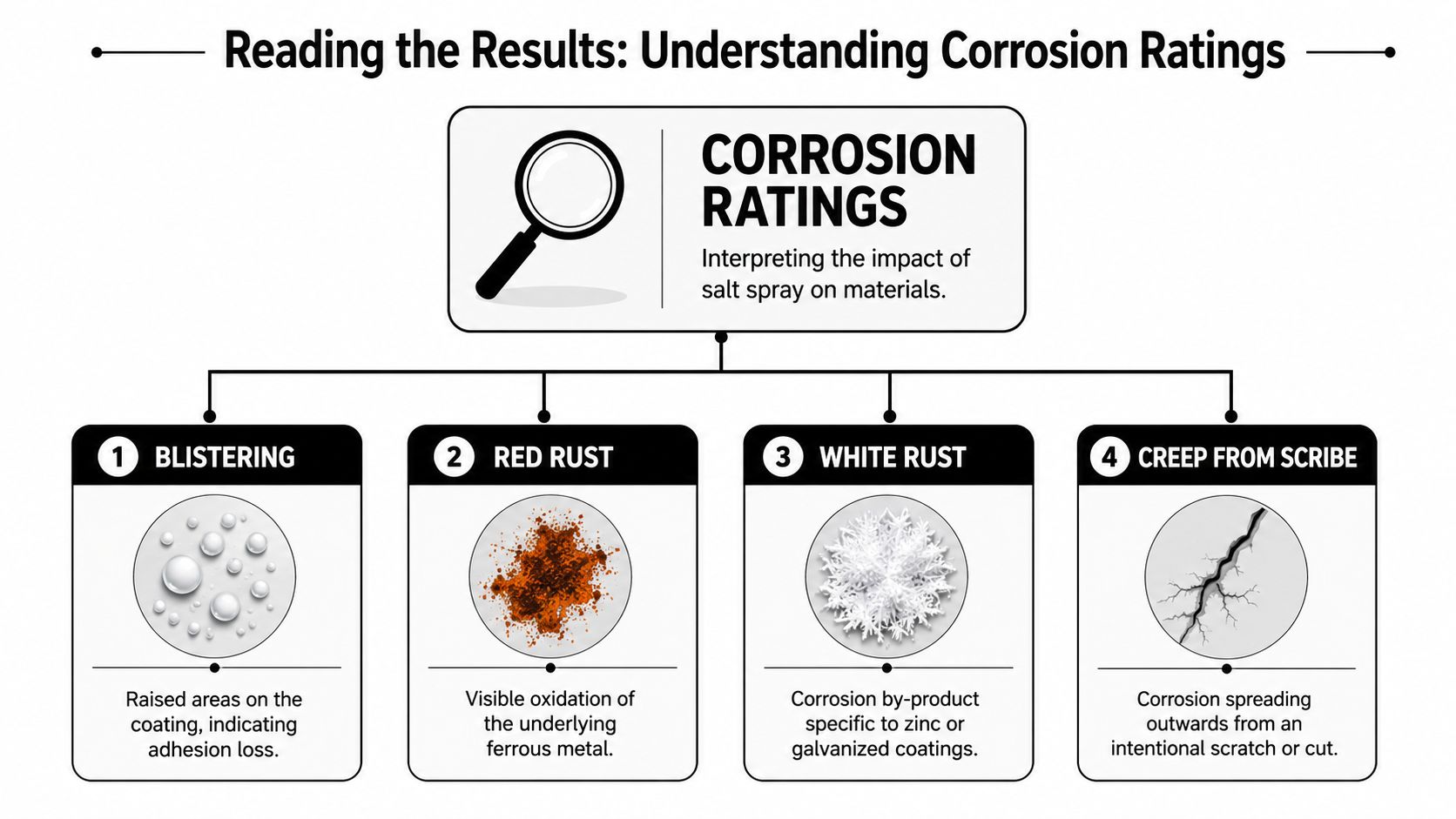
- Blistering: Raised bubbles in the coating. These often point to adhesion loss or moisture pressure beneath the film.
- Creep from scribe: Corrosion spreading sideways from an intentional scratch. This shows how well the coating limits underfilm attack after damage.
- White rust: A corrosion by-product often associated with zinc-based or sacrificial metallic layers.
- Red rust: Oxidation of the underlying steel substrate. This is the more serious signal because the base metal is now involved.
Not every visible change means the same thing. A trained reader separates cosmetic deterioration from structural concern.
White rust versus red rust
This distinction gets mishandled constantly in product marketing.
According to Omega Research’s analysis of salt spray results, light surface discoloration called white rust often indicates acceptable performance for 5–10 years of service, while deeper pitting or coating breakthrough called red rust signals potential failure within 1–2 years. The same analysis notes that electroplated zinc-nickel steel parts can last more than 720 hours in neutral salt spray without red rust, while white rust may appear after 100 hours without compromising integrity.
That’s a major practical takeaway. If a sacrificial layer shows white corrosion products, it may still be protecting the steel underneath. If the panel shows red rust, the barrier has been breached in a much more consequential way.
Don’t treat every rust color as equal. White rust can mean the protective layer is sacrificing itself. Red rust means the substrate is paying the price.
Reading the panel like a pro
A better way to judge a result is to ask:
| Observation | What it suggests |
|---|---|
| Isolated white rust | Surface reaction on a sacrificial layer, not always structural failure |
| Red rust at exposed steel | Breach of protection at the substrate |
| Large blisters | Moisture intrusion and bond failure |
| Long creep from scribe | Weak resistance to corrosion spread after impact damage |
For car finishes, this matters because owners often react to the first visible blemish without understanding the mechanism. A coating system should be judged by whether it preserves the substrate, limits spread, and maintains adhesion, not by whether every panel remains cosmetically perfect at every moment of accelerated exposure.
The Reality Check Lab vs The Real World
The biggest mistake in corrosion testing is also the most common. People assume chamber hours convert neatly into years on the road. They don’t.
The standard itself doesn’t support that shortcut. The Society for Protective Coatings concluded in 1995 that ASTM B117 offers a “rapid but unreliable means” for predicting actual coating behavior in natural settings, and the standard is intended to compare specimens prepared identically and exposed in the same chamber, not to make reliable comparisons across different chambers or claim direct service-life equivalence, as discussed in Sherwin-Williams’ review of the limitations of ASTM B117 salt spray testing.
Why road conditions are harder than a chamber
A car in service sees combined stress:
- UV exposure: Sunlight degrades chemistry in ways a salt chamber doesn’t measure.
- Thermal movement: Panels heat and cool, expanding and contracting daily.
- Mechanical impact: Gravel, bugs, wash contact, and road debris create defects.
- Dry-wet cycling: Real corrosion often accelerates during changing conditions, not static exposure alone.
That same logic applies outside automotive coatings. Anyone comparing building materials in harsh climates can learn from resources on choosing retaining wall materials wisely, because durability always depends on matching the material system to the environment, not trusting one simplified metric.
What a credible validation strategy looks like
Good coating evaluation uses layered evidence. A lab test establishes a controlled baseline. Field observation checks whether the chemistry still performs under UV, impact, contamination, and temperature stress.
That’s why serious formulators don’t stop at one corrosion chamber result. They combine standardized testing with long-term observation in demanding service environments. In marine conditions especially, this broader perspective matters, which is why a technical review of marine ceramic coating performance belongs in the conversation when corrosion resistance is the priority.
A strong salt spray result still matters. It just needs proper interpretation. The chamber is a tool, not a crystal ball.
The Titan Coatings Difference Engineered for Extreme Durability
The coating systems that hold up best over time usually solve two problems at once. They need surface hardness, and they need enough flexibility to avoid cracking when the environment changes. That balance is where Titan Coatings took a different path.
Titan developed its own coating technology and introduced elastomer coatings to the market using nanotubes technology and Dark Matter tech. In practical terms, that means a coating can be hard like glass and flexible at the same time. That combination matters on a vehicle because hardness helps defend the finish, while elasticity helps the film move with the substrate instead of breaking when temperatures swing from frozen conditions to extreme heat.
Why Alpha Quartz fits the real-world problem
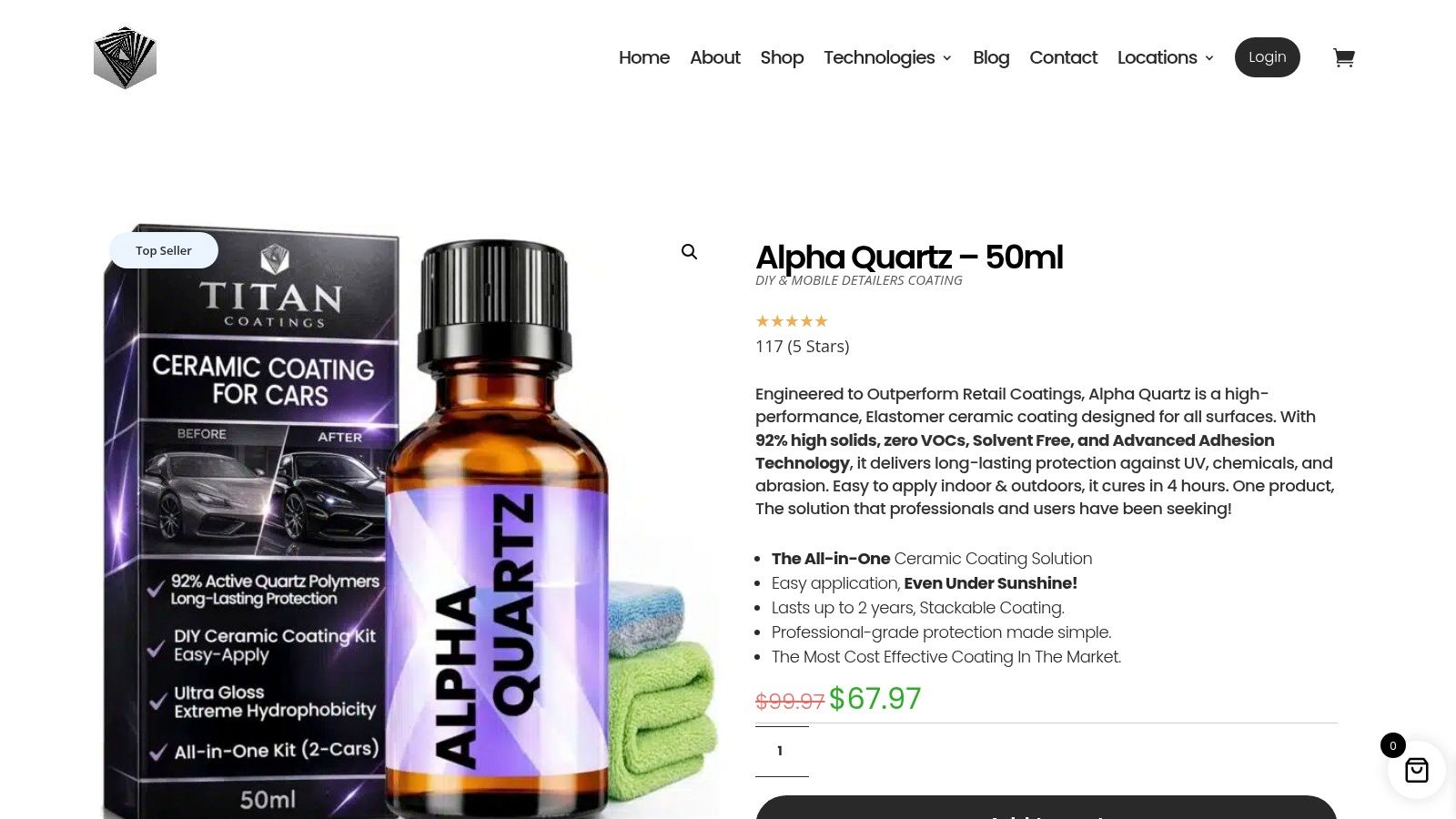
Traditional hard coatings can become vulnerable when impact and temperature movement introduce micro-cracking. That’s one of the hidden routes by which moisture reaches the substrate. Alpha Quartz addresses that weakness through elasticity. It’s designed to remain stable when panels move through hot-cold cycles, and that flexibility also helps when bugs and road contact strike the surface.
For installers, that matters just as much as chemistry. Alpha Quartz is easy to use, produces strong visual results, and works well for DIY users and mobile detailers who need reliable application without turning every install into a long correction project. The broader material story is explained on Titan’s page about elastomer coating technology.
A full system, not a one-product story
The same engineering mindset extends across the line.
- Alpha Quartz: Built for body protection where elasticity and durability matter most.
- Apex Glass Ceramic Coatings: Designed for glass and windshields to enhance visibility and make driving in rain feel far less stressful. It’s also straightforward to apply, which matters for everyday drivers and professionals alike. You can review it in Titan’s Apex Glass Ceramic Coatings product page.
- Ultra Ceramic Spray: A practical choice for users who want easy installation and strong results with less application complexity. Titan’s Ultra Ceramic Spray speaks directly to that need.
For owners working around coastal exposure or boating environments, it also helps to understand adjacent corrosion risks. Boat Juice has a useful article on how to safeguard your vessel’s metals, and the broader lesson carries over. Corrosion protection works best when you think in systems, not single surfaces.
If you want to browse the wider range, Titan’s coatings shop is the simplest place to compare options. You can also learn more about the company’s work at Titan Coatings.
A vehicle finish lasts longer when the coating doesn’t force you to choose between hardness and movement. That’s the practical edge of elastomer chemistry. It resists the conditions that often start corrosion before the owner ever sees the first bubble.
APEX NANO – Titan Coatings brings that lab-to-road mindset into every coating category. If you want protection engineered for harsh climates, daily driving, glass clarity in rain, and long-term surface resilience, explore APEX NANO – Titan Coatings.
0 Comments