
The secret to getting rid of water spots is dissolving the mineral junk left behind on your car’s paint. You can often start with a simple acidic solution, but for tougher spots that have started to etch, you’ll need to step up to chemical cleaners or even polishing.
The real key? Act fast. Untreated spots can permanently damage your clear coat, turning a small problem into a big, expensive headache.
Why Water Spots Are More Than Just an Annoyance
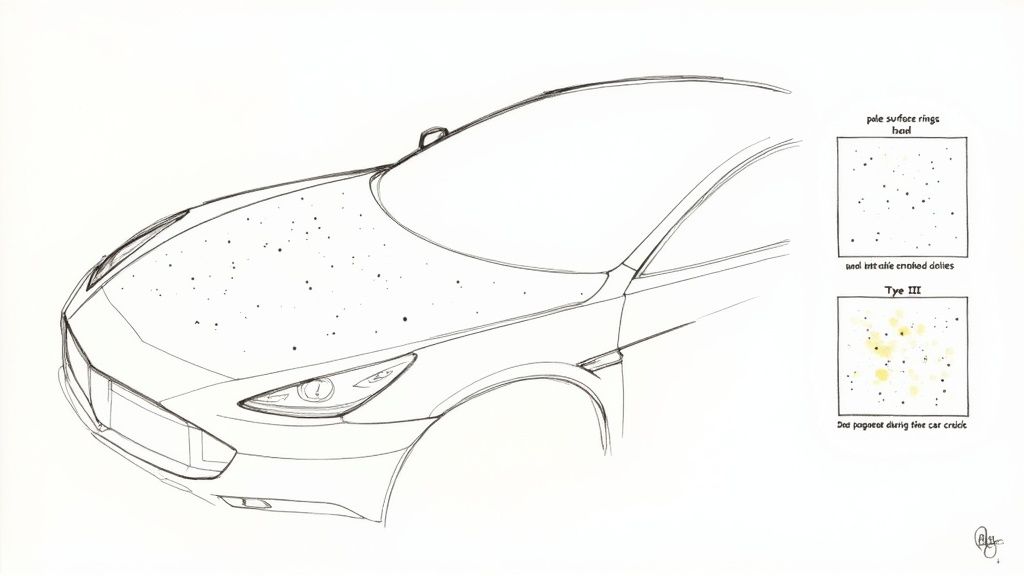
It’s a story every car owner knows all too well. You spend a beautiful afternoon giving your car a perfect wash, only to find a galaxy of chalky, annoying circles plastered all over the paint once it dries.
That’s not just dried water. Those are the mineral ghosts—calcium and magnesium, mostly—that have bonded right onto your car’s surface.
Ignoring them is a big mistake. What looks like a simple cosmetic flaw can quickly spiral into permanent paint damage. Think of each water droplet as a tiny magnifying glass, focusing the sun’s rays and literally baking the minerals into your clear coat. This process, called etching, physically eats away at the protective layer of your paint.
A Quick Guide to Water Spot Severity
Knowing what kind of water spot you’re up against is the first, most crucial step. You can’t just throw any product at them and hope for the best; that’s a recipe for making things worse. This table breaks down what you’re likely seeing.
| Severity Level | Visual Characteristics | Damage Type | Typical Removal Method |
|---|---|---|---|
| Type I (Surface Deposits) | Fresh, chalky rings or spots sitting on the surface. Can feel slightly gritty. | Topical. Minerals are just resting on the clear coat, not embedded. | Quick detailer spray, vinegar solution, or a dedicated water spot remover. |
| Type II (Etched Stains) | Faint but visible outlines that won’t wipe away. The surface might feel smooth. | Minor Etching. Minerals have started to eat into the very top layer of the clear coat. | Dedicated chemical water spot remover, clay bar, or light polishing. |
| Type III (Bonded Minerals) | Noticeable pits or “craters” in the paint. The outlines are very distinct and deep. | Severe Etching. Minerals have dug deep into the clear coat, becoming part of it. | Machine polishing, compounding, or in extreme cases, wet sanding. |
Basically, if a simple spray-and-wipe doesn’t work, you’re dealing with some level of etching. The deeper the etch, the more aggressive your approach will need to be.
“The difference between a pristine finish and a compromised one often comes down to how quickly you address environmental contaminants like water spots. What seems minor today can become a significant, permanent flaw in a matter of weeks.”
The Real Cost of Neglect
Letting water spots hang around isn’t just an aesthetic issue—it hits you in the wallet. The global market for automotive water spot removers has exploded past $1.23 billion. That number alone shows you how widespread and serious this problem is.
Worse yet, even minor imperfections can slash a vehicle’s resale value by 10-15%. This isn’t just about keeping your car clean; it’s about preserving your investment.
This is exactly why getting ahead of the problem is so important. A good defense is the best offense, and it’s always easier (and cheaper) to protect your paint than to fix it. A smart protection strategy can save you hundreds of dollars and countless hours of frustration.
If you want to get serious about prevention, our guide on how to protect car paint is the perfect place to start. It’s a must-read for any owner who wants to keep their vehicle looking its absolute best.
Gathering Your Water Spot Removal Toolkit
Trying to remove water spots without the right gear is a recipe for frustration. It’s like trying to paint a masterpiece with a toothbrush—you might make a mark, but the result won’t be pretty. Grabbing the wrong stuff, like an abrasive dish sponge or some harsh all-purpose cleaner from under the sink, can instantly turn a simple fix into a costly paint correction disaster.
So, let’s go over your pre-battle checklist to make sure you’re armed for success.
First things first, the absolute non-negotiables. You need a proper two-bucket wash setup. This is crucial to avoid dragging grit right back onto the paint you’re trying to clean. Get a quality, pH-neutral car soap and a stack of clean, plush microfiber towels. You’ll need one for washing, a dedicated one for drying, and at least a few more for applying and wiping off products.
Your Specialized Arsenal
With the basic wash out of the way, it’s time to bring in the specialized gear for those stubborn mineral deposits. What you’ll need really depends on how bad the spotting is.
- Decontamination Tools: A simple wash won’t lift off bonded grime. For that, you’ve got a couple of choices. The traditional clay bar works, but if you drop it once, it’s done. I much prefer a modern clay mitt or a clay towel—they do the same job, giving you that slick, glassy surface, but they’re reusable and far more forgiving.
- Chemical Removers: Not all water spot removers are built the same. A dedicated, pH-balanced formula is specifically engineered to dissolve mineral deposits without stripping your wax or damaging your paint. This is worlds safer and more effective than a vinegar-and-water homebrew, which can give you some seriously unpredictable results. To see how a pro-grade product can save you a headache, check out our Titan Auto Hard Water Spot Remover.
- Machine Polishers: When water spots have actually etched into the clear coat (what we call Type II or III spots), chemicals alone won’t cut it. This is where a machine polisher becomes your best friend. For DIYers and pros alike, a dual-action (DA) polisher is the way to go. Its orbital motion makes it incredibly safe, drastically reducing the risk of burning through your paint.
Safety Is Not Optional
Anytime you’re working with detailing chemicals and power tools, you need to have a healthy respect for safety. Protecting your car’s finish is the goal, but protecting yourself is the priority. Don’t even think about starting this job without the right personal protective equipment (PPE).
The golden rule of detailing has always been: start with the least aggressive method that works. You can always step it up, but you can’t undo damage from going too hard, too fast.
Your must-have safety kit is simple: nitrile gloves to keep chemicals off your skin and safety glasses or goggles to protect your eyes from splashes. It’s a basic step that prevents completely avoidable accidents.
I still remember a client, Mark, who figured a “quick polish” didn’t call for eye protection. A tiny fleck of dried compound spun off the pad and hit him just under his eye. He was okay, thankfully, but it was a jarring reminder of how fast things can go wrong. He never polishes without his glasses now. It’s a small habit that makes a huge difference, ensuring your project is successful and—most importantly—safe.
Actionable Strategies for Erasing Water Spots
Alright, you’ve got your gear and you’re ready to tackle those frustrating water spots. The single most important rule in detailing is this: always start with the least aggressive method possible. Think of it as protecting your car’s future. You want to preserve that precious clear coat, so you only pull out the big guns when you absolutely have to.
This handy decision tree gives you a great visual for where to begin. It’s all about getting your prep work and safety right before you even touch the paint.
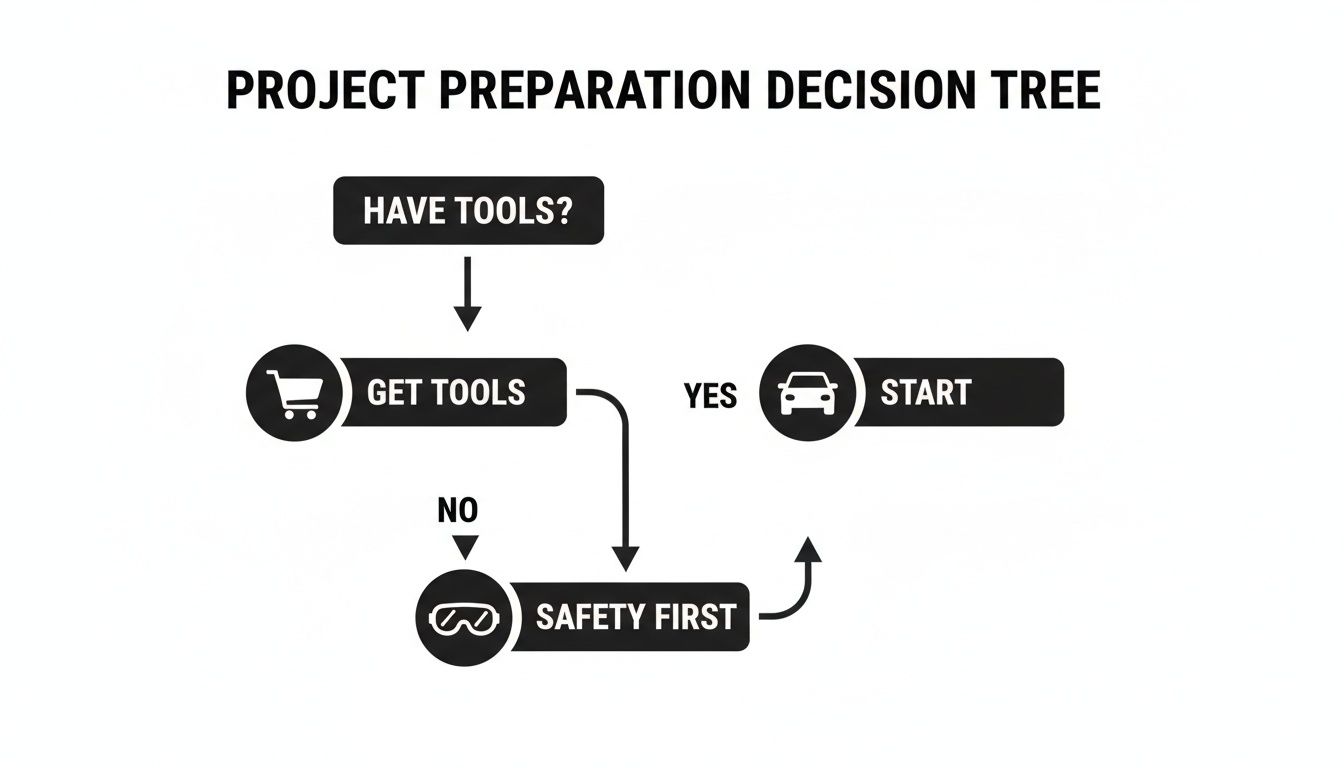
Think of this as your pre-flight check. A few minutes of preparation here can save you a world of headaches later on.
Starting with Light Surface Spots
If you’re dealing with fresh, chalky Type I spots—the kind that haven’t been baking in the sun for weeks—a simple and gentle approach is usually all it takes. These are just mineral deposits sitting on top of the paint, and the goal is to dissolve them before they can cause real trouble.
A popular homebrew solution is a 50/50 mix of white vinegar and distilled water. The vinegar’s mild acidity can dissolve the calcium and magnesium pretty well. But be careful. Never spray this on a hot panel or in direct sunlight, and always rinse the area thoroughly with clean water right after to neutralize the acid.
Honestly, a much safer and often more effective option is a quality quick detailer spray. These are pH-balanced and loaded with lubricants that lift the minerals off the surface without scratching. Just a quick spray, a gentle wipe with a plush microfiber, and a final buff is all it takes.
Tackling Stubborn Etched Spots
So, the quick detailer didn’t cut it. You’ve now officially entered Type II territory. These spots have started to etch into your clear coat, and you need more chemical firepower to get them out. This is where a dedicated water spot remover becomes your best friend.
These formulas are engineered specifically to break down stubborn mineral deposits. Considering that water spots affect over 70% of vehicles in areas with hard water, and that they can kill your paint’s gloss by 20-30%, using the right tool for the job is critical.
Even after a good chemical cleaning, you might still feel a gritty texture on the paint. That’s your cue to grab a clay bar or clay mitt. Claying is a mechanical decontamination step that physically shears off any bonded minerals the chemical cleaner left behind. It’s essential for getting that perfectly smooth, glass-like feel back.
For a complete walkthrough on this, check out our guide on https://titancoatings.us/how-to-decontaminate-car-paint/.
Correcting Deeply Etched Damage
If you can see distinct, crater-like Type III spots, you’ve got a bigger challenge. No amount of chemical cleaner or clay is going to fix this. The damage is now physically in your clear coat, so the only way to remove it is to level the surrounding paint down to the bottom of the etch.
This means it’s time for machine polishing.
You’ll start with a dual-action (DA) polisher and a cutting compound. The compound’s fine abrasives will carefully remove a microscopic layer of clear coat, erasing the water spot craters.
Here’s a pro tip: Don’t mash the polisher into the paint. A common mistake is using too much pressure or speed. Let the machine and the compound do the work. The goal is refinement, not brute force.
After the cutting stage, the area will look hazy. That’s normal. Next, you’ll switch to a softer foam pad and a finishing polish. This refines the surface, removes the micro-scratches from the compound, and restores that deep, dripping-wet gloss.
When to Draw the Line
There is one final, more aggressive method called wet sanding, but I have to be clear: this is an absolute last resort. Wet sanding takes off a serious amount of clear coat and has a very high risk of causing permanent, costly damage if you don’t know exactly what you’re doing.
If machine polishing doesn’t get the spots out, it’s time to stop. That’s your car telling you to call in a professional. A skilled detailer can use a paint depth gauge to see if there’s enough clear coat left to work with safely, saving you from a potential repaint.
And remember, this same logic of tackling stubborn spots applies elsewhere, too. If you’re fighting hard water on other surfaces, you can find plenty of easy methods to remove hard water stains from windows that follow similar principles.
The Ultimate Defense with Advanced Coatings
You’ve put in the hours. You’ve polished your paint back to a flawless, mirror-like finish, and the last thing you want is to do it all over again in a few weeks. The goal now is to shift from correction to prevention, making sure those aggravating water spots never get a foothold again. This is where you graduate from simple waxes and sealants and step into the world of serious, long-term paint protection.
This was the exact cycle a meticulous car owner named John found himself trapped in. He was constantly fighting a losing battle: wash, dry, find new water spots, polish them out, and repeat. He felt like he was just managing the damage, not preventing it. That all changed when he found a different kind of shield for his car.
A New Era of Paint Protection
John’s deep dive into paint protection led him to Titan Coatings, a company that was pioneering something different: Elastomer coatings built with sophisticated nano-tube and Dark Matter technology. One product, in particular, seemed like it was engineered specifically to solve his problem.
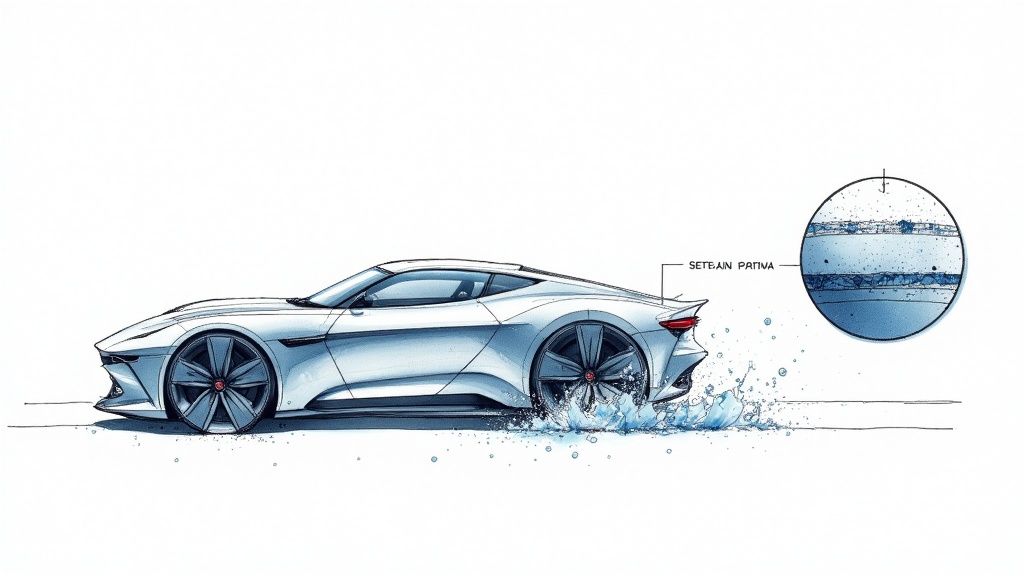
He found Titan Vulcan TX155, a coating designed for extreme durability and unbelievable water repellency. What really caught his eye wasn’t just its hardness, but its unique flexibility—a total game-changer for keeping a car protected year after year.
After applying Vulcan TX155, the results were instant and dramatic. The coating created an intensely hydrophobic surface. Water that used to puddle and dry into ugly mineral rings now beaded into perfect spheres and shot right off the paint, taking all those damaging minerals with it. He finally had the self-cleaning effect he’d been dreaming of. It was a proactive defense, not a reactive fix.
Beyond Hardness: The Power of Flexibility
So, what really sets this technology apart from the traditional ceramic coatings you hear about everywhere? It all comes down to elasticity.
Standard ceramic coatings are incredibly hard, but that hardness can be a double-edged sword. It makes them brittle. Think of it like a thin sheet of glass—it can develop micro-cracks from road vibrations or just the natural expansion and contraction of your car’s body panels as temperatures swing.
Titan’s elastic coatings, on the other hand, are engineered to be both hard and flexible. This is the crucial difference.
- Temperature Resilience: The coating flexes with the metal as it bakes in the summer sun and shrinks in the freezing winter. This flexibility prevents those tiny cracks where water and contaminants can sneak in and cause damage from underneath.
- Durability: This same flexibility helps the coating shrug off the abuse of daily driving, from small impacts to constant vibrations, keeping the protective layer intact for years, not months.
This combination of properties creates a far more robust and enduring barrier. John finally got the “set it and forget it” peace of mind he was after, knowing his investment was shielded 24/7 from water spots, bird droppings, UV rays, and harsh chemicals.
The reality is, hard water is a problem at an estimated 60% of global car washes. Professional detailers will tell you that 40% of their repeat business comes from fixing the same recurring water spot issues. This is why advanced protective coatings, which can cut etching risks by up to 70%, have become essential for modern vehicle care.
Creating a Comprehensive Shield
For truly bulletproof protection, the best coatings go beyond just water spots to defend against all the other environmental threats. Think about how protective films for ultimate surface defense use advanced technology for things like infrared rejection and UV protection. Applying that same multi-layered defense strategy to your vehicle’s paint is the key to preserving it for the long haul.
When you choose an advanced Elastomer coating, you’re not just making your car easier to clean. You’re fundamentally changing how its surfaces interact with the world around them. It’s the final step in moving from a reactive cycle of spot removal to a proactive strategy of total paint preservation.
To explore the full range of options and find the perfect shield for your vehicle, you can dive deeper into our lineup of automotive ceramic coatings.
Why Elastic Coatings Are a Game-Changer Over Traditional Ceramics
Look, not all paint protection is the same. Far from it. We’ve all heard about ceramic coatings and their reputation for being hard and glossy. But what if I told you that very hardness is often their biggest flaw?
Imagine a thin sheet of glass. It’s strong if you press on it directly, but it’s completely rigid. It can’t handle vibrations or small impacts without cracking. That’s the fundamental problem with many traditional coatings, and it’s where a smarter approach to coating science really makes a difference for preventing things like water spots.
Titan Coatings took a completely different path. We were the first company to introduce Elastomer coatings to the market, built from the ground up with advanced nano-tube and Dark Matter technology. Instead of wrapping your car in a brittle shell, our coatings give you the hardness of glass combined with the flexibility of a high-tech polymer. This isn’t just a small tweak—it’s a totally different philosophy for protecting your paint.
The Rigidity Trap
Most traditional ceramic coatings cure into a very stiff, crystalline layer on top of your paint. This sounds great in theory, and it does offer decent chemical resistance at first. But a car isn’t a static object sitting in a showroom.
Your car’s body panels are constantly expanding in the summer heat and contracting on cold winter nights. A rigid coating simply can’t move with the metal. Over time, that constant stress creates microscopic cracks in the coating itself. These tiny fissures are the weak points where water, minerals, and grime can sneak through and start etching your clear coat. It’s a big reason why you sometimes see water spots reappear even on a “protected” car.
Flexibility is the Secret to Real-World Durability
This is where Titan’s elastic coatings really prove their worth. Because they’re flexible, they can expand and contract right along with your vehicle’s panels, maintaining a perfect seal.
- No More Temperature Stress: Drastic temperature swings won’t cause the coating to crack down. It stays as a seamless, unbroken shield whether your car is frozen solid or baking in the sun.
- Vibration Proof: The coating naturally absorbs the tiny vibrations from driving on the road, which prevents stress fractures from ever forming.
- Better Impact Absorption: That elastic quality helps to spread out the energy from small impacts, like a stone kicked up on the highway, making chips less likely.
This design just makes more sense for a vehicle that actually gets driven. The protective barrier you invested in stays fully intact for much longer, giving you a reliable defense against the elements. You can explore the differences for yourself on our comparison page to see how this technology stands up.
The concept is really straightforward: a coating that can flex is a coating that can last. Its ability to adapt to what your car actually goes through day-to-day prevents weak points from forming, ensuring the shield you paid for keeps doing its job year after year.
This flexibility is absolutely critical for preventing water spots in the long run. By maintaining a perfect, non-porous surface, an elastic coating makes water bead up and roll right off, taking all those damaging minerals with it.
If you’re serious about preserving your vehicle’s finish, this is the next level of protection. You can check out the full lineup of our advanced coatings on the Titan Coatings shop page.
Answering Your Top Water Spot Questions
We’ve gone deep into identifying water spots, walking through the removal process, and layering on serious protection. But I know there are always a few lingering questions. Let’s tackle the ones I hear most often so you can handle any water spot situation with confidence.
Is It Safe To Use Vinegar on My Car?
The short answer is yes, but with a big asterisk. A 50/50 mix of white vinegar and distilled water can work on the faintest, freshest mineral deposits. The vinegar’s mild acidity can dissolve those surface-level minerals before they have a chance to bond.
But you have to be careful. Never, ever spray it on a hot panel or in direct sunlight—you’re just asking for trouble and could cause more etching. As soon as you’re done, you need to rinse the area completely with water to neutralize any remaining acid. Honestly, for anything more than a tiny, brand-new spot, you’re always better off reaching for a dedicated, pH-safe water spot remover. It’s the safer, more effective play.
Do Titan Coatings Stop Water Spots Completely?
Think of a top-tier elastomer coating like Titan Vulcan TX155 as your car’s ultimate defense, making it incredibly resistant to water spots, though nothing is 100% foolproof. The magic is in its unbelievable hydrophobicity. Water has no choice but to bead up and practically jump off the paint, taking those pesky minerals with it.
On the off chance some hard water does dry on the surface, here’s the key difference: the spots are sitting on top of the coating, not eating into your clear coat. A quick wipe with a detail spray is usually all it takes to remove them. The coating serves as a tough, sacrificial shield, taking the hits so your paint doesn’t have to.
When Is It Time to Call in a Pro?
You call a professional when you’ve hit a wall. If you’ve carefully used a chemical remover and even tried a light polish with your DA on those stubborn etched spots (Type III) and they’re not budging, it’s time to put the tools down.
Anything requiring aggressive compounding or—the final frontier—wet sanding is firmly in professional territory. These methods physically remove layers of your clear coat. One wrong move can cause permanent damage. A pro has the paint depth gauges and, more importantly, the experience to fix severe damage without burning through your paint.
Also, if you’ve used a chemical remover but the surface still feels gritty with bonded gunk, your car is telling you it needs a full decontamination. If you want to understand that process better, you can learn more about what a clay bar treatment involves and see how it preps the paint for polishing and coating.
Ready to give your vehicle a real, lasting defense against water spots and everything else the road throws at it? The unique, flexible elastomer technology in Titan Coatings, powered by nano-tubes and Dark Matter tech, offers a level of protection that old-school, rigid ceramics just can’t touch.
Explore our full range of advanced coatings and find the perfect shield for your car on the Titan Coatings shop page.
0 Comments
Trackbacks/Pingbacks