
A coating can look perfect on the day it's applied and still be the wrong coating for the surface. The failure often begins with a specification mismatch, not an obvious application mistake. A pavement seal coat may be designed to resist weather, moisture, oxidation, fuel spills, and contaminants, while an automotive or marine film must also manage repeated movement, chemical exposure, abrasion, and visibility. The label “ceramic,” “elastomeric,” or “seal coat” doesn't answer those questions by itself.
A useful specification tells you what the material contains, how it must be applied, which test method supports each claim, and what failure looks like. That logic applies whether you're reviewing a municipal asphalt product, coating a fiberglass boat, protecting a vehicle's paint, or applying glass protection to a windshield. The chemistry changes, but disciplined verification doesn't.
Why a Coating Spec Sheet Beats a Brand Promise
A premium ceramic coating can look flawless on a vehicle at delivery and still haze or develop defects after one freeze-thaw cycle. Gloss and reputation describe the initial finish, not whether the film can accommodate thermal movement on that substrate.
A detailer reviewing a competitor's technical material found documented discussion of crack movement in the 2 to 7 mil range during thermal cycling. Independent repair guidance explains why recovery through repeated cycles matters more than a single elongation value ICRI's thermal movement guidance. The trade-off is clear: a high elongation number alone does not prove durable recovery, while a brand name does not describe the service condition.
A useful specification sheet should answer four practical questions:
- What is the material? Identify the binder, polymer system, aggregate or filler, water phase, and prohibited ingredients.
- How is it controlled? Check solids, density, viscosity, sieve passage, emulsion stability, application rate, and cure conditions.
- How does it perform? Look for defined resistance to heat, water, adhesion loss, sagging, blistering, re-emulsification, abrasion, and movement.
- How was the claim tested? ASTM methods establish a procedure and result that can be compared, rather than leaving the buyer to interpret marketing language.
Pavement specifications also provide a useful bridge to elastomeric and ceramic coating reviews. A county seal-coat specification describes a proportioned mixture of petroleum-based emulsion, latex rubber, mineral aggregate, and water for sound asphalt. It references ASTM D140, D466, D529, and D2939, requires compliance with ASTM D8099, and prohibits refined coal tar Ontario County seal-coating specifications.
Practical rule: A performance adjective without a test method is a sales description, not a specification.
Climate belongs in the review as well. Freeze-thaw exposure, daily thermal movement, moisture, abrasion, and chemical contact can change which binder and cure window fit the job. A coating that survives on one substrate may fail on another when its movement response or exposure limits do not match the service condition.
The Four Building Blocks of Every Seal Coat Specification
Read a seal coat specification in four blocks: material definition, formulation parameters, performance criteria, and test methods. Together, they connect pavement-style requirements with elastomeric and ceramic coating decisions.
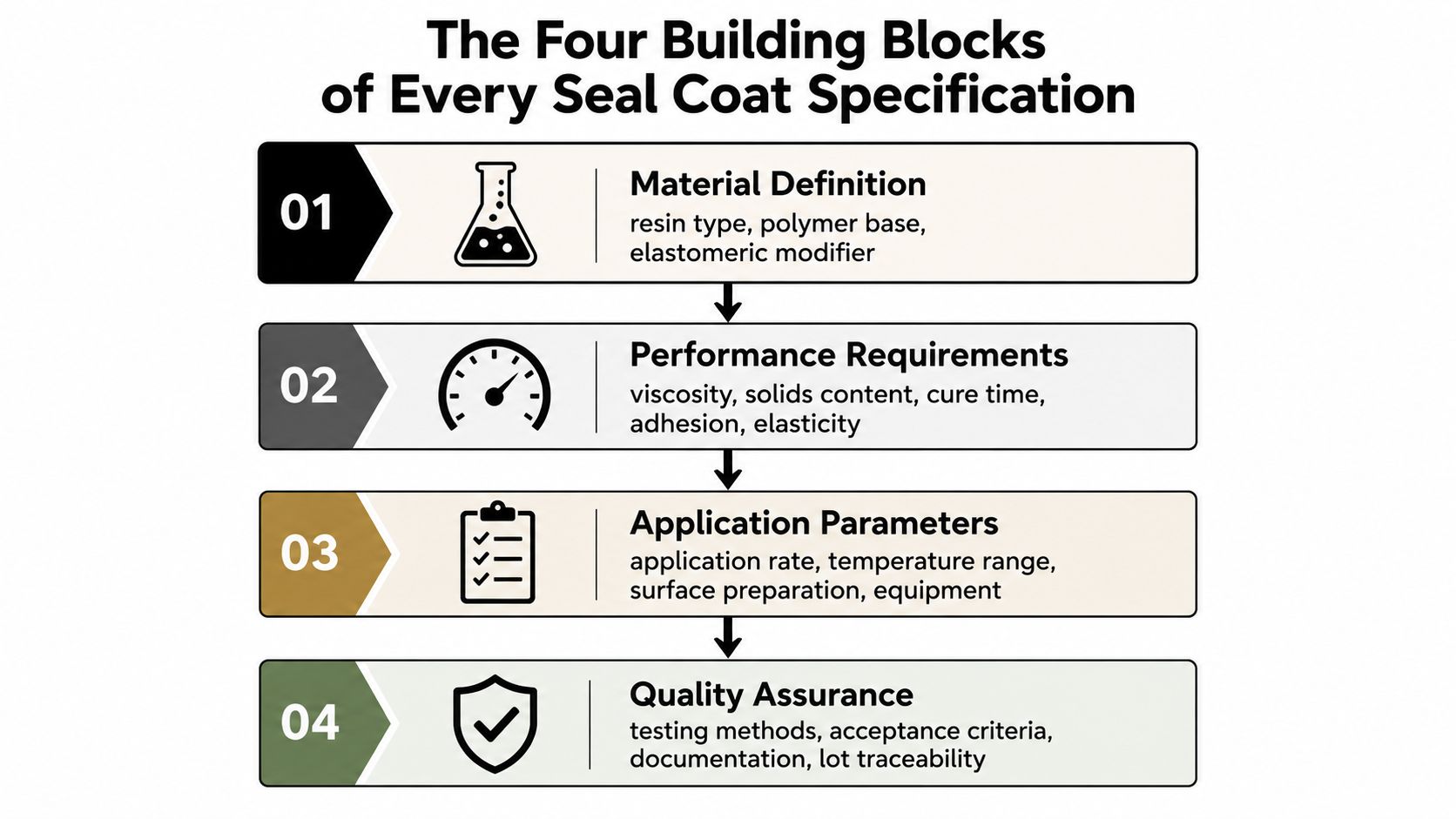
Material definition answers what it is
This block identifies the chemical system and its components. It may specify a petroleum emulsion, acrylic, polymer-modified asphalt, latex rubber, polyurethane dispersion, mineral aggregate, or water phase. In an elastomeric wall coating, the polymer modifier matters as much as the base resin because the complete film controls movement response. Ceramic-filled systems also need the filler type and its role stated clearly.
Formulation parameters answer how much is present
Check solids by weight, density, viscosity, sieve passage, water content, and application thickness. A municipal seal-coat requirement may call for a minimum weight of 9.5 lb/gal, at least 60% nonvolatile component by weight, complete passage of mineral aggregate through the No. 20 sieve, and asphalt content of 25% to 35% of nonvolatiles by weight TRB seal-coat reference.
These values control film build, sprayability, settling, and coverage. They also expose trade-offs. Higher solids can improve build, while viscosity and aggregate size still determine whether the material applies cleanly through the specified equipment.
Performance criteria answer how it holds up
Performance language should address heat, water, adhesion, abrasion, flexibility, and recovery after movement. A state highway specification requires resistance to heat without blistering, sagging, or slipping, while setting limits for water, nonvolatile solids, ash, and specific gravity New York State highway seal-coating specification.
For elastomeric and ceramic coatings, add the service exposure that matters on the project. Freeze-thaw cycles, daily thermal movement, moisture, abrasion, and chemical contact can change the acceptable binder, filler level, and cure window.
Test methods answer how we know
A reported value has meaning only when its procedure is defined. ASTM or ISO references identify sample preparation, conditioning, equipment, loading, and pass or fail interpretation. ASTM D140, D2939, and D3910 illustrate how pavement specifications connect sampling, emulsion behavior, and wear testing to material selection.
Without that context, suppliers can call two coatings “flexible” while measuring different responses. Require the method beside every performance claim.
ASTM and ISO Standards That Anchor Seal Coat Specifications
Standards establish repeatable measurement, but the buyer still must verify that each method matches the service environment. ASTM D140, D2939, and D3910 come from pavement-style seal coat work, yet their discipline also helps evaluate elastomeric and ceramic systems. The test must match the substrate, film, exposure, and failure mode.
| ASTM Standard | Tests For | Spec Block Served |
|---|---|---|
| ASTM D140 | Sampling bituminous materials | Material definition and quality control |
| ASTM D466 | Cementitious and resinous coating material classification | Material definition |
| ASTM D529 | Bitumen content and filler analysis | Formulation parameters |
| ASTM D2939 | Emulsion stability and residue behavior | Formulation and performance |
| ASTM D8099 | Pavement sealer emissions and durability requirements | Performance criteria |
| ASTM D3910 | Wear resistance under simulated traffic | Performance criteria |
Sampling determines whether the sample represents the batch
ASTM D140 belongs in the material-control block. Its value is straightforward: laboratory results depend on a representative sample. Poor collection can conceal settling, skinning, dilution, or variation between batches. It does not measure long-term durability, so it should not be presented as a substitute for exposure or wear testing.
Composition tests explain the film that remains
ASTM D529 supports analysis of bitumen and filler content. A wet emulsion can appear substantial while the cured film contains less binder than the applicator expects. That difference affects build, flexibility, cure behavior, and resistance to water or abrasion.
ASTM D2939 examines emulsion stability and residue behavior. It helps the spec writer assess whether the material remains uniform, sets as intended, and leaves the specified residue. For elastomeric and ceramic coatings, the same principle applies even when the chemistry differs. Verify what remains after cure, not only how the liquid looks in the container.
Classification and durability methods have different jobs
ASTM D466 supports classification of cementitious and resinous coating materials. ASTM D3910 measures wear resistance under simulated traffic, so it speaks more directly to pavement service than gloss or hardness alone. ASTM D8099 appears in newer pavement-sealer language where emissions and durability form part of the product requirement.
ASTM methods often anchor North American municipal specifications because agencies and contractors already use their terminology, equipment, and acceptance practices. ISO methods overlap in areas such as corrosion, adhesion, and coating characterization. If both systems appear, compare sample preparation, conditioning, loading, and pass criteria rather than treating the standards as interchangeable.
Climate can change which result matters most. Freeze-thaw exposure, daily thermal movement, moisture, abrasion, and chemical contact may make flexibility, adhesion, residue stability, or recovery after movement more important than a single hardness value. For detailers and fabricators reviewing a military specification coating reference, apply the same discipline: define the test, substrate, exposure, and pass condition before comparing products.
How Municipal and Highway Specs Define Acceptable Materials
A municipal seal-coat specification defines acceptance through measurable thresholds, not a brand promise. The same product can suit routine pavement maintenance yet fail a project that demands greater residue stability, heat resistance, traffic wear, or chemical resistance.
One municipal document based on Caltrans practice requires quick-setting emulsified asphalt grade CQS1h, potable water that will not cause separation, aggregate passing the No. 20 sieve, minimum 9.5 lb/gal weight, 60% minimum nonvolatile content, and 25% to 35% asphalt content by weight of nonvolatiles City of Horace seal-coat specification. These requirements describe application behavior and cured-film yield, not merely the liquid's appearance.
| Parameter | Municipal Range | State DOT Range | Why It Matters |
|---|---|---|---|
| Nonvolatile content | A municipal specification may require 60% minimum | A highway specification may require 47% minimum nonvolatile solids | Nonvolatile content indicates how much material remains after water leaves |
| Water content | Maximum depends on the document | One state specification sets 50% maximum water content | Excess water can reduce film build and extend cure |
| Mineral aggregate | 100% passing the No. 20 sieve in one municipal reference | Aggregate gradation is controlled by the project specification | Sieve passage influences sprayability and surface uniformity |
| Specific gravity | Not always stated | One state specification requires at least 1.16 | Density helps verify batch consistency |
| Heat behavior | No blistering or sagging may be required | One highway specification also prohibits slipping under heat | Heat resistance exposes binder instability |
The ranges cannot be treated as interchangeable. Compare the exact clause, test method, substrate, conditioning period, and pass condition before calling a material compliant. That discipline also applies when pavement-style language is used to assess elastomeric or ceramic coatings. ASTM D140, D2939, and D3910 may describe asphalt sampling, coating behavior, or simulated wear, but they do not by themselves predict performance on every metal, composite, or previously coated surface.
Traffic loading exposes weak residue, poor adhesion, and inadequate wear resistance sooner than lightly used pavement. A documented heavy-truck failure should be tied to the project record, test report, and substitution details before it is presented as evidence. Without those records, the defensible conclusion is narrower: service severity determines how much weight to give abrasion, adhesion, recovery after movement, and chemical exposure.
Public specifications also leave climate decisions partly unstated. Freeze-thaw cycles, moisture, strong solar heating, and daily expansion can shift the priority from density or hardness toward flexibility, adhesion, and retained film integrity. For broader commercial coating decisions, a commercial coating supplier resource can help distinguish a product category from a specification-grade material. The chemistry may change, but the verification process remains the same.
Formulation Parameters Buyers Should Verify
A seal coat formulation predicts application behavior more reliably than a product label. Solids, water, density, particle size, and cure conditions indicate what reaches the substrate, how the film builds, and how sensitive the work will be to temperature and moisture.
Public specifications show why these values must be read together. One municipal reference calls for 9.5 lb/gal minimum weight, 60% minimum nonvolatile content, aggregate passing the No. 20 sieve, and asphalt content of 25% to 35% of nonvolatiles by weight. A separate state specification uses different limits, including 50% maximum water content, 47% minimum nonvolatile solids, 30% to 40% ash of nonvolatiles, and a specific gravity of at least 1.16. The figures are formulation controls, not interchangeable quality scores.
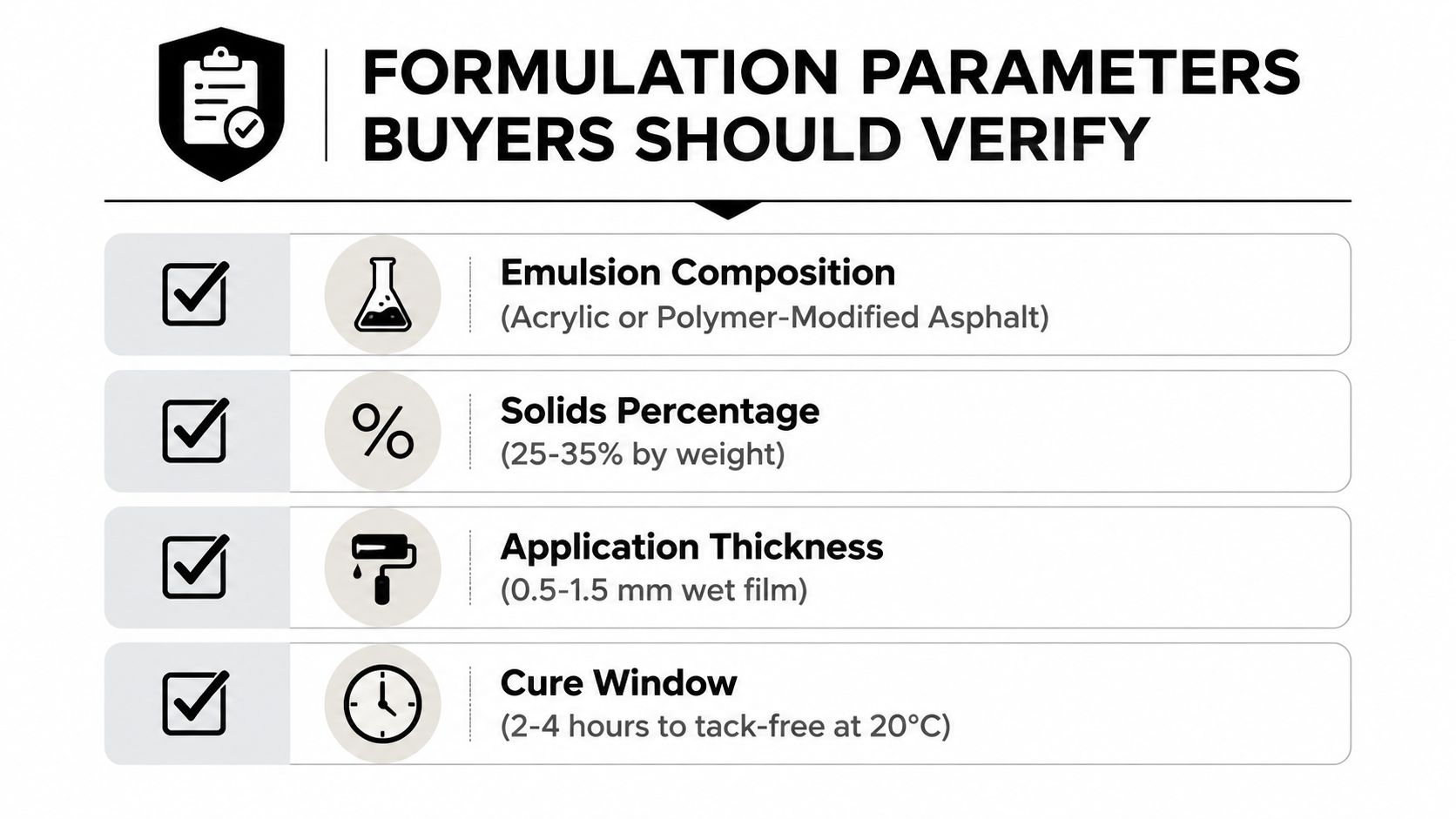
Read the sheet at the applicator
- Binder and emulsion: Identify whether the binder is petroleum-based, acrylic, latex-modified, or another polymer system. A quick-setting grade such as CQS1h will not behave like a slow-setting emulsion.
- Solids and water: Excess water can reduce film build, prolong set, and produce uneven coverage. Record the supplied value before any dilution.
- Particle size: Passage through the No. 20 sieve is a practical sprayability check. Oversized or poorly dispersed particles can clog equipment or leave a rough film.
- Cure and storage: Use the supplier's documented window. A surface that feels dry at the edge may not have developed serviceable cure through the film.
The specification should also address separation and water resistance. One municipal requirement calls for potable water that does not cause separation. Another requires resistance to water without blistering, sagging, adhesion loss, or re-emulsification, along with a firm set at 24 hours Spokane seal-coating specification.
Inspect each shipment for creaming, settling, skin formation, and unusual viscosity. Dilution errors are difficult to catch visually because the material may remain workable while falling outside its intended solids range.
For adjacent concrete work, the sealer guide for Atlanta concrete offers context for matching chemistry to exposure. Apply the same review to elastomeric and ceramic systems: verify the substrate, preparation, formulation, and test language before approving the product.
Thermal Cycling and Movement Profiles in Modern Specs
Thermal movement is where many attractive coatings reveal their weakness. ASTM-related analysis recommends plotting crack width against wall surface temperature to create a movement profile, rather than reducing performance to one elongation value ASTM thermal movement analysis.
Independent repair guidance notes that thermal-cycling crack movement may be only 2 to 7 mils, which is precisely why repeated-cycle recovery matters more than a single stretch result ICRI's thermal movement guidance. A coating can elongate dramatically once and still fail after repeated expansion and contraction if it doesn't recover, retain adhesion, and resist fatigue.
Plot the substrate, not just the product
For asphalt, gelcoat, and coated aluminum, record crack or joint movement against surface temperature. The resulting profile shows whether the substrate moves gradually, concentrates strain at a defect, or changes behavior near a transition temperature.
That information is more useful than a generic statement such as “highly flexible.” If the film bridges a moving crack but loses adhesion at the edge, the elongation number didn't predict the actual failure.
| Substrate | Movement Consideration | What to Record | Coating Question |
|---|---|---|---|
| Asphalt | Existing cracks and seasonal expansion | Crack width against surface temperature | Does the film retain adhesion as the pavement moves? |
| Gelcoat | Panel flex and thermal expansion | Crack or joint response through cycling | Does the coating recover without whitening or splitting? |
| Coated aluminum | Heat-driven expansion and contraction | Film defects at edges and bends | Does the film stay attached through movement? |
A rigid film may offer strong surface hardness but poor strain recovery. An elastomeric film can absorb movement more effectively, but it still needs adequate adhesion, cure, chemical resistance, and abrasion performance. Review Titan's coating flexibility information alongside the actual product data sheet, and ask for the test geometry, conditioning, and substrate used.
Where Elastomer and Dark Matter Technology Change the Equation
Elastomeric technology shifts the design target from maximum initial hardness to hardness with movement tolerance. Titan describes its system through elastomer coatings, nano tubes technology, and Dark Matter technology. The stated aim is a film with glass-like hardness that remains flexible enough to limit cracking as the substrate moves through hot and cold conditions.
That trade-off matters because static strength does not predict fatigue performance. A film can appear sound in a bench test, then fracture at a defect, edge, or impact point after repeated thermal movement. Flexible chemistry can absorb more strain, but the selected product still needs test evidence showing adhesion, recovery, and cure on the intended substrate.
| Performance Criterion | Unmodified Emulsion | SBS Elastomer-Modified | Dark Matter Hybrid |
|---|---|---|---|
| Movement response | Check fatigue and recovery carefully | Intended to add elastic response | Examine binder and additive interaction |
| Surface hardness | May favor film formation over flexibility | Can balance toughness and movement | Verify with the product's own data |
| Thermal cycling | Depends on substrate, cure, and adhesion | Modification may improve strain handling | Technology claims require product-specific validation |
| Buyer evidence | Residue, adhesion, water, and wear data | Recovery, bend, and abrasion data | Recovery, bend, abrasion, and exposure data |
For automotive, marine, and mobile-detailing work, request recovery after elongation, mandrel-bend performance, abrasion loss, adhesion, and environmental conditioning. A coastal gelcoat panel must handle movement, salt, water, ultraviolet exposure, and impact from road or marine contaminants. The highest hardness label alone does not establish that performance.
The same evaluation applies when pavement-style specification language meets elastomer and ceramic coating systems. ASTM D140, D2939, and D3910 help frame material handling, coating behavior, and application controls, while climate determines which failures deserve priority. Heat, freeze-thaw movement, saltwater, humidity, and substrate flex can expose weaknesses that a standard product sheet leaves unstated.
Review Titan's elastomer coating technology as part of that comparison, then verify the selected product's actual test geometry, conditioning, substrate, and film thickness. Detailers can also consult Soca Services Painting commercial coatings for a practical commercial-coating perspective, while treating product-specific claims as unverified until the current technical documentation supports them.
Field Test Methods That Match the Specification Language
A field test should expose a coating failure before the customer's vehicle, vessel, or pavement does. It cannot replace a certified laboratory method, but it can reveal poor adhesion, unstable flow, softening, sagging, or incomplete cure during product selection and job preparation.
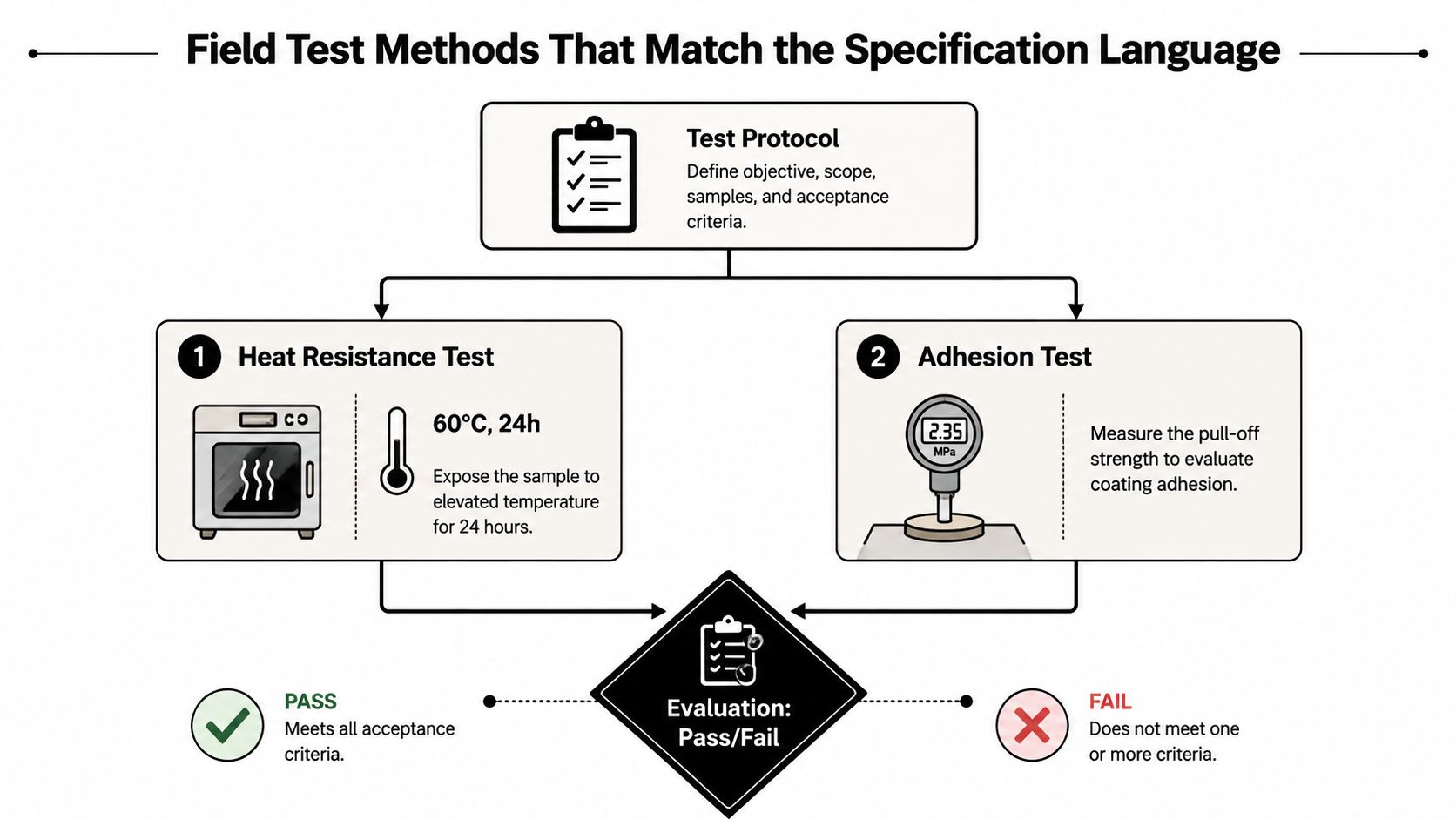
Turn specification terms into repeatable observations
- Heat resistance: Condition a coated panel in a controlled oven. Record softening, blistering, sagging, slipping, and color change. Report it as a screening result, not a certified ASTM result.
- Water resistance: After water exposure, inspect for blistering, whitening, re-emulsification, and adhesion loss. Follow the supplier's stated panel preparation and exposure method.
- Wet flow: Apply the material to a vertical panel. Record film thickness and panel angle, then check for runs or sagging.
- Firm set: Test tack at consistent intervals with a clean tool or gloved touch. A dry surface can still contain uncured material beneath the skin.
ASTM D3359 is associated with crosshatch adhesion evaluation, ASTM D4060 with abrasion testing, and ASTM D4585 with water exposure practices. A field check can examine the same failure concern without proving compliance with the official method. Record “ASTM passed” only when the responsible laboratory completed the full procedure.
For elastomer and ceramic systems, add recovery after elongation, mandrel-bend performance, abrasion loss, and environmental conditioning. Heat, freeze-thaw movement, saltwater, humidity, ultraviolet exposure, and substrate flex change which result matters most. Pavement references such as ASTM D140, D2939, and D3910 help organize material handling and application controls, but the panel, film thickness, conditioning cycle, and climate still need to match the intended service.
Use a controlled heat source, hygrometer, wet-film applicator, crosshatch cutter, adhesion tape, timer, calibrated scale where relevant, and camera. Log the batch, substrate, preparation, ambient conditions, thickness, cure time, conditioning, observations, and photographs. Titan's coating-testing resource provides a useful checklist for supplier questions and test records.
Matching Titan Coatings Products to the Right Spec Block
Product selection should start with the hardest service condition, then map that condition to the relevant specification block. Pavement-style specifications separate material handling, application controls, adhesion, wear, and environmental exposure. The same discipline helps with elastomer and ceramic systems. Glass needs optical and water-shedding performance. A flexible vehicle coating needs movement and impact tolerance. A spray product needs a controlled, repeatable workflow.
Confirm current availability and product positioning through the Titan Coatings shop before ordering.
| Product | Primary Spec Block | Key Verification Area | Suitable Buyer Question |
|---|---|---|---|
| Apex Glass Ceramic Coatings | Clarity, water behavior, and chemical resistance | Confirm current glass-specific application and performance data | Will it improve rain visibility without creating glare or wiper haze? |
| Alpha Quartz | Flexibility, abrasion, and thermal movement | Confirm elasticity, substrate compatibility, and cure instructions | Can the film tolerate movement and impact on the selected surface? |
| Ultra Ceramic Spray | Application workflow and maintenance protection | Confirm flash, cure, coverage, and recoat instructions | Does the process suit a mobile detailer or fast turnaround? |
Apex Glass Ceramic Coatings is intended for glass and windshield use. Check optical clarity, even coverage, water behavior, wiper compatibility, and removal procedure if an application goes wrong. The Apex Glass Ceramic Coatings product page supplies the product context. Verify glass preparation, ambient conditions, and curing requirements before treating a customer vehicle.
Alpha Quartz fits the elastomer block, where movement and surface resilience control the decision. Its intended flexibility can help the film remain intact during temperature changes and impacts, including bugs striking the vehicle surface. The specification still depends on the actual substrate, preparation, film build, cure, and maintenance schedule. Those details determine whether the coating can accommodate movement without losing adhesion.
Ultra Ceramic Spray belongs in the high-throughput block. Review the Ultra Ceramic Spray product information for application sequence, flash behavior, curing, compatible surfaces, coverage, and maintenance. A fast process may suit a mobile detailer, while a slower system may offer a different balance of film development and handling time.
Treat each product page as a starting point for verification, not proof that the product meets every project specification. Match the documented process to the substrate, climate, exposure, and available working time.
Choosing the Right Specification for Your Climate and Use Case
The correct seal coat specification starts with four service inputs: traffic or handling intensity, thermal movement, surface type, and chemical exposure. Pavement specifications connect material selection to traffic categories, while elastomeric and ceramic coating work adds substrate movement, film recovery, and cure control. MoDOT's seal-coat guidance shows why traffic belongs in the specification itself, rather than being treated as an afterthought.
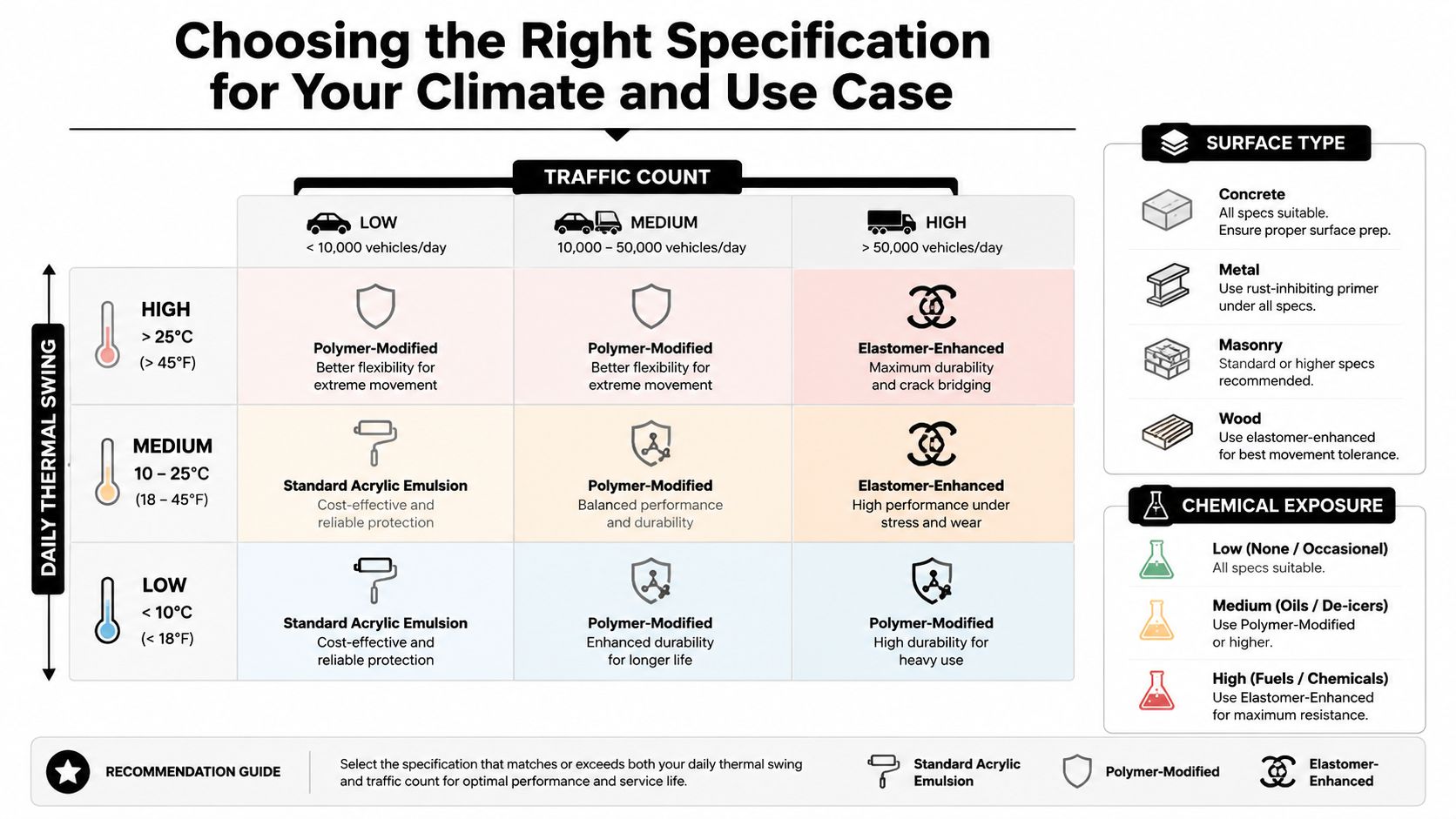
Use the service condition as the selector
- Light handling and stable temperatures: Verify material definition, solids, adhesion, and cure controls. A simpler formulation can suit a sound substrate with limited movement.
- Frequent turning, braking, or abrasion: Weight wear resistance, adhesion, aggregate control, and film recovery more heavily. Concentrated shear exposes weak coverage quickly.
- Freeze-thaw or large temperature changes: Prioritize movement profiling, flexibility, recovery, low-temperature adhesion, and crack resistance. Hardness by itself does not predict service life.
- Marine or salt exposure: Require water resistance, adhesion retention, chemical exposure data, and a named environmental test. Pavement-sealer salt performance does not automatically transfer to gelcoat or aluminum.
- High ultraviolet exposure: Request accelerated-weathering details, panel preparation, inspection criteria, and an explanation of how the exposure relates to the service environment.
A supplier comparison should list ASTM or ISO references, solids by weight, application thickness, cure window, flexibility or recovery data, and the exact method behind each claim. A brochure number without its test method, substrate, and conditioning does not support a specification-grade decision.
For a coastal daily driver, screen the system for glass visibility when windshield treatment is included, chemical and water resistance on vehicle surfaces, movement tolerance across flexible or mixed substrates, and a process the detailer can repeat. One vehicle may require different products for glass, paint, plastic, vinyl, and wheels because each surface imposes a different service condition.
The climate decision belongs in the specification, not only in the product choice. A seal coat selected for traffic but ignored thermal swing can fail at movement points; a ceramic or elastomeric film selected without substrate and cure data leaves the same gap.
Match the hardest service condition to the specification block, then choose the product with verifiable data for that block.
APEX NANO – Titan Coatings provides glass, elastomeric, and ceramic spray systems that can be reviewed through the same specification-first process used for seal coats. Review the available options and application requirements at APEX NANO – Titan Coatings, then compare documented performance and workflow with the surface, climate, and use case.
0 Comments