
A client can spend all morning polishing a vehicle and still leave with corrosion protection that fails at the first salty commute. A coastal car collects chloride in seams, wheel wells, fasteners, and underbody edges. A winter vehicle faces another kind of punishment, repeated freezing, thawing, wet roads, abrasive grit, and deicing chemicals that stay trapped behind trim.
That's why a product's headline claim rarely tells the whole story. Corrosion protection standards define the environment, the test method, or the acceptance criteria, but each document measures a different kind of abuse. A salt-fog result isn't the same as cyclic wet-dry exposure, and a hard surface isn't automatically a durable barrier when the substrate expands, contracts, flexes, and takes stone impact.
A Coastal Detail and a Frozen Commute
The Friday job is on a Florida Keys condominium lot. Salt haze sits on the paint, moisture remains around the lower doors, and the daily driver already shows rust staining where water has found a seam. The detailer can wash the surface, decontaminate it, polish the clear coat, and apply a coating. None of that changes the exposure category created by the location.
Two weeks later, the same operator is working outside a Chicago suburb. The vehicle has spent the winter on roads coated with magnesium chloride. Ice has thawed, refrozen, and thawed again around the wheel wells. Mud and salt have packed into brackets and drain points. The coating isn't facing one steady condition. It's moving through a sequence of moisture, cold, heat, impact, and contamination.
Field rule: specify the exposure first, then judge whether the coating system addresses it.
Laboratory methods try to make those stresses repeatable. Salt spray, humidity, immersion, thermal cycling, adhesion checks, and impact tests each isolate part of the field problem. A buyer who compares only the number of hours on two data sheets may be comparing unrelated tests.
The practical difference matters. ISO 12944 classifies corrosivity according to the environment, while a salt-spray method describes how a chamber operates. A product described as “salt safe” still needs a defined substrate, preparation method, film build, test procedure, and pass criterion before that phrase has purchasing value.
For a detailer, standards aren't paperwork collected after the job. They're a way to ask whether the protection matches the car's actual life. Coastal parking, urban road salt, marine splash, buried steel, and sheltered indoor storage demand different decisions.
What a Corrosion Protection Standard Actually Does
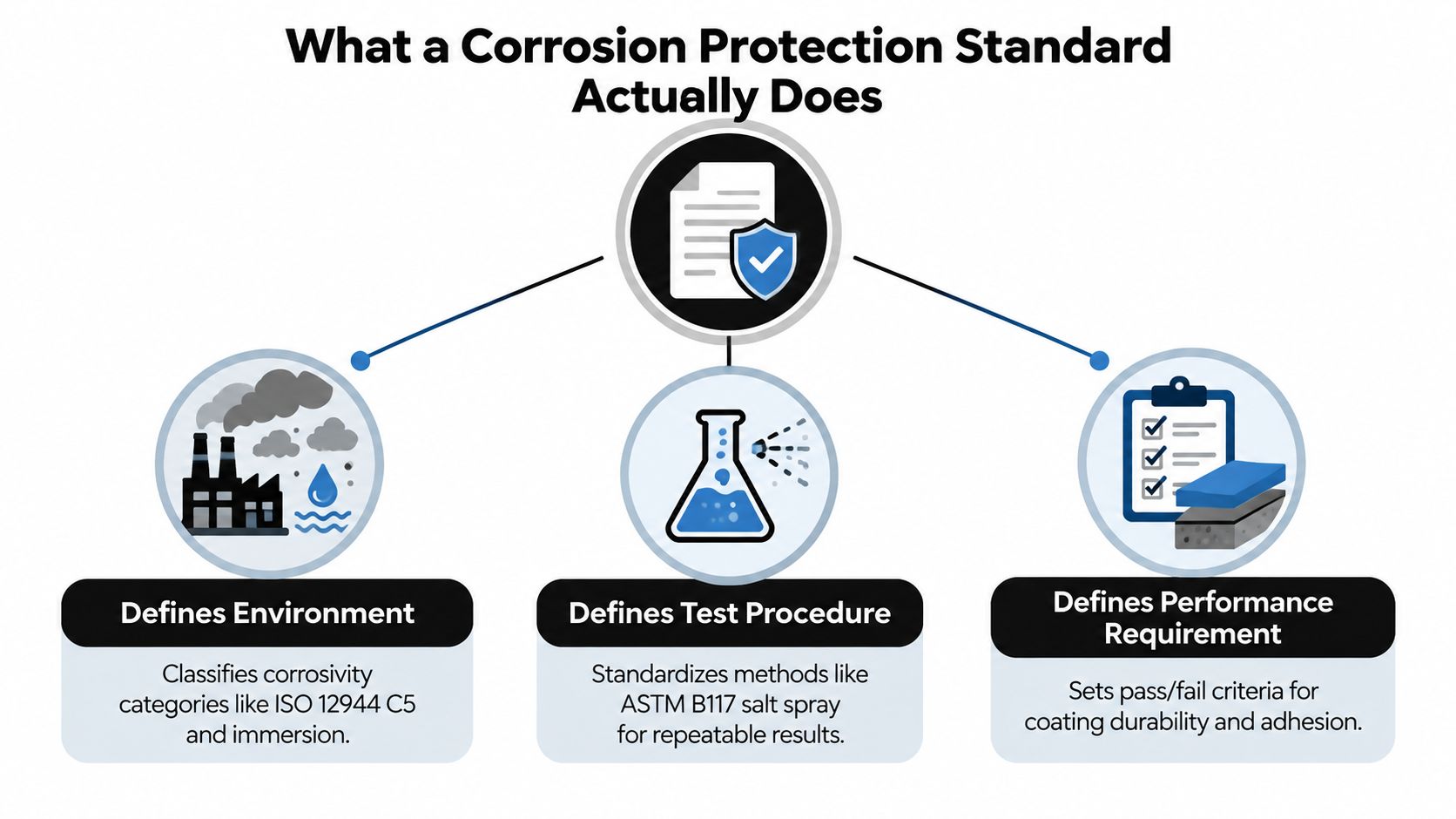
A corrosion protection standard normally performs one of three jobs. It can define an environment, standardize a test procedure, or set a performance requirement. Those functions overlap in a coating program, but they aren't interchangeable.
ISO 12944 is primarily an environment and coating-system framework for steel structures. ASTM B117, by contrast, is a method for operating a neutral salt-spray chamber. A procurement specification can then combine several methods, preparation requirements, film-build rules, and pass criteria into one qualification package.
Read the title as a technical label
The issuing body tells you who developed the document. The number identifies the subject, and a year or revision marker tells you which edition governs the result. Don't assume a familiar code means the same thing across organizations.
A useful report should identify:
- Substrate: steel, aluminum, a prepared panel, or a finished component.
- Preparation: cleaning, abrasive profile, pretreatment, and repair of defects.
- Application: coats, dry-film thickness, cure conditions, and application equipment.
- Exposure: salt fog, humidity, immersion, cyclic corrosion, thermal shock, or impact.
- Acceptance: rust, blistering, scribe creep, adhesion, cracking, or delamination.
“Passed testing” is incomplete without those details. Hours to first rust and scribe creep width often tell a buyer more than total exposure time, because a deliberate cut exposes how corrosion travels beneath the film. Blistering and adhesion ratings show whether the barrier is still attached and intact after exposure.
The standard's real value is traceability. It gives the detailer a language for challenging a vague product claim without pretending that one chamber result predicts every driveway, highway, or marina.
ISO 12944 and the Language of Corrosivity
ISO 12944 is the main global reference for protecting steel structures with protective paint systems. Its practical strength is environmental classification. Instead of treating every job as “indoors” or “outdoors,” it connects coating selection to expected corrosivity exposure. ISO 12944 background and revision history records its introduction as an eight-part standard in 1998, revisions in 2007, and expansion to nine parts in 2018.
The atmospheric classes run from C1 through CX. C1 represents very low exposure, while C2 is low, C3 is medium, C4 is high, C5 is very high, and CX is extreme. The ISO 12944 environment guide also distinguishes immersion categories IM1 through IM4, covering conditions such as fresh water, sea or brackish water, and soil.
Translate categories into working conditions
A heated interior with little contamination may fit C1. Rural or lightly exposed storage is closer to C2. Urban and light-industrial exposure points toward C3, while industrial atmospheres and more demanding coastal conditions move into C4. High-humidity industrial service and marine exposure require a more serious conversation, particularly where chloride deposits, splash, or persistent wetness remain on the surface.
The ISO 12944-5 specification sample organizes coating-system selection around corrosivity and intended durability. That's useful before field exposure begins, but a detailer should avoid turning a structural-steel category into an automatic approval for a consumer coating. Automotive panels, trim, seams, and underbody components have different substrates and failure points.
| Category | Environment | Example | Min. Durability |
|---|---|---|---|
| C1 | Very low | Controlled, heated interior | Confirm the specified durability class |
| C2 | Low | Rural or sheltered storage | Confirm the specified durability class |
| C3 | Medium | Urban or light industrial exposure | Confirm preparation and system compatibility |
| C4 | High | Industrial or coastal exposure | Require matched test evidence |
| C5 | Very high | High-humidity industrial or marine service | Review chloride and wet-dry exposure |
| CX | Extreme | Offshore or severe marine exposure | Require project-specific qualification |
The table is a decision aid, not a substitute for the current standard or a coating manufacturer's complete system specification. The buyer still needs the actual durability class, preparation requirements, film build, and test evidence.
ASTM Salt Spray and Humidity Test Methods Explained
ASTM methods answer narrower questions than ISO 12944. ASTM B117 describes neutral salt spray, a useful screening exposure for comparing panels prepared and coated under controlled conditions. It doesn't recreate every transition a vehicle experiences, because continuous fog can overemphasize some failure mechanisms and omit drying, impact, contamination, and temperature changes.
Humidity and immersion methods answer different questions. ASTM D2247 examines resistance to sustained humidity, while ASTM D1735 uses water fog. ASTM D870 focuses on water immersion. Cyclic procedures such as ASTM D5894, D7893, and D6944 introduce changing exposure patterns that can reveal weaknesses hidden by constant salt fog.
Look beyond the chamber name
A credible report should state panel material, preparation, coating thickness, cure time, scribe design, inspection schedule, and failure rating. Without those controls, “high-hour salt spray” is a marketing label rather than a comparable result.
| ASTM Method | Test Conditions | Primary Stress | Typical Pass Range |
|---|---|---|---|
| B117 | Neutral salt spray | Continuous saline fog | Use the supplier's defined pass criterion |
| G85 | Modified salt or cyclic exposure | Salt, acidity, or wet-dry change | Compare method and annex, not hours alone |
| D1735 | Water fog | Persistent moisture | Review blistering and adhesion |
| D2247 | Humidity | High humidity and condensation | Check substrate preparation |
| D870 | Water immersion | Sustained water contact | Check softening and delamination |
| D5894 | Cyclic corrosion | Alternating corrosive exposure | Prefer matched failure ratings |
The common buyer mistake is treating total hours as service life. Scribe creep width, blistering, and adhesion loss are more useful when the reports use the same method and inspection criteria. A panel that remains visually clean away from the scribe may still show aggressive underfilm movement at the cut.
For a practical primer on how salt-fog results should be interpreted, use this salt-spray corrosion testing resource. It's also worth remembering that a chamber test ranks systems under a defined stress. It doesn't promise that a vehicle parked near the ocean, exposed to road grit, and washed inconsistently will behave like a laboratory panel.
NACE and AMPP Standards for Harsher Environments
NACE documents, now associated with AMPP, are especially valuable when the exposure includes splash, immersion, chemical attack, or repeated environmental transitions. ISO 12944 classifies the environment and guides coating-system selection. ASTM methods often define a chamber or exposure procedure. A NACE test method can add tighter controls around panel preparation, scribe geometry, inspection, and performance interpretation.
NACE TM0304-2004 evaluates liquid-applied maintenance coating systems for atmospheric and splash-zone service through five separate checks: rust creepage resistance, edge retention, thermal-cycling resistance, flexibility, and impact strength. That combination is closer to the problems a marine coating faces at a wet-dry boundary than a single uninterrupted salt-fog exposure. The TM0304 preview provides the method scope.
Why splash zones expose weak systems
A splash-zone film repeatedly wets, dries, flexes, and takes mechanical abuse. A hard coating can look excellent on a static panel and still fail at edges, fasteners, welds, or impact marks. NACE procedures make those weaknesses harder to hide by asking the system to retain more than a clean appearance.
Other NACE and AMPP documents address immersion, aggressive service, and corrosion control for structures. Their value depends on whether the method matches the asset. A detailer doesn't need every offshore document, but a buyer coating marine hardware shouldn't accept a generic salt-spray claim as a replacement for splash-zone evidence.
The right comparison isn't “which standard has the bigger number?” It's “which standard loads the coating in the way the asset is loaded?” A cyclic splash-zone result can be more informative than a longer continuous-fog result when wet-dry transitions and impact dominate the failure.
MIL-SPEC and Defense-Grade Qualification
A MIL-SPEC is a procurement specification, not merely a test method. It can bundle material requirements, preparation, application controls, environmental exposures, acceptance criteria, and qualified-product conditions. That makes it different from a data sheet that lists one salt-spray result without showing how the system was built.
Documents such as MIL-PRF-24667, MIL-PRF-14105, MIL-DTL-16232, and MIL-STD-810 serve different purposes. MIL-PRF-24667 concerns antifouling coatings for marine hull service. MIL-PRF-14105 addresses heat-resistant coatings. MIL-DTL-16232 covers pretreatment coatings such as phosphate systems, while MIL-STD-810 provides environmental test procedures used alongside material and corrosion qualification.
What a non-defense buyer should take from it
A defense-qualified coating system may be evaluated for more than corrosion. Flexibility, impact resistance, fuel or chemical resistance, adhesion, surface preparation, and application repeatability can all matter. That broader qualification is why a MIL-SPEC result isn't equivalent to a longer consumer salt-spray claim.
The buyer still needs to verify the exact document, revision, product designation, and scope. A supplier should identify whether the product itself is qualified, whether the complete system is qualified, and whether the supplied batch and application process remain within the approved conditions.
For procurement teams comparing defense-style documentation with commercial products, this military specification coating guide provides a useful starting point. The practical lesson is simple: ask what the specification controls from substrate to acceptance, not just how many hours appear in the headline.
Matching Standards to Automotive, Marine, and Defense Use
The best standard depends on the failure that matters most. Automotive underbodies see road salt, abrasion, trapped moisture, stone impact, and vibration. Marine structures face chloride-rich air, splash, immersion, and wet-dry cycling. Defense equipment may add fuels, chemicals, heat, field repairs, and strict procurement controls.
Automotive
ISO 12944 categories can help frame the surrounding atmosphere for steel components, but they don't replace automotive-specific preparation and compatibility checks. For a daily driver, inspect seams, brackets, wheel wells, fasteners, and drain paths before selecting a coating. A salt-fog number for a smooth panel won't answer whether a flexible film bridges a moving joint or survives gravel impact.
Predictive maintenance adds another useful layer. A fleet or shop can use predictive maintenance for automotive to connect inspection findings with service decisions, rather than waiting for visible rust to become structural damage.
Marine
Marine topside and splash exposure calls for environmental classification plus evidence that addresses repeated wetting and drying. Use the marine boat bottom paint options as a product-selection reference, then confirm whether the chosen system is intended for the substrate, immersion condition, and maintenance plan.
Defense and heavy equipment
Defense procurement commonly requires a system specification, approved materials, controlled preparation, and documented acceptance. Don't transfer a defense document to a consumer vehicle without checking the intended substrate and application process.
| Environment | Primary Standards | Typical Test Hours/Cycles | Dominant Failure Mode |
|---|---|---|---|
| Automotive | ISO 12944 framework, ASTM methods, relevant automotive cycles | Use the supplier's defined method and criterion | Road salt, abrasion, pitting, and edge failure |
| Marine | ISO 12944 C5 or CX, NACE splash-zone methods, cyclic corrosion | Match exposure to splash or immersion service | Wet-dry attack, underfilm corrosion, and impact |
| Defense | MIL-PRF, MIL-DTL, and MIL-STD documents | Follow the specified qualification package | Chemical, thermal, impact, and field-service damage |
The table should guide questions, not replace an engineering review. A coating buyer needs the failure mode, preparation procedure, film build, and inspection criterion tied together in one traceable package.
Reading Pass Criteria Like a Coatings Buyer
A third-party report becomes useful when it shows what failed, where it failed, and how the laboratory measured it. Total exposure time is only one line in that story. The more revealing figures are often time to first visible corrosion, scribe creep width, blistering, and adhesion after exposure.
Scribe creep measures how far corrosion travels beneath the film from an intentional cut. Narrow creep suggests stronger resistance to underfilm spread under that test condition. Blistering ratings indicate whether moisture and corrosion reactions have lifted the film, while adhesion testing shows whether the coating still remains bonded to the substrate.
The report-reading sequence
- Confirm the method. “Salt spray” is incomplete unless the report identifies the governing procedure.
- Check the panel. Steel grade, surface profile, cleaning, pretreatment, and edge treatment affect results.
- Find the scribe result. Ask for the measured creep width and inspection time.
- Read the failure language. “No failure” must define whether that means no rust, no blistering, no delamination, or another limit.
- Compare like with like. Don't rank a continuous fog result against a cyclic result as though they were interchangeable.
Buyer's question: “Show me the cut, the preparation record, the film build, and the actual failure rating.”
A data sheet that omits scribe geometry or substrate preparation leaves out the context needed for comparison. The same caution applies to expensive consumer coating packages. Before approving a system, ask for the full seal coat specifications and verify that the document identifies the conditions under which the result was achieved.
Why Elastomer Membranes Change the Test Conversation
A rigid film can resist scratching and still struggle when the substrate moves beneath it. Steel, aluminum, glass, plastics, and painted panels expand at different rates. Temperature changes, vibration, stone impact, and flexing place stress at edges and defects. If the film can't accommodate that movement, a small crack can become a path for moisture.
Titan describes Alpha Quartz as an elastomeric coating approach, and the company's broader technology work includes carbon nanotube-reinforced elastomeric nanocomposites. A review of CNT-elastomer systems reports sustained industrial and academic interest because nanotube addition can enhance mechanical and electrical properties compared with conventional fillers. The CNT-elastomer review abstract supports that general research context, not a product-specific performance claim.
Flexibility changes what failure looks like
An elastomeric membrane is designed to remain flexible rather than behaving like a brittle shell. Titan presents its elastic coatings as hard like glass while remaining flexible, a combination intended to preserve surface protection while allowing movement. That matters when a vehicle moves from freezing conditions to heat, or when bugs, gravel, and road contamination strike the front end.
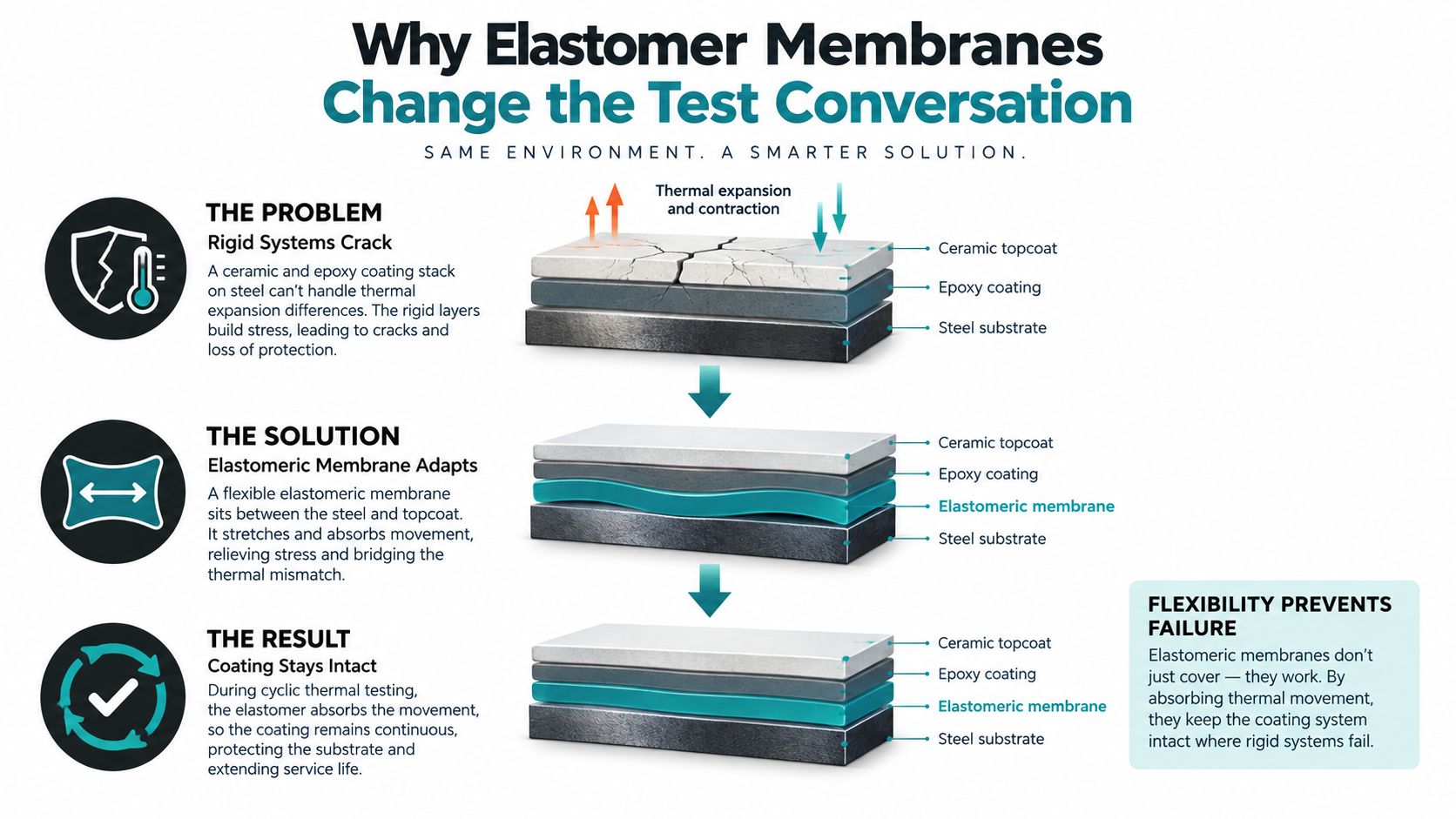
The standards don't change because the coating is elastic. The interpretation changes because the relevant evidence includes flexibility, impact retention, cracking, edge stability, and adhesion after cycling. A buyer should ask whether the barrier remains continuous after the exposure, not whether the surface retained gloss or hardness.
Alpha Quartz is positioned by Titan as easy to install for DIY users and mobile detailers. That makes process control especially important. A flexible product still needs proper cleaning, compatible layers, correct film build, cure time, and careful attention to seams and contaminated surfaces.
The Case for Flexibility Over Pure Hardness
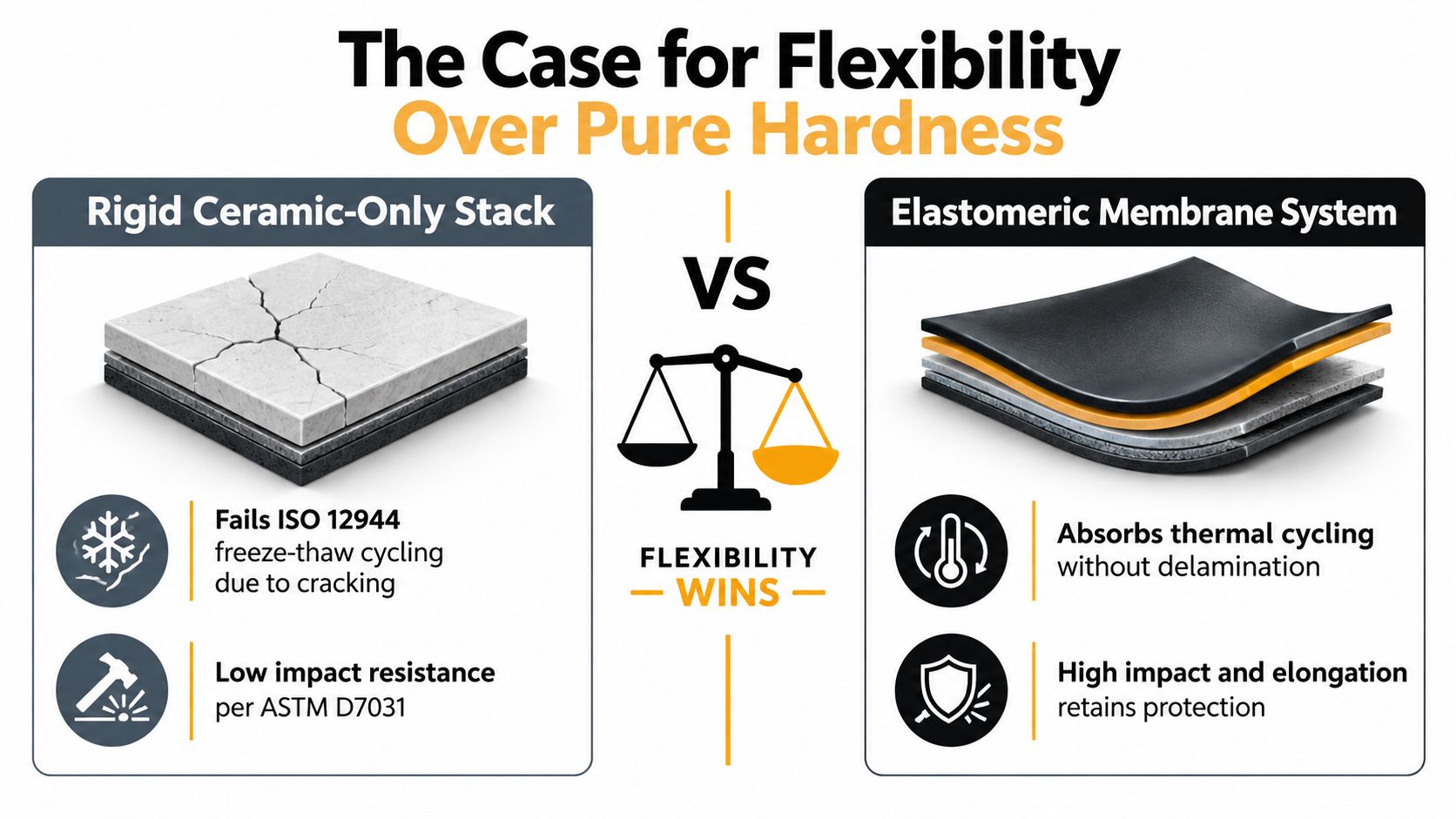
Pencil hardness is an incomplete durability strategy for a vehicle. A very hard surface may resist a light mark, but hardness doesn't guarantee resistance to thermal movement, stone impact, vibration, or corrosion traveling from a damaged edge. A coating buyer should ask about elongation, recovery, adhesion, impact resistance, and cracking after cycling.
Rigid ceramic-only systems can struggle when a panel or substrate moves differently from the film. Failure often begins at a scribe, chip, seam, or edge. Once the film cracks, moisture and chloride can reach the substrate, and the visible defect becomes a corrosion route rather than a cosmetic flaw.
Match the property to the abuse
- Thermal movement: A flexible membrane can accommodate expansion and contraction more readily than a brittle film.
- Impact: Elastic recovery can help maintain barrier continuity after minor strikes.
- Edges and seams: A coating that follows movement is less likely to open a crack at a transition.
- Chemical dwell: Bug residue, salt deposits, and road contamination demand chemical resistance as well as surface hardness.
- Maintenance: Flexibility doesn't excuse poor washing, neglected chips, or trapped contamination.
The coating flexibility resource is useful when comparing flexibility as a specification rather than treating it as a vague marketing adjective. For a detailer, the decision is practical. If the car sees freeze-thaw conditions, salty abrasion, and frequent impact, a system that combines surface hardness with elastic movement may fit the service better than a rigid layer chosen only for its hardness label.
Quick Reference Matrix of Standards and Applications
A useful matrix should help a detailer decide what evidence to request without turning every job into a defense procurement exercise. ISO 12944 is valuable for environmental classification and system selection on steel structures. ASTM methods help compare specific stresses. NACE and AMPP documents become more relevant around splash, immersion, and harsh industrial service. MIL documents matter when the customer or contract requires controlled qualification.
| Standard | What It Tests | Typical Pass Criterion | Primary Application |
|---|---|---|---|
| ISO 12944 | Corrosivity environment and coating-system selection | Matched category and durability class | Steel structures and exposure planning |
| ASTM B117 | Neutral salt spray | Defined rust, blistering, or creep limit | Screening and comparative panels |
| ASTM D5894 | Cyclic corrosion | Defined failure rating after cycles | Automotive and industrial comparisons |
| ASTM D2247 | Humidity exposure | Blistering, rust, or adhesion limit | Moist indoor and outdoor service |
| NACE TM0304 | Atmospheric and splash-zone maintenance coatings | Rust creep, edge retention, thermal cycling, flexibility, and impact | Marine and splash exposure |
| NACE SP0108 | Corrosion control guidance for structures | Project-defined controls and inspection | Fixed industrial structures |
| MIL-PRF-24635 | Elastomeric coating qualification | Specification-defined acceptance | Harsh marine or defense service |
| MIL-DTL-16232 | Pretreatment and phosphate coatings | Specification-defined preparation and performance | Metal preparation |
| MIL-A-8625 | Anodized aluminum finishes | Specification-defined anodizing requirements | Aluminum components |
The “typical pass criterion” column must remain tied to the actual report. A supplier should provide the precise limit rather than relying on a standard name.
For teams managing many specifications, automated compliance mapping can help organize requirements across documents. A typical detailer can safely ignore standards unrelated to the substrate or environment, but shouldn't ignore the method, preparation, and failure criterion behind any claim they intend to sell.
A Cross-Reference Checklist for Your Next Coating
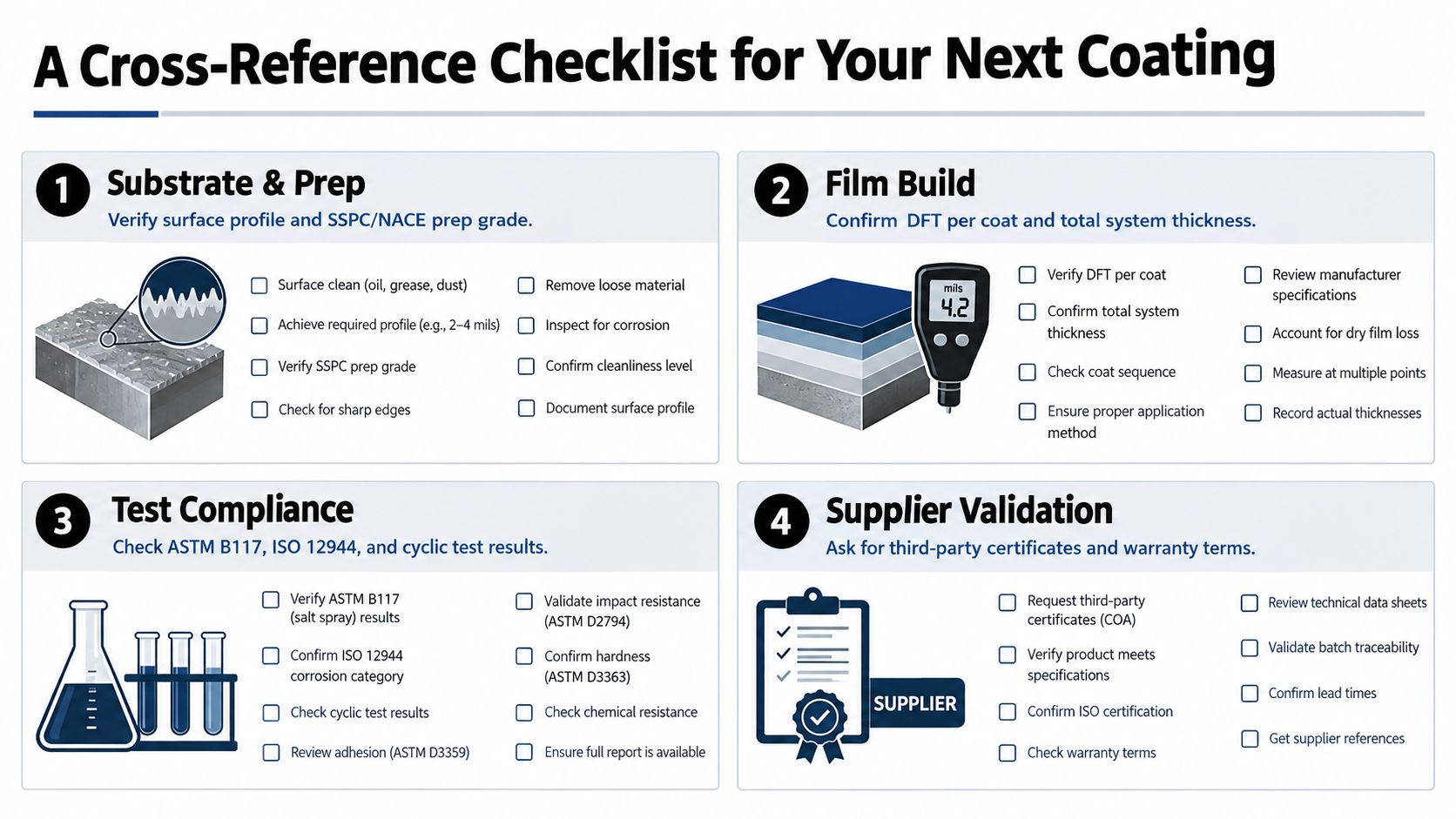
Take this checklist to a supplier call, job estimate, or product comparison. If the vendor can't answer the questions clearly, the coating may still work, but you won't have enough evidence to match it responsibly to the vehicle or asset.
Substrate and preparation
- Surface type: Is the substrate steel, aluminum, glass, painted bodywork, plastic, or a mixed assembly?
- Cleaning: What removes oil, salts, oxidation, and embedded contamination?
- Profile: What surface profile or preparation grade does the report require?
- Pretreatment: Does the system require a conversion coating, primer, or adhesion promoter?
Film build and application
- Dry-film thickness: What thickness is required for each coat and for the complete system?
- Coat sequence: Which layers are compatible, and which combinations are prohibited?
- Cure window: What temperature, humidity, and time are required before exposure?
- Repair method: How does the applicator repair a chip, scribe, edge defect, or missed area?
Qualification and evidence
- Environment class: Which ISO 12944 corrosivity category or immersion condition matches the job?
- Test method: Is the claim based on ASTM, NACE, AMPP, MIL-SPEC, or another named procedure?
- Failure metric: What are the rust, blistering, adhesion, and scribe-creep limits?
- Certificate date: Does the report identify the tested formulation, revision, substrate, and application conditions?
Three answers should stop the purchase until the supplier provides clarification: no third-party evidence, no scribe-creep value, or a salt-spray number without a referenced method. Those omissions prevent a fair comparison.
For automotive glass, Titan's APEX Glass Ceramic Coating is presented as an easy-to-use glass and windshield coating intended to improve wet-weather visibility. For a flexible vehicle surface system, review Alpha Quartz through the same lens, preparation, compatibility, movement, impact, and documented testing. Titan also offers Ultra Ceramic Spray for an application route suited to users seeking a spray format.
APEX NANO – Titan Coatings offers coating options that fit different parts of this decision, including flexible elastomer protection, windshield and glass coating, and Ultra Ceramic Spray for straightforward application. Review the product information, match the system to the vehicle's exposure and preparation needs, then visit APEX NANO – Titan Coatings to choose the coating and documentation that fit your next job.
0 Comments