
The owner of a sun-baked Miata brought it to my bay after rain began soaking the rear carpet. Its fabric top looked merely faded from a distance, but up close the weave had hardened, the seams had darkened, and water no longer formed beads.
The Convertible Top That Taught Its Owner the Hard Way
He'd owned the car for years and had treated the paint regularly. The roof was different. It received occasional washing, plenty of direct sun, and no consistent protectant. By the time he noticed the problem, the fabric had lost its color, the folds showed cracking, and a milky haze ran along the rear-window seam.
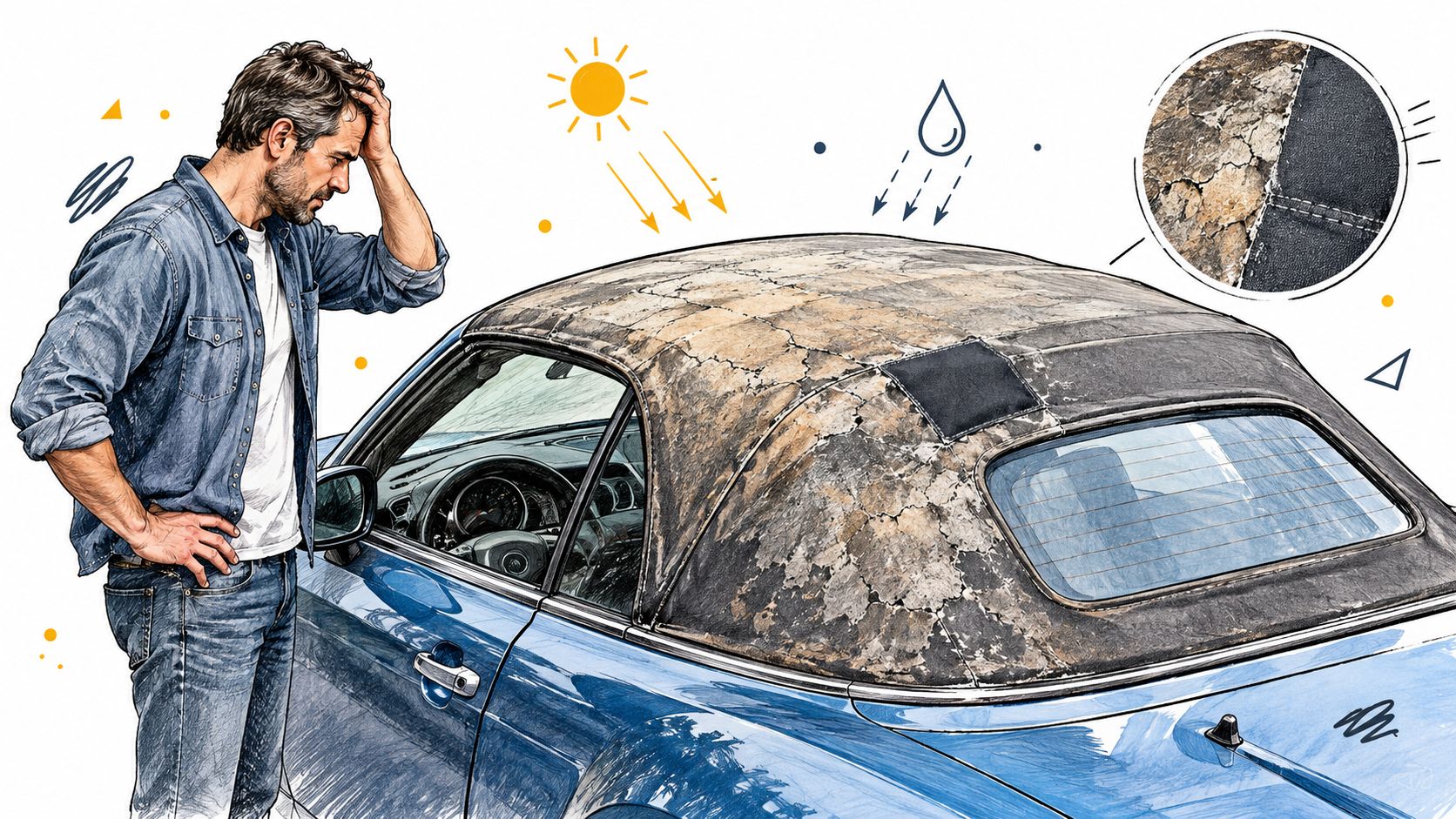
I cleaned a small area first. Dirt came away, but the original color didn't return. The owner asked whether a stronger cleaner or a new protectant could save it. The honest answer was no. A protectant can reduce future exposure, restore water behavior, and slow deterioration. It can't rebuild fibers that UV and heat have already weakened.
The damage starts before it looks dramatic
Convertible tops have changed materially over time. Pin-point vinyl was prevalent in American convertible tops from the 1950s through the 1990s, while coated fabrics have also been widely used because their waterproof performance often compared favorably with other soft-top materials, as described in this convertible-top material guide.
Those substrates fail differently. Vinyl tends to harden and crack under heat and UV exposure. Canvas and other fabrics are more vulnerable to fading and color loss from prolonged sunlight. That difference determines whether the right answer is a breathable fabric treatment, a vinyl conditioner, or a flexible coating designed for a compatible surface.
Detailer's rule: Choose the protection chemistry for the top you have, not the finish you wish it had.
A product that leaves a glossy film may look impressive on vinyl and perform poorly on fabric. A textile treatment that penetrates a weave may be appropriate for canvas but unsuitable for a plasticized vinyl surface. For owners considering a broader care routine, Titan's soft-top care guidance is a useful place to compare surface-specific approaches.
The three families are straightforward: fabric protectants, vinyl protectants, and flexible elastomer or coating systems. The last category deserves careful attention because hardness and flexibility aren't automatically opposites. Properly formulated elastomer coatings aim to form a durable barrier while accommodating movement, folding, and temperature changes.
What Convertible Top Materials Actually Need
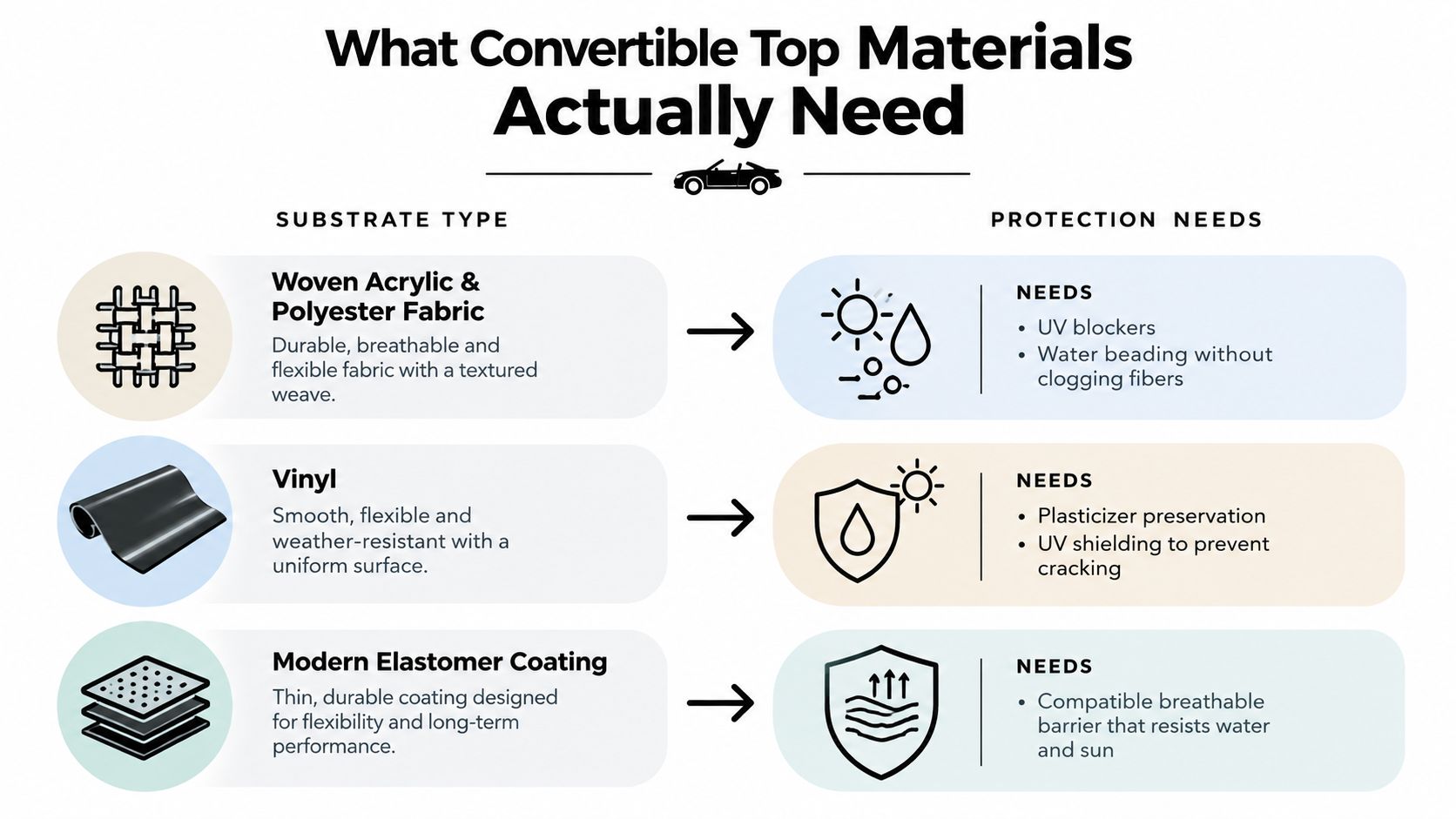
A soft top asks its protectant to work with movement, moisture, and heat at the same time. Fabric must keep its weave open, vinyl must retain flexibility, and seams need protection without becoming clogged with residue. After the failures described in the previous section, the useful question is not which product looks richest on day one, but what the surface must continue doing after repeated folding and sun exposure.
Fabric needs penetration without suffocation
Woven acrylic and polyester tops depend on dyed fibers and an open textile structure. Their protectant should deliver UV resistance and water repellency while preserving breathability, rather than sealing the weave under a glossy layer. A breathable treatment can help water bead while allowing the fabric to keep its intended feel and movement.
Fluoropolymer or UV-stabilized formulas are commonly selected because they can work through the weave instead of sitting only on top. Silicone-free construction also helps limit moisture retention inside the textile. The practical test is functional retention: renewed beading, less water intrusion, UV defense, and reasonable service life between applications, as discussed in this convertible-top sealer guide.
Preparation determines much of the result. The roof should be completely clean and dry before treatment, with seams covered deliberately because stitching can form channels for water. Owners caring for multiple surfaces can apply the same basic lesson found in this leather couch cleaning guide from J.G. Carpet Cleaning LLC, match the cleaner and method to the material instead of using a household product everywhere.
Vinyl needs conditioning and UV control
The previous section established how vinyl responds to severe exposure. Here, the protection requirement is clearer: vinyl needs UV stabilization and flexibility preservation, not water beading alone. Plasticized PVC benefits from a dressing that conditions the surface without leaving a hazy, slippery, or heat-sensitive film.
Guidance specifically identifies Aerospace 303 Vinyl Protectant as a suitable vinyl match because it addresses UV fading, oxidation, and plasticizer loss. Apply it evenly around folds and seams, where movement continues after the surface appears treated. A dark, glossy finish is not proof that the material is receiving the right protection.
Elastomers address movement
Elastomer coatings change the maintenance calculation by aiming to combine a durable barrier with the movement required by a folding roof. Titan says it introduced carbon nanotubes into automotive coatings in 2021, and describes ElastoTek as combining carbon nanotubes with other additives to target mechanical strength and thermal stability in its technology overview. Its APEX Nano line represents the same broader direction, using elastomer and CNT-based coating design to reduce the old compromise between surface hardness and flexibility.
A coating that accommodates modest shape changes is less likely to fracture as the panel flexes or temperatures move from freezing conditions to heat. Standardized bend testing such as ASTM D522 evaluates when cracking begins under controlled deformation. Coatings literature also treats glass transition temperature as a major flexibility indicator, as explained in this coating flexibility reference.
UV protection belongs in that evaluation too. A coating with suitable UV resistance can reduce exposure-driven deterioration, but only if it remains compatible with the substrate and its folding pattern. Start with material compatibility, then compare UV defense, water behavior, flexibility, application demands, and performance around seams and folds.
Comparing Fabric, Vinyl, and Elastomer Protectants
The table below is a practical comparison, not a promise that one chemistry fits every roof. Traditional products remain useful when their limitations match the vehicle's exposure and the owner's maintenance habits.
| Protectant Type | UV Protection | Water Repellency | Flexibility | Durability |
|---|---|---|---|---|
| Fabric protectants, such as 303 or RaggTopp | Good for routine fabric care, but dependent on regular renewal | Strong when applied to clean, dry fabric | Preserves the textile's natural movement | Commonly renewed every 6 to 8 weeks for fabric tops, depending on exposure |
| Vinyl dressings, such as Meguiar's or Black Magic | Focused on UV shielding and surface conditioning | Useful, but not the only performance measure | Helps maintain a supple appearance, though heat can encourage product migration | Commonly renewed every 4 to 5 weeks for vinyl tops when seeking optimal protection |
| Elastomer and CNT-based coatings, including Titan coating systems | Designed around a more persistent protective film and UV resistance | High hydrophobic potential when correctly applied | Built to accommodate movement, folds, and thermal change when properly formulated | Judged by water behavior, exposure, and coating condition rather than a universal calendar |
The reapplication intervals in the table reflect detailing guidance summarized by independent convertible-top protectant coverage. They aren't guarantees. A garage-kept weekend car and an outdoor daily driver don't consume protection at the same rate.
Traditional fabric protection still has a place
A fluoropolymer fabric sealant makes sense when a cloth top is healthy, the owner wants breathable coverage, and regular maintenance isn't a burden. Its strength is straightforward application and strong water behavior. Its limitation is that the outer protection gradually loses effectiveness through sun, washing, contamination, and repeated weather exposure.
Vinyl dressings make sense when the goal is to preserve a dark, supple appearance while reducing UV stress. They can be easy to use, but heavy application may leave an oily finish or migrate across adjacent surfaces in heat. More product isn't automatically more protection.
Flexible coatings change the compromise
Titan's APEX Nano concept belongs to a third path. Its CNT-based, elastomer-focused approach is intended to combine a hard protective character with flexibility, so the coating can move with a compatible surface instead of behaving like a brittle shell. Independent nanotube literature supports the broader material premise that nanotubes can improve thermal and mechanical performance in elastomers and form a conductive network without necessarily eliminating elasticity when properly formulated, as discussed in this nanotube elastomer overview.
That doesn't eliminate preparation or compatibility testing. It changes what detailers should evaluate: not just initial gloss or beading, but whether the film remains intact through folding, seam movement, cleaning, and temperature change. Titan's explanation of polymer coating behavior provides additional context for why film structure matters.
How Professionals Apply a Convertible Top Protectant
A professional result starts before the bottle is opened. I inspect the roof for failed stitching, tears, loose edges, window damage, and areas where the old treatment has become uneven. Coating over a defect can hide it briefly while making later repair more complicated.
Preparation controls the outcome
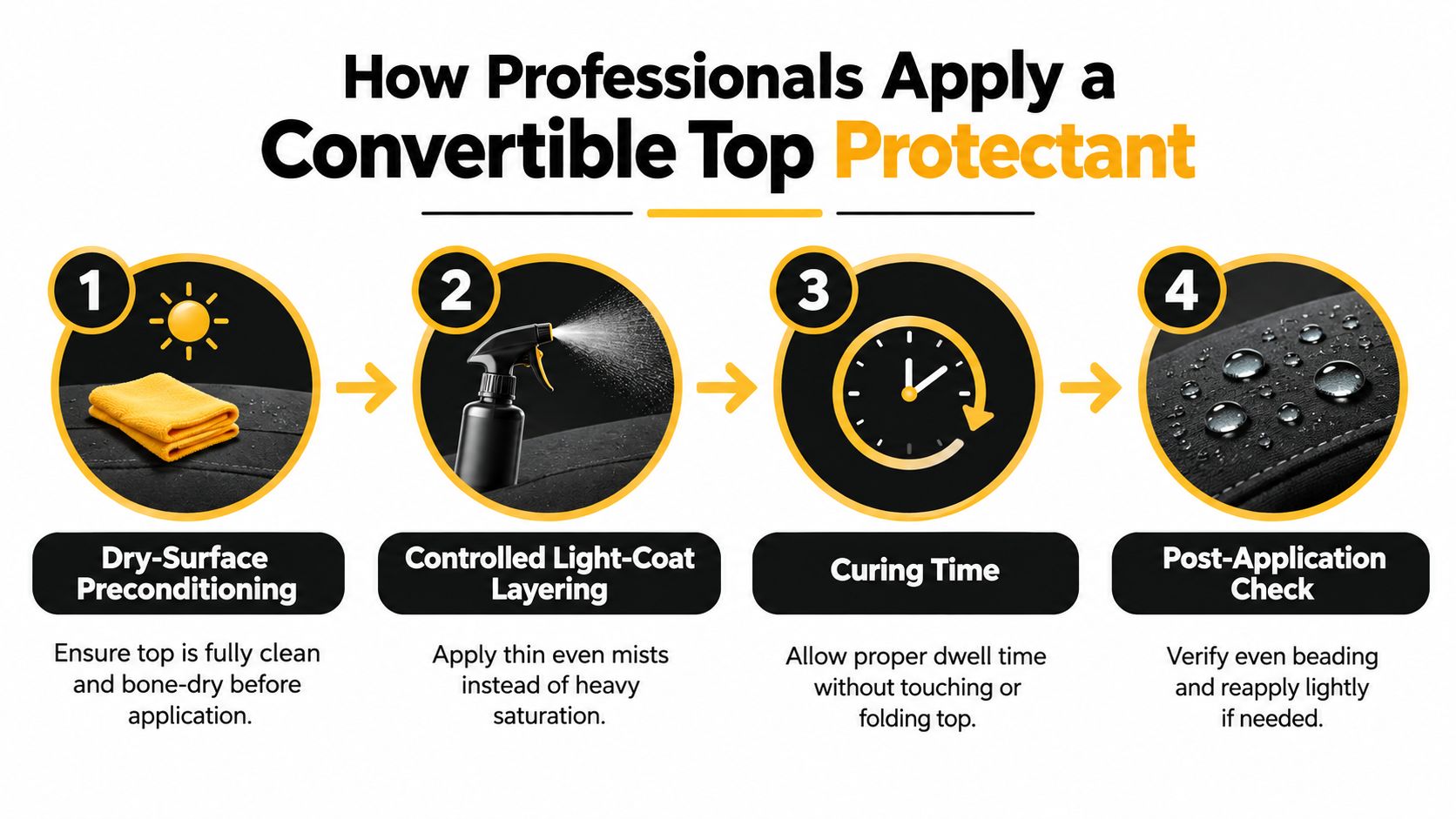
Work in shade on a cool surface. Rinse loose dirt away with gentle water pressure, then use a cleaner approved for the actual material. Fabric usually needs a dedicated textile cleaner and a soft brush. Vinyl may need a mild cleaner or a suitable degreasing pre-wash to remove dressing residue.
Rinse thoroughly and let the roof become bone dry. Independent guidance notes that fabric tops may need 24 hours to dry before treatment, particularly when moisture has entered the weave or seams, as discussed in this convertible-top maintenance guide.
Light coats beat heavy saturation
For a fabric protectant, I use controlled passes rather than flooding the roof. A light coat lets the formula reach the fibers evenly without creating wet patches. On vinyl, I work in small sections with a foam or microfiber applicator, then level the dressing so high spots don't dry into streaks.
For a Titan elastomer system, follow the product-specific instructions, use a micro-applicator pad, and keep the application thin and even. Cross-hatch passes help reduce missed areas. A short flash-off between coats may be appropriate where the system calls for layering, but the label's directions control the process.
Application checkpoint: Treat seams and stitch lines deliberately. They move, collect contamination, and often reveal a coverage problem before the broad roof panels do.
Don't apply in direct sun, don't fold the roof while solvents are still flashing, and don't spray freely near glass, paint, trim, or the cabin. Let the coating cure before lowering the top. The exact cure requirement depends on the formula, ambient conditions, and surface, so the Titan coating application methods should be consulted for the selected system.
Inspect before returning the car
Once the surface has settled, inspect it from several angles. Look for dry-looking patches on fabric, streaks on vinyl, overspray on adjacent paint, and uneven treatment near seams. A professional doesn't judge success by shine alone. The better test is consistent coverage, clean touch, and water behavior after the product has completed its required cure.
When to Reapply and Why Calendar Advice Falls Short
A calendar reminder is convenient, but it can't see your parking space. A convertible stored outside under intense sun will use its protection differently from one kept in a garage and driven only on clear weekends. Exposure, not mileage, drives top aging.
One maintenance guide identifies UV exposure as the main aging factor and recommends conditioning roughly every three months, with more frequent treatment in intense sun or coastal salt air, according to this soft-top maintenance guide. Product-market tracking also estimates the U.S. Amazon category for convertible-top cleaner and protectant at about $244K per year, with 121K searches per year, and reports peak demand in May and June at 4.1 times the quietest months, as detailed in the same source. The seasonality makes practical sense, owners remember roof care when strong sun and summer rain return.
Watch the water, not the label
I use a simple field test after washing. Spray a clean section with water and observe whether droplets bead tightly, sit loosely, or flatten and sheet across the material. If water spreads quickly and the roof darkens unevenly, the protective behavior has weakened.
A fingertip drag offers another clue on a clean, dry surface. The roof shouldn't feel greasy, but it also shouldn't feel unusually dry, rough, or chalky. This isn't a laboratory measurement. It's a repeatable inspection that helps an owner notice change before leaks or visible fading become the first warning.
Flexible films still need maintenance
An elastomer and CNT-based coating can be less vulnerable to cracking when the surface flexes or temperatures change, provided the system is correctly formulated and compatible with the substrate. That flexibility may preserve the film through more movement than a rigid coating, but it doesn't make the surface permanent. Contamination, washing, abrasion, and exposure still affect the outer layer.
For a broader explanation of why longevity depends on environment and maintenance rather than one universal promise, see this guide to how long ceramic coatings last on cars. Reapply when water behavior, surface feel, or visible coverage tells you to, then adjust the inspection frequency to your climate.
Matching Protectants to Real Driving Scenarios
A product decision becomes clearer when the owner describes the car's life instead of its badge.
The daily Miata in Phoenix
The first owner drives a fabric Miata most days and parks outdoors in intense heat. By late summer, the roof has seen repeated UV exposure, dust, rain, and folding. A basic fabric spray may restore beading temporarily, but frequent renewal can become an ongoing chore.
For this use, I'd evaluate a compatible elastomer or ceramic-hybrid coating, with special attention to flexibility at folds and seams. Titan's coating technology is relevant as an option because the company describes its Dark Matter Technology as combining carbon nanotubes with additives aimed at mechanical strength and thermal stability. The failure signature is clear: rapid loss of beading, uneven darkening after rain, or cracking at fold lines. Those signs call for inspection, not another heavy coat over a failing surface.
The garage-kept Mustang
The second car leaves the garage for weekend drives and sees mild weather. Its cloth top is clean, healthy, and rarely exposed to standing rain or salt. Here, a quality fluoropolymer fabric sealant can be a sensible choice because the owner can clean, dry, and refresh the roof before the next high-exposure season.
The maintenance cycle should follow water behavior and spring inspection rather than an automatic promise. If droplets flatten across the fabric or the color changes sharply after wetting, it's time to retreat the surface. If the top remains clean and beading is consistent, more product isn't needed.
The coastal convertible
The third owner battles salt air, pollen, tree drip, and frequent moisture. Vinyl may be easier to clean, but its plasticizers still need UV protection and conditioning. A vinyl-safe protectant that doesn't leave a heavy, sticky dressing is preferable to a wax-like approach that collects contamination.
Seams and stitch lines deserve extra attention because salt residue can remain concentrated there. The warning signs are a tacky surface, product migration in heat, water that sheets instead of beads, and dark deposits around stitching. Clean first, allow full drying, then choose a compatible vinyl dressing or flexible coating based on the owner's willingness to maintain it.
Choosing the Best Convertible Top Protectant for You
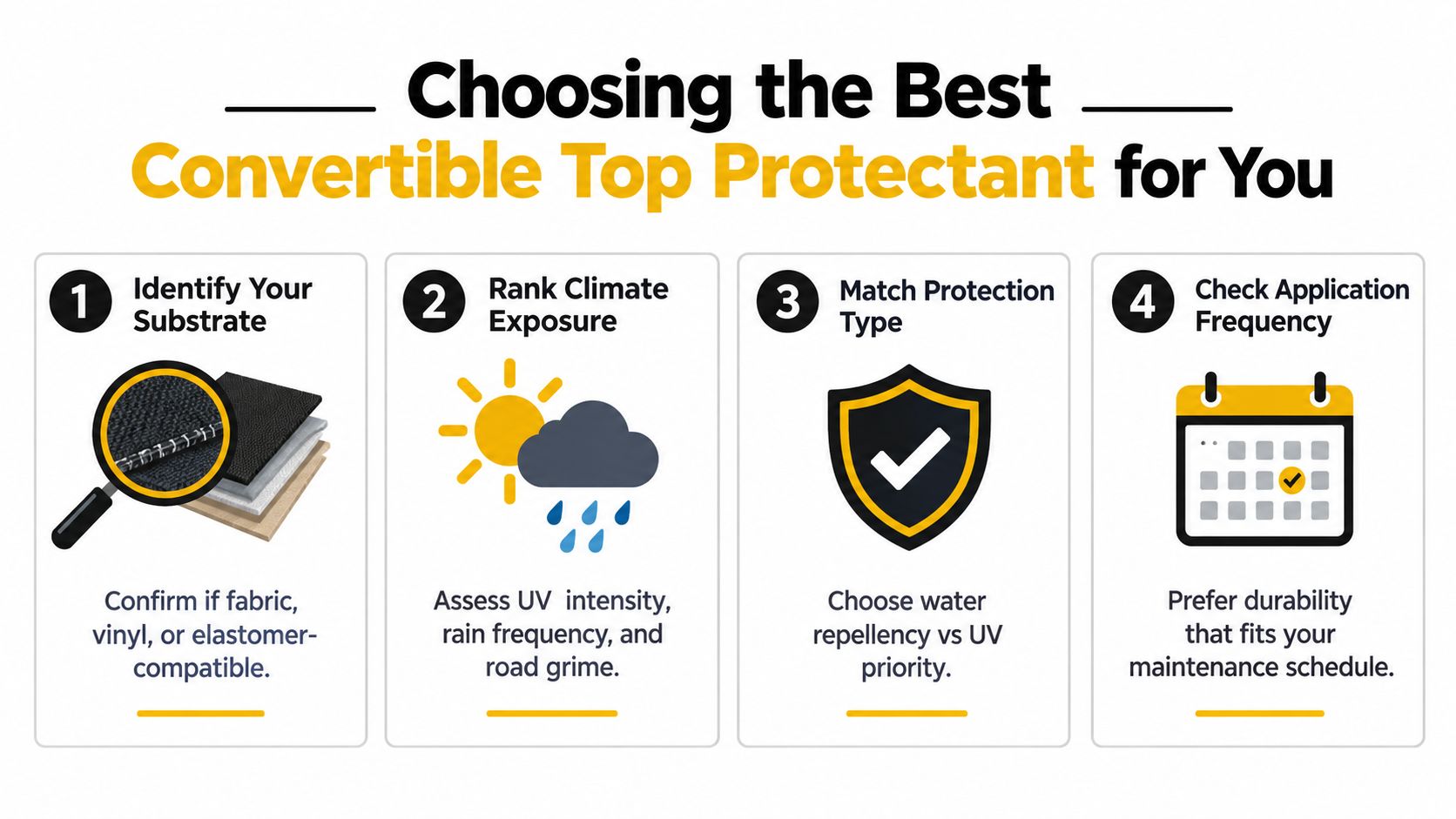
Start with the roof, not the shopping page. Identify whether you're working with fabric, vinyl, or a surface compatible with an elastomer coating. If you're unsure, check the vehicle documentation or ask a top supplier before applying any chemistry.
Use exposure as the second filter
Rank the conditions that reach the car.
- Sun intensity: Strong, sustained UV exposure raises the importance of UV stabilization and surface conditioning.
- Water contact: Frequent rain, washing, or coastal moisture increases the value of durable water repellency and careful seam treatment.
- Storage: Outdoor parking compresses the maintenance window, while a garage-kept weekend car may need less frequent intervention.
- Movement: Frequent folding makes flexibility and proper curing especially important.
A fabric owner in mild conditions may prefer a breathable fluoropolymer protectant. A vinyl owner should prioritize UV stabilization and plasticizer preservation. A daily-driven car facing heat, rain, and repeated folding may justify investigating a compatible elastomer or CNT-based coating that aims to remain flexible while providing a harder protective surface.
Match the product to your maintenance style
The best convertible top protectant is the one that fits both the material and the owner's habits. Before application, confirm four things:
- The top is clean and completely dry.
- Water behavior has weakened enough to justify treatment.
- The product is rated for the specific substrate.
- Application can happen in shade, using thin, even coats.
Don't wait for obvious fading, cracking, or leaks. Those symptoms indicate that the material has already absorbed damage. If you're also maintaining visibility, Titan's APEX Glass Ceramic Coating is designed for glass and windshield use, with an easy application approach intended to improve rain visibility. It belongs on the glass, not the convertible fabric or vinyl, but it can complement a roof-care routine by making wet-weather driving less stressful.
Titan also offers Ultra Ceramic Spray for owners and mobile detailers who want a straightforward spray application with a coating-style finish on appropriate automotive surfaces. For a flexible coating option, Alpha Quartz is presented for DIY and mobile-detailer use, but always verify substrate compatibility and follow the product instructions before treating a convertible top.
Inspect the roof now, before the next period of intense sun. Clean it, dry it fully, test its water behavior, and choose the protection family that matches the material rather than the most dramatic label.
APEX NANO – Titan Coatings offers coating options built around flexible elastomer technology, along with glass and spray ceramic products for related automotive surfaces. Visit APEX NANO – Titan Coatings to review the available systems and choose the product guidance that fits your convertible, climate, and detailing routine.
0 Comments