
A lot of cars look excellent for one afternoon.
You wash them, hit them with a glaze or spray topper, pull them into the sun, and for a moment the paint looks deep enough to swim in. Then the owner runs it through two rushed washes, parks outside through a hard temperature swing, and the finish starts looking flat, grabby, or smeared. That's the gap many people miss when they think about Shine On Detailing Supplies. Shine isn't one bottle. It's a system.
I see that most often on daily drivers. The owner bought a good product, but the prep was rushed, the towel choice was wrong, or the protection layer didn't match the way the vehicle gets used. If you want a true mirror finish that still looks right after real wash routines, road bugs, rain, heat, and cold mornings, every supply in the chain has to do its job.
Why True Shine Depends on More Than One Product
A black SUV rolled up to a mobile job looking like an easy win. Fresh wash, decent paint, no major oxidation. The owner had already used a shine product the week before and couldn't understand why the gloss disappeared so fast. Under soft morning light it still looked good. Under direct sun, the story changed. Water spots were still bonded in the clear, iron fallout was peppered across the lower doors, and the finish had light towel marring from rushed drying.
That's why shine fails. Not because the last product was bad, but because the surface underneath wasn't ready to hold that look.
Gloss starts below the gloss
They shop for detailing supplies backward. They start with the final layer because that's the exciting part. The shine comes from what happens before it.
- Clean paint reflects better because contamination doesn't interrupt the surface.
- Leveled paint reflects cleaner because polishing removes defects that scatter light.
- A stable protection layer holds the look longer because washing and weather don't beat it up as quickly.
That system view matters even more because car-care products sit inside a large and active market. The global car care products market was estimated at USD 11.2 billion in 2024 and is projected to reach USD 14.0 billion by 2030, with North America holding 37.8% of the market in 2024 and the retail channel accounting for 70.8% of revenue, which tells you enthusiast and consumer buying still drives a huge part of detailing-supply demand according to the Auto Care Factbook market overview.
A lasting finish needs the right foundation
In practice, I treat shine like a stack. Wash quality matters. Decon matters. Polishing matters. Then the protection choice matters because some layers look sharp at delivery but don't stay stable when the car lives outside and sees repeated cold-to-hot transitions.
That's where the idea behind elastic coatings makes sense. A coating can be hard at the surface and still benefit from flexibility underneath. If the coating film handles movement better, it's less likely to fail the moment the car goes from frozen mornings to hot panels later in the day. If you want more context on how coating selection fits paint protection as a whole, Titan has a useful overview on car paint coat options.
The shine people remember a month later comes from prep discipline, not from the last wipe alone.
What Each Supply Actually Does for Gloss and Protection
Walk into any van setup or shop cabinet and you'll see the same mistake. Too many products doing the wrong jobs. A compound is expected to finish like a polish. A ceramic spray is expected to perform like a true coating. A drying towel gets used until it starts inflicting damage. If you want reliable shine on detailing supplies, each item needs a clear role.
What changes the paint and what only dresses it
Compounds and polishes are correction tools. They remove or reduce defects. That means they can create real gloss because they improve the paint surface itself.
Waxes, sealants, and sprays mostly add surface character and short-term behavior. They can deepen the look and improve slickness or water behavior, but they don't erase defects underneath. If the paint is hazy, contaminated, or marred, no topper fixes that.
Panel wipes matter more than many think. If polishing oils stay on the surface, they can fake clarity for a few minutes and interfere with bonding afterward. That's why I never skip the wipe-down before applying a protection layer.
The supplies that earn their space
Here's the simple version I give customers and newer techs.
| Supply Type | Primary Job | Gloss Impact | Durability |
|---|---|---|---|
| Wash soap and mitt | Remove loose dirt safely | Sets the stage for clean reflection | Short-term cleaning step |
| Iron and tar removers | Dissolve bonded contamination | Improves clarity before claying and polishing | Prep step only |
| Clay media | Remove embedded contamination | Makes paint feel smooth, may induce marring | Prep step only |
| Compound | Remove heavier defects | Strong gloss gain when defects are significant | Correction step only |
| Polish | Refine haze and increase clarity | Major impact on depth and sharp reflection | Correction step only |
| IPA or panel wipe | Remove polishing residue | Reveals true finish and supports bonding | Prep step only |
| Wax or sealant | Add warmth, slickness, light protection | Good cosmetic boost | Lower than a dedicated coating |
| Ceramic spray | Fast enhancement and light protection | Strong visual pop for the time invested | Good for quick jobs and maintenance |
| True ceramic or elastomer coating | Build a harder protective layer | Locks in polished gloss with better staying power | Higher durability when installed correctly |
A lot of DIY confusion comes from mixing up polish and wax. One changes defects. One covers and protects. Titan's breakdown on the difference between polish and wax is worth reading if you want the plain-language version.
Pads, towels, and wipes decide the finish
The bottle gets the attention. The accessories decide whether the finish ends clean.
- Cutting pads remove defects faster, but they can leave haze on softer paint.
- Finishing pads refine better and usually produce a cleaner final image.
- Waffle-weave drying towels help reduce leftover water drag when they're clean and still soft.
- Edgeless microfiber towels are the safer choice for final wiping and coating leveling.
Practical rule: If a towel has become grabby, stiff, contaminated, or worn at the edge, retire it from paint duty before it writes defects back into the clear.
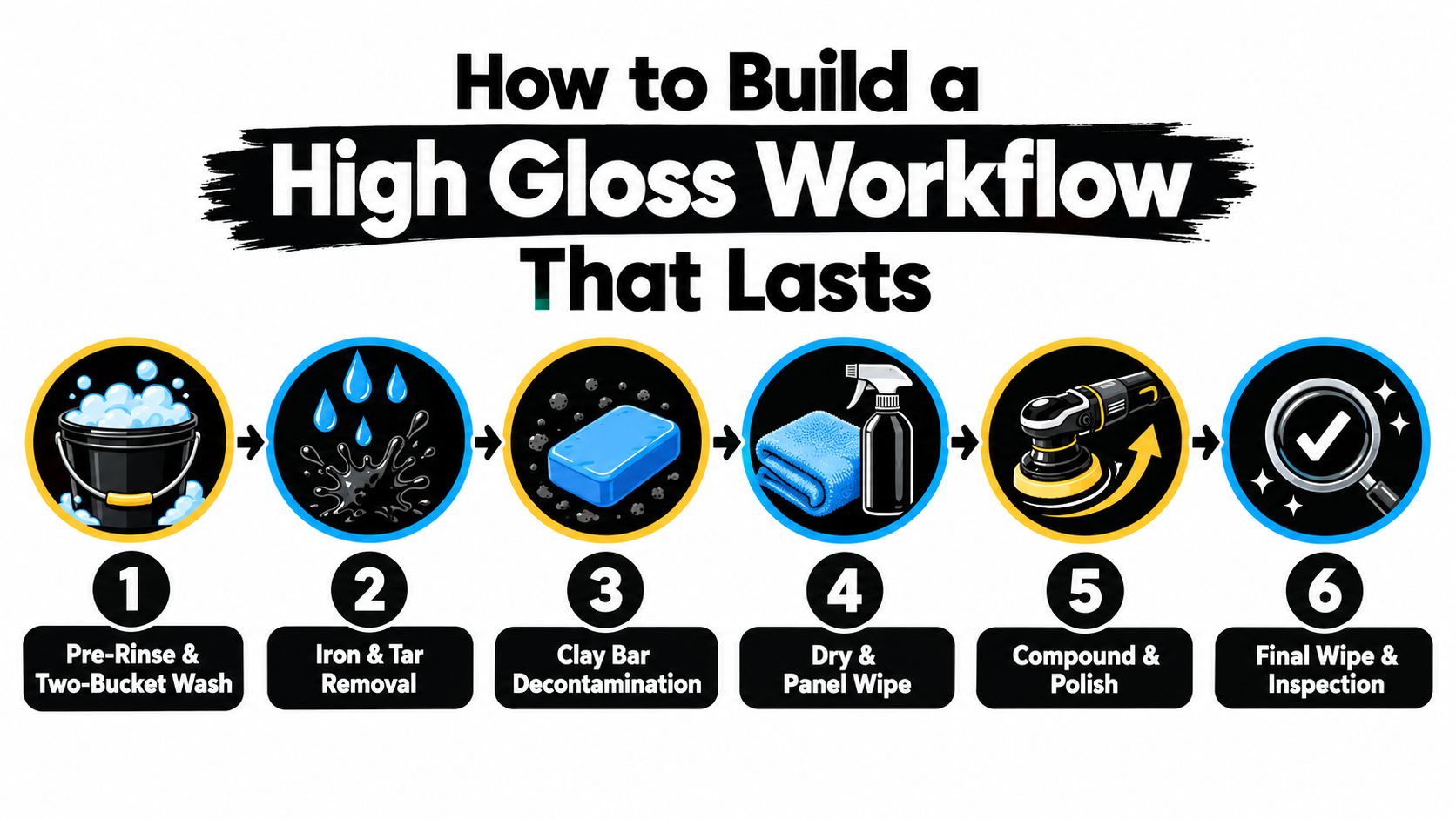
How to Build a High Gloss Workflow That Lasts
A mobile detail rarely happens under perfect conditions. Sometimes you've got direct light moving across the car by the hour. Sometimes the panels are cold at setup and warm by midday. Sometimes you're working in a driveway with one clean power source and just enough time to correct the paint without creating more work.
That's why the workflow has to be repeatable.

Start with decontamination, not correction
A professional paint-prep sequence before a coating should follow a specific order: pre-rinse or snow foam, two-bucket hand wash with grit guards, iron decontamination, tar removal, claying, drying with a clean waffle-weave microfiber, then a final IPA or panel-wipe pass with two clean microfiber towels panel by panel according to this ceramic coating paint prep workflow.
That order matters because each step removes a different type of contamination. If you clay before chemical decon, you force more trash across the paint than necessary. If you skip tar removal, the clay has to do harder work. If you skip the panel wipe, you don't know whether the finish is clean or just oily.
For mobile work, I keep each section small. Hood halves. One door at a time. Half a roof if the weather is moving fast.
Work on cool, shaded panels whenever you can. Small sections give you control over residue, wipe timing, and inspection before anything dries where you don't want it.
Expect clay marring and plan to polish
Clay is a prep tool, not a finishing step. One of the most common mistakes I see is stopping after decon because the paint feels smooth. Smooth isn't the same as corrected.
Expert guidance is clear that clay media are expected to induce light marring, and worn or improper drying towels can create marring too. The same guidance warns that on soft clear coats, especially after correction when paint is thermally softened, dry wiping can create micro-scratch networks, which is why a controlled environment, premium edgeless microfiber, and immediate dry buffing are recommended in this review of micro-marring causes and prevention.
So after claying, I assume polish time is coming. Sometimes it's a one-step on a daily driver. Sometimes it's heavier compounding followed by a refining pass on darker or softer paint.
Correction is where the mirror starts
I inspect under diffused light first, then confirm in direct light or a hard handheld source. That catches the difference between fake shine and true finish.
A practical correction flow looks like this:
- Test one area first. Find the least aggressive combo that gets the result.
- Correct defects before chasing gloss. A finish can't look deep if scratches are still bouncing light everywhere.
- Refine with a finishing pass. Even when a one-step looks good, a refining polish often sharpens the image noticeably.
- Wipe and inspect slowly. Rushing the wipe-off is where fresh marring sneaks in.
If I'm under a tight schedule, I'd rather fully finish the major visual panels than do a rushed pass over everything and leave haze behind.
Final wipe and protection need discipline
By the time you're ready for protection, the temptation is to move faster. Don't. An otherwise strong job gets streaky.
- Use two towels for panel wipe. One towel spreads and lifts residue. The second confirms a clean surface.
- Flip towels often. Loaded microfiber starts smearing instead of removing.
- Watch the edges and body lines. Residue hides there and hardens there first.
- Check the paint from more than one angle. One light source can lie to you.
For a more complete look at how paint correction fits into the whole service, Titan's page on auto detailing and paint correction lines up with the same real-world workflow.
Choosing Coatings That Stay Hard Flexible and Clear
Once the paint is corrected, the next question isn't just how glossy the coating looks on day one. Question is whether the coating stays clear, intact, and easy to live with after weather swings, bug hits, wash cycles, and outdoor parking.
That's why flexibility matters more than many product pages admit.
Why hard alone isn't enough
A coating should resist abrasion, chemicals, and routine wear. But a very rigid film can become a weak point if it doesn't tolerate expansion, contraction, and impact well. That's where elastomer concepts become interesting for detailing, especially for mobile work and daily-driven cars that see mixed climates.
Carbon nanotube-reinforced elastomer composites are a documented materials class, and one review cites carbon nanotubes with an elastic modulus near 1 TPa and tensile strength around 150 GPa, while also noting that dispersing them into less stable rubber matrices can improve thermal stability depending on loading in this review of CNT elastomer composites. In plain shop language, that supports the idea that a coating can be engineered to stay stable while still flexing better than a brittle film.
Thermal-cycling resistance also has a recognized test path. ASTM D6944 is designed to evaluate how repeated thermal cycles affect coating properties such as adhesion, checking, cracking, and blistering, and commercial lab descriptions of the method show a cycle can include about -5 °C for 16 hours and about 50 °C for 4 hours, with an optional immersion step in this ASTM D6944 lab testing description. That gives real meaning to the claim that a coating should handle frozen-to-hot transitions without cracking.
Where Titan's coating approach fits
Titan states that it created its own coating technology and introduced elastomer coatings to the market using nanotube technology and Dark Matter tech. That's the part that catches my attention as a practitioner because the promise isn't just hardness. It's hardness with flexibility, which is exactly what daily-driven cars need if you want the finish to last through temperature swings and routine abuse.

One option in that lane is Alpha Quartz, which Titan positions as an elastomer coating that's easy to install and practical for DIY users and mobile detailers. The appeal is simple. You want something that lays down predictably, leaves a hard gloss, and still has enough flexibility that temperature changes and minor impacts, like bug strikes on the front end, don't immediately work against the coating film. Titan explains that broader idea in its page on coating flexibility.
Matching the coating to the job
Not every vehicle needs the same protection package.
Glass and windshield use case
A dedicated glass coating makes sense when the owner drives long highway miles, deals with regular rain, or hates fighting smeary wipers. Titan's Apex Glass Ceramic Coatings is positioned for windshield and glass work, with the practical appeal being easier use and improved wet-weather visibility. For drivers who commute in rain, that's one of the easiest upgrades to feel immediately.Paint protection for daily drivers and mobile installs
Alpha Quartz fits the customer who wants a more committed protection step than a quick spray, but doesn't want a fussy installation process. Ease of use matters when you're working outside the perfect studio environment.Fast jobs and maintenance details
Ultra Ceramic Spray has an obvious place in the lineup. It's for the vehicle that needs quick gloss and a cleaner, more protected feel without a longer install window. I like products in this category for maintenance details, dealership freshen-ups, and owners who are honest that they want speed over ceremony.
Independent nanocomposite studies also support the broader logic behind hard-but-flexible protection. One study reported higher hardness, better surface uniformity, fewer cracks, and higher adhesion at 5 wt.% CNT loading, while another reported 35% higher tensile strength and 27% better impact resistance over pure epoxy in this nanocomposite coating study. That doesn't validate any single retail product by itself, but it does support why a coating built around nanotube-reinforced behavior is worth taking seriously.
Smart Tips to Match Protection to Your Vehicle and Schedule
The most useful coating decision isn't “What's the most advanced product?” It's “What can this owner maintain, and what can this environment support?”
That's where a lot of detailers either oversell or undersell the job.
When premium coating makes sense
A full coating package earns its place when the vehicle gets corrected properly, the owner plans to wash it with some care, and the car has enough value to justify the prep time. That can be a premium daily driver, a garage-kept enthusiast car, or a client who wants fewer paint headaches over time.
A quicker option makes more sense when the car is a commuter appliance, a fleet unit, or a maintenance client who needs clean, glossy, and easy without a long install window.
Recent industry coverage points to stronger demand for better protection with faster results, with more buyers preferring one-year coatings, express ceramic sprays, and hybrid toppers instead of only multi-year systems, and it also notes that installers want more predictable behavior across temperature and humidity swings in this overview of detailing product trends and faster-result protection options.
A simple way to choose
Use this filter before you grab the coating:
Daily driver outside all week
Choose something forgiving to maintain. The owner will benefit more from a stable, user-friendly protective layer than from an elaborate install they won't support with proper washing.Fleet or high-throughput work
Time matters. A fast spray or shorter-install protection step often wins because consistency and turnaround drive the job.Premium vehicle or show car
Full prep and a more committed coating make sense. The owner is paying for finish quality and durability, not just temporary pop.
If the wash routine is rough, don't pretend a premium coating will save the paint from bad habits. Protection helps. It doesn't replace technique.
Proof and maintenance matter more than hype
Customers ask the right questions now. How do I wash it? What shortens coating life? What proof exists beyond water beading?
That shift is real. Trend coverage says buyers are putting more weight on third-party verification, including ASTM and ISO-style evidence, contact-angle data, and adhesion or abrasion testing, while demand is also moving toward waterless or rinseless cleaning, low-VOC and biodegradable formulas, and multifunctional products in this discussion of proof, durability, and eco-conscious detailing product trends.
For real-world maintenance:
- Avoid dry wiping after correction, especially on softer clears.
- Use clean microfiber only for maintenance washes and topper applications.
- Pick wash products that support the coating, not ones that leave random residue behind.
- Be honest about climate. Humidity, direct sun, cold panels, and dust all affect install behavior.
If you're comparing paint protection against appearance changes from wraps or other finishing choices, Titan's page on ceramic coating vs wrap helps frame that decision.
Keep Your Shine Longer With Simple Next Steps
The cars that keep their shine aren't always the most expensive builds. They're usually the ones that followed the right sequence, used the right towel at the right time, and got protection that matched real life instead of fantasy maintenance.
If you're dialing in your next detail, keep it simple.
The next-detail checklist that works
- Wash with control so you're not grinding old contamination into the paint.
- Decontaminate before polishing so the pad works paint, not bonded debris.
- Polish with a test spot first instead of guessing your way across the whole car.
- Do a proper panel wipe so you know what the finish looks like.
- Choose protection by use case. Daily driver, show car, windshield, maintenance detail. They don't need the same answer.
- Maintain gently because even a good coating can be abused by poor wash habits.
Learn with your eyes, not just the label
Some products are easier to understand once you watch them used on a real panel. That's especially true for coatings, wipe timing, and final leveling. Titan's site and shop are worth browsing if you want to compare options like glass coatings, elastomer coatings, and faster spray protection in one place through the Titan Coatings shop.
If you're a DIY owner, start with the easiest win. Clean glass. Better towels. Proper decon. If you're a mobile detailer, tighten the workflow first. Faster hands don't beat a smarter sequence. Proper prep, correction, and a hard flexible coating system do.
APEX NANO – Titan Coatings offers elastomer-based paint protection, easy-to-use spray options, and glass coatings that fit the detailing workflow covered here. If you want to match prep, gloss, and long-term durability more intelligently, visit APEX NANO – Titan Coatings and look at the coating options that fit your vehicle, climate, and schedule.
0 Comments