
You’re standing at the counter with a clean truck, a dirty commute, and two quotes that don’t match your gut. One shop says coating, another says wrap, and both are talking like you need to pick a side for life. You don’t. The smart move is to match the protection to the job, then stack layers where they make sense.
| Option | What it does best | What it does badly | Best for |
|---|---|---|---|
| Ceramic coating | Easier washing, UV resistance, chemical protection, gloss | Does not stop rock chips | Daily drivers, outside parking, maintenance-first owners |
| Vinyl wrap | Color change, finish change, removable coverage | Limited impact protection, edges can lift over time | Style changes, lease-friendly cosmetic changes |
| Hybrid stack | Physical coverage plus slick, easier cleaning | Costs more and only pays off if you’ll maintain it | Long-term ownership, harsh weather, high-value vehicles |
The mistake most owners make is treating ceramic coating vs wrap like a yes-or-no contest. The decision is more useful, what are you protecting, how long are you keeping the vehicle, and do you care more about the finish or the factory paint underneath? If you get that wrong, you’ll overspend on the wrong layer or underprotect the part of the car that takes the abuse.
A decent coating and a quality wrap solve different problems. A wrap changes the car, a coating helps you live with it. For a lot of owners, the answer isn’t either one, it’s the right order of both.
The Shop Floor Decision Most Owners Get Wrong
A guy rolled in with a 2024 pickup, pointed at a coating quote, then at a full wrap quote, and asked which one was “the best protection.” That’s the wrong question, and it’s the one that burns people. Protection, finish change, resale, and wash routine all pull in different directions, and one product doesn’t win every category.
The first split is paint preservation versus appearance
If your only goal is preserving factory paint, you’re asking a coating and a wrap to do jobs they weren’t built to do in the same way. A coating helps the surface resist grime, UV, and chemical mess. A wrap changes the visible surface and gives you a removable skin, but it’s still mainly a cosmetic layer with limited impact resistance.
That’s why I tell customers to stop saying “best” and start saying what problem are you solving first. If the truck lives outside and gets washed in a hurry, coating solves the daily annoyance. If you bought it in a color you hate, wrap solves the visual problem immediately.
Practical rule: if the highway is your enemy, film wins the physical fight. If soap scum, water spots, and dull paint annoy you, coating wins the daily fight.
You can see how Titan positions its protection lineup for that layered approach in its own paint protection wrap guidance, because the question isn’t just “what’s on the panel,” it’s what job that layer is doing.
The second split is ownership horizon
A short-term owner cares about return condition, not a forever build. A long-term owner cares about washability now and resale later. A lease returner wants removable protection that doesn’t complicate the handoff, while a color-changer wants a finish that looks intentional, not temporary.
That’s why the answer changes by scenario. A wrap can make a black car into satin gray and give the owner a fresh look. A coating can make the same black car easier to clean every weekend. A hybrid stack gives you both outcomes, but only if you’ll keep up with it.
What Ceramic Coating and Vinyl Wrap Actually Are
Ceramic coating is a bonded surface layer
Ceramic coating is a liquid polymer that cures into a microscopically thin layer, typically about 1 to 3 microns after curing, according to a technical comparison of coating thickness and behavior bestauto.ge. That’s thin enough that it doesn’t act like armor, but it’s effective as a chemical and hydrophobic barrier. It bonds to the clear coat, helps water sheet or bead off, and makes cleaning easier.
That’s the key point people miss. Coating doesn’t stop rock chips, because it isn’t thick enough to be a physical shield. It’s there to reduce UV damage, contamination staining, and the daily pain of washing. If you expect it to absorb highway grit, you’re buying the wrong tool.
Vinyl wrap is a thicker cosmetic skin
Vinyl wrap is a film, usually around 70 to 100 microns in the comparison data, and the broader wrap market references film demand at scale rather than just boutique installs industryresearch.biz. Wrap sits on top of the vehicle and changes the appearance by covering the original paint with an adhesive-backed layer. That’s why it’s the go-to for color changes, satin finishes, and temporary branding.
Wrap gives you a thicker surface than coating, so it can take some surface abuse and contamination better than bare paint. It still won’t stop a rock chip the way real impact film does, and that’s where owners get sold a fantasy. The wrap changes how the car looks. It does not turn the panel into bulletproof armor.
A wrap is a visual rewrite of the car. A coating is a maintenance layer. Confusing the two leads to bad spending.
If you need a plain-English benchmark, professional ceramic coating is commonly placed in the 2 to 5 year range, while vinyl wrap is commonly placed in the 3 to 7 year range depending on conditions ezautospa.com. That difference matters, but only after you decide whether you’re solving finish, maintenance, or both.
Side-by-Side Comparison Across the Five Criteria That Matter
| Criterion | Ceramic Coating | Vinyl Wrap |
|---|---|---|
| Protection from chips and scratches | Helps with minor surface contamination, not impact | Better at covering the paint, but still not true chip armor |
| Longevity in real conditions | Commonly 2 to 5 years professionally | Commonly 3 to 7 years depending on climate and care epsppf.co.uk |
| Appearance options | Adds gloss and slickness, doesn’t change color | Wins outright on color, texture, and finish changes |
| Installed cost | Lower entry cost in most cases | Higher for a full color change |
| Maintenance effort | Easier washing, stronger chemical resistance | Easier to keep clean than bare paint, but more care at edges and seams |
Protection and longevity
Ceramic coating is the better call for chemical resistance and easier washing. Vinyl wrap wins if you want to change the visible finish and add a thicker layer over the original paint. Neither one turns a daily driver into impact film, and if you want a real test reference for that kind of claim, Titan’s own impact resistance testing overview is the right place to start.
Climate changes the result. In hot, high-UV markets, coating usually holds its usefulness longer because it is less exposed to edge lift, shrinking, and seam failure. In cold regions with road salt, wraps can still look good, but they need more attention at edges and around corners, where abuse shows first. Coating is the cleaner long-haul maintenance play, wrap is the stronger visual change.
The service-life window backs that up. A pro coating in the 2 to 5 year range is a maintenance layer, not a forever layer. A quality wrap in the 3 to 7 year range gives you more visible lifespan, but it still ages with sun, heat, and washing habits.
Appearance and maintenance
Wrap wins on appearance because it can completely change the car’s personality. Coating wins on maintenance because it makes washing quicker and less annoying. The owner who parks outside and hates stubborn grime usually feels the difference fast.
There is a catch with weather and use. A coated wrap behaves better than an uncoated one when it gets hit with rain, dust, and regular washing, because the topper helps with slickness and cleanup. On the other hand, the coating does not save a bad wrap install, and it does not stop the slow wear you get from edge lifting or repeated pressure washing. For the original paint underneath, that layered setup is still cleaner than leaving the car bare.
ASTM D7027 is the standardized scratch-resistance method for polymeric coatings and plastics ASTM D7027, but service damage on cars is still often judged visually rather than with a perfect on-road scorecard ASTM guidance PDF.
Cost, Lifespan, and the Real Cost-Per-Year Math
| Option | Installed Price Range | Expected Lifespan | Annualized Cost |
|---|---|---|---|
| Ceramic coating | Lower installed cost than a full wrap, often the less expensive path | 2 to 5 years commonly ezautospa.com | Usually the lower yearly spend |
| Vinyl wrap | Higher installed cost for a full vehicle color change | 3 to 7 years commonly epsppf.co.uk | Higher yearly spend unless appearance is the main goal |
Stop comparing sticker price only
Sticker price is the trap. A cheaper service that needs more frequent rework can cost more over a normal ownership window than a pricier install that lasts and stays easier to maintain. That’s why the right question is annualized cost, not “what’s the quote today?”
If you buy a coating because you want easier washing and then redo it again too soon, the cost climbs. If you buy a wrap for a color change and start repairing edge lift or planning a replacement before you expected, the cost climbs there too. The car doesn’t care what the invoice said, it cares how long the finish holds up.
Owner math that actually works: if the look matters more than durability, pay for the wrap. If your frustration comes from dirty paint and UV exposure, pay for the coating.
Titan’s own ceramic coating versus PPF cost guide fits into that conversation because customers don’t buy shiny claims, they buy a cost curve over time. That’s also where a premium elastomer-based system starts to make sense, because flexibility and durability change the replacement cadence when the build is planned correctly.
Where the math flips
The math changes when you’re building a long-term vehicle instead of a short-cycle one. On a lease or a short hold, a wrap or a basic coating can be enough. On a car you plan to keep, a layered build can reduce the number of times you’re back for correction, cleaning help, or surface refresh.
I’d write the estimate this way: if the owner wants appearance only, pick wrap. If the owner wants maintenance and chemical protection, pick coating. If the owner wants both and plans to keep the car, move to a hybrid stack.
The Hybrid Stack Why 2026 Owners Stop Choosing Just One
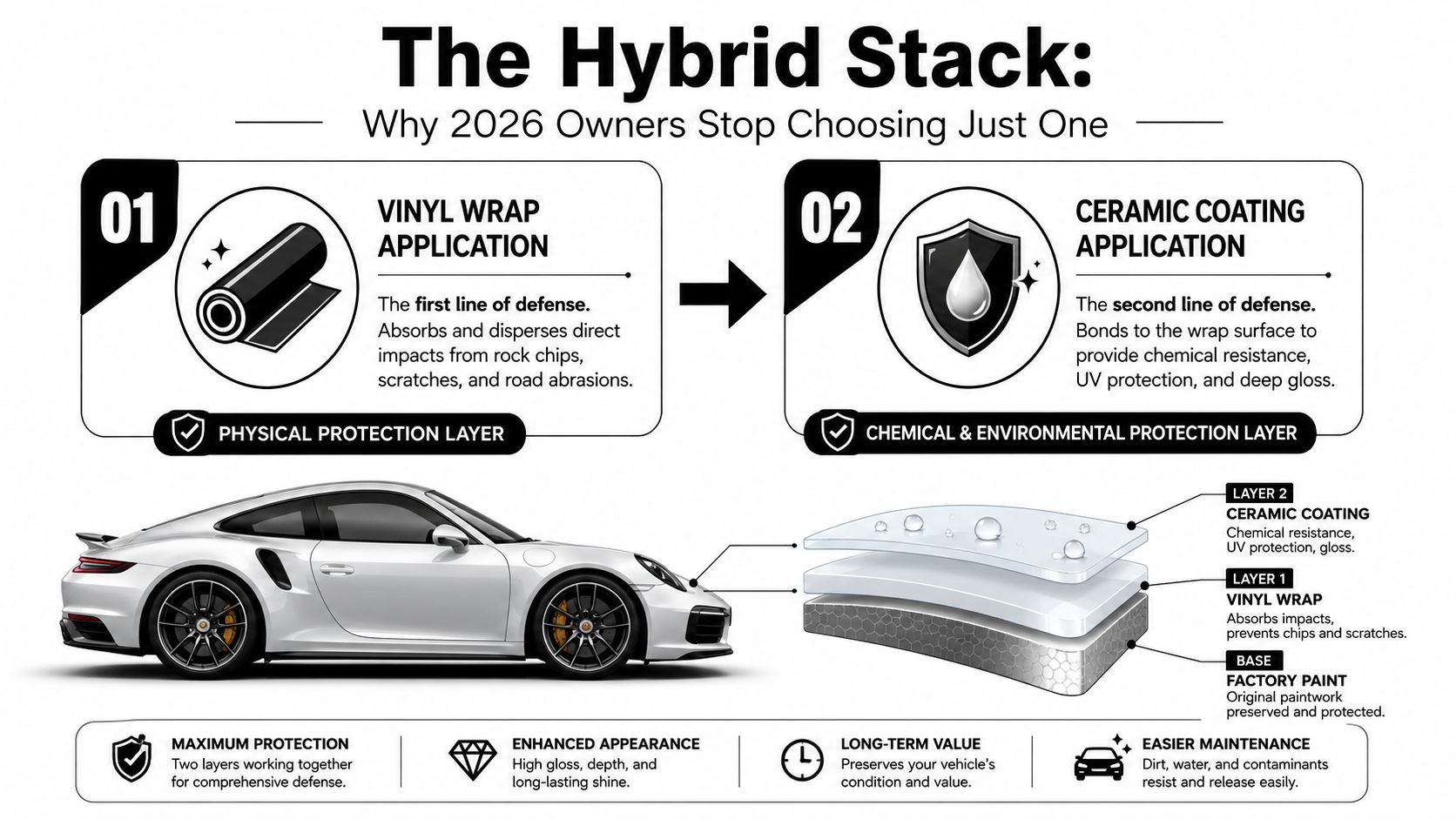
The smartest build for a lot of 2026 owners is no longer “ceramic or wrap.” It’s wrap first, ceramic on top, and only where the vehicle’s use case justifies it. The wrap handles the visible surface and the abrasion the panel sees, while the coating adds slickness, hydrophobic behavior, and easier cleanup over the top layer.
That hybrid idea is showing up more often in industry coverage because bundled protection packages are becoming normal and buyers are asking for layered value, not one-note answers euroluxedetailing.com. It makes even more sense when you’re talking about wrap-compatible coatings, because the question shifts from “which one?” to “how do I preserve both finish and function?”
When the hybrid stack earns its money
It makes sense for an owner who wants a color change but hates constant washing. It also makes sense for someone driving in rough weather who wants the wrap to stay cleaner and easier to maintain. If the vehicle is leased, the removable layer helps preserve what’s underneath, which is exactly why people ask about it when they’re balancing appearance against return condition.
There’s also a service-life benefit when the wrap is coated. One independent guide notes a coated wrap can extend usable life by about 12 to 24 months, which can move a typical wrap from roughly 5 to 7 years toward 6 to 9 years under good care epsppf.co.uk. That’s not magic, it’s just better surface behavior and slower fade.
When it’s overbuilt
Don’t oversell the hybrid if the owner won’t maintain it. If the budget is tight, if the car changes hands quickly, or if the owner treats detailing like a once-a-year event, the stack is too much. A basic coating or a straight wrap may be the smarter move.
Titan’s own ceramic coating for PPF guidance reflects the same real-world logic, because coatings on top of film are about making the system easier to live with, not just adding layers for the sake of it. The market is moving toward hybrid protection systems, but the build still has to match the owner, not the trend euroluxedetailing.com.
Where Titan Elastomer Coatings Fit in Your Build
Titan’s elastomer coatings fit where rigid thinking usually falls apart. A flexible coating layer makes more sense on a vehicle that sees temperature swings, vibration, daily washing, and mixed surfaces than a brittle, one-note finish. Titan’s own Titan Coatings elastomer system is built around that idea, and the category includes products like Alpha Quartz, APEX Glass, and Ultra Ceramic Spray.
How I’d use the lineup in the real world
Alpha Quartz belongs as the base protection layer when the owner wants a durable, flexible coating that works well in a serious detailer workflow. That’s the layer I’d trust as the starting point on a build that may later receive a wrap or already has one. The whole point is elasticity, so temperature swings and vibration don’t create the brittle behavior that ruins cheaper coatings.
APEX Glass is the windshield and glass move. If rain visibility matters, this is the part of the system that makes driving less stressful and glass easier to keep clear. For customers who care about the glass more than the body, that’s the obvious place to spend first.
Ultra Ceramic Spray is the maintenance tool, not the hero layer. Use it as a topper between full details when a DIY owner or mobile detailer wants a fast refresh without redoing the whole system. It’s the product I’d keep on the shelf for upkeep, not a substitute for prep.
A quick mobile-detailer workflow looks like this. Prep the paint, install the wrap if the car is getting one, let the surface settle, then apply the appropriate coating layer where it belongs. If the customer wants branded detailing touches, a Custom Sticker Shop Nissan decal is a simple example of how cosmetic add-ons and protection workflows can coexist without confusing the job.
Flexible coatings matter because real cars move, heat cycles happen, and surfaces don’t stay still. If a coating can’t flex, it’s already fighting the vehicle.
Which Path Is Right for Your Car and Your Driving Life
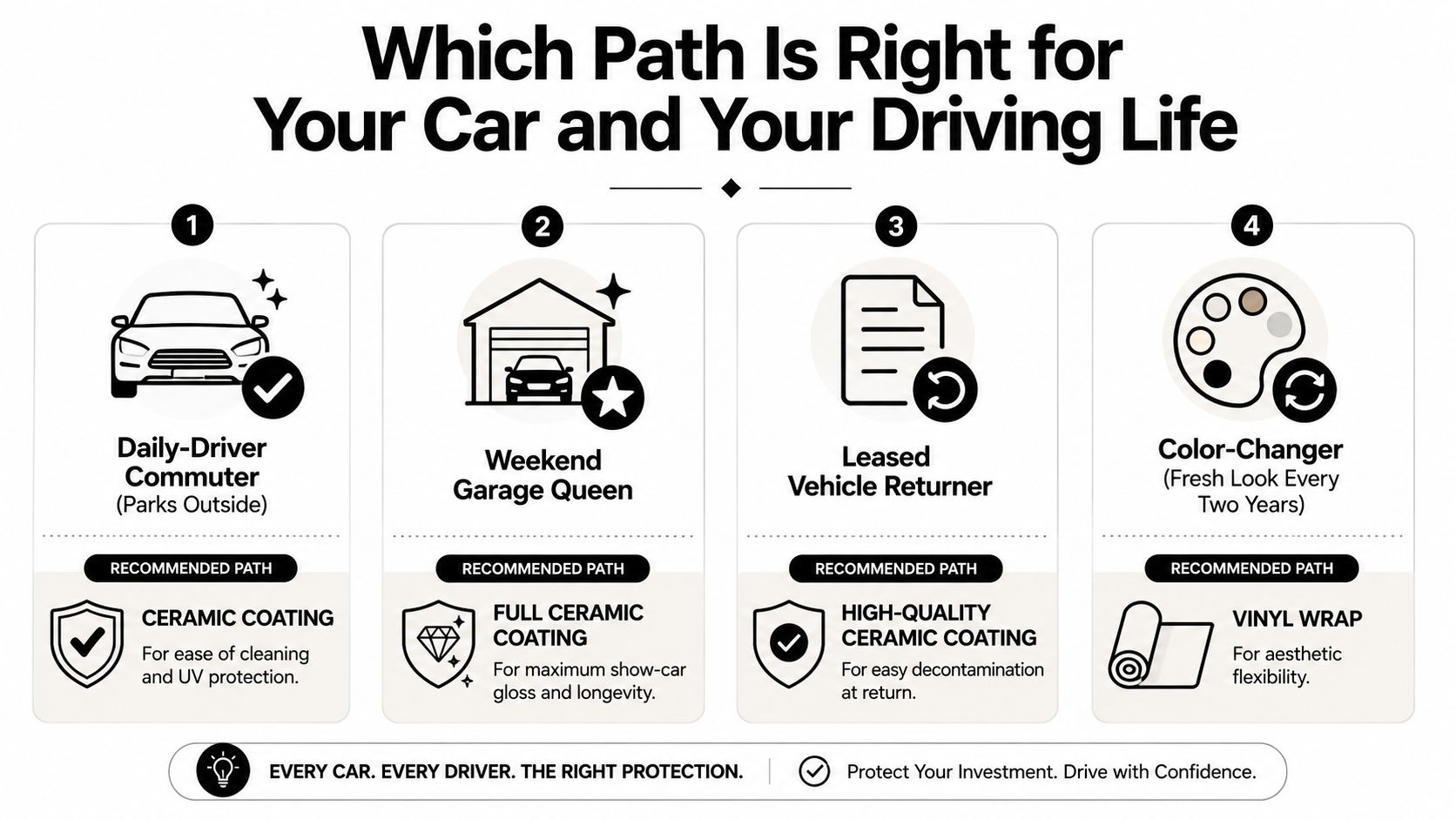
Daily-driver commuter who parks outside
Choose ceramic coating, then add Titan’s elastomer base if you want a more flexible, buildable system. You need easier cleaning, better UV resistance, and less hassle after rain, dust, and road grime. A wrap won’t solve the daily-cleaning problem as cleanly unless the main goal is color change.
Weekend garage queen
Choose a full ceramic coating and keep the surface simple. If the car isn’t living outside, the win is gloss, maintenance ease, and keeping the paint looking fresh between drives. A wrap here is a style choice, not a necessity.
Leased vehicle returner
Choose ceramic coating if your goal is easy decontamination and simpler turn-in prep. If the lease vehicle also needs cosmetic protection or you want to keep the factory finish underneath, a removable wrap can make sense, but only if you’ll keep it clean and inspect the edges. The return condition matters more than the badge on the invoice.
Color-changer who wants a fresh look every two years
Choose a vinyl wrap. That’s the clean answer. You want the color flexibility, the temporary nature, and the ability to change the car’s personality without repainting it, and a coating alone won’t give you that.
If you want the simplest checklist this week, use this:
- Inspect the paint condition. If the surface already needs correction, don’t pretend a cosmetic layer will fix that.
- Name the main goal. Protection, color, or both.
- Set a yearly budget. Think in ownership cost, not just install price.
- Book a consultation before you pay. The right build depends on how you drive, where you park, and how long you’re keeping the car.
If you’re building a car for real use, not for internet arguments, this topic stops being ceramic coating vs wrap and becomes layered protection that matches your life. APEX NANO – Titan Coatings gives you that layered path with elastomer coatings, glass protection, and maintenance toppers that fit into a wrap or coating build without forcing a false choice. Visit APEX NANO – Titan Coatings and pick the protection stack that fits the way you drive.
0 Comments