
The most popular advice about ceramic coating life is also the least useful: choose the largest number of years on the label and assume the coating will perform the same way until that date. A vehicle isn't a laboratory. Sunlight, salt, detergents, road grit, temperature changes, and washing technique decide how protection ages.
A better question is not, “How many years does this coating last?” Ask instead, what performance has the coating retained, and what caused that performance to change? A surface may lose its dramatic water beads while retaining useful chemical and ultraviolet protection. Another may still look glossy while its protective film has suffered from contamination, abrasion, or poor adhesion.
Redefining Ceramic Coating Life Beyond Calendar Years
A warranty period is a category, not a stopwatch. Independent coatings research identifies one to three years as a typical effective-protection range for automotive ceramic coatings, while also emphasizing that ultraviolet radiation, moisture, temperature, chemicals, abrasion, formulation, and maintenance alter the result. Automotive coatings research also distinguishes ceramic coatings from conventional waxes through their chemical bonding and greater hardness.
That range is a practical baseline, not a universal expiration date. An indoor-stored vehicle washed carefully may retain useful behavior longer than an outdoor daily driver exposed to intense sun, road salt, detergents, and repeated contact. The coating's life should be judged by retained performance, not by the calendar alone.
Three different endpoints
I evaluate a coating through three separate questions:
- Has the gloss remained stable? Gloss retention and color change reveal how the finish is aging visually.
- Does water still behave predictably? Hydrophobicity can decline because contamination masks the surface or because the coating's chemistry has changed.
- Does the barrier still resist chemicals and ultraviolet exposure? A coating can bead less aggressively while its bonded network remains partly functional.
This distinction matters because water behavior is only one indicator. An industry synthesis reports hydrophobicity declining from approximately 110° to 85 to 90° after one to three years of unsheltered sun, while the coating network beneath may remain intact. The coating-life analysis treats that change as a reason to test more carefully, not as automatic proof that the coating has disappeared.
Practical rule: Water beading tells you how the surface is behaving today. It doesn't, by itself, prove how much protective film remains.
That is why a coating can look present but provide weaker water repellency or chemical resistance. Traffic film, mineral deposits, iron particles, and maintenance products can also conceal the coating's real condition. Before replacing a system, clean and decontaminate the surface, then reassess gloss, water movement, spotting, and ease of cleaning.
Titan's discussion of long-term protection is useful when setting expectations, but a calendar claim still needs context. A product's preparation standard, exposure conditions, cure process, and maintenance schedule matter more than the number printed in isolation. For a broader comparison of how a longer-term coating claim should be interpreted, see Titan's five-year ceramic coating guidance.
Environmental and Mechanical Factors That Degrade Protection
A coating rarely faces one form of aging at a time. Ultraviolet radiation and chemical exposure receive most of the attention, but a daily-driven vehicle also experiences repeated washing, drying, road grit, decontamination, and accidental contact. Those actions create what I call an abrasion budget. Every contact cycle adds friction, and the total effect can matter as much as sunlight.
A garage-kept weekend car and an outdoor daily driver may carry the same formulation yet age very differently. Consumer comparisons report that a professional coating on a garaged vehicle may last five to seven years, while a DIY coating on an outdoor daily driver may last closer to one to two years, with preparation, wash chemistry, parking, and ultraviolet dose identified as major variables. The automotive-wear research also supports evaluating weathering, acid exposure, and solid-particle erosion together rather than treating each stress in isolation.
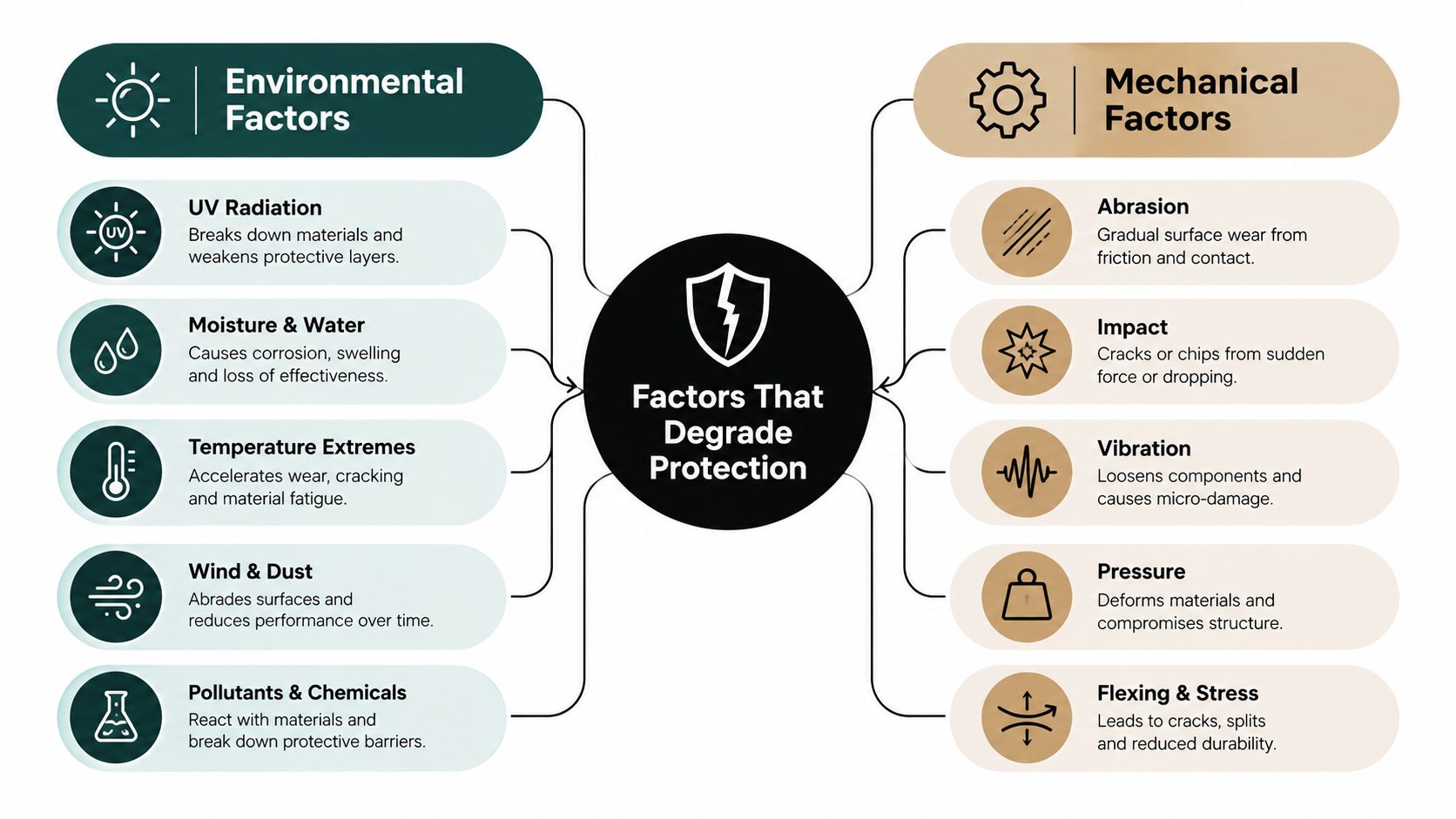
Where the wear comes from
Parking exposure controls the daily ultraviolet and thermal load. Outdoor parking also increases contact with pollen, bird deposits, tree residue, hard-water minerals, pollution, and road salt.
Washing technique controls mechanical stress. A dirty mitt dragged across paint carries abrasive particles. Drying a panel aggressively, especially when water and grit remain, adds another opportunity for micro-marring and surface wear.
Chemical selection affects the bonded film and the contamination sitting above it. Strong or poorly selected detergents can stress performance over repeated use, while mineral deposits may block water behavior without meaning the base coating has failed.
Road use adds grit, brake dust, insects, and de-icing chemicals. A high-mileage vehicle accumulates more exposure events than a lightly driven one, regardless of the coating's advertised duration.
Titan's guidance for harsh weather conditions is relevant because climate changes the balance between these stresses. Tropical humidity, winter salt, desert dust, coastal contamination, and intense sun don't produce the same aging pattern. A credible expectation should describe the vehicle's use case, not just the product category.
Choosing elasticity for abrasion-heavy use
For a mobile detailer or careful DIY owner, application quality still comes first. Surface preparation, decontamination, correction, panel wipe, and cure control determine whether the coating bonds properly. In this category, Alpha Quartz 50ml Ceramic Coating is described as an elastomer ceramic coating for all surfaces with 92% high solids, zero VOCs, a solvent-free composition, advanced adhesion technology, and a stated cure time of four hours.
Those product facts don't erase maintenance demands. They do show why formulation and service environment should be considered together. A flexible coating may accommodate movement more effectively, but it still needs safe washing and timely removal of corrosive contamination.
The coating protects the paint. It doesn't make neglect harmless.
Translating Accelerated Weathering Tests to Real-World Results
Laboratory weathering is valuable when the test method and failure criteria are clear. It becomes misleading when a test-hour figure is presented as a guaranteed number of years for every climate and vehicle.
Xenon-arc weatherometers expose coating systems to light, heat, moisture, condensation, and sometimes water spray. For automotive qualification, xenon-arc methods are relevant because they approximate the full solar spectrum more closely than ultraviolet-only lamps. SAE J2527 and related transportation-coating protocols control variables such as irradiance, black-panel temperature, moisture cycles, and exposure duration.
The correlations are useful, but they are system-specific. One coatings-industry analysis reports that 1,250 hours under SAE J2527 borosilicate exposure correlated with approximately one year in south Florida, while 750 hours under ASTM D7869 produced degradation equivalent to about one year at that location. The accelerated-weathering analysis also reports that, after 5,000 hours in a xenon-arc weatherometer, ultraviolet absorbance fell 33% and film thickness fell 16% in the automotive system studied.
Those figures don't convert directly into a universal lifespan. The test system, pigment chemistry, clear coat, film thickness, cure schedule, substrate preparation, climate, washing chemistry, and endpoint all influence the result. A Florida-equivalent exposure also isn't automatically representative of a snow belt, desert highway, coastal region, or fleet vehicle exposed to constant abrasion.
What a credible durability claim includes
A serious test report should identify:
- The method and exposure cycle, including light source, moisture, temperature, and duration.
- The starting condition, such as initial gloss, film thickness, or contact angle.
- The retained performance, measured after exposure rather than described with visual language alone.
- The failure criterion, such as adhesion loss, cracking, blistering, gloss loss, or chemical resistance.
- The intended climate and use case, because laboratory equivalence doesn't represent every parking and washing pattern.
A separate exposure model estimated that a coating designed to survive eight years in Florida would have a failure rate below 5% after ten years in United States service. Increasing modeled durability to ten years reduced that rate below 1%, while reducing it to six years increased the rate to 20%. These are modeled probabilities, not promises for a particular vehicle, and they demonstrate why durability should be expressed as a probability of retained performance.
Titan's third-party testing information can help buyers ask better questions. Don't accept “thousands of hours” without asking what was tested, how it was measured, and what the manufacturer defined as failure.
The Advantage of Elasticity and Dark Matter Technology
A hard surface isn't automatically a durable surface. Traditional ceramic chemistry can create a rigid, glass-like protective layer with useful hardness and chemical resistance, but a vehicle panel doesn't remain dimensionally still. It warms in direct sun, cools at night, vibrates at highway speed, and experiences impacts from insects, grit, and debris.
Titan Coatings describes its ElastoTek technology as a membrane-forming system based on elastomers and carbon nanotubes. The company's explanation centers on a practical trade-off: the surface can be hard like glass while remaining flexible, allowing it to accommodate panel expansion and vibration without cracking. Titan's technology explanation also identifies Dark Matter Technology as a blend using carbon nanotubes to increase stiffness, mechanical strength, and thermal stability while retaining the elastomeric layer's ability to flex.
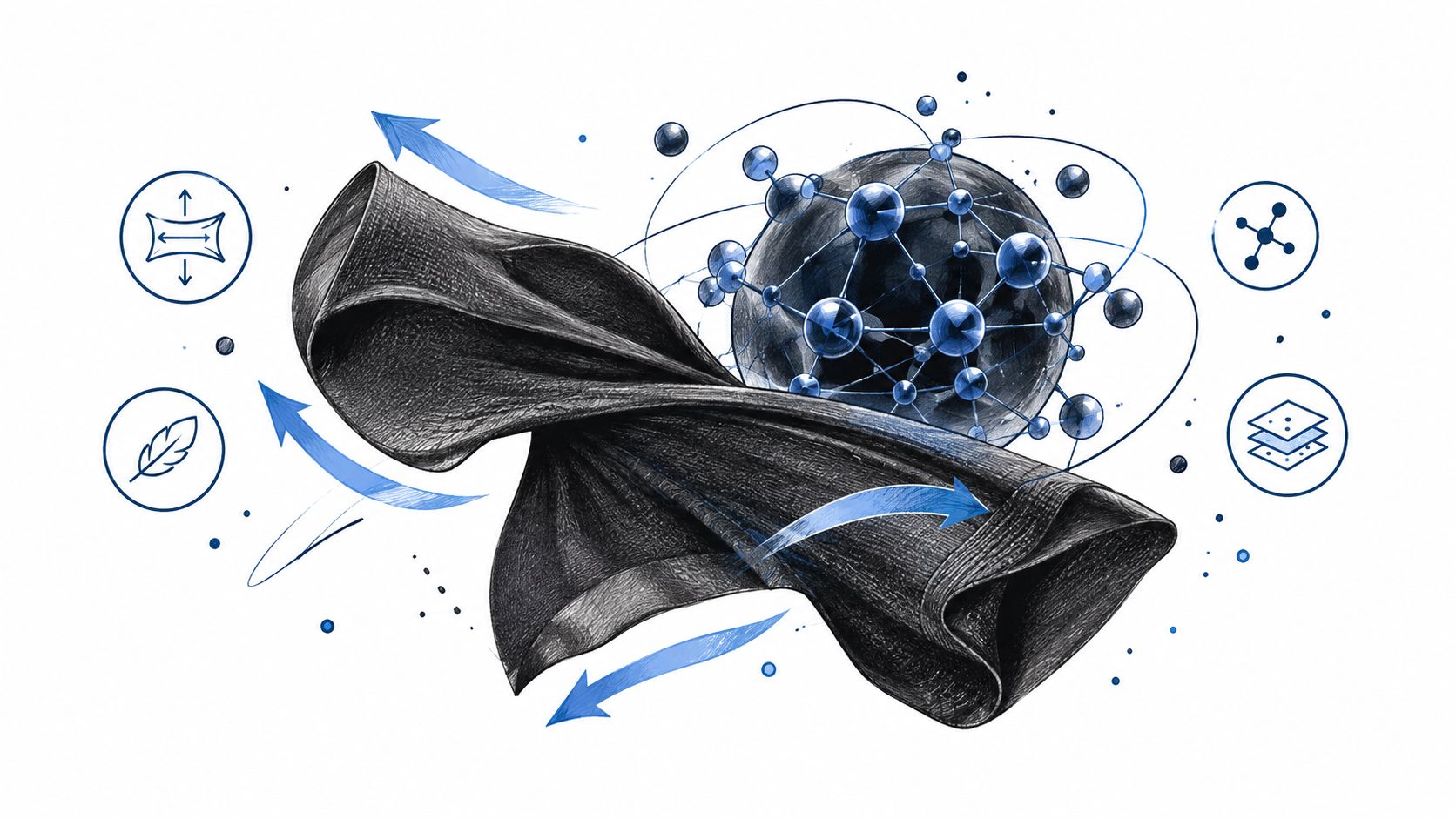
Hardness needs movement
Thermal cycling creates stress at the coating and substrate interface. A rigid film has less capacity to accommodate dimensional change, while an elastic membrane is designed to stretch and return toward its original shape. That doesn't mean temperature has no effect on any coating, and it doesn't establish a universal frozen-to-hot operating limit. It does support a narrower material-science claim: Titan designs its elastic architecture to reduce cracking risk during temperature variation by combining a flexible polymer membrane with reinforcing nanomaterials.
The same logic applies to vibration and minor impacts. Flexibility doesn't make a panel immune to damage, but it can reduce stress concentration compared with a film that must remain fixed while the surface beneath it moves. This is why hardness alone is an incomplete durability metric.
Material insight: The most useful coating isn't necessarily the hardest one. It needs enough hardness to resist contamination and enough flexibility to remain continuous as the vehicle moves.
Titan identifies 2021 as the year it introduced carbon-nanotube technology to automotive coatings and lists ElastoTek as a current coating platform using its proprietary Dark Matter blend. Its coating flexibility information gives detailers a useful way to discuss longevity with clients: a protective layer has to resist chemicals while accommodating real panel movement.
What self-healing does and doesn't mean
Titan lists Dark Matter Technology as a self-healing elastomer coating for certified professional detailers. Its vehicle-coating guide gives the product a stated durability range of seven to ten-plus years and describes thermally activated self-healing of fine swirls and scratches. Titan's vehicle paint coating information doesn't define the testing protocol behind that range, including climate, mileage, film thickness, preparation, or maintenance.
Treat that figure as Titan's stated product range, not a universal guarantee. The practical advantage is more specific: the coating architecture is designed to combine a glass-like hard feel, flexibility, and thermally activated repair of fine surface defects. It won't prevent deep scratches, impact damage, or poor washing from affecting the vehicle.
Maintenance Schedules for Maximum Hydrophobic Performance
A flexible coating still needs disciplined care. Maintenance preserves the surface's hydrophobic and self-cleaning behavior, removes contaminants before they bond aggressively, and limits the friction that consumes the vehicle's abrasion budget.
Start with the least aggressive method that can remove the contamination. A coated vehicle shouldn't be treated as scratch-proof, and repeated brush contact or careless drying can create defects even when the coating remains bonded.
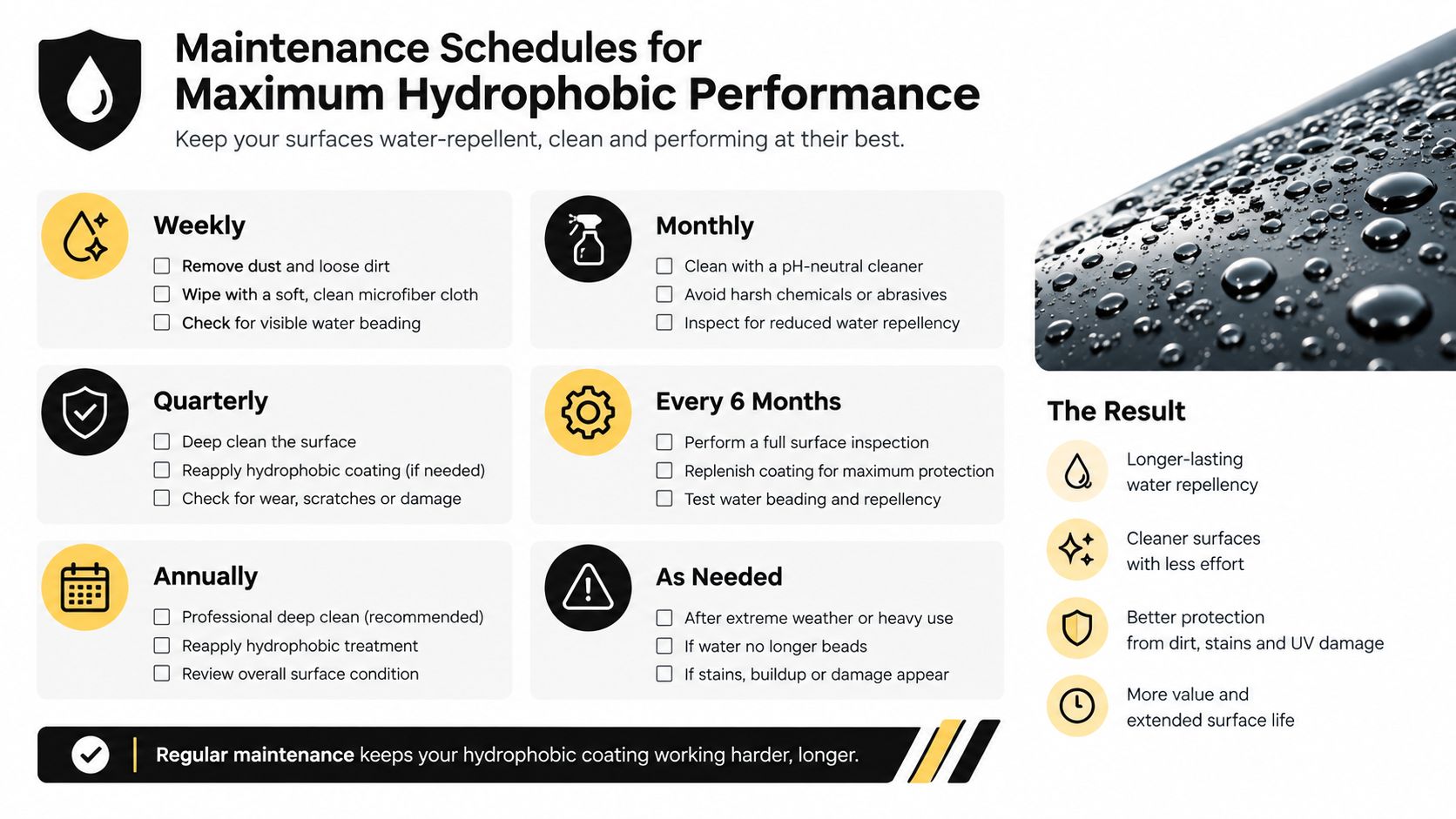
A practical wash process
Rinse before contact. Remove loose grit with water before placing a mitt on the paint. Pay attention to rocker panels, rear bumpers, and other areas that collect road film.
Use a pH-neutral shampoo. A neutral product cleans without unnecessarily stressing the surface. Follow the dilution and use instructions for the specific shampoo rather than assuming stronger concentration means better cleaning.
Separate dirty and clean water. A two-bucket method, or a contact-minimized wash where appropriate, reduces the chance of returning abrasive particles to the panel. Work from the cleanest upper surfaces toward the dirtiest lower sections.
Keep the mitt moving lightly. Don't scrub a bonded contaminant aggressively. Rinse, soften, and repeat instead of trading a small stain for micro-marring.
Dry with minimal friction. Use a clean, suitable drying towel or controlled air. Dragging a towel over a contaminated surface increases mechanical wear.
Inspect before adding products. If water behavior weakens, determine whether traffic film, mineral deposits, iron contamination, or a maintenance product is masking the surface.
Titan's ceramic coating maintenance guidance provides a useful reference for building a routine around the vehicle rather than around a rigid calendar.
Diagnose before resetting
Acidic products can dissolve mineral deposits, but aggressive or frequent use may accelerate coating wear. Don't reach for an acid reset just because water no longer forms tight beads. First wash safely, inspect the paint, and choose a decontamination process suited to the actual residue.
A maintenance topper can improve surface behavior, but it can also hide the condition of the base layer. Keep records of wash chemistry, decontamination work, drying method, and changes in gloss or water movement. That simple log helps a detailer distinguish genuine coating decline from temporary masking.
Maintenance decision: Clean the surface before judging the coating. Replace or repair a system when measurable performance and surface integrity have declined, not merely because the beads look less dramatic.
Selecting the Right Formulation for Every Surface and Skill Level
Product choice should follow the surface, exposure, and installer. Paint, glass, and quick-maintenance applications don't need the same chemistry or the same application process.
For windshields and exterior glass, Apex Glass Coating is described as an advanced hydrophobic glass and windshield coating with deep-pore bonding and water-repellent performance. Titan states that it enhances visibility, reduces wiper use, and lasts up to two years. On a rainy commute, the benefit isn't cosmetic. A cleaner, more water-repellent windshield can make driving feel less stressful by helping rain clear across the driver's field of view.
Match the system to the user
| Use case | Suitable direction | What matters most |
|---|---|---|
| Painted panels, professional installation | Elastomer ceramic coating | Preparation, adhesion, cure control, and maintenance |
| DIY or mobile detailing | Accessible elastomer formulation | Straightforward application, working conditions, and careful leveling |
| Windshield and glass | Dedicated glass coating | Deep-pore bonding, water behavior, and visibility |
| Fast refresh or repeat service | Ultra spray ceramic coating | Efficient installation and realistic reapplication expectations |
For a DIY owner or mobile detailer, Alpha Quartz is positioned as an elastomer ceramic coating designed for all surfaces, with high solids, zero VOCs, a solvent-free formulation, advanced adhesion technology, and outdoor or indoor application capability. Its stated four-hour cure can simplify scheduling, but the installer still has to control preparation, application, contamination, and exposure during curing.
Titan also offers an ultra spray ceramic format for users who prioritize rapid installation. The Ultra Ceramic Spray is the relevant option to evaluate when speed and straightforward application matter more than building a demanding professional coating process. Faster installation doesn't remove the need for a clean surface or realistic expectations about maintenance.
Elasticity remains the central selection question for harsh temperature cycling and moving panels. A coating that's hard like glass but flexible can be better suited to thermal movement than a rigid film that concentrates stress at the interface. The right decision still depends on the vehicle, the surface, the environment, and the skill of the person applying it.
APEX NANO – Titan Coatings offers glass, elastomer, and spray coating options for different surfaces and application styles, including products designed around flexibility and thermal movement. Visit APEX NANO – Titan Coatings to compare the available systems, review application information, and choose a protection approach that matches your vehicle and maintenance routine.
0 Comments