
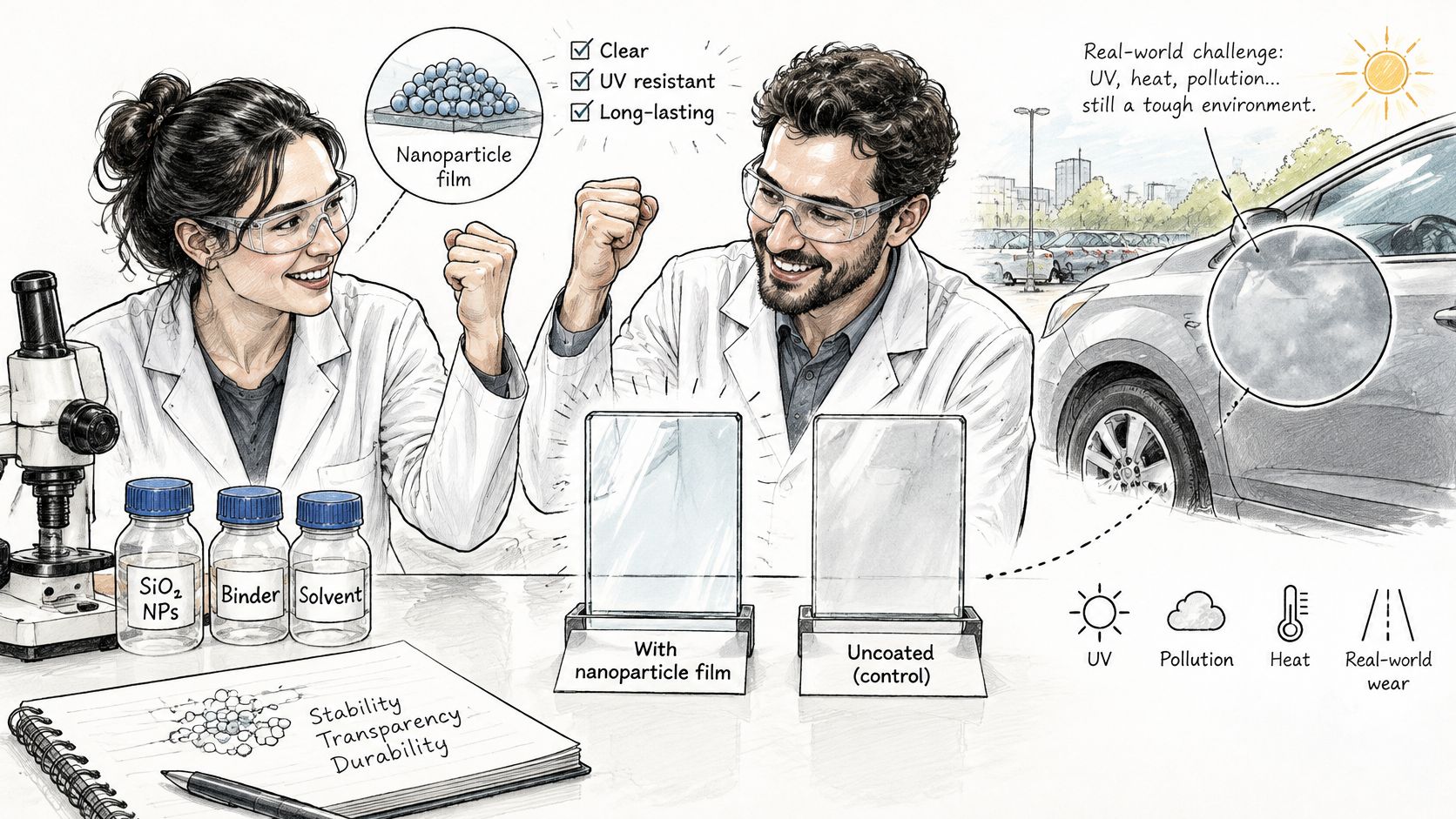
A formulation team celebrates a nanoparticle coating that outperforms its control on a small glass coupon. After application to a car panel, sun exposure and repeated washing leave the film cloudy, and the detailer wants to know what went wrong.
Why Coatings Teams Cannot Treat All R&D the Same
The team didn’t necessarily discover bad chemistry. It mistook an encouraging laboratory result for evidence of a finished coating system.
That distinction explains why the types of R&D matter to detailers, manufacturers and buyers. Understanding a material, solving a protection problem and delivering a repeatable product require different work.
The OECD’s Frascati Manual, first formalized in 1963 after experts met in Frascati, Italy, established the internationally recognized categories of basic research, applied research and experimental development. Its framework separates genuine R&D from routine technical work through novelty, creativity, uncertainty, systematic investigation and transferable or reproducible results.
For coatings, investigating particle behavior is different from solving UV degradation. Neither automatically proves that a production batch will remain clear, adhere properly and tolerate an installer’s working conditions.
Practical rule: Don’t approve a commercial durability claim using evidence that only establishes a laboratory mechanism.
Different work needs different evidence
Routine batch checks confirm whether a known process stays within specification. R&D addresses a technical question the team can’t already answer. Calling every mixing trial or customer application R&D hides the projects that actually need investigation.
The coupon-to-panel failure is therefore a management problem as much as a chemistry problem. Someone authorized progress without naming the missing evidence.
A useful project label must tell you what kind of uncertainty remains, whether the work concerns the product or its production method, and who should perform it. The standard is simple: name the project’s R&D category, then name the evidence still required before anyone calls it finished.
The Three Core Types of R&D Compared
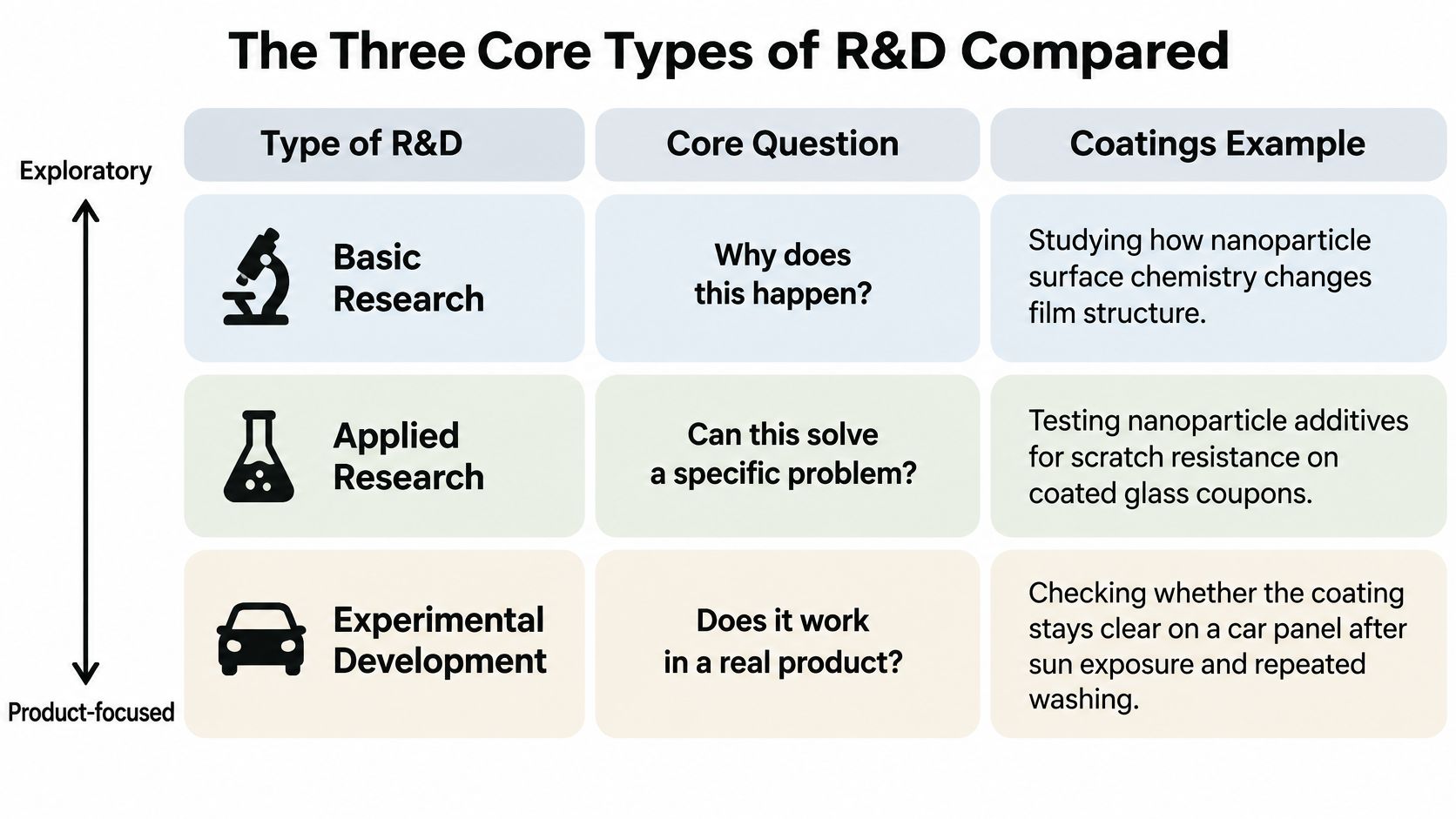
The three core types run from exploratory knowledge generation to product-focused development. Classify work by the question researchers are trying to answer, not by whether they wear lab coats.
The spending figures below describe U.S. domestic R&D in 2023, as reported by the National Center for Science and Engineering Statistics.
| Type | Core question | Coatings example | Share of U.S. R&D (2023) |
|---|---|---|---|
| Basic research | Why does adding this nanoparticle change clarity or hardness? | Studying how particle size and cross-link density shape film behavior | 14.7% ($138 billion) |
| Applied research | How do we stop UV from chalking this clearcoat? | Targeting UV stability or chemical resistance against a defined requirement | 18.6% ($174 billion) |
| Experimental development | Can we make this formula repeatable and prove it lasts? | Scaling a formula and validating it under UV, abrasion and temperature cycling | 66.7% ($625 billion) |
From explanation to a usable coating
Basic research asks why something happens without requiring an immediate commercial application. A scientist might investigate how nanoparticle surface chemistry changes polymer structure, even when there’s no product specification waiting.
Applied research directs new knowledge toward a practical objective. Instead of investigating every possible interaction, the team selects candidates that could prevent a particular clearcoat from losing integrity under UV exposure. Readers evaluating polymer nanocomposite coatings should distinguish an explanation of reinforcement from evidence that a formulation meets its intended requirement.
Experimental development turns findings and practical experience into new or improved products and processes. The NCSES definitions explicitly include experimental prototypes and first-time demonstrations at scale where further refinements are expected.
Think of basic research as mapping a river. Applied research selects a suitable bridge crossing. Experimental development builds the bridge and load-tests it before traffic arrives.
What the spending pattern means
Development dominates the national spending comparison. That isn’t a recommended budget ratio for every coatings business, but it’s a useful warning against treating commercialization as inexpensive finishing work.
My recommendation is to fund the proof before expanding the promise. A technically interesting ingredient deserves investigation; a coating sold for demanding service needs manufacturing, application and durability evidence.
Product R&D and Process R&D Explained
A coating can pass a lab test and still fail on the production line or a customer’s panel. Product R&D changes the formula; process R&D proves that people can make and use it consistently. Most promises break during experimental development, when teams test whether a promising formulation survives real manufacturing and application conditions.
| Dimension | Product R&D | Process R&D |
|---|---|---|
| Question it answers | What should the coating contain and do? | How should it be made, applied and cured? |
| Coatings example | A new elastomer ceramic formula with higher flexibility | A spray method that leaves no haze or streaks on a panel |
| Typical change | New chemistry or a new product line | Revised mixing order, curing window or cloth technique |
| Success measure | Verified performance in the target test | Repeatable results across operators and batches |
| Who notices first | Buyers and detailers choosing a product | Installers, production staff and quality control |
The bottle and the installation method
ULTRA Ceramic Spray is a product example. Its formulation is product development; establishing a reliable way to apply it is process development. Keep those questions separate. A coating’s chemistry cannot prove that its application procedure works across operators and panels.
Test the procedure with identically prepared panels and different operators. Record the amount applied, towel condition, ambient conditions and finish. Don’t let an experienced installer compensate for a narrow working window while the team declares the product easy to use. If one operator gets a clean finish and another leaves haze or streaks, the application process still needs work.
A coating isn’t easy to install merely because its formulator can install it.
Working time and the wait before leveling are process limits, not new chemistry. Use documented coating application methods to identify a usable operating window and record what happens outside it. Those results can show whether the formula needs revision or the procedure needs tighter instructions.
Process development applies to manufacturing too. A revised mixing order or curing window counts as R&D when the team is resolving technical uncertainty and checking repeatability across batches. If the right procedure is already known and the task is only to train installers, that is technical support, not R&D.
Use this sorting rule: a change to what’s in the bottle is product work; a change to how it’s manufactured, applied or cured is process work. Then ask whether the team is resolving a genuine technical uncertainty, rather than repeating a known method.
In-House and Outsourced R&D Trade-Offs
Keep proprietary formulation knowledge close; buy specialist testing when equipment or independent credibility is the constraint. Ownership matters, but owning every instrument doesn’t make a coatings company more capable.
The decision is about control, cost and feedback speed. An internal team can adjust a candidate immediately, while an outside laboratory can provide expertise and documented results the business can’t efficiently reproduce itself.
| Factor | In-house R&D | Outsourced R&D |
|---|---|---|
| Best for | Core formulas and proprietary chemistry | Accelerated weathering, standardized ISO/ASTM testing and niche studies |
| Control of know-how | Full control of formulas and data | Shared control, defined by contract terms |
| Upfront cost | High commitment to labs, chemists and equipment | Lower capital commitment through project or test fees |
| Speed to a first result | Slower to build capacity, faster to iterate once established | Quick when capacity is available, costly when every cycle is billed |
| Main risk | Gaps in specialist equipment and expertise | Leaking know-how and weak feedback loops |
| Typical partner | Internal laboratory and production team | Universities, government labs and contract testing houses |
Build a useful division of work
Say a coating manufacturer wants to understand an unfamiliar particle-polymer interaction. A university laboratory investigates the mechanism, the manufacturer retains formulation development, and a contract testing house evaluates coded finished panels.
That arrangement protects the recipe without asking the internal team to become expert in every analytical method. When comparing industrial coating suppliers, ask who designed the testing, who performed it and whether the full report is available.
Before sending samples, agree on substrate, preparation, film thickness, curing, controls and failure criteria. Require photographs and raw measurements, not just a pass statement. Otherwise, an impressive report may answer a different question from the one your customer cares about.
Buying advice: Pay for a clearly defined test question, not an official-looking certificate.
My advice to small teams is blunt: outsource more difficult validation before commissioning more exploratory projects. Keep work internally when it creates your competitive advantage and requires frequent iteration; outsource when specialist capacity or independent assessment is the limiting factor.
How Coating Ideas Move From Lab to Road
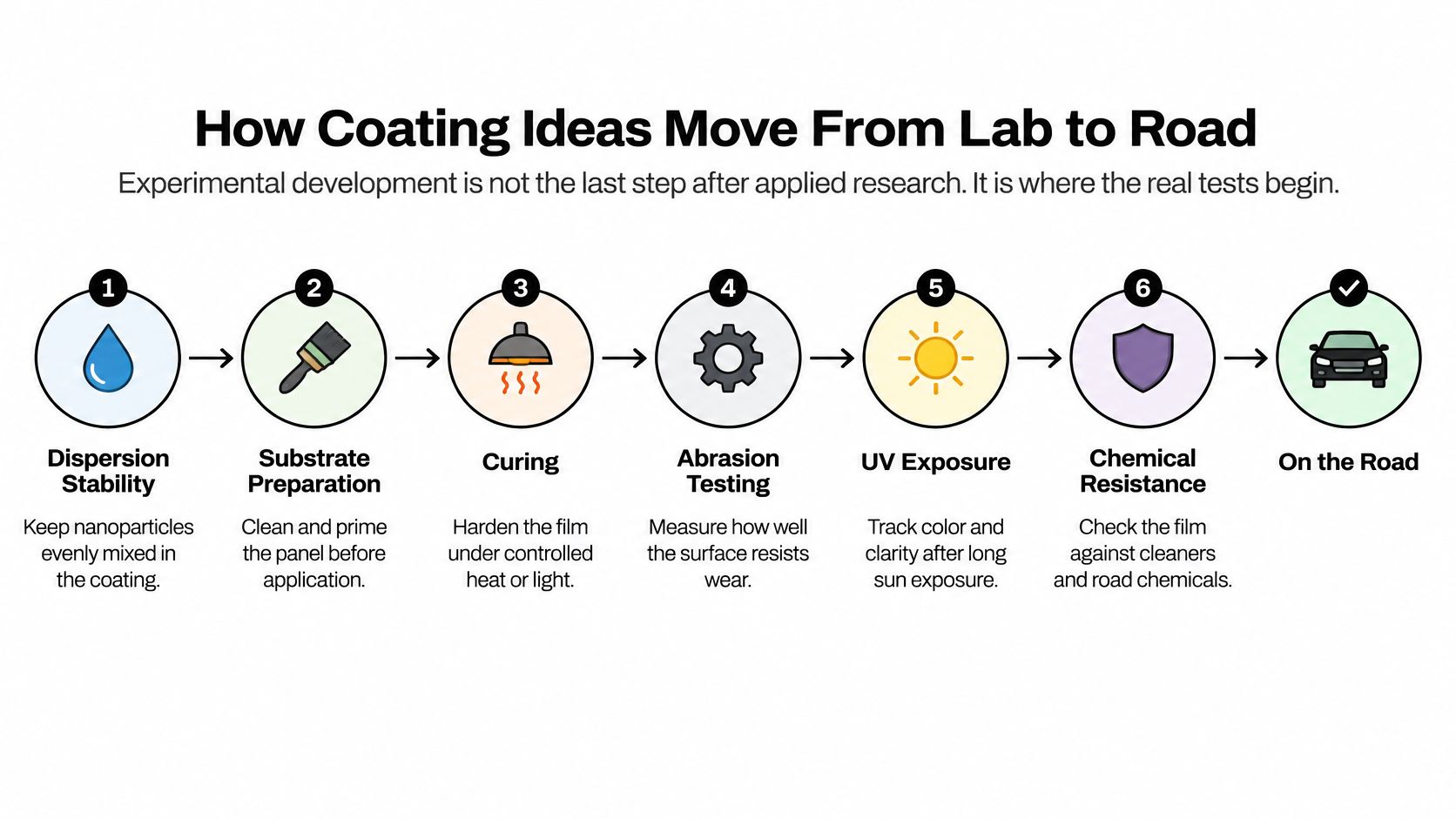
Experimental development is where coating promises meet production conditions. A formulation that works on a small coupon still has to survive dispersion, substrate preparation, curing and environmental exposure as a usable product. Most lab promises break here, during development and scale-up, rather than at discovery.
A clearcoat advertised for UV resistance, for example, needs evidence beyond small-coupon results. Larger panels can reveal uneven mixing, contamination that interrupts adhesion and thickness variation that changes the finish. A review of nanostructured coatings identifies large-area uniformity, scale-up and substrate-related adhesion as commercialization barriers.
Test the failure mechanism
NIST’s coating-weathering work describes polyurethane coatings containing silica nanoparticles exposed to intense UV and simulated rain washing. The study reports that UV-driven oxidation was the principal degradation pathway in a nanoform-pigmented coating, while the pigment reduced oxidation through UV absorption.
Accelerated exposure should explain a real failure, not just produce damage quickly. Pair it with outdoor panels, and track gloss, color retention, adhesion, scratch damage and chemical changes. Hardness or water beading alone does not establish durability.
| Stage | What you test | Failure signal to watch |
|---|---|---|
| Lab discovery | Mechanism on small coupons | Effect disappears at a larger panel size |
| Formulation screening | Dispersion, cure and adhesion across variants | Particles settle or the film delaminates |
| Pilot-batch reproducibility | Thickness, morphology and performance from batch to batch | Results differ between mixes made by different operators |
| Third-party standardized testing | Relevant ISO/ASTM methods and controlled UV, abrasion and chemical tests | Laboratory results don’t match outdoor exposure |
| Long-term field validation | Real climates, vehicles and temperature cycling | Gloss loss, cracking or water spotting during service |
Make the claim match the exposure
Titan describes its proprietary elastomer approach as combining glass-like hardness with flexibility, alongside nanotube technology and Dark Matter Technology®. The claimed first-to-market position requires historical substantiation; terminology alone does not establish performance.
Flexibility can accommodate movement and help limit cracking. Test frozen-to-hot resistance and impact tolerance under defined conditions. Do not turn those results into a promise that temperature can never affect the film.
Ask what third-party testing covered, including the coating, substrate and exposure conditions. For a different environment, Painters North Shore’s guide to the best exterior paint for coastal homes offers context for environment-specific product selection, not evidence about automotive coatings.
Classify Your Project and Audit Your R&D Mix
A coating can pass a lab test and still fail on a vehicle. Classify the work by the uncertainty it addresses and the evidence it produces, not by whether the team is using nanotubes, ceramic chemistry or elastomers.
The OECD’s detailed Frascati guidance frames R&D around uncertainty, systematic investigation and learning that can be reproduced or transferred. Apply that standard to separate genuine investigation from routine installation or production.
Classify the work before approving it
Write a testable question. “Does changing particle surface chemistry alter polymer interaction?” identifies an investigation and a result the team can assess. “Develop a better coating” remains too broad to guide a decision.
Name the uncertainty and expected learning. State what the team does not know and what evidence could resolve it. If the outcome is already known, assess whether the work is routine production or quality control.
Identify the intended output. New understanding points toward basic research. Solving a defined requirement points toward applied research. Establishing a repeatable product or manufacturing method points toward experimental development.
Set completion evidence. Specify the report, measurement, reproducibility check or field result required to close the project. Assign someone to reject incomplete evidence.
These categories change what a review should approve. A hypothesis about nanoparticle-polymer interactions needs an explanation supported by results, including a useful negative result. Optimizing hydrophobicity against a defined requirement needs comparative measurements and a stated target.
Pilot manufacturing needs its own approval package: reproducible batches, controlled application and validation under the intended stresses. Applying a known formula for a customer or checking a routine batch against established specifications does not automatically qualify as R&D.
Audit the portfolio and the purchase
Review the previous year’s projects by category, spending, unresolved uncertainty and completion evidence. Check whether discovery, problem-solving and development are represented, either in-house or through partners. A small business need not own every stage.
A portfolio full of promising ingredients but short on qualified products signals a development gap. Most lab promises break at experimental development or scale-up, where repeatable batches, application controls and real exposure test whether the claimed performance holds. Direct funds toward the uncertainty blocking the next defensible commercial decision, rather than copying national spending patterns.
For failed panels, use coating failure analysis to distinguish chemistry problems from preparation, application or exposure problems. Otherwise, the team may reformulate a suitable product to compensate for an uncontrolled process.
For product selection, Alpha Quartz is described as an elastomer ceramic coating for indoor and outdoor application. Installation practicality matters to DIY users and mobile detailers. Assess frozen-to-hot or bug-impact cracking claims against documented testing; elasticity alone does not establish immunity.
For windshields, Apex Glass is a glass-coating option to assess for application suitability and the intended visibility outcome. Judge the result by clearer visibility and properly functioning wipers, not by a promise of stress-free driving in every storm.
Compare the Titan Coatings shop by intended surface, installation requirements and available evidence. Choose the coating whose documented development matches your conditions, not the one with the boldest laboratory headline.
APEX NANO by Titan Coatings offers coatings for automotive and other demanding applications, including elastomer, glass and spray-applied options. Visit APEX NANO – Titan Coatings to compare product guidance, then ask for application and durability evidence relevant to your vehicle, customers and working conditions.
0 Comments