
Say it's Saturday morning and you're finishing a black sedan in a customer's driveway while clouds stack up behind the house. The paint looks deep enough to fall into, but you're deciding whether a quick spray is real protection or just a shiny goodbye.
Why Paint Needs a Spray Layer
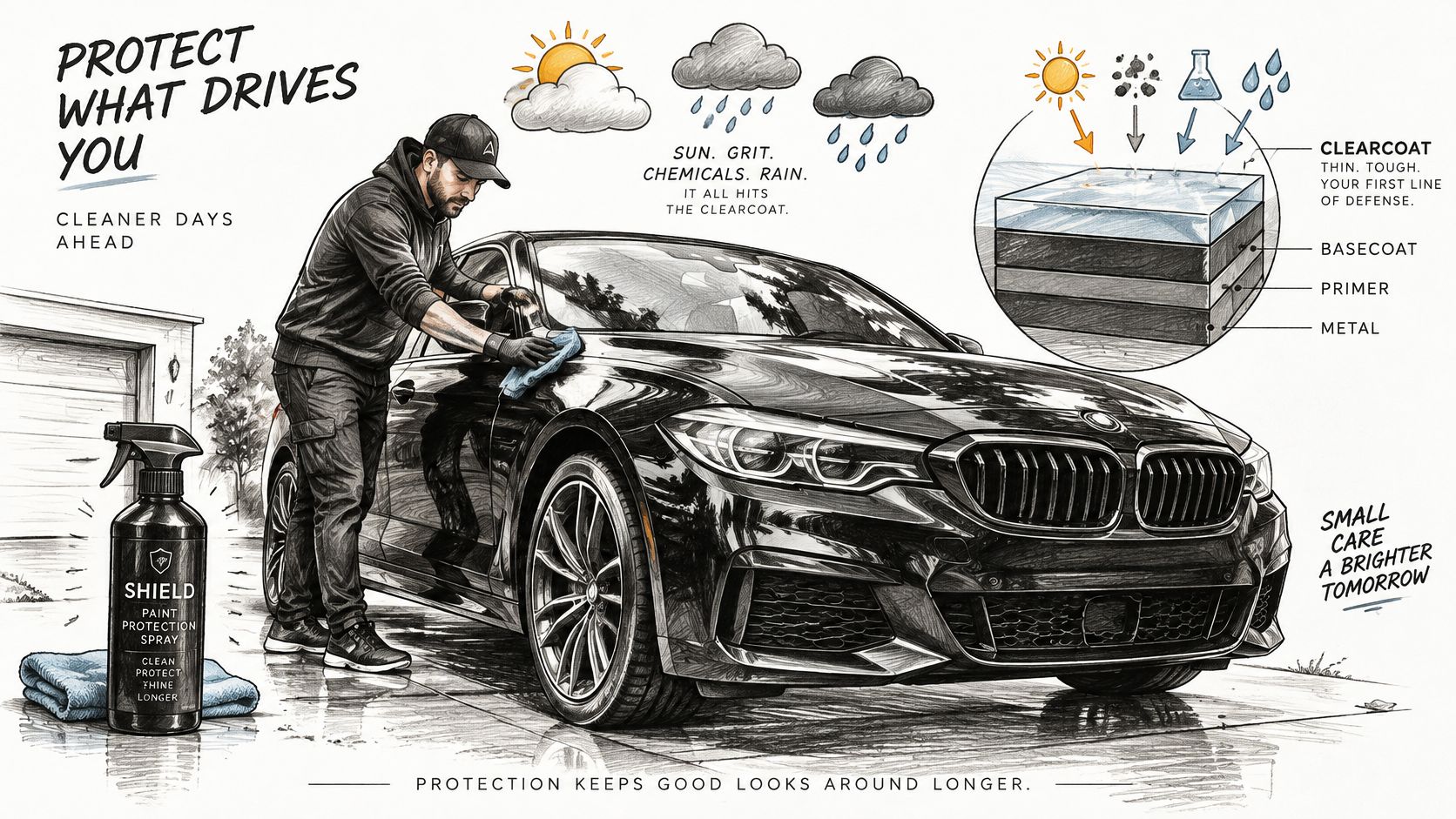
The hood catches a clean reflection after its final wipe, but shine alone says little about how well the finish is protected. A car paint protection spray makes more sense once you understand the factory layers it sits on.
Modern automotive paint pairs a thin pigmented basecoat for color with a thicker clearcoat that helps guard against ultraviolet light, environmental exposure, corrosion-related effects, and loss of gloss. The Collision Repair Magazine history of automotive coatings traces the wet-on-wet system to the late 1970s and its widespread use by the late 1980s. The history also notes that waterborne clearcoat entered production in 1990, using polyester acrylate chemistry cross-linked with isocyanate and melamine resins.
A Sacrificial Layer, Not New Paint
A spray adds a supplementary clear protective film over the existing finish. It does not replace the color coat or restore worn clearcoat. Instead, the renewable layer takes the first contact from contamination, chemical exposure, weathering, and light surface abrasion, reducing how directly those stresses reach the factory finish.
A customer may see the gloss and assume the paint is protected. Gloss is one signal, not proof of durability. A credible product should be judged by film formation, surface preparation, curing conditions, and clearcoat compatibility, as well as controlled tests for ultraviolet exposure, chemicals, abrasion, adhesion, and weathering.
A spray that only looks slick on delivery day has not shown how it will perform after regular use.
For a car parked outdoors and driven through weekday highway grit, the right choice depends on the demands placed on the finish. A short-lived wax, a bonded ceramic coating, and a physical film provide different kinds of protection and require different levels of effort. The spray layer has a defined role: it gives the surface an additional sacrificial barrier, while the clearcoat remains the underlying protection.
Spray Wax Sealant and Ceramic Compared
A dark sedan rolls into a driveway after a week of rain. Its paint still looks glossy, but water behavior alone cannot tell the owner how much protective film remains. A car paint protection spray can add a thin sacrificial polymer layer, while wax, sealants, bonded ceramic coatings, and paint protection film each serve different roles. The useful question is what the layer is expected to handle, and how much preparation and maintenance the owner will do.
| Protection type | Typical durability | Main job | Hard limit | Best fit |
|---|---|---|---|---|
| Carnauba or spray wax | Short term | Warm gloss and temporary beading | Washes away readily and offers little lasting film | Show preparation and quick shine |
| Synthetic spray sealant | Short to moderate term | Polymer layer between washes | Thin film, with limited chemical resistance | Owners who wash often |
| Silica car paint protection spray | Moderate term | Hydrophobic sacrificial layer | Less durable than a bonded coating; beading may persist after protection has weakened | DIY users and mobile detailers |
| Professional ceramic coating | With proper maintenance and periodic touch-ups, Titan Coatings can remain effective for 4 to 7 years or longer | Bonded coating over prepared paint | Not chip proof; preparation and cure affect the result | Daily drivers kept long term |
| Paint protection film | Long term | Physical barrier against stone impacts | Material, edges, and installation require consideration; it is not a spray | High impact panels |
Reading the Rows Like a Detailer
Carnauba and many wash-off spray waxes are straightforward choices when the goal is warm gloss and easy application. For a car being prepared for photos or a weekend meet, that may be enough. The trade-off is that detergent and weather remove the layer quickly, so it suits appearance and short-term beading better than lasting defense.
A synthetic spray sealant works as a maintenance layer between washes. After washing and drying, the owner applies a thin polymer layer, which can make routine cleaning easier for a while. The result depends on repeating the process; it is a maintenance habit, not a permanent correction.
Silica-based or ceramic sprays can provide a more durable hydrophobic layer than wax or a basic sealant, while still wearing sooner than a bonded coating. That makes them useful for DIY owners and mobile detailers who want a practical surface layer without presenting it as long-term coating protection. The terms ceramic and polymer describe different chemistry and behavior, so compare them using a guide to ceramic and polymer differences, rather than relying on the word “ceramic” on a label.
A bonded ceramic coating asks more of the application process. Surface preparation, panel conditions, and curing all affect how evenly it bonds. For example, Alpha Quartz 50ml Ceramic coatig is a DIY and mobile detailers coating. It belongs in the coating comparison, but its category does not make the paint chip proof or eliminate the need for sound preparation and maintenance.
Gloss, beading, hardness, UV resistance, and crack resistance are separate performance questions. A glossy finish does not prove that a layer resists abrasion; strong beading does not prove that UV protection remains intact. A harder coating may offer a different trade-off from a flexible one, and a claim about hardness alone does not establish resistance to cracking. Judge each quality by the evidence relevant to that failure mode, not by a single visual effect.
Paint protection film is a physical sheet fitted to areas exposed to stone impacts, such as bumpers, hoods, and rocker panels. Its role differs from that of a spray layer. Material, careful edge work, and installation skill matter, so compare it with sprays by the kind of impact it is meant to absorb, not by gloss alone.
Practical rule: Match the protection to the vehicle's use, the owner's maintenance routine, and the harm the layer needs to resist. A strong label cannot replace realistic expectations.
A crossover that is washed regularly and kept in a garage may suit a silica spray refreshed as needed. An outdoor daily driver whose owner will not maintain the finish calls for a different conversation. In either case, explain the trade-off plainly: a spray offers a convenient sacrificial layer, while a bonded coating depends more heavily on preparation, curing, and continued care.
UV Wear and Beading Are Different Signals
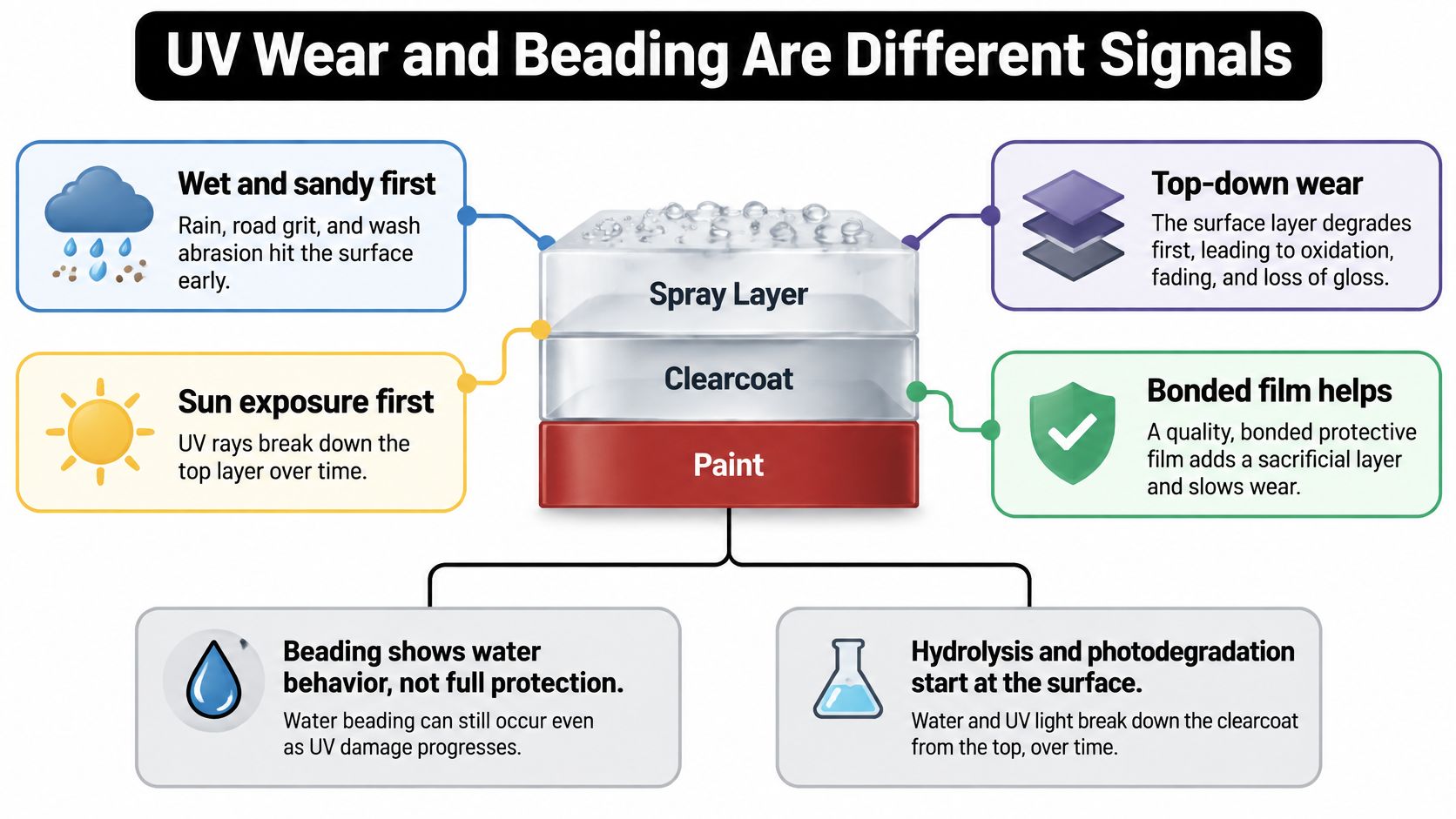
A spray layer takes contamination and ultraviolet exposure first, reducing what reaches the clearcoat while the film remains continuous and bonded. That protection wears from the surface downward, through moisture-driven and light-driven breakdown. A glossy finish can look healthy even as the protective layer gradually changes.
Laboratory weathering shows why shine alone cannot describe that change. In a peer reviewed automotive clearcoat study using conditions based on SAE J1960, specimens received 61 MJ/m² of ultraviolet exposure over 400 hours, and measured gloss decreased by approximately 10%. Gloss loss is a visible sign of surface degradation, though it can appear before severe color failure or cracking.
The study summary also reports that an acrylic melamine clearcoat stabilized with 3% ultraviolet absorber and 1% hindered amine light stabilizer lost 33% of UV absorbance and 16% of film thickness after approximately 5,000 hours in a xenon arc weatherometer. About half of the lost absorbing capacity was attributed to physical erosion. Sunlight changes the coating's chemistry and can wear away some of the film that protects the paint, so both effects matter when judging durability.
Four Stresses Arrive Together
A parked panel faces more than ultraviolet light. A review of coating degradation and protection identifies UV radiation, water, oxygen, and high temperature as interacting causes of photo-oxidative degradation. UV absorbers and hindered amine light stabilizers can extend outdoor service life, but the result depends on the finished film and the conditions it faces. Ingredient choice can help slow degradation; it cannot establish how long a particular coating will last by itself.
Consider two identical white trucks, each given the same spray on the same morning. One is garaged in a mild coastal town and hand-washed gently. The other sits in an open lot, collects sprinkler water, and is exposed to harsh wash chemistry. Their protection can age differently because preparation, film thickness, climate, cleaning products, parking exposure, and maintenance all affect the coating.
The ingredients used for UV protection in coatings offer useful context, but an ingredient name on a label does not show how quickly the finished film erodes. Look for the test standard, substrate, duration or energy dose, gloss retention, color change, and film-thickness results. Those details help separate a promising ingredient from evidence about a complete coating under tested conditions.
What Each Signal Really Proves
A tight bead makes a persuasive photo. It answers a limited question about water behavior, not every question about protection.
| Signal | What it measures | What it does not prove |
|---|---|---|
| Tight water beading | Hydrophobicity and surface energy | Abrasion resistance or adhesion |
| High gloss | Current light reflection | Remaining film thickness |
| Hardness rating | A specific scratch or mar test | Crack resistance through temperature cycles |
| UV absorber on the label | Potential to slow photo-oxidation | How long the film itself resists erosion |
| Immediate slickness | Lubricity after application | Chemical or etch resistance |
Water beading is not proof of abrasion resistance or adhesion. A panel can still throw round beads after a rinse even if its film has thinned along the path of a wash mitt. Gloss describes how light reflects from the surface today. It does not measure how much protective material remains for the next season.
Hardness has its own limits. A coating can score well in a particular scratch or mar test and still crack when temperature changes stress the film. Slickness feels convincing under a hand, but it does not establish resistance to bug acids, water-spotting minerals, or strong cleaners. Gloss, beading, hardness, UV life, and crack resistance describe separate performance questions. Flexible coatings should be judged by evidence from thermal cycling, not by slickness alone.
A fresh spray may send water racing off the hood before the car leaves the driveway. That display demonstrates immediate water behavior, but tells the owner little about wash marring, etching, or gradual UV loss. Ask for separate evidence:
- Adhesion evidence: How was bonding tested, and on what prepared surface?
- Abrasion evidence: Which method, load, media, and endpoint were used?
- Chemical evidence: Which chemicals, contact times, and failure signs were recorded?
- Weathering evidence: Which standard, duration, dose, and gloss or thickness results were reported?
Beading can stay visually strong while the protective film underneath is getting thinner.
Do not wait for beads to disappear before refreshing a spray. Set a maintenance schedule suited to the product class and the car's exposure, then inspect gloss, slickness, water behavior, and wash marring together. A sacrificial film does its job by taking wear in place of the clearcoat, and it needs refreshing before that wear leaves the paint to face the exposure alone.
How to Apply Protection Spray Correctly
Check panel temperature before opening the bottle. A door in the shade may be cool while the hood still holds engine heat, so judge each panel separately. Good application depends on a clean, dry surface and enough time to spread and level the product before it flashes.
Use this routine on sound clearcoat. A spray cannot repair paint that is peeling, failing, or heavily oxidized.
The Driveway Routine
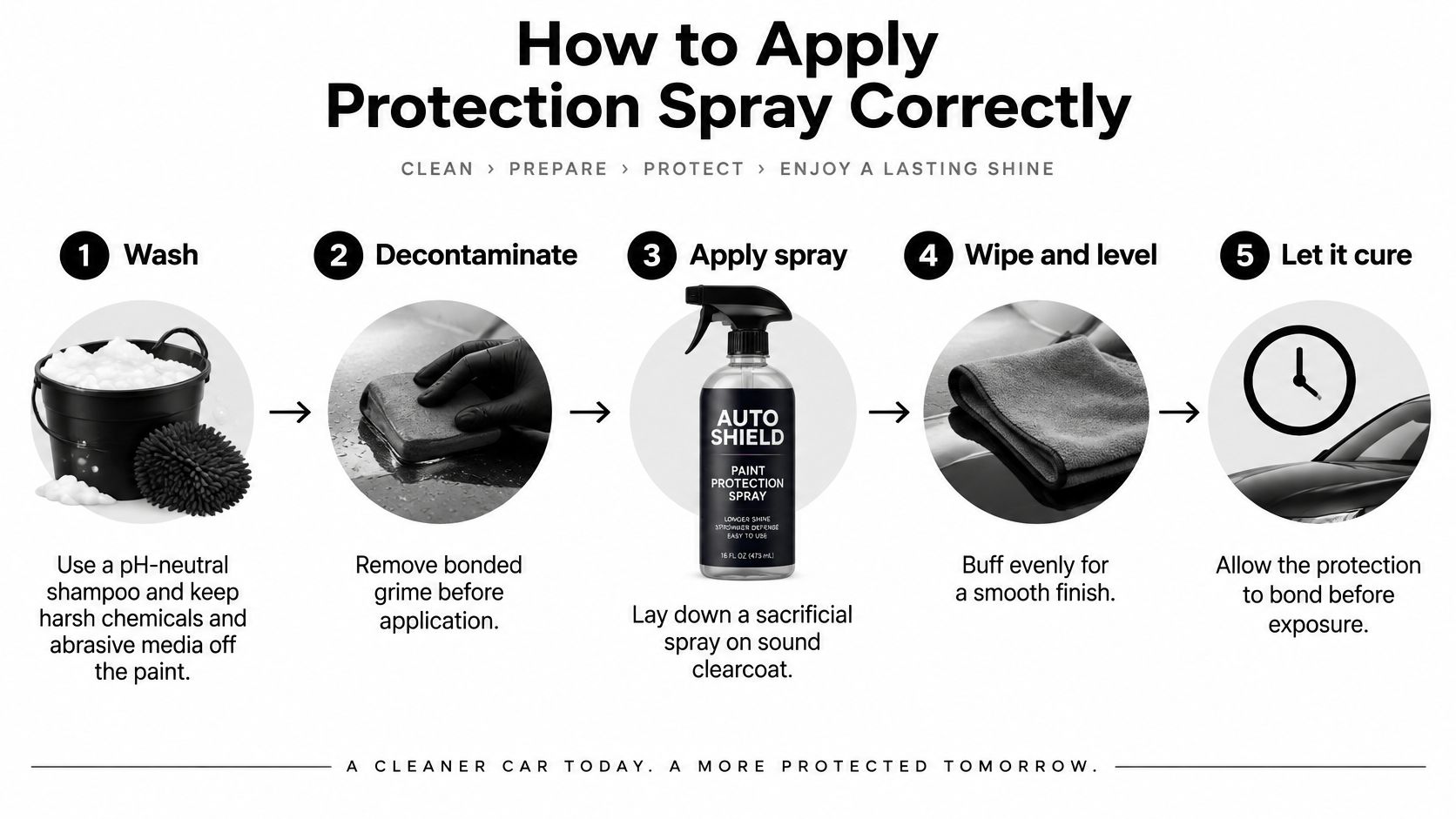
Wash with a pH-neutral shampoo. Lift loose dirt with clean wash media, keeping harsh chemicals and abrasive products away from the paint. A grit-loaded mitt can leave marks that the spray will cover without correcting.
Decontaminate, then polish only as far as the defects require. Remove bonded grime before polishing. If you polish, clear away polish oils and silicones afterward so the product can contact clean paint. Residue can interfere with bonding and leave areas where the spray does not form an even film. Follow this guide to prepping car paint before coating work.
Work panel by panel out of direct sun. The surface should feel cool and be completely dry. Heat can make product flash before you have time to level it, while water can interrupt even coverage. If the door is cool and the hood remains warm, apply to the door and wait for the hood to cool.
Apply product to a clean short-pile microfiber. Spread a thin, even film in controlled passes across one panel at a time. Use enough product for coverage, then follow the label's directions for the specific spray. Excess product is harder to level and can leave visible residue.
Buff with a fresh long-pile microfiber. Use light pressure and turn the towel to a clean face often. Make measured passes until the film looks even. If the towel picks up grit, set it aside before moving to another panel.
Inspect under bright, diffused light. Look for haze and high spots, then rebuff them before they cure. Check around edges, badges, and lower doors, where rushed or interrupted passes can leave uneven coverage.
Keep the vehicle dry for the product's stated curing window. Some Titan Coatings take 12 to 24 hours for initial curing, and the vehicle should not be washed for 7 days to allow full chemical bonding. A maintenance spray may have different exposure instructions, so use the directions for the product in hand.
Where Jobs Quietly Fail
Layering can create haze when the next coat goes on before the first is ready, or when the spray was not designed to be layered. Follow the product directions and allow each film to settle as specified. More product does not correct missed coverage or poor preparation.
A slick feel or lively beads after application can be satisfying, but those signs do not prove that the film is continuous around handles, trim edges, or the lower rocker. Inspect those areas in good light, especially where an applicator may have run dry. Gloss, beading, hardness, UV resistance, and crack resistance describe different performance questions; one attractive finish cannot answer them all.
Abrasion claims also need a defined method and endpoint. ScienceDirect's study of weathering, abrasion, and clearcoat cracking used ASTM D6037-96 methodology and measured dry mar performance through gloss retention. It links declining abrasion and scratch resistance during weathering with a greater likelihood of clearcoat cracking. For a fair comparison, expose treated and untreated panels to the same washing, grit, and chemicals, then record gloss retention, haze, color change, and visible mar density at set intervals.
Driveway test: Name the test method and endpoint before treating a scratch claim as a promise.
A spray may help retain gloss after controlled washing and reduce wash marring, but it cannot prevent paint chips or replace careful washing. Maintain the surface with pH-neutral washes, clean towels, and refreshes suited to the product and the vehicle's use. Check the finish on a regular schedule, rather than waiting until the surface looks dull.
Flexible Films Through Heat and Cold
Automotive panels and their coatings respond differently as temperatures rise and fall. When their thermal expansion behavior does not match, stress builds within the film. The ASTM published approach to elastomeric coating evaluation varies crack width from 0 to 50 mils while changing temperature by 30°F (17°C), treating movement and temperature as connected parts of durability testing. Heating may temporarily release stress; cooling restores it, and repeated cycles can contribute to cracking.
Hardness and Fracture Resistance
A coating's ability to resist marring is separate from its resistance to cracking. The American Coatings Association analysis of coating fracture states that fracture energy below 40 J/m² would likely lead to cracking during typical environmental cycling. In its model, a 50 µm coating exposed to stresses up to 25 MPa needed at least 70 J/m² to avoid cracking. Thickness, stress, and fracture energy all affect the outcome.
Elastomer-based ceramic coatings are designed to accommodate movement in the film. That mechanism alone does not establish how a particular formula performs through temperature changes. Check for thermal-cycle and fracture data on the coating itself, rather than treating gloss, beading, or hardness as proof of crack resistance. The explanation of coating flexibility describes the role flexibility can play, but testing is needed to assess performance.
Other factors can still cause failure. Research summarized by the American Society of Civil Engineers exposed specimens to 180 repeated cycles of two hours submerged in water followed by two hours in a 140 to 170°F heating chamber. Cyclic heating and submersion could produce discoloration and debonding on glass. A film's ability to stretch does not prevent moisture, poor adhesion, or thermal aging from affecting it.
Titan Coatings are elastomer-based ceramic coatings for automotive surfaces. Some are designed to be layered, with the installer recommending the process for each vehicle. Follow the specified coating system rather than guessing at the layer sequence. When assessing a flexible film, ask for evidence covering fracture energy, thermal cycling, adhesion, and weathering under conditions relevant to the formula and paint system. A credible durability decision separates those failure modes instead of relying on a slick feel or a single appearance test.
Pick the Right Spray for the Job
The bottle is in your hand, but the surface and the owner's routine should make the decision. A paint spray for upkeep, a coating for longer-term protection, and a glass product address different needs. For a quick overview, see this explanation of what car coating means.
For Fast Upkeep Between Fuller Coatings
Choose ULTRA Ceramic Spray for a ceramic sealant that helps maintain and refresh a coating at home. Apply a single, even layer rather than adding product in the hope of better protection. Its job is to support a maintained finish, not replace careful washing or surface preparation.
Say a detailer is refreshing a family SUV whose paint is in sound condition and whose owner washes gently. A spray sealant can suit that upkeep routine, especially when the aim is to keep the surface easier to maintain between more substantial coating work. Gloss and water beading are useful observations, but neither alone proves how well a surface resists UV exposure, scratches, or chemicals.
For a Flexible Paint Coating
Alpha Quartz is a DIY and mobile detailers coating. Consider it when the goal is a coating rather than a maintenance spray, and follow the product system and installer's guidance for preparation and application. For a flexible film, judge the relevant evidence separately: gloss does not establish hardness, and a slick surface does not demonstrate resistance to cracking or thermal cycling. The previous discussion of flexible films and temperature changes explains why those performance questions should not be collapsed into one claim.
For any coating, the paint's condition and the care it receives matter. Wash with pH-neutral shampoo and avoid harsh chemicals and abrasive cleaning products. Some Titan Coatings are designed to be layered, with the installer recommending the process for each vehicle. An authorized installer can assess the actual vehicle and advise which coating package fits its condition and intended use.
For Rain on the Windshield
For a windshield-focused need, Apex Glass Coating is the glass coating option. Its current price is $39.97 for 50ml. A commuter who regularly drives through rain may value water behavior on the glass more directly than extra gloss on the doors. Keep that decision tied to the surface: a glass coating is not a substitute for paint protection.
Titan Coatings application pricing depends on vehicle size, condition, and the coating package chosen. An authorized installer can provide an accurate quote after assessing the car. The Titan Coatings shop brings the product range together for shoppers comparing options.
Choose according to the surface, the maintenance routine, and the failure mode that matters. Use a spray sealant to refresh existing protection, consider a coating when the goal is a coating system, and reserve a glass product for the glass. That keeps each product's role clear without treating a bead of water or a glossy finish as proof of every kind of protection.
0 Comments