
A car coating is an extra protective film over your factory clearcoat that changes how water, dirt, sunlight, and chemicals meet the paint. It doesn't replace washing and it won't stop a rock chip.
She reversed out before sunrise with frost on the roof and, by lunch, heat was rising off the same hood in a supermarket parking lot. That swing, more than any showroom shine, is why owners start asking what a coating does.
What a Car Coating Does on a Real Drive
At 6 a.m., frost rims the windshield. The wipers scrape, the defroster hums, and you pull onto a wet road behind a truck spraying fine gray mist over the hood and mirrors. By the time you park, the mist has dried into a film across the panels.
The finish still looks glossy. Yet sunlight, road salt, and dried grime remain in contact with the surface for hours. A coating changes how those everyday contaminants meet the paint.
A Morning That Tests Every Surface
On the drive home, rain blurs the lane markings. Then the clouds break, and sunlight warms the wet panels. One commute has taken the car through cold, spray, grime, and heat.
In practice, what is car coating? It is a thin, cured film over the factory finish. Water, dirt, ultraviolet radiation, and chemicals meet that film first, so they have less opportunity to cling to the paint beneath. The film acts like a skin that sheds spray, slows the sun's effect, and gives the finish underneath more time.
You notice the difference at the wash bucket. Road film releases more readily, and water sheets or beads rather than sitting in flat, dirty patches. On glass, a coating can help rain clear sooner, reducing how hard the wipers have to work for a clear view.
A coating earns its keep on a wet Tuesday commute and the freezing morning after it, not under shop lights on delivery day.
Cleaning gets easier, but the coating has limits. It will not catch a stone traveling at highway speed, prevent swirls from a gritty sponge, or wash the car for you. Owners expecting those results can be disappointed, while detailers may be asked to redo work a coating was never designed to do.
The same commute breaks into three moments, and each one asks something different of the paint.
- The cold start: Panels cool overnight, frost settles, and you scrape or rinse before the surface warms through.
- The wet middle: Spray, salt, and grime settle on moving panels and can dry between showers.
- The hot finish: Sunlight warms a damp, dirty surface, contributing to the gradual loss of gloss.
A wax that handled frost last winter may have worn away by the first wet week of spring. A cured coating keeps meeting water and grime through that cycle, though the level of durability depends on the coating type. Waxes, sealants, ceramics, and paint protection film each serve different needs: film takes physical impacts, while surface coatings focus on weather and contamination. To judge what belongs on the car, start with the finish already protecting its body.
How Car Coating Layers Protect the Body
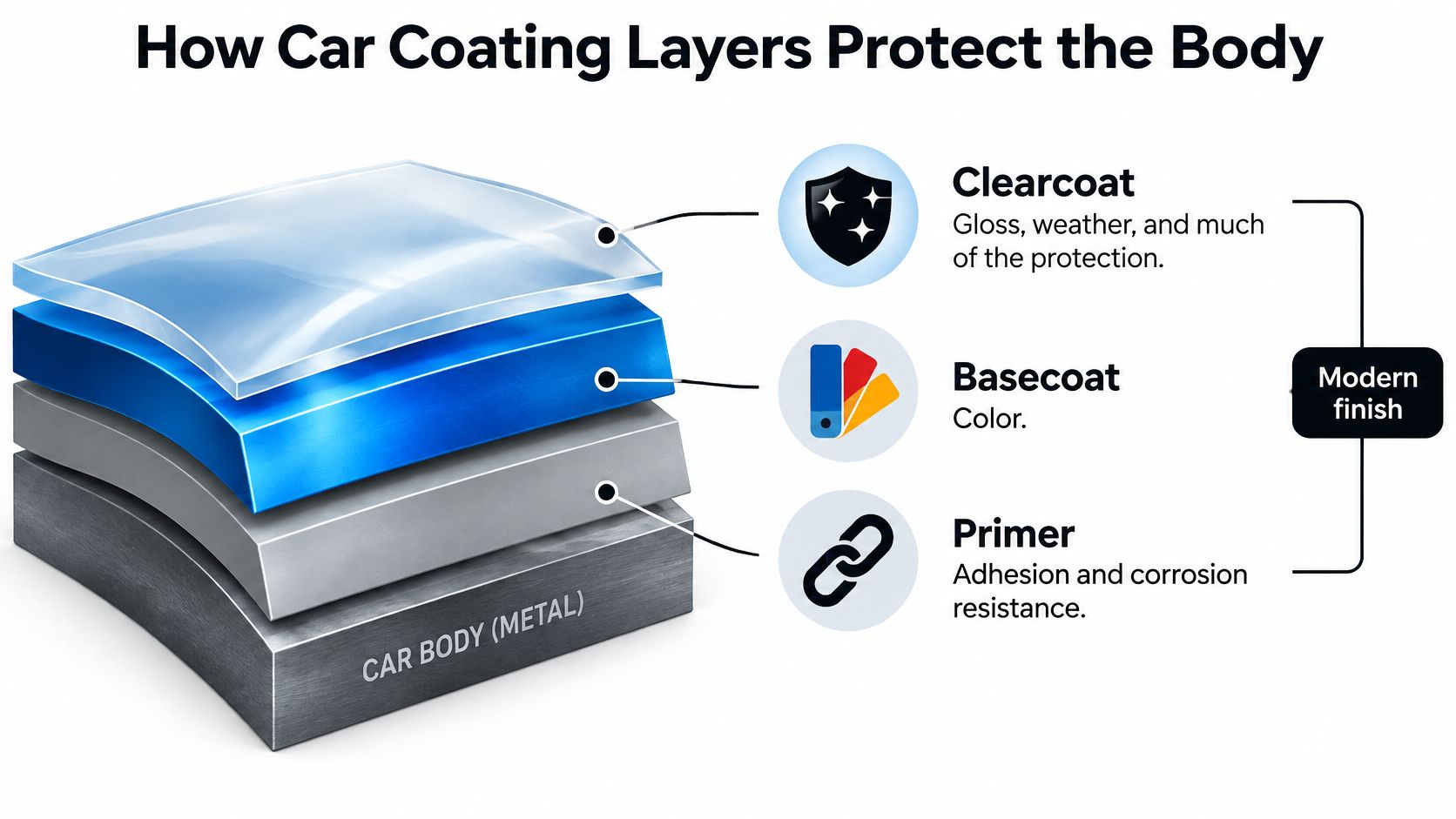
After rain, a car can still bead water while its finish loses protection from sunlight. To see why, follow the paint layers from the metal panel outward. Each has a separate job, and an added coating can only work well when the surface beneath it is sound.
Research on automotive coating history and structure describes this layered build of primer, basecoat, and clearcoat over metal or composite panels. Developed over decades from early lacquers to modern water-based systems, the layers help separate the body from water, oxygen, salts, and sunlight. In factory terms, a car coating is the whole multilayer system, so the question is which layer each product touches.
The Three Layers Already on Your Car
Start at the bottom. Primer grips the panel and supports corrosion resistance, while giving the layers above it a surface to adhere to. If that bond fails, the rest of the finish loses its foundation.
Next comes the basecoat, which carries the color, whether it is metallic flake or a solid pigment. It is vulnerable when exposed, so it sits beneath the clearcoat.
The outer clearcoat supplies gloss, weather resistance, and much of the scratch and chemical defense for the color below. When a car's paint looks tired, the clearcoat is often the layer showing wear.
The Screen in the Window
A detailer might compare clearcoat protection to a window screen. Additives called ultraviolet absorbers absorb radiation in roughly the 290 to 400 nanometer range before it damages the polymer structure. The absorbers block part of the incoming light.
Light that gets through encounters hindered amine light stabilizers. These interrupt the free-radical reactions that break down the coating, helping preserve gloss and flexibility. The UV absorbers work like a window screen, and the amine stabilizers mop up the radicals that slip through.
A panel can still look shiny as its protective absorbers deplete. Water beading alone reveals little about that change, so it is a poor measure of how much protection remains.
Practical rule: Judge a finish by gloss retention, adhesion, and how it weathers, not by a single photo of water beads.
An aftermarket coating adds a thin film over the factory clearcoat. It does not replace washing, decontamination, or paint correction. If polishing oils, bonded contamination, or weak oxidation remain, the new film bonds to that residue rather than the clearcoat. Even a strong formula may then let go early. Clean paint gives the added layer a sound surface to bond with.
Comparing Waxes Sealants Ceramics and Film
Walk into any detailing aisle and everything promises shine. The labels blur together, so forget the gloss for a moment and sort products by the threat they're built to handle. That's how a detailer builds a recommendation for a daily driver.
From Weekend Wax to a Cured Film
A traditional carnauba wax is the Sunday afternoon option. You spread it on, buff it off, and the paint looks warm and deep for a while. It's a sacrificial gloss layer more than a barrier, and heat and washing wear it away fairly quickly.
A synthetic sealant stretches that idea further. It's a polymer product that bonds more durably than wax, keeps its shine longer between applications, and sheds water well. For owners who enjoy topping up protection a few times a year, it's a sensible middle step.
Ceramic and modern polymer coatings work differently. They form a cross-linked, cured film on the clearcoat rather than sitting loosely on top, and that structure is why they handle UV, chemicals, and weathering better than wax. If you want the finer distinction between those families, Titan's guide to how ceramic and polymer coatings differ in structure and use lays it out in plain terms.
A technical review notes that ceramic coatings are harder and more resistant to UV, corrosion, and chemicals than conventional waxes, with typical effective life often one to three years depending on formulation and maintenance. Read that as a realistic range shaped by prep and care, not a promise printed on every bottle.
Paint protection film sits in a different category altogether. It's a thicker, physical layer designed to absorb stone chips and deeper scuffs, the kind of impact a thin chemical coating was never built to stop. Owners who do heavy highway miles often pair film on the front end with a coating over the rest.
Match the Family to the Threat
| Coating family | Best job | Clear limit |
|---|---|---|
| Wax | Short-term gloss and light water behavior | Wears away quickly with heat and washing |
| Synthetic sealant | Longer polymer shine and easier rinsing | Still a sacrificial layer, not a cured barrier |
| Ceramic or polymer coating | UV, chemical staining, and easier cleaning | Won't stop rock chips or dents |
| Elastomer ceramic | Hard surface with flexible film underneath | Still needs clean prep and correct curing |
| Paint protection film | Rock chips and physical impact | Higher effort to install, edges need care |
That last row before film is the one many buyers miss. An elastomer ceramic aims to stay hard at the surface for everyday abrasion while keeping flexibility through the film, so it moves with the panel instead of behaving like a rigid shell. The hardness slogan on any bottle, though, won't stop a dent, a key scratch, or swirls from a dirty wash mitt.
Shortlist by threat, not by hype. If chemical staining and easier washing top your list, you're shopping coatings. If chipped paint on the front bumper keeps you up at night, you're shopping film, possibly with a coating on top for the cleaning benefits.
What Car Coating Prevents and What It Misses
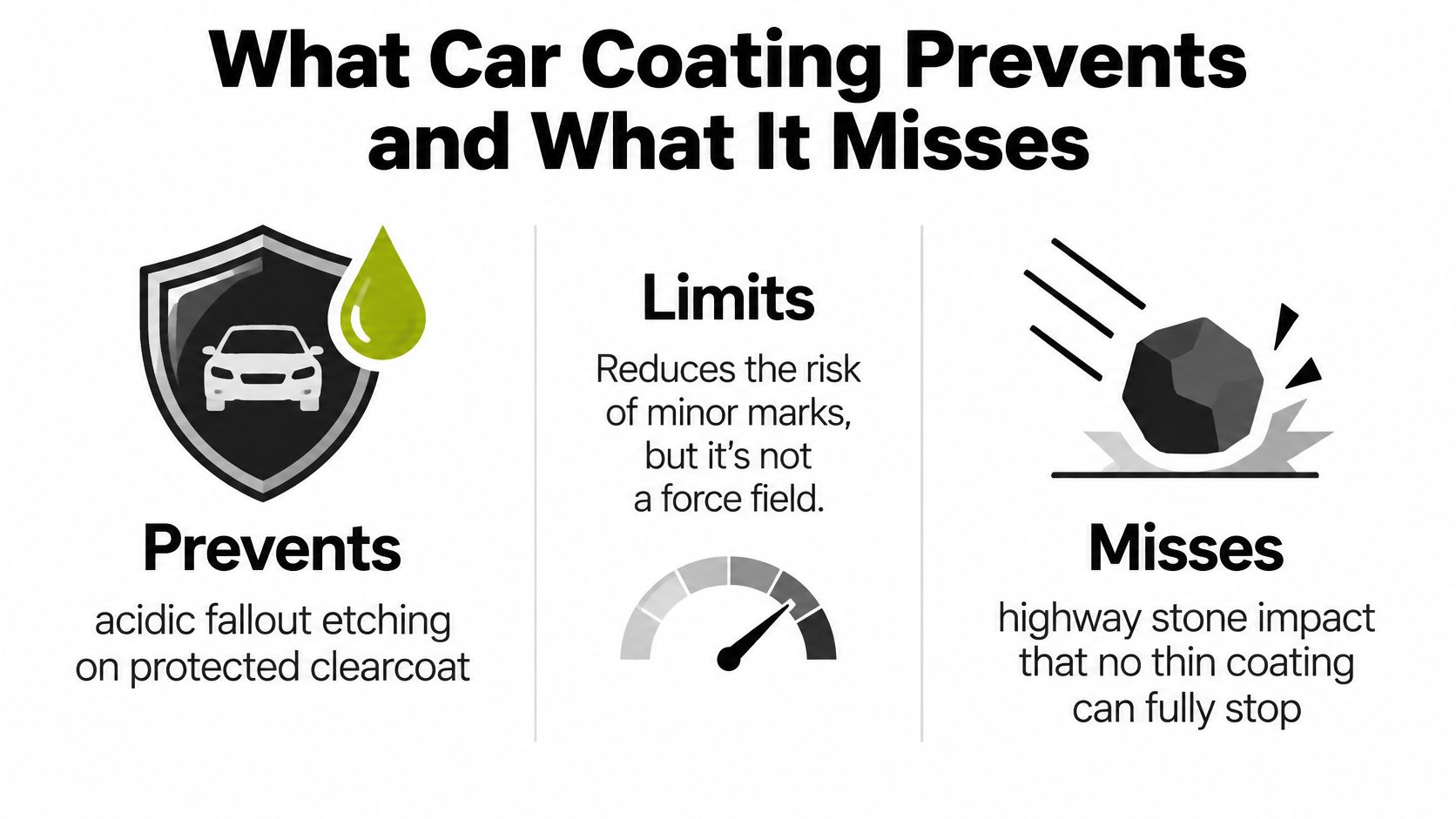
Friday's bird droppings are still on the roof when the car leaves work. After a sunny weekend, the residue has dried into a dull outline. On bare clearcoat, droppings and tree sap sit directly against the paint, making prompt cleanup important.
A chemically resistant coating gives you more time. Contaminants rest on the coating rather than the clearcoat, and water behavior can help rinse them away sooner. The coating also takes the first exposure to sunlight. That is contamination resistance, not impact protection. Titan's guide to whether car paint protection works in real driving conditions explains the difference.
The Stone Nobody Saw Coming
On the highway, a stone snaps against the hood. At the next stop, a pale chip exposes the paint beneath. A thin coating cannot absorb that kind of impact. Even a thick ceramic layer is only a few microns, while a rock chip can punch through paint to the primer.
Surface hardness alone does not determine how well a coating holds up. Research on clearcoat aging shows that prolonged UV exposure drives oxidation that can increase surface hardness and stiffness while making the film less flexible and more prone to cracking. That added stiffness can make the surface more vulnerable to cracking as it ages through sun, moisture, and heat. A weathering study also found that gloss loss can precede visible cracking, so a panel may look glossy while its surface is already changing (clearcoat photo-oxidation first reduces gloss and can progress to cracking, then depleted UV absorbers let sunlight reach and degrade the basecoat).
Match the protection to the damage you want to avoid:
- Chemical staining and UV: Coatings help against droppings, sap, alkaline cleaners, and sun.
- Chips and deeper scuffs: Paint protection film is designed to take physical impacts.
- Swirls and wash marks: Clean mitts, proper towels, careful washing, and patience matter most.
One hardness rating cannot tell you how long a coating will last, and a water-bead photo cannot show how it performs after weathering. A rigid coating that grows brittle in the sun leaves a clear job for a film designed to flex.
Why Elastic Coatings Handle Heat and Cold
A car door left outside moves with the weather. The metal contracts on a freezing night, then expands in afternoon sun. On the same drive, a bug strikes the bumper and dries onto the paint. The coating has to handle both temperature changes and everyday contact.
A rigid film resists movement, so stress can build at weak points as the panel expands and contracts. Over time, the coating may crack, lift, or lose adhesion. The change is gradual, driven by repeated swings between cold and heat.
Hard Like Glass, Flexible Underneath
Titan Coatings developed elastomer coatings using nanotube technology and Dark Matter Technology to address that movement. The goal is a surface that is hard like glass against everyday abrasion, with flexibility through the film to absorb panel movement. Titan's elastomer coating page describes the coating approach.
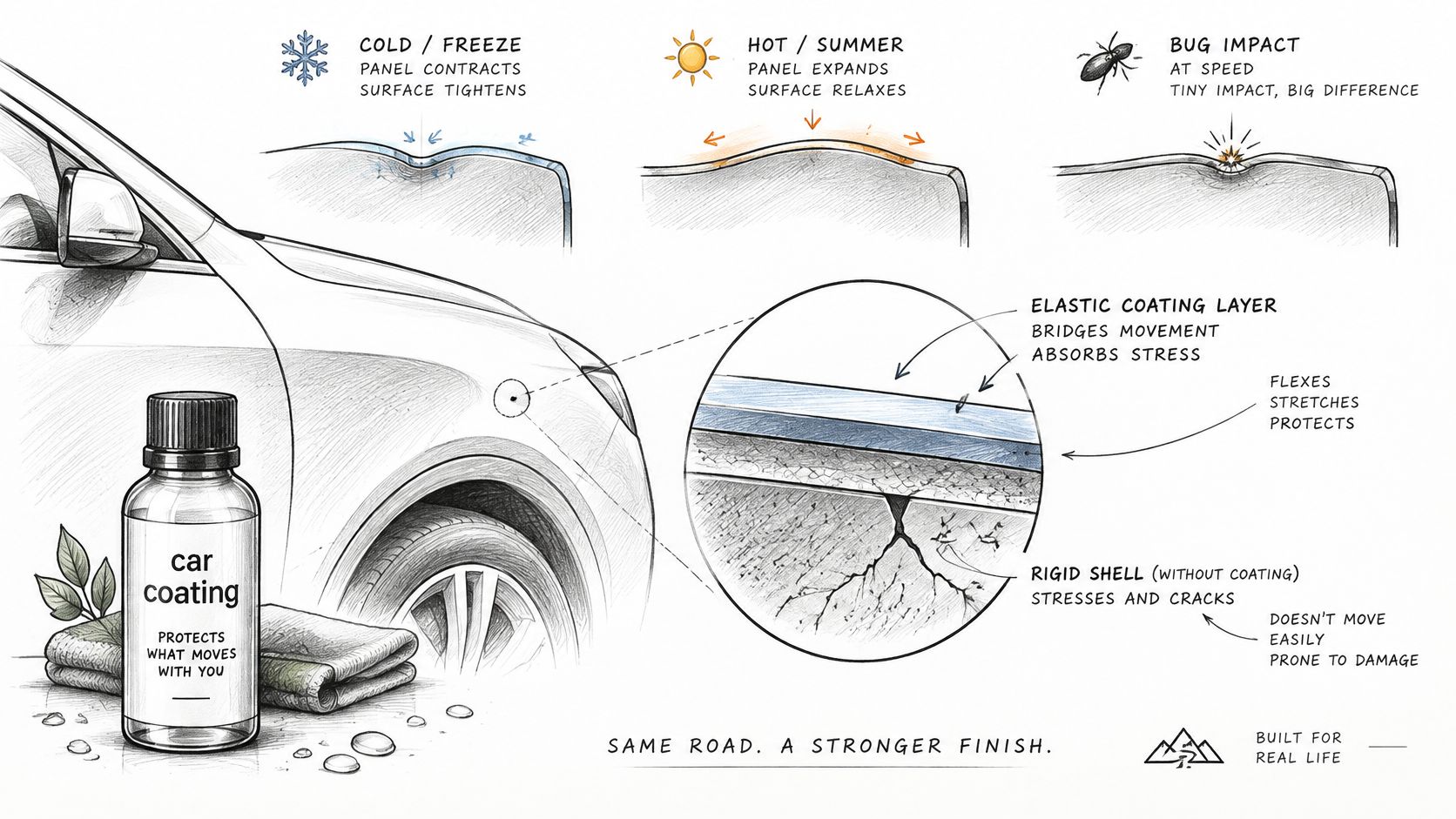
That flexibility serves a different job from contamination resistance. A coating can help shield paint from grime and make cleaning easier, while a flexible film is designed to accommodate movement and everyday impact. It is not a substitute for paint protection film against chips or deeper damage.
Nanotubes have a defined role in the material. Technical references describe carbon nanotubes as fillers with a high aspect ratio and notable strength that can reinforce a polymer matrix and influence the composite coating's mechanical performance. The polymer forms the continuous protective film, while nanoscale reinforcement helps tune its strength without making the whole coating brittle.
Dark Matter Technology is Titan's durability and anti-static approach within that system. The dark matter layer helps the film last and resist dust-pulling static, but the result still depends on clean paint and full cure time.
Built for the Swing, Not the Lab
A car parked outdoors faces more than one temperature. Standardized evaluations consider weathering, humidity, UV, and thermal cycling, because coatings face repeated environmental change rather than one constant temperature. A single hardness score cannot show how a coating responds to repeated cold and heat.
During a hot drive, a panel expands; on a cold night, it contracts. A flexible film is designed to move with that change and settle back, rather than resist the panel until stress builds. Its ability to flex helps distinguish it from a rigid shell, while contamination resistance remains a separate part of the coating's job.
The work still starts with preparation. Paint must be clean, the coating needs its full cure time, and maintenance washing affects how the surface ages. Elasticity helps the film handle movement, while careful application gives it a chance to do that job.
Coatings That Make Driving and Detailing Easier
Material science only matters if it solves a job you recognize. So walk around one car with three problems, a rain-blurred windshield, paint that needs protecting on a driveway, and a finish that needs a quick top-up before the weekend.
Rainy Glass on the School Run
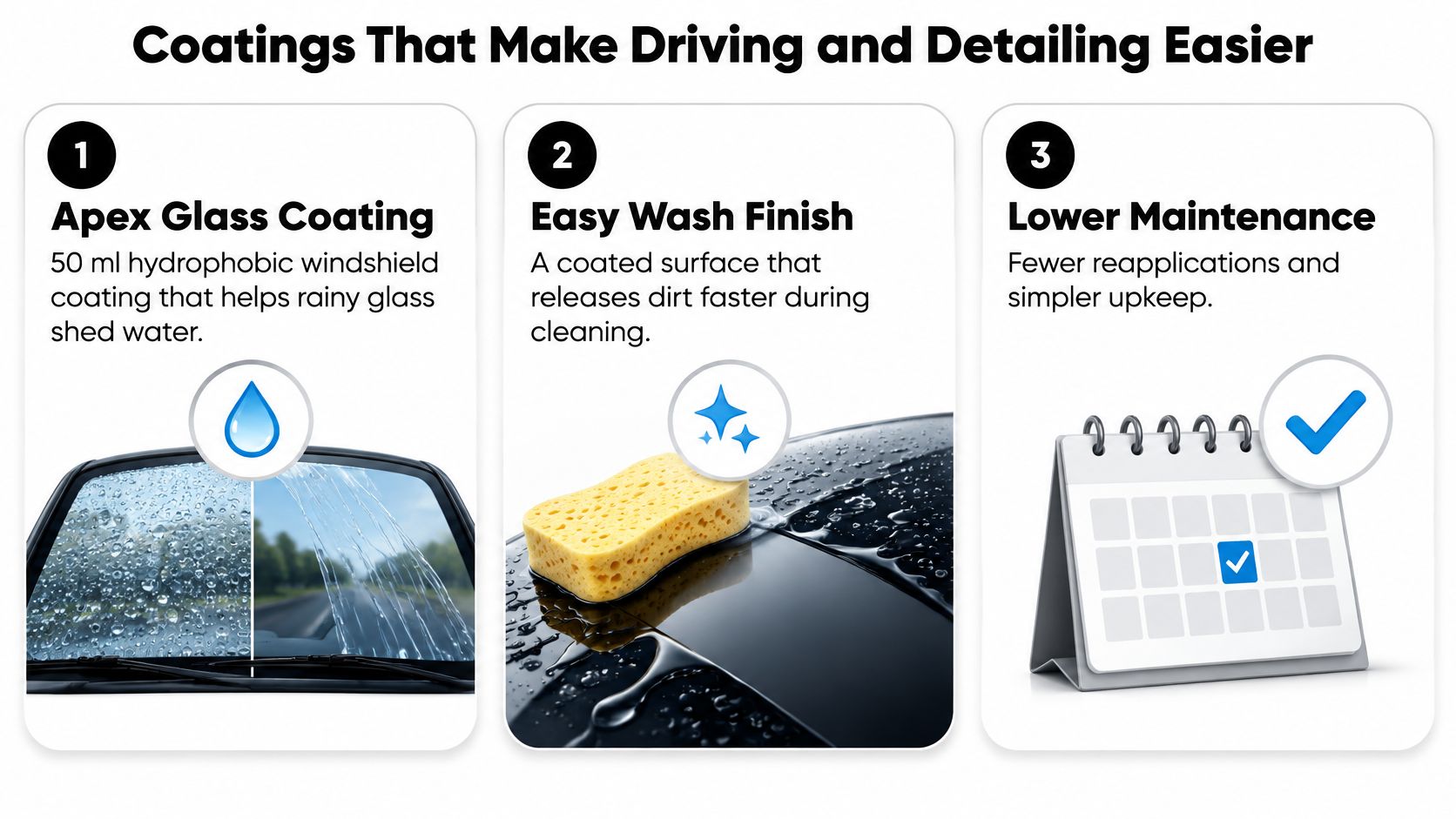
The first job is the windshield at 7 a.m. in heavy rain. Apex Glass Coating- 50ml is a hydrophobic glass coating that bonds into the pores of the glass, sheds water, dirt, and grime, and is described as lasting up to 2 years while reducing wiper use. Water starts sheeting away around 30 mph, which is exactly the speed where you're squinting through spray on a wet arterial road.
Application is refreshingly short. Clean and dry the glass, apply 10 to 15 drops, let it dwell a few minutes, then level with short-pile and long-pile microfiber. Two coats are recommended, including the wiper blades, and owners notice the help with glare at night and frost release on cold mornings.
Paint Protection Without a Shop Bay
The second job belongs to the mobile detailer working on a customer's driveway, or the DIY owner with one free Saturday. Alpha Quartz 50ml Ceramic coatig is an elastomer ceramic coating with 92% high solids, zero VOCs, and no solvents, designed for all surfaces with protection against UV, chemicals, and abrasion. It cures in about 4 hours, can be applied indoors or outdoors, and is described as lasting up to 2 years.
You work it in a small cross-hatch pattern, level it, and buff. It can be stacked for those who want to build the film. The flexibility is the point here, since a driveway car lives through exactly the frozen mornings, hot afternoons, and bug strikes that punish a rigid coating. Maintenance washing stays simple too, especially paired with a coating-safe wash like Titan's gentle snow foam for coated vehicles.
A Fast Topper Before the Weekend
The third job is speed. Ultra Ceramic Spray is a water-based flexible sealant for paint, wraps, film, glass, wheels, and trim, with protection up to 12 months. You spray it onto a short-pile towel, wipe it over the panel, and buff, or use it wet as a drying aid right after rinsing. It's a single-layer product, so there's no stacking routine to manage.
Three jobs, three different bottles. Glass for visibility, a full elastomer coating for paint that lives outdoors, and a spray for a fast sacrificial layer. Matching the product to the job beats buying the strongest label in the store.
Choosing a Car Coating and Your Next Step
Stand next to your car and answer four honest questions. Where does it sleep, in a garage or under open sky? Do chips or chemical stains bother you more? Who's applying the product, you or a professional? And will the work happen in a controlled bay or on a driveway between weather fronts?
Your answers point to a short list faster than any advertisement. Costs vary with prep and coverage, and Titan's breakdown of what vehicle ceramic coating costs and what drives the price helps you budget before you commit.
Let the Job Pick the Product
If you're a mobile detailer or a confident DIYer working outdoors, an easy elastomer coating fits that reality, since it tolerates driveway application and flexes through temperature swings. If rain, frost, and night glare on glass are your daily stress, start with the glass coating and feel the difference on your next wet drive. If the car already wears a coating, wrap, or film, the spray sealant gives you a simple sacrificial layer you can refresh without a full redo.
Whatever you choose, read claims like a tester would. Coating performance breaks into separate failure modes, and adhesion, abrasion, impact, and pull-off strength are each measured by different ASTM methods, from tape adhesion rated 0B to 5B to abrasion weight loss per 1,000 cycles. One impressive number can't prove every benefit, which is why defined test methods matter more than slogans.
Serious evaluations state their conditions. One clearcoat study exposed panels to 61 MJ/m² of UV energy over 400 hours, then scratched them with loads rising from 2 to 100 N. That kind of specificity, plus real use in harsh climates, tells you far more than the word hard on a box.
Decision shortcut: Name the surface, name the threat, then pick the simplest product that handles both.
Write down the surfaces you want to treat, glass, paint, wheels, or all three. Then compare the glass coating, the elastomer paint coating, and the spray sealant in the Titan shop's full product range, read the application steps for your pick, and order only what matches your list. A hard, flexible film is meant to ride out freeze and heat without cracking like a fixed shell, but only if it's the right film on properly prepared paint.
If rain-blurred glass, driveway-friendly paint protection, or a quick spray topper matches the job you just named, APEX NANO – Titan Coatings offers elastomer, glass, and spray coatings built around hard, flexible films that handle temperature swings. Visit the shop, compare the application steps for each surface on your list, and pick the coating that fits how and where you drive.
0 Comments