
A freshly polished truck sits under the shop lights on Saturday morning. The owner has spent six hours correcting the paint, and a forum thread on his phone insists two coats are the minimum and three separate a real job from a rushed one. The practical answer is simpler: follow the coating manufacturer's specified coat count and application process.
For most coatings, one properly applied coat is the default. Add a second only when the product is designed for layering, and apply a third only when the manufacturer's instructions call for it. The coat count follows the product's recipe, including its cure chemistry and recoat window. Extra coats do not automatically add protection; each additional application creates another chance to leave defects in the finish.
The Third-Coat Temptation
Two panels into the job, the doubt creeps in. The bottle still feels heavy, the towel stack is clean, and the truck's owner has already asked twice whether three coats would be safer than two. Out comes the applicator again. The next coat lands on a film that has not finished flashing.
That is how a corrected panel gets smothered. The owner is treating coat count like a durability dial. It is a manufacturer recipe. The label prints the count, cure chemistry decides how the film builds, and the recoat window decides whether another pass bonds or smears. Stack past that recipe and an inspection lamp finds high spots.
Treat the coat count as a spec printed on the label.
Read it the way you would read a torque spec. The people who tested the chemistry set the number, and it travels with the bottle. A heavy bottle is leftover product, not unused protection. Lay more on before the film flashes and you buy defects, not durability.
How Many Coats of Ceramic Coating to Apply
The right coat count comes from the product's label and application instructions. One coat is the default unless the coating is designed for layering. Apply two or three only when the manufacturer specifies that process.
| Coating type | Recommended coats | Recoat window | Why this count |
|---|---|---|---|
| Single-layer ceramic coating | 1 | Not applicable | The product is designed for one application |
| Layerable elastomer coating | Follow the manufacturer's instructions | Per product instructions | The installer follows the layering process specified for that coating |
| Glass and windshield coating | Follow the product instructions | Per product instructions | Coat count and timing depend on the glass coating |
| Ceramic spray sealant | Follow the product instructions | Per product instructions | Application directions vary by product |
| Professional base plus top-coat system | Follow the product instructions | Per technical data sheet | The system specifies how its base and top coat are applied |
| Third coat or more | Only if the manufacturer specifies it | Per product instructions | Extra coats add application steps and opportunities for uneven coverage |
Use the table to identify the product format, then follow its label and technical data sheet. A coat count is a recipe, not a durability dial: adding a pass without manufacturer instructions does not guarantee more protection.
Titan Coatings manufactures elastomer-based ceramic coatings, and some are designed to be layered. The installer recommends the layering process for each vehicle. Professional-grade Titan Coatings must be applied by certified installers, who can advise on the suitable product and coat count for the job.
For a DIY option, Alpha Quartz – 50ml is a DIY and mobile detailers coating, currently priced at $67.97. Check the product's current instructions before applying it. Match the bottle to the job in the Titan Coatings shop.
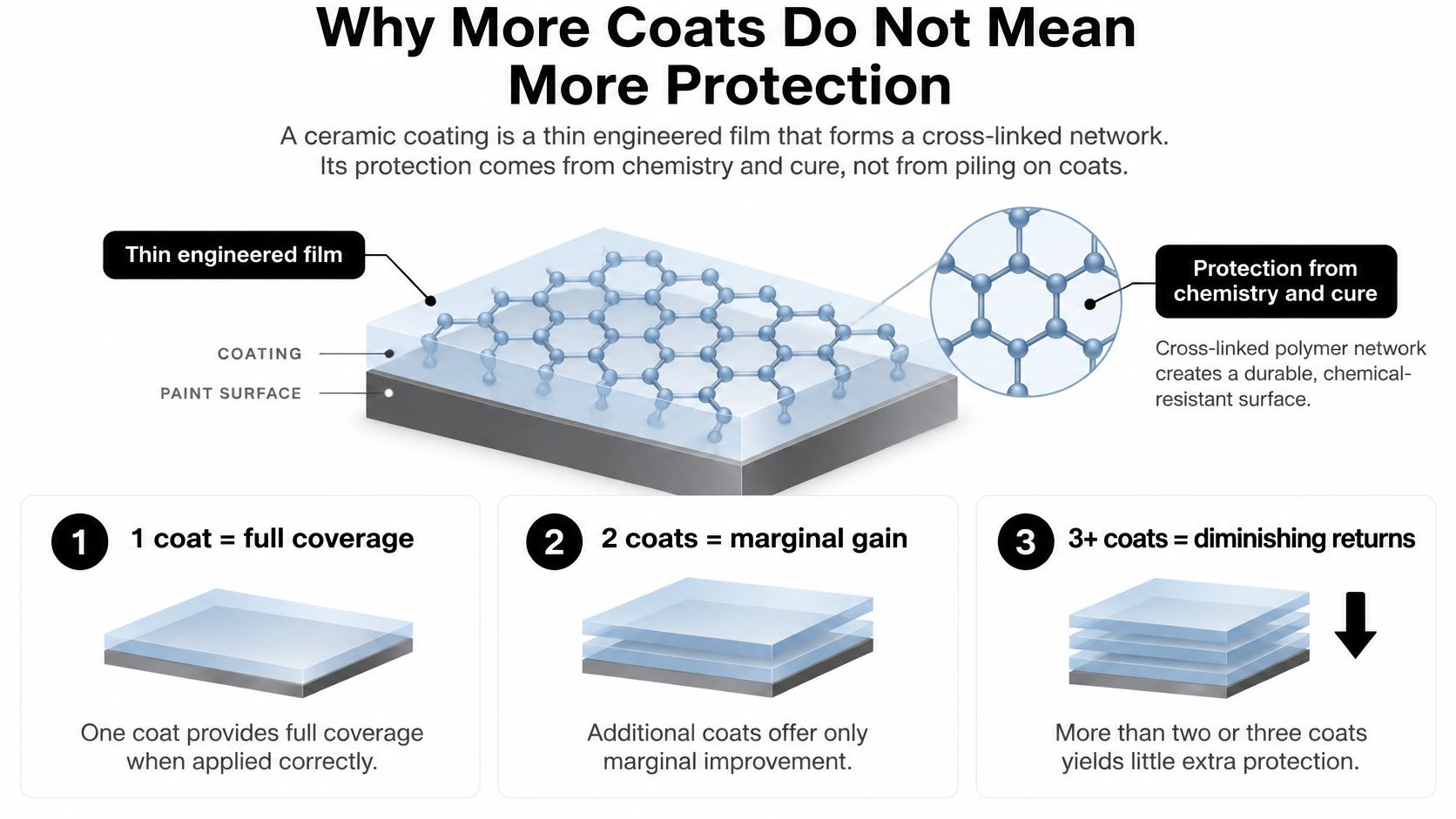
Why More Coats Do Not Mean More Protection
A coating does not gain protection in proportion to its coat count. Its chemistry, cured film and application determine how it performs. Extra layers can instead introduce uneven coverage, trapped defects or internal stress.
The First Coat Has to Stabilize
Apply another pass before the first film flashes, and it meets a wet, solvent-rich surface. The new layer can soften or drag the first one, leaving an uneven finish. A rushed second coat can look worse than one careful application.
What the Lab Numbers Actually Say
Coat count alone does not define film thickness or protection. Results depend on the coating chemistry, substrate, intended thickness and curing process. In multilayer silica coating research, a 2006 sol-gel study produced crack-free coatings up to 20 micrometers thick on an aluminum-silicon-carbide composite and examined single-layer and multilayer structures. A 2016 electrochemically assisted experiment built films with as many as 10 layers, totaling about 1 ± 0.1 micrometers.
Layer count and finished thickness are different measurements. Ten laboratory layers together can measure less than one heavier deposited film.
Thickness also affects stress. In thermal-shock testing at different film thicknesses, a 100-micrometer coating showed only localized spallation after 905 cycles. The 300- and 500-micrometer coatings failed sooner, with the 500-micrometer film severely spalling after about 150 cycles. More material increased internal stress rather than strength.
Why Titan Builds the Thickness Into the Formula
Titan Coatings manufactures elastomer-based ceramic coatings for automotive surfaces. Its elastomer formulas use Dark Matter Technology to combine a hard surface with flexibility. Nanofiller coating research describes how carbon nanotubes can obstruct corrosive media, reduce water absorption and reinforce coating interfaces. The research measured corrosion resistance using electrochemical impedance spectroscopy, salt-spray exposure under ASTM B117 and Taber abrasion under ASTM D4060.
Film thickness is set by the formula and application process. A coating designed to flex can accommodate panel movement through changing temperatures, rather than cracking as the surface moves. See this guide to ceramic coating thickness for more on how film thickness relates to performance.
Follow the product's specified coat count. Extra layers are not a durability dial.
What Decides the Right Number of Coats
A coating's label, chemistry and intended surface set the coat count. Treat it as a manufacturer's recipe, not a durability dial. Extra layers introduce more chances for uneven coverage and bonding problems, so decide based on the conditions that affect the film.
Six Checks Before You Choose a Coat Count
- Substrate compatibility. Paint, glass, wheels, plastic trim and marine gelcoat have different surface properties. Use a coating approved for the material, and follow its directions for that substrate. A glass coating's instructions do not establish the right number of coats for automotive paint.
- Surface preparation. Polishing oils, residue and contamination can interfere with bonding. Follow a sound car paint preparation process before applying the coating; adding another layer cannot correct a poorly prepared surface.
- Bay temperature. Temperature affects how the coating flashes and settles. Conditions in a warm bay differ from those on a hot driveway, so follow the product's temperature guidance and avoid applying in conditions outside its stated range.
- Humidity and airflow. Moisture in the air and ventilation affect how the film dries. Consider both when planning the application, rather than assuming the same timing will work in every setting.
- Coverage goals. A daily driver needs even protection across the surface. For a show car, the priority may be a uniform finish under inspection lighting. Choose the coat count the product permits to meet that goal, and focus on consistent application.
- Installer and work setting. A mobile detailer must account for changing outdoor conditions, while a controlled studio can keep the environment steadier. Professional-grade coatings also require certified installers, who can apply the product according to its instructions.
What Happens When You Guess
A premature layer can soften or disturb the coating underneath. After a layer has fully cured, adhesion may suffer unless the specified surface preparation is completed. Sol-gel research on layer count and film behavior connects film thickness, adhesion, roughness and cracking with drying conditions, substrate expansion and residual stress. The application count alone does not predict the result.
Without a manufacturer's multilayer procedure, added passes can leave high spots, streaks, trapped solvent and uneven gloss. Follow the coating's instructions and let substrate, application conditions and coverage needs guide the decision.
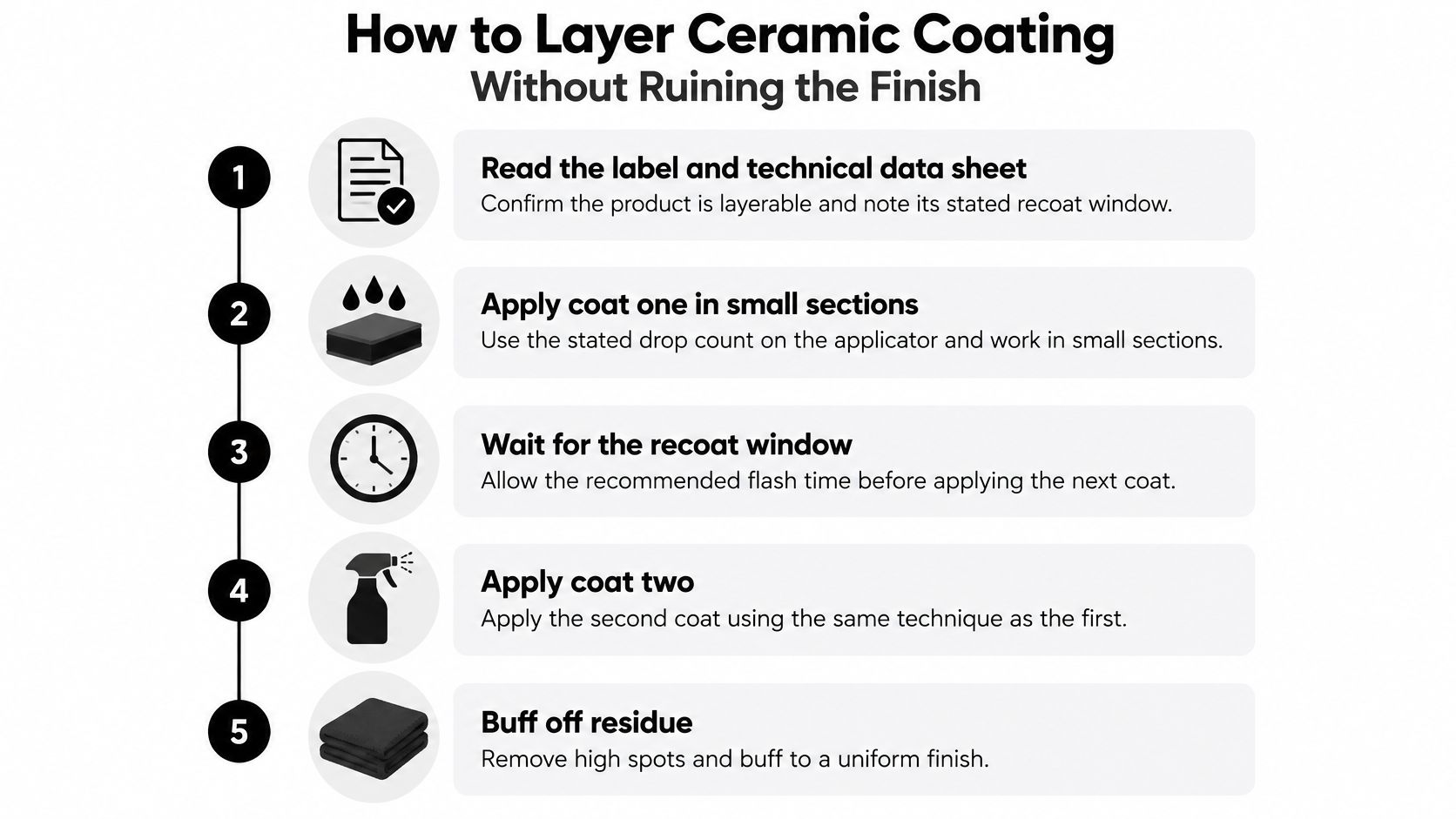
How to Layer Ceramic Coating Without Ruining the Finish
A second coat only helps when the product is made for layering and the application follows its instructions. Titan Coatings products designed for layering have a process recommended by the installer. Check the product label and current data sheet before applying another layer. The step-by-step ceramic coating application guide explains the application sequence.
The Six Steps in Order
- Read the label and data sheet. Confirm the product is designed for layering and follow its stated recoat instructions. If they do not specify a second coat, apply one.
- Apply the first coat in small sections. Follow the product's application instructions and keep each section small enough to level before the film starts to set.
- Follow the stated flash procedure. Use the product's specified method and timing. Conditions can affect how the coating behaves, so do not substitute a general timing rule for the product instructions.
- Apply another coat only as directed. Follow the specified recoat window and any instructions about the condition of the first layer.
- Level and buff as directed. Use the towels and technique specified for the product, then inspect the surface under diffused light for streaks or high spots.
- Allow the coating to cure. Other Titan Coatings take 12 to 24 hours for initial curing. Do not wash the vehicle for 7 days to allow full chemical bonding.
Flash-Time Procedure at a Glance
| Product or format | Flash-time procedure |
|---|---|
| Titan Coatings products | Follow the current product label and data sheet. Use the installer's recommended process for products designed to be layered. |
Do not apply a generic flash time to every coating. Product instructions set the procedure; follow them rather than borrowing timings from another formula.
What to Do When a Second Coat Goes Wrong
A defect that appears during a second pass is almost always a timing or thickness problem. Diagnose it in that order before you touch another bottle.
- High spots and ridges under inspection light. Too much product or uneven leveling. Level earlier and lighter next time rather than adding more film to hide it.
- Streaking or haze. Heavy application or buffing too late. Work smaller sections and buff while the film still moves.
- Uneven gloss. The second layer landed on a partly cured film, so the two passes never merged. Check the recoat window you used.
- Tacky or soft patches. Recoating before the flash or cure was ready, or applying in cold, humid air outside the label limits.
Then follow the response order. Stop applying. Let the film reach the cure time printed on the data sheet before you judge it, because a soft film at hour two isn't the same film at hour twenty-four. Check the day's temperature and humidity against the label limits, and correct only the way the manufacturer's guidance allows.
Removing or reworking a coating can need a product-specific method, so don't strip and repeat on instinct. If a coating degrades, one of our certified installers has to inspect the vehicle, give feedback and restore the coating as needed. Our notes on coating failure analysis walk through the usual causes before you escalate.
A defect that shows up on the second coat is evidence about timing and thickness, never evidence that the car needs more coats.
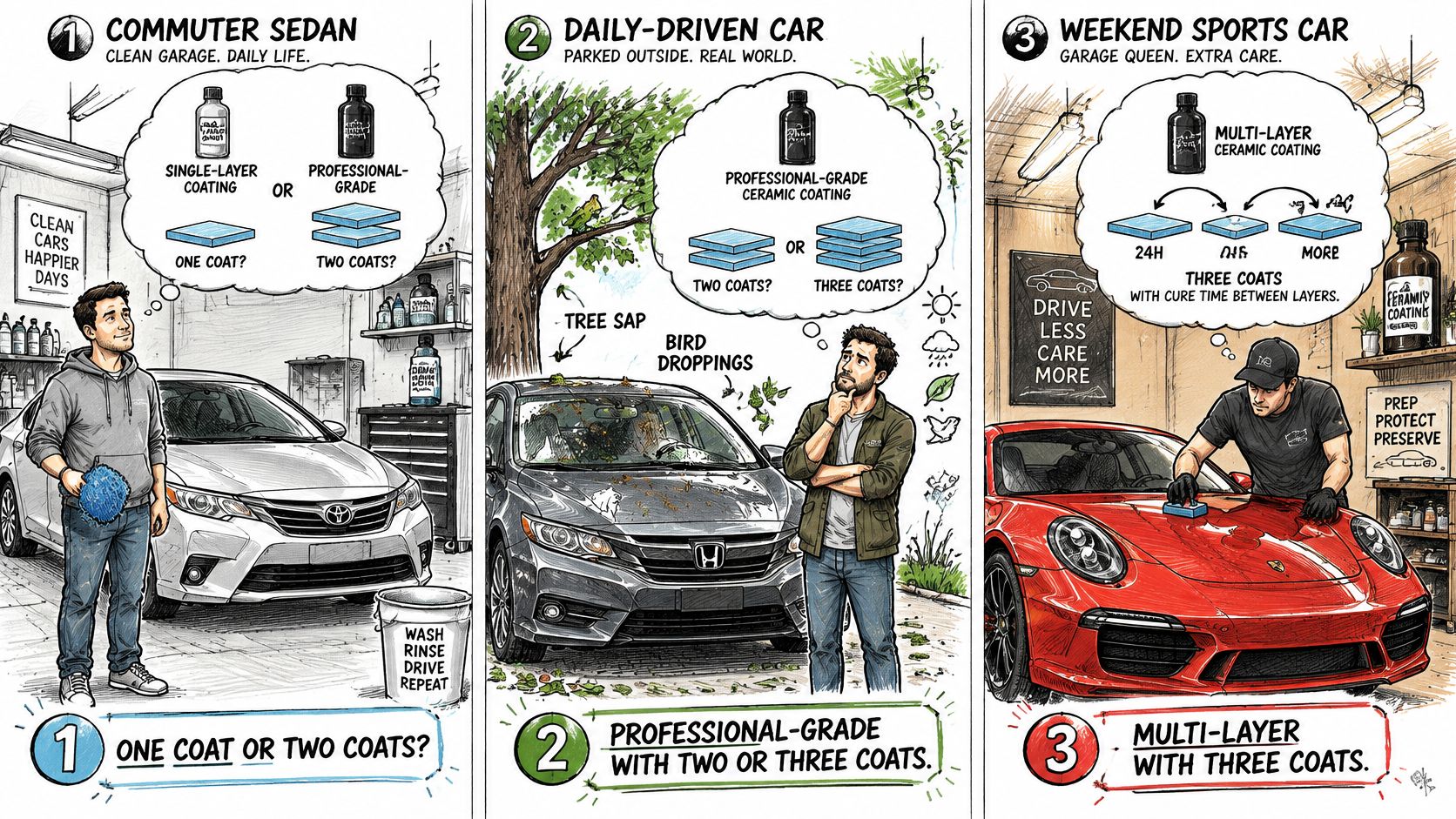
Coat Counts for Three Common Jobs
Coat count is a recipe. The label, the cure chemistry and the recoat window set it. It is not a durability dial, and a third pass you invent on the driveway only raises the chance of ridges, haze and a film that never bonds cleanly.
Three jobs, three different answers, and none of them decided by a forum thread.
The Commuter That Lives Outside
A sedan owner washes weekly, parks under trees at night and wants easier maintenance more than maximum film build. One coat of a single-layer coating gets him there. If the product is a stackable elastomer, two coats even the coverage and buy a little forgiveness on the rocker panels. A third coat changes nothing he can see, feel or measure at the next wash.
The Rain-Belt Windshield
A driver in a rain-heavy region fights glare and wiper fatigue more than he fights dirt. Two thin passes of Apex Glass ceramic coating on the windshield and wiper blades, first pass into the pores and second pass to build the sheeting layer, and water clears at highway speed instead of smearing. Storm driving stops being a white-knuckle event. The glass sets the count here.
The Mobile Detailer Working Through a Temperature Swing
A mobile detailer coats a fleet truck outdoors on a morning that starts below freezing and an afternoon that climbs into the heat. The panel expands and contracts all day, which is exactly why flexibility matters. Research on diamond-like carbon coatings on rubber measured an average film of 2.5 micrometers and a Vickers microhardness of 1,350. Tensile stress caused further fragmentation in an unstructured coating that had already cracked, while a patterned substrate limited new fractures by controlling where they formed. Hardness resists abrasion. Adhesion and flexibility resist cracking.
An elastomer film that stays hard like glass while flexing with the panel is the safer specification for that route than piling rigid layers on a surface that never stops moving. Coatings also age differently from job to job, which is why ceramic coating life depends on maintenance and environment as much as application.
Substrate still sets the count. A materials overview of automotive ceramic coating processes notes that industrial processes may use two to three coats to reach a specified dry-film thickness, with flash-off and thermal curing between layers. Vehicle coatings are thin, chemically cross-linked films applied after decontamination and polishing. Those factory figures never justify adding arbitrary layers to a cured passenger vehicle. Excessive film build can hurt appearance and adhesion.
Get the Coat Count Right on Your Next Detail
Before buying another bottle, decide what the job requires: a professional coating, a DIY coating, or a product for maintaining an existing coating. Then follow the product's specified application process. Extra layers add opportunities for uneven coverage and finish defects without guaranteeing more protection.
Titan Coatings come with a warranty when installed by a certified professional. The installer provides the warranty, and its terms depend on the products and layering used. With proper maintenance and periodic touch-ups, Titan Coatings can remain effective for 4 to 7 years or longer. Professional-grade Titan Coatings must be applied by certified installers.
Match the product to the task. Alpha Quartz is a DIY and mobile detailers coating. Apex Glass is a glass coating, while Ultra Ceramic Spray is a ceramic sealant for maintaining a coating. For a professional-grade system, ask an authorized installer which products and layering process suit your vehicle.
Choose the format before you settle on a coat count. The label and the installer's recommendations determine the process, not a desire to add one more layer.
APEX NANO – Titan Coatings manufactures elastomer-based ceramic coatings for automotive surfaces. To choose a coating for your vehicle and understand its application process, browse the range at APEX NANO – Titan Coatings or speak with an authorized installer.
0 Comments