
A black SUV rolled into the bay with a fresh ceramic glow and a hood that looked sandblasted anyway. The owner was frustrated because the shine was still there, but the front edge was peppered with chips and bug scars from one season of highway commuting. That's the moment most coating conversations get real.
| Coating family | What it's really good at | Where it starts to fall short | Best fit in the bay |
|---|---|---|---|
| Ceramic | Gloss, easy washing, UV and chemical resistance | Impact protection is limited | Daily drivers, show finishes, maintenance layers |
| Polymer | Quick application, short-term slickness, sacrificial shine | Shorter durability and weaker resistance | Base layers, toppers, budget refreshes |
| Hybrid elastomer | Flex recovery, layered protection, balanced durability | Needs the right prep and product selection | Harsh climates, impact-prone zones, mixed-use vehicles |
The owner had asked the usual question, “What's the best auto paint protection coating?” The better question was sitting on the hood in plain view: which panels take the abuse, and which product belongs there.
Practical rule: a coating that looks flawless on the invoice can still be wrong for the car's risk zones.
A Detailing Bay Moment That Reframes the Coating Question
That SUV came in six months after a ceramic install, and the customer had every right to expect easier maintenance. The wash mitt still glided well, the paint still popped under the lights, but the leading edge of the hood told a different story. Road debris doesn't care about gloss.
A veteran detailer reads damage by panel. Hood, bumper, mirrors, lower doors, rocker panels, and front fenders each take a different kind of abuse. When a coating choice ignores that map, the car ends up protected in the wrong places and exposed where it matters most.
What the bay shows before the brochure does
The hard part is that ceramic coating rarely “fails” in the way people mean it. It can still help with UV oxidation, wash marring, bird-drop etching, and grime release, but it won't stop impact damage from rock chips or heavy strikes. That's why the right conversation starts with risk zones, not a single product label. A front bumper in winter highway traffic needs a different answer than a garage-kept coupe that sees weekend miles.
The shop-floor lesson is simple. Protection isn't a trophy for picking the toughest-sounding coating, it's a strategy built around how the car is driven, stored, washed, and weathered.
When the panel gets hit, flexibility matters as much as surface hardness.
The market itself reflects that shift. Paint protection film is a large, growing automotive category, with one estimate putting the market at USD 946.1 million in 2025, rising to USD 1,041.7 million in 2026 and projected to reach USD 2,476.3 million by 2035, a 10.1% CAGR over 2026–2035, while automotive and transportation accounted for 73.64% of that market Grand View Research. That doesn't make film the answer for every panel, but it does show how seriously owners treat impact protection now.
The Three Coating Families Every Detailer Should Know
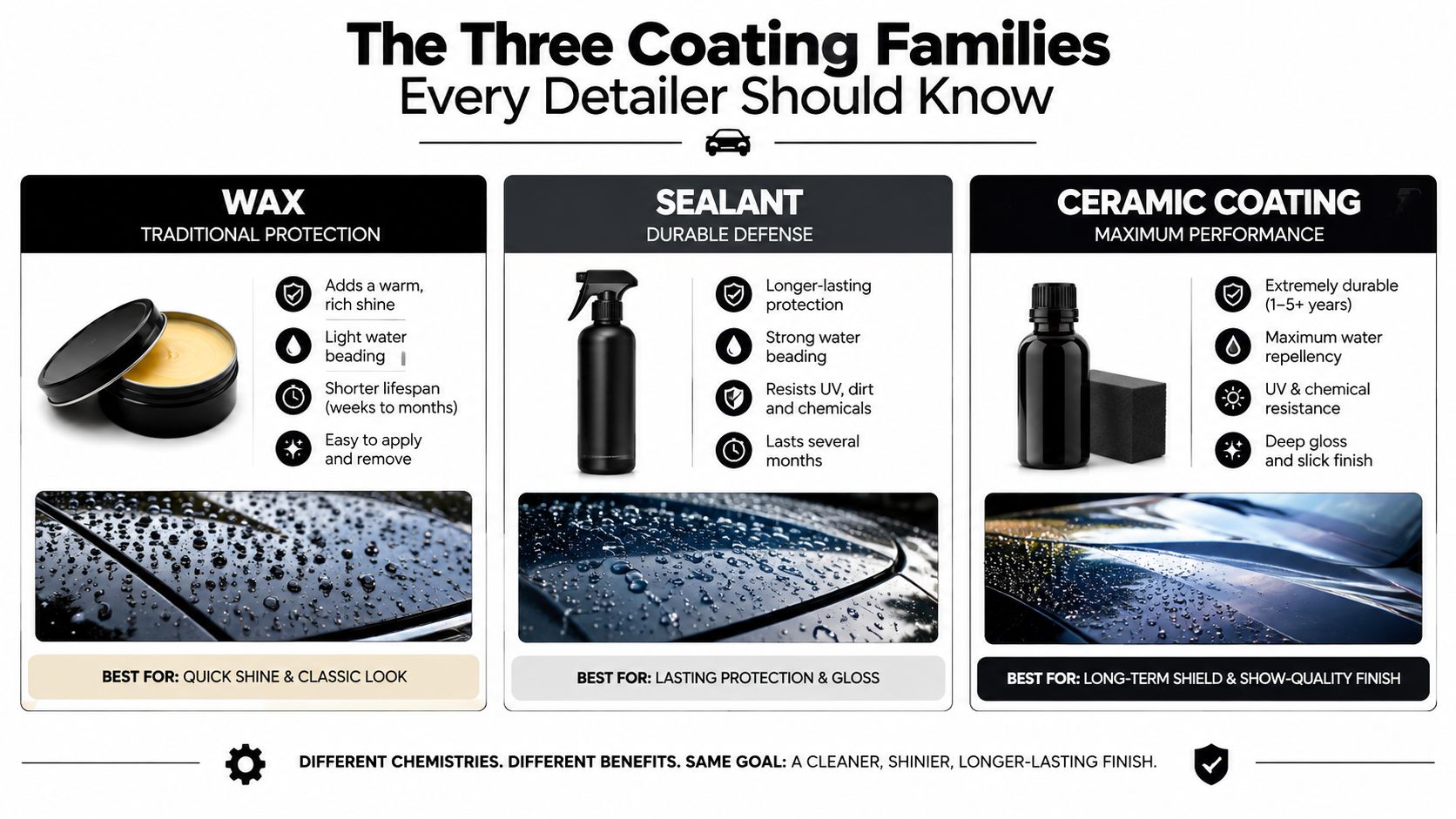
Ceramic, polymer, and hybrid elastomer in plain language
Ceramic coatings cure into a hard, slick layer that detailers like for gloss, water behavior, and chemical resistance. They're popular because they make a car easier to keep clean and they hold that freshly detailed look for longer. They're not, however, the same thing as impact armor.
Polymer sealants sit closer to the traditional detailing playbook. They're usually easier to apply, often used as sacrificial layers, and they're handy when a customer wants shine without a long install window. They're the kind of product you use when speed and convenience matter more than deep endurance.
Hybrid elastomer coatings sit in the middle in a more useful way. They're built to keep a hard surface while allowing movement underneath, so the coating can flex with the panel instead of behaving like brittle glass. Titan's material language around elastomer-based systems and membrane-forming technology points in that direction, which is why flexible hard coatings have become such an important category in real-world use.
A simple way to think about it is this. Ceramic gives you the finish, polymer gives you convenience, and elastomer helps the coating survive the car's movement.
Shop-floor note: the strongest stack is usually not one product doing everything, it's the right layer doing the right job.
If you're comparing a glass coating for windshields and daily visibility work, Apex Glass Coating- 50ml is described as an Advanced Hydrophobic Glass & Windshield Coating with deep pore bonding, water-repellent performance, improved visibility, reduced wiper use, and durability of up to 2 years.
For a deeper product comparison, the difference between ceramic and polymer coatings is laid out clearly in Titan Coatings' ceramic and polymer guide, which is useful when you're deciding what belongs as a standalone layer and what belongs in a stack.
Comparing Ceramic Polymer and Hybrid Coatings Side by Side
The bay doesn't reward theory. It rewards the product that still looks intact after heat cycles, wash cycles, and road miles. That's why side-by-side comparisons need to focus on the things customers notice, how long the finish stays presentable, how well it handles UV abuse, what happens when chemicals land on it, and whether the surface still has flex recovery after real driving.
| Coating Family | Durability (months) | UV & Oxidation | Scratch Resistance | Chemical Resistance | Gloss Retention | Flex Recovery |
|---|---|---|---|---|---|---|
| Ceramic | Longer than basic sealants, strongest when maintained | Strong | Good against light wash-related marks, not impact | Strong | High | Limited |
| Polymer | Shorter than ceramic or hybrid systems | Moderate | Modest | Moderate | Good early, fades sooner | Moderate |
| Hybrid elastomer | Long-lived when installed correctly | Strong | Better in stress zones than rigid layers | Strong | High | Strong |
The key trade-off is easy to see once you've polished enough cars. Ceramic often wins on raw slickness and hardness, polymer wins on speed and simplicity, and hybrid elastomer wins where movement and impact matter. That last point matters on front clips, roof edges, mirror caps, and the lower sides of a vehicle that sees rough roads.
For readers who want another angle on product choice, which ceramic coating is right for you? is a useful way to think through the category before spending a weekend in the garage.
Where the numbers stop and the panel starts
If the customer's route is mostly highway, the front end gets hammered first. If the car lives under trees, chemical fallout and bird droppings become a bigger issue. If the car lives in a garage and sees fair-weather miles, gloss and easy washing might matter more than impact absorption.
That's why a coating stack should be chosen by use pattern, not hype. The right answer for a daily commuter isn't always the same as the answer for a weekend toy, even when the paint is identical.
For detailers who like to organize their installs by chemistry and workflow, Titan Coatings' polymer nanocomposite coatings are worth reviewing alongside the harder finishes, because the decision is often about how a layer behaves under load, not just how it looks on day one.
What Ceramic Coatings Can and Cannot Protect Against
Ceramic coatings earn their place because they make paint easier to live with. They help slow UV damage, cut oxidation, shed water, reduce grime bonding, and make wash maintenance less punishing on the finish. That's real value, especially for owners who want a car to stay presentable without constant correction.
The limits show up fast in the wrong zone. Rock chips on the hood, deep scratches on the front bumper, hail, and collision damage are outside the lane of what a ceramic layer can stop. In the bay, that's where the mismatch becomes obvious, because the coating did exactly what it was designed to do, just not what the customer hoped it would do.
| Risk Type | Ceramic Performance | Weak Spot | Recommended Add-On |
|---|---|---|---|
| UV and oxidation | Strong | Not a physical shield | Regular maintenance, hybrid stack |
| Bird droppings and bug residue | Good against staining when cleaned quickly | Delayed cleaning can still mark the surface | Faster wash routine, top-up layer |
| Road rash and rock chips | Limited | Impact energy passes through | PPF on high-hit zones |
| Hard-water spots in sun | Moderate | Heat accelerates spotting | Careful wash timing, water control |
| Lower doors and rear quarters | Good for cleaning ease | Gravel spray and debris strike | Elastomer or film protection |
| Front bumper and hood leading edge | Good gloss retention | Repeated impact | PPF, hybrid stack |
The practical answer is often a hybrid. PPF on the front-end strike zones, a coating over the rest, and a flexible topper where temperature swings are brutal. That's the logic behind layered protection, and it lines up with the way real driving loads a vehicle.
For readers who want to think about filtration and contamination control during prep, T1A Auto's filter guide is a useful reminder that fine contamination management matters before any coating goes down.
The category is also moving toward layered systems in product design and buyer behavior, which matches the practical reality that no single layer solves every risk. ULTRA Ceramic Spray is described as Ultra 4.0, a highly concentrated, water-based flexible membrane sealant for paint, wraps, PPF, glass, wheels, plastic trim, and even household or personal items, which makes it a logical maintenance layer rather than a stand-alone cure-all.
For chemical behavior specifics, Titan Coatings' chemical resistance table gives a more technical look at how protection varies under different exposures.
Why Flexibility Matters More Than Raw Hardness
Titan's elastomer message makes sense to anyone who has watched a coated panel survive real life. A hard finish that can't move is vulnerable when the body flexes, the weather swings, or the surface gets peppered with debris. A coating that keeps its structure while bending with the panel has a better chance of staying intact.
Heat, cold, and the daily flex of a car
A car doesn't live in one temperature. It sees summer heat on black paint, then cold mornings, then hot brake heat, then winter contraction, and those shifts stress both the panel and the layer on top of it. Titan says its elastic coatings are designed to handle frozen-to-hot transitions without cracking or delaminating, and that flexibility is the reason these systems get attention in the first place.
That lines up with broader flexible-material thinking in automotive systems, where durability across wide temperature ranges is a major advantage. Independent technical material on vehicle elastomers notes flexibility across roughly -40°C to 316°C, plus resistance to aging, cracking, and compression set Antala.
Impact mechanics on the road
Bug strikes and sandblasting don't look dramatic in isolation, but they add up. A rigid coating can stay glossy and still micro-fracture under repeated abuse, while an elastomer membrane can absorb and rebound better because it isn't fighting the panel's movement. That's where flexibility becomes a durability feature, not just a chemistry term.
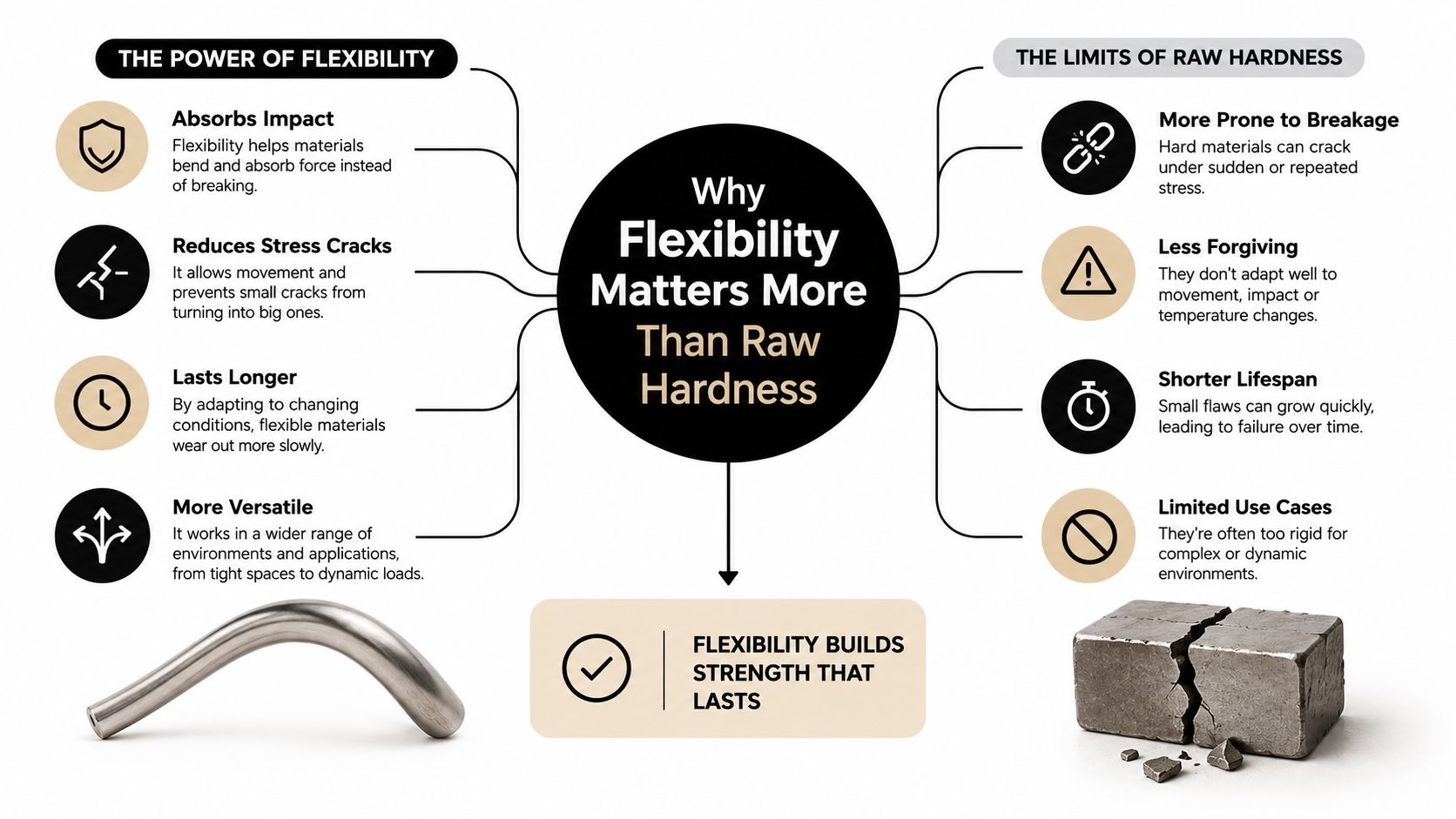
Detailer's rule of thumb: a finish that keeps moving with the panel usually keeps looking fresh longer.
That flexibility also supports gloss retention. When the coating surface stays intact, it keeps its optical quality longer, which is why a car can still look newly detailed months later if the layer isn't being fractured by daily stress. Titan's elastomer-based approach, including its membrane-forming technology, is built around that logic rather than around hardness alone.
Thermal shock matters too. Independent technical material on ceramic coatings notes that thickness affects resistance, with coatings around 5 mils (0.127 mm) or less showing the best thermal shock behavior, and another source says some ceramic coatings can endure abrupt temperature drops of 200°F to 300°F without damage Kera-Coat. The takeaway is plain, formulation and flexibility drive real-world survival.
You can also see Titan's broader positioning in coating flexibility, where the value of movement under stress is tied directly to durability.
Matching the Right Coating to Your Real World Use Case
A mobile detailer who turns cars quickly needs a product that wipes on clean, cures predictably, and doesn't punish the clock. For that kind of work, a fast-install coating or maintenance spray makes more sense than a highly elaborate stack on every vehicle. The trade-off is that speed usually means less built-in forgiveness when the car sees harsher use.
A weekend enthusiast usually wants depth, slickness, and the satisfaction of a finish that looks expensive under the lights. That owner can live with a longer install window because the car's mileage and exposure are lower. The trade-off is time, because richer finishes often ask for cleaner prep and more careful application.
| Buyer Profile | Best Coating Family | Service Interval | Key Trade-Off |
|---|---|---|---|
| Mobile detailer | Polymer or hybrid topper | Short to moderate | Speed versus maximum endurance |
| Weekend garage enthusiast | Ceramic or layered hybrid | Moderate to long | Longer install for richer finish |
| Daily driver in harsh climate | Hybrid elastomer with PPF in impact zones | Long | More planning up front |
| Dealership or fleet operator | Polymer and maintenance spray stack | Short to moderate | Throughput versus peak durability |
Harsh northern climates change the math. Salt, gravel, slush, and freeze-thaw cycles punish rigid layers and front-end panels more than most owners expect. That's where elastomer and hybrid systems make more sense, especially when they're paired with film on the highest-hit areas.
For buyers looking at factory-fresh cars, Titan Coatings' guide to the best paint protection for new cars fits neatly into this kind of decision-making, because new paint still needs a strategy, not a wish.
Fleet and dealership work runs on predictability. The coating has to be fast enough to fit production and consistent enough that the result doesn't vary from vehicle to vehicle. Those buyers usually accept less theatrical gloss in exchange for reliable turnaround and lower rework risk.
Titan Coatings Stack for Long Lasting Vehicle Protection
Titan's lineup works best when it's treated as a layered system instead of a single product promise. Alpha Quartz is presented as an elastomer ceramic coating with 92% high solids, zero VOCs, solvent free construction, advanced adhesion technology, and a 4 hour cure, which makes it a strong base layer for surfaces that need both hardness and movement.
Apex Glass belongs on windshields and glass where visibility matters most. It bonds deep, repels water, and is meant to reduce wiper use while improving driving confidence in rain. Ultra Ceramic Spray is the maintenance layer that keeps hydrophobic behavior alive between bigger applications, especially on vehicles that see regular washing and mixed surface types.
A practical install sequence
The sequence is straightforward. Decontaminate the surface, polish if needed, apply Alpha Quartz as the base membrane, top with Apex Glass where visibility and slickness matter, then maintain the finish with Ultra Ceramic Spray on a regular cadence. That approach makes more sense than trying to force one coating to solve every problem in one pass.
Install logic: base for flexibility, topper for clarity, spray for upkeep.
| Product | Base Technology | Durability | Gloss Level | Best Use | Application |
|---|---|---|---|---|---|
| Alpha Quartz | Elastomer ceramic coating | Long-lasting protection | High | Paint systems that need flexibility and UV, chemical, abrasion resistance | Base layer on corrected paint |
| Apex Glass | Hydrophobic glass coating | Up to 2 years | Clear, functional | Windshields and glass | Glass-specific application |
| Ultra Ceramic Spray | Flexible membrane sealant | Maintenance layer | Good refresh gloss | Paint, wraps, PPF, glass, wheels, trim | Top-up and upkeep |
For a real shop, that stack solves different problems at once. Alpha Quartz handles the body's movement, Apex Glass keeps the glass usable in bad weather, and Ultra Ceramic Spray helps refresh the surface between full services. The result is a layered defense that fits daily driving better than a rigid single-product mindset.
If you want a coating plan built around the way cars are driven, not just how they look on day one, visit APEX NANO – Titan Coatings. You'll find coating options that map to paint, glass, and maintenance needs, which makes it easier to build a protection stack that holds up in the bay and on the road.
0 Comments