
You’re standing beside a freshly coated car when a bottle of wheel cleaner slips, hits the hood, and leaves a wet trail across the finish. The instinct is to wipe quickly, but that can spread the chemistry, add abrasion, and turn a small spill into a larger repair. A reliable chemical resistance table gives you a calmer answer. It tells you what was tested, under which conditions, and what “resistant” actually means.
That distinction matters for ceramic coatings, elastomer coatings, glass treatments, plastics, seals, and painted panels. A coating can pass a short room-temperature spot test and still soften, stain, or lose adhesion when heat, dwell time, flexing, and repeated washing enter the picture. The practical question isn’t whether a product is “chemical resistant.” It’s whether it remains intact under the exposure your customer’s vehicle will encounter.
When a Spilled Bottle Becomes a Table Problem
Saturday was already busy when a junior technician carried a jug of iron-fallout remover across the bay. The bottle clipped the edge of a freshly coated hood, tipped, and left a dark purple stripe on the panel. Nobody saw it immediately. Under the inspection lights, the liquid had sat for roughly forty seconds before the owner noticed.
The customer had paid for a premium ceramic job, and suddenly the conversation moved from gloss and water behavior to possible etching, staining, and rework. The technician reached for a towel, then stopped. Wiping could drag concentrated gel across the clear coat and introduce grit from the panel.
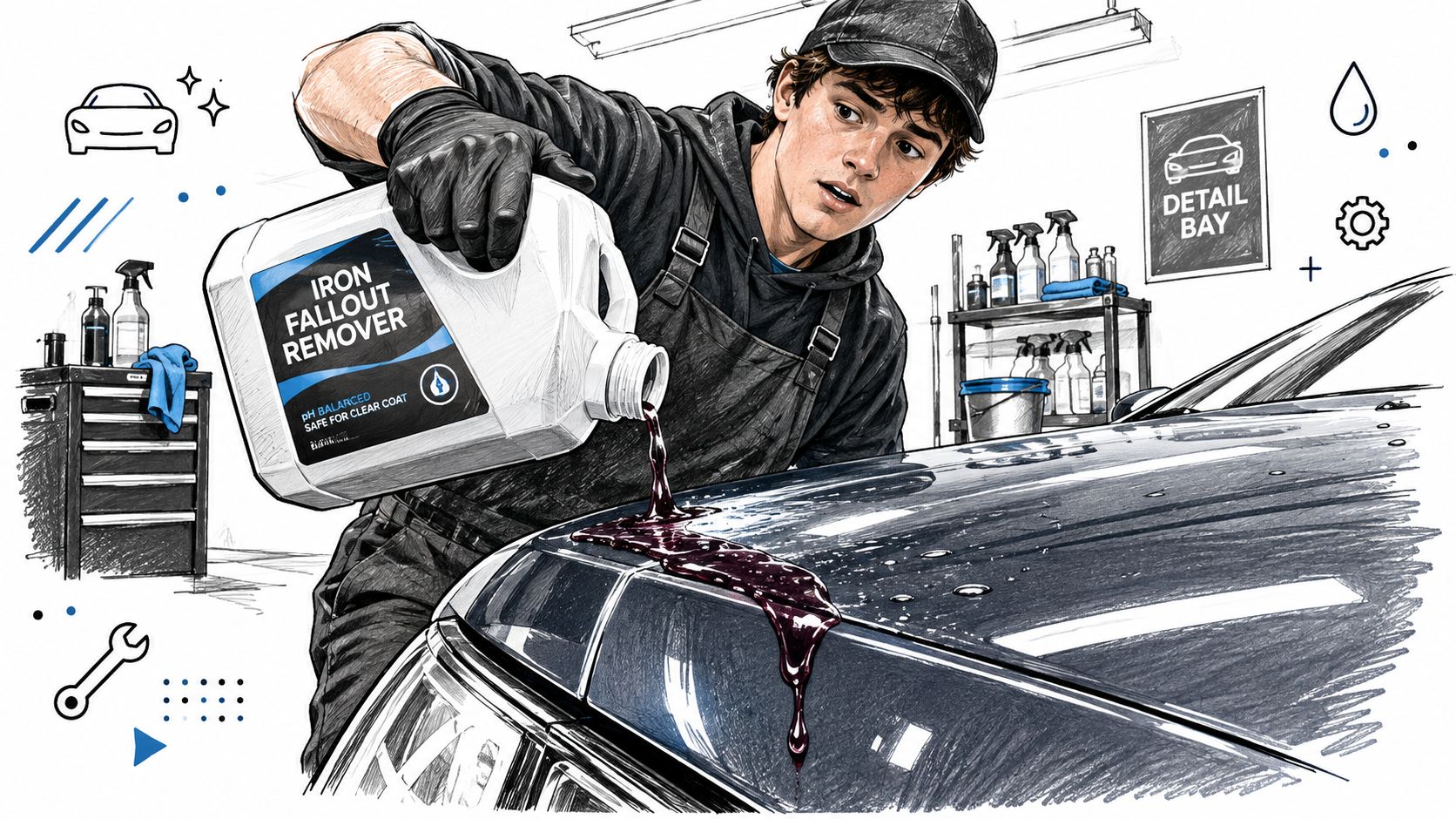
The supplier’s technical sheet offered little help. It said the coating was “resistant to acids,” but didn’t identify the remover’s concentration, exposure method, temperature, or pass criteria. A phone call produced the same broad answer. The detailer then pulled a printed table from the shop pinboard and matched the chemical family, dilution, and exposure mode.
The decision happens before the damage is visible
The table didn’t promise that the hood was safe. It showed whether the product had been evaluated under conditions close enough to guide the next action. The owner chose to flood the area with neutral snow foam, rinse it thoroughly, and avoid wiping until the contaminant was diluted and removed.
After drying, the team checked the panel under multiple lights, measured film thickness where relevant, and inspected the finish for gloss change, haze, swelling, and loss of uniformity. The table had done its real job. It hadn’t replaced judgment. It had stopped marketing language from making the decision.
Shop-floor rule: A resistance claim without concentration, temperature, exposure time, and test method is a starting point, not permission to leave chemistry on a panel.
What a Chemical Resistance Table Actually Is
A chemical resistance table is a structured matrix. It pairs a reagent with a material, a defined exposure protocol, and an observed response. It isn’t a universal compatibility promise, and it shouldn’t be read as one.
ISO/TR 7620 classifies chemical resistance into four grades based on measurable material change. Grade 1 means less than 10% volume change with no significant effect. Grade 2 covers 10% to 30% volume change with a minor effect. Grade 3 covers 30% to 60% with a moderate effect, while Grade 4 means more than 60% and a severe effect. These definitions are described in the ISO/TR 7620 guidance.
Read the legend before the chemical row
Coating and materials sheets may also use letters such as E, B, S, and N. One common schema uses E for excellent resistance, B for good or borderline performance depending on the supplier’s legend, S for fair or splash-limited exposure, and N for not recommended. Those letters only have meaning when the legend defines temperature, duration, and failure criteria.
For example, a coating might tolerate a brief isopropyl alcohol wipe while showing poor performance during prolonged contact with a solvent-rich brake cleaner. That isn’t a contradiction. The chemicals, exposure mode, and attack mechanism differ. A table that lists only “alcohol, E” hides more than it reveals.
The same principle applies to the historical standardization of plastics pipes and fittings. ISO/TR 10358 established a combined chemical-resistance classification table for polymers including PE, PP, PVC, ABS, and PVDF. Industry charts may evaluate chemicals at 20°C and 50°C, or at boiling temperature when below 50°C, which shows why temperature belongs in every serious comparison.
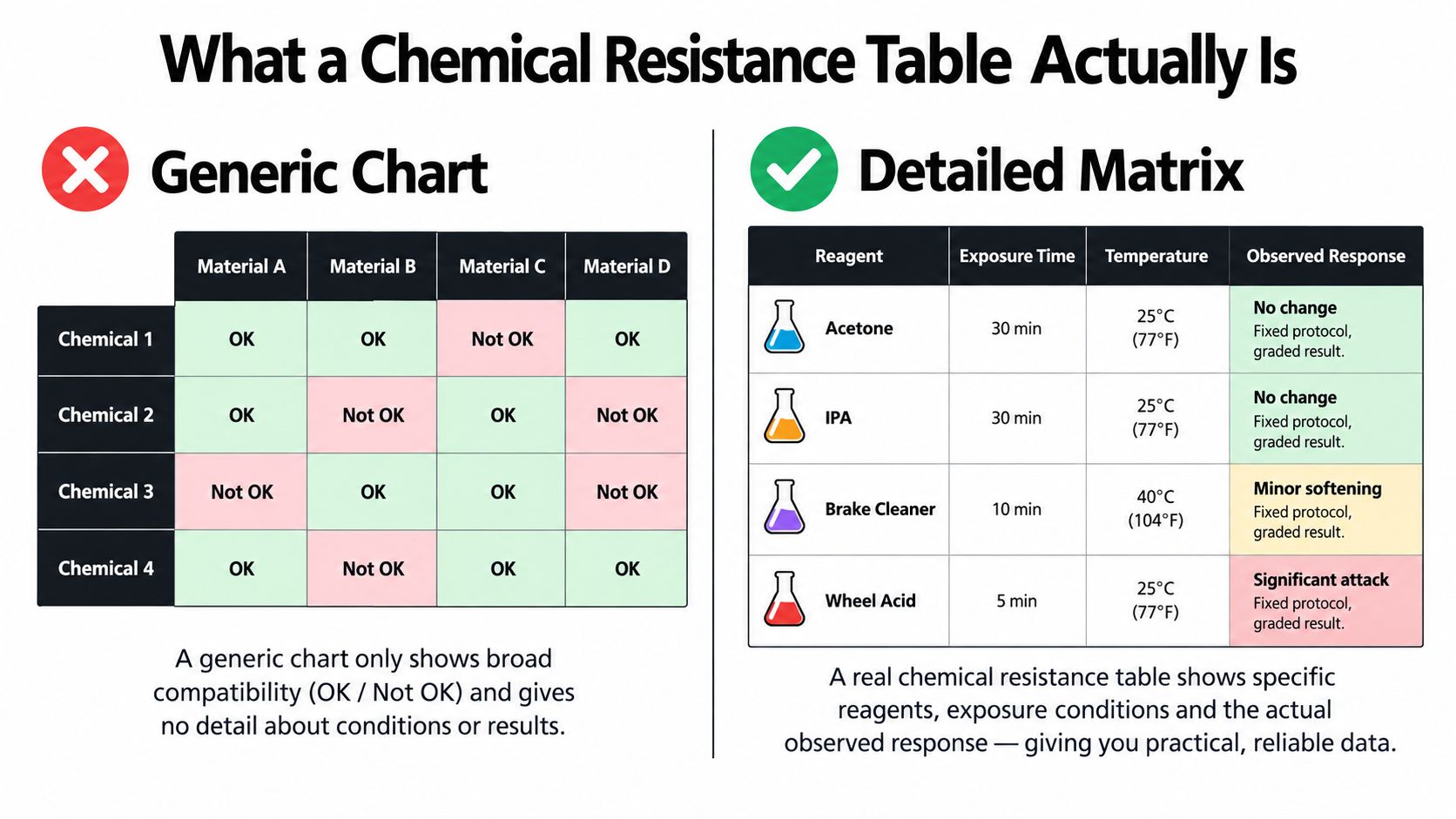
For a shop, the useful question is simple: what changed, after what exposure, and was the change acceptable for the intended service? Titan’s chemical resistance testing information is most useful when read through that lens.
The Standards Behind Every Rating
A credible table begins with a protocol, not a letter. The protocol defines how the sample sees the chemical and which changes count as failure.
ISO 2812-1 is used for chemical immersion testing of coatings, while related ISO 2812 methods address other immersion arrangements. Spot testing, including ASTM D1308, answers a different question: how does the finish react when a limited amount of household or representative chemical remains on the surface? ASTM D543 is commonly used for plastics and elastomers, but its results are limited because concentration, duration, stress, and temperature are necessarily selected test conditions.
Match the method to the shop event
ASTM D1308 is relevant to a wheel-cleaner drip or a cleaner left on a door handle. Immersion testing is closer to a gasket, seam, or engine-bay area exposed to a persistent leak. ISO 4628-1 through 6 helps quantify visible defects such as blistering, rusting, cracking, and flaking. After exposure, ASTM D3363 pencil hardness can show whether the surface has softened, while ASTM D2240 Shore A can help characterize elastomer coating hardness.
The coatings chemical resistance testing overview identifies methods including ASTM D6943, ISO 2812-1, ASTM D1308, ASTM D5402, and ASTM G20. For industrial floors, tanks, and production areas, a resource on industries that need chemical resistant floors adds useful context because the exposure is often more sustained than a vehicle spot test.
| Test Method | Exposure Mode | Measurement | Shop-Floor Question Answered |
|---|---|---|---|
| ISO 2812-1 | Partial immersion | Visible and physical coating change | Can the film tolerate contact with a standing liquid? |
| ISO 2812-2 | Continuous immersion | Coating integrity during immersion | What happens when a leak remains present? |
| ISO 4628-1 through 6 | Condition assessment after exposure | Blistering, rusting, cracking, flaking | Has the coating developed a service defect? |
| ASTM D1308 | Spot contact | Finish reaction and visible change | Will a drip or cleaner residue mark the surface? |
| ASTM D543 | Immersion or stressed exposure | Swelling, softening, cracking, dimensional change | How does a plastic or elastomer respond to a reagent? |
| ASTM D3363 | Post-exposure pencil hardness | Surface hardness | Did chemical contact soften the finish? |
| ASTM D2240 Shore A | Elastomer hardness measurement | Shore A hardness | Has an elastomer coating changed mechanically? |
A rating without a cited standard is a marketing line, not a reproducible result. Titan’s explanation of third-party testing is useful for separating independently documented testing from a broad supplier statement.
For maintenance products, OMNIGUARD – Waterless Wash is described as a quick sealant for fast wipe-downs, water mark removal, and UV protection, with HYPERBEAD™ particles for self-cleaning and oxidation resistance.
How to Read a Single Row Correctly
Start at the left and refuse to skip columns. The chemical name tells you the family, but the CAS number helps distinguish a defined reagent from a loosely named commercial blend. “Wheel cleaner” is a product category, not a complete test chemical.
Next, check concentration, temperature, duration, and exposure mode. A cotton-pad spot, static immersion, vapor exposure, and repeated wipe-down don’t create the same stress. A row for 70% isopropyl alcohol under a spot-contact method cannot automatically predict full immersion in the same liquid.
The temperature column can change the decision
A test at room temperature may show a stable surface, while a warmer panel increases softening, diffusion, or reaction speed. The exact result depends on the coating chemistry and method, so don’t assume a fixed grade change unless the table reports it. A table that compares 23°C and 50°C conditions, as many industry references do, gives a more useful view than a single ambient result.
| Column | Example Value | What It Really Tells You |
|---|---|---|
| Chemical identity | Isopropyl alcohol, defined grade | Which reagent was actually tested |
| CAS number | Supplier-specified identifier | Whether the test matches the material in your bottle |
| Concentration | 70% by weight | How strong the exposure was |
| Temperature | 23°C | Whether the result reflects ambient conditions |
| Duration | Supplier-reported test period | How long the film remained exposed |
| Exposure mode | Spot contact or immersion | Whether the result fits a drip, wipe, or leak |
| Initial film rating | Before recovery | Immediate swelling, haze, softening, or staining |
| Recovery rating | After conditioning | Whether the change remained after the reagent left |
| Gloss result | Reported gloss change | Whether appearance shifted |
| Adhesion result | Cross-hatch comparison | Whether the film still grips the substrate |
Reading discipline: Don’t compare two letters until you know they came from comparable protocols.
A strong row also reports what happened after the chemical was removed. Initial swelling may partly recover, while gloss loss, adhesion loss, or a permanent mark may remain. Before trusting the row, verify the exact product formulation, dilution, substrate, cure state, temperature, duration, exposure mode, visual failure criteria, and post-exposure measurements.
Chemical Families Detailers Meet in Real Life
Detailers don’t work with isolated laboratory reagents. They work with blends, residues, road films, cleaners, fuels, and salts. Grouping them by chemical family helps predict what to inspect first.
| Family | Common Examples | Attack Mechanism | Visible Failure Mode |
|---|---|---|---|
| Mineral acids | Battery acid, hydrochloric wheel cleaners | Acidic attack can alter the surface and accelerate etching | Haze, etching, roughness |
| Alkalis | Degreasers, alkaline wheel cleaners | Can swell or soften susceptible films | Dulling, swelling, adhesion loss |
| Fuels and aromatics | Gasoline, toluene-containing products | Can penetrate or plasticize polymer networks | Softening, staining, tackiness |
| Alcohols | Isopropyl alcohol, ethanol cleaners | Repeated exposure can stress the cured network | Gloss change, dry-looking surface |
| Salts and chlorides | Road salt, coastal residue | Promote under-film corrosion at defects and scribe edges | Rust creep, edge lifting, staining |
Mineral acids deserve fast removal because the visible damage may begin as a small change in surface texture rather than a dramatic failure. A dark panel under strong lighting can hide that change until the customer sees it in direct sun.
Alkaline cleaners create a different problem. A film may look intact while the surface has softened, making it more vulnerable to towel marks, brush contact, or later abrasion. Concentration and dwell time matter more than the product category printed on the bottle.
Fuels and aromatic solvents often expose the difference between a short splash and persistent contact. A single drip may be removed safely, while a soaked seam, trim edge, or porous defect retains the solvent and continues attacking the film.
Alcohols are usually discussed as if they were harmless because technicians use them for prep. That shortcut fails when the formulation, exposure duration, heat, and repeated wiping change. Salts behave less like a dramatic solvent and more like a pathway for corrosion when the coating has a scribe, pinhole, thin edge, or contaminated substrate.
The useful property to track isn’t just “chemical resistance.” It’s surface integrity after the chemical leaves, including gloss, hardness, adhesion, and flexibility.
Why Elastomer Coatings Shift the Table
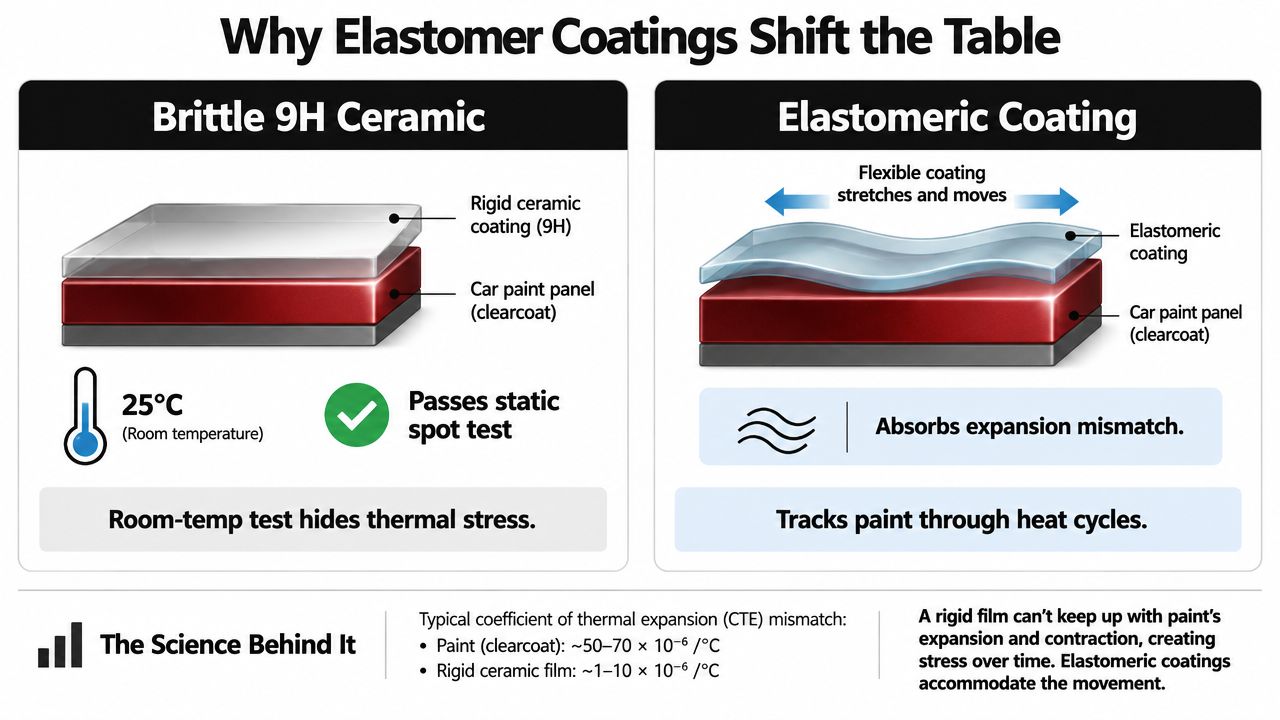
A static room-temperature spot test can hide the weakness of a rigid film. The coating may resist the reagent chemically while still cracking when the film and painted substrate expand or contract at different rates.
That coefficient-of-thermal-expansion mismatch becomes important when a hot panel meets a cold splash, frozen residue, or an impact from a dried bug. A rigid layer can lose continuity before the chemical has enough time to create obvious staining. Once a crack or edge defect appears, the contaminant has a new route toward the substrate.
Flexibility changes what the rating means
An elastomer coating is designed to remain hard at the surface while accommodating movement underneath. Titan describes its elastomer coatings as combining glass-like hardness with flexibility. That combination is relevant to vehicle panels, where the coating must resist contamination and abrasion without behaving like a brittle shell.
Thermal cycling is therefore a better challenge than one ambient spot. A coating can be exposed between -20°C and 80°C, then subjected to chemical contact, to examine whether the film survives movement before the reagent arrives. Those temperatures are a test design example, not a universal service guarantee, and the result depends on the protocol and substrate.
Research on polymer coatings reports that temperature affects crack behavior around the substrate’s glass-transition temperature, while a coating and substrate study found measurable changes at 150°C compared with 23°C, including reduced critical delamination and lower interfacial shear strength. The Titan elastomer coating information provides useful product context, but a shop should still ask for the actual test conditions behind any rating.
Bug impact is mechanical before it is chemical
Bug residue can combine impact, organic acids, heat, and drying. A flexible film won’t make every chemical harmless, but it can preserve the barrier when the panel flexes or the contaminant lands on a stressed surface. That is why an elastomeric result shouldn’t be reduced to a single letter copied from a rigid-coating chart.
Titan Products Mapped to the Same Test Set
A fair comparison needs one panel, one chemical set, one exposure method, and one rating system. Otherwise, a product may appear stronger only because it was tested under a shorter dwell time or a milder dilution.
The requested comparison uses brake fluid, isopropyl alcohol, road salt solution, gasoline drip, and diluted citric acid in a 24-hour spot test at 23°C, with ISO/TR 7620 grades used as the reporting frame. The supplied product notes identify Alpha Quartz as an elastomer ceramic coating, Apex Glass as a glass and windshield coating, Ultra Spray as a spray ceramic coating, and Omniguard as a quick sealant. They don’t provide verified test results for each product under this exact panel, so the table below is a test plan rather than a fabricated pass/fail report.
| Chemical | Alpha Quartz | Apex Glass | Ultra Spray | Omniguard |
|---|---|---|---|---|
| Brake fluid | Test required | Test required | Test required | Test required |
| Isopropyl alcohol | Test required | Test required | Test required | Test required |
| Road salt solution | Test required | Test required | Test required | Test required |
| Gasoline drip | Test required | Test required | Test required | Test required |
| Diluted citric acid | Test required | Test required | Test required | Test required |
Fit the product to the job
Alpha Quartz is positioned for all-surface use and combines high solids with an elastomer formulation, which makes flexibility a relevant property to investigate during thermal cycling. It isn’t responsible testing to convert that design description into a chemical grade without the corresponding results.
Apex Glass belongs on windshields and glass surfaces where visibility and water behavior matter. The product page describes easy use and visibility enhancement, but glass exposure should still be evaluated separately from painted-panel chemistry.
Ultra Spray is appropriate for a workflow that values a spray application format and fast installation. Its product information should be read alongside the exact prep, cure, and chemical test conditions.
For a weekend driver, application convenience may dominate. A daily commuter needs a table that reflects repeated wash and road exposure. Fleet and marine users should demand immersion, salt, thermal, and substrate-specific testing rather than rely on a short spot result. Titan’s coating excellence information can sit alongside those records, not replace them.
Quick Reference by Exposure Scenario
A table becomes useful when a technician can make a decision without translating laboratory language from scratch. The three situations below cover common moments where dwell time, heat, and contamination combine.
| Scenario | Chemical Family | Typical Contact Time | Damage Mode | Minimum Rating Needed |
|---|---|---|---|---|
| Bird dropping left on a hood | Organic acidic contamination | Until discovered and removed | Etching, staining, gloss loss | A documented rating under relevant spot conditions |
| Fuel splash at the pump | Fuel and aromatic solvents | Brief splash, possibly trapped at an edge | Softening, staining, swelling | E for the defined splash condition, or a documented fuel-specific result |
| Weekly pH-neutral wash | Mild detergent exposure | Short repeated contact | Accumulated dulling or residue-related wear | B or better for repeated spot exposure, with wash compatibility confirmed |
The table doesn’t turn an unknown product into a safe one. “pH-neutral” describes acidity and alkalinity, not every solvent, surfactant, fragrance, or additive in the formulation. Likewise, a passing short spot test doesn’t automatically cover a longer exposure under a hot sun, where heat can accelerate chemical and mechanical change.
Three shop rules
- Bird residue: Remove it with lubrication and minimal pressure as soon as practical. Don’t let a clean-looking rating encourage prolonged dwell.
- Fuel splash: Rinse and dry the affected area instead of scrubbing a contaminated panel. Check whether the table covers gasoline specifically.
- Wash cycle: Verify repeated-contact behavior, not just a single exposure. Use clean media because chemical resistance won’t prevent abrasion from trapped grit.
For garage floors and work areas, it also helps to compare epoxy flooring for garages because vehicle-care spaces may expose the floor to a different combination of fuels, detergents, salts, and mechanical wear than the vehicle itself.
Where Standard Tables Quietly Fail You
The comforting cell is “pass.” The problem is that a coating can pass one exposure and fail the service combination. A static rating may not include UV preconditioning, repeated washing, thermal cycling, variable film thickness, substrate movement, or abrasion.
Consider bug residue on a hood. The chemical table may show excellent resistance to the relevant contaminant in a controlled spot test. In summer sunlight, the residue dries, the panel heats, and the film experiences chemical contact, thermal stress, and UV exposure at the same time. The eventual mark doesn’t prove the table was false. It shows that the field exposure exceeded the test definition.
Stress modes that change the answer
- Thermal shock: Sudden temperature changes strain the film and substrate interface.
- Film thickness variation: Thin edges and high spots may fail before the center of a panel.
- Substrate flex: A hood, bumper, or plastic trim piece moves differently from a rigid test panel.
- Mechanical abrasion: Brushes, towels, and road grit can remove a weakened surface.
- Prior contamination: Oils, polish residue, and poor preparation can reduce adhesion before chemical exposure begins.
- UV conditioning: Weathering can change the film before the cleaner or contaminant arrives.
Elastomeric coatings can also hide early chemical attack because the surface may retain gloss while the underlying mechanical properties change. That makes hardness, adhesion, and recovery checks important, not just visual inspection.
Titan’s coating failure analysis information is most useful when a shop records the complete event: product batch, substrate, cure state, cleaner formulation, dwell time, temperature, removal method, and observed defect. The table then becomes evidence for the next decision rather than a shield against accountability.
Using the Table as an Ongoing Decision Tool
A chemical resistance table should live beside the shop’s products and process notes. Each time a new wheel cleaner, fuel additive, degreaser, or wash chemical arrives, record its active chemistry, dilution, intended dwell time, and likely exposure mode.
The technician then checks the matching product row, confirms whether the row covers spot contact or immersion, and reviews temperature. If the table doesn’t match the actual event, the correct action is to run a controlled test on a sacrificial panel or contact the supplier for a formulation-specific answer.
Keep three records aligned
The standards record holds the named methods, acceptance criteria, and exposure conditions. ISO/TR 7620 provides a graded framework for measurable change, while ASTM D1308 and coating immersion methods answer different exposure questions. Don’t merge their results into one unexplained letter.
The supplier record holds technical sheets, cure instructions, product updates, and test notes. A YouTube demonstration can show application technique or water behavior, but it shouldn’t be treated as chemical evidence unless the video identifies the reagent, concentration, temperature, duration, substrate, and inspection method.
The shop-floor record captures what happened in service. Note whether a bird dropping dried in sun, fuel reached a trim edge, or a cleaner was removed by rinsing instead of wiping. Those details help explain why two jobs using the same coating produced different outcomes.
A weekly review is enough to keep pending exposures visible. Check fuel splash, road salt, bug residue, wash chemicals, glass cleaner, and any new product entering the bay. When Titan publishes a new test cycle, add it beside the existing row instead of deleting the old result. That preserves the conditions and makes changes traceable.
The practical choice is not “Which coating has the highest letter?” It’s “Which coating and maintenance process match this vehicle, this substrate, this climate, and this chemical exposure?” Titan’s elastomer approach, Alpha Quartz, Apex Glass, Ultra Spray, and supporting maintenance products can be evaluated through that same discipline. A table earns trust when it narrows uncertainty without pretending to eliminate it.
APEX NANO – Titan Coatings develops coating systems for automotive, aviation, marine, and defense applications, with product information and testing context that help technicians evaluate chemical exposure alongside flexibility, adhesion, and thermal cycling. Visit APEX NANO – Titan Coatings to review the available coating options, application resources, and standards-focused information before choosing a system for your next vehicle.
0 Comments