
Say a customer rolls in with a three-year-old daily driver in early spring, and the hood looks clean until the sun hits it low and the whole panel reads as a scratch map. You're now choosing a car paint protection kit against what ruined that paint: not one big impact, but a few hundred wash cycles, UV hours and temperature swings. The bottle label won't tell you which kit survives that. The test methods will.
What Belongs in a Car Paint Protection Kit
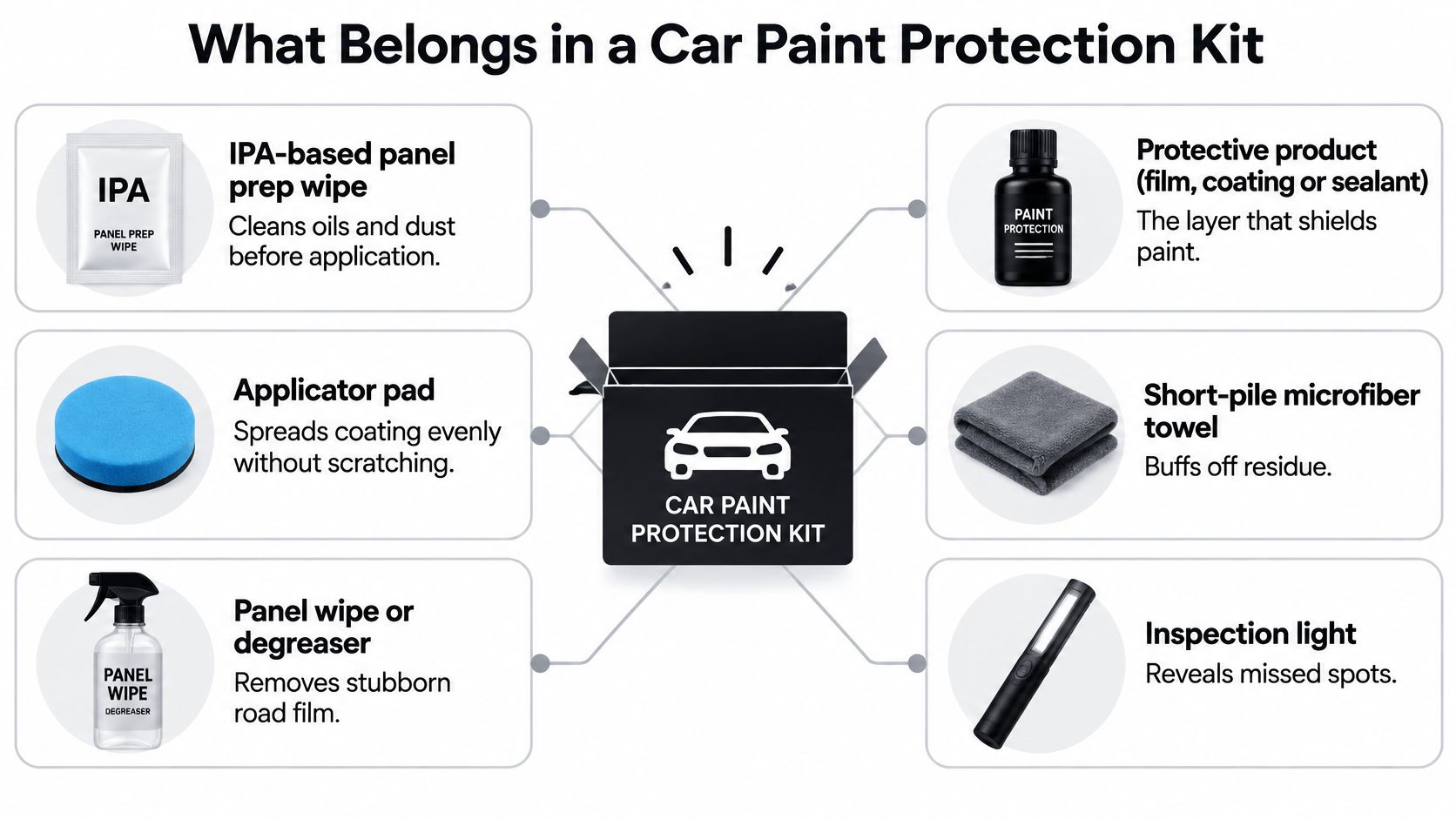
Open a kit box on a bench and you know within thirty seconds whether the seller understands paint or just packaging. A complete car paint protection kit contains an IPA-based panel prep wipe, the protective product itself, an applicator pad, a short-pile microfiber for leveling, a long-pile microfiber for the final buff, and a printed dry or cure window that says how long the vehicle stays out of wet weather. When one of those is missing, you improvise, and improvisation on fresh clearcoat leaves marks that don't polish out.
Here's the inventory a buyer should demand before paying for anything:
Film and coating do different jobs
A film is sacrificial. It takes the hit so the panel doesn't. That idea came out of aviation, not styling: 3M built a transparent polyurethane tape in the 1960s for helicopter rotor blades being eroded by sand, grit and shrapnel at blade speed, and its wind protection tape technical bulletin records that field experience with erosion-resistant tape dates to that decade, with the technology later moving into the automotive market as paint protection film. The tape worked because it failed in place of the blade.
Coatings and sealants do a quieter job. They bond to, or sit on, the clearcoat and slow UV, chemical attack and the fine marring a wash mitt adds every weekend. Gloss is a by-product of a good coating, not its purpose.
Kits are cut in patterns, and the pattern tells you what the kit is for. A partial front-end covers the bumper, part of the hood, the mirrors and often the headlights. Full-body patterns cost several times more and need a trained hand. Match the pattern to where your paint takes damage: highway nose first, everything else after.
Buying rule: if the box lists a hardness number but no cure window, no applicator and no prep wipe, you're paying for a label.
Applying a coating rather than film? The ceramic coat applicator guide covers pad choice and how much product a panel really needs. For the wipe-down between washes, OMNIGUARD is a quick sealant for fast wipe-downs, water mark removal and UV protection, with HYPERBEAD™ particles for self-cleaning and oxidation resistance, durable up to 6 weeks.
Whatever the box holds, the thing you're saving is the painted surface underneath.
Scratch Resistance Is Not Pencil Hardness
9H is a pencil grade, not a protection grade. It describes how a cured film resists a graphite point under a lab load, and almost nothing about what happens when a mitt full of road grit crosses a hood at washing speed.
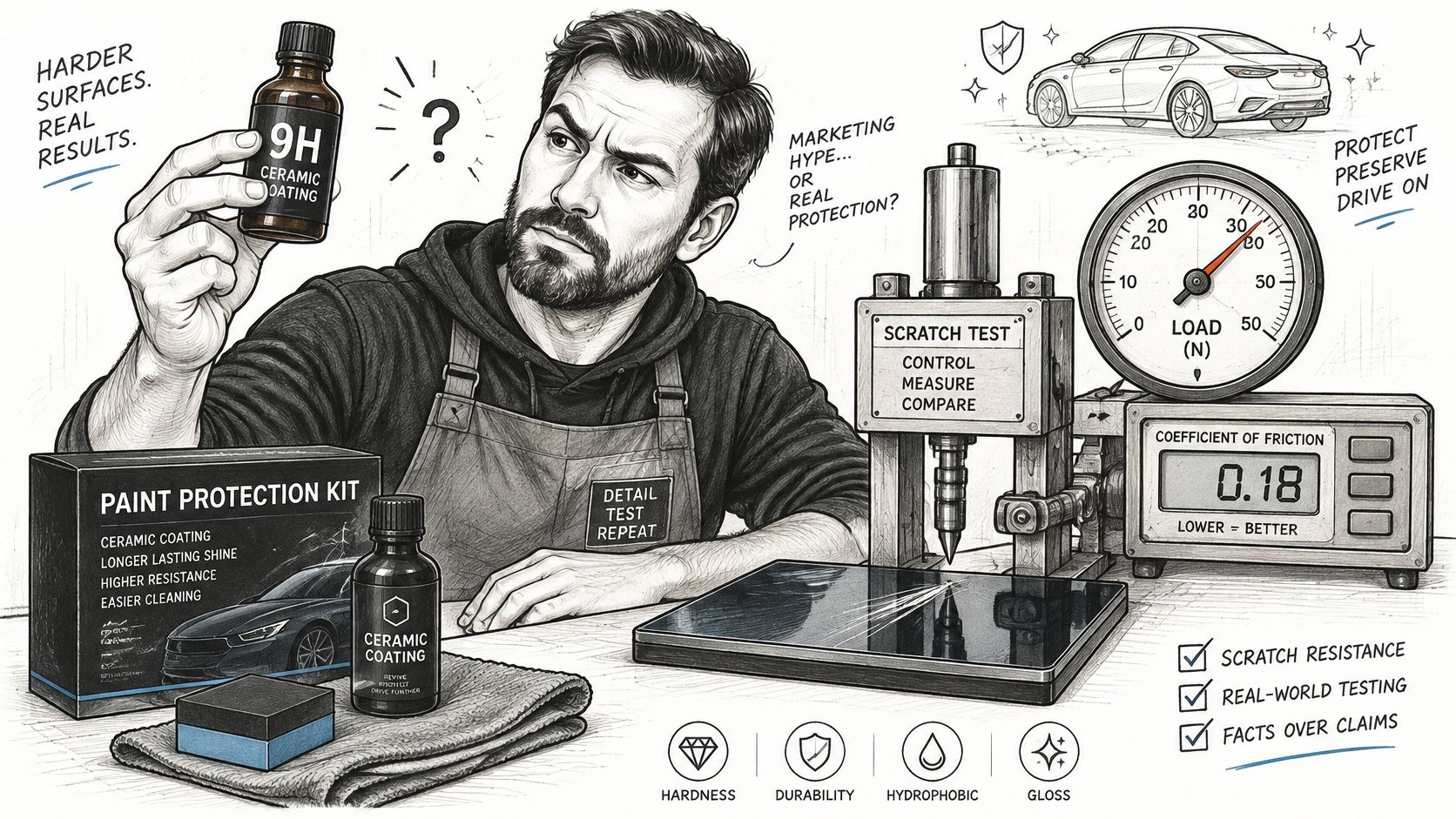
A scratch instrument settles the argument in one pass. ASTM D7027 drives a stylus across the surface under a set load and quantifies the damage, measuring parameters such as scratch response and friction, so two products can be ranked on the same substrate at the same thickness with the same stylus geometry, load and pass count, as the ASTM D7027 standard sets out. That last part is the whole point: a controlled comparison instead of a number printed above a logo.
Why a hard surface still mars comes down to three properties. If coefficient of friction is high, grit digs in instead of sliding. If elastic recovery is poor, the groove stays. If crack-initiation resistance is weak, a light contact starts a fracture that grows with every wash.
What elastic recovery buys on a daily driver
Compare a pane of glass with a rubber eraser. Drag a fingernail across glass and you get a chip or a crack. Drag it across something that gives and springs back and you get a temporary depression that disappears.
That's the behavior Titan Coatings builds into its ceramic coatings. The cured surface feels hard like glass under a fingernail, but the elastomer chemistry lets it move with the panel and recover from light contact, so one grain of grit is less likely to open a crack that stays. Hardness alone can't do that, because a rigid film transmits the load straight into the clearcoat beneath it.
Set up a fair comparison with three fixed conditions:
- Same panel, same prep. Two test spots on one prepped hood, not two different cars.
- Same thickness and load. A thin coat and a thick coat are different products, whatever the label says.
- Two measurements, not one. Inspect scratch depth and optical haze together, because a shallow scratch that hazes the surface still ruins the look.
ASTM's method has a ceiling worth naming. It's a comparative laboratory procedure, not a forecast of five winters of road exposure, so field validation means repeated wash-media contact, dust contamination and wet-dry cycles. If you want to know what a third-party test covers before trusting a number on a box, our breakdown of third-party testing explains the methods and where they stop.
The question to carry into a purchase isn't which number is printed on the label. It's what the surface does a second after contact.
Heat Cycles a Rigid Shell Cannot Take
A hood that looks flawless in July can show fine checking in February, and nothing touched it in between. What happened is mechanical: the clearcoat expanded in the heat, contracted in the freeze, and repeated the cycle until microscopic cracks opened in the layer that's supposed to be protecting the color.
Single temperature readings tell you almost nothing. ASTM lists D6944 as the standard practice for determining the resistance of cured coatings to thermal cycling, and related ASTM methods separately evaluate coating flexibility and exterior paint checking, as set out in the ASTM paint and coating standards catalogue. Those are three different tests because they measure three different failure modes. A coating can be hard and glossy and still fail once expansion and contraction win.
Why old clearcoat gets harder and cracks sooner
Sun exposure changes the substrate under your coating. Research on automotive acrylic and urethane clearcoats exposed in Florida, Belgium, Australia and accelerated xenon-arc conditions found that weathering significantly reduced abrasion and erosion resistance while increasing hardness, according to a study of weathered clearcoat performance. Read that twice. The panel gets harder and more brittle, so the washing, grit impact and polishing that follow do more damage, not less. A brittle surface is not a protected surface.
That's the case for an elastic coating. Titan's elastomer coatings combine a glass-like cured surface with enough flexibility to move with the paint rather than sitting on it as a fixed shell. The practical payoff shows up in three places: freeze-to-heat swings that would crack a rigid film, bug strikes at highway speed that hit and release instead of fracturing the layer, and the general expansion of a sun-baked hood on a hot afternoon.
The honest limit: an ASTM reference gives you the test framework. It doesn't certify any brand's performance or publish a freeze-to-heat range for a specific product.
Titan describes nanotube and Dark Matter technology as part of its own coating story, and that's the maker's account rather than a lab certificate. Materials science backs the caution. NIST reports that nanoadditives improve polymer stability and mechanical properties when they're homogeneously dispersed, and warns that carbon nanotubes and aluminosilicate clays aren't thermodynamically compatible with most polymers, which affects both dispersion quality and lifecycle performance, per NIST research on nanocomposite stability. Formulation and application decide the outcome, not the word "nano."
Some Titan coatings are designed to be layered, and the installer recommends the layering process per vehicle. Check flexibility the way the weather will test it, through the coating flexibility guide, and judge the complete system, prep plus coating plus cure, after weathering rather than a fresh swatch in a showroom.
How to Apply Alpha Quartz and Apex Glass
Two jobs a mobile detailer can finish in a driveway without a studio: a coated panel and a treated windshield. Both products are positioned for outdoor use, which matters when your workspace is a customer's parking spot.
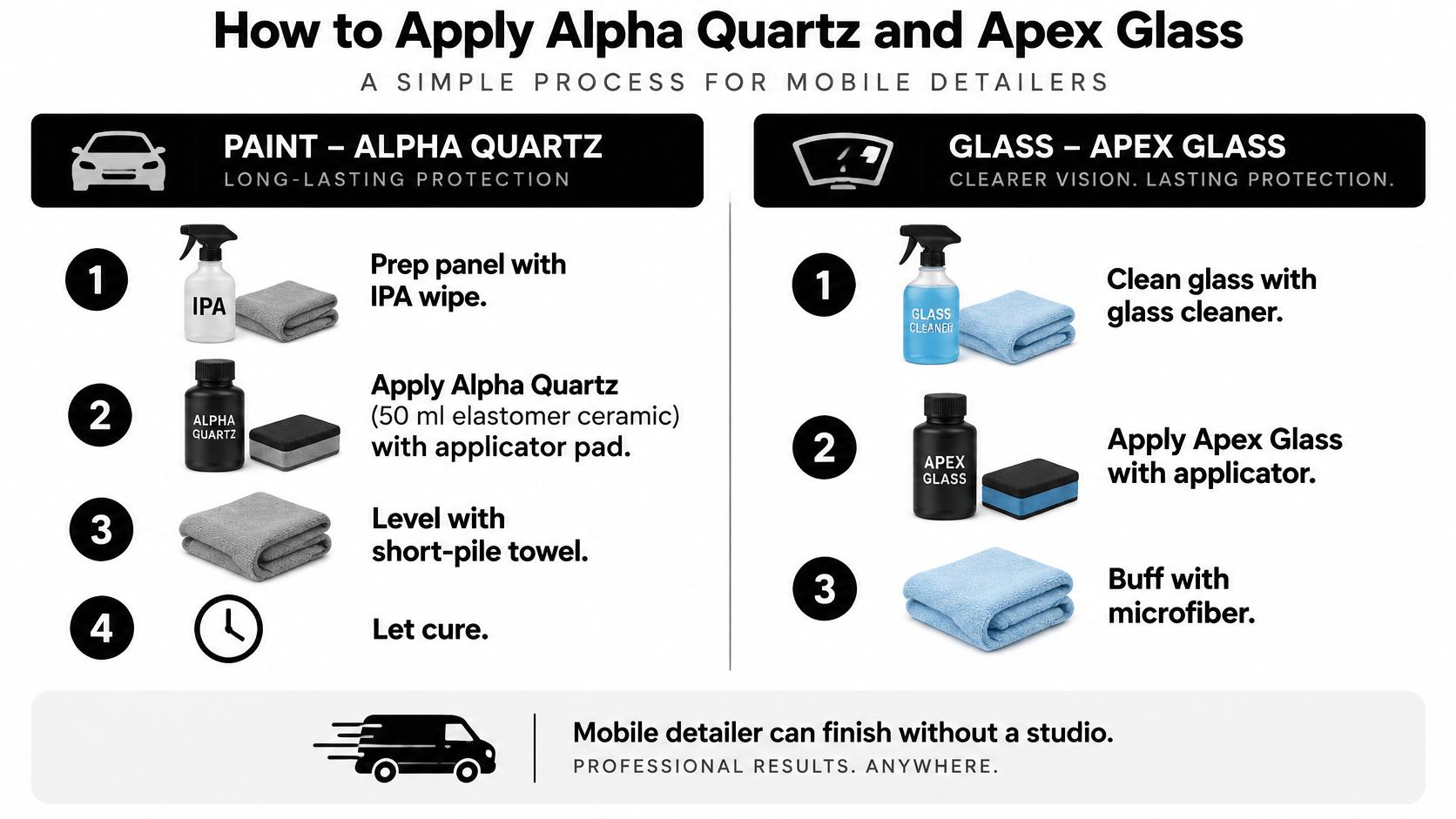
Alpha Quartz on paint
Alpha Quartz is a 50 ml elastomer ceramic coating at 92 percent high solids, zero VOCs and solvent free, and it cures in about 4 hours. It's built as a DIY and mobile detailer coating, so the routine has to be short enough to repeat on a full car.
- Clean and dry the panel. Any moisture left in a seam will push back through the coating.
- Place 20 to 25 drops on the applicator pad. Enough to wet the pad, not so much that it runs.
- Spread in a cross-hatch over about 50 by 50 cm. Two passes at right angles give even coverage without a heavy ridge.
- Wait 3 to 5 minutes, and never more than 15. Past 15 the residue sets and fights the towel.
- Wipe with a short-pile microfiber. This is leveling, so keep the towel flat and turn it often.
- Buff with a long-pile microfiber. The high spots flash off here.
- Keep the car out of wet weather for about 4 hours, then inspect under diffused light. Angled light shows the missed edges that daylight hides.
Layers can be stacked where the vehicle and the customer's budget justify it, with the interval between coats set by the cure window rather than guesswork. For the full sequence on a complete vehicle, the step-by-step ceramic coating application walkthrough covers prep, panel-by-panel order and the post-cure inspection.
Apex Glass on the windshield
Apex Glass is the same discipline pointed at visibility. Rain on a windshield at night is a glare problem before it's a detailing problem, and water that sheets instead of beading into scattered droplets keeps the wiper sweep cleaner.
- Clean and dry the glass. Glass cleaner first, and polish out any wiper haze before coating.
- Add 10 to 15 drops and work in circles. The circular motion pushes product into the pores and micro-pits rather than skating over them.
- Let it sit 3 to 5 minutes.
- Wipe with a short-pile microfiber, then buff with a long-pile microfiber.
- Apply a second coat and treat the wiper blades. The blades touch the glass on every sweep, so coating them keeps the interface consistent.
The product page describes the coated glass as water-sheeting. Check that on your own windshield in real rain before you promise it to a customer, and look at a nighttime drive, not just a hose test.
Between full coating jobs, ULTRA Ceramic Spray is a highly concentrated, water-based flexible membrane sealant for paint systems, wraps, PPF, glass, wheels, plastic trim and household items. It's the sensible refresh on a car that isn't due for another coating yet.
Remove Contamination Before It Etches Paint
A kit buys you time, and contamination spends it faster than anything else on the car. Bird droppings are the urgent case. Environmental-coating research identifies sunlight and humidity as the major weathering drivers and reports that bird droppings can reduce clearcoat mechanical properties, including glass-transition temperature and elastic modulus, per the IntechOpen chapter on environmental conditions and automotive coating degradation. A separate study in the same body of work found that simultaneous bird-dropping and UV exposure degraded clearcoats more intensely than exposure after artificial aging.
Read that as a clock, not a hazard warning. A dropping on a cool, shaded panel is a cleaning job. A dropping on a black hood in August sun is a chemistry problem that starts eating the layer you paid to apply.
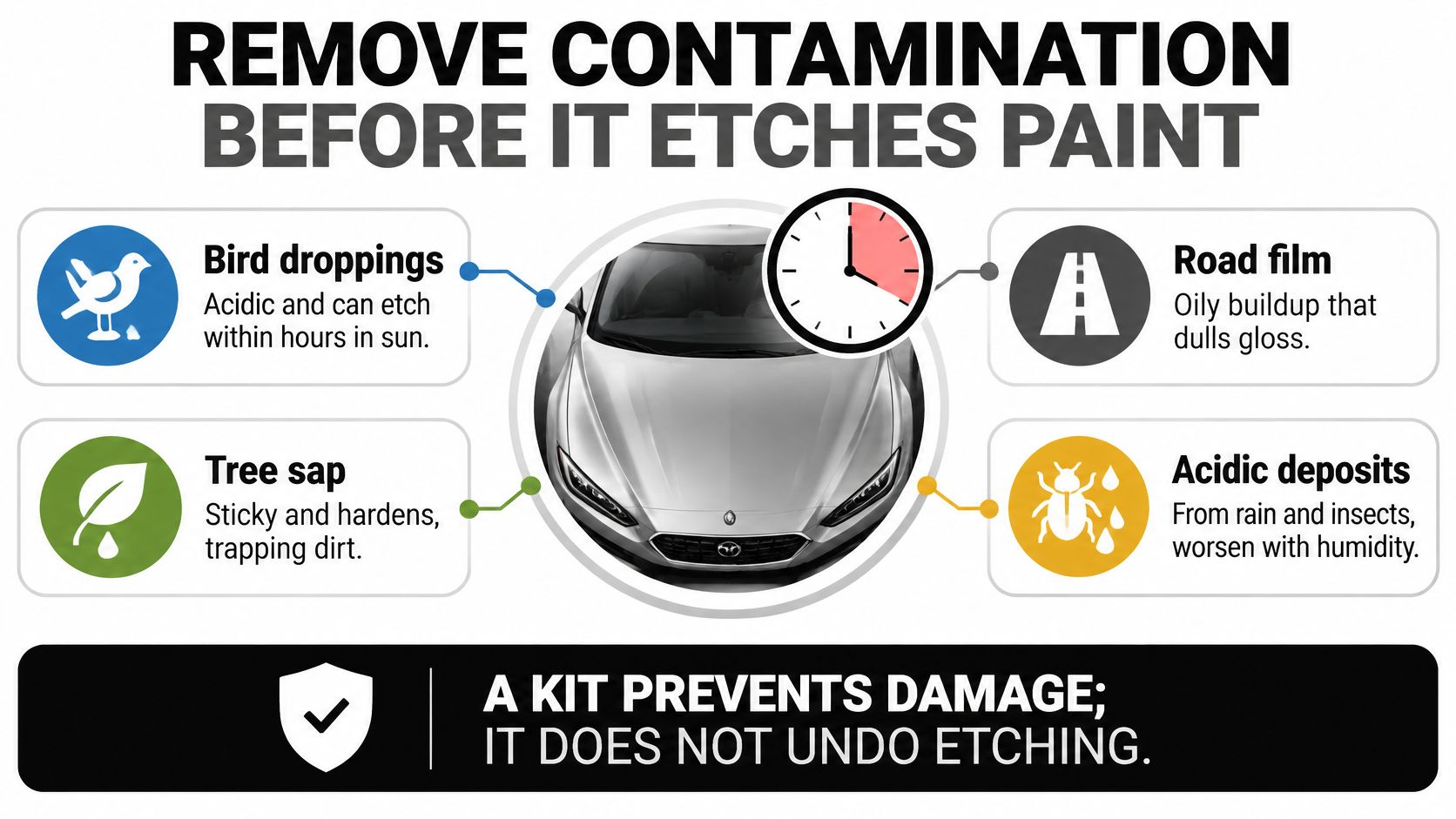
The same-day rule: droppings and tree sap come off the day you see them, not at the weekend.
| Contaminant | Act within | Safe first step | Protection has failed when |
|---|---|---|---|
| Bird droppings | Same day | Rinse, then pH-neutral wash | Etching remains after the spot is gone |
| Tree sap | Same day | Neutral wash, then a paint-safe solvent if the maker allows it | A rough stain is still in the clearcoat |
| Road film or industrial fallout | This week | Rinse and neutral wash; decontaminate if the surface feels rough | Iron spots or dull patches will not release |
| Winter salt or coastal mist | After the drive | Fresh-water rinse, then neutral shampoo | Corrosion or staining sits under the coating |
What inspection tells you about maintenance
Climate changes the clock, not the rules. Tropical humidity and strong sun shorten every interval. Winter road salt and coastal aerosol add a rinse-first step after every drive. Urban fallout means a rougher surface between washes, which is your cue to decontaminate rather than scrub harder.
Wash with a pH-neutral shampoo and skip harsh chemicals and abrasive pads, because those strip or scratch the very layer the kit added. That's the whole maintenance brief in one line, and it's what we tell every customer who asks how to keep a coating alive.
Then watch for the three signs that upkeep is no longer enough: water that stops sheeting, dull patches that won't lift, and stains that stay put after a neutral wash. Any of those points to polishing, and heavy etching points to repainting. A coating prevents damage. It cannot restore clearcoat that chemistry has already eaten.
For the correct order of rinse, chemical decontamination and mechanical decontamination, follow the car paint decontamination process rather than inventing a sequence on the driveway.
Which Kit Fits Your Car and Skill
Pick the row before you read a single product page. Each protection type handles a different kind of damage, and the lifespan changes with formulation, sun exposure, color, storage, washing technique and prep quality.
| Kit type | Typical lifespan | Skill fit | Main job |
|---|---|---|---|
| Wax kit | About 1 to 3 months | Beginner DIY | Short-term gloss and light water beading |
| Spray sealant kit | About 3 to 12 months | Beginner DIY or maintenance wash | Fast hydrophobic layer on paint, wrap or film |
| Ceramic coating kit | About 1 to 3 years | Confident DIY or mobile detailer | UV, chemical and wash-mar resistance |
| Glass and windshield coating | About 6 to 24 months | DIY or mobile detailer | Rain beading and clearer wet-weather vision |
| Paint protection film kit | Often 5 to 10 years on impact panels | Trained installer | Stone chips and abrasion on nose and edges |
The short-life rows and who they suit
A wax kit is the honest starting point for someone who wants shine this month and doesn't mind reapplying. It's a sacrificial layer with a short life, and heat plus detergent take it off faster than the label implies.
A spray sealant kit is the row for owners and mobile detailers who want a fast hydrophobic top-up on paint, wrap or film. It sits above wax on convenience and lifespan, and it's the right choice when the car already has protection and needs the surface refreshed rather than rebuilt.
The long-life rows and their conditions
Ceramic coatings commonly provide effective protection for roughly one to three years depending on formulation and environmental exposure, with periodic maintenance washing still recommended, according to a review of automotive coating durability. The same review notes that UV irradiation reduced gloss by approximately 10 percent under tested conditions and can cause polymer-chain scission.
That range moves for reasons a single advertised number hides. Basecoat color changes the outcome: silver systems photodegraded faster than black in some tests, while other work found black basecoats weathered faster under different conditions. There's no universal best lifespan and no color-independent claim worth printing. Separately, a coatings study summarized in this history of paint protection film reported that over a 5,000-hour exposure period UV absorbance declined by 33 percent and film thickness by 16 percent, with approximately 50 percent of the loss of UV-absorbing capability attributed to film loss from erosion. Coating performance is a barrier question, not a gloss question.
Appearance retention and physical protection are two different scores. A panel can stay glossy while its polymer chemistry is already changing underneath. Judge both, and separate the showroom shine from the barrier.
Matching the row to your miles and parking
Highway commuter with a low nose and a lot of following distance? Film on the impact panels, coating everywhere else. Garage-kept weekend car? A ceramic coating plus a disciplined wash routine covers it. Coastal parking with salt mist and strong sun? Shorter intervals and a rinse after every drive, whatever the bottle promises.
For a daily driver and DIY or mobile paint work, Alpha Quartz 50 ml is the pick at $67.97. It's an elastomer ceramic coating, hard like glass and flexible, which is the property that matters when the hood goes from frozen to hot and back. For rain-day visibility, Apex Glass 50 ml is the pick at $39.97, and it's the easiest visibility upgrade in the range for a solo operator. Between installs, ULTRA Ceramic Spray 100 ml at $39.97 refreshes paint, wraps, film, glass, wheels and trim: one layer only, sprayed onto a fresh short-pile microfiber, buffed with a long-pile towel, checked under diffused light, and the car kept dry for at least 6 hours.
Titan Coatings describes its elastic coatings as hard like glass yet flexible, and that's a claim to test against your own car in your own weather rather than accept from a page. Browse the full range in the Titan Coatings shop and match the kit to the exposure you drive in.
APEX NANO – Titan Coatings builds elastomer-based ceramic coatings that stay hard like glass while flexing with the panel, so freeze-to-heat swings and bug strikes are less likely to crack the layer that's protecting your paint. If you want a kit you can apply yourself and inspect afterward, start with APEX NANO – Titan Coatings and choose the coating, glass treatment or spray sealant that matches your climate, your parking and your skill level.
0 Comments