
A car paint protection sticker is clear paint protection film, not a colored vinyl decal, and a representative film is 7.5 mil thick, or 0.19 mm; coatings solve a different job by protecting the surface without that thick impact barrier. Say you're washing the car on Saturday and find fresh chips across the bumper but water marks across the doors: those problems don't need the same treatment.
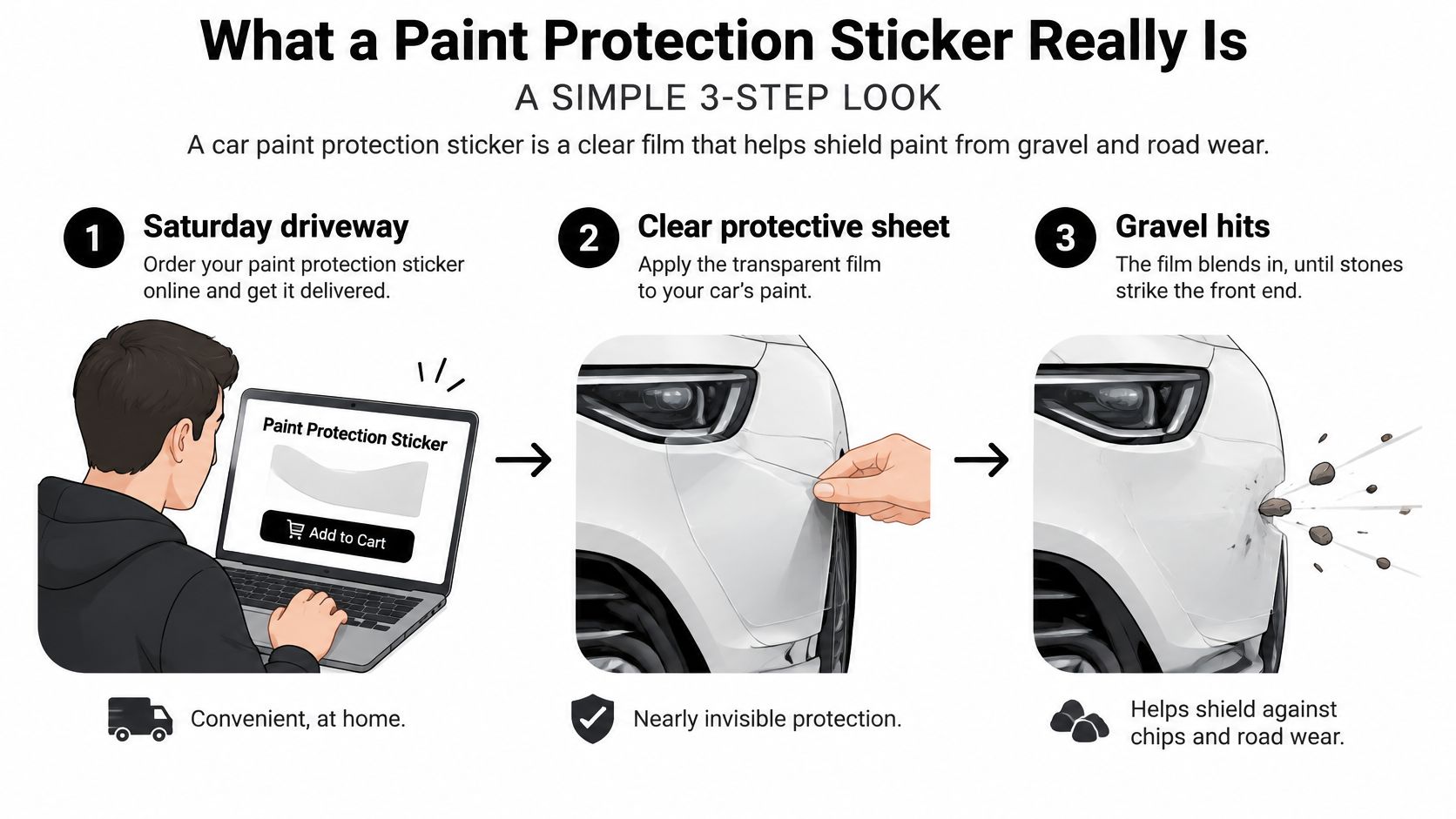
What a Paint Protection Sticker Really Is
The first protective films were developed for helicopter blades exposed to sand and debris. In the 1960s, the U.S. military worked with 3M on that challenge; by the 1980s and 1990s, the technology had reached automotive use, particularly on racing and high-performance vehicles, according to PCI Magazine's history of protective films.
Today, a car paint protection sticker usually means transparent paint protection film, shortened to PPF or called a clear bra. Its layers work together: a clear topcoat faces the road, a flexible polyurethane body absorbs and spreads minor impacts, and pressure-sensitive adhesive holds the film to the paint.
The layer structure matters at the edges. A bumper has curves and seams, while road contamination and airflow press against the film. If it is cut or fitted poorly, those edges can lift, even when the sheet itself remains clear.
The useful distinction: Vinyl changes the appearance. PPF provides a sacrificial impact layer. A coating changes how the exposed surface handles water, dirt, and contamination.
Online listings may call PPF a sticker, shield, or clear bra. The name varies, but the layered construction explains how the material protects the finish.
Film Vinyl and Coating Side by Side
Choose clear film for flying gravel, vinyl for color or graphics, and a coating for surface protection and easier cleaning. Start with the damage you can point to, not the glossiest demonstration video.
The driver with peppered bumper paint needs material that can take a physical strike. The driver with sound paint, stubborn contamination, and a long washing routine needs a different kind of protection. Neither benefits from buying the wrong product just because it looks impressive under studio lighting.
Paint sticker, vinyl, and coating compared
| Option | Material | Best against | Hard limit | Typical life | Who should apply it |
|---|---|---|---|---|---|
| Clear PPF sticker | TPU about 7.5 mil thick, with clear topcoat and adhesive | Stone chips, light scratches, bugs, tar | Doesn't stop dents; edges can lift | Product warranty and maintenance set the replacement plan | Professional installer |
| Colored vinyl wrap or decal | Pigmented PVC film | Color change and graphics | Not an equivalent chip barrier; weathering can affect appearance | Replace when fading, shrinkage, or adhesion loss appears | Skilled installer or careful DIY |
| Standard ceramic coating | Thin liquid-applied silica or polymer coating | Surface contamination, water behavior, gloss | Almost no impact thickness | Follow the specific coating's service and reapplication schedule | DIY after careful preparation or professional |
| Elastomer ceramic coating | Flexible protective membrane, hard yet elastic | UV, chemicals, temperature movement, light abrasion | Not a thick sacrificial impact skin | Formula, preparation, care, and approved layering set service life | DIY and mobile detailers |
| Spray sealant topper | Water-based flexible membrane spray | Refreshing protection on compatible paint, wrap, or PPF | A maintenance layer, not structural protection | Refresh according to the product directions and surface condition | Accessible DIY application |
The film dimensions above come from a representative product, not a universal specification. 3M's Series 100 product bulletin describes 7.5-mil (0.19 mm) construction with 350% elongation and 3,200 psi tensile strength. Those properties help explain how the sheet follows compound curves while providing a meaningful physical barrier.
The same bulletin reports adhesive peel strength increasing from 4.7 N/cm after 20 minutes to 6.7 N/cm after 24 hours at room temperature. A freshly finished installation may look settled while its bond is still developing.
What each choice looks like in the driveway
For PPF, look at the nose of the car. A chipped hood edge and battered mirror caps are reasons to consider targeted film coverage. A dent from a larger object is a body repair problem, not evidence that a thicker sticker would have solved everything.
For vinyl, look at the intended visual result. Racing stripes, business graphics, and a different body color belong in this category. Don't use a cosmetic wrap quote as though it buys the same impact protection as polyurethane film.
For coatings, look at the washing routine. If contamination clings to broad panels but the paint isn't being struck by gravel, a liquid-applied system avoids the seams and wrapped edges of a full-body film installation. Our professional car coating guide helps connect that choice to preparation and application needs.
A spray sealant belongs in the maintenance cupboard rather than the impact-protection category. Match the treatment to the actual problem, and the comparison becomes much simpler.
Chip Heat and UV Limits of Film
A documented polyurethane film showed no paint chipping in SAE J400 gravelometer testing, while separate 24-month Arizona and Florida natural-weathering exposures produced slight discoloration without cracking, chalking, or dulling, according to 3M's film 8591 and 8592 technical document. Those are useful results because they describe a test and an observed outcome, not just a durability adjective.
The weathering conditions matter. Arizona exposes a surface to strong sun and heat; Florida adds humidity and frequent wetting. Slight discoloration isn't the same outcome as a sheet cracking apart, but it still matters to an owner trying to keep white paint visually consistent.
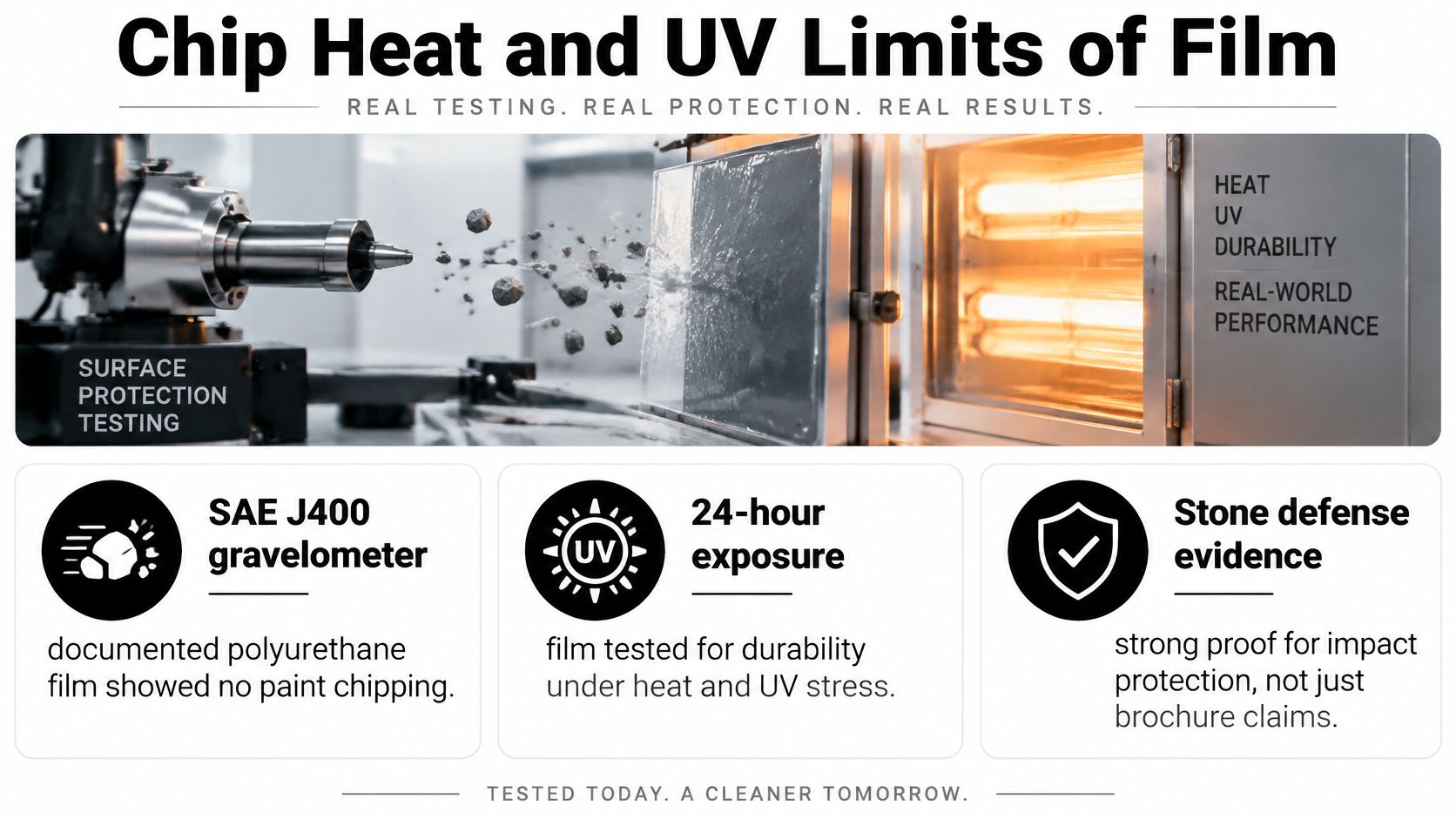
Film test results and what they mean
The natural-weathering and impact results below apply to the documented film, not every clear film sold online. Separate automotive-film specifications discussed alongside published automotive clear-coat weathering research report approximately 3,000 hours of xenon-arc weathering above 4,500 kJ, with no detrimental effect recorded for the tested film.
| Test or exposure | Condition | Reported result |
|---|---|---|
| SAE J400 gravelometer | Gravel impact | No paint chipping |
| Arizona natural weathering | 24 months at 45° south-facing | Slight discoloration; no cracking, chalking, or dulling |
| Florida natural weathering | 24 months at 5° south-facing | Slight discoloration; no cracking, chalking, or dulling |
| Xenon-arc weathering | About 3,000 hours, above 4,500 kJ | No detrimental effect recorded for tested film |
The actual weathering periods are those stated in the table, not a short exposure that can be treated as equivalent.
Translate the test into coverage
UV exposure and heat can degrade polymers. Gravel applies concentrated force to a tiny area. A protective topcoat helps control staining and weathering, but film chemistry, thickness, edge treatment, preparation, and maintenance still influence the result.
Self-healing also needs a sensible definition. On films designed for it, fine surface marks can relax with warmth. A torn sheet doesn't regenerate missing material, and a deep puncture remains damage.
Before choosing coverage, inspect:
- Forward-facing surfaces: Bumper corners, mirror caps, and the hood's leading edge.
- Lower panels: Rocker panels where tires throw grit and road contamination.
- Touch points: Door cups and loading areas that collect contact scratches.
Our impact resistance testing information gives that buying conversation a more useful starting point than a warranty year alone.
Ask what was tested, under which conditions, and what counted as failure.
Keep cosmetic preservation separate from mechanical maintenance, too. Owners building a broader care checklist can find fuel system maintenance information from Pete Nelson Automotive without confusing a protected finish with a fully maintained vehicle.
Install Rules That Decide Whether Film Lasts
Specks beneath bumper film often begin with a dusty workspace, while lifting edges can start with poor preparation or a rushed bond. The installation depends on the vehicle's surface, the working conditions, and how the film is handled around curves.
- Prepare the paint first. Wash, remove bonded contamination, and inspect the clear coat. Loose paint, failing repairs, or residue beneath the adhesive can turn a sound installation into a removal problem.
- Control the working conditions. Use a sheltered, clean workspace and measure conditions instead of judging them by how comfortable the air feels. A dark hood in direct sun can be much hotter than the surrounding air.
- Manage the application solution. For wet-installed film, float the material into position and evacuate solution with controlled, overlapping squeegee strokes. Keep the tool clean so grit doesn't drag across the surface.
- Ease tension around complex shapes. Watch sensor openings, bumper recesses, and panel returns. If the pattern needs too much stretch, reset its position before securing it.
- Finish the edges carefully. Clean and secure the returns according to the film system. A contaminated flap can catch wash water and begin to lift.
- Protect the developing bond. Follow the specific aftercare window, keep pressure-washer jets away from edges, and avoid aggressive cleaning immediately after installation.
3M's PPF technical guidance recommends installation at 21–26°C (70–79°F), warns against stretching beyond 15%, and advises avoiding washing for 72 hours. These figures apply to the relevant system, not automatically to every film.
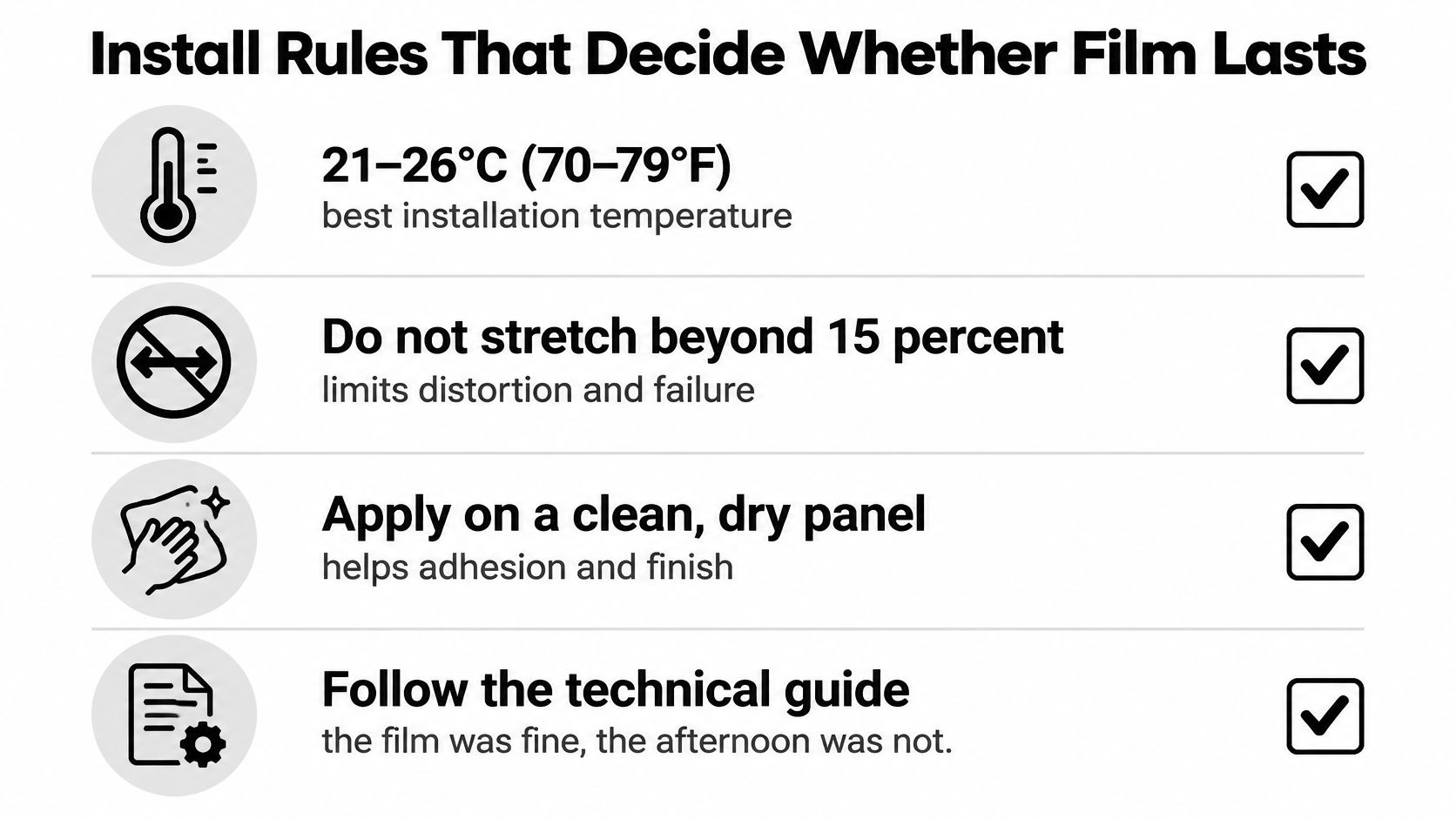
Read the failure before blaming the roll
Dust caught in wet adhesive, a sun-heated panel, and repeated stretching around a difficult corner can leave specks, tension marks, or edges that lift. The film itself may be sound; installation conditions can still shape the result.
Bubbles and moisture marks point toward solution management or contamination. Distorted lines suggest excessive tension. Dirt beneath a return directs attention to edge preparation and adhesion.
For help choosing a pattern, consult this pre-cut paint protection film guide. A shaped kit still needs careful fitting and suitable conditions.
Mobile-detailing rule: If dust, wind, panel temperature, or shelter can't be controlled, change the appointment or the job rather than forcing the installation.
Even a small installation needs suitable weather and working conditions. Coatings have their own application requirements, although they avoid stretching a large sheet into shape.
For coated surfaces, use pH-neutral shampoo and avoid harsh chemicals and abrasive cleaning products. Follow separate care instructions for film and coating so washing doesn't undermine either system.
When an Elastic Coating Beats a Sticker
Say a café owner commutes on highways and worries about chips on the front of the car. Film on the nose may suit that risk, while covering an undamaged roof and every door can add material where the owner may need a different kind of protection. Sun, temperature changes, surface movement, and washing all help determine which approach fits.
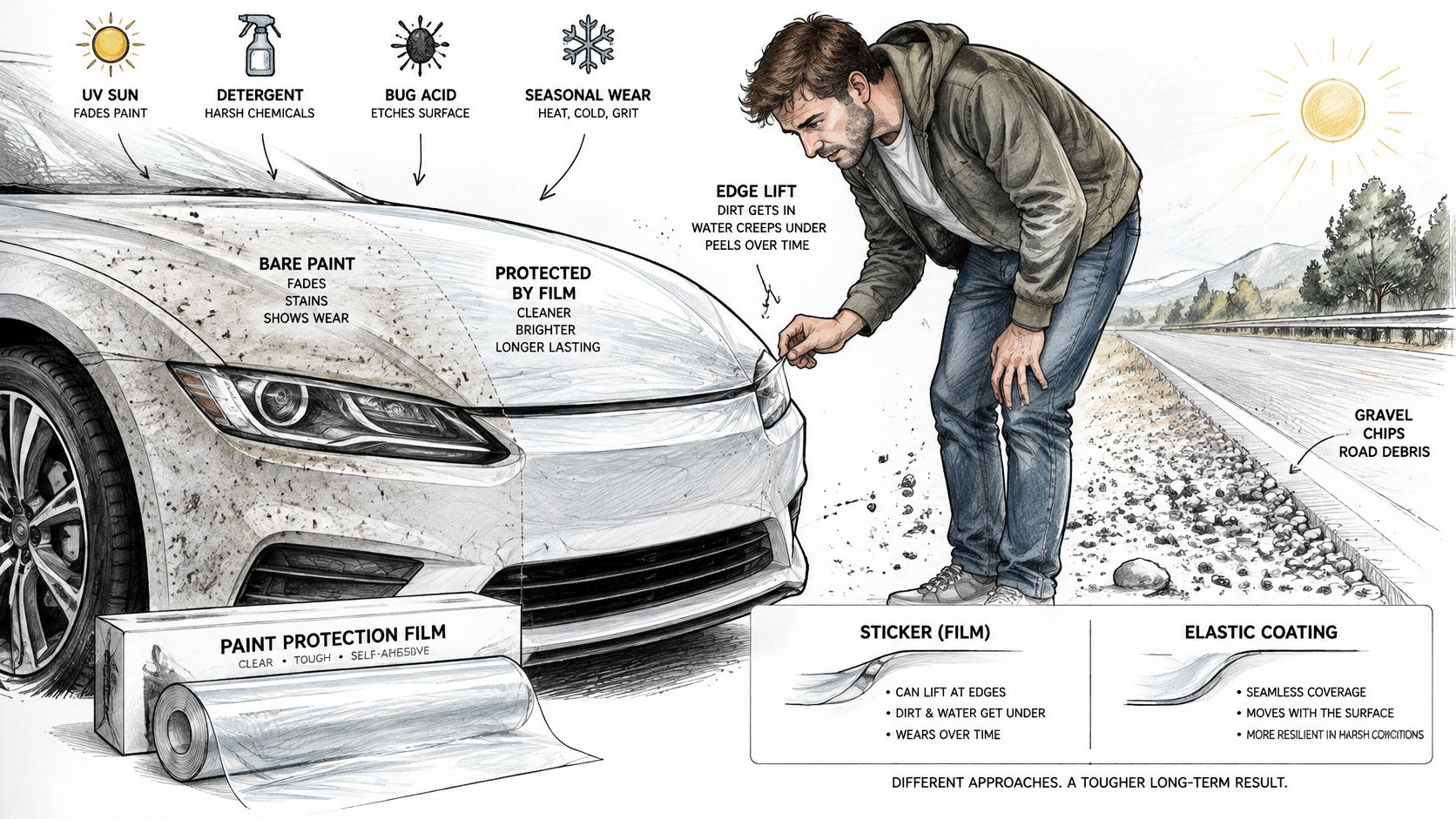
Flexibility is an engineering property
The ORAGUARD 2815GF technical specification rates the film for adhered use from -40°F to +212°F (-40°C to +100°C) and records at least 200% elongation at break. Those figures describe that film, not a liquid coating's temperature rating. They do show why a protective material's response to stretching and movement matters in changing conditions.
Titan Coatings is a manufacturer of elastomer-based ceramic coatings for automotive surfaces. Its approach pairs a glass-hard surface with flexibility, and the coating flexibility information explains the role of that flexibility. It can help a coating accommodate movement and temperature changes, but it does not guarantee immunity from every impact or climate condition.
Paint protection without a wrapped edge
For a driver whose main concern is surface protection across panels, Alpha Quartz 50ml Ceramic coating is a DIY and mobile-detailer coating, currently priced at $67.97. It offers an option where a wrapped film edge is not the preferred approach. The choice still depends on the vehicle, its exposure, and how the owner plans to maintain it.
Application needs care. Prepare and dry the panel, work manageable areas, then level the coating with clean microfiber towels. Check under directional lighting before moving on. A visible high spot is easier to address during application than after curing, and layering should follow the installer's recommendation for the vehicle.
Glass calls for its own product. Apex Glass Coating is intended for glass surfaces, so it is not a reason to assume a paint coating belongs on the windshield. Clean the glass thoroughly and buff away residue to keep the view clear. Water repellency can support visibility in rain, while effective wipers remain important, and a coating does not prevent a stone from breaking the glass.
Warranty Gaps Removal and Real Ownership Cost
A film's removal can bring its own costs: adhesive cleanup, paint inspection, and disposal of the sheet. Say a café owner has a bumper film removed after years on the road. A rushed peel could put vulnerable paint at risk, while the film itself may not be accepted in curbside recycling. Plan for removal before installation, not just the purchase and fitting.
Published film warranties can run roughly 7–12 years, depending on product and region. Exclusions may cover improper care, installation errors, impact damage, and unsuitable painted surfaces. STEK's DYNO-series warranty terms show why the written conditions matter. Check the product-specific terms to understand what the stated duration covers.
Ownership costs film and coating do not advertise
| Stage | What you pay or risk | Film reality | Coating reality |
|---|---|---|---|
| Purchase | Material for the coverage you choose | Partial panels or full-body coverage | A bottle or professional package |
| Install | Labor, time, and conditions | Pattern fitting, solution management, edges, and aftercare | Surface preparation, application, levelling, and specified cure |
| Maintenance | Wrong wash chemistry | Edge and surface damage can require correction | Aggressive cleaning can shorten service life |
| Repair | Who pays after a hit | Cuts and punctures may be excluded; panel replacement may be needed | Reapplication or professional restoration |
| End of life | Removal and disposal | Adhesive cleanup and disposal of the film sheet | Remove coating residue as directed, and dispose of used products and packaging according to local guidance |
For Titan Coatings installed by a certified professional, the installer provides the warranty, which depends on the products and layering used. If a coating degrades, a certified installer must inspect the vehicle, provide feedback, and work on restoring it as needed. The paint protection film warranty guidance can help you identify separate questions to ask about film coverage.
Budget for removal before installation
Keep the installation date, product batch details, photographs of the original paint, and a record of maintenance products. Matte and specialty finishes need particular care: an incompatible cleaner or appearance-changing treatment can make a cosmetic repair difficult.
When removing film, use controlled warmth and lift a corner with a plastic tool. Peel slowly, following the manufacturer's removal method rather than pulling sharply against vulnerable paint. Test a clear-coat-safe adhesive remover in a hidden area before cleaning residue. For aged, repainted, or matte surfaces, have a professional handle removal.
Ask your local waste facility whether it accepts adhesive-coated automotive film, then follow its disposal instructions.
For coating maintenance between appointments, ULTRA Ceramic Spray is a 100ml ceramic sealant for refreshing a coating. It can support routine upkeep, but it does not replace damaged film or restore a missing impact barrier.
Pick Film Coating or a Combined Plan
Walk around the car before choosing a package. Touch the damage, inspect it in daylight, and decide which surfaces need an impact layer and which need easier maintenance.
Choose the plan that fits the panels
- Film the strike zones. If gravel has marked the bumper, hood edge, and mirror caps, book professional clear-film installation on those areas. Make edge finish, pattern fit, and working conditions part of the buying decision.
- Coat sound broad panels. If the paint is intact but sunlight, contamination, and washing are the main concerns, an elastomer coating may be the more proportionate choice. You avoid covering every panel with a sheet merely to improve surface behavior.
- Combine treatments where needed. Use film on exposed impact areas and a compatible coating strategy elsewhere. Specify windshield protection separately, and confirm compatibility before adding anything over installed film.
A glass-hard but flexible protective layer makes sense when you want resistance without unnecessary brittleness. The sensible expectation is accommodation of movement, not immunity to every frozen morning, hot panel, chemical, or bug strike.
Price the next step clearly
In our Titan Coatings shop, the DIY and mobile-detailer elastomer option is 50ml at $67.97. The dedicated windshield coating is 50ml at $39.97, while the ceramic spray sealant is 100ml at $39.97. Choose by surface and purpose rather than assuming the bottles are interchangeable.
For professional application, our authorized installer quotes according to vehicle size, condition, and coating package. That conversation should include preparation, approved layering, maintenance, and the installer-provided warranty, not just the finished shine.
Pick the plan that matches the damage you can point to today. A chipped bumper, a contaminated door, and a wet windshield are separate jobs, and your protection plan should treat them that way.
APEX NANO – Titan Coatings offers elastomer-based paint protection, dedicated glass coatings, and maintenance sealants for different parts of your vehicle. Visit APEX NANO – Titan Coatings to choose the appropriate surface treatment and discuss a coating package that complements, rather than substitutes for, film where impact protection matters.
0 Comments