
A client once came back after a cold snap with a fresh chip on the front edge of the hood and a harder question than the stone itself. If the coating was supposed to be so hard, why did it crack instead of survive?
That’s the problem with a lot of impact claims in this industry. They sound strong on a box, but they don’t always hold up on a winter highway, under wiper abrasion, or on a curved panel taking an angled hit.
That Shattering Sound The Myth of Hardness
Every experienced detailer has seen some version of it. A vehicle leaves the shop looking locked in. The gloss is sharp, the surface feels slick, and the customer hears the usual language about hardness and long-term protection. Then a minor road hit happens, often on a cold morning, and the owner comes back pointing to a tiny fracture line or flaked edge.
The failure usually isn’t about effort. It’s about material behavior.
A coating can be hard and still be brittle. Those are not the same thing. In real service, especially on front clips, mirrors, A-pillars, and other exposed areas, the coating doesn’t just need surface hardness. It needs toughness, strain tolerance, and the ability to stay intact when the panel moves, the temperature swings, or debris strikes at an angle.
Hardness helps. Brittleness hurts.
Many installers learned to associate premium performance with higher hardness claims, especially in the era of 9H ceramic coating marketing. That language shaped customer expectations, but it also created one of the most persistent myths in detailing. Hardness alone doesn’t tell you whether a coating will absorb stress or crack under it.
A coating that can’t flex with the panel becomes a liability the moment the environment stops behaving like a lab.
Think about what a hood sees in one week. Heat soak in the sun. Overnight cold. Wiper chatter near the cowl. Bug strikes. Grit. Wash mitt pressure. Light panel flex. A rigid shell can look excellent at first and still fail because it has no way to manage that movement.
What detailers actually need
The practical question isn’t “How hard is it?” The practical question is, “What happens when stress shows up?”
A better answer comes from coatings that combine surface durability with controlled flexibility. That’s where old assumptions start to fall apart, and where impact resistance testing becomes more useful, if you understand what the tests measure and where they stop helping.
Understanding Standard Impact Resistance Testing
If you read a coating data sheet and see impact resistance data, the most relevant benchmark for coated surfaces is often ASTM D2794. In plain terms, it’s a controlled falling-weight test. A coated panel is struck from a set height, and the evaluator checks whether the coating cracked.

What ASTM D2794 actually measures
According to TRL’s overview of ASTM D2794 paint impact testing, ASTM D2794 Universal Impact Testing evaluates coating film and substrate deformation by measuring the minimum energy required to cause cracking in a coated surface using a falling weight from controlled height. In practice, failure shows up as a crack in the paint film, and that makes the test useful for judging coating flexibility and adhesion under sudden load.
That matters because many coatings look fine under slow handling but break under sharp impact. D2794 gives formulators and quality teams a repeatable way to compare one system against another.
Think of it like a controlled hammer drop
For non-engineers, the easiest analogy is a controlled hammer drop:
- A coated panel is prepared to standard dimensions.
- A weighted striker is set above the panel.
- The weight drops from a controlled height.
- The coating is inspected for cracking or visible failure.
- The minimum failure energy is recorded.
That’s useful information. It tells you how much impact energy a coated panel can take before the film gives up.
Why the setup matters
Good impact resistance testing depends on repeatability. The specimen, the drop height, the impactor, and the inspection method all have to be consistent. That’s one reason serious test environments matter, including practical infrastructure choices such as new laboratory furniture for research. Stable benches, organized equipment placement, and clean workflows don’t sound glamorous, but they reduce setup errors and make test results more trustworthy.
For detailers, the key takeaway is simple. When a manufacturer says a coating “passed impact testing,” the statement should mean something specific, not just “it seemed durable.”
Practical rule: If a brand talks about impact resistance but never explains the method, ask what test was used, how failure was defined, and whether the panel was flat, coated, and evaluated for cracking.
Titan publishes broader technical context around coating testing methods, and that’s the right direction for the industry. Detailers don’t need to become lab technicians, but they do need to know what a result is supposed to represent before using it to sell a job.
Why Lab Tests Fail in The Real World
I have seen coatings pass a clean bench test, then chip on the first cold-week highway run. That gap is where a lot of durability claims fall apart.
A standard lab impact test gives useful data, but it measures a narrow event under controlled conditions. Vehicles live through angled strikes, panel flex, wash chemistry, heat soak, winter cold, and thousands of low-energy hits that never look like a single drop on a flat coupon.

Flat panels and perfect hits are not real driving
Lab coupons are convenient. Cars are complicated.
A typical impact test uses one controlled strike on a flat specimen with a defined backing condition. In service, the coating sits on curved panels with beads, edges, body lines, and varying substrate stiffness. A glancing stone hit on a bumper corner loads the film very differently than a centered impact on a flat test panel, and installers see that every season.
Coating failures in the field frequently occur in conditions the standard setup does not capture. The coating can survive the datasheet scenario and still crack, chip, or lose adhesion on the vehicle because the stress path changed.
A useful parallel shows up outside detailing. Roofing contractors deal with the same problem. Lab ratings help, but storm exposure decides whether the system holds up, which is why resources like Hail King Professionals impact resistant roofs are worth reading. Different application, same lesson. Test protocols are only as good as their match to service conditions.
Temperature is the hidden failure trigger
Temperature is the variable too many coating claims leave out.
Most published impact results are generated around room temperature, usually about 23°C. That is fine for repeatability, but it misses what happens when a coating gets cold and brittle, or hot and softer than intended. Polymer response changes with temperature, and impact resistance changes with it.
Xometry’s analysis of Izod testing makes that point clearly. Impact performance shifts across wide temperature swings, and some polymers lose a meaningful amount of toughness as temperatures drop. If a brand promotes impact resistance without showing cold-weather or high-heat behavior, detailers are being asked to assume the film behaves the same way year-round. That assumption gets expensive.
What this means in the bay
For a working detailer, the trade-off is straightforward. A hard, rigid film can look impressive on paper and still disappoint on a customer vehicle because the test favored a simple, repeatable event instead of service reality.
| Situation | What old test logic assumes | What happens in service |
|---|---|---|
| Flat coupon in a lab | Single direct hit | Curved panels redirect stress |
| Room temperature | Polymer stays stable | Cold can make films less forgiving |
| One-time impact | Isolated event | Vehicles see repeated, mixed stress |
| Clean substrate conditions | Ideal adhesion behavior | Road grime, wash cycles, and flex complicate failure modes |
That does not mean traditional testing is useless. It means the result has to be read in context. If the method ignores temperature range, panel geometry, and repeated off-angle strikes, it gives you only part of the durability picture.
For anyone comparing mechanical durability with corrosion performance, Titan’s salt spray corrosion testing data and context adds another piece detailers should care about. Coatings fail in combined environments, not isolated ones. Impact, moisture, and thermal cycling stack together, and that stacked exposure is what customers pay you to defend against.
The Titan Solution Hard Like Glass Flexible Like Rubber
The coating industry spent years chasing hardness as the headline feature. That made sense for gloss retention and surface feel, but it pushed many systems toward rigidity. The better approach is different. Keep the surface durable, then build in enough elasticity to prevent fracture when stress arrives.
That’s where Titan changed the category.
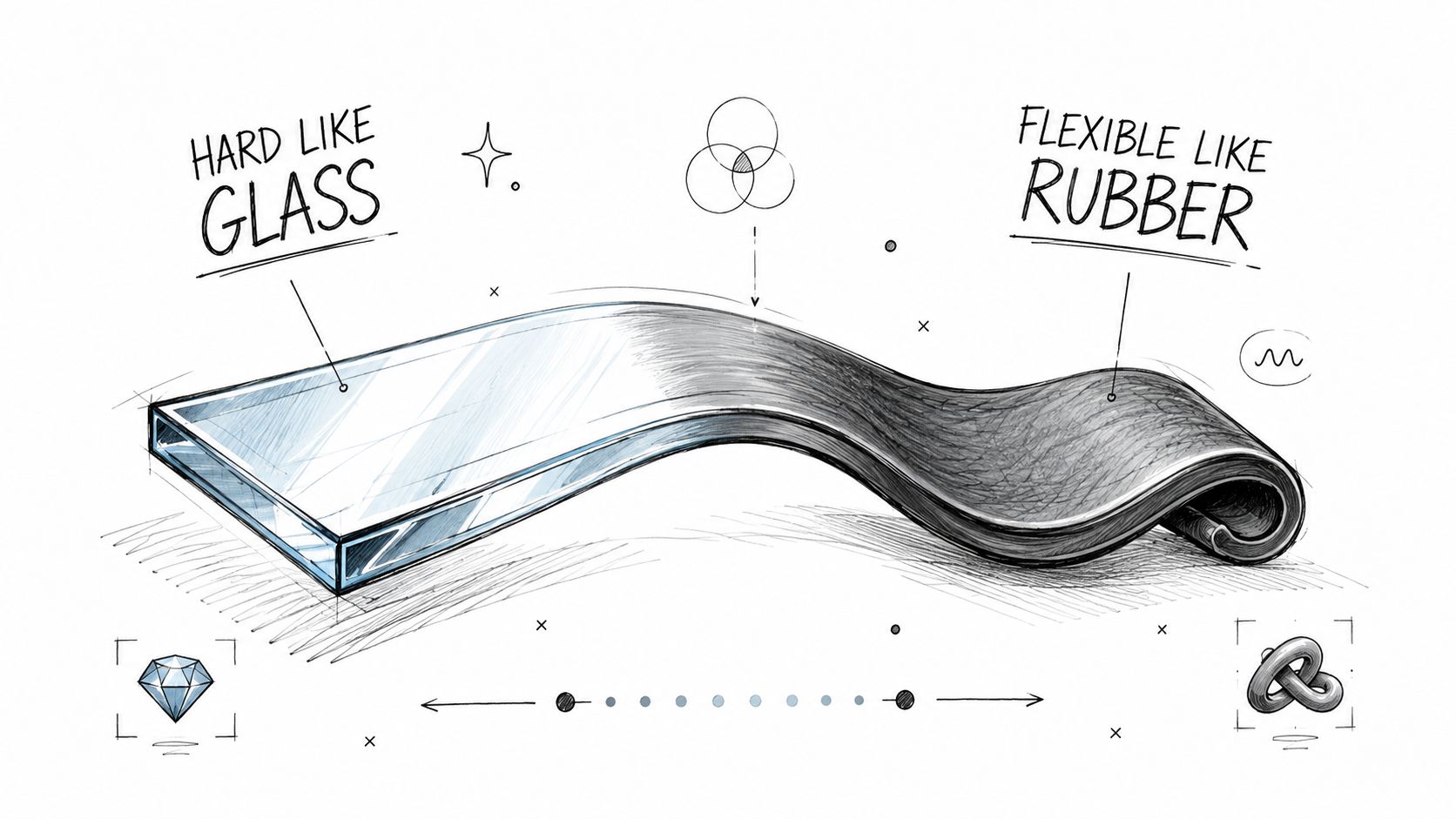
The shift from brittle shells to elastic membranes
Titan pioneered the introduction of carbon nanotubes into the automotive coatings market in 2021, marking the first commercial deployment of CNT-reinforced elastomer coatings for impact resistance testing, as documented in the Titan technology timeline. That matters because it reframed the problem. Instead of asking how rigid a coating could become, Titan built systems that can manage impact energy without giving up the protective character professional detailers want.
The phrase I use with installers is simple. Hard like glass, flexible like rubber. That isn’t a slogan. It’s the material target.
Why elasticity changes the outcome
Titan’s ElloTek elastomer technology explanation states that ElloTek® elastomer membrane-forming technology significantly improves impact resistance by enabling coatings to stretch and return to original shape, thereby resisting crack formation under thermal expansion and mechanical strain, with performance validated through ASTM third-party testing protocols.
That’s the difference between a coating that chips like a shell and one that moves with the surface.
Here’s the practical effect:
- Under road debris impact, the coating has a better chance of dispersing stress instead of concentrating it at one brittle point.
- During thermal swing, the film can tolerate expansion and contraction without opening micro-fractures.
- On flexible substrates or curved panels, the coating is less likely to delaminate because it isn’t fighting every bit of panel movement.
The industry spent too long treating flexibility like weakness. In coatings, the right kind of flexibility is structural intelligence.
Carbon nanotubes and Dark Matter Technology
Titan also built this category with nanotube-based architecture and Dark Matter Technology. The company’s material platform includes carbon nanotube integration and proprietary structural design that supports impact energy dissipation. That is one reason the systems feel different in service than conventional brittle ceramics.
If you want an analogy from another protection market, CANARMOR’s plate comparison guide is useful because it shows the same engineering tension between hardness, weight, and energy management. Different application, same design lesson. Surviving impact is rarely about hardness alone.
Temperature resilience is the business advantage
For detailers, elastomer chemistry functions as a real business tool. Customers don’t care what a coating did on a neat test panel at room temperature. They care whether it cracks in winter, hazes under use, or fails after bug hits on the highway.
Titan’s elastomer systems are designed around that reality, and the broader Titan elastomer coating platform reflects the idea clearly. A coating that stays intact across frozen and hot conditions protects more than paint. It protects your reputation, your warranty confidence, and your ability to explain why your installation lasts.
Putting Elastomer Technology into Practice
The lab story matters, but installers win or lose with product behavior in a driveway, in a mobile setup, or under shop lighting at the end of a long day. The best coating technology is the one that performs without demanding perfect conditions every time.
That’s why Titan’s elastomer approach is useful in the field. It translates material science into products that fit different workflows.
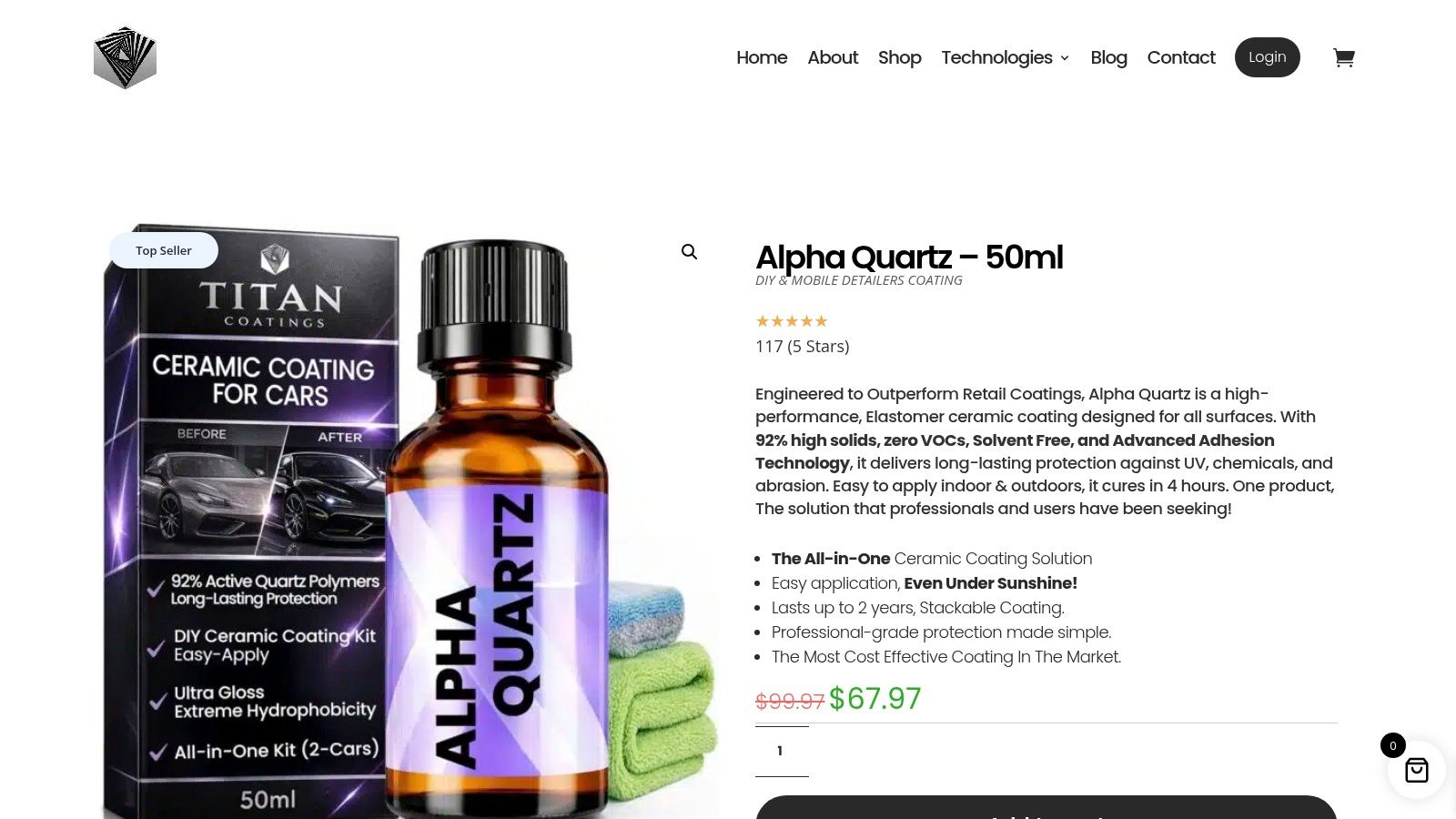
Alpha Quartz for mobile detailers and DIY installers
Alpha Quartz is the product I’d point to first when the installer needs easy use without giving up serious protection. For mobile detailers, that matters a lot. You’re not always working in a sealed, climate-controlled bay. You need a coating that lays down predictably, installs cleanly, and doesn’t punish small environmental variation.
Alpha Quartz fits that role well. It’s easy to use, gives strong visual results, and its elastomer character helps it avoid the brittle behavior detailers worry about when temperatures swing from frozen mornings to hot panels. It’s also a strong option for DIY users who want a forgiving install path rather than a finicky pro-only formula. You can browse it through the Titan shop and see where it sits in the lineup.
Ultra Ceramic Spray for fast enhancement work
Not every client books a full correction and long-form coating package. Some need a fast service with visible return. Titan’s Ultra Ceramic Spray works well in that lane because it’s easy to install and practical for maintenance work, add-on upsells, and mobile packages.
Used correctly, this kind of spray format can act as a simple protective layer when speed matters. The value for a business is obvious. Faster install, easier client education, and a cleaner path to recurring service.
APEX Glass Coating for visibility and windshield durability
Glass gets overlooked in coating conversations, even though it takes constant abuse from wipers, dust, rain, and road grit. Titan’s APEX Glass Coating deserves more attention because the customer benefit is immediate. Better water behavior on the windshield improves visibility and makes driving in rain feel more controlled and less stressful.
That product category also makes sense in an impact-resistance discussion. A coating on glass has to deal with repetitive abrasion and environmental cycling. Ease of use matters here too, because many detailers want a windshield add-on that doesn’t slow the job down.
What sits underneath these products
Titan’s broader material approach includes Dark Matter Technology®, which, according to the company’s technical post, combines vertically aligned carbon nanotubes grown on chlorine-etched aluminum foil to achieve 99.995% light absorption, and that same platform is presented as improving coating density and impact energy dissipation during mechanical stress in Titan’s proprietary material science data, as described in the Dark Matter Technology post.
For installers, the takeaway is less about the headline number and more about the result. The products aren’t just trying to be harder. They’re engineered to behave better.
Simple In-Shop Checks You Can Show Clients
A client hears “9H” and assumes stronger always means better. Then winter hits, the panel contracts, a stone glances off the front end, and that hard film gives up before the paint does. That is why shop demonstrations work best when they show behavior under strain, not just a marketing claim on a label.
You do not need lab equipment to make that point clearly. You need matched samples, repeatable handling, and enough discipline to keep the demo honest. The goal is simple. Show clients how a coating responds when stress is introduced the way it happens on a vehicle, through flex, sharp contact, and changing conditions.
The bend-card demonstration
Use two coated sample cards or thin coated panels. One should represent a conventional rigid coating. The other should use an elastomer-based coating system.
- Prepare matching samples with the same substrate type, similar coating area, and a similar cure window.
- Label the back so the client can identify each sample after handling.
- Bend each card gradually by hand to the same degree. Keep the force controlled and repeatable.
- Check the surface under direct light for haze, fine stress lines, edge disturbance, or visible cracking.
- Hand both samples to the client so they can see and feel the difference themselves.
This test works because body panels move. They move with temperature swing, vibration, wash contact, and light impact. A coating that stays intact through mild flex usually gives you a better starting point for real service conditions than one that only looks impressive on a static panel at room temperature.
The controlled tap comparison
Use a small object and a light, repeatable tap on both coated samples. Keep the strike modest and consistent. You are showing how the film handles a localized shock, not trying to damage a panel for theatrics.
If a demo only proves value after obvious damage, the method is too aggressive for a client-facing explanation.
As noted earlier, many real coating failures happen outside the narrow conditions of a standard single-hit lab test. That gap gets wider once temperature enters the picture. A rigid coating that survives a room-temperature panel check can turn brittle in the cold, while an elastomer-modified film has a better chance of absorbing that same hit without cracking.
Presentation matters too. Pair the sample demo with basic substrate verification so the conversation stays grounded in the actual vehicle, not just the coating bottle. A simple paint thickness gauge for cars helps explain why panel history, previous repairs, and uneven film build all affect the result the client will get.
Offer Your Clients The Future of Durable Protection
A winter callback usually sounds the same. The coating looked great at delivery, then the first cold stretch hit, the vehicle picked up normal road impact, and the finish started showing failure that never appeared on a room-temperature sample panel.
That gap is where old coating sales language falls apart. Hardness was easy to sell because it sounded technical and premium. Clients heard “harder” and assumed “more durable.” In practice, a coating that performs on a flat panel in stable lab conditions can still chip, craze, or crack once temperature drops and the panel starts dealing with real movement and impact.
Professional detailers make better recommendations when they judge durability the way the vehicle experiences it. That means looking beyond a single impact number and asking how the film behaves in cold weather, heat, vibration, panel flex, and repeated minor hits from daily driving.
Shops that understand this make the sales conversation stronger. They stop relying on outdated hardness claims and start explaining toughness, flexibility, and temperature stability in terms clients can connect to actual ownership cost, comeback risk, and long-term appearance.
Elastomer-modified coatings deserve attention for that reason. The goal is not a soft film. The goal is a coating with enough surface hardness to resist wear, enough elasticity to absorb shock, and enough stability to stay intact from frozen mornings to hot panels in the sun.
If you want coating technology built around real-world durability instead of brittle marketing, take a close look at APEX NANO – Titan Coatings. Their work in elastomer coatings, nanotube integration, glass protection, and easy-to-install systems gives professional detailers, mobile installers, and serious DIY users a stronger way to deliver protection that lasts.
0 Comments