
Say you pick up a new SUV on Saturday, park it in full sun on Sunday, and by Monday the tailgate is already wearing dust, bug spots, and a bird dropping on the roof rail. That's the moment most owners ask about ceramic coating for SUV paint, and it's also the moment to slow down and map the vehicle before buying anything.
Coating Choices for Each SUV Panel
Horizontal and vertical panels fail for different reasons. A thin ceramic layer stands up to UV and chemicals. It cannot absorb the energy of a flying stone.
A three-row that sleeps under a tree line and does highway miles on weekends shows the split fast. The roof and hood take the longest sun. The flat tailgate holds droppings and sap. The front bumper eats gravel kicked up by trucks. One product is not the best answer to all three.
Start With Sun and Chemicals
Horizontal panels fade first. In an accelerated xenon-arc test, an acrylic-melamine clearcoat exposed for 5,000 hours lost 33% of its UV absorbance and 16% of its film thickness, according to the ScienceDirect clearcoat weathering study. Roof and hood sit in that line of fire on every clear day, so UV resistance matters more there than a dramatic sheet of water.
Vertical panels tell a different story. The tailgate and rear doors hold road film, sap, and wash marks because water does not sheet off them cleanly. Coating helps those contaminants release with less scrubbing, which means fewer wash marks over a season.
| SUV area | Main threat | Best-fit protection |
|---|---|---|
| Roof and hood | UV fading and oxidation | Ceramic coating |
| Front bumper and leading edges | Rock chips and gravel | Paint-protection film, with coating over it |
| Lower doors and rocker panels | Road salt, mud and grit | Ceramic coating with frequent rinsing |
| Wheel arches | Stone impacts and road film | Paint-protection film on lower edges, coating above |
| Tailgate and vertical panels | Bird droppings, sap and washing marks | Ceramic coating |
| Windshield and side glass | Rain, bug residue and glare | Glass coating such as Apex Glass |
Where Film Beats Coating
Impact zones need a harder answer. The front bumper, the leading edge of the hood, mirror caps, and the lower lips of the wheel arches need paint-protection film if stone chips worry you. A coating can sit on top of that film for easier cleaning and chemical resistance. It is not a substitute for the film underneath.
Lower doors and rockers sit in the middle. Coating works there if salt and grit get rinsed often instead of sitting for a month. Black cladding needs its own decision. Check what is rated for textured plastic before coating over it, as the guide to coating plastic trim on SUVs and crossovers explains.
Glass is its own row on the map. A dedicated glass coating helps rain clear faster and makes bug residue easier to wash off the windshield. That is a visibility job, not a paint job.
Lost water beading is not the same signal as a failed coating. A dull bead after a dirty week can show up while the UV and chemical layer is still in place. Fading, etched droppings, or chips through to paint are the failures this map is built to catch.
Three questions before you buy: Where does this SUV spend its days, what hits its front end, and which panels would bother you most if they faded or chipped?
Answer those three and the panel map writes itself. Coat the sun and chemical panels. Film the impact panels. Leave the rest until there is a reason.
Why SUV Size and Ride Height Change the Job
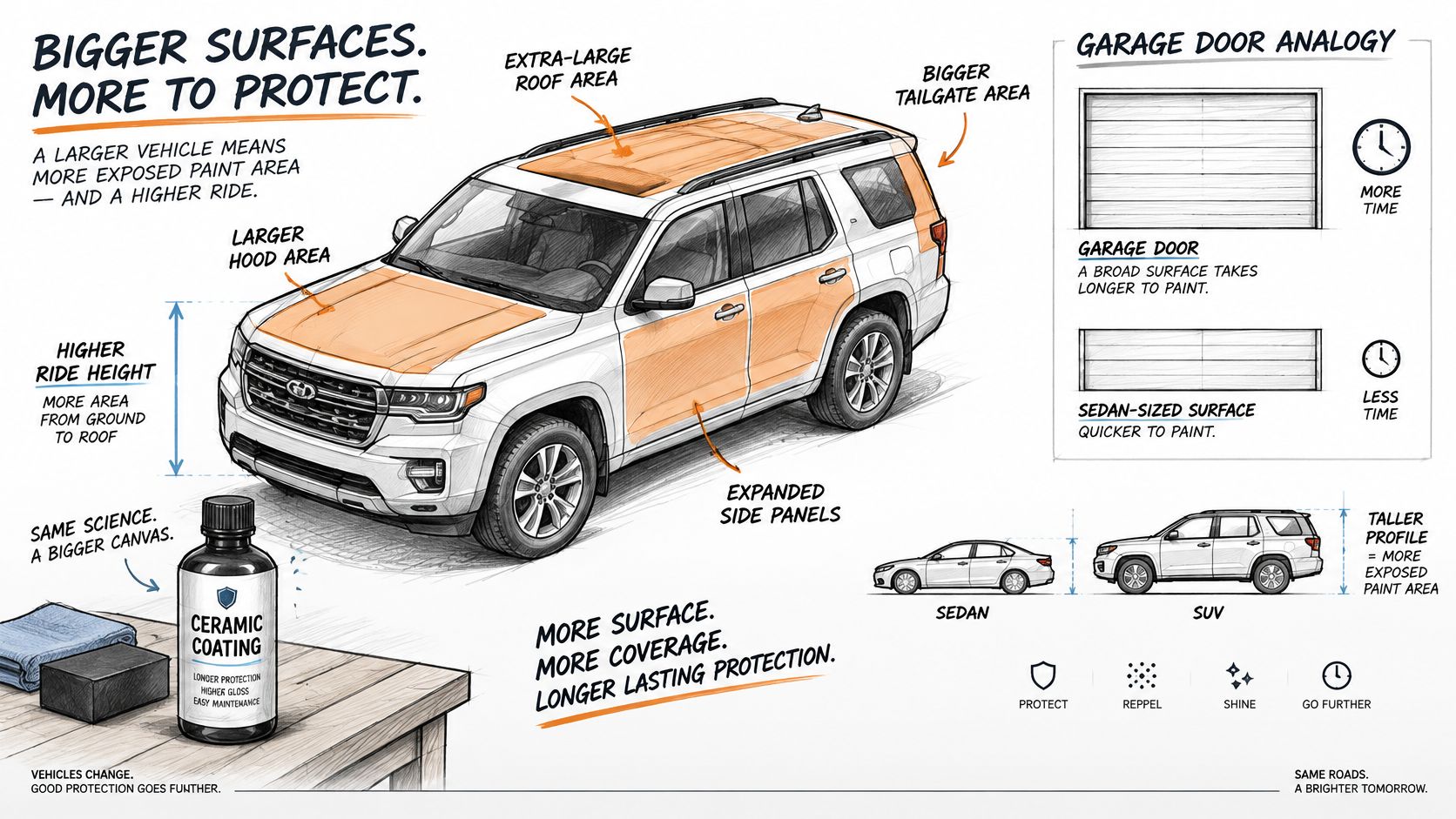
Coating an SUV isn't coating a sedan with a taller roof. Think of painting a garage door versus painting a bedroom wall. Same paint, same roller, but the garage door eats more product, more time, and more chances to leave a visible edge where you stopped.
More Paint Means More Everything
A three-row SUV carries a bigger roof, a longer hood, taller doors, and a tailgate the size of a small door. Each panel needs washing, decontamination, polishing, wiping, and coating in small sections. If you rush the roof because you're tired by hour three, that roof shows high spots under the next sunny day.
Budget for it plainly:
- More product per coat: A bottle that covers a compact sedan may not finish a full-size SUV, especially with a second layer.
- More towels and applicators: Large panels load up microfibers faster, and a saturated towel smears instead of leveling.
- A second pair of hands: One person applies while the other levels and buffs, so no section flashes too long on a big hood.
- A longer cure plan: A heavy vehicle that lives outside needs a dry window you can protect, not a hopeful forecast.
Height Changes What the Paint Collects
Ride height puts rocker panels, lower doors, and wheel arches right where your own tires throw grit, salt, and mud. A sedan's lower doors get dirty. An SUV's lower doors get sandblasted slowly, wash after wash, mile after mile.
Shape matters just as much. A vertical tailgate holds dirty water in streaks, curved roofs shed product toward the edges, and tall flat doors show every wipe mark under garage lighting. You'll inspect an SUV from a step stool and from ground level, because light hits those panels differently.
Trim Changes the Method
Count the non-paint pieces before you start. Black plastic cladding, roof rails, running boards, and matte or satin trim either need masking or a product rated for that surface. Coating glossy paint right up to unmasked textured plastic leaves white residue lines that are miserable to remove later.
So measure first. Walk the vehicle, count the trim pieces, note the roof size, and estimate your paint area before you order product or book an installer. That ten-minute count prevents the common SUV mistake of buying a sedan-sized job for a garage-door-sized vehicle.
How to Prepare and Coat an SUV Step by Step
A two-year-old SUV looks tidy in the driveway until a work light crosses the doors. Wash swirls show on every panel. Iron specks freckle the tailgate. Coat over that and the film locks the defects in. They read sharper, not cleaner.
Prep decides the result. Published technical reviews describe hydrolyzed silicon precursors reacting at the clear-coat interface to form Si-O-Si bonds, as summarized in the PMC review of ceramic coating chemistry. That bonded layer also seals tar, grit, and holograms left underneath.
Map the damage before the first pad spins. Roof, hood, and upper doors take ultraviolet load and chemical fallout such as bug acids and bird droppings. Rocker panels, lower doors, and wheel arches take stone hits and road film. A coating can slow fade and etching on the high panels. It cannot stop a rock from chipping paint low on the door. Note that split on the mirror so correction follows the panel, not one blanket pass over the whole SUV.
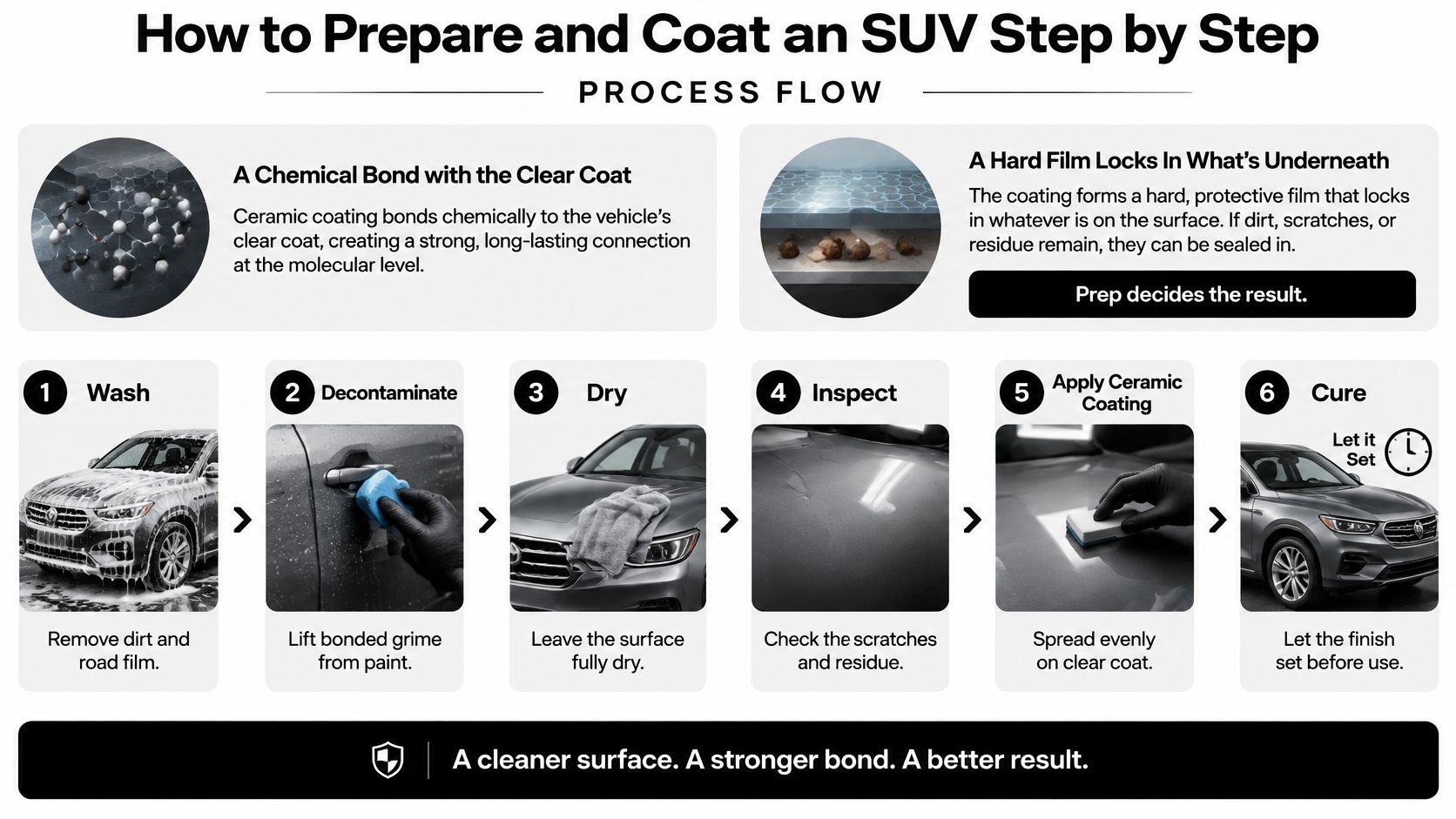
The Nine Steps That Matter
- Wash thoroughly: Use a pH-neutral shampoo with the two-bucket method, then dry with clean microfiber or forced air so leftover grit is not ground into tall doors.
- Chemically decontaminate: Apply an iron remover and let it dissolve embedded iron and mineral deposits, especially on the tailgate and lower panels where brake dust and road film settle.
- Clay in small sections: Work panel by panel with plenty of lubricant, kneading the clay often, until the surface feels smooth through a thin plastic bag.
- Polish out defects: Correct swirls and light scratches now, because a glossy coating makes them more visible. Our walkthrough on preparing car paint before any coating work covers pad and polish selection in detail.
- Panel wipe every section: BIOPREP removes polish residues and silicones without damaging the paint or clear coat. Inspect under diffused light before any coating touches the panel.
- Apply in small sections: Work from the roof down in a cross-hatch pattern, using the dose printed on the label for that bottle.
- Let it flash, then level: Wait for the product to flash as the label describes, then wipe with a short-pile microfiber using light, even pressure.
- Buff and inspect: Follow with a long-pile microfiber and check each panel under diffused light from two angles. Flat water after a dusty wipe is contamination sitting on top. A real bonding miss looks patchy and dull, will not level, and stays dull after a clean panel wipe. Fix that section before you leave it.
- Protect the cure: Keep the vehicle dry and away from detergents while the film bonds.
For a DIY or mobile job, Alpha Quartz 50ml Ceramic coating is an elastomer ceramic coating sold for driveway and mobile detailers. It suits a job you can stage outdoors or in a garage without booking a multi-day booth.
Other Titan coatings take 12 to 24 hours for initial curing, and the vehicle should not be washed for 7 days to allow full chemical bonding. The label on the bottle you opened sets dose and flash time.
Start on the roof while your arms are fresh. Those high panels are where ultraviolet and chemical protection earn their keep. Save lower doors and rockers for last. They still need a clean, bonded film, and they still need you to accept that impact protection is paint thickness, not the coating. Rotate fresh towels as you drop down the sides. On a vehicle this tall, a steady pace beats a fast one.
How Long an SUV Coating Lasts and How to Tell
An owner finishes a Saturday rinse, watches water sheet flat across the hood, and calls the coating dead before the towel is dry. Bonded contamination often hides a film that is still working. Iron fallout and mineral scale dull the paint and flatten the beads while the protective chemistry underneath stays in place.
A spray topper can reverse that picture overnight. Tight beads the next morning show that water is shedding again. Lasting ultraviolet and chemical resistance is a separate question, and beading alone does not answer it.
What the Test Numbers Actually Say
Durability claims mean more when they name a test. Accelerated weathering of 1,250 hours under SAE J2527 borosilicate exposure has been reported as approximately one year in South Florida, according to the ScienceDirect study on weathering and erosion of automotive paint. Road service is a different statement. Formulation, sun load, road chemicals, and how often the SUV is washed all shift how long the film stays useful. That maintenance side of the math sits in realistic ceramic coating lifespan.
On the Titan Coatings homepage, Dark Matter Technology combines carbon nanotubes with high-performance coating chemistry. It is designed for cars, boats, and aircraft, and it resists ultraviolet exposure, scratches, and chemicals. Judge that description with the same panel inspection you would use on any film.
Walk the SUV as a damage map. Hood, roof, and mirror caps carry the ultraviolet and chemical load: bug acids, bird droppings, and hours of direct sun. Lower doors, rockers, and wheel arches take stone hits and door dings. A hood can still hold gloss and resist etching after a rock chip has already opened the film on a rocker. Lost chemistry and impact damage fail in different places, so read them separately.
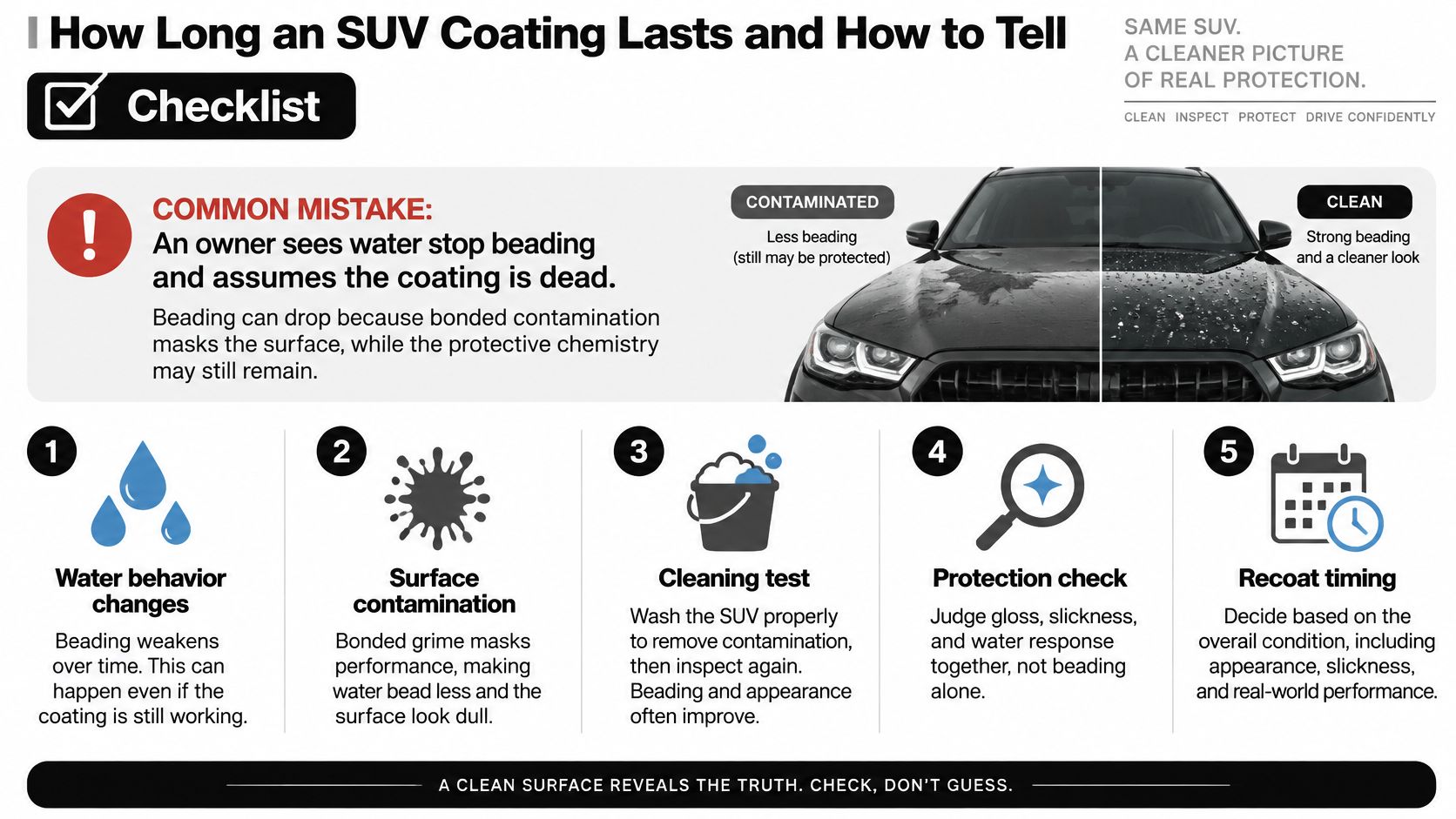
Run This Inspection Before You Recoat
- Check gloss and color: Compare the same panels under the same lighting each time. A cloudy day hides fading that direct sun makes obvious.
- Feel for bonded contamination: Run clean fingers over washed paint. Gritty patches point to iron or mineral deposits sitting on the film.
- Test contaminant release: Note whether bird droppings and road film still rinse off safely, or whether they now need aggressive scrubbing.
- Separate slickness from protection: A temporary loss of slick feel often follows a dirty month on a film that is still bonded.
- Log your maintenance: Write down washes, decontamination, and toppers so you are judging a record, not a memory.
Decide in that order. Decontaminate first, wash, and retest the same panels. If gloss, release, and water behavior come back, the coating was masked. If they stay flat after a proper decontamination, ask the installer about a topper or a fresh coat. Polishing first wastes clear coat and money on a film that may still be working.
Heat, Cold and Why Elastic Coatings Hold
An SUV that leaves a frozen driveway at dawn, gets washed at noon, and sits on hot asphalt by midafternoon puts every panel through expansion and contraction in one day. Cold nights and warm garages keep that cycle going all winter. Summer parks the same heat on the roof and hood for hours. Repeated seasonal swing is the durability test, not a single temperature rating.
Where Each Panel Takes the Stress
Heat, cold, UV, and chemicals do not land evenly, and impact damage is a separate problem.
| Panel | Seasonal stress | What the coating is for | What it still will not stop |
|---|---|---|---|
| Roof and hood | Long sun soak, UV, fast cool-down | UV resistance that limits oxidation, fading, and sun damage while the film moves with the panel | Hail marks and deep scratches |
| Hood edge and bumper | Highway bugs, grit, heat off the nose | A film that gives slightly at light strikes instead of opening cracks | Rock chips and shopping-cart hits; use film on leading edges if impacts are the worry |
| Doors, rockers, arches | Freeze, salt, and wet road film | Keeping water and chemicals out of stress cracks as the panel contracts | Abrasive scrubbing and harsh cleaners |
Titan Coatings manufactures elastomer-based ceramic coatings for automotive surfaces. The film is built to flex as paint and metal expand in heat and contract in cold. The technical explanation of ElastoTek covers how that flexibility handles thermal expansion and mechanical stress, and why coating flexibility matters in changing climates walks through the expansion cycle in plain terms. ACCR, an artificial clear coat resin, goes on with a machine polisher and deposits a clear layer of up to 4 microns of ElastoTek resin without removing paint or clear coat.
Thermal cycling, not one temperature rating, decides how a coating ages on an SUV that lives through real seasons.
If the film cracks along movement lines, water and road chemicals sit in those openings and the coating ages faster than a hard surface ever suggested. Elasticity still has a hard limit. It does not stop a rock chip, a key scratch, or a cart strike.
Lost water beading after a hot week is not the same as a dead film. Compare the roof with a shaded door in the same light. Dull, faded color on the sun panel means UV got through. Beading that returns after a gentle wash, with color still even, means contamination was masking a film that is still there.
Between full coats, ULTRA Ceramic Spray is a ceramic sealant. Ultra is a DIY product that helps maintain and refresh a coating at home. A garaged SUV in a mild town and a work SUV parked through freeze and heat waves are not asking that film for the same job.
SUV Coating Maintenance Schedule
A coated SUV still needs a driveway routine. The film swaps heavy scrubbing for lighter, regular care. Skip that care and salt, acid, or a dusty wipe gets blamed on the product.
| Typical cadence | Task | Why it matters |
|---|---|---|
| Every wash | Gentle shampoo wash, no harsh or abrasive cleaners | Keeps gloss and the maintenance film in place |
| Weekly or after winter roads | Rinse lower doors, rockers, and wheel arches | Gets salt and mud off before they bond |
| Same day | Lift bird droppings, sap, and bug residue | Limits acids sitting on roof, hood, and hatch |
| Seasonally, if water behavior changes | Iron remover and clay | Clears bonded contamination without a re-coat |
| A few times a year | Topper such as ULTRA Ceramic Spray | Brings gloss and slickness back at home |
| Yearly | Diffused-light check of gloss, color, and film | Separates real degradation from a dirty surface |
The Tasks Owners Skip
A week of winter commuting paints a gray film on the rockers. That residue holds moisture and road salt against the lower doors and arches overnight. A plain water rinse of the lower third, wheel wells included, breaks the cycle before the next freeze.
Bird mess on a hot roof is a chemical event, not an impact event. Soften it with a wet microfiber, lift without scrubbing, and rinse the panel. Five calm minutes beats an etched ring that only shows up in spring sun. A stone nick on the bumper follows a different rule. Elasticity and a topper will not fill a gouge, so leading edges that take rocks belong under film. Roof, hood, and hatch are where UV and acids do the daily work, which is why those panels get the quick cleanup.
The two-bucket, pH-neutral wash from the prep steps still runs this schedule. A dry wipe across a dusty tailgate puts more swirls into coated paint than a season of normal driving.
Lost water beading usually means bonded contamination or a tired topper, while gloss and color are still even. Park in shade or under an overcast sky and walk panel by panel. If the roof sheets poorly but the paint still looks clean and uniform, decontaminate, then refresh with a DIY topper such as ULTRA Ceramic Spray. A panel that looks dull, stained, or faded under that same light, while the rest of the SUV still shines, is degradation. A certified installer inspects the vehicle, gives feedback, and restores the coating as needed. Leave the polisher in the garage.
Some Titan Coatings are designed to be layered, and the installer recommends the layering process for each vehicle. Do not stack extra products on a calendar you invented in the driveway.
What an SUV Ceramic Coating Costs and Where the Money Goes
Quotes for ceramic coating for SUV work swing widely, and the gap usually sits in prep, not product. Understanding the line items lets you compare two bids on the same panels instead of comparing two totals that hide different jobs.
Paint area drives the base price. A three-row SUV has more roof, hood, tailgate, and door skin than a compact crossover, so it consumes more product and more labor hours at every step.
Prep drives the surprise price. Swirled, iron-contaminated paint needs decontamination, claying, and polishing before coating, and that correction can cost more than the coating itself. Our guide to paint correction cost and what drives it breaks down how defect severity changes the hours.
Trim, glass, and film add their own lines. Masking black cladding and roof rails takes time, a windshield coating is a separate product and process, and paint-protection film on the bumper and arches is a different trade entirely. Then maintenance adds a smaller recurring cost for shampoo, iron remover, clay, and a topper every few months.
Ask every installer for the same written list: prep, coating, glass, film, and aftercare, panel by panel. A DIY route trades labor cost for your own weekend and materials, which is fair math if you'll do the prep thoroughly. Either way, request quotes for your specific vehicle and region rather than budgeting from a single advertised figure.
Confirm Your SUV Coating Plan Before You Book
Say a three-row SUV comes home dull along the rockers after a salty winter, while the hood still looks dark and water sheets off the doors. Booking that afternoon can lock in the wrong job. First separate a tired surface from a coating that has actually failed.
Lost water beading often means road film or a worn maintenance layer. A real failure shows up as oxidation coming back on sun-facing panels, chemical marks a wash will not lift, or film edges peeling at the bumper while the coated paint beside them still sheds water. Walk the vehicle in daylight and note those spots. That note is what you hand over, or what you use if you are doing the work yourself.
Before you call or order, settle six decisions:
- What the daylight walk found: Beading loss only, or oxidation, etching, or lifted film.
- Quote lines you will match: Prep hours, coating package, glass, film coverage, and aftercare, written the same way on every bid.
- Film extent: Whether the bumper and wheel-arch edges get film, and how far that film runs past the leading edge.
- Climate and parking: Freeze and heat swings, coastal salt, desert dust, winter road treatment, a garage, shade, or a full-sun lot.
- Trim: Gloss black, textured cladding, matte or satin, and how those areas will be masked.
- Who fixes a later failure: A certified installer must inspect the vehicle, provide feedback, and work on restoring the coating as needed.
Two Ways to Lock the Plan
DIY owners and mobile detailers can start with an easy-to-install elastomer coating and refresh it with a spray topper between fuller applications. Browse the full range in the Titan Coatings shop, check Apex Glass Coating, a DIY and mobile detailers coating, and see the ULTRA spray for maintenance top-ups before you give up a weekend.
The professional route is priced per vehicle. Pricing for a Titan application depends on the vehicle size, its condition, and the coating package chosen, and an authorized installer provides an accurate quote.
Write those six answers down, then request the quote or order the DIY products while the paint still has something left to protect.
Elastomer coatings from APEX NANO – Titan Coatings resist UV that fades paint and shed water so spots have less time to sit. Glass and spray products sit with that plan so wet-weather driving and home upkeep stay simple. Explore the range and confirm the work you measured.
0 Comments