
You've just driven through a wet winter road, and the lower doors are carrying a gray film of salt, grit, and road spray. The hood still beads water, but the coating has begun to lose its slick feel, and a few weeks of temperature swings have exposed the weakness of a rigid film. That's where choosing the right ceramic coating liquid matters. A bottle can promise hardness, gloss, and hydrophobic behavior, but real durability depends on chemistry, surface preparation, curing, flexibility, and the exposure your vehicle faces every day.
Traditional ceramic technology still has an important place. Yet the hardest surface isn't automatically the most durable surface. A coating must also manage abrasion, chemical attack, expansion, contraction, and impact. Titan's elastomeric and nanotube-based approach focuses on that wider problem, combining ceramic-like surface hardness with flexibility intended to reduce cracking under stress.
Understanding Ceramic Coating Liquid Chemistry
A winter detail job often reveals the difference between a coating that merely looks impressive and one that has been installed correctly. The paint may appear glossy after application, but if the panel wasn't clean, the film wasn't leveled, or the cure was interrupted by moisture and temperature, the liquid hasn't become the protective network the owner paid for.
Ceramic coating liquids are rooted in the sol-gel process, a liquid-phase method that transforms molecular precursors into inorganic oxide networks. In 1846, French chemist Jacques-Joseph Ebelmen observed the hydrolysis and polycondensation of tetraethoxysilane, or TEOS, a silicon-containing precursor now closely associated with silica sol-gel chemistry. The process later moved from laboratory work toward industrial optical coatings and high-purity glass production, while ceramic-polymer hybrids developed during the 1980s expanded the technology beyond rigid glass-like films. The historical development of sol-gel chemistry explains why modern formulations commonly use silica, titania, silazane, or hybrid polymer chemistry.
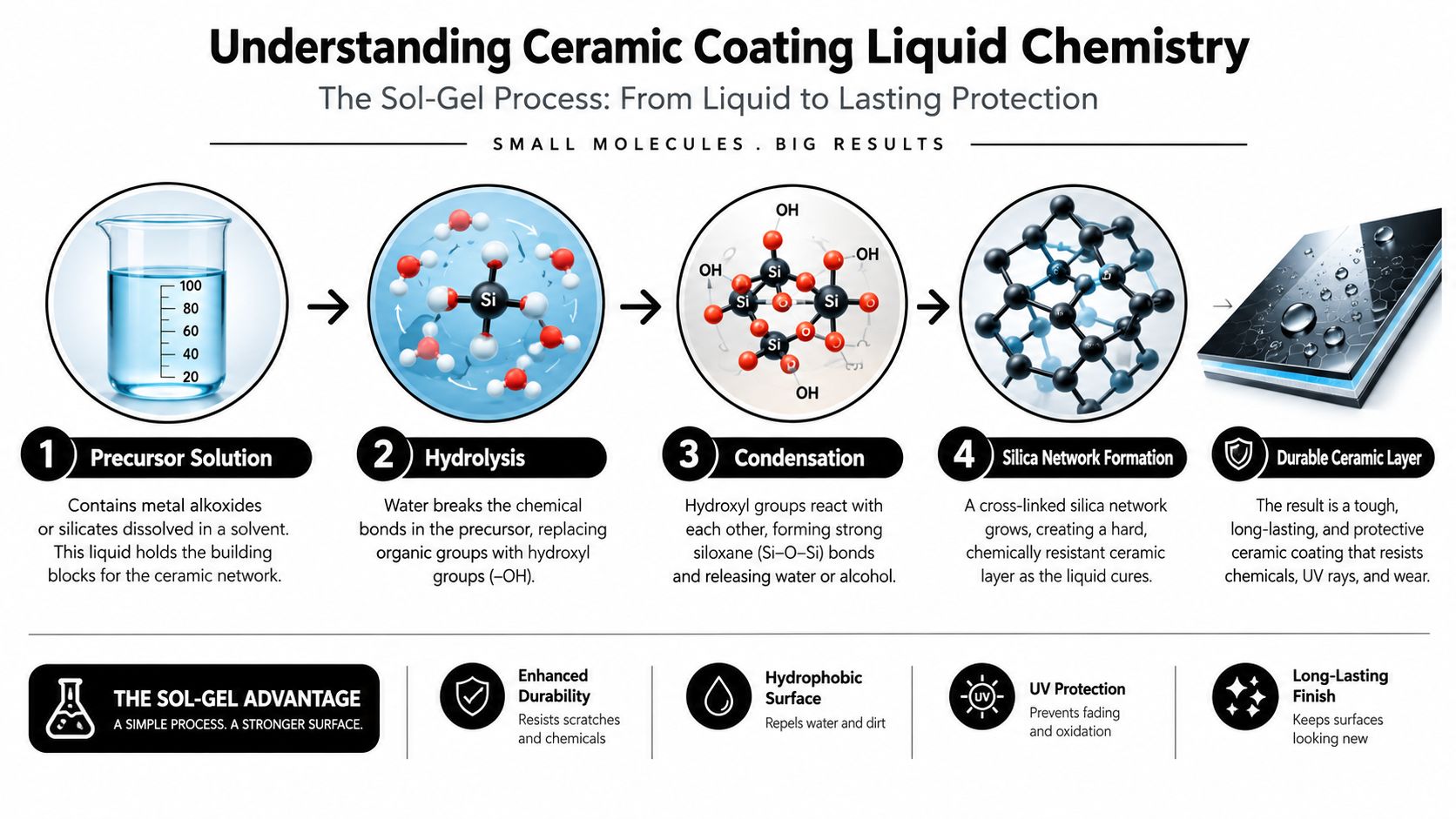
What happens inside the bottle
The liquid is an application medium, not the finished ceramic layer. A typical formulation begins with metal alkoxides or related molecular precursors suspended in a solvent system. Moisture triggers hydrolysis, converting precursor groups into reactive hydroxyl groups. Condensation then forms silicon-oxygen-silicon or metal-oxygen-metal bonds.
As the solvent leaves the film, the network densifies and cures into a thin ceramic-like layer. A useful comparison is wet concrete. You spread it while it is workable, but its final strength appears only after the chemical and physical curing process has progressed. Applying too much product, working in unsuitable conditions, or wiping at the wrong stage can leave an uneven film rather than a clear, continuous shield.
| Precursor Type | Primary Function |
|---|---|
| Silica-based precursors | Form a silicon-oxygen network during hydrolysis and condensation |
| Silazane precursors | Convert toward silica-based ceramic networks through moisture-driven crosslinking |
| Titania-related precursors | Contribute to inorganic oxide coating chemistry |
| Hybrid polymer precursors | Combine inorganic hardness with polymer flexibility |
Preceramic polysilazane illustrates why cure control matters. Its liquid or solution form supports spray, dip, and spin application, while moisture-driven crosslinking moves the precursor toward a silica-based Si-O network. Research on perhydropolysilazane-derived films found stronger hardness and chemical durability in water and aqueous ammonia than conventional alkoxide-derived silica-gel films, but the result depends on film uniformity, humidity, temperature, and conversion. Research on polysilazane-derived silica films reinforces a point every installer learns eventually: the chemistry only performs as well as the application conditions allow.
For a practical discussion of why formulation and substrate compatibility must be considered together, see chemistry versus compatibility in coating selection. The bottle may be advanced, but preparation still determines whether the coating can bond evenly and cure into a stable film.
The Evolution From Brittle Glass to Elastic Protection
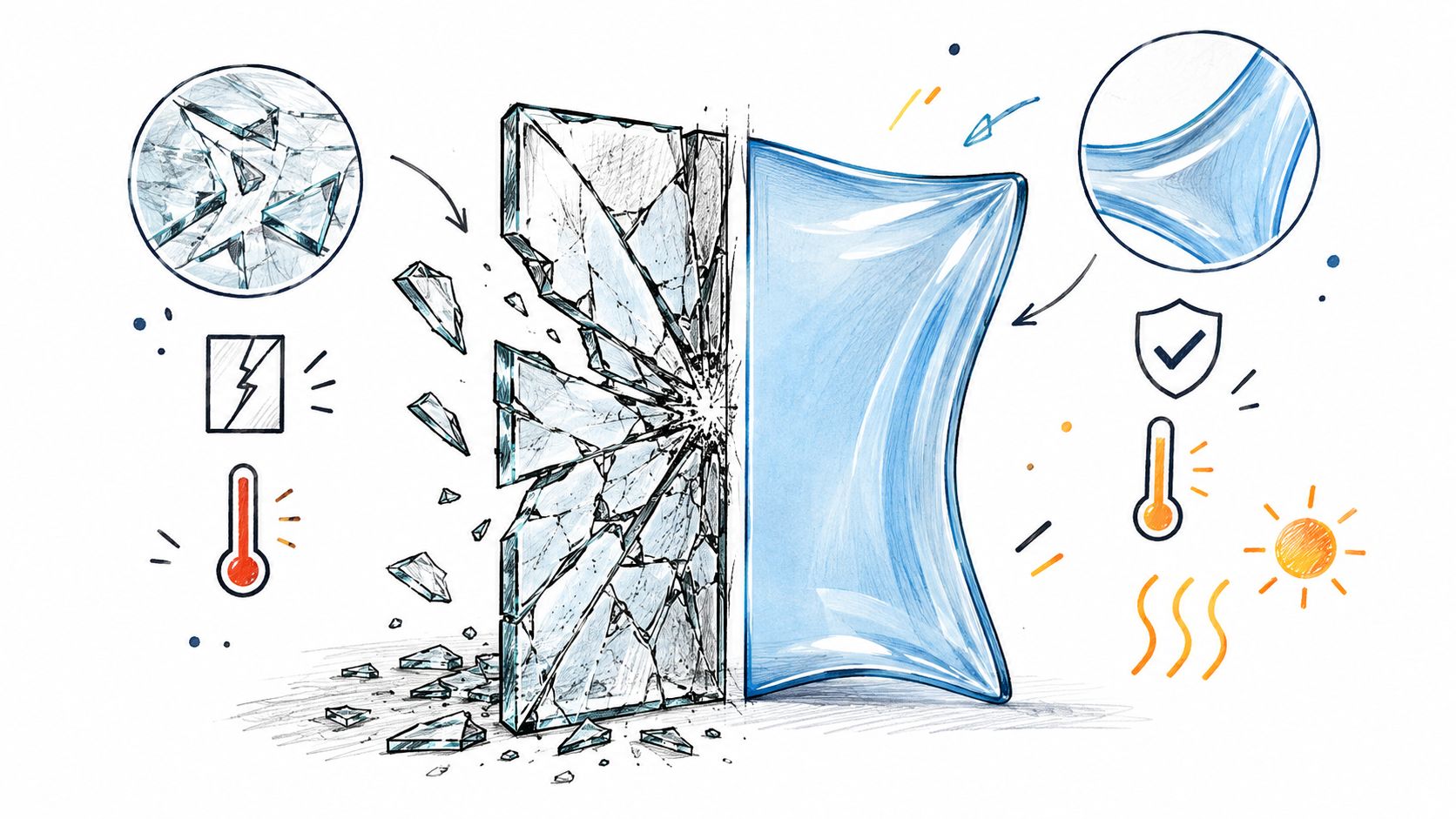
Hardness became the shorthand for ceramic quality because a hard surface sounds reassuring. It suggests resistance to washing, scuffs, and environmental contamination. But a rigid layer can still fail when the panel beneath it moves, the temperature changes quickly, or an impact concentrates stress in one small area.
That distinction matters on a daily driver. A hood heats in direct sun, cools during a cold rinse, and flexes slightly as the vehicle travels over uneven roads. A coating that cannot accommodate those changes may develop microscopic damage even if its initial hardness measurement looks impressive. Surface hardness is one performance attribute, not a complete durability profile.
Why flexible ceramic matters
Elastomers approach the problem from another direction. They combine an inorganic ceramic phase with polymeric flexibility, aiming to preserve a hard, protective surface while allowing the film to absorb movement and stress. Titan introduced its own elastomer coating technology using nanotube technology and Dark Matter technology, with the stated goal of producing a barrier that is hard like glass yet flexible.
That flexibility is relevant during freeze-thaw exposure, road vibration, and repeated impact from insects on the front end. The claim isn't that an elastomer coating makes paint immune to every form of damage. It is that a coating with controlled flexibility may manage stress more effectively than a purely brittle film, reducing the likelihood that a small crack becomes a larger failure.
Carbon nanotubes can contribute to that behavior through mechanisms such as crack deflection, crack bridging, and nanotube pullout. A review of multi-walled carbon-nanotube ceramic composites describes how these mechanisms can interrupt crack growth and absorb part of the fracture energy, while also emphasizing that performance depends on the material system and processing method. The review of carbon-nanotube-reinforced ceramic nanocomposites supports a careful conclusion: nanotubes aren't automatically a guarantee of stronger performance, but they can be meaningful reinforcement when properly dispersed inside a compatible matrix.
Practical rule: Don't choose a coating by its hardness label alone. Ask how the film handles abrasion, chemical exposure, thermal cycling, and impact on the substrate you actually intend to protect.
For a product built around this elastomer concept, Alpha Quartz 50ml Ceramic coatig is described as a high-performance elastomer ceramic coating for all surfaces. Its listed specification includes 92% high solids, zero VOCs, a solvent-free formula, and Advanced Adhesion Technology, with protection against UV, chemicals, and abrasion. The product is described as suitable for indoor and outdoor application and as curing in 4 hours. Those details describe the formulation and intended use, but an installer should still follow the product procedure and assess the finished film after curing.
Titan's Apex Glass Enhancing Visibility and Safety
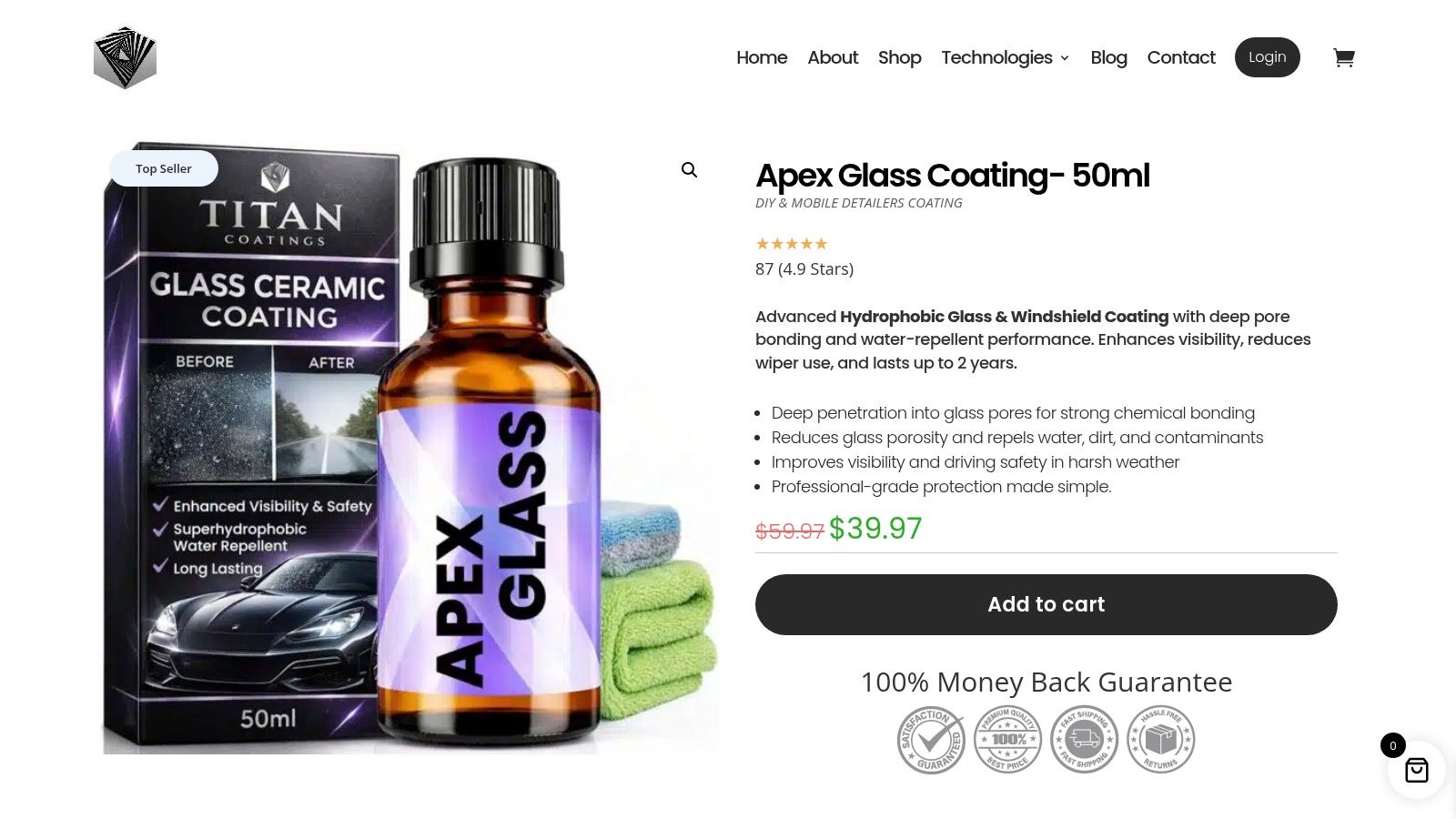
You notice the difference on a dark highway in steady rain. Water starts clearing off the windshield instead of smearing into a weak, wiper-driven blur, and the glass stays more readable between passes. That is the job of a dedicated glass coating. Paint-focused products chase gloss and broad surface protection. A windshield has a narrower standard. It needs clean optics, stable water behavior, and no haze in the driver's line of sight.
Titan's Apex Glass Coating- 50ml is positioned for that specific use. Its deep-pore bonding and water-repellent behavior are meant to help rain move off the glass rather than sit as a continuous sheet. In real driving, that can improve wet-weather visibility and reduce some of the load on the wipers. It does not replace clean glass, good blades, or sensible speed in heavy rain.
Glass coating versus paint coating
Glass is less forgiving than paint. A slight high spot, leftover silicone, old water-repellent residue, or polishing oil that might go unnoticed on a hood can show up immediately on a windshield, especially at night or in bad weather. The installer has to strip the surface back to clean glass before applying anything.
Hydrophobicity still matters, but it needs to be read correctly. Contact angle is a useful way to track how a surface wets. Hydrophobic surfaces generally measure 90 to 150 degrees, while values above 150 degrees are classed as superhydrophobic, according to The study discussing cure conditions and contact-angle measurement. That same research also shows why beading alone is a weak shortcut. It does not tell you how the film handles abrasion, chemical exposure, or long-term service.
That trade-off matters on glass more than almost anywhere else. Hardness gets too much attention in coating marketing. On a windshield, predictable behavior through temperature swings, wiper contact, washer fluid, road film, and daily cleaning is the true test. A product that sheds water well but turns grabby, patchy, or cloudy under use has failed its purpose.
Apex Glass is described as easy to use for professionals and DIY users, which gives it a practical place in an exterior protection plan. For more application context, Titan's ceramic coating for windshield guide is a useful reference.
Some owners also add personalized banner stickers for cars. Keep any decal clear of the coated viewing area, and make sure placement does not interfere with sightlines or local regulations.
Applying Alpha Quartz The Professional Elastomer Standard
The coating itself rarely causes the failure. Poor preparation does. I've seen glossy panels lose performance quickly because an installer rushed through decontamination, left polishing oil behind, or applied a coating over paint that needed correction. Elastomeric chemistry can improve stress management, but it can't create a sound bond over residue.
Prepare the surface before opening the bottle
Start with a thorough wash using a clean mitt and a method that removes traffic film without grinding grit across the paint. Decontaminate the surface, inspect it under strong lighting, and correct swirls, oxidation, or other defects before coating. A ceramic coating liquid locks in the condition beneath it, so coating uncorrected paint preserves the defects rather than hiding them.
After correction, remove polishing oils and residues with the recommended panel-prep method. Work indoors or in a controlled outdoor location whenever possible, away from direct sun, dust, wind, and sudden moisture. Temperature and humidity influence flash time and conversion, so don't treat the wipe window as optional.
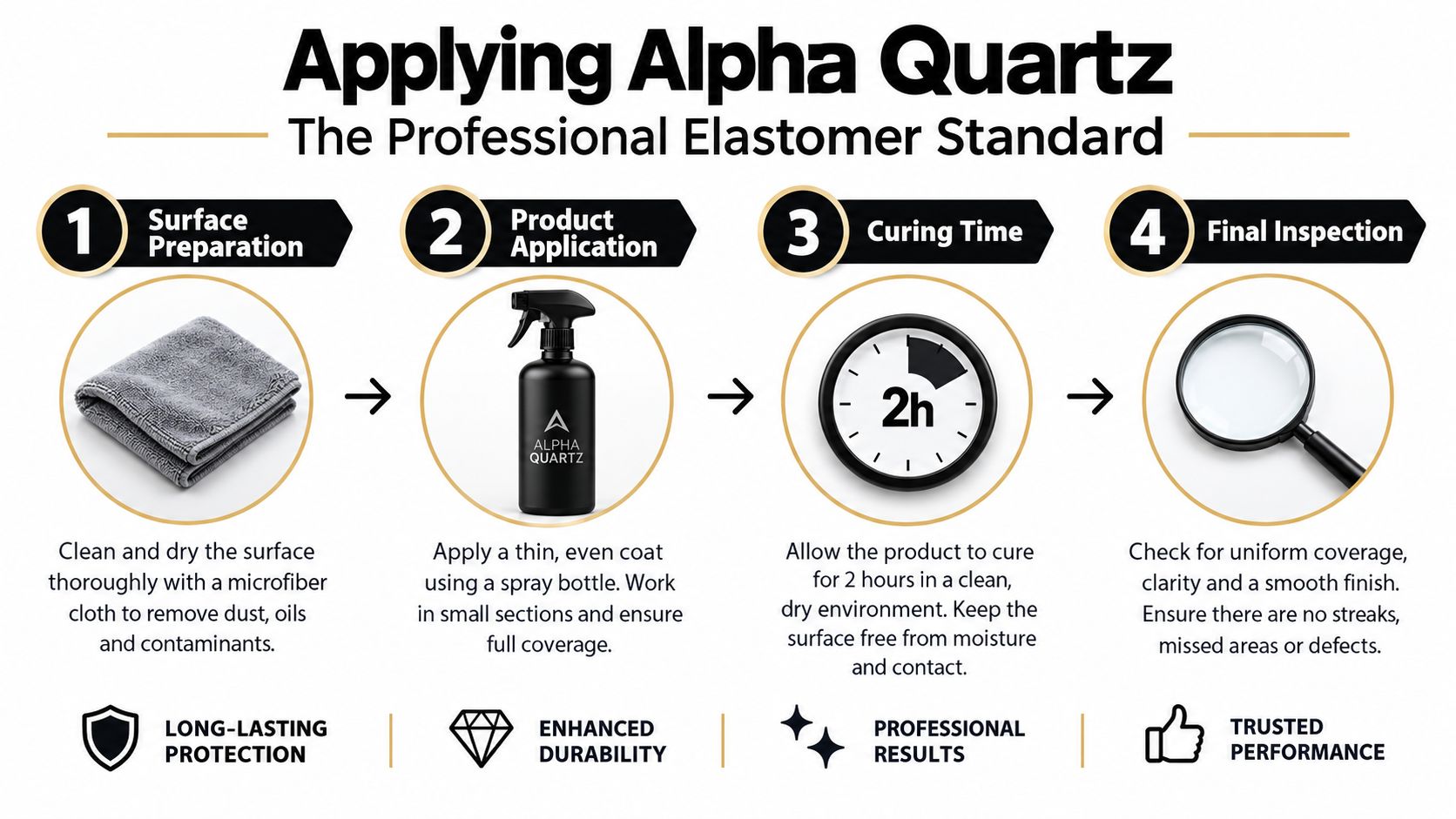
Apply in small, controlled sections
Use the applicator and product amount specified for the panel. The Alpha Quartz procedure calls for applying 20 to 25 drops, then spreading the coating in a cross-hatch pattern. First move in one direction, then cross that path to build an even film rather than leaving narrow untreated channels.
Allow the coating to reach the appropriate wipe stage before leveling. The exact wait depends on the working environment, so watch the film rather than following a blind timer. If you wipe too soon, you may remove too much product. If you wait too long, the coating can become difficult to level and may leave high spots.
- Spread evenly. Work a manageable section and keep the applicator loaded consistently.
- Watch the flash. Look for the visual change that indicates the film is ready to level.
- Level with clean microfiber. Use a controlled first towel to remove excess, then a second towel to refine the finish.
- Inspect under multiple angles. High spots can be difficult to see under flat lighting, especially on dark paint.
Installer's observation: A coating that looks perfect under one light can show residue under another. Inspect every panel before moving on.
Alpha Quartz is listed with 92% high solids, zero VOCs, and a solvent-free formulation, with Advanced Adhesion Technology and a stated cure time of 4 hours. The elastic film is intended to move with the vehicle's panels instead of acting as a completely rigid shell. That doesn't eliminate the need to protect the car from early water, dust, and contact during curing.
Mobile detailers benefit from a process that is repeatable outside a full studio. DIY owners benefit for the same reason, but they should work slowly, maintain clean towels, and avoid coating more surface than they can level properly. Titan's ceramic coating application guide is a useful reference before starting, especially for users unfamiliar with flash behavior and high-spot inspection.
Temperature Resilience and Real-World Durability
A coating that survives a steady laboratory temperature may still struggle when the substrate heats and cools repeatedly. Thermal cycling creates expansion and contraction at the coating, interface, and substrate. The greater the mismatch between those materials, the more important stress management becomes.
This is the strongest argument for flexibility. A hard film can resist abrasion, but if it cannot move with the panel, hardness may become a liability. An elastomeric coating is designed to retain a durable surface while accommodating movement, which is especially relevant for vehicles exposed to frozen winters, hot summers, road vibration, and repeated impact from insects.
Research provides useful context without proving that every automotive product behaves the same way. One ceramic-coating study exposed samples above 1,250°C and used rapid heating and cooling rates of approximately 100 to 120 K/s. After 10 thermal cycles, the coating showed no observed cracking, spalling, or loss of adhesion. The thermal-cycling study demonstrates that thermal-shock resistance can be engineered through composition, interface design, and stress control, but it doesn't establish a universal temperature range for automotive coatings.
What nanotubes add
A NIST and Kansas State University reported spray-on coating combined multiwall carbon nanotubes with a silicon-boron-carbon-nitrogen ceramic. In testing, it absorbed 97.5% of incoming light and tolerated a laser intensity of 15 kW/cm² for 10 seconds without major burning or deformation. NIST's report on the nanotube-ceramic spray coating describes a complementary mechanism, with nanotubes absorbing light and transferring heat while the ceramic phase supplies oxidation-resistant structure.
That evidence supports the value of reinforcement, not a blanket promise that a car coating can withstand every extreme. Carbon nanotube performance changes with dispersion, atmosphere, temperature, and matrix chemistry. Research on silicon-aluminum-carbon-nitrogen composites reports that unprotected nanotubes tend to lose their characteristic structure near 400°C in air, while a polymer-derived ceramic matrix can remain stable to approximately 1,400°C and improve nanotube thermal stability, particularly in nitrogen. The composite-materials research explains why product-specific testing matters.
For vehicle owners, the practical question is simple: does the film remain continuous after repeated temperature changes and normal road abuse? Titan's elastomeric approach is designed around that problem. Product claims should still be checked against defined substrate, temperature, cycle, and failure criteria, as outlined in Titan's high-temperature ceramic coating information.
Choosing the Right Coating for Your Needs
The right ceramic coating liquid depends less on the loudest hardness claim and more on the job. A mobile detailer may prioritize speed, portability, and a forgiving application window. A garage enthusiast may prefer a more involved preparation process in exchange for a denser, longer-term film. A daily driver in a harsh climate should place flexibility and thermal stress near the top of the list.
Match the product to the use
Ultra Spray Ceramic Coating suits owners who want a simple spray application for quick maintenance and easy refresh work. Its value is convenience and straightforward installation, not a substitute for the preparation and cured-film behavior of a professionally applied coating. The product is presented as easy to install with strong practical results, making it a sensible option for mobile work and routine upkeep. Details are available on the Ultra Ceramic Spray product page.
Alpha Quartz is the more appropriate direction for a professional-grade elastomer finish or a serious DIY installation. Its listed high-solids, solvent-free formulation and elastic ceramic design suit users who are prepared to wash, decontaminate, correct, panel-wipe, apply carefully, and inspect every section. That extra preparation is where much of the finished result comes from.
For windshields, use a dedicated glass coating rather than treating paint and glass as identical substrates. Glass requires optical clarity, clean bonding, and consistent water behavior. For broader selection criteria based on exposure, surface, and application goals, review Titan's guide to best auto paint protection coating options.
A practical decision looks like this:
- Choose a spray format when maintenance speed and simple application are the priority.
- Choose an elastomer ceramic coating when freeze-thaw exposure, road impact, and long-term film flexibility matter.
- Choose a dedicated glass coating when rain visibility and water removal from the windshield are the main concerns.
- Choose professional installation when paint correction, controlled curing, or high-spot removal exceeds your experience.
Preparation remains the common denominator. No product can compensate for contamination, unstable paint, dirty towels, or rushed leveling. For drivers who regularly face severe winter conditions, Titan's elastic coating concept offers a more complete durability strategy than hardness alone.
APEX NANO – Titan Coatings offers ceramic, elastomeric, glass, and spray coating solutions for automotive, marine, aviation, and other demanding applications. Visit APEX NANO – Titan Coatings to compare the product range and choose a ceramic coating liquid that matches your vehicle, climate, and application experience.
0 Comments