
Rain is coming down steadily, your wipers are working hard, and every approaching headlight seems to spread across the windshield. You’ve cleaned the glass, yet it still feels as though you’re looking through a film. A glass coat for cars can help change that experience, but choosing one confidently means understanding more than the water-beading demonstration.
What a Glass Coat Does to Your Windshield
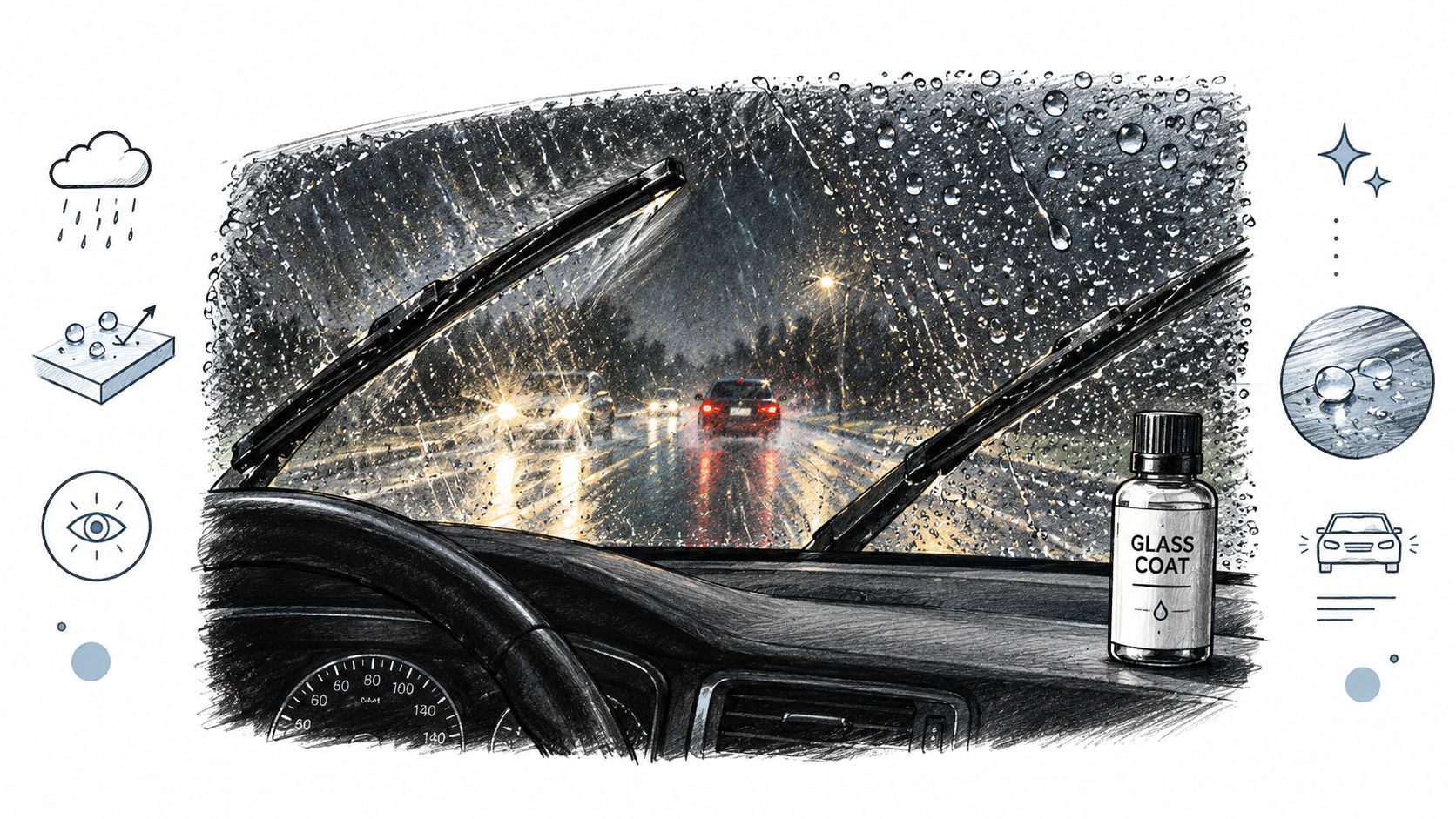
A glass coat is a thin, water-repellent, or hydrophobic, layer applied to automotive glass. Its main job isn’t to make the windshield shinier. It changes how rainwater behaves on the surface you need to see through.
Think of a nonstick pan. Instead of clinging across the surface, food releases more readily. On treated glass, water gathers into droplets rather than spreading into a persistent film, making it easier for moving air and your wipers to clear it.
What the visibility evidence actually shows
In the University of Michigan Transportation Research Institute’s 1997 experiment, a newly applied hydrophobic treatment reduced the minimum visual angle needed to distinguish targets in simulated rain by almost 34% and reduced response time by more than one second, from roughly four seconds to approximately three.
That’s evidence of improved performance in a particular visual task, not proof that every coating prevents collisions. The researchers tested fresh treatment, not a windshield after prolonged wiper abrasion.
What you might notice behind the wheel
- Water clears more readily. Droplets can move away as airflow increases, depending on the treatment and driving conditions.
- Loose dirt releases with runoff. This can make routine cleaning easier, although bonded contamination still needs attention.
- Wipers have less persistent water film to clear. That doesn’t make them optional or excuse worn blades.
Practical rule: Judge a windshield treatment by what you can see through the glass, not by how attractive the droplets look.
Preparation matters before any bottle is opened. Start with the best way to clean an auto windshield, because a coating shouldn’t be used to cover unresolved film, deposits, or streaking.
Glass Coat vs Ceramic and Polymer Coatings
The useful question isn’t just which coating lasts longest. It’s which product belongs on which surface, how it forms its protective layer, and whether its durability claim matches your intended use.
Glass coat compared with ceramic, polymer and wax
| Coating | Main surface | How it bonds | Typical durability | Best fit |
|---|---|---|---|---|
| Glass coat | Windshield, side and rear glass | Glass-specific bonding that creates a water-repellent film | Product-dependent, with shorter service possible in the wiper path | Glass-only protection and wet-weather clarity |
| Ceramic coating | Approved paint, glass, wheels and trim | Formulation-dependent chemical bonding | Approximately one to three years with maintenance washing, as described in an automotive-coatings review | Longer-term protection on approved surfaces |
| Polymer sealant | Approved paint, glass and plastic | Synthetic polymer film | Depends on formulation, exposure and maintenance | Straightforward application and routine renewal |
| Carnauba wax | Primarily paint | A wax layer over the finish | Depends on the product and washing conditions | Appearance-focused care and regular reapplication |
Read the surface approval before the durability claim
“Ceramic” doesn’t automatically mean suitable for a windshield. A product designed to leave a glossy finish on paint must still have explicit approval for optical glass, including any restrictions around cameras.
Likewise, a dedicated glass coating needn’t be the right choice for painted panels. Titan’s comparison of ceramic and polymer coatings is useful when separating the wider protection categories from a glass-specific treatment.
Where flexible coatings fit
Titan describes its proprietary approach as combining Dark Matter Technology and elastomer membrane formulas, and claims it was the first company to bring elastomer coatings to market using nanotube technology. That first-to-market statement is a company claim, not an independently established comparison.
The Alpha Quartz 50ml Ceramic coatig is described in its product information as an all-surface elastomer ceramic with 92% high solids, zero VOCs, a solvent-free formulation, and a four-hour cure, suitable for indoor or outdoor application. Those characteristics make it relevant to DIY owners and mobile detailers evaluating a broader coating system.
Titan’s hard-like-glass-yet-flexible positioning addresses a sensible engineering concern. NIST research on thermal cycling explains how attached materials that expand differently can develop interfacial stress during heating and cooling.
Flexibility may help accommodate movement. It doesn’t, by itself, prove that a coating will never crack between frozen and hot conditions, last longer in every environment, or resist every insect impact. Those promises require product-specific temperatures, cycle counts, impact methods, and failure criteria.
Why Water Beads Off Treated Glass
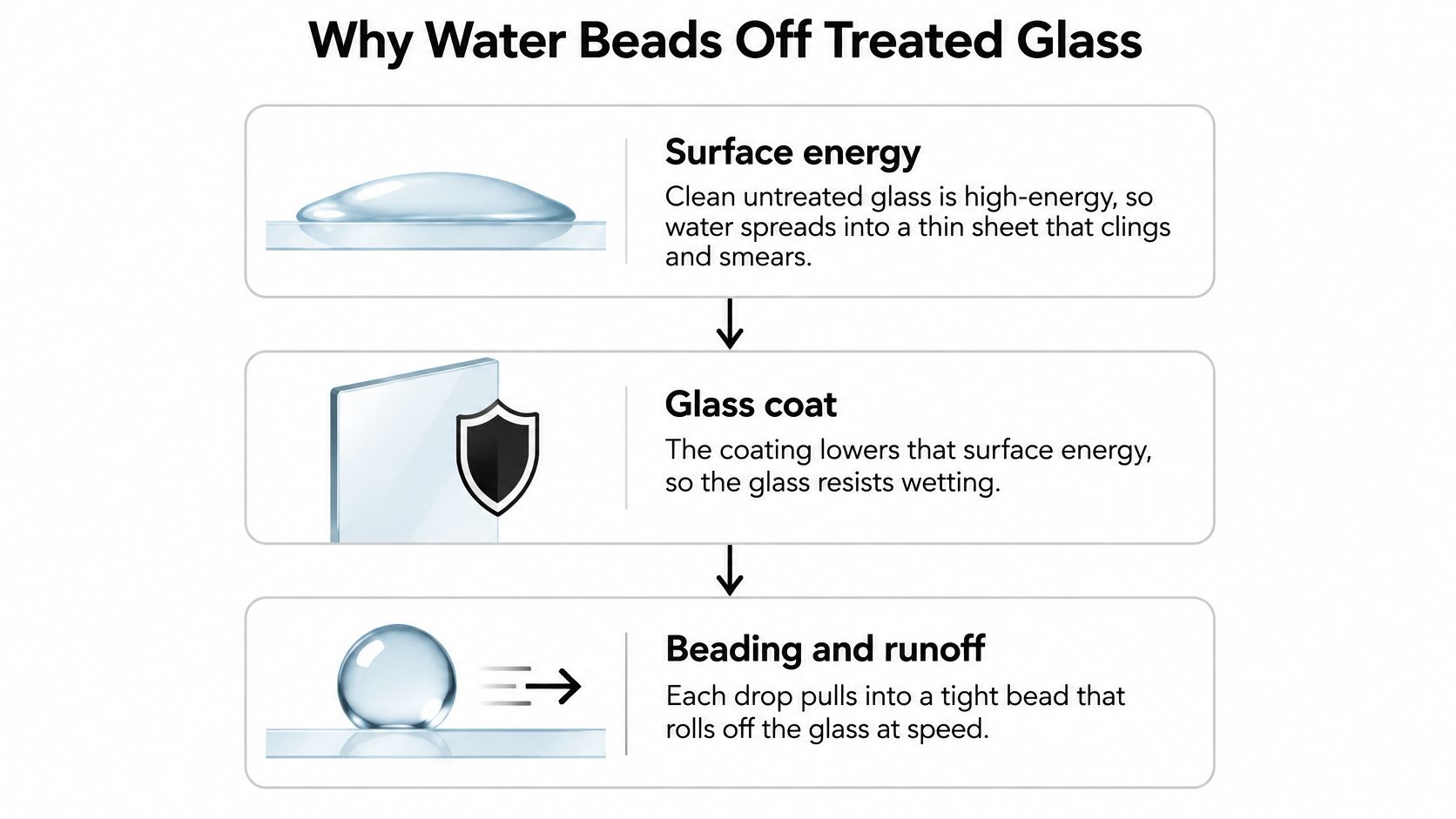
Water responds to the surface it touches. Clean untreated glass encourages wetting, so rain can spread across it rather than remaining in compact droplets. A hydrophobic treatment lowers the surface energy and changes that interaction.
The familiar comparison is a freshly protected hood: drops look rounder and move differently. On a windshield, however, the important result is water evacuation without an optical penalty, not appearance.
Contact angle measures shape, not the whole result
Researchers describe droplet shape using water contact angle. A rounder droplet has a different contact angle from water that spreads flat, providing a way to compare surfaces rather than relying on photographs.
A peer-reviewed polymer–titania coating study reported a contact angle of approximately 135°, alongside average visible-light transparency of 97.5% across 400–800 nm, compared with 94.3% for unmodified glass. That demonstrates that repellency and optical transmission can coexist in a tested formulation, not that every retail coating produces those results.
Why the effect changes over time
In a separate transparent hydrophobic-coating study hosted by Technological University Dublin, contact angle declined from 107 ± 1.2° to 63 ± 1.0° over 2,422 hours; the researchers also reported a 14° critical sliding angle for a 0.1-milliliter droplet. Contact angle and sliding angle describe different things: droplet shape and the tilt needed to start movement.
For an owner, the lesson is straightforward. A treatment can still be present while its water-repellent behavior has weakened, and initial beading doesn’t establish permanent performance.
After curing, inspect the glass under diffused light:
- Streaking: Look for lines of residue across your normal viewing area.
- Rainbowing: Check for uneven optical effects rather than assuming they’re harmless.
- High spots: Find localized patches where excess product remains.
- Clarity: Inspect through the glass separately from judging droplets on it.
A uniform film matters. Particle agglomeration and uneven application can undermine clarity even when parts of the surface bead impressively.
Protect Windshield Camera Zones Before You Coat
Your windshield may serve more than your eyes. Forward-facing cameras can look through it to support lane-keeping and automatic emergency braking. A treatment that improves a human driver’s experience isn’t automatically proven compatible with those systems.
The earlier visibility experiment didn’t test modern camera-based driver assistance. Don’t use that result as a substitute for your vehicle manufacturer’s coating guidance.

Establish the approved coverage first
Check the owner’s manual and current manufacturer service guidance for your exact vehicle. If coating approval is unclear, ask the manufacturer or an appropriately qualified service provider before treating the camera’s viewing area.
- Identify the optical zone. Don’t guess its boundaries from the interior camera housing.
- Leave uncertain areas untreated. Proceed only where the vehicle maker permits the treatment.
- Control application edges. Use suitable automotive masking tape where appropriate, following vehicle and product instructions.
- Check other windows too. Side and rear glass may be simpler, but don’t assume they’re free of cameras or sensors.
Document before and after
For a detailing business, record existing glass condition, visible camera-area contamination, and dashboard warnings before starting. Afterward, inspect the optical zone for residue and confirm that no new warnings have appeared.
A normal, lawful drive can reveal a new warning or unexpected system behavior, but it cannot certify emergency-braking performance. Never deliberately create a collision scenario to test it.
Clear-looking glass isn’t proof that a driver-assistance camera has an acceptable optical view.
If functionality changes, stop relying on the affected assistance feature and arrange qualified inspection and diagnostics. Calibration, where required, should follow the vehicle manufacturer’s procedure, not a generic detailing checklist.
How to Apply a Glass Coat Step by Step
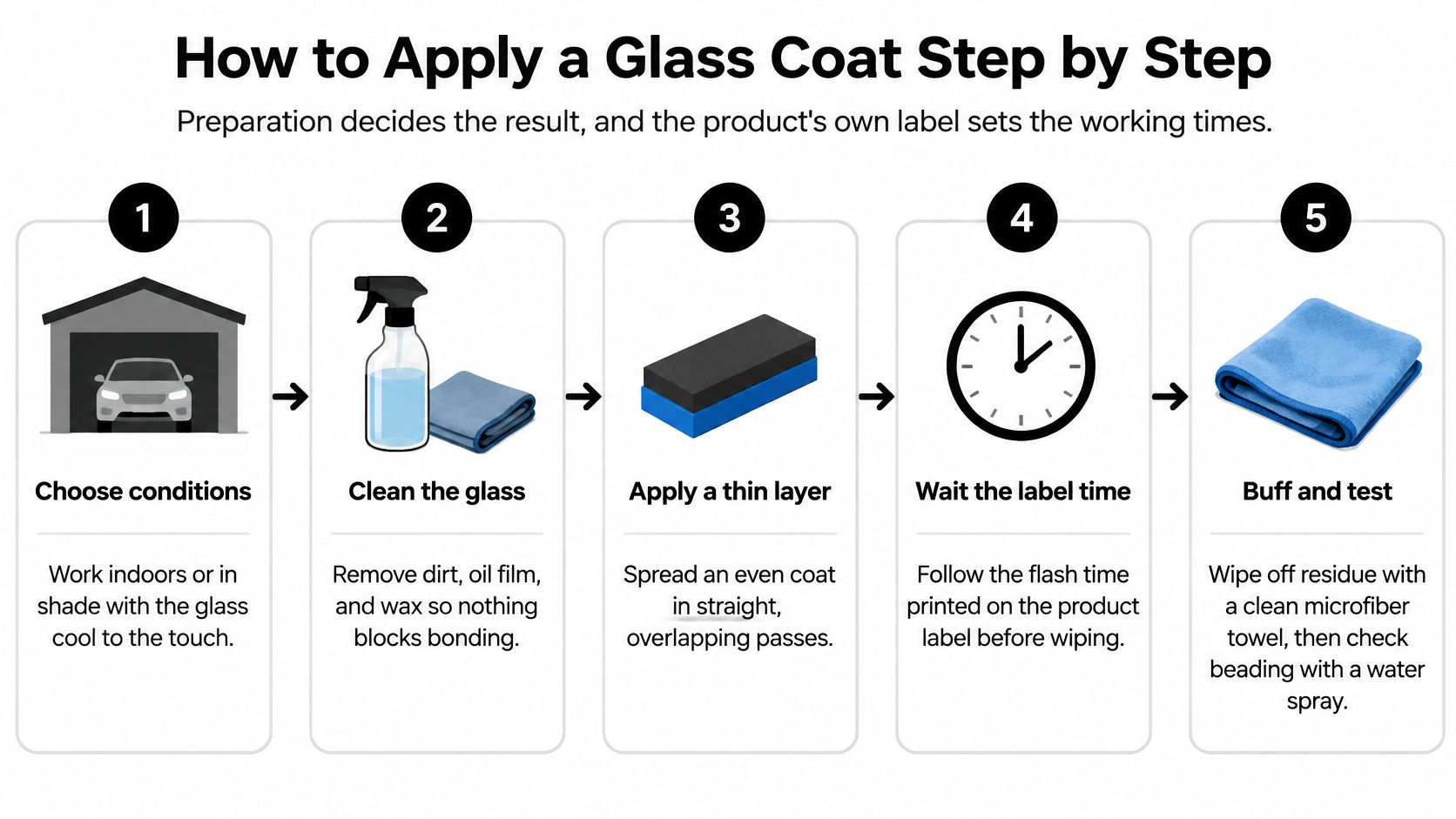
Preparation decides whether the treatment bonds to clean glass or just sits over contamination. The current product label controls dosage, application method, wipe-off timing, and cure conditions. Don’t transfer instructions from a paint ceramic to a windshield coating.
The Apex Glass Coating- 50ml product information describes deep-pore bonding, water-repellent performance, enhanced visibility, reduced wiper use, and durability up to two years. Treat that as a product claim rather than a promise for your wiper-swept zone; DIY owners and mobile detailers should confirm its current instructions before application.
Prepare the surface before opening the coating
Choose suitable conditions. Work indoors or in shade, with the glass inside the product’s stated temperature range. Don’t apply to a windshield that’s hot from direct sunlight or carrying condensation.
Wash away loose contamination before using any contact method. Rinse thoroughly so you aren’t dragging road grit across the glass during preparation.
Remove bonded contamination when needed. Use a glass-compatible decontamination method and suitable lubrication. Clay isn’t a substitute for washing, and it shouldn’t be used aggressively to force off every stubborn mark.
Inspect for deposits or defects that cleaning hasn’t resolved. If polishing is appropriate, select suitable glass polishing pads and follow a glass-specific process rather than improvising with paint-correction tools.
Chemically clean the glass. Use the coating maker’s approved preparation cleaner to remove oils and polishing residue. Finish with clean towels, and avoid touching the prepared surface.
Apply, level and protect the film
Mask approved boundaries, rubber seals, and adjacent trim where needed. Keep the camera-area decision made earlier intact throughout application.
Dose the applicator according to the label. More product isn’t automatically better. A controlled, thin layer is easier to spread and inspect than a heavy wet film.
Spread evenly using the specified pattern and working area. Overlapping passes help avoid missed strips, but don’t keep rubbing beyond the product’s workable window.
Level within the stated wipe-off period. Use clean microfiber towels suited to the directions, changing towels when they become loaded. Inspect from different angles and add another layer only if the manufacturer recommends it.
Keep the glass protected for the full specified cure. Don’t spray water to check beading immediately after buffing, even if a simplified demonstration makes that look like the final step.
A materials study of transparent superhydrophobic glass illustrates why optical performance and mechanical durability require separate evaluation. Careful application supports the intended film, but it can’t turn every formulation into an abrasion-proof surface.
Before you walk away: Check through the windshield from the driver’s seat, not only across it from outside.
The common mistake is leaving excess product because a thicker layer feels more protective. If you see smearing, don’t add another coat to hide it. Resolve the residue according to the manufacturer’s instructions, and remember that cold conditions can change the working behavior.
Where a Glass Coat Wears Out and How to Maintain It
The first weak area may be a curved band directly in front of your eyes, while the windshield corners still bead beautifully. That pattern matters more than the calendar date on the application receipt.
Wipers repeatedly move across the same glass. Fine mineral particles caught between blade and coating can act as abrasives, so the most heavily wiped area experiences a different environment from an untouched corner.
Read the windshield as separate wear zones
A review of hydrophobic windshield-coating risks and performance reports that a three-month claim can fall to roughly two to eight weeks in the wiper path, and describes a 2024 anti-fogging-film study in which conventional treatments lost performance after ten wiper passes, while another polymer system failed after 50 passes on one untreated surface.
The anti-fogging results aren’t a service-life test for every rain-repellent coating. They illustrate why repeated wiping deserves attention, not why a particular windshield product should be assigned the same failure point.
Use the surface itself as your comparison:
- Wiper sweep: Inspect first because it receives repeated mechanical contact.
- Corners and edges: Compare their water behavior with the main viewing area.
- Unwiped side glass: Use it as another reference, while remembering that exposure and preparation may differ.
- Rear glass: Include its wiper path if the vehicle has a rear wiper.
A maintenance routine you can actually follow
The schedule below is a suggested owner routine, not a laboratory-established lifespan or a replacement for product instructions. Increase cleaning when visible contamination or poor wiping makes it necessary.
Glass coat maintenance schedule
| Task | How often | Why it matters |
|---|---|---|
| Wash glass with an approved pH-neutral cleaner | Every two weeks or after storms | Removes grit and road film before repeated wiping |
| Rinse road salt | After each winter drive, where practical | Removes salt-laden contamination rather than leaving it on the surface |
| Clean wiper blades | Monthly, and whenever visibly dirty | Reduces contamination carried across the coating |
| Avoid dry wiping and metal scrapers | Every use | Limits avoidable abrasive contact and smearing |
| Water test on each zone | Monthly, after cleaning and once fully cured | Helps identify uneven water behavior |
Choose cleaner chemistry that the coating maker approves. “Strong enough to remove everything” isn’t a useful maintenance standard if the same cleaner also affects the protective layer.
If the surface develops deposits, identify them before deciding the coating has failed. Titan’s guide to removing water spots from a windshield can help separate contamination removal from coating renewal.
Reapply for a reason, not just a date
Patchy beading deserves investigation, but inconsistent wipe clarity, renewed haze, and poor water evacuation are more important than droplet appearance alone. First clean the glass and blades, then reassess the same zones under comparable conditions.
If only the swept region remains weak, ask whether the product permits localized preparation and reapplication. Partial wear doesn’t automatically require stripping every window, although an incompatible or uneven film may need more extensive correction.
Tell a detailer what you actually experience: frequent motorway rain, winter grime, persistent washer use, or automatic washing. Those details provide a better maintenance starting point than asking for a universal lifespan.
The ULTRA Ceramic Spray is described as a concentrated, water-based flexible membrane sealant for surfaces including paint, wraps, PPF, glass, wheels, and trim. It’s an optional maintenance product to evaluate between full coating applications, but confirm compatibility, layer instructions, and windshield restrictions before treating it as a topper.
Choose the Right Glass Coat and Start Today
If your main problem is rain lingering on the windshield, start with a dedicated glass treatment rather than an all-purpose paint product. Choose it for approved optical use, clear application instructions, and a maintenance routine you’ll realistically follow.
For a DIY owner or mobile detailer protecting several surfaces, the elastomer ceramic described earlier offers a different proposition. Its broader application scope may suit that job, but surface approval still matters more than the convenience of using a single bottle.
Match the purchase to your situation
- Frequent wet-weather driving: Prioritize windshield clarity, camera compatibility, and a plan for inspecting the wiper sweep.
- Whole-vehicle protection: Compare approved substrates and installation conditions before choosing a broader ceramic system.
- An existing protective layer: Check whether a compatible spray sealant is appropriate before adding anything.
- Little interest in maintenance: Consider a simpler approved glass sealant, or keep the glass clean without adding a coating.
My verdict is that a glass coat is worthwhile when rain regularly affects your driving and you’re willing to maintain the surface. It isn’t a cure for damaged glass, worn blades, poor visibility habits, or uncertain camera compatibility.
Titan’s flexible elastomer approach is a design argument worth examining. Claims about surviving frozen-to-hot changes without cracking, resisting impacts, or lasting longer should still be supported by product-specific testing rather than assumed from flexibility alone.
Before buying, check your vehicle’s camera guidance, decide which surfaces need protection, and compare the relevant options in the Titan Coatings shop. Choose the product for the job, then give preparation and maintenance the same attention as application.
APEX NANO – Titan Coatings offers dedicated hydrophobic glass treatments, elastomer ceramic coatings, and spray sealants for different vehicle-care needs. Visit APEX NANO – Titan Coatings to review the product instructions and select an option that fits your windshield, vehicle guidance, and maintenance routine.
0 Comments