
You’re halfway through washing the car when the hood tells you the truth. Water gathers into tight beads, the paint feels slick under the mitt, and the black finish looks sharp under the shop lights. Then the car sits outside through a hard freeze, a hot afternoon, road salt, bug residue, and another wash cycle. That’s where a nano quartz coating earns its reputation, or loses it.
After coating hundreds of vehicles, I’ve learned that gloss and hydrophobicity are only the opening scene. The test is what happens when the panel expands, contracts, vibrates, heats up, and gets scrubbed repeatedly. A rigid film can look impressive on day one. A more flexible quartz system may be the one that still looks coherent months later.
Nano quartz technology has a longer history than many product pages suggest. Independent industry history traces early quartz coating development to the 1990s, when the technology moved from protecting glass, ceramics, and electronics into automotive detailing. Early versions were difficult to apply because they required strict temperature control, while the 2010s brought much wider adoption in detailing studios and stronger competition with waxes and polymer protectants. The history of quartz coating technology shows how a specialized surface treatment became a mainstream detailing category.
A Cold Morning That Changed How I Think About Coatings
At 6 a.m., the shop bay was cold enough that the overhead door rails sounded brittle. Frost rimmed the edges of the black daily driver I’d pulled inside, and the hood held a thin film of condensation that turned my microfiber towel damp before I’d even started the inspection.
That car had received a rigid ceramic coating eighteen months earlier. It still had shine, but the inspection light revealed a problem near the front edge of the hood. I wiped the condensation away, changed my angle, and watched a hairline mark branch across the cured film like a tiny lightning strike.
The paint underneath hadn’t split. The coating had.
It wasn’t a dramatic failure. No sheet peeled away. No customer would notice it from across a parking lot. But under magnification, the crack told a useful story. The hood had contracted overnight, the rigid film had resisted that movement, and the stress had found the weakest path.
A coating doesn’t live in a showroom. It lives on a panel that moves.
A few weeks later, a sedan came back for maintenance. I’d sealed it with an elastomer-modified nano quartz coating, and it had spent the winter outside. I wiped the same kind of condensation from its hood, inspected the leading edge, and found no spidering in the film. The surface had flexed with the panel instead of fighting it.
That difference changed the way I discuss coatings with customers. Hardness matters, but hardness alone doesn’t explain durability. Chemistry, bonding, flexibility, preparation, and maintenance all decide what happens after the first perfect wipe.

What Nano Quartz Coating Actually Is
Think of the cured film as a miniature wall on top of the clear coat. Nano-sized silica particles are the bricks, the resin binder is the mortar, and optional elastomer modifiers work like flexible reinforcement that helps the wall move without breaking apart.
Quartz coatings generally use silica chemistry, often described as silicon dioxide or SiO₂ chemistry. After the solvent carrier evaporates, reactive ingredients form a cross-linked inorganic network that bonds to the prepared clear coat. Technical datasheets for quartz and nano-ceramic coatings commonly specify a cured film thickness in the 600 to 800 nanometer range, with cross-cut adhesion rated 5B, meaning 0% removal, and salt-spray resistance exceeding 400 hours to the first sign of corrosion under ASTM B117 testing. Those figures come from the Quartz Pro technical datasheet.
The shop-floor version is simpler. You apply a controlled amount, allow it to flash, then level the residue before it locks in place. What remains is thin, bonded, and much harder to remove than a traditional wax film.
Where flexibility changes the film
A conventional rigid ceramic can provide a hard surface, but a vehicle body isn’t static. Panels vibrate, temperature changes pull them in different directions, and small impacts transfer energy into the coating. Elastomer modifiers give the film more ability to accommodate that movement.
Titan describes ElastoTek® as a proprietary membrane-forming technology built from a specialized blend of elastomers. The company says those elastomers can be chemically modified with functional groups including methoxy, epoxy, hydroxyl, and carboxyl, modifications intended to improve flexibility, chemical resistance, thermal stability, and adhesion. You can read Titan’s explanation of ElastoTek® membrane technology for the formulation context.
Premium systems may also use carbon nanotube reinforcement. CNTs can contribute to wear resistance and durability when dispersed through polymers, elastomers, and coating systems. One technical compilation reports CNT-modified UV coatings reaching 3H to 6H pencil hardness and reducing Taber abrasion weight loss by 60% to 85% compared with neat polymers under ASTM D4060 testing. The CNT wear-resistance reference provides those reported test values.
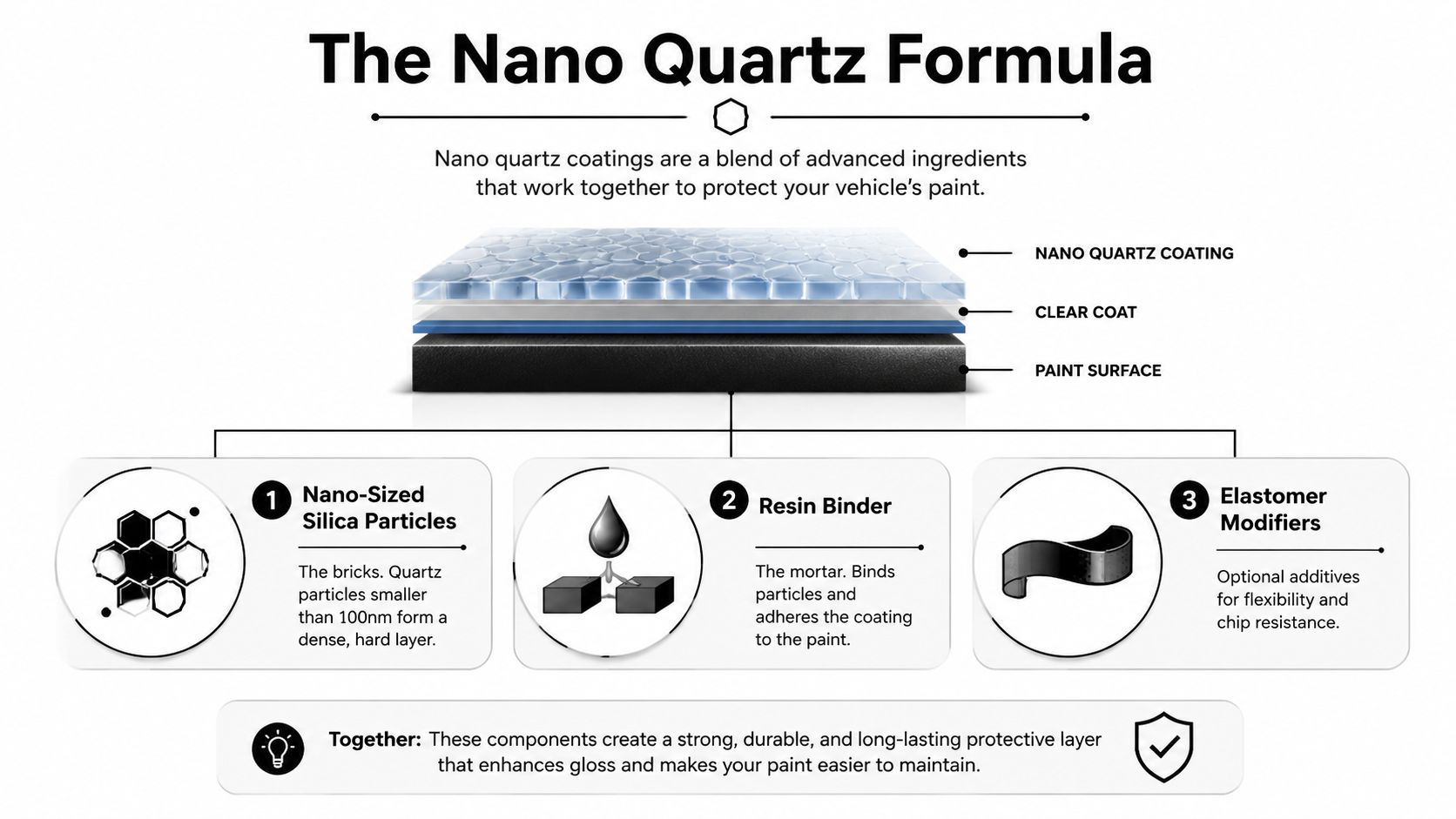
That’s also why a nano quartz coating shouldn’t be treated as identical to every ceramic spray. Pure SiO₂ sprays, higher-solids ceramic formulas, polymer sealants, and quartz elastomer membranes can differ in resin content, cure behavior, film build, and flexibility. For a broader plain-language explanation of coating construction, see what ceramic coating means at the surface level.
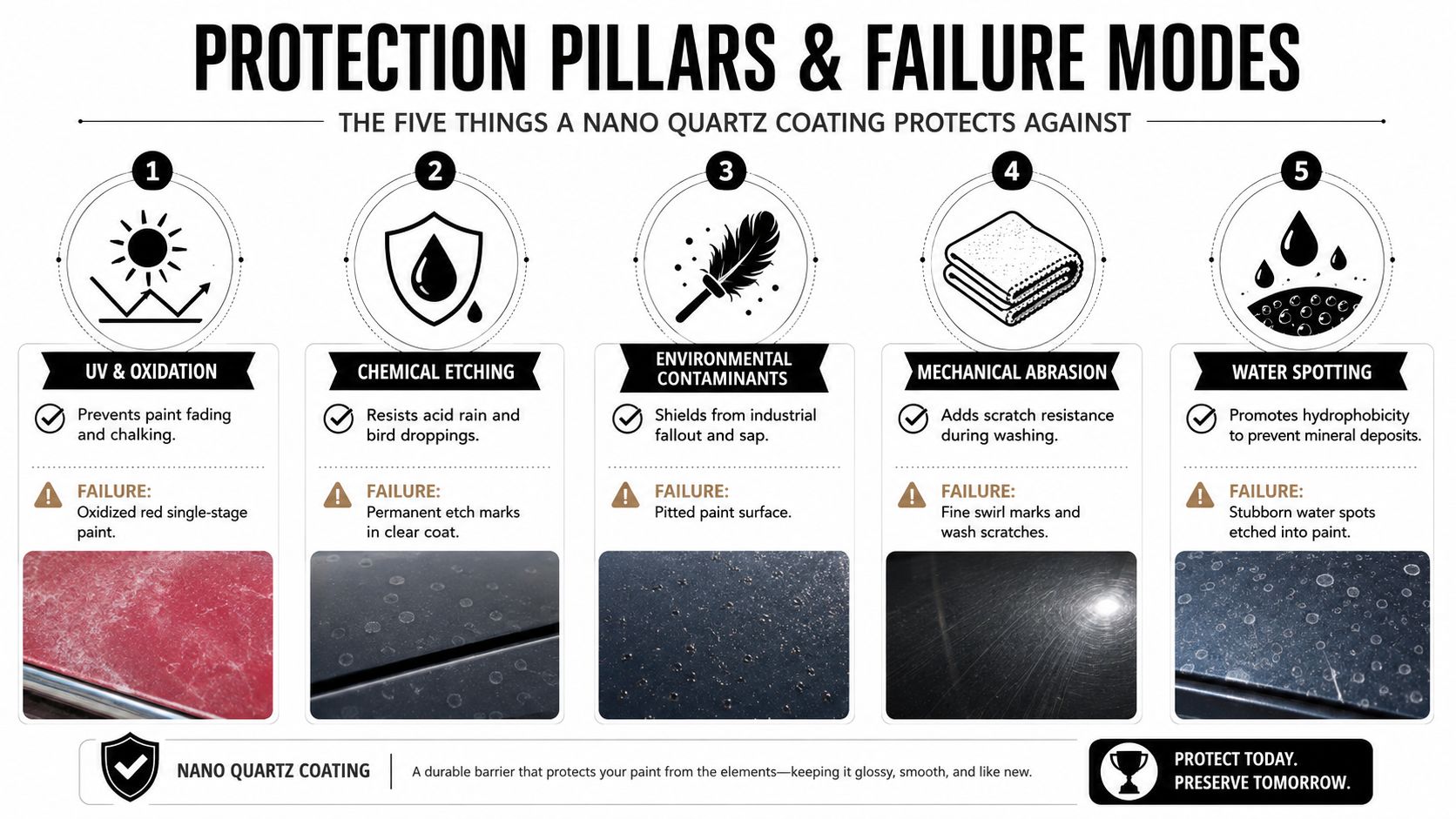
The Five Things a Nano Quartz Coating Protects Against
A customer usually asks about shine first. I show them the hood, but I explain the failure modes that matter after the delivery photos are finished.
UV and oxidation
An oxidized red single-stage finish often looks dry, chalky, and uneven because sunlight and oxygen have attacked the exposed surface. A protected panel doesn’t become immune to aging, but the coating creates a sacrificial barrier between the paint and the environment.
The useful inspection is visual consistency. Compare the coated hood with an exposed door edge, or check how the finish responds after decontamination and polishing. The outcome you can demonstrate is a cleaner-looking surface with less exposed paint taking the direct punishment.
Chemical etching
Bird residue, bug remains, road film, and acidic deposits can sit on paint long enough to leave permanent marks. On an unprotected panel, the residue may etch the clear coat before the owner gets home from work.
A coated panel gives you more time and easier cleanup, but it doesn’t grant permission to ignore contamination. Remove deposits promptly, use a safe wash method, and don’t confuse chemical resistance with chemical immunity.
Mechanical abrasion
Most wash marring starts with contamination trapped between the mitt and the paint. A slick surface can help dirt release more easily, while a bonded film adds another surface for the wash process to work against.
The practical demonstration is a controlled inspection under a strong light before and after maintenance washing. You’re looking for fewer fresh fine swirls, not a promise that the coating will stop a key, stone, or careless brush.
Thermal cycling
A coating that can’t accommodate panel movement may develop microcracks as the substrate responds to cold mornings, hot sun, and repeated temperature changes.
Recent materials research describes how crystal phase changes in nano-structured ceramic systems can create cracks, while nanoparticle design can suppress cracking and improve oxidation resistance. The reported research on crack suppression and oxidation resistance also reinforces a point detailers see regularly: laboratory performance doesn’t erase the importance of preparation, dispersion, application quality, and defect control.
Hydrophobic behavior
Water behavior is easy to show. Spray the panel, watch the droplets tighten, then rinse and observe how quickly water sheets away. That behavior can reduce the amount of wiping needed, which helps lower the opportunity for wash-induced marring.
Hydrophobicity still has limits. Minerals can remain behind when droplets dry, and water spots can etch the underlying surface if the owner leaves contamination in place. The coating makes cleaning easier. It doesn’t replace cleaning.
How Nano Quartz Stacks Up Against Other Nano Coatings
The right coating depends on the panel, the owner, and the abuse the vehicle receives. A garage-kept show car doesn’t need the same compromise as a work truck that sees winter salt, and a mobile detailer may value speed more than maximum film build.
| Coating Type | Avg. Durability | Hydrophobic Angle | Flexibility | Best Use Case |
|---|---|---|---|---|
| Nano quartz | Product and maintenance dependent | Strong water beading and sheeting when properly maintained | Elastomer-modified versions can accommodate panel movement | Daily drivers and mixed-weather vehicles |
| Graphene oxide | Formulation dependent | Often marketed for water behavior and surface slickness | Depends on the binder and dispersion | Specialty formulations where added material properties matter |
| Silicon carbide | Formulation dependent | Can provide strong surface repellency | Rigid systems may offer less movement tolerance | Hard-wearing applications where surface hardness is prioritized |
| Polymer sealant | Shorter and maintenance dependent | Good initial slickness and repellency | Generally more forgiving and flexible | Owners wanting simpler periodic protection |
| Carnauba wax | Short-term and maintenance dependent | Warm gloss and fresh water behavior | Soft sacrificial film | Show-car finishing and easy refreshes |
The table avoids a false precision problem. There isn’t one universal durability number for an entire chemistry category. Formulation, prep, film thickness, cure conditions, washing, climate, and exposure all change the outcome.
For a black daily driver parked outdoors, elastomer-modified nano quartz can make sense because it balances protection with movement tolerance. For a garage-kept show car, wax or a polymer sealant may provide the finish the owner wants with less commitment. For a salt-exposed work truck, surface preparation and maintenance may matter more than choosing between two fashionable ingredients.
Graphene oxide and SiC can be useful in specialized systems, but the label alone doesn’t tell you how the cured film behaves. This comparison of ceramic and nano coating approaches is a useful reminder to evaluate the complete formulation rather than one headline ingredient.
Choose by exposure first, chemistry second, and marketing language last.
Applying Nano Quartz the Way the Pros Do It
A flawless coating job starts before the bottle is opened. I’ve seen more failures caused by trapped residue, rushed leveling, and poor environment control than by the chemistry itself.
Prepare the panel
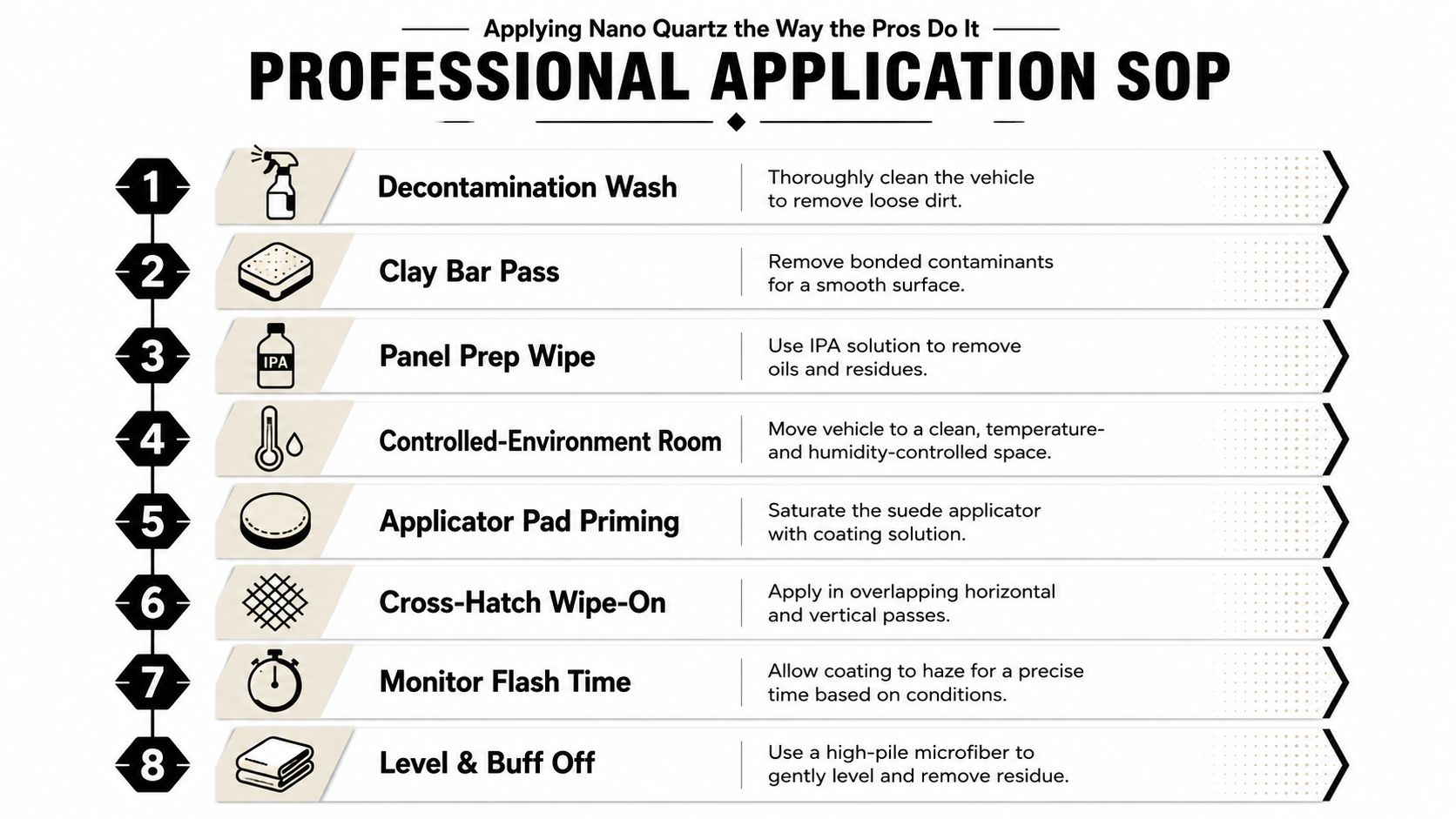
Start with a thorough decontamination wash. Remove loose dirt, traffic film, and old maintenance products, then use a clay bar pass where bonded contamination remains. The paint should feel smooth under a clean plastic bag or gloved hand before polishing or panel preparation begins.
If the paint needs correction, do it before coating. After polishing, use a panel prep wipe to remove oils and polishing residue. Titan’s surface-preparation guidance belongs in the prep stage, not as an afterthought.
Control the room and the applicator
A controlled application environment gives you a predictable flash and leveling window. Many professional workflows target 60 to 80°F and 40% to 70% humidity, but always follow the product’s own instructions because carrier systems differ.
Prime the suede applicator pad evenly. Don’t flood one corner and drag it across the whole panel. Work small sections, apply in overlapping horizontal and vertical passes, and watch the film as it begins to flash.
The cross-hatch pattern matters because it helps expose missed areas and keeps coverage consistent. It also gives you a visual rhythm, which is valuable when the coating starts to haze at different speeds across the panel.
Level before the film locks
If you apply too much, you create high spots. If you wait too long, the residue becomes difficult to level. If you work in direct sun, the panel can flash before you’re ready.
Use a short-pile or high-pile microfiber according to the product directions, and rotate to a clean side as residue builds. I usually keep separate towels for the initial wipe and final inspection so the leveling towel doesn’t redistribute coating.
The five minutes you save by rushing a leveling pass can become an hour of polishing later.
Keep the vehicle dry through the initial cure window. Many systems call for 12 to 24 hours without water, but the manufacturer’s instructions control the job. Avoid touching the surface unnecessarily, and don’t return the car to harsh use until the coating has developed enough strength for that environment.
What ISO, ASTM, and CNT Testing Really Tell Us
A test result is useful only when you translate it into a customer expectation without stretching the claim.
ASTM D3363 pencil hardness evaluates resistance to marks from pencils of defined hardness. A result in the 3H to 6H range for CNT-modified UV coatings, as reported by the CNT technical reference, suggests a harder surface response in that test system. It doesn’t mean the coating is scratch-proof, and it doesn’t predict every wash or impact scenario.
ASTM B117 salt spray places coated samples in a controlled corrosive environment. A quartz technical datasheet reports more than 400 hours to the first sign of corrosion, with the result linked to that specific test system and substrate preparation. You can explain that the coating showed strong resistance in a salt-fog test, but you shouldn’t convert that laboratory duration into a guaranteed service life on a vehicle.
| Test Standard | What It Measures | Typical Nano Quartz Result | Field Translation |
|---|---|---|---|
| ASTM D3363 | Pencil resistance to marking | CNT-modified UV coatings reported at 3H to 6H in the cited technical source | Better resistance to some light marking, not immunity from scratches |
| ASTM B117 | Salt-fog corrosion resistance | More than 400 hours to first corrosion sign in the cited quartz datasheet | Strong controlled corrosion resistance, not a direct road-life guarantee |
| Cross-cut adhesion | Bond strength after lattice scoring | 5B, with 0% removal, in the cited quartz datasheet | The film stayed strongly attached in that test |
| Contact-angle testing | Water repellency and droplet behavior | Result depends on formulation and test conditions | Beading and sheeting can make washing easier |
ISO chemical-resistance testing can help show how a coating responds to selected chemicals under defined conditions. It doesn’t mean every bird dropping, cleaner, solvent, or road contaminant behaves the same way on a neglected vehicle.
CNT reinforcement adds another layer to the discussion. Review literature reports thermal conductivity of about 6600 W m^-1 K^-1 for single-walled CNTs and 3000 W m^-1 K^-1 for multiwalled CNTs, with CNT dispersion in rubber matrices linked to faster heat dissipation and improved thermal stability. The independent review reference supports the material-science context.
The quote-ready version is honest: testing can support claims about hardness, adhesion, corrosion resistance, and heat management under stated conditions. It cannot promise that a coating won’t fail when the panel is dirty, poorly prepared, over-applied, or abused. Titan’s coating-testing information can help detailers frame those conversations responsibly.
Matching the Right Titan Product to the Right Job
A black Audi that sits outdoors arrives with baked-on grime, delicate paint, and a long correction ahead. A dealership fleet may need a faster turnaround, while a glass-roof vehicle calls for clearer wet-weather visibility. The right Titan product follows the surface and the workflow, not the bottle on the shelf.
Alpha Quartz for flexible painted-surface protection
Alpha Quartz suits painted surfaces, PPF, vinyl, plastic, and wheels when the job calls for an elastomeric quartz membrane. In the shop, that means a film with a hard-feeling finish that can still accommodate panel vibration, temperature changes, and small daily impacts. This flexible behavior is the practical difference between a membrane built to move with the surface and a rigid film more likely to crack under repeated stress.
That makes Alpha Quartz a fit for a careful DIY owner or a mobile detailer who can keep the vehicle dry through the required cure period. It also follows the article’s larger point about Titan’s ElastoTek-style approach: elastomer modification supports movement, while carbon nanotube reinforcement is intended to strengthen heat-management and film performance rather than merely chase gloss. Review the Alpha Quartz product information and verify the product labeling and application instructions before purchase.
APEX Glass for transparent surfaces
A windshield and a painted hood face different problems. On glass, the detailer needs clean pores, even coverage, and water that moves across the surface instead of lingering as a broad, dirty film. Proper cleaning and maintenance still determine how clearly the driver sees through rain.
APEX Glass is intended for windshields and side windows. Its product information describes a coating designed to penetrate glass pores and help protect against water spots and contaminants. The APEX Glass ceramic coating page covers its application requirements and intended use.
Ultra Ceramic Spray for rapid workflows
At a dealership wash bay, a fleet reconditioning lane, or a mobile job with a tight schedule, a spray format can keep the process moving. Ultra Ceramic Spray is positioned for easier installation and visible surface results, making it suitable for a weekend refresh or a customer who prefers a simpler maintenance step.
The trade-off is the film-building approach. A spray coating prioritizes speed and convenience, while a dedicated quartz coating demands more controlled preparation, application, and curing. Check the Ultra Ceramic Spray product page and match the choice to the owner’s care routine.
A studio handling a full correction may choose Alpha Quartz. A mobile operator may choose the spray. The surface, schedule, and expected maintenance should set the ambition.
When Nano Quartz Coating Is and Is Not the Right Choice
Nano quartz makes sense when the vehicle lives outside, the owner faces winter salt or intense sun, and regular washing is realistic but not always frequent. It can also suit a customer who wants a serious protection commitment rather than another quick gloss application.
That doesn’t make it universal. A brand-new vehicle with intact factory protection may not need an immediate premium coating unless the owner wants the additional surface behavior and maintenance plan. A garage-kept show car may get the desired visual finish from a lighter sealant or wax. A leased vehicle approaching contract return may not justify a long-term coating investment, and a budget client may gain more from a quality sealant applied periodically.
Flexibility is not indestructibility
An elastomer-modified film can be hard like glass while retaining flexibility. That flexibility may help it tolerate movement and temperature change better than a purely rigid film, but it won’t stop every stone chip, deep scratch, solvent attack, or poor wash technique.
Nano quartz also isn’t the same tool as paint protection film. The comparison between paint protection film and ceramic coating helps clarify the difference between a bonded surface coating and a thicker impact-focused film.
Use this decision rule:
- Choose nano quartz for owners committed to preparation, careful washing, and long-term surface protection.
- Choose an elastomer-modified formula when panel movement, temperature variation, or minor impact tolerance matters.
- Choose a spray or sealant when speed, budget, or easy reapplication matters more than maximum coating build.
- Choose protection film when impact resistance is the primary concern.
The coating still needs maintenance. Wash from clean to dirty areas, use safe towels and mitts, remove bird residue and bugs promptly, and inspect the finish instead of relying only on water beading.
APEX NANO – Titan Coatings offers options that fit this range, including flexible quartz protection for painted surfaces, a dedicated APEX Glass treatment for windshields and side windows, and Ultra Ceramic Spray for quicker detailing workflows. Visit APEX NANO – Titan Coatings to compare the products, review application guidance, and choose the coating that matches your vehicle’s exposure and your available maintenance time.
0 Comments